Logo Placement Is a Procurement Spec, Not a Creative Afterthought
Canvas wine carriers look simple from a distance, but the logo placement decision affects print quality, sewing yield, packed appearance, and how the product reads on a bookstore shelf. In university retail, the carrier may carry a crest, mascot, bookstore wordmark, alumni mark, donor-event graphic, or a co-branded local partnership. Once that artwork moves onto a sewn textile product, the surface stops behaving like a flat sheet. The front panel bends when a bottle is inserted, the handles pull the fabric upward, and the print area can shift after folding and carton compression.
That is why a mockup is not enough. Procurement needs a measurement-based placement spec. The supplier should know whether the logo is defined from the top seam, side seam, centerline, bottom fold, or handle reinforcement stitch line. Phrases like "center front" or "middle of the bag" are too loose for a sewn item. Different teams can interpret them differently, and each interpretation can move the mark several millimeters.
University programs also add approval complexity. Licensing, brand management, athletics, alumni relations, and the bookstore may all review the same product. If the placement changes late, the factory may need new screens, a revised proof, a re-cut sample, or a shifted sewing fixture. The cleaner approach is to approve the product pattern, logo size, print method, and placement drawing together, then hold those documents as the control set for the PO and for later reorders.
- Define the display side if the carrier could be packed in either direction.
- Use physical measurement references, not only a visual mockup.
- Approve the placement drawing together with the fabric and print method.
- Keep the signed sample, placement drawing, and artwork file together for reorders.
- Treat any move in logo position as a new approval event.
Start With the Carrier Format and the Bottle Profile
The correct logo placement depends first on the carrier format. A single-bottle canvas wine carrier usually has a narrower front panel and a simpler bottom structure. It works well for gift wrapping, event add-ons, and impulse retail sales, but the front panel offers less room for large artwork. A two-bottle carrier gives the buyer more branding space and a more premium gift look, but it adds a divider, more seams, and more opportunities for the print area to be interrupted by structure.
For bookstore programs, the use case should be written before the art is approved. A commencement gift set may need a two-bottle carrier with a structured divider and a cleaner premium print. A homecoming retail assortment may need a single-bottle carrier that stacks neatly on a display shelf. A donor dinner or alumni reception may care more about speed, consistency, and one-color branding than about decorative detail. Each use case changes the best fabric weight, artwork size, and packing format.
Bottle assumptions matter as much as the carrier style. A standard 750 ml bottle is not the same as a wider local winery bottle or a taller sparkling bottle. If the carrier needs to hold more than one bottle shape, define the widest diameter and tallest height. If the carrier is only meant for one known bottle in a gift program, the factory can work to tighter tolerances. Do not approve one dimension set for a narrow bottle and a wide bottle unless the program genuinely needs that flexibility.
- Single-bottle format: simpler pattern, lower carton weight, and easier bulk packing.
- Two-bottle format: more premium presentation, but the divider and seams need extra inspection.
- Event giveaway format: usually favors one-color printing and stock canvas to protect lead time.
- Retail shelf format: should be tested while filled so the logo reads from shopper height.
- If the program may expand to other bottle sizes later, write that into the spec now.
Map the Printable Area Before You Size the Logo
The logo size should come from the clean printable area, not from the maximum space visible in a flat drawing. The clean printable area is the portion of the front panel that stays flat enough for even ink pressure and remains visible after a bottle goes inside. It excludes handle reinforcement, bartacks, heavy side seams, the bottom fold, divider ridges, and any hard curve that pulls the artwork out of shape. On a narrow single-bottle carrier, the usable area can be noticeably smaller than the front panel looks in CAD.
As a practical starting point, many buyers begin with a front logo width around 90-130 mm on a single-bottle carrier and 120-170 mm on a two-bottle carrier. Those are starting ranges, not universal rules. A long bookstore wordmark behaves differently from a round crest or a wide mascot graphic. Horizontal art often needs to be smaller so it stays away from side curves. Compact marks can sometimes be slightly larger without crossing seam zones. The right answer depends on the art shape, the panel dimensions, and the print method.
The placement drawing should show the logo boundary box and every reference measurement. That means panel width, panel height, logo width, logo height, distance from the top seam, distance from each side seam, and distance from the handle stitch line. For two-bottle carriers, include the divider line even if it is internal, because it can affect print pressure and appearance. A useful quote package leaves no room for the factory to guess where the mark belongs.
- Ask for the maximum clean print area on the actual production pattern.
- Show the logo boundary box even when the artwork shape is irregular.
- Keep seals and circular marks away from side curves so they do not read as ovals when filled.
- Do not place small legal or department text below the fold where it may disappear.
- Approve logo size on fabric if the mark has thin lines, small text, or tight registration.
Choose Fabric Weight, Weave, and Finish With the Print Method in Mind
For bookstore retail, 10-12 oz cotton canvas, roughly 340-410 GSM, is a practical default range. It has enough body to feel reusable and enough surface stability for screen print. It also folds and sews more predictably than very heavy canvas. A lighter 8 oz canvas can work for budget event distribution, but it wrinkles more and can look less substantial on a premium retail table. A heavier 14 oz canvas can feel strong, but it raises material cost, sewing resistance, needle wear, and freight weight.
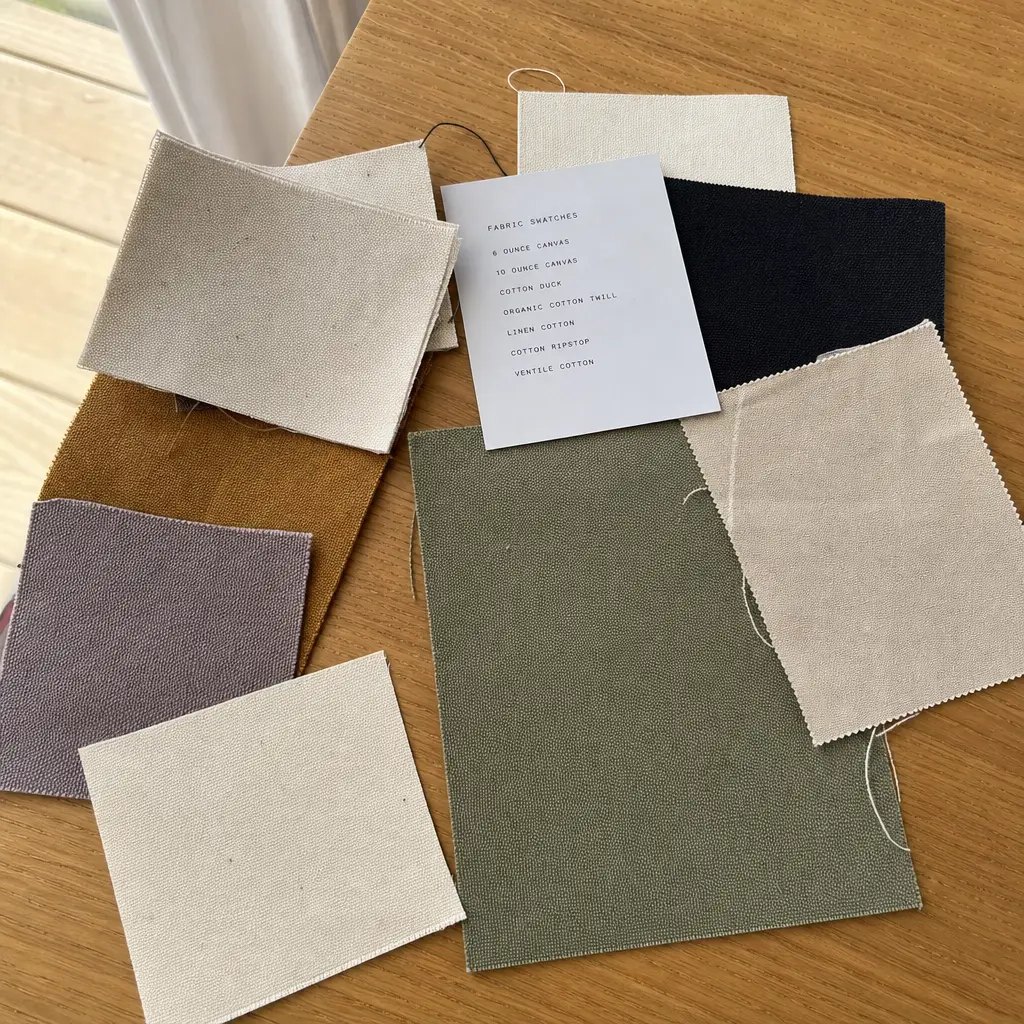
Fabric finish matters too. Natural canvas is common because it takes dark school colors well and gives a familiar gift-packaging look. Bleached canvas can make bright artwork appear cleaner, but it can also show handling marks more easily. Dyed canvas can support school colors or a more curated retail look, but the buyer should ask how shade consistency will be controlled across the lot. If color matters, request a lab dip, bulk swatch, or cut-panel approval before sewing.
If sustainability language is part of the brief, write it precisely. Recycled cotton, organic cotton, unbleached canvas, low-impact dyeing, and plastic-free packing are different requirements. Ask what can be documented in the shipment: supplier declaration, fiber content, certificate, or no consumer-facing claim at all. Keep those requirements separate from the logo placement spec so the factory can quote each component cleanly.
- Budget event carrier: 8 oz or about 270 GSM, usually one-color print and bulk carton packing.
- Standard bookstore retail carrier: 10 oz or about 340 GSM, a common starting point for one-bottle programs.
- Premium alumni gift carrier: 12 oz or about 410 GSM, with more body and a cleaner shelf profile.
- Heavy boutique carrier: 14 oz or higher, only when the buyer accepts higher freight and sewing cost.
- Dyed-canvas program: request shade approval and confirm whether one dye lot can cover the order quantity.
Match the Print Method to the Artwork and the Approval Route
For most university bookstore marks, spot color screen print is the most controllable option. It handles one- to three-color logos well, is familiar to textile factories, and can be matched against a Pantone or physical standard. For repeat seasonal orders, screen print also gives procurement a more stable path because the artwork settings and ink standard can be retained for the next production run. If the art is simple, this is usually the cleanest and lowest-risk choice.
Heat transfer has a role when the artwork uses gradients, many colors, or highly detailed event graphics. The tradeoff is durability and packing sensitivity. Transfers can show edge marks, adhesive halos, or cracking if the bag is folded too tightly or compressed before the transfer fully stabilizes. If the design needs transfer, test the exact folding and carton layout before mass packing, not after the entire lot is made.
Embroidery and woven patches can look premium, but they are not automatically better on a narrow wine carrier. Embroidery can distort small text and pull on the panel. Woven patches preserve detail better than embroidery, but they add a component MOQ, a sewing operation, and another placement tolerance. For licensed university artwork, any method that changes the mark's appearance should be signed off in sample stage, not left to the line operator.
- Use screen print for solid bookstore names, mascots, alumni marks, and simplified crests.
- Use heat transfer only when the design needs more color or image detail than print can reasonably handle.
- Avoid tiny reversed text below about 2.5-3 mm on coarse canvas.
- Request a strike-off for fine lines, metallic inks, or strict school colors.
- Ask whether printing happens before sewing or after sewing, because that changes placement control.
Write the RFQ So Setup, Unit Price, and MOQ Stay Visible
A useful quote separates the cost drivers instead of bundling them into one line. On canvas wine carriers, MOQ and price are often driven by different components: fabric purchase, dye lot, print setup, handle webbing, divider construction, woven label, hang tag, barcode sticker, carton size, and packing method. A supplier may offer a low MOQ for natural canvas with one-color screen print because the body material is already in regular production. The same quantity can become inefficient if the buyer asks for custom dyed canvas, a more complex logo, and retail-ready packing at the same time.
For apples-to-apples comparison, ask the supplier to show setup cost separately from unit cost. Screen charges, transfer plate fees, sample labor, label setup, and artwork adjustment should be visible. That matters in bookstore procurement because many programs reorder each academic year with only a date or event change. If the first-order price hides setup inside the unit rate, the buyer cannot see what really changes on the second order.
If the order includes more than one SKU, quote it by style. A single-bottle carrier, a two-bottle carrier, and a premium gift bundle may share the same artwork family, but they do not share the same cutting, sewing, divider, and packing assumptions. Mixed assortments should be broken out by quantity, size, fabric color, print version, and packing format so the factory can identify the real MOQ pressure points.
- Ask for setup costs, unit price, and repeat-order pricing separately.
- Request separate MOQs for the bag body, print, label, and retail packing components.
- Ask for carton dimensions, carton count, and gross weight with the quote.
- Confirm whether the price is EXW, FOB, or another trade term before comparing suppliers.
- Request a sample revision policy so development changes do not become surprise charges.
Use the Sample Stage to Test the Filled Carrier, Not Just the Flat Bag
An empty flat sample is not enough for a wine carrier. Put a real bottle inside and review the product from the front, side, and shelf angle. Once the bottle is loaded, the front panel curves, the logo shifts visually, the handles change angle, and the carrier may or may not stand cleanly. That is the condition the bookstore customer actually sees. For a two-bottle carrier, test two standard 750 ml bottles and any wider bottle that is realistic for the program.
The sample path should be documented by stage. A development sample can use substitute fabric, temporary stitching, or a quick print method to confirm overall size and proportions. A pre-production sample should match the approved fabric weight, print method, handle webbing, divider structure, logo placement, label placement, and packing format. Only the pre-production sample should become the production approval reference. If the supplier sends a sample with a substitute print method, it should not be used to approve final logo clarity.
Keep a sample record. Photograph the front, back, side, bottom, handle reinforcement, divider, and packed carton layout. Measure the logo centerline from the seams, note the bottle used, and keep the approved sample with the signed placement drawing. That record is what protects the buyer when the production lot arrives and someone later argues that the logo was "close enough."
- Measure logo centerline from left and right seams on the physical sample.
- Load the carrier with the target bottle size and check whether the logo remains readable.
- Check handle comfort and balance while the carrier is filled, not only while empty.
- Rub the printed area lightly after curing to identify weak adhesion before mass production.
- Fold one packed unit as planned for carton loading and inspect for transfer or creasing.
Set QC Thresholds for Logo, Construction, Color, and Load
Quality control should be measurable before production starts. For logo placement, many buyers can accept plus or minus 3 mm from the approved sample on a standard flat panel. A wider tolerance may be necessary if the print happens after sewing on a narrow or heavily structured carrier, but that exception should be agreed in advance. For color, compare against a signed strike-off, Pantone reference, or physical standard under D65 or another agreed light source. A monitor image is not a color standard.
Construction QC matters because a wine carrier is a loaded product, not a soft accessory. Handle attachment, divider security, bottom gusset alignment, and stitch strength affect the customer experience and the risk of failure in use. A common static load test for a filled wine carrier is 8-10 kg when the construction is designed for that load, but the buyer should define the actual requirement based on intended use. The key is to test the carrier under a relevant load for a stated time and inspect for seam opening, handle tearing, or stitch failure.
Inspection should cover the beginning, middle, and end of the lot so the buyer can see whether the process drifted. Ink can drift as viscosity changes. Placement can drift if the fixture moves or operators change. Natural cotton canvas can include minor slubs, but stains, oil marks, holes, severe knots, and shade mismatch in the logo area should be rejected if the carrier is retail-facing. A clear inspection checklist reduces subjective debate at shipment time.
- Logo position: plus or minus 3 mm from approved sample for standard flat panels, unless otherwise agreed.
- Print appearance: no bleeding, broken text, double image, adhesive halo, scorch mark, or contaminated ink spot.
- Handle strength: static load test defined by the buyer, commonly 8-10 kg for filled carriers when appropriate.
- Stitching: no skipped stitches, open seams, loose divider ends, rough edges, or thread tails on the display face.
- Fabric appearance: no stains, holes, severe slubs, shade mismatch, or visible defects inside the logo area.
- Packing check: carton count, barcode placement, and carton markings match the purchase order.
Protect the Retail Presentation in Packing and Carton Design
University bookstore staff often receive products during busy retail windows and do not have time to reshape every unit before stocking. Packing should protect the printed face, keep handles neat, and prevent the bottom gusset from being crushed. Flat packing is efficient and usually appropriate, but cartons that are too tight can crease the logo area, press dark ink into the opposite panel, or leave handles bent in a way that makes the product look unfinished on the shelf.
For dark navy, black, burgundy, forest green, or metallic inks, request a small packing test before mass packing. The supplier can pack a trial carton, leave it compressed for a reasonable period, and then check for ink transfer and print-face creasing. If there is risk, use tissue, a separator sheet, or a revised folding layout. It is easier to solve that before mass packing than after cartons are sealed and labeled.
Retail packing choices should be decided before the quote is compared. Individual polybags improve dust protection, but they may conflict with campus sustainability policies. A paper belly band or hang tag can improve presentation and scanning, but it adds artwork and labor. Bulk carton packing is often enough for backroom storage, but the barcode plan has to be clear. If the bookstore needs unit-level scanning, state whether the barcode goes on a hang tag, sticker, paper band, or retail label.
- Flat pack: lowest freight volume and practical for bulk bookstore replenishment.
- Individual polybag: cleaner receiving but more material and possible sustainability objections.
- Paper band or hang tag: stronger retail presentation with added labor and print setup.
- Separator sheet: useful for heavy ink coverage, dark prints, or transfer graphics.
- Carton label: should show SKU, quantity, PO number, fabric color, logo version, and carton number.
- Receiving plan: confirm whether bookstore staff need units grouped by style, event, department, or barcode.
Manage Licensing, Reorders, and Change Control Like a Buying Program
The most expensive errors in bookstore merchandise are often not print defects but change-control failures. A university logo can move, shrink, or change color between orders if the approved sample is not the only reference. The buyer should keep a spec packet that includes the placement drawing, approved artwork, fabric reference, print standard, carton label format, and any licensing approval note. That packet becomes the source of truth for reorders, even if the next order is placed by a different buyer or for a different event.
If the program needs multiple versions, give them clear version control. For example, use one style number for the core bookstore carrier, another for alumni event art, and another for department gifting. Do not let the factory improvise small changes because the next order will not read the same way. A controlled SKU structure is especially important when the campus wants the same carrier to work for different departments but still keep the logo placement and packing logic consistent.
For annual or seasonal reorder programs, ask the supplier to keep the same fabric source, same print screens or files, same packing method, and same carton dimensions unless the buyer approves a change. If there is a reason to change any of those items, treat it as a revision with a revised drawing and sample review. That discipline is what makes the next order predictable instead of starting from scratch.
- Keep one approved reference package per SKU and do not rely on memory.
- Assign version numbers when artwork, fabric, or packing changes.
- Require written approval before changing screens, labels, cartons, or seam placement.
- Use the same reference sample for reorders unless the program changes on purpose.
- Track any buyer-requested revisions so cost and lead time can be compared cleanly.
Specification comparison for buyers
| Spec decision | Recommended option | When it fits | Buyer risk to check |
|---|---|---|---|
| Front logo position | Center on the main flat panel, typically 35-55 mm below the handle reinforcement stitch line and 20-30 mm away from heavy seams | Best for bookstore shelf display, alumni tables, gift sets, and retail programs where the university mark must read at arm's length | Logo placed too high can distort near the handle; too low may disappear when the carrier is filled or folded |
| Fabric weight | 10-12 oz cotton canvas, roughly 340-410 GSM, with pre-shrunk fabric or shrinkage allowance built into cutting | A practical balance for one- and two-bottle carriers sold as reusable gift packaging in campus retail settings | Very light canvas wrinkles around the print; very heavy canvas raises freight weight and can reduce sewing consistency |
| Print method | Spot color screen print for one- to three-color bookstore logos; heat transfer only for gradients, photographic art, or high-color event graphics | Suitable for crests, mascots, bookstore wordmarks, alumni marks, and department artwork | Fine serif text, thin outlines, and registration-sensitive art need a strike-off; transfers can crack or show edge marks if folded sharply |
| Logo size | Front logo width around 90-130 mm for single-bottle carriers and 120-170 mm for two-bottle carriers, subject to the actual flat print area | Keeps the logo visible without fighting bottle curves, side seams, bottom folds, or divider construction | Oversized logos may wrap onto side curves, causing uneven ink pressure and inconsistent unit-to-unit placement |
| Measurement reference | Placement drawing measured from top seam or panel edge, side seams, bottom fold, centerline, and handle stitch line | Useful for RFQs, pre-production sample approval, incoming inspection, and repeat orders across seasons | Visual mockups alone can be interpreted differently by sampling, printing, sewing, and inspection teams |
| Bottle divider construction | Stitched internal divider for two-bottle carriers; full-height divider when glass bottles, premium gifting, or retail stability matter | Needed for bookstore wine bundles, alumni gift sets, donor packages, and local winery collaborations | Divider seams can create a raised line behind the logo if printing after sewing without proper support |
| Handle reinforcement | 25-30 mm cotton webbing with box stitch, cross stitch, or bartack reinforcement confirmed by load testing | Appropriate for filled carriers, retail handling, event distribution, and staff restocking | Logo must not overlap reinforcement stitches because ink coverage breaks over seam thickness and pressure becomes uneven |
| Label placement | Small woven side label in the side seam or an inner care/content label, kept separate from the licensed university mark | Useful when the buyer needs manufacturer traceability, fiber content, or country-of-origin information without reducing the main branding area | External factory branding may be unacceptable for licensed university merchandise unless pre-approved by the bookstore or licensing office |
| Packing format | Flat pack with printed faces protected when needed; carton sized to avoid heavy compression and handle deformation | Works for bookstore receiving rooms, backstock shelves, holiday sets, and event distribution where staff count and replenish manually | Over-tight cartons can transfer ink, crease handles, flatten gussets, or make finished carriers look tired before they reach the sales floor |
Buyer checklist before sampling
- Define the carrier format: single bottle, two bottle, or mixed assortment, including target bottle diameter, bottle height, and whether a filled carrier must stand upright.
- State the canvas weight in oz or GSM and whether natural, bleached, dyed, recycled, or certified cotton canvas is required.
- Confirm whether the university mark is licensed merchandise, department use, alumni use, event use, or internal gifting, because approval routes may differ.
- Provide exact logo files in vector format with Pantone references, minimum text height, clear space rules, and any licensing approval notes.
- Mark logo placement using measurements from physical seams, stitch lines, folds, and panel edges, not only a rendered visual mockup.
- Specify whether the front logo, side label, hang tag, and carton label all need separate artwork approvals.
- Choose the print method before the sample stage: screen print, transfer, embroidery, woven patch, or another approved method.
- Set tolerance for logo position, print color, panel size, handle length, divider alignment, stitch quality, carton quantity, and barcode placement.
- Confirm whether print approval requires a fabric strike-off, a full pre-production sample, a filled-bag review, or all three.
- List retail packing needs such as hang tag, barcode sticker, individual polybag, paper band, plastic-free packing, separator sheet, or carton-only bulk pack.
Factory quote questions to send
- Which canvas weights do you keep in regular production for wine carriers, and what GSM tolerance can you hold on bulk fabric?
- Is the quoted fabric greige, natural, bleached, dyed, recycled, organic, or certified, and what documentation can be supplied with shipment?
- Will the logo be printed before cutting, after cutting, or after sewing, and how does that decision affect placement accuracy and cost?
- What is the maximum clean print area on the front panel for this exact carrier size when the bag is empty and when a bottle is inserted?
- Can you provide a placement drawing with measurements from the top seam, side seam, bottom fold, centerline, and handle reinforcement stitch line?
- What print method do you recommend for our artwork, and what are the setup charges, screen charges, color limits, and repeat-order costs?
- What minimum text height and line width do you recommend for 10 oz and 12 oz canvas using our chosen print method?
- What MOQ applies to the bag body, fabric color, print color count, woven label, hang tag, barcode sticker, and retail packing separately?
- How many pieces are included in the pre-production sample cost, and are development sample revisions charged separately?
- Can the sample be tested with our target bottle size, or should we provide bottle dimensions and filled-weight assumptions?
Quality-control points to confirm
- Logo centerline within plus or minus 3 mm from the approved placement on standard flat panels, unless a different tolerance is agreed for narrow or post-sewn panels.
- Logo height and width within approved artwork tolerance, with no visible stretching, skewing, or unintended resizing between production lots.
- Print color matched to approved Pantone, signed strike-off, or physical color standard under D65 or another agreed light source.
- No ink bleeding, pinholes, double image, scorched transfer edge, visible adhesive halo, contaminated ink spot, or broken fine text on the front display panel.
- Canvas weight within agreed GSM tolerance, typically plus or minus 5 percent unless a tighter range is contracted.
- Canvas panels free from stains, holes, oil marks, severe slubs, shade mismatch, or visible defects inside the logo area.
- Handle attachment passes a buyer-defined load test, commonly 8-10 kg static load for filled wine carriers when appropriate to the construction.
- Handle length within agreed tolerance so carriers hang evenly and remain comfortable to carry when filled.
- Divider seam straight and secure, with no loose thread, open seam, or rough edge that can catch bottle labels.
- Bottom gusset and side seams aligned well enough for the loaded carrier to stand or fold as approved.