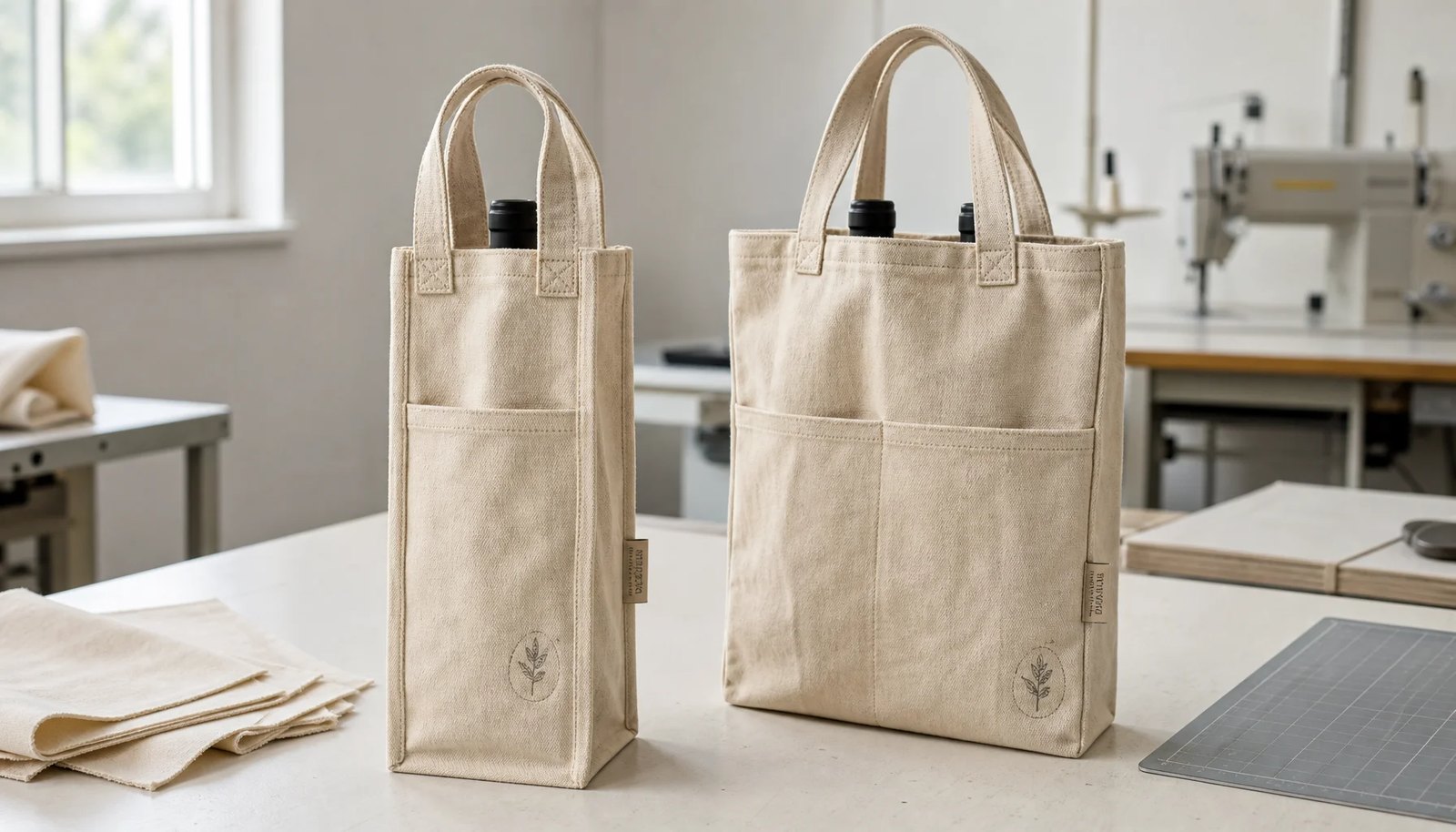
Why lead time planning is different for bookstore wine carriers
Canvas wine carriers look simple, but they create more calendar risk than a flat tote because the product must carry glass, display well on a shelf, and meet licensed artwork requirements. A university bookstore often needs the bags for a fixed retail window: alumni weekend, graduation season, homecoming, holiday gift tables, or department donor packs. If the carrier arrives two weeks late, the unit cost may still look acceptable on paper, but the sales opportunity is gone.
The biggest planning mistake is treating the lead time as only factory sewing time. A realistic schedule includes artwork release, license approval, fabric confirmation, sample making, print strike-off, production queue, inspection, packing, export handling, and domestic receiving. For a simple natural canvas carrier, buyers can often plan around 45-60 days after sample approval. For dyed canvas, private label packing, barcode work, or complex logo colors, the planning window should be longer.
- Use the event date as the backward planning point, not the purchase order date.
- Separate development lead time from bulk production lead time in the RFQ.
- Hold internal artwork and trademark approval before the supplier starts final sampling.
- Add receiving buffer for university bookstore warehouses, especially before peak campus events.
Build the specification around bottle fit first
The carrier cannot be quoted accurately until the supplier knows the bottle format. A standard 750 ml wine bottle is different from a taller champagne-style bottle, a wider burgundy bottle, or a gift set that includes tissue wrap and a hang tag. If the carrier is too tight, the user forces the bottle into the bag and stresses the bottom seam. If it is too loose, the product looks cheap on the retail shelf and the logo panel may collapse.
For bookstore retail, a single-bottle carrier is usually the safer launch item because it has lower material cost, simpler sewing, and lower MOQ pressure. A two-bottle carrier can be more profitable as a premium alumni gift item, but it needs a real divider and a stable base. A decorative divider that is only lightly stitched may look acceptable in a photo and fail once two loaded bottles are carried across campus.
- State the assumed bottle size: standard 750 ml wine bottle, tall bottle, or mixed bottle allowance.
- Define finished dimensions for width, height, depth, handle length, and base gusset.
- For two-bottle carriers, specify divider material, seam placement, and whether bottles may touch.
- Request a fit photo with the approved bottle type before moving to bulk production.
Choose fabric weight that supports the retail use
For canvas wine carriers, fabric weight is not just a cost line. It affects shelf shape, print appearance, seam strength, and customer perception. A 6 oz or 8 oz cotton fabric may be acceptable for a lightweight promotional sleeve, but it often lacks body for bookstore resale. For most university bookstore wine carriers, 10 oz to 12 oz canvas, roughly 280-340 GSM, gives a better balance of structure and cost.
Heavier fabric is not always better. Moving to 14 oz or 16 oz canvas can improve premium feel, but it increases material cost, sewing difficulty, carton weight, and shipping cost. It can also make small logo details less clean if the fabric surface is coarse. Buyers should request the supplier's actual fabric card and confirm whether the fabric is natural, bleached, dyed, or pre-shrunk. Dyed canvas adds lab dip time and color approval risk, which matters when the bookstore is matching school colors.
- Use 10 oz to 12 oz canvas for most retail-ready university bookstore programs.
- Use lighter fabric only when the carrier is a low-cost event giveaway and not a premium resale item.
- Use heavier canvas when the buyer wants a structured gift product and accepts higher freight weight.
- Record both ounces and GSM in the RFQ to reduce quote confusion between suppliers.
Print method choices and logo approval risk
University artwork usually includes crests, mascots, department names, small legal marks, or licensed identity rules. Screen printing is normally the most practical method for one to three solid colors on canvas wine carriers. It gives consistent color and cost for repeat runs, but the print quality depends on artwork line weight, fabric surface, ink coverage, and curing. Fine serif letters can fill in on rough canvas, especially when the logo is reduced to fit a narrow front panel.
Heat transfer can solve some gradient or full-color artwork needs, but it may change the hand feel and can look less integrated on natural canvas. Embroidery is possible but usually less efficient on narrow wine carrier panels and may pucker if the fabric is not stabilized. For bookstore buyers, the safer process is to approve a physical print strike-off on the actual fabric, then use that strike-off as the color and clarity reference for production inspection.
- Screen print is the default for solid university logos and repeatable spot colors.
- Heat transfer is useful for complex artwork, but test adhesion and hand feel before bulk.
- Embroidery should be used only when the design size, backing, and panel access are confirmed.
- Print approval should include placement tolerance, color target, curing quality, and logo clarity.
MOQ logic and how suppliers build the quote
MOQ is driven by fabric availability, cutting efficiency, print setup, sewing line setup, and packing labor. A simple natural canvas single-bottle carrier may be realistic at 300-500 pieces, depending on the factory's fabric stock and production schedule. A dyed canvas carrier, two-bottle divider, custom woven label, special hang tag, or barcode application may push the practical MOQ toward 800-1000 pieces because more materials and setup steps are involved.
When comparing quotes, a very low MOQ is not always the best sourcing route. It may use leftover fabric, limit color choices, reduce print options, or carry a higher unit price that becomes unattractive after freight. For bookstore buyers, the better question is the cost curve: what changes at 300, 500, 1000, and 2000 pieces? This shows whether the supplier has real production efficiency or is simply padding the quote for small-batch inconvenience.
- Request tiered pricing at realistic quantities instead of one MOQ number.
- Separate natural canvas MOQ from dyed canvas MOQ because the sourcing route changes.
- List optional items such as woven label, hang tag, barcode sticker, and inner polybag separately.
- Compare the final usable cost after sample fees, print setup, carton count, and freight impact.
Sampling workflow that prevents late production changes
A production sample should not be a rough style sample with a similar logo. For canvas wine carriers, the approved sample needs to represent the actual fabric weight, finished dimensions, handle reinforcement, divider construction, print method, label, and packing method. If the supplier sends a sample made from available fabric only, it can still be useful for shape review, but it should not become the production approval sample.
The buyer should keep approvals sequential. First approve the structure and bottle fit. Then approve the artwork layout and print strike-off. Finally approve packing and labels. Mixing these steps creates confusion when a later print change affects the delivery date. A clean approval record also helps if the final inspection finds a dispute over print position, fabric shade, or handle construction.
- Prototype sample: review carrier shape, bottle fit, handle length, and divider concept.
- Pre-production sample: approve final fabric, print, stitching, label, and packing.
- Print strike-off: approve logo color and detail on the same canvas used for bulk.
- Sealed sample: keep one buyer-approved sample for final inspection reference.
Production calendar and where delays usually happen
The production clock should start after final sample approval, not after the first supplier email. For normal natural canvas production, a practical timeline may include several days for material preparation, cutting, printing, curing, sewing, trimming, inspection, and packing. The factory may quote a shorter sewing lead time, but the real schedule also includes print room availability and export carton preparation.
The most common delay points are artwork revision, Pantone mismatch, late label information, divider redesign, and carton mark changes. University bookstore projects often involve multiple stakeholders: buyer, licensing office, alumni department, distributor, and sometimes an outside design agency. Every approval handoff can consume days. A sourcing calendar should show who owns each approval and the last date for changes before the delivery date is at risk.
- Plan 3-7 days for artwork clarification if the logo files are incomplete.
- Plan 7-14 days for sample making and domestic courier review, depending on location.
- Plan 25-40 days for bulk production after approval for many standard programs.
- Add extra buffer for dyed fabric, school color matching, holiday rush periods, and container congestion.
Packing decisions that affect cost and receiving
Packing is often treated as a final detail, but it affects freight cost, product appearance, and bookstore receiving speed. Flat packing is usually best for canvas wine carriers because it keeps carton volume efficient and avoids unnecessary shaping inserts. However, cartons should not be packed so tightly that the printed front panels arrive with hard creases. Buyers should approve pieces per carton, carton dimensions, gross weight, and stacking instructions.
Inner polybags are not always necessary. For a retail-ready bookstore program, individual bags may help keep natural canvas clean and make receiving easier, but they add material cost and handling time. For a distributor shipping to multiple campus stores, barcode stickers, carton marks, and master carton labels may be more important than individual polybags. The RFQ should separate these options so the buyer can see which packing decisions affect price and lead time.
- Use flat packing for standard single-bottle and two-bottle carriers unless shelf presentation requires special folding.
- Set carton weight limits that warehouse staff can handle safely.
- Confirm whether barcodes are applied to each unit, each inner pack, or only the master carton.
- Require clean carton marks showing item number, quantity, color, PO number, and destination where needed.
Inspection thresholds for loaded-use products
A wine carrier is a loaded-use product, so inspection should go beyond appearance. Visual defects matter because the item is sold in a bookstore, but structural defects create higher risk. Handle attachment, bottom seam strength, divider stability, and bottle fit should be checked before shipment. A beautiful print does not compensate for a weak handle that fails during normal carrying.
Buyers should define acceptance criteria before production begins. For example, print placement can be measured from the top edge and side seam, loose threads can be trimmed within a defined tolerance, and stains on natural canvas can be classified by size and location. For functional checks, the inspection should include a loaded lift test using the approved bottle weight. If the supplier cannot describe these checks, the buyer should not rely only on final product photos.
- Measure finished size against agreed tolerances, especially width, depth, handle length, and divider spacing.
- Test loaded handle strength using the intended bottle count plus a reasonable safety margin.
- Inspect print clarity, color, curing, and position against the approved strike-off.
- Reject severe stains, oil marks, broken stitches, exposed raw edges where not approved, and weak dividers.
Quote data needed for landed-cost comparison
A unit price alone is not enough for a buying decision. Canvas wine carriers can have different carton efficiencies depending on fabric weight, divider design, handle bulk, and packing style. A slightly cheaper unit price may become more expensive after dimensional weight, extra cartons, or additional handling fees. Importers and distributors should request carton data early, not after the PO is placed.
The quote should also identify what is included in the price. Screen charges, sample charges, custom label charges, hang tags, barcode application, export carton upgrades, and inspection support can all change the real cost. The most useful comparison is a landed-cost worksheet by quantity tier, with Incoterms, FOB port, carton dimensions, gross weight, lead time, and optional packing costs shown separately.
- Collect FOB unit price, setup charges, sample fees, and optional retail packing charges.
- Request carton quantity, carton dimensions, net weight, gross weight, and estimated CBM.
- Compare natural canvas and dyed canvas as separate cost scenarios.
- Use landed usable unit cost, not only factory unit price, when selecting the supplier.
Specification comparison for buyers
| Spec decision | Recommended option | When it fits | Buyer risk to check |
|---|---|---|---|
| Fabric weight for bookstore retail shelves | 10 oz to 12 oz cotton canvas, approximately 280-340 GSM, pre-shrunk if print registration is tight | Best for reusable wine carriers sold as branded alumni gifts or paired with campus merchandise | Under-260 GSM fabric can collapse around the bottle and make the printed crest look uneven on shelf |
| Bottle capacity and internal divider | Single-bottle carrier for low MOQ launches; two-bottle carrier with stitched divider for premium gift sets | Single-bottle works for broad bookstore retail; two-bottle works for alumni weekends, faculty gifts, and donor packs | Loose dividers can shift in carton transit; require divider width, seam line, and bottle-fit sample approval |
| Handle construction | Self-fabric handles with box stitch or bar tack reinforcement; webbing handles only when contrast styling is intentional | Needed when buyers expect the bag to carry glass bottles, catalogs, or small add-on gifts | Cheap handle seams may pass visual inspection but fail during a loaded pull test |
| Print method for school marks | Screen print for one to three solid colors; heat transfer only for gradients or short artwork tests | Screen print is stable for repeat orders and campus logos with clean spot colors | Fine serif text and small legal marks can fill in on coarse canvas; request strike-off on actual fabric |
| MOQ planning | 300-500 pcs for simple natural canvas; 800-1000 pcs when dyed fabric, custom webbing, or private label packing is used | Useful for bookstore buyers splitting quantities across departments or seasonal assortments | A very low MOQ quote may hide stock fabric limits, shared production, or higher unit freight per carton |
| Packing format | Flat packed 50-100 pcs per export carton, with inner polybag only when retail cleanliness requires it | Flat packing keeps cartons efficient and reduces crushing of rectangular carrier panels | Over-tight cartons can crease printed panels and distort dividers; approve carton size and gross weight |
| Lead time buffer | Plan 45-60 days after sample approval for normal production; add 10-20 days for dyed canvas, lab dips, or holiday congestion | Fits most campus retail programs when artwork and purchase order are ready before the event window | Counting from RFQ date instead of final artwork approval causes late deliveries |
| Compliance and labeling | Country of origin label, fiber content guidance where required, and retail barcode sticker if bookstore receiving needs scanning | Important for university-owned stores, licensed marks, and distributors shipping to multiple campus locations | Missing receiving labels can delay floor launch even when the product arrives on time |
Buyer checklist before sampling
- Define the target use: retail resale, alumni event gift, donor package, or bundled wine promotion, because each use changes fabric weight, packing, and inspection level.
- Specify bottle size assumptions, such as standard 750 ml wine bottle, plus whether the carrier must fit taller champagne-style bottles.
- State fabric construction in both ounces and GSM, and request the supplier's actual available fabric card instead of accepting a vague canvas description.
- Send vector artwork with Pantone references, maximum print area, logo placement, and any university licensing rules before the supplier quotes production lead time.
- Require a pre-production sample using the confirmed fabric, handle construction, divider, print method, label, and retail packing.
- Approve carton packing with pieces per carton, carton dimensions, gross weight, and whether cartons can be stacked without bending printed panels.
- Build the calendar from final sample approval, not from first inquiry, and add buffer for campus approval, trademark review, and bookstore receiving windows.
- Compare quotes by delivered usable unit, including sampling fees, screen charges, carton count, dimensional weight, and any rework risk from weak seams or poor print registration.
Factory quote questions to send
- What exact fabric weight and GSM are being quoted, and is the canvas greige, natural, bleached, dyed, or pre-shrunk?
- Is the quoted carrier designed for one 750 ml bottle, two 750 ml bottles, or mixed bottle shapes, and what bottle was used for the fit test?
- What reinforcement is used at the handle attachment points: simple stitch, cross stitch, box stitch, or bar tack?
- Which print method is included in the unit price, how many colors are included, and what is the maximum printable area on the actual carrier panel?
- Are screen setup charges, sample charges, and revised sample charges included or listed separately?
- What is the MOQ for natural canvas, dyed canvas, custom label, custom carton mark, and retail barcode application?
- What is the normal production lead time after sample approval, and what capacity risks apply during the requested shipping month?
- How many pieces are packed per carton, what are the carton dimensions and gross weight, and can the packing pass bookstore receiving requirements?
- What in-line and final inspection checks are performed for seam strength, bottle fit, print position, color matching, stains, and loose threads?
- Which Incoterms are quoted, and can the factory provide FOB port, carton data, and HS code guidance for landed-cost comparison?
Quality-control points to confirm
- Fabric weight should match the approved sample within a practical tolerance agreed before production, especially when the quote uses both oz and GSM.
- Finished carrier size should hold the approved bottle without forcing the seams, and the base should remain stable when the loaded carrier is placed upright.
- Handle attachment should pass a loaded pull or lift test using the buyer-approved bottle weight plus a safety margin.
- Print position should be measured from the top edge and side seam, not judged by eye only, because wine carriers have narrow front panels.
- Logo color should be checked against approved Pantone or physical strike-off under consistent lighting, not only from a phone photo.
- Divider seams on two-bottle carriers should be straight, secure, and wide enough to prevent bottle-to-bottle contact during normal carrying.
- Cartons should not be overfilled, wet, crushed, or packed so tightly that printed panels arrive creased.
- Retail labels, country of origin marks, barcode stickers, and carton marks should match the bookstore purchase order and receiving instructions.