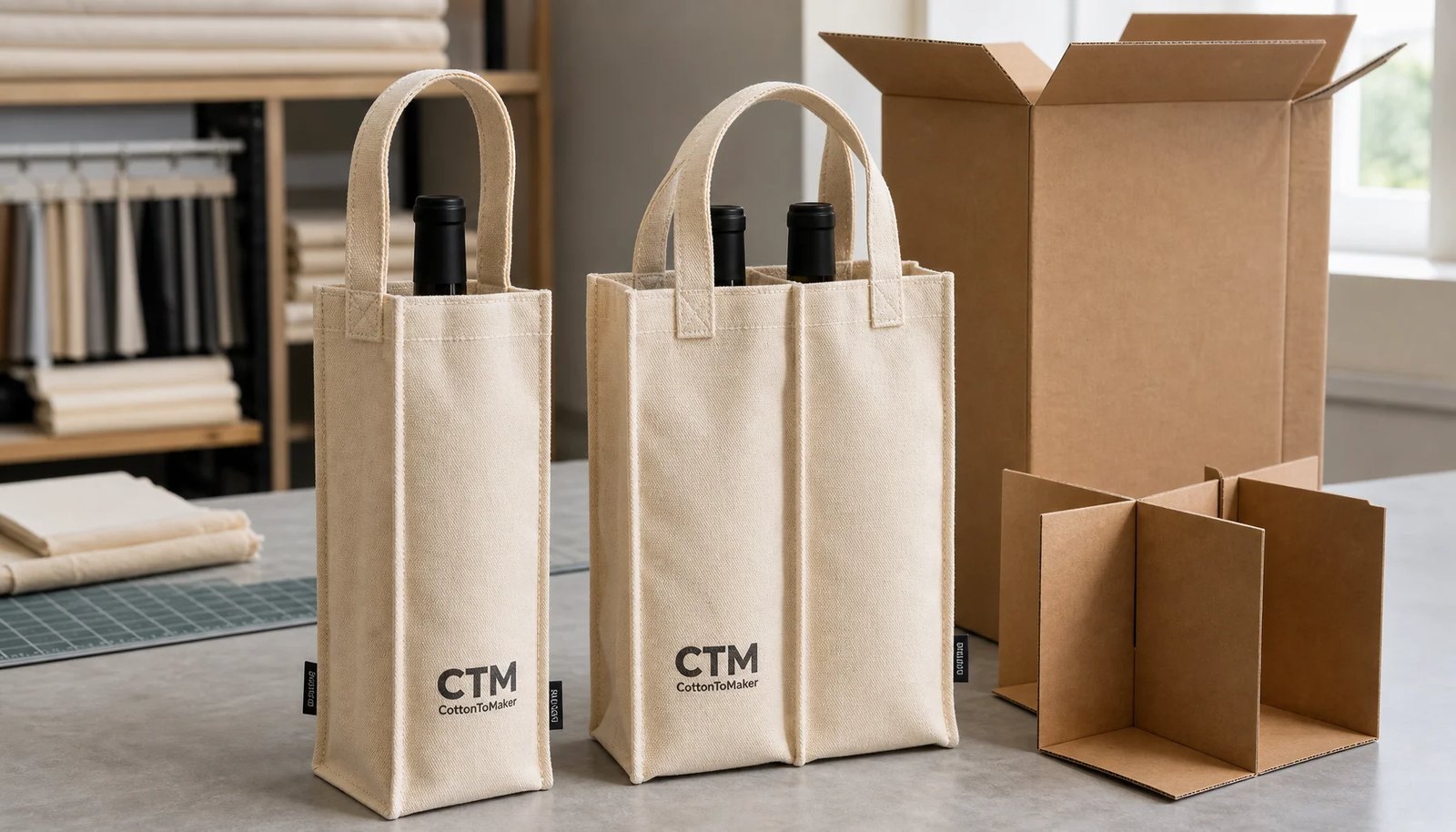
The Buying Problem Is Carton Planning, Not Just Bag Design
Canvas wine carriers for university bookstores often look simple on a spec sheet: natural canvas, one-color logo, bottle-sized bag, export carton. The expensive mistakes usually appear later, when the carton count is wrong, the carrier is too bulky for the stockroom, or the printed front panels arrive creased because the folding method was not approved. For bookstore procurement teams, carton planning should start before the first quote, not after the sample is approved.
The correct buying question is not only whether the carrier looks good. It is whether the finished product can be packed, shipped, received, stored, and merchandised without extra labor. University bookstores may order for alumni weekends, campus wine programs, graduation gifting, donor events, or holiday retail tables. Those orders have fixed selling windows. If cartons are too heavy, poorly marked, or over-sized, the receiving team pays for the problem even when the bag unit price looked competitive.
- Plan carton quantity from the filled carrier size, not from flat fabric measurements.
- Treat single-bottle and two-bottle carriers as different logistics products, even if the fabric and logo are the same.
- Approve the folding method because it changes carton cube, print appearance, and unpacking speed.
- Keep master cartons within a handling weight the bookstore or distributor can realistically move.
- Use carton marks that match the purchase order, store allocation, SKU, and logo version.
Define the Bottle and Finished Carrier Before Requesting Prices
A 750 ml Bordeaux bottle, Burgundy bottle, champagne bottle, and campus-branded promotional bottle do not share the same shoulder shape or diameter. If the RFQ only says wine carrier, many factories will quote a common size from an existing pattern. That may work for a standard bottle but fail when the bookstore sells wider gift bottles or uses a rigid neck tag. The finished size should be built around the actual bottle plus packing and removal clearance.
For a single 750 ml wine carrier, buyers often start with an internal width around 10-11 cm, depth around 9-10 cm, and height around 35-38 cm, depending on handle placement and bottle shoulder. For a two-bottle carrier, the width and divider structure matter more than the height. A soft canvas carrier can tolerate small variations, but a tight fit makes loading slow and can distort printed logos after the bottle is inserted.
- Send the factory bottle height, maximum body diameter, shoulder width, and neck height.
- State whether the carrier must hold one bottle, two bottles, or one bottle plus gift insert.
- Require a test fit with the actual bottle or a dimension-matched dummy bottle.
- Confirm whether the carrier must stand upright when empty for retail display.
- Record finished size tolerance in the purchase order instead of relying on sample photos.
Choose Canvas Weight by Shelf Appearance and Carton Cube
Canvas weight changes how the carrier stands, folds, prints, and ships. A common retail canvas wine carrier can be made in 10 oz cotton canvas, roughly in the 300-340 GSM range depending on weaving and finishing. This is usually strong enough for a standard bottle and still folds efficiently for carton packing. A 12 oz canvas, often around 360-410 GSM, gives a more premium hand feel and better shape retention, but it increases material cost, carton weight, and carton volume.
Very light canvas can reduce the first quote but create retail problems. A 6 oz or 8 oz carrier may collapse on the shelf, show the bottle outline too sharply, or wrinkle around the printed panel after packing. Heavy canvas can also create issues if the bookstore expects flat-packed goods for compact storage. The practical decision is to balance appearance and freight: choose the lowest fabric weight that still meets handle strength, print quality, and display requirements.
- Use 10 oz canvas for most bookstore retail and event wine carriers.
- Use 12 oz canvas when the product is positioned as a premium alumni gift or reusable carrier.
- Avoid quoting by fabric name only; require oz and GSM, with tolerance.
- For dyed canvas, approve lab dip or bulk shade standard before cutting.
- For natural canvas, accept reasonable cotton seed specks but define stain and oil mark rejection.
Branding Method Affects MOQ, Lead Time, and Packing Protection
Most university bookstore wine carriers use screen printing because it is reliable for simple logos, school names, department marks, and one-to-three spot colors. Screen printing gives clean coverage on canvas when the artwork is not too fine and the ink is properly cured. The buyer should define Pantone references, print size, placement from seams, and acceptable registration tolerance. A factory cannot quote accurately if the logo is only supplied as a low-resolution image.
Heat transfer can handle gradients or small detailed graphics, but it may not match the same natural feel as direct screen print. Embroidery can look premium, but on a wine carrier it adds cost, thread density risk, and possible panel puckering. Woven labels or sewn side labels are useful when the front logo should stay clean or when multiple bookstore departments share the same bag body. Each method changes MOQ logic because setup, screens, films, label weaving, and line changeovers are cost drivers.
- Screen print is usually best for simple collegiate marks and repeat bookstore orders.
- Heat transfer fits detailed graphics but needs wash, rub, and edge-lift checks.
- Embroidery should be tested for puckering before approving a large logo.
- Woven labels work well for small CTM, brand, or campus collection identifiers.
- Protect printed panels in cartons with correct folding direction, paper interleaving, or controlled stacking.
MOQ Logic Should Separate Fabric, Color, Logo, and Size
MOQ is often misunderstood because buyers treat it as one number. For canvas wine carriers, MOQ may be driven by fabric availability, dyeing minimum, print setup, sewing line efficiency, or carton packing. A natural canvas single-bottle carrier with one-color print can often be planned at a lower MOQ than a custom-dyed two-bottle carrier with multiple logo versions. If the bookstore wants different college names, alumni marks, or event graphics, the supplier must know whether those are separate print setups or shared production runs.
A practical RFQ groups demand where it makes production sense but separates inventory where the bookstore needs control. For example, one body fabric and one carrier size can be produced together, while each logo version is packed and labeled separately. This protects MOQ efficiency without creating receiving confusion. The quote should show which cost is fixed setup and which cost changes by quantity, so the buyer can compare 500, 1,000, and 3,000 pieces without guessing.
- Ask for price breaks by total quantity and by logo version quantity.
- Confirm whether MOQ applies per fabric color, per print design, or per carrier size.
- Keep SKU cartons separate unless the receiving team accepts mixed cartons.
- Request setup costs separately so repeat-order pricing is transparent.
- Avoid over-ordering slow logo versions only to meet a misunderstood MOQ.
Carton Quantity Must Be Tested With Real Folding
Carton planning cannot be solved accurately from a flat pattern alone. The same carrier may pack very differently depending on handle thickness, base insert, divider, fabric stiffness, and print protection. A single-bottle carrier without insert may fold flat and pack tightly. A two-bottle carrier with sewn divider and reinforced base may create a thick stack that increases CBM by a noticeable amount. The factory should provide a packed carton sample or at least a packing photo with dimensions and gross weight before bulk shipment.
For university bookstore shipments, the master carton should usually stay within a practical weight range such as 14-18 kg gross, unless the buyer has a different warehouse standard. Export cartons should be strong enough for sea freight stacking and domestic handling. A 5-ply carton is commonly used for export, but the buyer should not accept the term export carton without dimensions, board quality, tape method, and carton mark layout. Under-filled cartons crush; over-filled cartons distort the product.
- Approve pieces per carton only after seeing the actual folded carrier stack height.
- Record master carton length, width, height, gross weight, net weight, and CBM.
- Use carton marks with PO number, SKU, quantity, color, logo version, and carton sequence.
- Avoid cartons above the receiving team’s safe handling limit.
- Consider pallet loading if the order ships to a distributor or campus warehouse.
Packing Method Changes Retail Readiness
Flat packing is efficient for freight, but it can create fold lines across the printed logo if the carrier is folded incorrectly. Semi-open packing protects shape better but increases carton cube. Individual polybags protect against moisture and dirt but may conflict with bookstore sustainability goals or add unpacking labor. Paper bands or kraft sleeves can present better for retail, but they must survive export handling and should not stain natural canvas.
The right packing method depends on how the bookstore will receive and sell the goods. If carriers go straight to a backroom and are unpacked by staff, simple flat packing may be enough. If they are shipped onward to campus stores, alumni centers, or event locations, inner packing and carton marks become more important. For gift programs, buyers may need the carrier to arrive ready for bottle insertion without heavy creasing, loose threads, or dust from carton board.
- Use flat packing for lower freight cost and compact storage.
- Use paper interleaving when printed panels touch hardware, dividers, or dark fabric.
- Use moisture barrier or carton liner for long sea freight routes in humid seasons.
- Use store-allocation packing when one shipment serves multiple campus retail locations.
- Define whether hangtags, barcode labels, or retail sleeves are applied at factory or after receipt.
Sample Approval Should Include a Packed Carton Review
A loose sample on a table does not prove the bulk order will receive well. The sample approval process should include fabric hand feel, bottle fit, handle comfort, print color, seam strength, and packing method. For a university bookstore order, the pre-production sample should be reviewed in the same folded position proposed for mass packing. This is where buyers catch logo creases, handle twisting, poor standing shape, or dividers that do not align with bottle bodies.
The sample should also carry the same artwork size and print position as bulk. Scaling the logo down for a sample can hide registration or coverage problems. If the product uses natural canvas, shade and cotton specks should be judged against a realistic material standard. Natural cotton is not a coated synthetic surface; buyers should reject oil stains, mildew marks, and severe slubs, but should not expect every fiber fleck to disappear unless using bleached or dyed material.
- Approve a blank fit sample before spending time on complex artwork if the bottle shape is unusual.
- Approve a printed pre-production sample before bulk cutting and printing.
- Photograph the approved folding method and attach it to the purchase order.
- Measure handle drop with the carrier loaded, not only when empty.
- Keep one sealed approved sample for final inspection comparison.
Quote Comparison Needs More Than Unit Price
A low unit price can be misleading when carton cube, packing labor, setup charges, and receiving errors are ignored. Two suppliers may quote the same canvas wine carrier at similar unit cost, but one packs 100 pieces per carton in a heavy box while another packs 60 pieces in a carton that fits pallet loading and protects the logo. The second quote may look higher per piece but reduce damage, labor, and freight surprises.
Buyers should request quote data in a consistent structure. The quote should separate bag cost, branding cost, sample cost, mold or screen cost if any, inner packing, master carton, barcode or hangtag application, and export documentation. Freight terms should be clear: EXW, FOB, CIF, DDP, or another basis. For importers and distributors, the comparison should include CBM per 1,000 pieces and gross weight per carton because those numbers affect landed cost more than small fabric-cost differences.
- Compare CBM per 1,000 pieces across suppliers, not only price per bag.
- Separate one-time setup charges from repeat-order unit cost.
- Confirm whether carton packing is included or charged as a separate export packing fee.
- Ask whether samples are made by the production workshop or a sample room with different machines.
- Require a packing list draft before final shipment so freight estimates can be checked.
Lead Time Risk Comes From Approval Delays and Material Changes
Canvas wine carrier lead time is usually driven by artwork approval, fabric availability, printing schedule, sewing capacity, and packing confirmation. A simple natural canvas one-color print order can move faster than a custom-dyed, multi-logo, two-bottle carrier with woven labels and special retail sleeves. Buyers should treat lead time as a sequence, not a single promise. The clock may start after deposit, artwork approval, fabric approval, or pre-production sample approval depending on supplier policy.
University bookstore orders often connect to fixed campus dates, so the schedule must include buffer for sample shipping, internal trademark approval, freight booking, customs clearance, and campus receiving. The most common delay is not sewing time; it is late artwork correction, unclear logo rights, or a last-minute carton change after the buyer sees freight cost. A clean RFQ reduces this risk by locking the bottle size, logo file, fabric weight, carton target, and packing method early.
- Build a timeline for artwork review, sample making, sample transit, approval, production, inspection, and shipment.
- Reserve extra time for university licensing or trademark approval where required.
- Do not change carton quantity after bulk packing starts unless freight savings justify repacking cost.
- Use inline inspection for large orders so carton or print problems are found before final packing.
- Plan earlier for holiday, graduation, alumni weekend, and fundraising event sales windows.
Specification comparison for buyers
| Spec decision | Recommended option | When it fits | Buyer risk to check |
|---|---|---|---|
| Carrier format | Single-bottle 750 ml canvas carrier with boxed base; add two-bottle format only if stores sell gift bundles | Best for alumni gifts, campus events, wine club promotions, and bookstore holiday displays | Do not approve carton quantities until filled carrier dimensions are tested with the actual bottle shape |
| Fabric weight | 10 oz canvas for standard retail use; 12 oz canvas for premium gift positioning or heavier bottles | 10 oz controls unit weight and carton cube; 12 oz improves hand feel and standing shape | Too-light 6-8 oz canvas may collapse on shelf and show bottle corners after packing |
| Material composition | Natural cotton canvas or recycled cotton blend with confirmed shrinkage and color tolerance | Natural canvas works for collegiate branding and lower dye risk; dyed canvas works when brand color is required | Dyed fabric can transfer color if packed before full curing or if humidity is high during sea freight |
| Print method | Spot-color screen print for bookstore logos; heat transfer only for complex gradients or small runs | Screen print is stable for simple university marks and repeat orders above typical MOQ | Ink cracking, poor registration, or logo distortion can happen if the panel is printed after sewing without a jig |
| Handle construction | Self-fabric handles with cross-stitch reinforcement or cotton webbing handles stitched into side seams | Use self-fabric for a coordinated retail look; use webbing for heavier bottle sets and frequent reuse | Handle drop and stitch density must be checked under loaded pull testing, not only by visual inspection |
| Inner protection | Cardboard divider or sewn center divider for two-bottle carriers; flat base insert for premium packs | Needed when cartons are moved through parcel networks or mixed with fragile glass gift sets | Loose dividers can shift in transit; sewn dividers add labor and may change folding thickness |
| Retail packing | Individual flat fold in polybag or paper band, then master carton with moisture barrier if shipping by sea | Flat packing reduces carton cube and receiving labor for campus retail stockrooms | Over-compressed packing can crease printed panels and make carriers difficult to merchandise immediately |
| Master carton planning | Use a tested carton around 14-18 kg gross weight with 5-ply export carton for sea freight | Good balance for bookstore receiving, distributor handling, and pallet loading | Cartons above 20 kg increase handling complaints and may fail corner drop tests if under-filled |
| Order structure | Group color, logo, and size variants into one production plan while keeping SKUs packed separately | Helps reach MOQ without confusing store-level inventory and replenishment | Mixed-SKU cartons save space but create receiving errors unless carton marks and packing lists are precise |
Buyer checklist before sampling
- Define bottle type before quoting: 750 ml wine bottle, champagne bottle, campus-branded bottle, or mixed gift pack.
- Specify finished carrier size, handle drop, fabric weight in oz or GSM, seam allowance, and base construction.
- Send vector artwork with Pantone references, print size, print placement, and rules for logo distortion tolerance.
- Require a pre-production sample packed in the proposed folding method, not only a loose photo sample.
- Approve carton dimensions, pieces per carton, gross weight, carton board grade, and pallet loading before bulk sewing.
- Separate retail display requirements from export packing requirements so the factory does not over-pack or under-protect.
- Set acceptance limits for stitch defects, print defects, color variation, fabric slubs, stains, odor, and carton damage.
- Request quote data in a format that separates bag unit cost, setup cost, sample cost, carton cost, inner packing, and freight basis.
- Confirm whether the supplier will pack by SKU, by store allocation, or by master carton only.
- Build a receiving plan for university bookstore storage limits, especially for seasonal alumni, graduation, and holiday orders.
Factory quote questions to send
- What finished size do you recommend for the exact bottle diameter and height we will use, including safe clearance at the top?
- What fabric weight options can you supply in stock, and what are the actual GSM, shrinkage range, and tolerance after finishing?
- Is the quoted price based on screen print, heat transfer, embroidery, woven label, or another branding method?
- How many pieces per master carton are included in the quote, and what are the estimated carton dimensions, gross weight, and CBM?
- Will the carriers be packed flat, semi-open, or nested, and how will printed panels be protected from rubbing?
- What is the MOQ by carrier size, fabric color, print color, and logo version?
- What sample stages are included: blank fit sample, printed sample, pre-production sample, and packed carton sample?
- What production lead time starts after artwork approval, fabric approval, deposit, or final sample approval?
- Can you provide carton drop test photos, seam pull test results, and bulk inspection photos for the first production batch?
- How will cartons be marked for SKU, logo version, PO number, university store allocation, and country of origin requirements?
Quality-control points to confirm
- Finished size tolerance should normally stay within plus or minus 5 mm for width and depth, and plus or minus 8 mm for height unless the design is intentionally soft.
- Fabric weight should be verified by GSM cutting test from bulk material, not only by supplier declaration on the quote sheet.
- Handle pull testing should use a filled bottle weight plus safety margin, with no seam opening, thread breakage, or fabric tearing.
- Print position should be measured from fixed seams or panel edges, with clear tolerance such as plus or minus 3 mm for retail logos.
- Print curing should be checked by dry rub, wet rub where relevant, and tape pull testing after the ink has fully cured.
- Cartons should be inspected for correct ply, bursting strength where specified, clean marks, secure tape, and no crushed corners before shipment.
- Packed cartons should be weighed against the approved packing list so the forwarder and bookstore receiving team see predictable handling weight.
- Random filled-bottle fitting should be performed during inline inspection, especially if the carrier has a tight neck opening or divider.
- Odor, mildew risk, and moisture level should be checked before sealing cartons for sea freight.
- Bulk goods should match the approved sample in fabric shade, logo color, handle length, folding method, and inner packing.