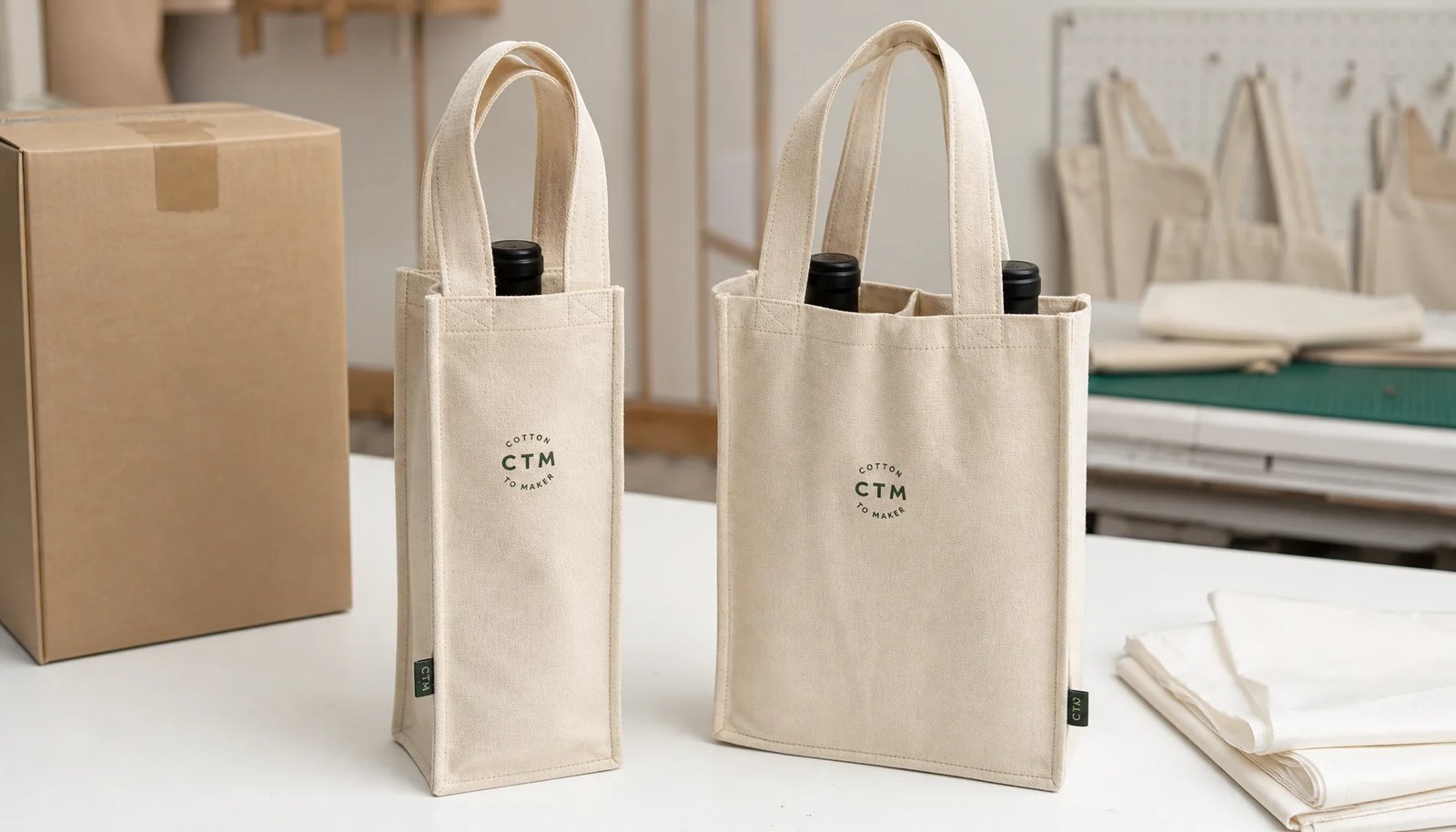
Start With the Carton Problem, Not Only the Bag Design
For university bookstores, canvas wine carriers often sit between retail merchandise and event packaging. The buyer may care about campus branding, but the warehouse cares about carton count, carton weight, label accuracy, and how easily the product can move to stores or event sites. A good RFQ should therefore define the carton packing plan at the same time as the bag specification.
The buying mistake is treating packing as a factory detail to be solved after production. Wine carriers are small, but they are not always easy to pack efficiently because handles, dividers, print panels, and thicker canvas create bulk. If the order is packed too tightly, front panels crease and prints rub. If it is packed too loosely, freight cost rises and cartons deform during stacking.
- State the required selling format: flat, lightly shaped, folded with belly band, or ready for retail display.
- Give the supplier a maximum carton gross weight, not only a preferred carton size.
- Require one carton mock-pack photo before bulk packing starts.
- Define whether each unit needs an individual polybag, paper wrap, hangtag, barcode, or no retail inner pack.
- Avoid mixed artwork in the same carton unless the packing list and carton marks are very clear.
Choose Canvas Weight by Bottle Load and Retail Positioning
Most bookstore wine carrier projects work well in 10 oz to 12 oz cotton canvas. This range gives enough body for a reusable product without making the carton cube inefficient. A lighter 8 oz fabric can be acceptable for a short-life promotional sleeve, but it may look weak around a glass bottle and can wrinkle badly after carton compression. A heavier 14 oz canvas feels premium, but it increases material cost, sewing resistance, and packed volume.
GSM and ounce references should be made clear because suppliers may quote differently. A 10 oz canvas is commonly around 340 gsm, while 12 oz is often around 400 gsm, depending on weave and finishing. If the buyer compares one quote based on 10 oz natural cotton canvas with another based on 12 oz dyed canvas, the unit prices are not equivalent. The RFQ should require fabric weight, composition, color, and finish in writing.
- 8 oz canvas: use only when low cost and light promotional handling matter more than structure.
- 10 oz canvas: good for single-bottle bookstore and event sales where foldability matters.
- 12 oz canvas: stronger retail feel for alumni gifts, campus wine clubs, and holiday programs.
- 14 oz canvas: reserve for premium gifting where higher freight cube is accepted.
- Dyed canvas: confirm colorfastness and shade tolerance before placing repeat orders.
Match the Carrier Structure to the Bottle and Sales Channel
A single-bottle canvas wine carrier is usually the safest choice when the bookstore needs a broad retail item. It is easier to sew, easier to pack flat, and simpler to inspect. A two-bottle version can increase perceived value, but it introduces a real engineering point: the internal divider must prevent glass-to-glass impact while still allowing the carrier to fold neatly into cartons.
Buyers should provide the bottle dimensions used for testing. Standard 750 ml wine bottles vary in shoulder shape and height, and campus retail programs may also use olive oil, sparkling cider, or local beverage bottles. The factory cannot verify fit properly from capacity alone. Provide bottle height, bottom diameter, maximum shoulder diameter, and filled weight, then specify whether the top of the bottle should remain visible or sit lower inside the bag.
- For single-bottle carriers, confirm base width and side gusset so the bottle stands without excessive lean.
- For two-bottle carriers, require a sewn divider or reinforced separator, not only a loose fabric flap.
- For tall bottles, check handle drop so the bottle neck does not interfere with carrying comfort.
- For retail display, decide whether the carrier must stand when empty or only when filled.
- For events, test how quickly staff can insert bottles without fighting tight seams.
Print Method Decisions for University Marks
University bookstore artwork often includes licensed marks, department names, event dates, or alumni graphics. For most canvas wine carriers, screen printing is the practical default. It handles solid logos well, offers durable color, and keeps unit cost controlled at volume. The buyer should specify exact print dimensions, Pantone references if required, and print location measured from the top edge or seam line.
Heat transfer can be useful for complex artwork, photographic effects, or low-volume personalization, but it changes hand feel and may not breathe into coarse canvas the same way ink does. Embroidery is possible but can pucker lighter canvas and may not suit small type. Woven labels or side labels are a clean alternative when the front panel should stay retail-neutral, but they require label MOQ and extra sewing steps.
- Use screen print for one- to three-color logos with clean edges and repeatable campus branding.
- Use heat transfer only when artwork complexity justifies higher setup and a different surface feel.
- Use embroidery for small premium marks, not large filled logo areas on thin canvas.
- Use woven labels when the buyer wants subtle branding and easier repeat production.
- Approve a print strike-off before full production when licensed colors or logo proportions matter.
MOQ Logic: Total Units Can Be Misleading
Canvas wine carrier MOQ is not only about the total order quantity. Factories calculate feasibility through fabric purchasing, cutting efficiency, print setup, sewing line changeover, and packing separation. An order for 3,000 units of one style and one print is very different from 3,000 units split across six campus departments, three fabric colors, and twelve artwork versions.
A practical RFQ should list the base style quantity and then show artwork splits. If all versions use the same natural canvas, same bag size, and same one-color print, the supplier may be able to combine fabric cutting and only charge additional screens or setup fees. If each version uses a different dyed canvas or different print placement, the factory will likely treat them as separate production lots.
- Clarify MOQ per bag style, per fabric color, per print design, and per label version.
- Group small department orders under one base fabric and one carrier structure where possible.
- Accept setup charges transparently instead of forcing unrealistic unit prices on small art splits.
- Reserve extra units for event shortages, inspection rejects, and bookstore replenishment.
- Avoid final artwork changes after cutting because printed panel size may affect sewing sequence.
Build the Carton Packing Plan Before Price Comparison
Two suppliers can quote the same canvas wine carrier but pack it very differently. One may fold the carrier flat with handles tucked inside and 100 units per carton. Another may use individual polybags, tissue, shaped inserts, and only 40 units per carton. The unit price alone will not show the landed cost difference. Carton cube, gross weight, labor time, and destination handling all influence the real cost.
A strong packing plan includes units per carton, folding direction, inner packing, carton dimensions, gross weight, carton material, carton marks, and pallet preference if applicable. For hand handling, many buyers prefer export cartons under about 16 to 18 kg gross weight. For courier shipments, dimensional weight may matter more than actual weight. For ocean freight, carton strength and stacking pattern become more important.
- Flat pack: lowest cube, best for warehouse storage, but needs print crease control.
- Lightly shaped pack: better retail presentation, higher carton volume.
- Individual polybag: protects print and fabric, but may conflict with plastic-reduction policies.
- Paper wrap or tissue: cleaner retail feel, more labor and possible compression wrinkles.
- Master carton with inner bundles: easier counting and store allocation for multi-campus distribution.
Sample Approval Should Include Packing, Not Just Appearance
A pre-production sample that looks good on a desk can still fail in bulk cartons. Canvas thickness, handle placement, and printed ink surface all behave differently when 50 to 100 units are compressed for export. For this product category, sample approval should cover bottle fit, handle strength, print durability, folding marks, and a small packing trial.
The buyer does not always need a full production carton before placing the order, but the supplier should be able to show a carton mock pack using the approved folding method. Photos should show the first layer, middle layer, top layer, closed carton, carton marks, and gross weight. If the order includes multiple artwork versions, one mixed-carton example should show how versions are separated and identified.
- Approve one physical pre-production sample made with the quoted canvas weight.
- Request a print strike-off if the logo color, registration, or ink thickness is critical.
- Test the sample with the actual bottle size and filled weight used in store.
- Fold the sample for 24 to 48 hours and inspect print cracking or permanent creasing.
- Review packed sample photos before authorizing bulk packing.
QC Thresholds That Prevent Bookstore Receiving Problems
Retail buyers often focus on visible logo defects, but receiving teams reject shipments for many other reasons: wrong carton marks, short counts, mixed SKUs, mildew odor, crushed cartons, or cartons too heavy for normal handling. AQL inspection should therefore combine product checks with packing checks. The purchase order should define critical, major, and minor defects in plain language.
For product inspection, handle strength and seam quality are more important than cosmetic perfection hidden inside the bag. For packing inspection, the inspector should open random cartons and verify count, folding method, inner protection, SKU separation, and carton label accuracy. If the buyer requires barcodes, the inspector should scan samples rather than only look at the label.
- Critical defects: unsafe sharp objects, mold, severe contamination, wrong licensed logo, or unusable handle failure.
- Major defects: wrong size, weak seam, heavy print misalignment, obvious stains, wrong carton count, or wrong SKU label.
- Minor defects: small loose threads, slight shade variation within tolerance, or small hidden fabric slubs.
- Handle load test: use filled bottle weight plus a safety margin and hold for a defined time.
- Carton drop or compression review: use realistic handling checks when the order ships by courier.
Lead Time Risks Around Artwork, Labels, and Packing
Canvas wine carriers are not usually the slowest textile product to sew, but schedule risk builds around approvals. Licensed university artwork may require several internal reviews. Dyed fabric may need lab dips. Woven labels may have their own MOQ and production time. Carton labels and barcode files may arrive late from the bookstore system. These delays happen before the sewing line becomes the bottleneck.
A practical timeline separates artwork approval, sample making, sample shipping, bulk material preparation, printing, sewing, inspection, packing, and export handover. For repeat programs, the buyer should keep the same dieline, print position, carton size, and packing method to reduce risk. Changing carton quantity late can be more disruptive than it seems because the factory may already have purchased cartons and planned labor.
- Artwork approval delay affects print screens, strike-offs, and licensed brand release.
- Fabric shade approval delay affects cutting and may split production into separate lots.
- Label file delay affects barcode printing, carton marks, and store allocation.
- Packing change delay affects carton procurement and warehouse labor planning.
- Inspection delay affects vessel booking, courier pickup, and campus event deadlines.
Quote Data Needed for a Fair Landed-Cost Comparison
A complete quote for canvas wine carriers should make cost drivers visible. Buyers should not accept a single unit price with no details if they need to compare suppliers properly. The quote should state fabric weight, bag dimensions, handle construction, print method, number of colors, sample charges, setup charges, packing method, carton dimensions, units per carton, gross weight, and delivery term.
Landed-cost comparison is especially important for campus retail programs because orders may be split across bookstore warehouses, event venues, and distributor facilities. A lower unit price can lose its advantage if cartons are bulky, counts are hard to allocate, or extra domestic repacking is needed. The best supplier quote is not always the cheapest; it is the one that reduces surprises after goods arrive.
- Compare unit price together with carton cube and gross weight.
- Separate one-time setup costs from repeat-order unit costs.
- Request the same Incoterm from all suppliers, such as FOB port or EXW factory, before comparing.
- Ask for estimated packed CBM per 1,000 units to model sea freight or warehouse storage.
- Include inspection cost, sample freight, and domestic redistribution labor in the buying decision.
Specification comparison for buyers
| Spec decision | Recommended option | When it fits | Buyer risk to check |
|---|---|---|---|
| Fabric weight | 10 oz to 12 oz cotton canvas for most campus wine carriers; 14 oz only for premium gift sets | Bookstore retail, alumni gifts, winery partnerships, graduation packs, and holiday merchandising | Too-light canvas can collapse around the bottle; too-heavy fabric increases freight cube and may reduce neat folding |
| Bottle capacity | Single-bottle carrier for volume programs; two-bottle carrier with divider for gift bundles | Single units fit impulse purchase and alumni event sales; two-bottle bags suit premium retail sets | Two-bottle styles need bottle divider testing because weak dividers allow glass contact during transit |
| Handle construction | Self-fabric handles with box stitch or cross stitch reinforcement | Reusable retail product where customers carry filled bottles from store to car or event venue | Decorative stitching without reinforcement can fail under bottle weight, especially after washing or repeated use |
| Print method | Screen print for solid university marks; heat transfer only for complex gradients or low-volume personalization | One- to three-color bookstore logos, alumni marks, campus event artwork, and simple department branding | Thick ink on coarse canvas may crack at folds; registration tolerance must be agreed before bulk approval |
| Inner packing | Flat folded or lightly shaped with paper insert depending on display requirement | Flat folding reduces carton volume; shaped packing supports retail presentation for premium programs | Over-compression can crease printed panels; excessive inserts raise labor cost and carton volume |
| Carton plan | Export carton sized to avoid over 16 to 18 kg gross weight for hand handling | Mixed campus-store orders shipping by sea, air, courier, or domestic redistribution | A carton that is too heavy increases warehouse damage and may be rejected by some receiving teams |
| MOQ logic | Combine fabric color, print color, and style count before judging MOQ | Multi-campus or department orders where artwork changes but base bag remains the same | Splitting the order into many small art versions may trigger setup fees, print loss, and shade variation |
| Sample approval | Pre-production sample using correct fabric, handle stitch, print size, folding method, and carton mock pack | Any order tied to licensed branding, event dates, or retail launch windows | Approving only a photo sample misses bottle fit, handle strength, folding marks, and carton compression issues |
| Compliance evidence | Request fabric composition, colorfastness notes, packing photos, and inspection records rather than vague factory claims | Importers, distributors, and bookstores needing internal procurement files | Unverified claims about eco fabric, azo-free ink, or recycled packaging can create labeling and brand-risk problems |
Buyer checklist before sampling
- Define whether the carrier is single-bottle, two-bottle, or mixed capacity before requesting price.
- Specify bottle dimensions and filled bottle weight used for fit and handle testing.
- Choose canvas weight by retail purpose, not only by lowest unit cost.
- State print size, ink color count, logo position, and whether licensed artwork needs formal approval.
- Require a pre-production sample with the same folding and carton packing method planned for bulk.
- Set acceptable carton gross weight, carton dimensions, units per carton, and inner polybag or paper wrap rules.
- Confirm whether cartons need SKU labels, barcode labels, campus department codes, or mixed-carton markings.
- Include AQL level, critical defect definitions, and photo records in the purchase order.
- Separate product lead time from artwork approval, sample shipping, inspection, and vessel or courier transit time.
- Ask suppliers to quote tooling, print setup, sample cost, carton cost, and inland freight separately.
Factory quote questions to send
- What fabric weight, composition, and shrinkage tolerance are included in your quoted canvas wine carrier price?
- Is the quoted MOQ based on total units, per style, per fabric color, per print color, or per artwork version?
- What bottle size and filled weight will you use for fit, seam, and handle load testing?
- Which print method is included, and what is the maximum printable area on the front panel before distortion or seam interference?
- Can you provide a carton packing plan showing units per carton, folding method, carton dimensions, gross weight, and carton material grade?
- How many extra units are allowed for print loss, inspection replacement, and shipping shortage?
- What sample stages are included: blank sample, print strike-off, pre-production sample, or carton mock-pack sample?
- What is the normal lead time after sample approval, and which steps can delay shipment if artwork or carton labels change?
- Can carton marks, SKU labels, barcodes, and mixed-style packing lists be applied at factory before export?
- What inspection standard do you accept for stitching, print registration, stains, loose threads, handle strength, and carton damage?
Quality-control points to confirm
- Canvas GSM or oz weight matches approved sample within agreed tolerance.
- Finished bag dimensions fit the buyer’s nominated bottle size without stressing side seams.
- Handle attachment passes a practical load test using filled bottle weight plus safety margin.
- Front print is centered within agreed tolerance and does not crack after normal folding.
- Divider panel, if used, keeps bottles separated under movement and carton compression.
- Stitch density, thread color, seam allowance, and reinforcement pattern match the approved sample.
- No visible oil marks, weaving defects, mildew odor, heavy creasing, or ink transfer on retail-facing panels.
- Carton count, carton marks, SKU labels, and packing list match the buyer’s receiving requirements.
- Carton gross weight and carton dimensions match the approved packing plan.
- Random packed cartons are opened during inspection to verify folding direction, print protection, and unit count.