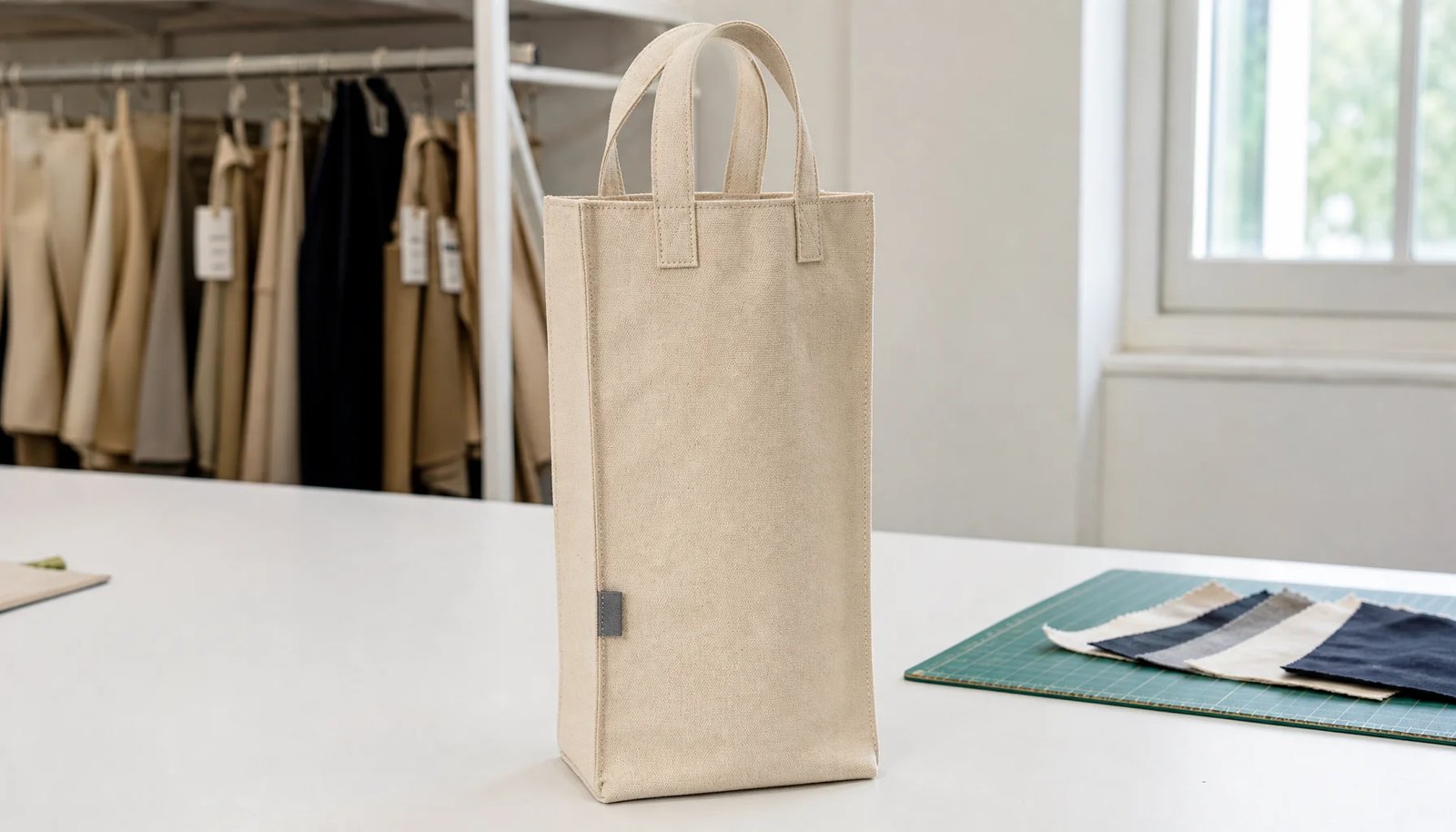
Start With the Event Job, Not the Bag
Canvas wine carriers for trade show use are not generic bottle sleeves. The same product might be used as a booth giveaway, a VIP gift, a hospitality kit insert, or a retail-style branded handout. Each use case changes the construction, presentation, and acceptable cost. A bag that only needs to survive a short handoff can be lighter and simpler than one that must sit on a meeting table and still look sharp after multiple touches.
The bottle profile belongs in the first version of the brief. A standard 750 ml bottle behaves differently from a sparkling bottle, a tall imported bottle, or a heavier glass bottle with a broader shoulder. Height determines whether the logo stays visible after loading. Diameter affects side seam tension and the front-panel shape. Filled weight drives handle reinforcement and bottom support. If the carrier is meant to be pre-filled by a third party, the sample must be reviewed in that exact loaded state, not as a blank shell.
Lead time should be managed against the event calendar, not against a generic production window. Work backward from the in-hands date and include artwork review, proof approval, sample loops, inspection, freight, receiving, kitting, and booth delivery. If the bag is part of a larger program, the carrier should be written as one component in the event pack, not as a loose accessory that can be finalized later.
- State the use case: booth giveaway, VIP gift, retail resale, hospitality kit, distributor sample, or internal sales kit.
- Confirm whether carriers ship flat, folded, individually packed, bulk packed, pre-loaded, or packed with inserts.
- Identify the exact bottle size, filled weight, and whether the logo must remain visible after loading.
- Set the required in-hands date with receiving, kitting, domestic transfer, and booth delivery buffer.
Lock Bottle Geometry Before You Talk Decoration
A good-looking sample can still fail in the field if the fit is wrong. Measure the real bottle or a dummy that matches its height, diameter, shoulder shape, cap height, and filled weight. Those measurements drive the finished size, handle drop, seam tension, and the amount of visible logo area left on the front panel. If the bottle is too tight, seams work harder and the bag can twist. If it is too loose, the carrier may collapse and hide the branding when staff set it on a table.
Decide early whether the event team needs a flat-packed item that is filled later or a pre-loaded unit that goes directly into a welcome kit. That choice changes how the carrier folds, how much the print can crease, and whether the bottle sits proud enough for the mark to remain readable. It also changes the carton plan. A flat-packed carrier can fit more units per carton, while a pre-loaded kit needs more crush protection and tighter packing control.
Treat geometry as a written spec, not as a design comment. Finished height, width, gusset, handle length, handle drop, and opening width should all be measured and recorded. Once the pattern is fixed, the supplier can price the material and sewing more accurately, and the buyer can compare samples without arguing over impressions.
- Measure the actual bottle or a weighted dummy before pattern approval.
- Write finished dimensions, handle drop, opening width, and gusset depth into the spec sheet.
- State whether the carrier is intended for flat packing, pre-filling, or booth handout use.
- Test the loaded sample on a table and in hand to confirm the logo stays visible.
Choose Fabric Weight and Construction as One Decision
Fabric weight changes more than price. It changes hand feel, print opacity, body, folding behavior, and freight cost. A 12 oz cotton canvas, around 340 gsm, can work for budget event giveaways when the bottle is standard and the logo is simple. A 14 oz canvas, around 400 gsm, is a stronger middle ground when the buyer wants the carrier to stand up on a table and feel more substantial in hand. A 16 oz build, or a reinforced style with lining, makes sense for premium gifting, heavier bottles, double-bottle formats, or retail resale where the bag has to survive repeated use.
Do not approve the fabric label alone. Ask whether the canvas is natural, bleached, dyed, washed, pre-shrunk, lined, laminated, or treated. Those choices materially change the outcome. Natural canvas is usually the easiest to source and the most forgiving on MOQ, but the shade can vary by lot. Bleached canvas can make logo colors look cleaner and brighter. Dyed canvas supports brand color control, but it often brings higher MOQ, longer lead time, and more approval steps. Lining improves presentation and can protect the bottle, but it adds bulk and can change the way the carrier folds.
Construction should sit beside fabric weight in the spec. Handle material, handle attachment, stitch density, bottom support, gusset shape, and reinforcement points all influence real performance. A good print on a weak seam still fails at the trade show. Ask for the loaded sample to be handled the way the booth staff will actually use it, because that is the fastest way to see whether the construction is right.
- Use 12 oz canvas only after checking opacity, loaded shape, and handle reinforcement.
- Use 14 oz canvas when structure and presentation matter more than the lowest unit price.
- Use 16 oz canvas, lining, or reinforcement for premium gifts, heavier bottles, or retail use.
- Specify handle material, handle drop, reinforcement pattern, bottom construction, and finished dimensions.
Match Decoration to the Artwork, Not the Factory Default
Screen printing is usually the most predictable decoration method for canvas wine carriers when the artwork is simple and the order volume is meaningful. A one-color logo on natural or light canvas is often the cleanest balance of cost and consistency. The important point is not that screen printing is common. It is that ink density, edge sharpness, and placement tolerance need to be approved on the actual fabric, because canvas texture changes how a logo reads once it is cured and sewn.
Multi-color screen printing needs tighter control. If the logo has spot colors, thin strokes, small type, or a dark canvas base, then registration tolerance, underbase behavior, curing, and minimum line weight matter more than the artwork itself. The underbase can improve opacity, but it also creates another layer that can show at the edges if the print shifts. On a trade show bag, the failures are often subtle: soft edges, slight haloing, color drift, and text that becomes harder to read from booth distance.
Transfers, woven labels, side tags, and patches are useful when the order has low MOQ, variable logos, or a premium trim requirement that does not justify a large front-panel print. These options are not automatically better. They solve different problems. A transfer can handle a complex mark, but it can crack or lift if folded carelessly. A woven label looks clean, but it has its own MOQ and placement issues. Procurement should match the decoration to the use case, not to a default factory suggestion.
- Use screen print for simple spot-color logos, repeat orders, and higher quantities.
- Check underbase and registration details for dark fabric, multi-color logos, and small type.
- Use transfers for gradients, low MOQ, or variable artwork, then test folding, rub, and edge lift.
- Use woven labels or patches when a smaller brand mark fits the presentation better than a large print.
Read Supplier Capability Before You Compare Price
Supplier choice affects more than unit price. A direct factory with in-house cutting, sewing, printing, curing, inspection, and packing gives procurement one accountable owner across the production path. That matters when print placement is sensitive, the logo cannot drift, or the schedule leaves little room for handoff errors. A capable factory can also answer practical questions faster, such as fabric shrinkage, stitch pattern, curing time, and what tolerance the line can actually hold without slowing production.
A trading company or multi-factory partner can still be the right choice when the program includes other event items, such as totes, drawstring bags, aprons, inserts, or packaging. The tradeoff is visibility. If the supplier is not the manufacturer, the buyer needs to know which factory is actually cutting and printing, who signs off on proofing, and who owns corrective action if bulk production diverges from the sample. Without that visibility, the buyer may get a responsive quote but weak accountability after approval.
The capability differences that matter most are concrete. An in-house print room usually shortens sample loops and improves placement consistency. A dedicated sewing line usually tightens seam repeatability and handle alignment. A supplier with controlled dyeing or finishing can deliver custom color or wash effects, but the lead time and MOQ usually go up. Pick the source based on the program requirement, not on whether the supplier can simply say yes to every feature.
- Use a direct factory when production visibility and defect accountability are top priorities.
- Use a trading partner when SKU coordination matters, while requiring clear proof ownership and factory-level evidence.
- Treat custom dyeing, lining, or special finishing as capability choices that usually increase lead time and MOQ.
- Prefer the supplier whose strongest process matches the most failure-sensitive part of the order.
Build a Quote That Can Survive Comparison
Unit price alone does not support a real sourcing decision. A useful supplier quote breaks out the cost drivers: fabric, cutting, sewing, decoration, setup fees, sample fees, labels, packing, inspection, carton marks, freight, and any optional testing. If those items are bundled into one number, procurement cannot tell whether a cheaper quote is actually cheaper or just less complete. The landed cost can change materially once artwork is finalized or packing is revised.
Request quantity bands that reflect plausible order scenarios, such as 500, 1,000, and 2,500 units. That shows where setup fees spread out and where MOQ pressure starts. It also shows whether one extra color changes the cost more than one extra hundred units. For buyers splitting the order by location, exhibitor, or logo version, the key question is whether the MOQ applies per version or across the combined run. That distinction often decides whether a program is feasible.
Lead time should be tied to actual change triggers. If artwork changes, if a new fabric color is introduced, if the packing format becomes retail-ready, or if barcode labels are added, the schedule can move even when the base product stays the same. A supplier quote should state where the clock starts, what causes a restart, and what happens if the buyer changes a detail after proof approval.
- Request itemized pricing for fabric, sewing, printing, setup, sampling, labels, packing, inspection, freight, and optional testing.
- Compare 3 quantity bands instead of only the target order size.
- Clarify MOQ by fabric color, logo version, print method, label type, handle material, and packing format.
- Record what changes trigger repricing or lead-time resets.
Run Proofs in the Right Order
A workable print proofing checklist has three gates: digital proof, printed strike-off, and sewn pre-production sample. Each gate proves a different thing. The digital proof confirms layout, logo size, placement intent, color references, and no-print zones. The strike-off shows how the chosen ink or transfer behaves on the actual canvas color and finish. The sewn sample proves the complete product, including seam geometry, handle balance, bottle fit, and how the logo sits once the bag is fully assembled.
Do not overread a partial sample. A local mockup may help a marketing team judge creative direction, but it does not prove the bulk process unless it uses the same fabric, sewing path, print method, and curing method as production. A strike-off on the wrong fabric can only serve as a rough color reference. A sewn sample without the actual handle spec confirms shape, but not carrying performance. If substitutions are made, those substitutions should be written down so the sample does not get treated as a full production reference by mistake.
The best sample review is physical and specific. Put the bottle inside, lift it, set it on a table, look at the logo from booth distance, and inspect the front, back, side seams, bottom, top hem, handle, label or patch, and print area. Decisions should be recorded as approved, rejected, or approved with listed changes. That language creates a clean production record and avoids vague comments that slow schedules and create later disputes.
- Use the digital proof for layout approval, not final print approval.
- Approve a strike-off on the same fabric color and texture planned for bulk.
- Approve a sewn pre-production sample with the actual bottle or a weight and size equivalent.
- Record sample deviations, approval date, approver name, and final corrections before bulk release.
Write QC Tolerances the Inspector Can Use
Quality control needs measurable language. Good print and clean sewing are not inspection standards. The purchase order should define finished dimensions, print placement, acceptable skew, color reference, print coverage, sewing quality, bottle fit, handle strength expectations, carton count, and packing method. If the supplier cannot measure a requirement, then the requirement is too vague to enforce later. The goal is to prevent the familiar argument where the buyer says the logo looks off and the factory says it meets the sample.
Placement should be measured from fixed reference points. If the buyer and the factory use different reference points, both sides can think they are right. Choose the finished top edge, center line, side seam, or bottom fold before production starts. Example values such as +/-3 mm for front-panel placement or +/-5 mm for body dimensions are practical starting points, but they should be written into the order so both sides are judging the same thing.
Defects should be grouped by severity. Critical defects can include unsafe contamination, sharp objects, or handle failure. Major defects can include wrong artwork, unreadable print, severe cracking, open seams, incorrect bottle fit, wrong fabric color, or carton mix-ups. Minor defects can include small thread ends, slight slubs, or limited shade variation within the approved range. If an AQL is used, state the sampling level and defect categories before production so the inspection result has a clear meaning.
- Define finished size, print placement, skew, color, print coverage, sewing, bottle fit, and packing acceptance points.
- Measure logo position from named reference points rather than judging by eye.
- Group defects into critical, major, and minor before production starts.
- State whether inspection is factory internal, buyer-arranged, third-party, or a combination.
Pack for the Show Floor, Not the Warehouse
Packing is part of proof approval because a correct print can still be damaged after production. Fresh ink packed too soon can offset onto adjacent bags. Transfers can scuff against rough canvas. Hard folds across the logo can create visible creases. Moisture in cartons can leave odor or surface marks. For that reason, the packing specification should be reviewed with the physical sample, not added later as a generic shipping instruction.
The right packing format depends on the event workflow. Bulk packing is efficient for booth giveaways if the print is fully cured and protected from abrasion. Individual polybags, tissue, interleaf, hangtags, or barcode stickers may be needed for VIP or retail-style programs. If the carrier is folded, the fold line should not cut through the print area unless the buyer has already accepted the visual crease. If the bags are pre-loaded with inserts, the sample should be checked in that exact packed state so the weight and shape are realistic.
Carton discipline matters because trade show goods often move through more than one handoff. Specify units per inner pack, units per master carton, carton dimensions, gross weight target, SKU labels, outer marks, and pallet requirements if needed. Ask for pre-shipment photos of open cartons, folded product, sealed cartons, and mixed-SKU layouts before the goods leave the factory. That gives procurement a last chance to catch packing drift without opening a shipment at the venue.
- Confirm curing or heat setting is complete before folding, stacking, polybagging, or carton packing.
- Approve flat, folded, bundled, individually packed, or insert-packed presentation in advance.
- Define carton count, carton size, gross weight, SKU labels, outer marks, and pallet needs.
- Use tissue, interleaving, or individual protection when scuffing would harm the presentation.
Release the PO Only After the Paper Trail Is Complete
The final purchase order should read like an execution document, not a sales note. It should attach the approved spec sheet, dieline, artwork file, sample approval, QC tolerance, packing specification, carton marks, and in-hands date. That reduces the number of decisions the factory must guess at and gives procurement a single reference if a dispute appears later. If the order is split across exhibitors, locations, or logo versions, each version needs to be named clearly rather than described loosely in email threads.
Change control deserves a line of its own. If any part of the order changes after sample approval, the buyer should know whether the change affects the screen, the sewing pattern, the label placement, the carton size, or the production schedule. The most expensive mistakes usually come from small revisions that are treated as harmless. For that reason, the supplier should state which changes are free, which need a new sample, and which restart the lead time clock.
Before shipment, the buyer should have evidence that the bulk order matches the approved reference. Pre-shipment photos should show the product, the print, the packing format, and the carton marks. If the program is important enough to have a printed carrier, it is important enough to require the photo set. That is the cleanest way to close the loop between proof, production, and delivery.
- Attach the final spec sheet, dieline, artwork, sample approval, QC tolerance, and packing spec to the PO.
- Name each logo version, SKU, location, or event site explicitly.
- Write a change-control rule for artwork, fabric, packing, labels, and carton marks.
- Require pre-shipment photos that show product, packing, and carton identification before release.
Specification comparison for buyers
| Option type | Best use | Typical MOQ / sample timing | What to specify | Cost impact |
|---|---|---|---|---|
| 12 oz cotton canvas, about 340 gsm | Budget booth giveaways and standard 750 ml bottles | Typical MOQ 500 to 1,000 pcs; blank sample 3 to 5 days; strike-off 5 to 7 days | Fabric weight in oz and gsm, natural or bleached finish, handle reinforcement, finished dimensions | Lowest fabric cost and lighter freight |
| 14 oz cotton canvas, about 400 gsm | Core trade show program and repeat-use carriers | Typical MOQ 300 to 800 pcs; blank sample 3 to 5 days; strike-off 5 to 8 days | Weave, handle drop, bottom shape, printable panel size, and whether the bag must stand upright | Moderate cost increase with better structure |
| 16 oz canvas with lining or reinforcement | Premium gifting, heavier bottles, double-bottle styles, retail resale | Typical MOQ 500 to 1,500 pcs; blank sample 5 to 7 days; sewn sample 10 to 15 days | Outer fabric, lining, reinforcement zones, needle spec, load target, and stitch pattern | Highest material and labor cost, plus heavier freight |
| Natural unbleached canvas | Simple logos, large event runs, faster approval cycles | Typical MOQ 300 to 1,000 pcs; sample timing usually fastest if stock fabric is used | Shade range, weave consistency, shrinkage expectation, and ink opacity target | Usually the best value |
| Bleached or dyed canvas | Brand-controlled presentation and darker or more polished builds | Typical MOQ 500 to 2,000 pcs; sample timing often 1 to 2 weeks because color approval may be needed | Exact fabric color, wash treatment, pre-shrink status, and ink coverage standard | Higher cost because dyeing and approvals add work |
| One-color screen print | Clean exhibitor logos and high-repeat orders | Typical MOQ 300 to 1,000 pcs; strike-off 5 to 7 days | Logo size, placement reference points, Pantone reference, curing method | Lowest decoration cost and setup complexity |
| Multi-color screen print with underbase | Brand-controlled spot colors and higher-contrast logos | Typical MOQ 500 to 1,500 pcs; sample timing 7 to 10 days | Color count, underbase need, registration tolerance, screen fees, and minimum line weight | Higher setup and inspection cost |
| Heat transfer, woven label, or patch | Low MOQ, variable logos, or premium trim detail | Typical MOQ 100 to 500 pcs; sample timing 5 to 10 days | Transfer size, finish level, label size, stitch placement, rub resistance, and pack presentation | Can be efficient for smaller runs, but unit cost can climb |
Buyer checklist before sampling
- Final artwork is supplied in AI, EPS, or print-ready PDF format, with fonts outlined, linked images embedded, flattened effects, and named color references for each print color.
- A factory dieline or flat pattern is approved with printable area, logo size, placement reference points, and no-print zones near side seams, bottom folds, handle stitch boxes, labels, and patches.
- Canvas weight is locked in both gsm and oz, with fabric color, weave, finish, lining, lamination, wash treatment, shrinkage expectation, and reinforcement details stated on the order.
- Bottle fit is checked against the actual bottle or a dummy that matches height, diameter, shoulder shape, cap height, and filled weight, including how much of the logo remains visible when loaded.
- Decoration method is approved in writing, including screen print, transfer, woven label, or patch, plus color count, underbase need, curing or heat-setting method, and maximum print size in mm.
- Logo placement is defined by measurement method, such as millimeters from the finished top edge and front-panel center line, instead of subjective directions like centered or slightly higher.
- Printed strike-off is approved on the same fabric color and texture planned for bulk production, especially when natural canvas shade variation could affect ink color and opacity.
- Sewn pre-production sample is approved with the actual handle construction, seam finish, bottom shape, label or patch placement, bottle fit, and packing presentation.
- QC tolerances are written before production, including limits for finished size, handle drop, print placement, skew, color variation, ink defects, fabric defects, stitch defects, and carton count variance.
- Packing specification is confirmed for folding method, unit packing, tissue or interleaf if needed, barcode sticker, carton count, master carton dimensions, gross weight target, outer marks, and pre-shipment carton photos.
Factory quote questions to send
- Which steps are done in-house, and which are outsourced for cutting, sewing, printing, curing, inspection, or packing?
- What canvas weight are you quoting in gsm and oz, and will the bulk fabric match the approved sample lot or an approved equivalent lot?
- Is the fabric natural, bleached, dyed, washed, pre-shrunk, lined, laminated, or treated, and how does that choice affect print absorption, hand feel, MOQ, and lead time?
- What bottle size is the pattern designed for, and can you confirm fit with our actual bottle height, diameter, shoulder shape, cap height, and filled weight?
- How many print colors are included in the base price, and what are the setup fees per screen, color, underbase, transfer sheet, woven label, or patch?
- What is the printable area in mm, and what placement tolerance do you recommend from the finished top edge, side seam, bottom fold, and center line?
- Can you provide a blank sample, printed strike-off, and sewn pre-production sample before bulk, and which sample charges are refundable after order placement?
- What is the MOQ by fabric color, print method, handle material, label type, packing format, and logo version if we split the order across locations or SKUs?
- When does production lead time start, and what changes if artwork, fabric color, sample approval, packing, barcode labels, or carton marks are revised?
- What curing, drying, or heat-setting process is used, and how long must the carriers rest before folding, stacking, polybagging, or carton packing?
Quality-control points to confirm
- Fabric weight is checked against the approved spec in gsm or oz, and the fabric color, weave, and hand feel match the sealed reference sample within the agreed variation.
- Finished dimensions are measured empty and loaded, including height, width, gusset, handle drop, bottle opening, and bottom stability. A practical starting tolerance is +/-5 mm on body dimensions and handle drop, unless the construction requires tighter control.
- Print placement is measured from agreed reference points, including logo center, top margin, side margin, and skew. A practical starting tolerance is +/-3 mm on front-panel placement, with the reference points written on the PO.
- Print color is compared against the approved strike-off or named color reference under consistent lighting, with natural canvas shade variation reviewed separately from ink color error.
- Print coverage is inspected for pinholes, patchy opacity, ink bleeding, underbase exposure, registration drift, fuzzy edges, scorch marks, transfer film outlines, cracking, and edge lift.
- Ink or transfer durability is checked with dry rub, fold, and handling tests that reflect trade show use. If the decoration method is sensitive, ask for a fresh test sample from the same lot before release.
- Handle attachment is inspected for stitch count, reinforcement pattern, loose threads, skipped stitches, bar tack quality, symmetry, and lifting performance with the filled bottle weight.
- Side seams, bottom corners, gusset folds, lining, and top hem are checked for open seams, puckering, raw edges, needle damage, loose threads, or twisting after loading. Load-bearing seams should not open, and loose thread ends should be trimmed to a short, clean finish.
- Bottle fit is tested with the actual bottle or equivalent dummy, confirming that the carrier stands, lifts, hangs, and presents the logo without tipping, tearing, or hiding the artwork.
- Odor, moisture, dust, lint, ink residue, carton count, carton marks, and folding method are checked before shipment because canvas can absorb warehouse smells and hold surface contamination if packed too early. If you use AQL, write the sampling plan and defect classes into the PO; a common starting point is critical 0, major 2.5, minor 4.0.