Start With the Event Use Case, Not the Mockup
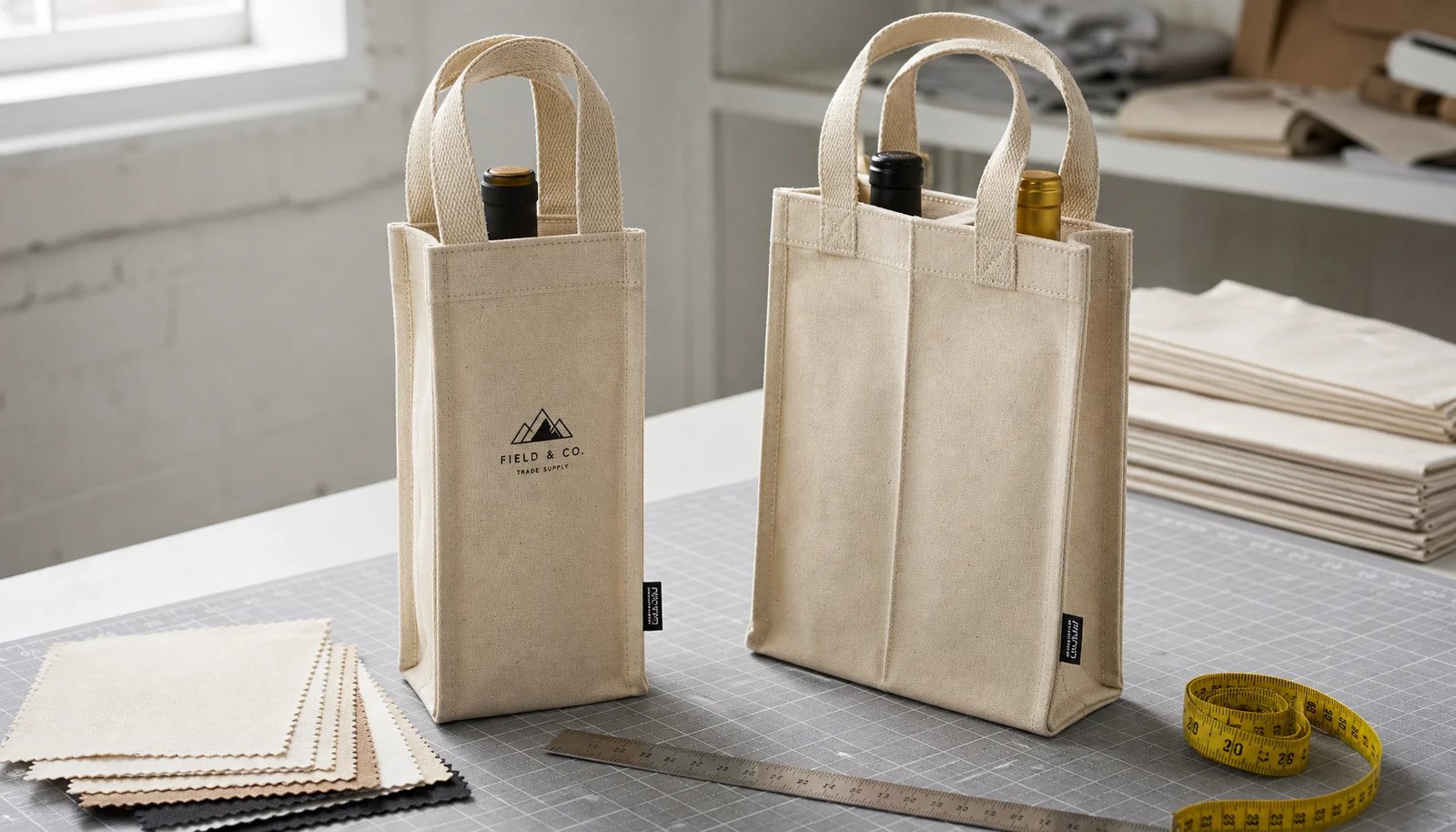
A canvas wine carrier for a trade show is doing more than carrying a bottle. It may be handed out at a booth, used in a tasting room, packed into a premium gift kit, or shipped to a distributor meeting after the event. That matters because the bag will be judged in three states: flat on a table, filled with a bottle, and moving through a crowded venue. A logo that looks centered on a flat mockup can shift into a seam, rise above the handle line, or sit too high once the carrier is filled.
Procurement teams get better results when they define the use case before they approve artwork. Ask whether the bag is meant for a single bottle, a two-bottle set, or a mixed program that may need more than one bottle profile. Then define the bottle type, the finished size, the reading distance for the logo, and the approval format. A digital mockup is not enough if the final decision depends on how the print behaves on sewn canvas and under bottle weight.
- State the bottle format: Bordeaux, Burgundy, champagne, or another shape.
- Ask for front, side, and filled photos before approving placement.
- Keep the main mark readable from about 1 to 2 meters for booth traffic.
- If the carrier may be reused after the event, choose a layout that still looks balanced after handling.
Translate Bottle Dimensions Into the Bag Pattern
Single-bottle and two-bottle carriers are not interchangeable from a sourcing perspective. A single bottle creates a central bulge that can move the logo upward visually once the bag is filled. A two-bottle style usually introduces a divider or center seam that changes the way the front panel lays flat, which can narrow the actual print space even if the overall bag looks larger. The same artwork width can feel elegant on one pattern and crowded on another.
Buyers should ask the supplier to quote against the actual bottle or a dimensional dummy, not against a generic wine bag description. The critical dimensions are bottle diameter, shoulder shape, overall height, handle drop, bottom width, and divider height. If the program needs to fit more than one bottle family, the spec should be built around the largest shape. That prevents a clean mockup from turning into a production fit problem.
- Request the finished printable area in millimeters, not only a sales photo.
- Confirm whether the carrier is sized for one bottle, two bottles, or mixed bottle sizes.
- For two-bottle styles, check whether the bottles sit parallel or slightly angled.
- Build the spec around the largest bottle you expect to carry if the program is not uniform.
Choose Canvas Weight and Finish Before Finalizing Artwork
For most trade show programs, 10 oz to 12 oz cotton canvas is the practical center of gravity. It is heavy enough to support glass without reading as disposable, but not so heavy that the bag becomes expensive, bulky, or difficult to sew. Lighter 6 oz to 8 oz canvas can work for short-term promotional use, but it wrinkles more easily and can make a printed logo appear less stable when the bottle is inserted.
Heavier 14 oz and above canvas can support a more premium position, but that weight shows up in fabric cost, sewing time, freight, and carton weight. It can also change the feel of the bag enough to require stronger handles and different stitch logic. Buyers should specify whether the fabric is natural, bleached, dyed, pre-shrunk, or washed, because each finish affects print contrast, shrink behavior, and final dimensions.
- Use natural canvas if you want a softer, eco-leaning look and can accept mild flecking.
- Use bleached or off-white canvas when you need stronger contrast under a dark logo.
- Ask whether the fabric is pre-shrunk or washed if size consistency matters after decoration.
- Do not choose heavier canvas only for appearance if air freight weight is a cost driver.
Place the Logo Against the Finished Bag, Not the Cut Panel
A usable logo area on a sewn wine carrier is smaller than the flat fabric panel. Side seams, bottom folds, handle stitch boxes, divider seams, and the bottle bulge all reduce the area that reads cleanly. That is why the buyer should define the safe print zone from finished sewing references, not from a loose cut piece that may shift during production. A front panel that looks wide in an artwork file can become much tighter once the bag is actually constructed.
For many single-bottle carriers, a centered logo around 60 to 90 mm below the finished top edge reads well. For two-bottle carriers, the logo often needs to sit slightly lower, depending on the front panel width and divider layout. Small type should be treated carefully because coarse canvas can fill in thin strokes. Keep the composition simple, leave more white space than you would on coated paper, and avoid crossing seams or reinforcement points.
- Use the finished top edge or handle stitch line as the primary vertical reference.
- Keep at least 20 to 30 mm clearance from side seams for standard front printing.
- Avoid crossing the bottom fold, divider seam, or handle reinforcement with the artwork.
- Approve placement with a filled sample because bottle pressure changes the visual center.
- Ask the factory to mark the print box on the sewing pattern, not only on a digital mockup.
Compare Decoration Methods by Artwork, Volume, and Wear
Screen printing is the default choice for most canvas wine carriers because it handles simple logos, event marks, and sponsor branding well at scale. It is usually the best fit when the artwork uses one to three solid colors and the brand needs repeatability across a batch. The main variables are mesh selection, ink type, curing, and the absorbency of the canvas. A design that looks crisp on screen may need simplification to print cleanly on woven cotton.
Heat transfer is better when the artwork includes gradients, fine detail, or multiple color transitions that would be expensive to separate into screens. It should be tested for bending, edge lift, and cracking because wine carriers are folded, stacked, and handled frequently. Embroidery can add a premium feel for a small mark, but large embroidery on a bottle carrier can pucker the fabric and make the panel sit unevenly. A woven side label is often the cleanest option when the front panel must stay visually quiet.
- Use screen print for most exhibitor logos, event graphics, and repeat orders.
- Use heat transfer only when the artwork genuinely needs more color complexity.
- Use embroidery for small premium marks, not oversized full-panel branding.
- Use a woven label when the buyer wants subtle permanent branding or origin marking.
- Ask for a strike-off or print sample before production if the artwork has small text or strict color targets.
Specify Handles, Dividers, and Stress Points as Part of the Brand Spec
A wine carrier fails differently from a normal tote. Bottle weight creates direct stress on the handle area, and rigid glass presses into the bottom and side walls. The RFQ should define handle width, handle length, handle drop, stitch-box size, bartack requirement, and whether a reinforcement patch or double layer is needed. If the handle reinforcement sits too close to the front print area, the bag can wrinkle and make the logo look uneven once filled.
For two-bottle carriers, the divider is not just a convenience feature. It controls bag shape, keeps glass from contacting glass, and helps the front panel remain stable. The divider can be sewn into the bottom, side seams, or both. A loose divider is cheaper, but it tends to shift during packing and use. A fixed divider is more stable, but the sewing order and print order must be planned in advance so the artwork stays clear of seam lines.
- Request load testing with the intended bottle weight, not only a general pull test on empty fabric.
- Use bartack or box-stitch reinforcement at handle stress points.
- Confirm divider height and width against the actual bottle diameter and shoulder shape.
- Keep the logo away from heavy reinforcement seams to avoid uneven ink deposit.
- Ask whether the factory uses folded handles, self-fabric handles, or sewn straps because each changes feel and cost.
Build an RFQ That Lets Suppliers Quote the Same Thing
Many quote problems come from RFQs that are too general. If one supplier quotes a plain natural canvas bag and another quotes a fully finished product with label insertion, divider stitching, and venue-ready packing, the numbers will not compare cleanly. Buyers should send a spec sheet that captures the exact style, dimensions, fabric weight, fabric color, print method, logo size, logo placement, label requirements, divider construction, carton marks, packing count, destination, and trade show deadline.
The RFQ should also separate the core product from options. Ask the vendor to list screen charges, sample costs, label cost, individual polybags, carton inserts, special marks, and freight terms separately. If the order may scale after the event, request pricing at several quantity tiers. That turns the quote into a landed-cost comparison instead of a unit-price contest. It also makes it easier to see whether one supplier is cheaper because they excluded a detail that the others included.
- Provide one artwork file in vector format and one reference image with dimensions marked in millimeters.
- List the target Incoterm and destination so the supplier knows whether to quote EXW, FOB, or delivered terms.
- Ask for unit price at multiple quantity tiers if the program may scale.
- Make the vendor confirm what is included and excluded in the base price.
- If there are multiple bag variants, request separate quote lines for each variant.
Compare Vendor Quotes on Total Landed Cost, Not Just MOQ
For canvas wine carriers, the cheapest ex-factory unit price is often not the cheapest delivered cost. Landed cost changes with fabric weight, decoration method, packaging density, carton size, shipping mode, duty classification, and whether the supplier is close to your final destination. A heavier 14 oz bag can look similar on a quote sheet to a 10 oz bag, but the freight difference can be meaningful once cartons are counted for air or courier shipment. Likewise, a low unit price can hide expensive screen charges, high sample costs, or oversized cartons that raise transport cost.
Supplier segmentation matters too. A large export factory may give better repeatability and packing control, but they often want higher MOQ and a longer planning horizon. A smaller workshop may accept a lower MOQ and faster sample iteration, but it may struggle with tight QC systems, complex carton marking, or consistent print registration on larger runs. Regional sourcing also affects the quote. Nearshore production can reduce transit time and simplify communication, while offshore sourcing may lower unit cost but adds more risk around port delays, customs, and late venue delivery. Buyers should compare suppliers using a common template that includes: material, construction, decoration, MOQ, sample cost, lead time, packing, Incoterms, inland transport, and a realistic buffer for event delivery.
- Ask for a side-by-side quote in the same currency, same Incoterm, and same carton count.
- Separate fabric cost, sewing cost, print cost, packing cost, and freight if the supplier can provide it.
- Compare carton dimensions and gross weight, not only bag unit price.
- Check whether the supplier is quoting from stock canvas, mill-ordered fabric, or dyed-to-order fabric.
- Treat very low MOQ quotes cautiously if they come with higher per-unit print charges or limited color options.
Approve Samples in the Same Sequence Production Will Follow
Sample approval should mirror the factory workflow. Start with a blank size sample if the bottle fit, handle drop, or divider position is uncertain. Then approve the print strike-off on the actual fabric. After that, review a pre-production sample that includes the final logo position, stitching, divider, label, and packing fold. Skipping directly from a digital mockup to bulk production is where many trade show orders go wrong, because canvas shifts after sewing and again after the bottle is inserted.
The sample evidence should include measurements, not just photos. Ask the factory to place a ruler or printed scale in frame and to show the bag empty, filled, and held by the handles. Keep a signed sample or sealed reference copy so the QC team has a physical standard. If the buyer later changes artwork or bag dimensions, the approval should reset. Small changes can move the logo enough to matter on a crowded front panel.
- Blank size sample: verifies bottle fit, handle length, divider position, and standing shape.
- Print strike-off: verifies color, line clarity, curing, and how the ink sits on canvas.
- Pre-production sample: verifies final logo placement after sewing and filling.
- Packing sample: verifies folding direction, polybag quantity, carton fit, and crease risk.
- If the project is time-sensitive, ask for photos at each stage before bulk cutting begins.
Set QC Acceptance Criteria Before the Order Moves to Bulk
Canvas is a soft material, so QC should be specific and measurable. Placement should be measured from fixed sewing references, and the buyer should define the tolerance in advance. For centered front printing, plus or minus 5 mm is a practical target in many programs, but the exact tolerance should reflect the size of the bag and the way the print is applied. Color should be checked against the approved reference under consistent light because natural cotton can vary from lot to lot.
Quality control should cover both appearance and function. A clean logo is not enough if the handle reinforcement fails, the divider shifts, or the carton arrives crushed. If your sourcing team uses AQL, define the exact level in the PO and align it with the order's risk profile. For trade show shipments, inspection should also check carton marking because the boxes may go directly to a venue warehouse or freight forwarder and there may not be time to rework them at destination.
- Measure logo centering from fixed seams or finished edges, not from a loose folded panel.
- Check print adhesion with dry rub, light scratch, and bending after curing.
- Reject broken stitches, loose bartacks, open seams, and uneven divider attachment.
- Reject heavy oil marks, mold smell, visible yarn contamination, and print smears.
- Verify carton quantity, gross weight, carton size, and event-specific marks before shipment.
- Confirm that the filled bag hangs straight and does not twist the print into a slanted read.
Specification comparison for buyers
| Buying decision | Best when you need | Main tradeoff | What to verify in the quote |
|---|---|---|---|
| Screen print | A clean front logo, event branding, or sponsor mark in one to three solid colors | Lowest unit cost at scale, but coarse canvas and large ink coverage can affect sharpness | Ink type, color count, cure method, maximum print area, and whether a strike-off is included |
| Heat transfer | Gradients, small text, or multi-color artwork that would be expensive to separate for screens | More flexible artwork, but edges can lift or crack if the carrier is folded and handled often | Transfer grade, wash or rub testing, application temperature, and durability expectations |
| Embroidery | A premium look for a small mark or secondary brand hit | Adds texture and perceived value, but can pucker soft canvas and increase cost | Stitch count, backing, size limit, and whether the panel remains flat after stitching |
| Woven side label | Permanent branding without crowding the front panel | Subtle and durable, but not as visible from a distance as a printed logo | Label size, fold allowance, insertion point, and whether it is sewn into the seam or applied separately |
| 10 oz to 12 oz canvas | A balanced trade show carrier that must hold glass without feeling flimsy | Good structure without excessive freight weight | Actual oz and GSM, pre-shrink status, and whether the fabric is bleached, natural, or washed |
| 14 oz+ canvas | A premium bag with a sturdier hand and more body | Higher fabric, sewing, and shipping cost | Sewing feasibility, carton weight, handle reinforcement, and whether the added stiffness suits the bottle size |
| Fixed divider | Two-bottle carriers that need bottle separation and a stable front panel | More stable in use, but sewing order and print area become tighter | Divider height, attachment points, and how the divider changes the printable front panel |
| Loose or removable divider | Lower-cost or flexible packing use cases | Cheaper to make, but bottles can shift and the bag can twist under load | How the divider is secured, whether it was tested with the target bottle, and whether it stays aligned after handling |
Buyer checklist before sampling
- State whether the carrier is for one bottle, two bottles, or a mixed bottle-size program before discussing logo placement.
- Provide the exact bottle profile or a dimensional bottle drawing, including diameter, shoulder shape, and overall height.
- Specify fabric weight in oz and GSM, not only the word canvas.
- Define the logo position from the finished top edge and from the side seam, with a tolerance you can actually inspect.
- Ask for a filled-bottle sample photo from front, side, and handle views before approving bulk production.
- Confirm the decoration method, ink type, color count, and whether the artwork will be altered to suit canvas print limits.
- Require the supplier to show the usable print area after seam allowance, handle stitching, and divider construction are deducted.
- Request separate pricing for sample costs, screen charges, label costs, packing, and freight so quotes stay comparable.
- Set acceptance criteria for print alignment, color tolerance, stitching quality, handle strength, carton condition, and odor or stain defects.
- Confirm carton quantity, carton marks, carton dimensions, and the receiving location for the trade show shipment.
Factory quote questions to send
- What exact fabric weight, GSM, and finish are included in the quoted price, and is the canvas pre-shrunk or washed?
- What is the maximum printable area on the finished bag after seam allowance, handle reinforcement, and divider stitching are deducted?
- Can you show the logo on a filled-bottle sample and provide front, side, and top photos before bulk approval?
- Which decoration method do you recommend for this artwork, and what are the limits for fine lines, small text, and color matching?
- What is the MOQ for our exact size, fabric weight, color, and decoration method, and what changes if we use your existing pattern?
- Are handle reinforcement, bartacks, divider stitching, and label insertion included in the base quote or priced separately?
- What sample stages are available: blank size sample, printed strike-off, pre-production sample, or production reference?
- What packing method is included, and can cartons be marked with PO number, SKU, booth number, event name, and destination?
- What is the production lead time after sample approval, and what are the cutoff dates for artwork, fabric booking, and shipping?
- What inspection standard do you use for print alignment, stitching strength, stains, odor, and carton condition?
Quality-control points to confirm
- Logo placement should be measured from fixed sewing references, with a documented tolerance for centered front printing.
- Print color should be checked against the approved artwork or Pantone target under consistent light, with natural canvas variation understood in advance.
- Print adhesion should pass a dry rub, light scratch, and bend check after curing.
- Handle reinforcement should be verified by load testing with the intended bottle weight, not only with an empty bag.
- Divider stitching on two-bottle carriers should remain straight and secure after bottles are inserted, removed, and carried.
- Bag dimensions should be checked flat and filled because canvas shape changes once glass is inside.
- Panels should be free from heavy creases, oil marks, dark yarn contamination, loose threads, or visible print smears.
- Cartons should protect printed faces from compression marks and moisture during ocean or air transport.
- Finished bags should hang straight and not twist the print into a slanted read when carried.
- If carton labels matter for venue receiving, verify mark placement, legibility, and consistency across every carton.