Start With The Event Workflow
Canvas wine carriers for trade show exhibitors are small promotional items with a very real job: they carry filled glass through busy venues. A typical filled 750 ml bottle often weighs about 1.2 kg to 1.6 kg, depending on the glass and contents. Put two bottles in one carrier and the load can exceed 3 kg before you add tasting cards, openers, inserts, tissue, or literature. That is why a wine carrier should be sourced as load-bearing packaging, not as a generic tote with a bottle shape.
The first procurement question is not only what the bag looks like. It is where the bag is packed, who fills it, how long visitors carry it, and where the cartons must arrive. Some exhibitors hand out empty carriers at the booth. Others pre-pack bottles at a distributor warehouse, hotel, kitting vendor, or hospitality suite. Advance warehouses may require strict labels and receiving windows. Each route changes the right answer for fabric, bottom support, handle strength, inner packing, and carton marks.
Vague quoting is the biggest early risk. Three suppliers can all quote a natural canvas wine bag with a one-color logo, while one is pricing 8 oz fabric, another 10 oz, and another 12 oz. One may include a boxed bottom and reinforced handles; another may quote a flat sleeve. Procurement cannot compare those prices until the construction, logo method, packing, sample plan, and freight data are written into the RFQ.
- Map the handoff: factory, freight forwarder, advance warehouse, kitting vendor, distributor office, hotel, booth, or sales team.
- Define whether the carrier is handed out empty, pre-packed with a bottle, or packed on site by temporary staff.
- Compare quotes by finished size, canvas weight, handle construction, logo method, packing, sample plan, Incoterms, and lead time.
- Require carton data early so freight planning, warehouse receiving, and booth delivery do not wait until production is complete.
- List fixed charges separately, including screens, samples, labels, inserts, inspection, special packing, and event carton marks.
Bottle Fit Comes Before Bag Style
Bottle fit should lead the specification. A slim Bordeaux bottle, a wider Burgundy bottle, a Champagne-style sparkling bottle, an olive oil bottle, a spirits bottle, and a heavy premium glass bottle may all be called bottle size in a quick email. They will not sit the same way inside a canvas carrier. Diameter, height, shoulder profile, closure, glass weight, label texture, and neck tags all affect loading and final appearance.
For many one-bottle 750 ml canvas carriers, buyers may see finished flat widths around 90 mm to 100 mm and heights around 350 mm to 380 mm. Treat those as starting points, not rules. The gusset, boxed bottom, seam allowance, opening clearance, and desired coverage all matter. A tall bottle may need extra height so the carrier does not look short. A sparkling wine bottle may need a wider body and a more stable base.
Two-bottle carriers deserve their own test. Widening a one-bottle pattern is rarely enough. The divider needs to be centered, tall enough to reduce glass contact, and anchored well enough that it does not twist when the bag is lifted. A low divider can pass a flat photo review and still fail once two filled bottles swing together. Ask for loaded photos from the front, side, top opening, and handle-lift position.
When the program includes mixed bottles, size the carrier around the largest bottle that must fit. It is also acceptable to state exclusions, such as not suitable for sparkling wine or oversized spirits bottles. That is cleaner than approving a sample around the easiest bottle and discovering the issue during booth setup.
- Provide bottle diameter, height, filled weight, closure type, shoulder shape, and any neck tag, tissue wrap, insert card, or accessory.
- For mixed assortments, name the widest and tallest required bottle and state any excluded bottle families.
- For booth-filled giveaways, allow enough opening clearance so staff can load bottles quickly without fighting the fabric.
- For pre-packed kits, test that the loaded carrier stands upright after carton transit and does not lean around the bottle weight.
- For two-bottle carriers, load two filled bottles together and check whether glass touches, knocks, or shifts when carried.
Choose Canvas Weight With Cost And Structure In Mind
Canvas weight is one of the clearest cost and performance levers. In a wine carrier, the fabric is not just a printable surface. It has to hold a narrow heavy object, resist sagging, and keep the front panel neat enough for a buyer-facing logo. For most one-bottle trade show programs, 10 oz to 12 oz cotton canvas, roughly 340 to 410 GSM depending on weave and finish, is a practical range. Two-bottle styles and premium reusable packaging often move to 12 oz to 14 oz, roughly 410 to 475 GSM.
Lighter 6 oz to 8 oz canvas can work for simple bottle sleeves or highly price-sensitive giveaways, but buyers should name the tradeoff before approving it. Lighter fabric may wrinkle more easily, show less shape when loaded, and make heavy print areas look less controlled. Heavier canvas is not automatically better either. Very stiff fabric can be harder to turn, sew, and press around narrow boxed bottoms. It may also increase carton volume and freight cost.
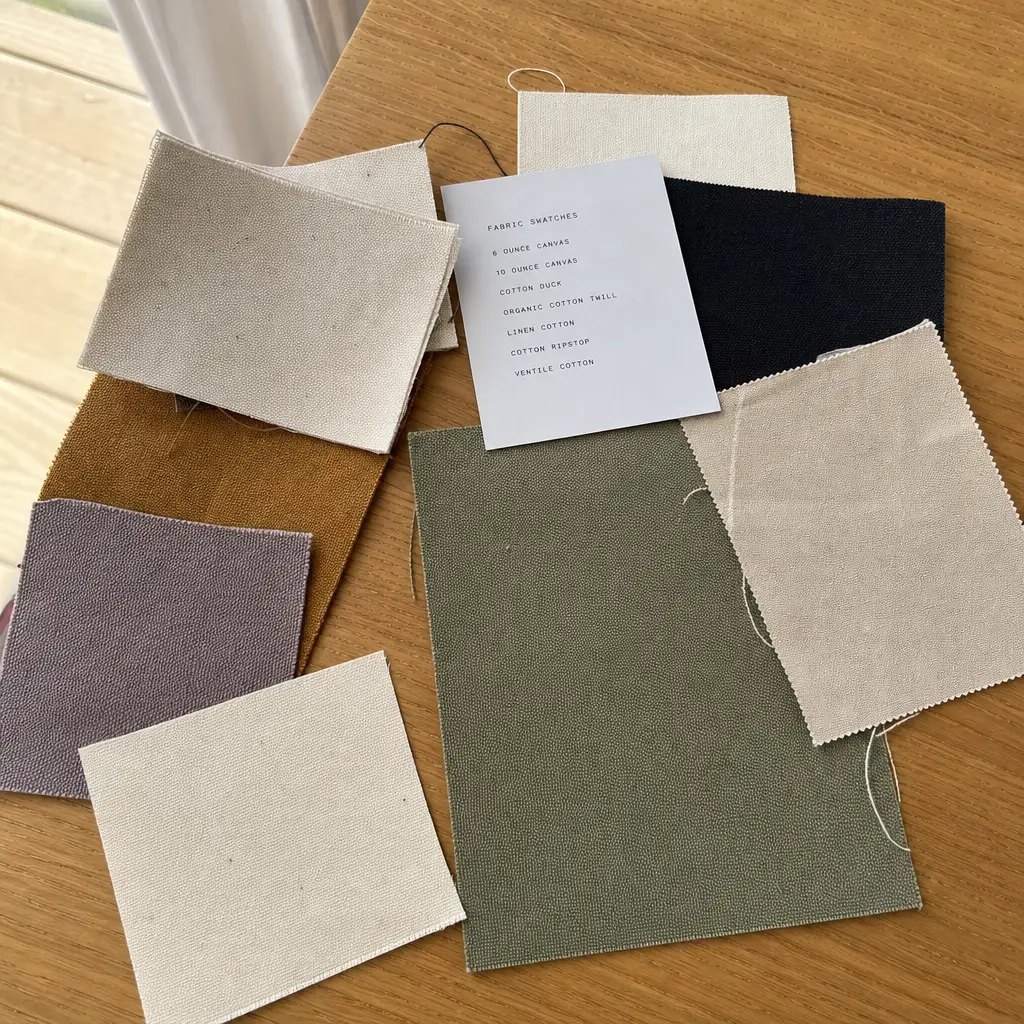
Natural canvas is popular for wine, food, hospitality, and sustainability-themed events because it feels familiar and pairs well with spot-color screen printing. Still, natural cotton is not a sterile white substrate. Shade, flecks, slubs, and weave texture vary by lot. If the brand expects a cleaner premium look, approve a physical swatch and define what level of cotton character is acceptable.
Dyed canvas adds another layer of control. A lab dip or strike-off should be approved before bulk dyeing when brand color matters. Ask whether MOQ changes by color, whether dark colors need colorfastness checks, and whether the print requires a white underbase. If fabric is washed, dyed, or finished before cutting, confirm shrinkage expectations because they can affect finished dimensions.
- Use 10 oz canvas for many one-bottle trade show carriers that need structure while keeping cost and freight controlled.
- Use 12 oz canvas when the bag should stand better, feel more substantial, and support a cleaner brand impression.
- Use 14 oz selectively for premium two-bottle carriers or reusable retail packaging where durability is part of the value.
- Ask for both oz and GSM so quotes from different markets can be compared clearly.
- Approve natural canvas shade and weave character from a physical swatch, not only from a digital photo.
- For dyed canvas, confirm lab dip timing, shade tolerance, colorfastness expectations, and MOQ per color.
Specify Handles, Bottoms, And Dividers
The most important sewing details are often the ones a buyer notices only when they fail. Handle attachment, side seams, bottom corners, and divider anchoring carry the load. An empty sample can look tidy and still twist, pucker, or tear when lifted with a bottle inside. The RFQ should describe how the handle is made, where it attaches, and how stress points are reinforced.
Self-fabric handles can give the carrier a clean matched look, but they need enough width, folding, and reinforcement. Cotton webbing handles are often more consistent and comfortable, especially at 25 mm to 38 mm wide. They also bring choices around color, weave density, softness, and attachment method. Handles sewn into side seams may distribute the load well. Panel-attached handles need a defined box stitch, cross stitch, or bartack with enough distance from the panel edge.
The bottom structure affects both function and display. A flat sleeve may be acceptable for a low-cost bottle cover. A boxed bottom is usually better when carriers are staged upright on a tasting counter, hotel welcome desk, booth shelf, or retail display. Premium two-bottle carriers may need a reinforced base panel, removable board, or padded insert. If a board is included, test that it does not curl, slide, or create visible wrinkles.
Dividers are functional parts. A low or loose divider can let bottles knock together. An off-center divider can make the whole bag lean. A divider that is too stiff can slow packing. Ask the factory to show the divider attachment at the bottom and side seams, then include divider height and centering in inspection.
- Specify handle drop, handle width, handle material, attachment position, and reinforcement stitch.
- Use bartack, cross stitch, or box stitch reinforcement where handles meet the body or side seam.
- For boxed bottoms, inspect corner symmetry so loaded carriers stand evenly on a flat surface.
- For two-bottle carriers, require a divider height and anchoring method that reduces glass contact during carrying.
- Confirm thread color, stitch density expectation, and trimming standard for premium buyer-facing programs.
- State whether the bag must hold shape empty, loaded, or both, because that affects fabric and bottom choices.
Make Logo Approval Practical
Decoration is where many trade show orders lose precision. Screen printing is usually the efficient route for wholesale canvas wine carriers with solid one-color or spot-color logos. The RFQ should include vector artwork, exact print size, location from seams and top edge, Pantone references, logo count, and whether the artwork appears on one side, two sides, a side label, or an insert.
Heat transfer can be useful for full-color artwork, gradients, photographic details, or smaller programs where screen setup is less efficient. It still needs a physical sample on the selected canvas. Transfers can feel more like a surface film, and heavy handling may reveal cracking, edge lift, or rubbing issues. If carriers will be folded, stacked, or handled by many attendees, rub and fold checks are worth doing before bulk production.
Embroidery can look premium, but it is not always a good match for narrow wine bag panels. Dense stitches can pucker the fabric, distort small logos, or make the front panel feel heavy. Woven labels, cotton labels, and small patches often work better for quiet retail-style branding or for programs with multiple distributor names on the same base carrier.
Review artwork at actual size. Fine reversed text, QR codes, sponsor names, legal lines, and thin strokes may not reproduce cleanly on coarse canvas. On dark fabric, a white underbase may be needed for logo accuracy. That can change both cost and hand feel. Large ink areas can also stiffen the panel and may crack if folded sharply during packing.
- Provide vector artwork and lock actual print size rather than letting each supplier scale the logo independently.
- Keep fine text, QR codes, sponsor names, and compliance marks large enough to remain readable on woven canvas texture.
- Avoid placing print across seam transitions unless the factory confirms its fixture can hold the panel flat.
- For dark canvas, confirm whether a white underbase is needed and whether it changes price or lead time.
- Request a rub check after curing, especially for heavy ink coverage and heat transfer decoration.
- For multi-sponsor artwork, approve a real-size printed proof so small names remain legible.
Read MOQ And Price Breaks Carefully
MOQ is shaped by more than a supplier's preference. Fabric buying, dyeing, cutting yield, sewing setup, screen making, label production, logo changes, and packing labor all contribute. A standard natural canvas wine carrier with a one-color screen print usually has a lower MOQ than a dyed canvas style, embroidered logo, custom label, two-bottle divider, or multi-version exhibitor program.
Separate factory minimums from efficient price breaks. A supplier may accept 500 pieces, but the unit price may improve at 1,000, 2,500, 5,000, or 10,000 pieces because setup costs spread across more units. If one order is split among several exhibitor logos, each version may need its own screen, print approval, carton label, and segregation during packing, even when the base bag is identical.
A clean quote separates unit price from fixed and variable charges. Screen charges, sample fees, artwork adjustment, custom labels, insert boards, individual polybags, special carton labels, and third-party inspection should not be hidden in vague notes. That lets procurement evaluate the total program cost instead of chasing a low unit price that excludes necessary work.
Freight belongs in the comparison. Canvas is not as dense as metal or glass, but cartons can become bulky, especially with 12 oz to 14 oz fabric and boxed bottoms. Ask for carton dimensions, gross weight, net weight, pieces per carton, CBM, and shipping terms before award. A small unit-price difference can disappear once carton volume and delivery responsibility are included.
- Request price breaks at realistic quantities such as 500, 1,000, 2,500, 5,000, and 10,000 pieces.
- Ask whether MOQ applies per total order, fabric color, bag size, print version, or label version.
- Separate unit price from screens, samples, labels, insert boards, packing, inspection, and special carton marks.
- For logo splits, confirm added sample approvals, setup charges, carton segregation, and production timing.
- If a supplier offers very low MOQ, ask whether the quote uses stock fabric, simplified sewing, or digital transfer.
- Compare total landed cost using carton CBM, gross weight, freight mode, duty responsibility, and destination fees.
Use Samples As Working Proof
A sample should be approved as a working carrier, not as a flat textile item. Put the intended bottle inside. Lift it by the handles, set it on a flat surface, check whether the front panel twists, and inspect the bottom corners. For two-bottle styles, load two filled bottles and check divider performance while the carrier is actually being held.
Sampling timing is often underestimated. Artwork preparation, fabric sourcing, sample sewing, decoration setup, ink curing, buyer review, courier transit, and revisions can easily take two to three weeks before bulk production starts. Dyed fabric, custom labels, embroidery, and two-bottle construction may add time. The purchase order should identify the approved sample version and state that production follows that sample unless a change is formally approved.
A strong sample review is structured but not complicated. Measure width, height, gusset, bottom, handle drop, handle width, and divider height. Check logo position from the top edge and side seams. Rub the print after curing. Look inside at seam finish, thread trimming, and bottom construction. Photograph the sample flat, loaded, standing, lifted, inside, and packed. Those photos help the supplier, buyer, and inspection team stay aligned.
Not every repeat order needs a full new sample. If the same factory is using the same fabric, pattern, logo method, and packing, a photo approval or fabric swatch may be enough. For a new bottle type, new canvas weight, dyed fabric, new logo method, two-bottle structure, or event-critical order, a physical pre-production sample is the safer gate.
- Approve physical samples for new sizes, new bottle types, dyed canvas, two-bottle styles, custom labels, or premium programs.
- Confirm whether the sample uses production fabric and production decoration or substitute materials.
- Keep one approved sample with the buyer and one sealed reference sample at the factory.
- Record sample revision numbers so bulk production does not follow an outdated prototype.
- Measure the sample flat and loaded, because bottle weight can reveal twisting or base instability.
- Lock artwork, fabric, construction, and packing after approval to protect lead time.
Build A Quote Comparison Worksheet
A useful supplier quote makes assumptions visible. It should list finished dimensions, fabric weight, fabric color, logo method, print size, print colors, handle construction, divider details, bottom construction, MOQ, price breaks, sample cost, production lead time, packing method, carton dimensions, gross weight, CBM, Incoterms, and payment terms. If those fields are blank, the buyer is comparing guesses.
The most common mismatch is fabric weight. One quote may be based on 8 oz natural canvas while another assumes 12 oz, and both may say canvas bag. The second mismatch is decoration. One-color screen print, full-color heat transfer, embroidery, woven labels, and patches have different setup costs, appearance, and durability. The third mismatch is packing. Bulk bundles, individual polybags, kitting by logo, and event-labeled cartons all require different labor and materials.
Finished tolerance should be part of the quotation. Sewn cotton products are not machined parts, so a practical tolerance such as +/-5 mm on simple dimensions may be reasonable depending on the style. More complex boxed bottoms and divider structures may need separate notes. The goal is not the strictest possible standard. The goal is to prevent disputes and protect bottle fit.
Shipping terms should be plain. EXW, FOB, CIF, DDP, and delivered-to-warehouse quotes transfer different responsibilities. For trade shows, the destination may be an advance warehouse with specific labels and receiving dates, not a normal commercial dock. Confirm whether delivery includes appointment booking, domestic trucking, liftgate service, inside delivery, or only arrival at a port or terminal.
- Require each supplier to quote the same finished size, fabric weight, logo size, logo color count, and packing method.
- Ask for finished size tolerance, fabric weight tolerance, and print placement tolerance in the quotation.
- Request carton dimensions, pieces per carton, gross weight, net weight, CBM, and carton count before freight comparison.
- State Incoterms clearly and confirm who pays duties, customs clearance, domestic delivery, and event warehouse fees.
- Keep separate lines for tooling, screens, samples, labels, inserts, inspection, and special packing.
- Treat missing quote fields as open risk, not as minor paperwork.
Plan Packing Around Receiving And Use
Packing affects cost, cleanliness, speed of use, and receiving accuracy. Flat packing is efficient, but over-compressed cartons can leave creases in canvas if bags sit for weeks before the show. Individual polybags protect from dust and handling marks, but they add cost, labor, and waste. For many exhibitor programs, counted inner bundles of 25 or 50 pieces are a practical middle ground.
The pack format should match the work after delivery. If a domestic kitting vendor will insert bottles and collateral, bundles should be easy to count and cartons should not be too heavy for repeated handling. If bags ship to a trade show advance warehouse, carton labels may need event name, exhibitor name, booth number, PO number, SKU, carton count, and warehouse address. If several logos are produced, one logo per carton reduces sorting errors.
Moisture and odor control deserve attention because cotton can absorb warehouse smells and humidity during ocean freight or long storage. Buyers can ask for clean packing surfaces, carton liners, and desiccants when appropriate. Excess packaging is not always necessary, but the supplier should explain how bags will stay clean from sewing line to final carton.
Approve packing before cartons are sealed. Ask for photos of inner bundles, bag folding, carton layout, carton marks, and event labels. This does not replace inspection, but it catches basic mistakes early: wrong carton count, mixed logos, missing booth number, poor label placement, or overstuffed cartons.
- Use counted bundles of 25 or 50 pieces when booth teams or kit packers need fast receiving and counting.
- Avoid cartons that become too heavy for repeated warehouse handling after canvas weight is added.
- Keep one SKU or logo version per carton unless a mixed carton is clearly documented on the packing list.
- Provide event warehouse label templates before bulk packing begins, not after cartons are sealed.
- Ask for carton strength suitable for export handling, stacking, and domestic redistribution.
- Confirm carton dimensions, pieces per carton, gross weight, net weight, CBM, and final carton count before booking freight.
Control QC And Lead Time Backward From The Show
Quality control for canvas wine carriers should match the way the product is used. A front-panel photo is not enough for an item that carries filled glass. Inspection should include measurement, loaded fit, handle load, seam review, divider function, print checks, fabric cleanliness, trimming, packing accuracy, and carton marks. For two-bottle carriers, both bottles should be loaded during the functional check.
The purchase order should define acceptance standards before production. Include finished size tolerance, print placement tolerance, acceptable fabric shade range, stain and odor requirements, loose thread standard, stitch defect rules, carton shortage policy, and logo version segregation. AQL-style sampling can be useful for larger wholesale orders, but even smaller event orders need a checklist tied to the approved sample.
Lead time should be built backward from the move-in date or advance warehouse deadline. Include artwork approval, sample making, sample courier time, revision buffer, fabric preparation, cutting, printing, curing, sewing, trimming, inspection, packing, export transit, customs, domestic delivery, and warehouse receiving. Air freight can rescue some late orders, but bulky canvas cartons can make that rescue expensive.
Lead time risk rises with dyed fabric, multiple logos, special labels, two-bottle dividers, insert boards, individual packing, premium finishing, event-specific carton labels, and factory holiday periods. When the calendar is tight, simplify the specification first: stock natural canvas, one logo, one print location, standard handles, bulk bundles, and standard carton labels.
- Measure width, height, gusset, bottom, divider, opening, handle drop, and handle width against the approved sample.
- Load test handles with filled bottles using a practical static hang or repeated lift check for the final capacity.
- Inspect seam allowance, stitch consistency, bartacks, bottom corners, divider attachment, and thread trimming.
- Check logo color, registration, edge sharpness, rub resistance, curing, and placement from seams.
- Verify carton count, inner bundle count, logo segregation, packing list, SKU marks, and event labels before shipment release.
- Reserve delivery buffer for carton shortages, relabeling, kit assembly, advance warehouse exceptions, or local trucking delays.
Specification comparison for buyers
| Spec decision | Recommended option | When it fits | Buyer risk to check |
|---|---|---|---|
| Canvas weight | 10 oz to 12 oz cotton canvas, roughly 340 to 410 GSM, for most one-bottle carriers; 12 oz to 14 oz, roughly 410 to 475 GSM, for two-bottle or premium styles | Trade show gifting, winery promotions, distributor sample kits, hospitality suites, retail bottle packaging, and exhibitor giveaways where the bag must carry a filled bottle without looking limp | Quotes that only say canvas may hide 6 oz to 8 oz fabric; very heavy canvas can raise freight cost, slow sewing, and create bulky seams on narrow panels |
| Bottle capacity | One 750 ml bottle sized from the actual bottle diameter and height, or two-bottle style with sewn divider, reinforced bottom, and tested opening clearance | Broad booth giveaways, buyer appointment gifts, wine-and-literature kits, bottle-plus-accessory programs, and VIP meeting sets | A carrier approved with a slim Bordeaux bottle may fail with Burgundy, sparkling wine, olive oil, spirits, or unusually heavy glass bottles |
| Finished size tolerance | Set practical finished tolerance such as +/-5 mm for width and height on simple styles, and confirm tolerance separately for gusset, handle drop, and divider height | Orders where bags are sewn in bulk and must still fit a known bottle and pack evenly into cartons | No tolerance on the PO invites arguments; too-tight tolerance may raise cost or rejection risk without improving function |
| Handle construction | Cotton webbing or folded self-fabric handles, 25 mm to 38 mm wide, with box stitch, cross stitch, or bartack reinforcement at stress points | Repeated carrying during show days, pre-packed bottle kits, distributor handling, and programs where visitors carry bottles through a venue or hotel | Short handle drop feels awkward; weak stitch area can tear; narrow handles can dig into the hand under the weight of glass |
| Logo method | Screen print for solid spot-color logos; heat transfer for full-color or small-run artwork; woven label, cotton label, or patch for quiet premium branding; embroidery only after pucker testing | Screen print is usually efficient for 500 to 10,000 pieces with one to three colors on natural or dyed canvas | Fine text may fill in on coarse canvas; dark fabric may need an underbase; embroidery can distort small panels; transfers need rub and fold testing |
| Fabric color | Natural canvas, black, navy, or approved dyed canvas with lab dip and dye-lot tolerance if color matters | Natural works for wine, food, hospitality, and reusable packaging; dark colors hide dirt from event handling and warehouse storage | Natural cotton shade varies by lot; dyed canvas can add MOQ, lead time, and colorfastness requirements |
| Bottom support | Boxed canvas bottom for standard trade show programs; reinforced base panel, removable board, or padded insert for premium two-bottle sets | Needed when carriers are pre-packed, displayed upright, staged on tasting counters, or handed to buyers with bottles already inside | Soft bases can lean; loose boards can shift; oversized inserts wrinkle the bag; undersized bases make the carrier unstable |
| Divider design | Full-height or high partial-height sewn divider, anchored into side seams and/or bottom, tested with two filled bottles | VIP gifts, paired wine sets, distributor samples, bottle-plus-glassware programs, and buyer meeting kits | Low or loose dividers allow glass contact; off-center dividers make the bag tilt; stiff dividers can slow packing |
| Packing method | Flat packed in counted bundles, usually 25 or 50 pieces per bundle, in export cartons with moisture protection, carton marks, and event labels approved before packing | Bulk shipment to trade show advance warehouse, distributor DC, kitting vendor, hospitality agency, sales office, or exhibitor booth storage | Over-compression causes creases; mixed-logo cartons create sorting errors; individual polybags add cost and may conflict with event waste rules |
Buyer checklist before sampling
- Define the bottle before quoting: bottle type, diameter, height, filled weight, shoulder shape, closure, and whether a neck tag, tissue wrap, insert card, or accessory is included.
- State target capacity: one 750 ml bottle, two bottles, one bottle plus accessory pocket, bottle plus literature, or mixed bottle types with a largest-bottle requirement.
- Specify finished dimensions for width, height, gusset or boxed bottom, opening clearance, divider height, handle drop, and handle width instead of relying on a photo.
- Specify canvas weight in oz and GSM, fabric composition, natural or dyed color, acceptable shade variation, shrinkage expectation, and whether fabric is washed or unwashed.
- Provide vector artwork with exact print size, print position from top and side seams, Pantone references, logo quantity, and whether artwork appears on one side, two sides, or a label.
- Confirm decoration method by artwork type: screen print, heat transfer, embroidery, woven label, cotton label, PU patch, leather-look patch, or combination branding.
- Include handle material, handle drop, handle width, attachment method, reinforcement stitch, and minimum load test expectation for the filled carrier.
- Require a real filled-bottle fit test using the widest and heaviest bottle expected in the program, not only an empty-bag photo.
- Set sample approval criteria for dimensions, stitching, print color, print position, handle strength, divider performance, standing shape, packing fold, and carton marks.
- Ask for carton dimensions, pieces per carton, gross weight, net weight, CBM, carton count, and event label requirements before confirming freight.
Factory quote questions to send
- What exact canvas weight in oz and GSM is included in the quote, and is the fabric greige, washed, dyed, or finished after weaving?
- What are the finished dimensions, gusset or boxed bottom size, handle drop, handle width, divider height, and sewing tolerance after production?
- Which bottle did you use for the fit test, including diameter, height, and filled weight, and can you test our physical bottle or matched dummy?
- Are the handles self-fabric or webbing, what width are they, and what reinforcement stitch is used at each stress point?
- For two-bottle carriers, how is the divider anchored, what is its height, and how do you prevent bottles from striking each other when carried?
- Which logo method are you quoting, what is the maximum print area, and what is the minimum printable line width on this canvas?
- For dyed or dark canvas, will the logo require a white underbase, and what color tolerance will you use for fabric and print?
- What MOQ applies by fabric color, bag size, print color count, label type, and logo version, and what changes if the order is split across exhibitors?
- How many samples are included, are they made with production fabric and production decoration, and what is the timing and cost for revisions?
- What sample will be sealed as the approval standard for bulk production, and will your inspection team use the same sample?
Quality-control points to confirm
- Measure finished flat width, height, gusset, boxed bottom, opening, divider height, handle drop, and handle width against the approved sample and PO tolerance.
- Fit test the approved bottle type after bulk sewing, including the widest and heaviest bottle if the program includes mixed bottle styles.
- Load test handles with filled bottles using a practical static hang or repeated lift check appropriate to one-bottle or two-bottle capacity.
- Check seam allowance, stitch density, bartack or box-stitch reinforcement, handle attachment, bottom corner stitching, and divider stitching for skipped stitches and thread breaks.
- Inspect print color, registration, ink coverage, edge sharpness, rubbing resistance, curing, and print placement from seams and top edge.
- Review fabric shade, stains, weaving defects, slubs, odor, shrinkage, surface cleanliness, and shade consistency between panels before packing.
- Verify that fine logo text, QR codes, compliance marks, sponsor names, and small distributor details remain legible at the approved print size.
- Review divider height, divider centering, and bottom structure on two-bottle carriers so loaded bottles do not knock together or tilt when lifted.
- Confirm removable boards or inserts fit the bottom without curling, shifting, causing visible wrinkles, or arriving loose in cartons without instruction.
- Check trimming quality for loose threads, uncut thread tails, lint, chalk marks, oil marks, needle marks, and dirty fold lines before final packing.