Start With The Event Job, Not The Bag Name
Canvas wine carriers for trade show exhibitors are easy to underestimate. They look like small totes, but the load is concentrated, rigid, and breakable. A filled 750 ml bottle often weighs around 1.2 to 1.6 kg depending on glass weight, closure, and bottle shape. That weight pulls on the handle attachment, pushes against the gusset, and tests the bottom seam every time staff lift, fill, sort, or hand out the gift.
Before talking about MOQ, define what the carrier must do at the show. A low-cost booth giveaway may only need a single-bottle natural canvas carrier with one-color screen print and bulk carton packing. A private distributor meeting gift may need a stronger handle, cleaner stitching, heavier canvas, and more controlled presentation. A resale or wine club item may need hangtags, barcodes, country-of-origin labeling, and tighter shade consistency.
The best negotiations separate performance from decoration. Performance covers bottle fit, loaded handle strength, secure seams, readable branding, acceptable odor, correct counts, and delivery before booth setup. Decoration covers dyed canvas, contrast stitching, woven labels, premium bands, special cartons, extra pockets, and multiple logo versions. When those two groups are clear, the supplier can show where MOQ flexibility exists without quietly weakening the bag.
This also keeps internal teams aligned. Marketing may care most about logo placement. Sales may care about fast bottle insertion during appointments. Procurement is watching MOQ and delivered cost. Logistics needs carton dimensions, labels, and delivery dates. A complete RFQ turns those preferences into one product brief instead of a chain of late changes.
- Use a standard single-bottle pattern, stock natural canvas, one print position, and one or two screen colors when MOQ is the main pressure.
- Spend the specification budget on fabric weight, handle reinforcement, divider quality, and packing clarity before adding decorative extras.
- Treat resale labels, barcodes, hangtags, legal text, and carton marks as part of the product, not as a final packing note.
- Decide early whether regional teams can share one universal logo or whether each logo version creates separate setup work.
Set Fabric Specs In Real Numbers
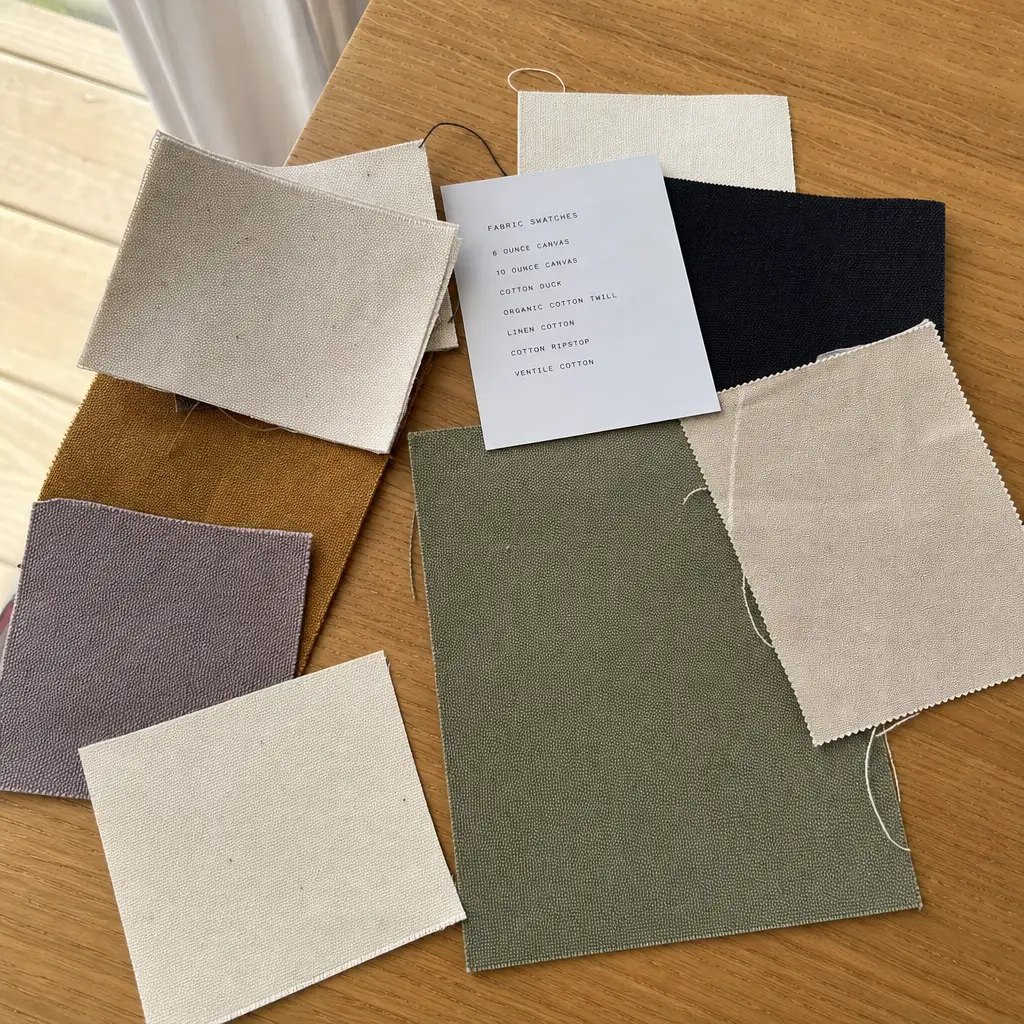
Fabric choice affects structure, print appearance, sewing speed, folding marks, carton weight, and cost. For many custom printed canvas wine carriers, 10 oz to 12 oz cotton canvas, roughly 340 to 410 GSM, is a practical B2B baseline. It usually gives enough body for a filled bottle while staying workable for cutting, printing, sewing, folding, and export packing.
Lighter canvas can still be useful, especially for short-use promotions, but the buyer should accept the tradeoff knowingly. Around 260 to 300 GSM, the bag may wrinkle more, collapse around the bottle, and make a screen-printed logo look less even. If the goal is to reduce MOQ, it is often better to simplify artwork, use standard packing, or accept an existing pattern before dropping the fabric below the level needed for the event impression.
Heavier fabric is not automatically safer. Canvas in the 430 to 480 GSM range can improve structure and shelf presence, but it may also create bulky seams, harder folding, slower sewing, heavier cartons, and more needle wear. For two-bottle carriers, a strong divider and handle attachment may matter more than another ounce of fabric.
Write the tolerance into the quote. Cotton canvas is not a machined material, so exact GSM from every roll is unrealistic. A tolerance such as +/- 5% is common, but the agreed range should appear before order confirmation. Descriptions like premium canvas or heavy cotton are too loose for comparing suppliers.
Dyed canvas adds another MOQ layer. If the color is not already stocked, the fabric mill may require a dye lot minimum, and unused fabric may have little value to the factory. Natural, black, navy, and other stocked shades are usually easier to negotiate than a custom Pantone dyed ground. When quantity is limited, controlling logo color on natural canvas may be more reliable than trying to dye the whole bag.
- Light promotional canvas: about 260-300 GSM for softer, lower-structure event giveaways.
- Balanced event canvas: about 340-410 GSM for most branded wine carriers used by exhibitors, wineries, and distributors.
- Premium retail canvas: about 430-480 GSM when structure and presentation justify heavier sewing and freight.
- Custom dyed canvas: better for larger or repeat programs unless the supplier confirms fabric is already in stock.
- RFQ detail: ask for GSM tolerance, color tolerance, shrinkage expectation, finish, and whether fabric is stock or made to order.
Fit Around The Bottles You Will Actually Use
Bottle fit is where many wine carrier projects go sideways. Drawings often show a generic 750 ml bottle, but Bordeaux, Burgundy, Riesling, Champagne, sparkling, and wide private-label bottles do not share the same diameter, height, shoulder shape, or filled weight. A carrier that fits a slim Bordeaux bottle may strain at the seams with a wider sparkling bottle.
Name the bottle type in the RFQ and include approximate diameter, height, and filled weight. If several wine partners will supply bottles, test against the largest likely bottle. Do not rely on the phrase fits 750 ml. Volume does not describe the bottle profile.
Gusset depth deserves its own line item. A shallow gusset may look clean when flat, then become unstable when loaded. A deeper gusset can make insertion easier and improve standing, but it changes the printable area, carton volume, and sewing time. The top opening matters too. If it is tight, booth staff lose time inserting bottles. If it is too loose, the bottle can lean and make the gift feel unfinished.
For two-bottle wine carriers, the divider is a structural component. It should have a confirmed height, attachment method, and bottom stability. A divider that looks fine in a flat sample photo can fold down once two glass bottles move during normal carrying.
Ask the supplier to document the fit test. The note should state which bottle or dummy load was used, whether the carrier stood upright, whether seams were under visible strain, and whether the divider prevented contact. This small record is useful if bulk production later appears different from the approved sample.
- Single-bottle carriers need enough gusset depth for the bottle to sit upright without stretching the bottom seam.
- Two-bottle carriers need divider height, divider anchoring, bottom stability, and glass-to-glass separation confirmed in the sample.
- Champagne and sparkling bottles need separate confirmation because diameter and filled weight are often higher than still wine bottles.
- For booth filling, avoid tight openings that slow staff during peak traffic.
- Ask the factory to record the bottle used for fit testing, not only the finished flat bag dimensions.
Understand What MOQ Is Paying For
MOQ is rarely just a stubborn number. It usually reflects the point where fabric sourcing, cutting setup, print setup, sewing line changeover, inspection, packing, documentation, and export handling become practical. A small quantity with dyed canvas, several print colors, a new pattern, a two-bottle divider, hangtags, and individual packaging is still a full production setup.
Factories can often flex when the specification fits existing materials and processes. Stock fabric lowers material risk. A standard pattern reduces sampling and cutting work. One-color screen print cuts setup time. Standard export packing avoids extra labor and special carton planning. These choices give the supplier a real reason to accept a lower MOQ or quote a fairer small-run price.
Ask what is driving the minimum. If the fabric mill is the issue, a stock color may solve it. If print setup is the constraint, simplifying artwork may help. If the new divider drives sampling time, an existing two-bottle pattern may be the better compromise. If packing labor is the problem, bulk packing with clear inner labels may be more efficient than individual retail packaging.
Compare MOQs only after normalizing the spec. One supplier may quote 300 pieces based on 10 oz stock canvas, one print color, and bulk packing. Another may quote 500 pieces based on 12 oz canvas, a divider, two-color print, individual bags, and labeled cartons. The lower MOQ may not be the better match.
A useful format is to ask for three numbers using the same specification: target quantity, supplier minimum workable quantity, and next meaningful price break. Then request one lower-MOQ alternate that changes only the least important features. That keeps the discussion factual.
- Stock fabric lowers material MOQ because the supplier can cut from available rolls.
- Standard patterns reduce sampling risk because the cutting and sewing team already understands the construction.
- One-color screen print makes small runs easier to schedule.
- Standard export packing keeps labor predictable and avoids special packing procurement.
- Combining wine carriers with other cotton bags helps only when fabric, color, print process, and production timing truly align.
Use Branding Choices As Negotiation Levers
For canvas wine carriers, screen printing is usually the practical choice for solid logos, winery marks, distributor branding, and event slogans. It gives good coverage on cotton canvas and has a clear cost structure. Each color normally needs its own screen, so a one-color or two-color mark is easier to negotiate than a four-color graphic.
Heat transfer can help when artwork includes fine detail, gradients, or color complexity that will not print well on textured canvas. The tradeoff is hand feel and edge durability. A transfer may look sharp in a flat photo, then feel stiff on the bag or lift at the corners after folding. If heat transfer is chosen, test the sample the way bulk goods will be packed and handled.
Embroidery can work for a small premium mark, but it is not always ideal on narrow bottle bags. Dense embroidery can pucker thinner canvas, add stiffness, and increase cost. Woven labels are useful for retail identity, but they bring label MOQ, color approval, placement tolerance, and extra sewing time.
Confirm print placement on a loaded sample. Once the bottle is inserted, the front panel curves and the lower area may pull toward the gusset. Artwork placed too low can distort around the bottle base. Artwork too close to the side seam can disappear into the curve. Leave enough working margin for seam allowance, gusset expansion, fabric movement, and sewing tolerance.
Ask suppliers to show print setup costs clearly. Screen charges, film, artwork cleanup, color matching, pre-production strike-off, repeat-order screen storage, and extra logo positions should not be hidden inside vague pricing. Clear print costing makes MOQ negotiation cleaner.
- Screen print: best for solid marks, practical MOQ, repeat orders, and simple event branding.
- Heat transfer: useful for fine detail or gradients, but check edge lifting, cracking, hand feel, and gloss difference.
- Embroidery: better for small premium marks than large filled artwork on narrow canvas panels.
- Woven label: good for retail identity, but confirm label MOQ, placement, color approval, and sewing tolerance.
- Print position: keep artwork away from seams, gusset folds, bottom curvature, handle stitch lines, and high-friction packing areas.
Compare Quotes By Delivered Event Cost
A low unit price can become expensive if the quote excludes setup fees, sampling, courier charges, carton volume, inspection support, or realistic freight. For exhibitors, the real number is the cost of having usable wine carriers at the event location on time.
Separate product cost from project cost. Product cost includes fabric, cutting, sewing, printing, handles, dividers, labels, and packing. Project cost includes samples, artwork handling, courier fees, inspection, inland transport, export handling, international freight, duties, destination delivery, event warehouse receiving charges, and possible rush fees.
Ask for several price points under the same specification. The target may be 300 pieces, but the supplier may have a meaningful break at 500 or 600 because fabric spreading, screen setup, or carton packing becomes more efficient. The best quantity is not always the lowest MOQ. A carton-efficient quantity may provide useful spares and a lower effective cost per usable unit.
Use consistent Incoterms. EXW, FOB, CIF, DAP, and DDP allocate freight, risk, duty, and responsibility differently. Comparing an FOB quote to a delivered quote can produce the wrong decision. For fixed-date events, ask exactly what the supplier controls, where responsibility transfers, and which delivery date the quote supports.
Plan spare units instead of hoping for extras. Event programs often need overage for damaged cartons, miscounts, sample retention, VIP additions, showroom sets, or late sales requests. Put the spare quantity into the PO and packing plan.
- Record unit price at target quantity, next price break, and supplier carton-efficient quantity using the same specification.
- Separate screen charges, sample fees, label fees, packing charges, inspection support, and courier costs from unit price.
- Request estimated carton dimensions, carton count, gross weight, and volume before finalizing freight budget.
- Include spare units for event damage, VIP additions, showroom samples, miscounts, and sample retention.
- Use the same Incoterms and delivery point when comparing suppliers.
Approve Samples With Pass Or Fail Criteria
A sample is not approved just because the logo looks good in a photo. For wine carriers, the pre-production sample must prove bottle fit, handle strength, seam quality, print position, print durability, divider function, and packing method. It should use actual fabric weight, actual print process, actual thread color, actual handle construction, actual divider construction if used, and actual packing label when packing is part of the presentation.
Write sample comments as instructions, not impressions. If the logo is 8 mm too low, state the corrected position. If the handle feels short with a filled bottle, revise the handle drop. If the canvas is too soft, change the GSM before bulk cutting. If bottles touch inside a two-bottle carrier, adjust divider height or attachment. Comments like make it more premium can create another round of sampling without solving the problem.
Use a measurement table. Include finished height, width, gusset depth, handle drop, handle width, print size, print position from top edge, and print position from side seams. For two-bottle designs, add divider height and attachment points. Tolerance should be realistic for sewn cotton goods. Too tight creates avoidable inspection failures; too loose leaves room for dispute.
Do the simple physical checks. Load the sample with the nominated bottle, carry it repeatedly, place it upright, insert and remove the bottle several times, rub the print after curing, and fold the printed panel as it will be packed. These checks catch practical failures before bulk production.
For larger or higher-risk orders, the approved sample should become the reference for final inspection. Shade, hand feel, print position, stitching, and packing should all be judged against the same approved standard.
- Load the sample with the actual bottle type or equivalent weight for repeated carry cycles.
- Measure finished width, height, gusset, handle drop, handle width, divider height, and print position against agreed tolerance.
- Rub the printed area with a dry white cloth after curing to check obvious ink transfer.
- Fold and unfold the printed panel to check cracking, transfer lifting, heavy ink stiffness, or edge peeling.
- Photograph approved sample details and attach them to the purchase order or production file.
Define QC Before Goods Are Sewn
Quality control should focus on carrying performance, appearance, and event readiness. The most serious defects are not always the most visible. A small print speck may be acceptable on a promotional item. A weak handle attachment is much more serious because the carrier holds glass.
Define critical, major, and minor defects before production. Critical defects may include unsafe handle failure, open bottom seams, sharp contaminants, mildew odor, wet goods, or construction that cannot hold the nominated bottle. Major defects may include wrong fabric weight outside tolerance, wrong logo color, severe print misregistration, visible stains, size problems affecting fit, broken stitches at stress points, weak dividers, or wrong packing count. Minor defects may include small thread tails, slight fabric slubs within the approved standard, or small print specks that do not affect brand readability.
AQL sampling can be used, but it needs product-specific checks. Many importers use ANSI/ASQ Z1.4 or similar sampling plans for final inspection. The important part is defining what the inspector will check: dimensions, bottle fit, stitching, handle pull, print quality, packing count, carton marks, odor, shade consistency, and barcode or label accuracy when relevant.
Handle testing should be simple and repeatable. Ask the supplier to load the carrier with the nominated bottle weight or a specified test weight, lift and hold it for a defined time, and perform repeated carry or gentle lift cycles. Strong handle is not a test method. The result should be recorded with photos or inspection notes.
Print QC should include position, color, opacity, curing, rub resistance, and edge behavior. Screen prints should not smear, transfer, crack heavily after normal folding, or show unacceptable pinholes in key logo areas. Heat transfers should not lift, bubble, or crack at corners after bending. The approved sample should define what is acceptable on textured cotton.
- Define critical defects around safety, glass-carrying failure, mildew, wet goods, and wrong construction.
- Define major defects around bottle fit, handle strength, wrong fabric, wrong logo, severe print defects, and wrong packing.
- Use the approved sample as the inspection reference for shade, hand feel, print position, stitch method, and packing.
- Record handle pull or loaded carry method in the PO so the factory and inspector use the same standard.
- Check carton labels and counts during inspection, not after goods reach the event warehouse.
Control Packing For Event Distribution
Packing has to be decided early because these carriers often ship directly to event logistics centers, distributor warehouses, hotel receiving docks, or booth kit assembly points. If mixed logos, regions, colors, or sizes are packed without clear inner labels, setup staff lose time sorting. If printed panels are compressed before ink is fully cured, bags may arrive with creases or ink transfer.
Flat packing in counted inner bundles, recycled polybags, paper bands, or individual polybags can all work. Paper bands may create a more natural presentation, but they must hold the folded carrier securely and avoid rubbing the print. Individual polybags protect against moisture and handling marks, but they add material, labor, and sometimes sustainability concerns. Retail programs may need hangtags, barcodes, carton-level SKU labels, shelf-ready counts, or retailer-specific marks.
Carton quantity should balance freight efficiency with usability. Very heavy cartons are difficult for event staff. Oversized cartons may crush lower layers or crease printed panels. Mixed-SKU cartons may reduce carton count but increase sorting mistakes. If an event contractor receives the shipment, carton marks should be clear to people who have never seen the purchase order.
Ask for packing photos before shipment. The photos should show inner packing, carton labels, carton number sequence, event codes, and any separated spare units. For high-stakes orders, inspection should include carton condition, carton count, label accuracy, and confirmation that spares are packed as instructed.
If the event messaging mentions sustainability, packaging should support that claim without overreach. Recycled polybags, paper bands, and bulk packing may reduce packaging material, but documentation and material availability should be confirmed before making public claims.
- Avoid overpacking cartons when heavy canvas and fresh screen print are involved.
- Keep print faces protected from direct rubbing against hardware, tags, rough carton interiors, or dark fabric panels.
- Use inner labels when the shipment includes different logos, colors, regions, booth teams, or sales kits.
- Request carton photos before shipment, especially when goods ship directly to an event contractor.
- Confirm whether spare units are packed in a separate carton or distributed across cartons.
Build Lead Time Backward From The Show Date
Trade show orders often fail because approvals are late, not because sewing is unusually slow. Start with the booth setup date and work backward through local delivery, event warehouse receiving, customs clearance, international freight, export handover, final inspection, packing, bulk sewing, printing, material preparation, sample approval, and artwork proofing.
MOQ and lead time are connected. A very low quantity may wait for a suitable production slot. Custom dyed fabric may wait for mill production. A complex print may need artwork separation, screen making, color approval, strike-off review, and curing time. Retail packing may require labels, bands, inserts, or barcodes that are not stocked. Negotiate MOQ and timing in the same conversation.
Build buyer decision deadlines into the schedule. Artwork approval, sample review, PO release, deposit payment, carton mark approval, inspection booking, and freight booking all require buyer-side action. If legal, brand, wine partner, or event contractor approval is needed, add those days visibly.
For immovable show dates, define rescue options before the order is late. Possible choices include splitting shipment, sending VIP quantities by air, using stock fabric instead of dyed fabric, reducing print colors, choosing a standard pattern, or accepting standard packing. These decisions are easier during sourcing than during a freight emergency.
The PO should include the latest acceptable arrival date and the intended event date. The supplier may not control every downstream logistics step, but they need to understand why a delay of a few days matters. For event programs, scheduling is part of quality control.
- Artwork proofing: allow time for logo cleanup, Pantone confirmation, and printable area approval.
- Sampling: include sample-making days, courier transit, buyer review, and correction time.
- Bulk production: starts after written sample approval and payment or credit terms are confirmed.
- Inspection: book before final carton sealing when possible so rework is still practical.
- Freight: keep an air freight fallback budget if the show date cannot move.
Specification comparison for buyers
| Spec decision | Recommended B2B baseline | When it fits | Buyer risk to check |
|---|---|---|---|
| Fabric weight | 10 oz to 12 oz cotton canvas, approx. 340-410 GSM, with fabric weight tolerance stated in the quote, commonly +/- 5% unless otherwise agreed | Most trade show wine gifts, winery promotions, distributor handouts, appointment gifts, and sales kits where the carrier must hold shape better than light cotton | Below about 280 GSM the bag may collapse around the bottle and make print appear wavy; above about 450 GSM can increase sewing difficulty, carton weight, folding marks, and needle-break risk |
| Bottle capacity | Single-bottle carrier for simpler MOQ and faster production; two-bottle carrier only when gift value supports extra fabric, divider work, and fit testing | Single-bottle bags fit booth giveaways and lead follow-up gifts; two-bottle bags fit VIP appointments, wine clubs, retailer packs, and distributor meetings | Two-bottle designs require divider height, divider anchoring, bottom stability, bottle diameter confirmation, and loaded carry testing; weak dividers can tear or allow glass-to-glass impact |
| Handle construction | Self-fabric handles with box-X stitching for a retail look, or 25-38 mm cotton webbing handles sewn into reinforced seams for heavier loads | Self-fabric works for cleaner presentation; webbing suits repeated carrying, heavier bottles, and busy booth distribution | Handle drop, seam allowance, stitch density, reinforcement patch, and bartack or box-stitch method must be sampled with a filled bottle, not approved from flat artwork |
| Printing method | Screen print for one to three solid colors; heat transfer only for fine detail, gradients, or very low-volume artwork that cannot be simplified | Screen print is usually the best trade show balance of cost, durability, MOQ flexibility, and repeat-order consistency | Dense ink on coarse canvas can crack or feel heavy if ink deposit and curing are wrong; request dry rub, fold, adhesion, and registration checks |
| MOQ negotiation lever | Use stock natural canvas, a standard pattern, one logo position, and standard export packing before negotiating print colors, pockets, dyed fabric, or premium packaging | Best for exhibitors who need an event quantity but still require custom branding and presentable quality | Pushing MOQ down while also changing fabric color, size, print method, divider, and packing usually moves cost into setup fees, sample delays, higher unit price, or weaker construction |
| Branding placement | Front center print within a confirmed printable area, usually leaving at least 20-25 mm from seams, folds, and gusset transitions; optional woven side label or hangtag for repeat programs | Front print works for event visibility and booth photos; labels and hangtags support retail or wine club identity | Artwork too close to seams, bottom folds, handle stitching, or bottle curvature can distort once the bottle is inserted |
| Packing method | Flat packed in counted inner bundles, recycled polybags, paper bands, or individual polybags, then export cartons with carton marks and SKU/event labels | Works for booth kits, distributor warehouses, event freight consolidation, and field sales allocations | Over-tight cartons can crease printed areas; mixed SKUs need inner labels or setup teams may lose time sorting on site |
| Lead time buffer | Approve the pre-production sample at least 30-45 days before booth setup when sea freight is involved, and earlier for dyed fabric, two-bottle dividers, retail packing, or inspection rework | Useful for importers and brands coordinating event kits, catalogues, wine samples, displays, and printed collateral | Artwork revisions, fabric stock changes, carton mark edits, inspection booking, export documents, and freight handover can each consume several working days before shipment |
Buyer checklist before sampling
- Define the job first: free booth giveaway, hosted tasting, distributor meeting, VIP gift, staff tool, resale item, wine club insert, or post-show lead follow-up.
- State the exact bottle format and filled weight, including 750 ml Bordeaux, Burgundy, Riesling, Champagne, sparkling, magnum, or unusually wide private-label bottles.
- Specify fabric composition, weave if known, weight in oz and GSM, color, finish, stock status, and acceptable tolerance instead of using only the word canvas.
- Confirm finished height, width, gusset depth, handle drop, handle width, divider height, seam reinforcement, printable area, and measurement tolerance in the RFQ.
- Ask suppliers to quote the target quantity, minimum workable quantity, next price break, and carton-efficient quantity under the same material, print, and packing assumptions.
- Separate non-negotiable performance requirements from optional upgrades such as dyed fabric, contrast stitching, woven labels, hangtags, pockets, paper bands, and retail cartons.
- Request a pre-production sample using actual fabric, actual print, actual handle stitching, actual divider construction if used, and actual packing label before bulk cutting.
- Set pass/fail checks for bottle fit, loaded handle pull, seam slippage, print rubbing, divider strength, carton compression, odor, shade consistency, and label accuracy.
- Compare quotes by total delivered project cost, not only unit price, because setup fees, samples, courier charges, carton volume, inspection, duties, and rush freight can change the event budget.
- Reserve schedule buffer for artwork proofing, sample approval, ink curing, cutting, sewing, inspection, carton marking, export documents, customs clearance, and final delivery to the event location.
Factory quote questions to send
- What is your MOQ for this canvas wine carrier using stock natural canvas, and what changes if we require dyed canvas, organic cotton canvas, recycled cotton blend, black canvas, or heavier fabric?
- Which fabric weight do you recommend for our nominated filled bottle, and can you provide GSM tolerance, shrinkage expectation, finish, and whether the fabric is pre-shrunk, sanforized, or untreated?
- Is the quoted size based on your existing single-bottle or two-bottle pattern, and what bottle diameter, height, shoulder shape, and filled weight were used for the fit test?
- What are the finished dimensions, gusset depth, handle drop, handle width, seam allowance, stitch density, and measurement tolerance included in your quote?
- What is the maximum printable area after allowing for seam allowance, gusset expansion, bottom fold, handle attachment, bottle curvature, and expected sewing tolerance?
- Which print method is included in the quote, how many colors are included, and what setup, screen, film, artwork separation, Pantone matching, or repeat-order charges apply?
- Can the pre-production sample use the same fabric lot, ink system, curing method, handle construction, divider method, thread color, and packing method as bulk production?
- What handle pull test or loaded carry test can you perform, what test weight will be used, how long or how many cycles will be checked, and what result will be recorded in the inspection report?
- How many units are packed per inner bundle and export carton, what are the estimated carton dimensions and gross weight, and can cartons be marked by event, booth kit, sales region, SKU, or recipient list?
- What is the production lead time after written sample approval, and which steps will change if artwork, fabric color, divider construction, packing, or carton marks are revised?
Quality-control points to confirm
- Fabric weight should match the approved range, with no obvious thin panels, oil marks, yarn contamination, uneven dye lot, mildew odor, dampness, panel-to-panel shade difference, or heavy slubs outside the approved sample standard.
- Finished size should stay within agreed tolerance, commonly around +/- 0.5 cm for small panels and +/- 1 cm for overall height or width on sewn cotton goods, unless the supplier states another workable tolerance before order confirmation.
- The carrier must fit the nominated bottle type without forcing seams, distorting print, making the bottle lean excessively, exposing unstable bottom corners, or making the loaded bag tip when placed upright.
- Handle attachment should survive the agreed loaded pull or carry test with no skipped stitches, broken thread, seam opening, fabric tearing, reinforcement failure, or visible stress whitening around stitch points.
- Stitching should be even at stress areas, with secure back-tacking, bartacking, or box-X stitching at handles, clean thread trimming, and no open seams at gusset corners, bottom folds, or divider attachment points.
- Print position should follow the approved sample and remain away from seam distortion, bottom folds, bottle curvature, handle stitch lines, and high-friction packing edges.
- Screen print should pass a dry rub check and reasonable fold handling after curing; heat transfer should show no lifting, bubbling, gloss inconsistency, cracked corners, or adhesive bleed after bending.
- Print color should be checked against approved Pantone target, lab dip, or signed sample under consistent light, with realistic tolerance for printing on natural cotton texture.
- Divider panels on two-bottle carriers should reach the agreed height, remain secured after repeated bottle loading, and prevent glass-to-glass contact during normal carrying.
- Packing should protect the print face from heavy creasing, ink transfer, moisture, odor, abrasion, and mixed SKU confusion during event distribution.