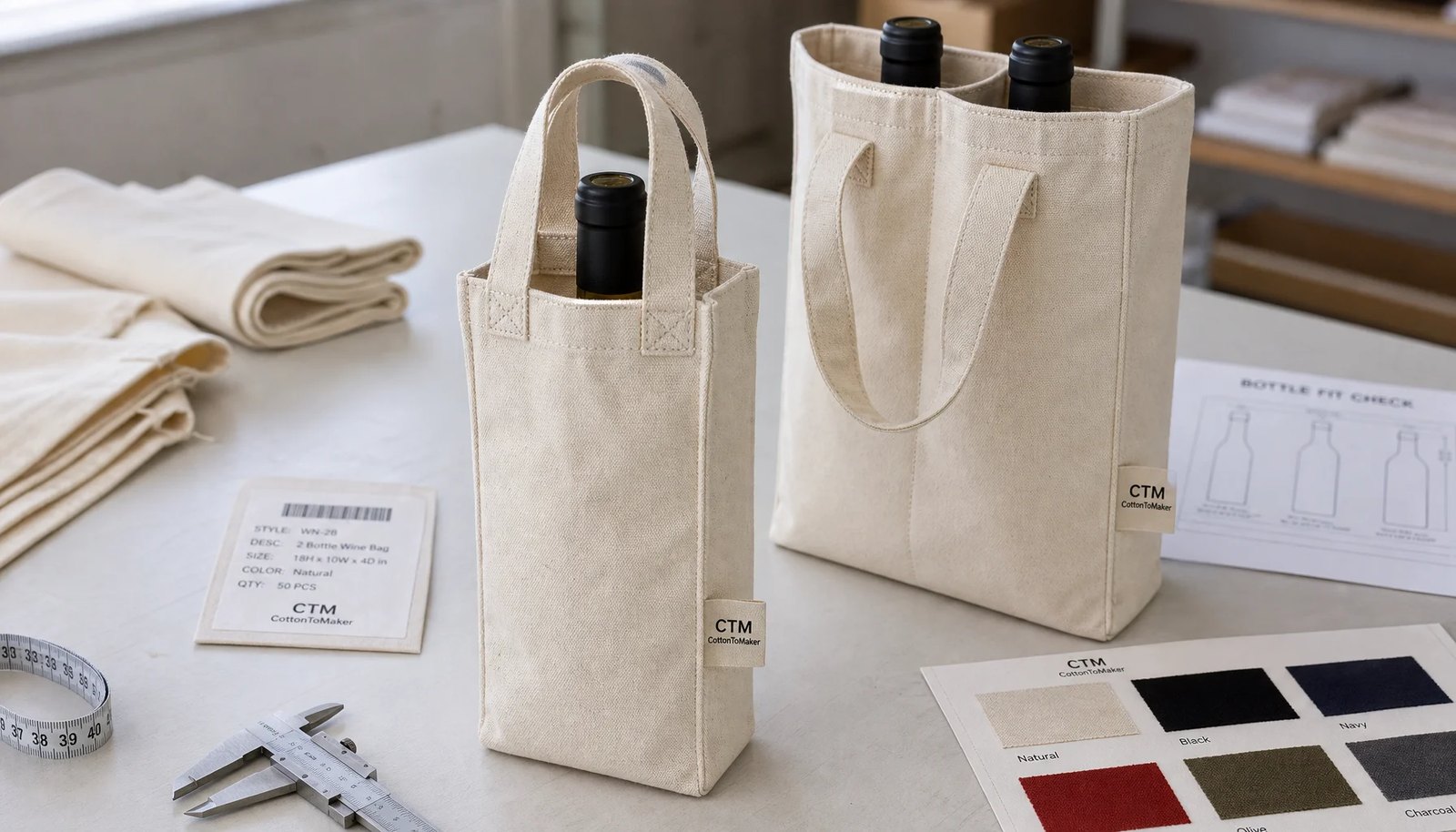
Start With the Event Calendar, Not the Bag Photo
For trade show exhibitors, canvas wine carriers are tied to a date that will not move. That makes lead time planning more important than the product photo. The bags need to be usable before the booth opens, before the hospitality suite is stocked, and before distributor kits are assembled. Production completion at the factory is only one point in the schedule. The order still has to pass artwork approval, sampling, fabric preparation, printing, sewing, trimming, inspection, packing, export handling, freight, customs clearance, inland delivery, receiving, sorting, and sometimes show-site drayage.
Build the schedule around four separate dates: show opening date, booth setup date, required in-hand date, and supplier handover date. The show opening date is when visitors arrive. Booth setup is when your team or contractor needs materials ready to place, sort, or kit. Required in-hand date is the real internal deadline for warehouse checks, relabeling, bottle packing, sales allocation, or onward shipment. Supplier handover is the date the finished goods must be ready for inspection and pickup. If these dates are blended together, the quote may look workable while the execution plan is already too tight.
Receiving rules deserve early attention. Convention centers, hotels, advance warehouses, and general service contractors may set narrow delivery windows and specific carton label formats. Some locations reject unmarked freight or add handling charges when labels are missing. If the wine carriers will be packed with bottles, tasting cards, printed inserts, or VIP notes after arrival, the kitting labor also needs calendar space. A practical canvas wine carriers for trade show exhibitors lead time planning guide starts with the first day the goods must be handled, not the public event date.
- Put the show opening date, booth setup date, required in-hand date, receiving address, and receiving window in the RFQ header.
- Confirm whether goods ship to your warehouse, 3PL, distributor, hotel, convention center, booth contractor, or multiple destinations.
- Ask the factory to separate proofing, sampling, material preparation, production, inspection, packing, and freight timing.
- Add buffer around Chinese New Year, Golden Week, year-end congestion, port congestion, and peak exhibition seasons.
- For urgent orders, simplify specifications early instead of relying only on premium freight at the end.
Define Bottle Fit Before Construction
A canvas wine carrier is not a small tote with a logo. It is a sewn package for a heavy glass object with a specific shape. Bottle dimensions affect almost every construction choice: panel width, gusset depth, base shape, divider height, handle drop, handle reinforcement, and carton count. A standard 750 ml Bordeaux bottle is often straighter and slimmer than many Burgundy bottles. Champagne and sparkling wine bottles may be wider and heavier. Riesling bottles can be taller. If the event includes mixed bottles, quote against the largest realistic bottle and the highest loaded weight.
Send the actual bottle when possible. If that is not practical, send a measurement set that includes maximum bottle height, maximum body diameter, base diameter, shoulder shape, and filled weight. Include the event materials too. Tissue paper, cards, brochures, corkscrews, bottle tags, neckers, and small inserts can change the fit enough to matter. A sample that fits the bottle alone may become tight, lumpy, or hard to pack once the show materials are added.
Single-bottle carriers work well for tasting samples, hotel drops, welcome gifts, and lower-cost handouts. Two-bottle carriers are better for buyer appointments, distributor meetings, sponsor gifts, and VIP kits. The second style needs more scrutiny because the divider must do a real job. Specify divider height, material, base attachment, and side seam anchoring. A divider that looks tidy in a flat sample may still let two bottles hit each other when someone walks from the booth to a meeting room.
- Measure maximum bottle diameter, total height, base diameter, shoulder profile, and filled weight before confirming the bag size.
- For mixed bottle programs, approve the carrier with the largest and heaviest expected bottle combination.
- Specify whether the carrier must stand upright when loaded or only serve as a hand-carry presentation bag.
- Check handle drop with a loaded sample so the bottle neck sits correctly and the carrier clears the floor.
- For two-bottle styles, require an inside photo showing divider attachment at the base and side seams.
Specify Dimensions and Tolerances in Millimeters
Many sourcing problems begin with a style name that sounds clear but is not measurable. One supplier may quote a narrow two-bottle carrier sized around Bordeaux bottles. Another may quote a wider version that can handle champagne. Both may call the item a canvas wine carrier. Procurement needs the numbers: finished width, height, gusset depth, base width, handle drop, handle width, divider height, seam allowance, and tolerance. The approved sample is important, but the purchase order still needs written dimensions.
For standard sewn canvas carriers, plus or minus 5 mm is often a reasonable starting point for width and height. It should not be applied without thought. If the bottle diameter nearly fills the gusset, a few millimeters can decide whether the carrier loads easily or fights the packer. If a divider sits between two bottles with little spare room, small shifts can affect protection. Handle drop is also practical, not decorative. Too short feels awkward; too long can make the carrier swing heavily or drag against displays, cartons, and other hand-carried items.
Print placement needs its own tolerance because fabric is flexible and sewn edges are not perfectly rigid. Measure from fixed seams, panel center lines, fold lines, or approved reference marks. Avoid judging placement only by eye from a loose fabric edge. For branded exhibitor programs, define the logo size, distance from the top edge or bottom seam, horizontal centering point, and whether the print must remain visually flat when a bottle is inserted.
- List width, height, gusset, base width, handle drop, handle width, divider height, and seam allowance in the quote sheet.
- Use millimeters for production tolerances so buyer, factory, and inspector work from the same standard.
- Confirm whether tolerances apply to unloaded flat measurement or loaded bottle-fit condition.
- Measure print placement from fixed seams or panel reference points rather than from a loose fabric edge.
- Include tolerance rules in the pre-production sample approval record and final inspection checklist.
Choose Canvas Weight by Use, Cost, and Freight
Canvas weight changes more than handfeel. It affects structure, print result, cutting, sewing speed, carton density, and landed cost. For many trade show exhibitor orders, 10 oz to 12 oz cotton canvas, roughly 340 to 400 GSM, is a practical range. It has enough body for a branded gift, supports straightforward screen printing, and remains manageable for folding, carton packing, and freight. It is usually a sensible first specification when the carrier should feel useful without becoming a premium luggage-style product.
Lighter canvas around 8 oz can work for budget single-bottle giveaways or presentation sleeves. It may wrinkle more, collapse around the bottle, and feel less substantial in a buyer meeting. Heavy canvas around 14 oz to 16 oz can feel stronger, but it brings tradeoffs: bulky seams, slower sewing, more needle pressure, possible distortion around dense logos, higher carton gross weight, and higher air freight or handling cost. A heavier fabric is not automatically better for a fixed-date event if it makes production and shipping harder.
Color and finishing also need room in the plan. Natural unbleached canvas is not bright white, and shade can vary by lot. Bleached canvas gives a cleaner base for some logos but can have a different handfeel. Dyed canvas supports brand color programs, yet it adds color matching, dye-lot approval, rubbing checks, and sometimes shrinkage concerns. Washed canvas can look softer but may increase dimensional variation. Recycled cotton blends or organic cotton can support brand requirements, but buyers should confirm certification scope and documentation before presenting the item internally as a certified sustainable product.
- 8 oz canvas: economical for simple giveaways, with less structure and lower premium feel.
- 10-12 oz canvas: balanced for most exhibitor gifts, winery promotions, and distributor handouts.
- 14-16 oz canvas: stronger handfeel but higher material, sewing, packing, and freight implications.
- Natural canvas: schedule-friendly, but shade range must be approved because it is not pure white.
- Dyed canvas: useful for brand color, but needs lead time for color approval and rubbing checks.
Match Decoration to Artwork and Approval Risk
Screen printing is usually the most practical decoration method for canvas wine carriers when the artwork is a bold logo, event mark, short message, or one-to-three-color design. It keeps cost predictable and works well on flat panels before sewing or on accessible finished panels, depending on construction. Still, the buyer should approve a print sample. Canvas texture, absorbency, and base color can change ink opacity, edge sharpness, and Pantone appearance.
Transfer printing may be the better route for gradients, many colors, small details, or photographic artwork. It can solve color-count problems, but the printed area may feel different from the surrounding canvas. Ask about edge adhesion, cracking, rubbing, and abrasion expectations if the carrier is meant to be reused. Embroidery can look premium on heavier canvas for small marks, though dense embroidery can distort lighter panels and slow production. Woven labels and sewn patches give a quieter brand treatment but add label MOQ, label lead time, and placement checks.
Artwork delays are common because several teams may need to approve the same logo. Marketing checks the mark, legal checks usage, the event team checks dates, and sales may ask for a sponsor version. Collect final vector artwork, Pantone references, logo dimensions, placement instructions, and approval authority before asking for a firm delivery date. If the art includes thin lines, small type, or a QR code, test it on the selected canvas. A smooth digital proof cannot show what a coarse weave will do to legibility.
- Use screen print for bold logos, solid fills, short text, and controlled color count.
- Use transfer printing for high color count or gradients, but test handfeel, edges, and cracking risk.
- Use embroidery for small premium marks on suitable fabric weights, not large dense designs on thin canvas.
- Use woven labels or sewn patches when subtle branding is preferred, and include label lead time in the schedule.
- Avoid approving QR codes, thin lines, or small text on coarse canvas without an actual print test.
Map MOQ to the Real Production Route
MOQ is not only a sewing-line number. It is shaped by fabric sourcing, dye lot size, cutting efficiency, print setup, label production, carton packing, and post-production sorting. A stock natural canvas single-bottle carrier with a one-color print can usually support a lower MOQ than a custom dyed two-bottle carrier with private labels, separate regional packs, barcode stickers, and carton-level allocation.
When buyers ask for a lower MOQ, the supplier may need to change the production route. That can mean stock fabric instead of custom dyed fabric, a simplified divider, fewer print colors, no woven label, a different packing method, or setup charges outside the unit price. These changes may be acceptable. They just need to be visible. A clean quote states what is included at the requested quantity and what changes if the order drops below the normal threshold.
Quantity should also reflect event uncertainty. If the exhibitor needs exactly 1,000 pieces at the show, ordering exactly 1,000 leaves no room for inspection pulls, retained samples, carton damage, replacement needs, late VIP additions, sales-team requests, or regional allocation changes. A modest overage is often cheaper than a rush reorder after screens are removed or after the show window becomes too tight to recover.
- Ask what MOQ applies separately to fabric, dyeing, print setup, labels, and packing style.
- Clarify what changes below MOQ: surcharge, stock material, fewer print colors, simplified packing, or longer lead time.
- For multiple logos, confirm separate screen charges, artwork approval, carton separation, and QC checks for each version.
- Include overage for inspection samples, replacements, internal teams, and last-minute event demand.
- Compare setup, sample, courier, and packing charges separately from unit price.
Use Samples as Production Controls
A sample should prove more than appearance. It should confirm bottle fit, loaded balance, handle comfort, divider performance, logo placement, fabric shade, print method, stitch quality, and packing assumptions. For a fixed trade show date, the approved sample becomes the control point that keeps the order from drifting once bulk production starts. A good-looking sample is not enough if it was never measured, loaded, photographed, and compared with the RFQ.
Start with a digital proof showing dimensions, print size, print location, Pantone references, handle position, and divider layout. For standard natural canvas and simple one-color printing, one physical pre-production sample may be enough if the construction is low risk. For dyed canvas, a new size, two-bottle divider changes, transfer printing, embroidery, premium gifting, or strict brand color, allow time for one correction round. Sampling feels slow when the calendar is tight, but it is the least expensive moment to find a problem.
Turn sample approval into inspection evidence. Keep one approved sample with the buyer and one with the factory when possible. Photograph the sample with a ruler showing finished width, height, gusset, handle drop, divider height, logo placement, and bartack location. Test it with the actual bottle or bottle set, including tissue, inserts, and printed materials. Later, when final inspection happens under pressure, these records prevent arguments about what was approved.
- Approve the sample with the actual bottle, not a similar bottle from the sample room.
- Photograph ruler measurements for finished dimensions, handle drop, divider height, and print placement.
- Check loaded comfort, bottle neck height, divider function, and whether the carrier twists when lifted.
- Review fabric shade and print color under neutral light, not only warm office lighting.
- Keep approved samples available for inline and final inspection comparison.
- Do not release bulk cutting for new constructions until the physical sample is approved or the risk is consciously accepted in writing.
Build a Lead Time Map With Decision Gates
A useful lead time plan separates factory work from buyer decision time. Artwork proofing may take one to three working days when files are clean, but it can stretch when logos are low resolution, Pantone colors are missing, or approvals must pass through marketing, legal, sales, and events teams. Sample production may take about a week for standard materials, plus courier time and buyer review. Dyed fabric, woven labels, embroidery, transfer tests, or divider revisions add more steps before bulk production can safely begin.
Bulk production follows a sequence: material preparation, fabric inspection, cutting, printing, curing, sewing, trimming, pressing or shaping if used, final inspection, packing, carton marking, export paperwork, and handover. Not every step can be compressed. Prints may need curing or setting time. Sewing time depends on line capacity and construction complexity. Inspection requires finished goods to measure and test. Packing cannot be closed until carton marks and packing rules are approved.
For many custom printed canvas wine carrier orders moving by ocean freight, planning 45 to 60 days before the required delivery date is a realistic starting frame. It is not a guarantee. Destination, quantity, specification, season, inspection plan, and freight mode all matter. Air freight can reduce transit time, but it does not remove proofing, sample approval, print curing, QC, customs, or receiving. If the schedule is shorter than ideal, reduce variables early: stock fabric, standard size, one-color print, no custom label, flat packing, and one destination.
- Proofing gate: vector artwork, Pantone colors, print size, placement, and internal brand approval.
- Sample gate: physical fit, construction, decoration, fabric shade, and packaging assumption approved.
- Production gate: material available, cutting approved, printing method locked, and line schedule confirmed.
- Inspection gate: dimensional checks, loaded test, print checks, stitch checks, carton count, and packing list verified.
- Logistics gate: freight booking, Incoterm, carton data, customs documents, delivery appointment, and receiving labels confirmed.
Pack for Freight, Warehouses, and Show-Site Handling
Packing is both a cost decision and an execution control. Canvas wine carriers are often flat-packed to reduce volume, but too much compression can crease panels, mark printed areas, or distort the shape. If printed panels touch before curing is complete, scuffing or ink transfer can occur. Individual polybags, tissue sheets, or paper bands may protect premium programs, but they add labor, material, carton volume, and sometimes sustainability concerns. Approve the packing method before mass packing begins.
Carton data should be known before freight decisions are made. Pieces per carton, carton dimensions, gross weight, net weight, and total CBM affect ocean freight, air chargeable weight, warehouse handling, and show-site receiving. Two quotes with similar unit prices may have different landed costs if one uses heavier export cartons, looser packing, or inefficient carton sizes. For air shipments, dimensional weight may matter more than actual weight.
Trade show receiving depends on clear labels. Cartons should show PO number, item name, SKU or item code, quantity, destination, carton sequence, and any required event label. For split shipments by sales region, distributor, logo, booth location, or kitting destination, request a carton-level packing list. The list should match the physical labels so a receiving team can identify contents quickly without opening every carton under deadline pressure.
- Confirm pieces per carton, carton dimensions, gross weight, net weight, and total CBM before freight booking.
- Decide whether to use individual polybags, master bags, tissue, paper bands, or plastic-free bulk packing.
- Use export cartons strong enough for warehouse handling, contractor movement, and possible re-forwarding.
- Approve carton marks with PO number, item name, SKU, quantity, destination, and carton sequence.
- For split shipments, require carton-level packing lists that match physical labels.
- Do not authorize final packing until print curing and rub checks are complete.
Compare Quotes by Landed Cost and Execution Risk
A low unit price can hide weak assumptions. One supplier may quote 12 oz canvas, reinforced bartacks, a functional divider, one-color screen print, approved carton marks, and export packing. Another may quote lighter fabric, simple topstitching, vague divider details, no visible screen charge, no carton data, and an optimistic production date. The unit prices may look close, while the delivered cost and event risk are not close at all.
Normalize each quote in a comparison sheet. Include fabric weight and content, finished dimensions, gusset, handle construction, divider construction, print method, number of colors, print area, sample cost, screen or setup charges, label costs, packing method, pieces per carton, carton dimensions, gross weight, total CBM, Incoterm, payment terms, production lead time, inspection support, and shipment route. For a fixed exhibition, schedule confidence is part of cost. A late order can trigger air freight, overtime kitting, reinspection, missed advance warehouse dates, or distributor allocation problems.
Compare Incoterms on the same basis. EXW may look cheaper because inland pickup, export handling, customs documents, and freight are outside the unit quote. FOB can work well when the buyer controls the forwarder. DDP can simplify internal budgeting, but the supplier must define destination, duties, taxes, delivery limitations, and excluded accessorial charges. Do not select a supplier until the commercial basis, carton data, lead time start point, and approval responsibilities are clear.
- Compare all quotes using the same Incoterm, destination, and required delivery date.
- Separate unit price from setup charges, screen fees, sample fees, courier fees, label costs, inspection fees, and packing surcharges.
- Calculate freight using carton CBM and gross weight, not only estimated piece weight.
- Confirm whether production lead time starts after deposit, artwork approval, sample approval, or material arrival.
- Treat vague fabric weight, undefined handle reinforcement, missing carton data, and unclear tolerances as quote risks.
Specification comparison for buyers
| Procurement decision | Practical specification to request | When it fits trade show use | Risk to verify before approval |
|---|---|---|---|
| Event schedule basis | Required in-hand date, booth setup date, show opening date, delivery address, receiving window, and show-site labeling rules listed in the RFQ | Any fixed-date exhibition, distributor meeting, wine fair, hospitality suite, or buyer appointment program | Factory production lead time does not include proofing, sampling, sample courier, freight booking, customs, warehouse intake, carton sorting, advance warehouse deadlines, or booth delivery |
| Bottle format | Confirm actual bottle type and dimensions: maximum height, maximum diameter, base diameter, shoulder shape, and filled weight | Single-bottle for samples or welcome gifts; two-bottle for VIP kits, buyer meetings, and distributor sets | 750 ml Bordeaux, Burgundy, Riesling, sparkling wine, and champagne bottles can differ enough that a catalog size may fail the real fit test |
| Finished dimensions | Width, height, gusset depth, base width, handle drop, handle width, divider height, seam allowance, and dimensional tolerance stated in millimeters | Custom printed programs where bottle fit, logo placement, and carton count must stay consistent | A 5-10 mm variation may be acceptable for some sewn items but can be critical if the bottle diameter is close to the gusset or divider |
| Fabric weight | 10 oz to 12 oz cotton canvas, approximately 340-400 GSM, quoted with fiber content and whether greige, natural, bleached, dyed, washed, recycled blend, or organic certified material is used | Balanced option for most branded exhibitor gifts and trade show hand-carry programs | Below 8 oz can feel thin and collapse around the bottle; above 14 oz can increase seam bulk, sewing difficulty, carton weight, and freight cost |
| Handle construction | Self-fabric or cotton webbing handles with bartack, box stitch, or cross-stitch reinforcement through all load-bearing layers | Repeated movement between booth, hotel, meeting rooms, warehouse, and buyer appointments | Decorative topstitching alone can tear when two loaded bottles swing or when cartons are handled roughly |
| Divider construction | Divider material, height, base attachment, side seam anchoring, stitch type, and whether the divider reaches the base | Two-bottle carriers where bottles should not knock together during walking or repacking | A loose divider may look fine in photos but fail to keep bottles apart under loaded handling |
| Print method | Screen print for solid logos; transfer print for high color count or gradients; embroidery or woven label only where artwork and fabric weight support it | Screen print suits most exhibitor logos when artwork is bold and color count is controlled | Canvas texture affects small type, QR codes, Pantone appearance, ink coverage, edge sharpness, and registration |
| Sample route | Digital proof, print strike-off if needed, and physical pre-production sample before bulk cutting for new size, new artwork, dyed fabric, divider changes, or premium gifting | Any program where the event date is fixed and rework is not practical | Skipping the sample can create disputes over bottle fit, handle drop, divider height, fabric shade, print color, or logo placement |
| MOQ planning | MOQ tied to fabric stock, dye lot, cutting efficiency, print setup, label production, packing style, and destination sorting | Orders from 500-5,000 pieces where one artwork repeats and packing is straightforward | Very low MOQ may require stock fabric, setup surcharges, simplified construction, fewer print colors, or limited packing options |
Buyer checklist before sampling
- Write the show opening date, booth setup date, required in-hand date, receiving window, final delivery address, and show-site labeling rules at the top of the RFQ.
- Identify the bottle type before quoting: 750 ml Bordeaux, Burgundy, Riesling, champagne, sparkling wine, mini bottle, magnum, or mixed-size program.
- Provide maximum bottle height, maximum bottle diameter, base diameter, shoulder shape, filled weight, and any added inserts, tissue, cards, brochures, or accessories.
- Choose single-bottle, two-bottle, divided, open-top, drawstring-top, or windowless gift style based on the actual event workflow, not only a catalog photo.
- Specify fabric weight in oz and GSM, fiber content, color, finishing, shrinkage expectation, and whether natural cotton, dyed canvas, recycled cotton blend, organic cotton, or washed canvas is required.
- Confirm finished width, height, gusset, base width, handle drop, handle width, divider height, seam allowance, and acceptable tolerances in millimeters.
- Send vector artwork with Pantone references, print size, print location measured from fixed seams or panel edges, and whether branding appears on one side, two sides, handles, or labels.
- State the preferred decoration method or ask the factory to recommend screen print, transfer, embroidery, woven label, or sewn patch based on artwork detail and lead time.
- Request a digital proof and physical pre-production sample for any new size, new construction, new artwork, dyed fabric, divider construction, or premium gift program.
- Approve the sample using the actual bottle and photograph the approved sample with ruler references for bottle fit, handle drop, divider position, bartacks, and print placement.
Factory quote questions to send
- What fabric weight in oz and GSM are you quoting, what is the fiber content, and is it stock natural canvas, custom dyed canvas, washed canvas, recycled cotton blend, organic cotton, or another material?
- Is the fabric weight measured before or after washing/finishing, and can you provide a fabric swatch or fabric test reference for shade, handfeel, and shrinkage behavior?
- What exact bottle size has the carrier been tested with, including maximum diameter, bottle height, shoulder shape, base diameter, and total filled weight?
- What are the finished dimensions, gusset depth, base width, handle drop, handle width, divider height, seam allowance, and production tolerances in millimeters?
- How are the handles reinforced: bartack, box stitch, cross stitch, rivet, or another method, and what loaded hanging or lift test can be performed during QC?
- For two-bottle carriers, how is the divider attached at the base and side seams, what material is used, and can you provide inside construction photos before sample approval?
- Which print method is included in the unit price, how many colors are included, what is the maximum print area, what ink or transfer type is used, and what print placement tolerance is realistic on sewn canvas?
- Does the quotation include artwork setup, screen charges, sample fee, sample courier, woven labels, barcode labels, inner packing, carton marks, export cartons, inspection support, and document preparation?
- What is the MOQ for the exact fabric, color, print method, size, label, and packing style, and what specification changes if the order quantity is reduced?
- How many working days are needed for artwork proof, sample production, sample courier, sample revision, bulk fabric preparation, cutting, printing, curing, sewing, trimming, inspection, packing, and export handover?
Quality-control points to confirm
- Finished size tolerance should normally be controlled within plus or minus 5 mm for width and height on standard sewn canvas carriers, unless bottle fit or artwork placement requires a tighter or wider tolerance.
- Gusset depth, base width, and divider position should be measured because a narrow or inconsistent base may cause the carrier to twist, bulge, or lean when loaded with a full bottle.
- Handle attachment should pass a loaded hanging or lift test using the intended filled bottle weight plus a practical handling margin, especially for two-bottle styles and heavier glass bottles.
- Bartacks, box stitches, or cross stitches should be positioned consistently and sewn through all intended load-bearing layers without loose threads, skipped stitches, or broken needle damage.
- Print placement should be measured from fixed seam points, panel fold lines, or approved reference marks, not judged only by eye from an uneven fabric edge.
- Screen print should be checked for smudging, pinholes, ink cracking, poor curing, edge bleeding, off-registration, color mismatch, poor opacity, and rubbing under neutral light.
- Small text, QR codes, thin lines, and detailed logos should be test printed on the selected canvas texture before bulk approval because coarse weave can reduce legibility.
- Divider stitching on two-bottle carriers should be straight, centered, tall enough to reduce bottle contact, and secured at base and side stress points.
- Main seams should be checked for skipped stitches, loose threads, seam puckering, broken needle risk, insufficient backstitching, and inconsistent seam allowance.
- Natural canvas shade variation should be approved against a swatch or sample because unbleached cotton is not pure white and may vary by lot.