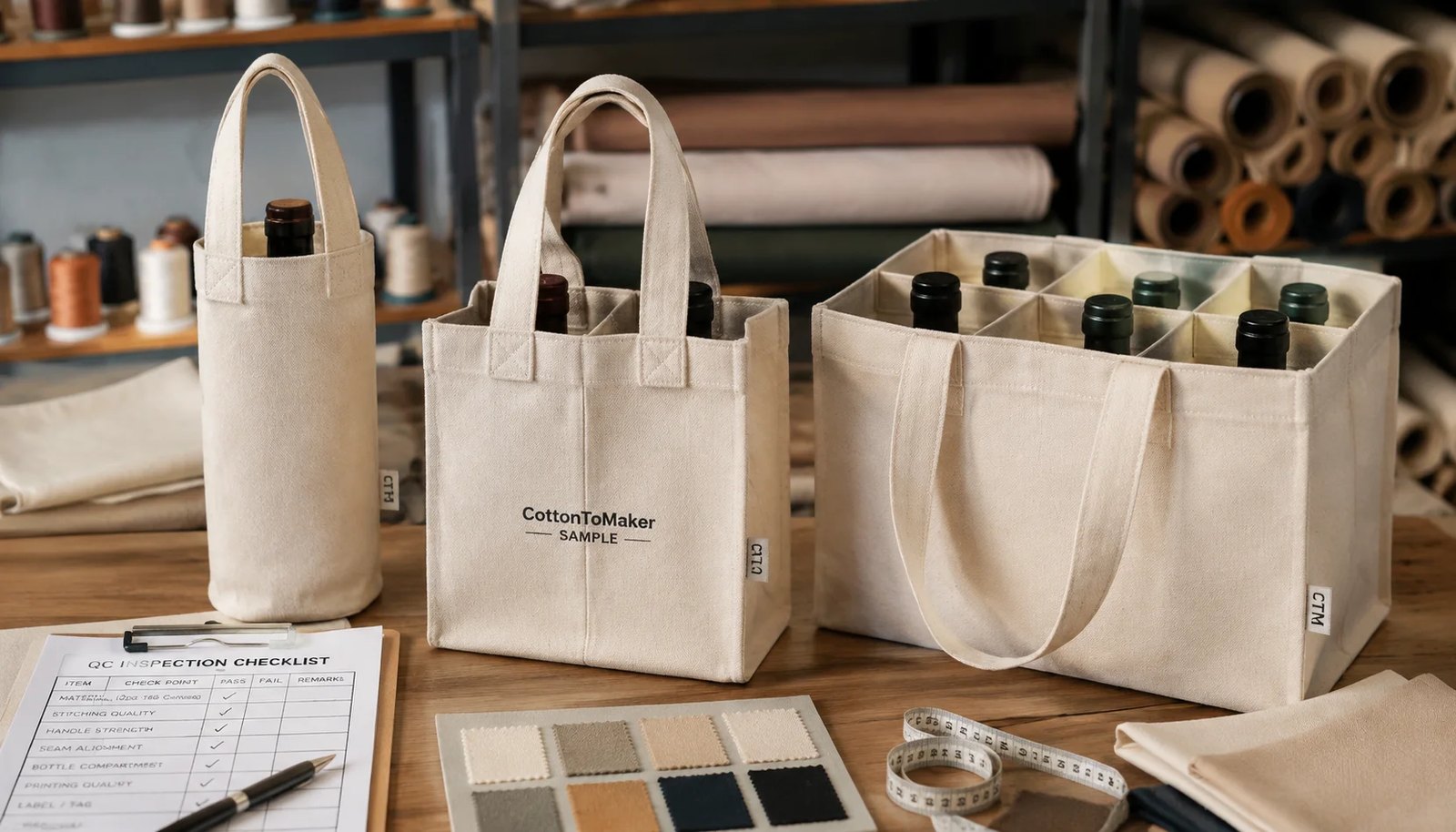
Why compliance is a sourcing problem, not just a paperwork problem
For liquor retail, a canvas wine carrier is a simple product until a buyer has to defend the supplier choice to compliance, merchandising, logistics, and store operations at the same time. The real issue is not whether a factory can sew a bottle bag. It is whether the factory can produce a repeatable item with traceable materials, usable test files, consistent branding, and packing that works through a retail distribution system. Procurement teams often receive quotes that look comparable on unit price but are based on different fabric weights, different print chemistry, and different assumptions about packing.
That is why a compliance checklist for suppliers should start with the commercial risk behind each specification. A 12oz natural canvas single-bottle bag for a holiday promotion is not the same sourcing project as a 16oz six-bottle reusable carrier for year-round retail sale. The required documentation, testing exposure, and production control are different. If your RFQ does not tie the intended use to the construction and evidence required, you will get a low quote from one vendor, a safer quote from another, and no clean basis to compare them.
- Link compliance requirements to use case: promotional giveaway, retail resale, loyalty program, or gift-with-purchase.
- Separate company-level documents from product-level evidence tied to the actual fabric, ink, label, and packaging route.
- Treat quote comparison as a specification control task, not only a price collection task.
Start with the right bag construction for the bottle load
Most sourcing mistakes begin with the wrong construction baseline. A canvas wine carrier must be specified around bottle count, bottle height, bottle diameter, and expected reuse. For a single 750 ml bottle bag, 10oz to 12oz canvas, roughly 285 to 340 GSM, is often enough if the bag is mainly promotional and does not need a rigid feel. Once the format moves to two bottles or more, especially with a gusseted body, heavier 14oz to 16oz canvas, roughly 400 to 540 GSM, usually gives better sidewall stability and lower return risk.
Multi-bottle carriers need more than heavier cloth. Buyers should specify whether the divider is sewn-in, removable, or omitted. A two-bottle carrier without a divider may be acceptable for a low-cost event bag, but not for a retail item expected to protect glass during transport. Inadequate bottom width and weak gusset seams are common hidden failures. Many quotes are built on outside dimensions only; the bag looks right flat but cannot hold the intended bottle profile once seams and fabric thickness reduce internal space.
- Single bottle: common target 10oz-12oz canvas, self-fabric handle or cotton webbing handle.
- Two bottles: usually 12oz-14oz minimum, with divider if used for paid retail or gifting.
- Four to six bottles: usually 14oz-16oz canvas with reinforced bottom and stitched divider assembly.
- State bottle dimensions in the RFQ, not just bottle count.
- Add a load requirement example, such as total carried weight equivalent to filled bottles.
Material compliance evidence should match the actual bill of materials
Many importers receive a tidy PDF package that includes a company certificate, a social audit summary, and perhaps one old test report. That is not enough if the evidence does not match the actual material route used for the wine carrier. Canvas bags often combine body fabric, sewing thread, print ink, woven label, hangtag, and polybag. A buyer who only reviews the body fabric report can still inherit risk from printing chemistry or packaging materials that are sourced separately.
The practical route is to request a simple bill-of-materials view from the supplier and map evidence to each component. For cotton canvas, ask whether the factory buys stock greige cloth and bleaches or prints later, or whether it sources finished dyed canvas. The answer affects both restricted-substance exposure and color consistency. For print, ask whether the supplier uses water-based screen ink, pigment print, or heat transfer film. Compliance review becomes much easier when the supplier can identify the exact upstream source rather than supplying generic declarations.
- Request material route by component: canvas, thread, webbing, divider board or insert, print ink, labels, polybag, carton.
- Ask whether test reports are tied to recent production lots or only representative archive samples.
- Prefer product-level documentation sets that can be refreshed for repeat orders with minimal rework.
- If using recycled cotton blends, confirm how blend content is declared and whether texture variation is expected.
Print method choice affects both durability and quote structure
For canvas wine carriers, screen printing remains the most practical option for simple retail branding. It usually gives the best balance of unit cost, color coverage, and durability when artwork is limited to one or two spot colors. On natural canvas, buyers should expect some ground-color influence on printed shades. That matters if the retailer wants a very clean white logo or brand-specific pale tones. A print strike-off on the actual fabric weight is more useful than a digital proof because the surface texture changes edge sharpness and ink laydown.
Heat transfer can work for small graphics, variable names, or short-run designs, but it is more sensitive to heavy canvas texture and repeated fold lines. It may also change the hand feel in a way that makes a reusable bag look cheaper. Pigment print and direct digital approaches can be viable for artwork detail, but cost, wash behavior, and MOQ dynamics differ by factory. If the quote simply says logo print included, the buyer still does not know the real production route.
- Screen print: best for simple logos, larger runs, and stronger repeat cost control.
- Heat transfer: useful for short runs or detailed art, but review cracking and edge adhesion risks.
- Approve print size, position, and shade against actual bulk-intent fabric, not paper output.
- For dark dyed canvas, ask whether an underbase is needed and how that changes print hand feel and price.
MOQ logic changes fast when you move from standard body to custom retail program
Suppliers often quote attractive MOQs for a standard bag body with one-color print because they can use stock canvas widths, established cutting markers, and routine sewing operations. The MOQ can rise quickly once the buyer requests dyed canvas, custom webbing color, internal divider redesign, special bottle fit, retail insert cards, or barcode labeling by SKU. Procurement teams should separate what is essential to the program from what is nice to have in the first order.
A useful sourcing strategy is to launch with a standard body and custom branding, then add higher-complexity details only after proving sell-through. This matters especially in liquor retail, where promotional timing can be fixed while final artwork and pack-out rules move late. If the supplier must develop custom dyed material or nonstandard divider components for a modest first run, the hidden cost may appear in surcharge lines rather than the quoted unit price.
- Lower MOQ route: stock natural canvas, standard dimensions, one-color screen print, standard carton pack.
- Higher MOQ triggers: custom dyed body, contrast webbing, specialty trims, woven brand label, multi-SKU barcode setup.
- Request MOQ by feature so merchandising can see what cost comes from real customization.
- If comparing suppliers, normalize quotes to one standard construction before evaluating optional add-ons.
Sample approval should test real use, not just appearance
A sales sample that looks good on a desk can still fail in stores or during customer use. For canvas wine carriers, the pre-production sample should be evaluated with actual bottle formats or weighted substitutes. Bottles should slide in without excessive force, stand upright without collapsing the sidewall, and stay separated if a divider is included. The handle drop should be practical for carry, especially for six-bottle formats where hand clearance and load distribution matter.
Appearance checks still matter, but they are not enough. The sample should show actual seam construction, reinforcement, print registration, label application, and intended packing fold. A common problem is approving a hand-made sample with stronger stitching or cleaner print than the line production method. Buyers should request that the PP sample be made as close as possible to the bulk route, using intended materials and normal factory operations.
- Test fit with the real bottle shape, including wider sparkling wine or gift bottle formats if applicable.
- Inspect handle reinforcement from the inside and outside, not just exterior neatness.
- Fold and repack the sample to see whether the print cracks, marks, or transfers.
- Approve carton packing style alongside the product sample if presentation on arrival matters.
Use measurable QC thresholds instead of vague quality language
Terms like good quality, export standard, or durable stitching do not help inspectors or suppliers make the same decision you would make at receipt. A better approach is to translate risk into measurable acceptance points. For example, specify finished size tolerance for width, height, gusset depth, and handle drop. State whether shade variation within the same shipment is acceptable on natural cotton. Define the maximum print position drift you can accept on front logos, especially on narrow bottle bag panels where even small shifts stand out.
Load-related quality is often ignored because buyers assume a simple fabric bag cannot be complicated. In reality, a wine carrier fails at the seam, handle root, or divider attachment long before the fabric itself tears. Inline inspections should focus on skipped stitches, seam allowance consistency, divider installation, and reinforcement pattern. A final random inspection should include practical load simulation, not just counting cosmetic defects.
- Typical controls to define: dimensions, print position, print coverage, shade variation, loose threads, seam puckering, label placement.
- Set load test method as an agreed in-house standard if no formal external standard is required.
- Require defect photos by category during inline review so corrections happen before full output is completed.
- Use final inspection levels that match retail risk; visual-only approval is weak for multi-bottle bags.
Packing decisions can erase savings if they are made too late
Liquor retailers and distributors often focus on product specs first and leave packing to the end of the conversation. That is a mistake because canvas wine carriers are soft goods with wide freight outcomes depending on how they are folded, bundled, and carton-packed. Flat-packing usually gives the best cube efficiency, but over-compression can create crease lines across printed panels or deform divider inserts. If the bag is sold as a giftable item, arriving crushed can create immediate markdown pressure.
The quote should state units per inner pack, units per export carton, carton dimensions, gross weight, and whether polybags are included or omitted. Some retail channels prohibit excessive plastic, while others still require unit-level protection. Multi-bottle bags can become surprisingly heavy at carton level, especially with thick canvas and divider assemblies. A carton that is cheap to make but too heavy for warehouse handling can increase downstream labor cost or damage risk.
- Define whether bags are individually packed, bundle packed, or packed loose by carton count.
- Set carton gross weight cap based on warehouse handling preference, often before the supplier finalizes pack count.
- If bags need retail-ready labeling, specify barcode position and outer carton marks early.
- For ocean freight, compare cube efficiency between flat-fold and semi-formed packing before approval.
Lead time should be managed by milestones, not one total number
Canvas wine bag lead time is often quoted too simply. A supplier may say 30 to 40 days after approval, but that range hides several risk points: sourcing or reserving the fabric, making print screens, producing the PP sample, lining up the sewing schedule, and booking export space. For liquor retail promotions, a missed in-store date can destroy the value of the program even if the order ships only a week late.
Procurement teams should request milestone dates instead of one broad promise. For example, separate days for artwork approval, print strike-off, PP sample dispatch, material booking, cutting start, inline inspection, final inspection, and ex-factory readiness. This approach makes delay visible while there is still time to react. It also exposes which suppliers are using actual planning data and which are simply quoting a market-average lead time.
- Get lead time split by development, material, production, inspection, and dispatch stages.
- Note whether the quote assumes stock fabric or fresh fabric procurement.
- Seasonal risk increases before major gifting periods when print and sewing capacity tighten.
- If shipment must consolidate with bottles or other merchandise, add buffer for cross-vendor coordination.
Compare supplier quotes on landed value, not unit price alone
A low ex-factory price can come from lighter fabric, fewer stitches at the handles, reduced seam allowance, simplified divider construction, or stripped-down packing. Those are not automatically bad choices if they fit the retail purpose, but they must be visible in the quote comparison. Procurement should build a landed-value view that includes fabric spec, print method, packaging, sample charges, testing exposure, freight cube, and likely rework risk. A quote that is 6% higher at factory level may become the cheaper option if it ships in fewer cartons, needs no emergency sample revision, and produces fewer receipt claims.
When evaluating suppliers, standardize the quote sheet around one exact bag design and one exact packing plan. Then list variances separately. This stops one factory from quoting 12oz body fabric and another from quoting 16oz while both appear to be pricing the same wine carrier. It also helps the internal buying team explain why the selected supplier is commercially safer, not just administratively convenient.
- Normalize fabric weight, size, handle construction, and print count before comparing prices.
- Add quote lines for sample cost, test cost exposure, label cost, polybag cost, and carton specification.
- Review freight cube impact from packing method, not only product dimensions.
- Track likely hidden costs: re-approval delays, failed fit samples, damaged arrivals, and relabeling at destination.
Specification comparison for buyers
| Supplier option | What to verify | Commercial advantage | Buyer risk to control |
|---|---|---|---|
| Direct sewing factory | fit-test photos with reference bottle, bottom reinforcement close-up, handle load proof, and final carton photo set | Better sample-to-bulk control and faster production feedback | May be weaker on export paperwork or branded packing unless checked early |
| Trading company | Factory name, production photos, trim-source proof, and who owns QC decisions | Can coordinate small mixed orders and extra services | Markup can hide real factory capability and slow defect decisions |
| Specialized bag workshop | bottle fit, bottom reinforcement, handle or cord strength, divider option, seam allowance, and upright stability | More practical for detailed construction, trims, and repeat programs | Capacity may be limited during peak seasons |
| Low-price general supplier | cotton canvas, jute, felt, nonwoven, or laminated paper sized to bottle diameter, weight, and condensation risk | Useful for simple promotional runs with loose specs | Material downgrades, weak packing, and vague inspection scope can erase savings |
| Retail-ready supplier | upright or flat packing, bottle-protection insert, carton count, moisture control, and retail display orientation | Can handle labels, SKU separation, carton marks, and receiving rules | Higher unit cost must be compared against reduced warehouse work |
| Compliance-focused supplier | Fabric records, labeling review, test plan, and production traceability | Safer for retail programs and repeat brand orders | Documentation claims need evidence, not only sales language |
| Local sample room plus bulk factory | Signed sample, bulk factory handoff, first-piece photos, and deviation owner | Good for complex branding before large production | Sample room quality may not match bulk line unless handoff is controlled |
Buyer checklist before sampling
- Define bottle count and load requirement by SKU: single, double, four-bottle, or six-bottle carrier, and state whether internal dividers are mandatory.
- Set fabric target in both oz and GSM, for example 12oz approximately 340 GSM or 16oz approximately 450-540 GSM, to reduce quote ambiguity.
- State fabric composition clearly: 100% cotton canvas, recycled cotton blend, or cotton-poly canvas, since compliance files and print behavior differ.
- Specify handle construction: self-fabric stitched handle, cotton webbing handle, handle width, handle drop, cross-stitch or box-x reinforcement, and bar-tack locations.
- List branding method and artwork coverage: one-color screen print, two-side print, woven label, embossed patch, or inside care label.
- Require evidence tied to the actual material route, such as fabric test report, print ink declaration, and supplier restricted-substance control statement.
- Approve a pre-production sample showing actual fabric, print scale, divider construction, and final stitching, not only a digital mockup or stock sample.
- Set acceptance criteria for seam strength, print registration, color tolerance on natural canvas, and handle alignment before mass production starts.
- Define packing method by retail channel: folded each in polybag or no poly, bundle quantity, carton size range, carton gross weight limit, and carton marks.
- Break lead time into sample approval, material booking, bulk sewing, final inspection, and dispatch windows so schedule slippage is visible early.
Factory quote questions to send
- What exact canvas specification are you quoting, including composition, weave, fabric weight in GSM, and finished weight tolerance?
- Is the quoted bag made from stock greige canvas, dyed canvas, or custom-dyed fabric, and how does that affect MOQ and lead time?
- For the stated bottle capacity, what seam construction and reinforcement do you use at handles, side seams, and bottom panel?
- If a divider is included, what material, thickness, and attachment method are used, and has that divider been tested under bottle load?
- Which print method is included in the quote, how many colors, what print area, and what durability or crocking standard do you normally control to?
- What compliance evidence can you provide for the actual fabric and print components used on this order, and are the documents product-specific or generic company files?
- What is your MOQ for a standard body with custom print, and what MOQ changes apply for custom fabric color, woven label, inside pocket, or divider changes?
- Can you provide a pre-production sample made from bulk-intent material, and what sample cost and sample lead time apply?
- How many units fit per export carton, what are the packed carton dimensions and gross weight, and how do you prevent crease marks during shipment?
- What are your milestone lead times for fabric sourcing, print strike-off, PP sample, bulk sewing, final inspection, and ex-factory date?
Quality-control points to confirm
- Fabric weight should stay within the agreed tolerance, commonly plus or minus 5% to 7%, because underweight canvas changes strength, feel, and print appearance.
- Handle attachment must show agreed reinforcement pattern, such as box-x stitch or bar-tack count, with no skipped stitches or loose thread ends at load points.
- Finished size tolerance should be stated for width, height, gusset, and handle drop, since multi-bottle fit failures often come from gusset variation rather than total height.
- Print position should remain within approved tolerance, especially on narrow front panels of wine bags where a 5-8 mm shift is visually obvious at retail.
- Natural cotton shade variation must be approved by standard or sample, otherwise bulk lots may look mismatched across stores or between repeat orders.
- Divider fit must hold bottles upright without excessive tilt; loose dividers create collision damage and poor shelf presentation for gift programs.
- Bottom seam and gusset stitching must stay flat and even; puckering here causes unstable standing and distorted bottle spacing.
- Carton packing count and folding method should match approved standard so bags arrive without heavy creasing over the printed area.
- Needle control, metal contamination control, and clean-factory handling matter for retail import programs even when not explicitly listed in the purchase order.
- Final inspection should include a simple load test using the intended bottle count or equivalent weight, not visual inspection alone.