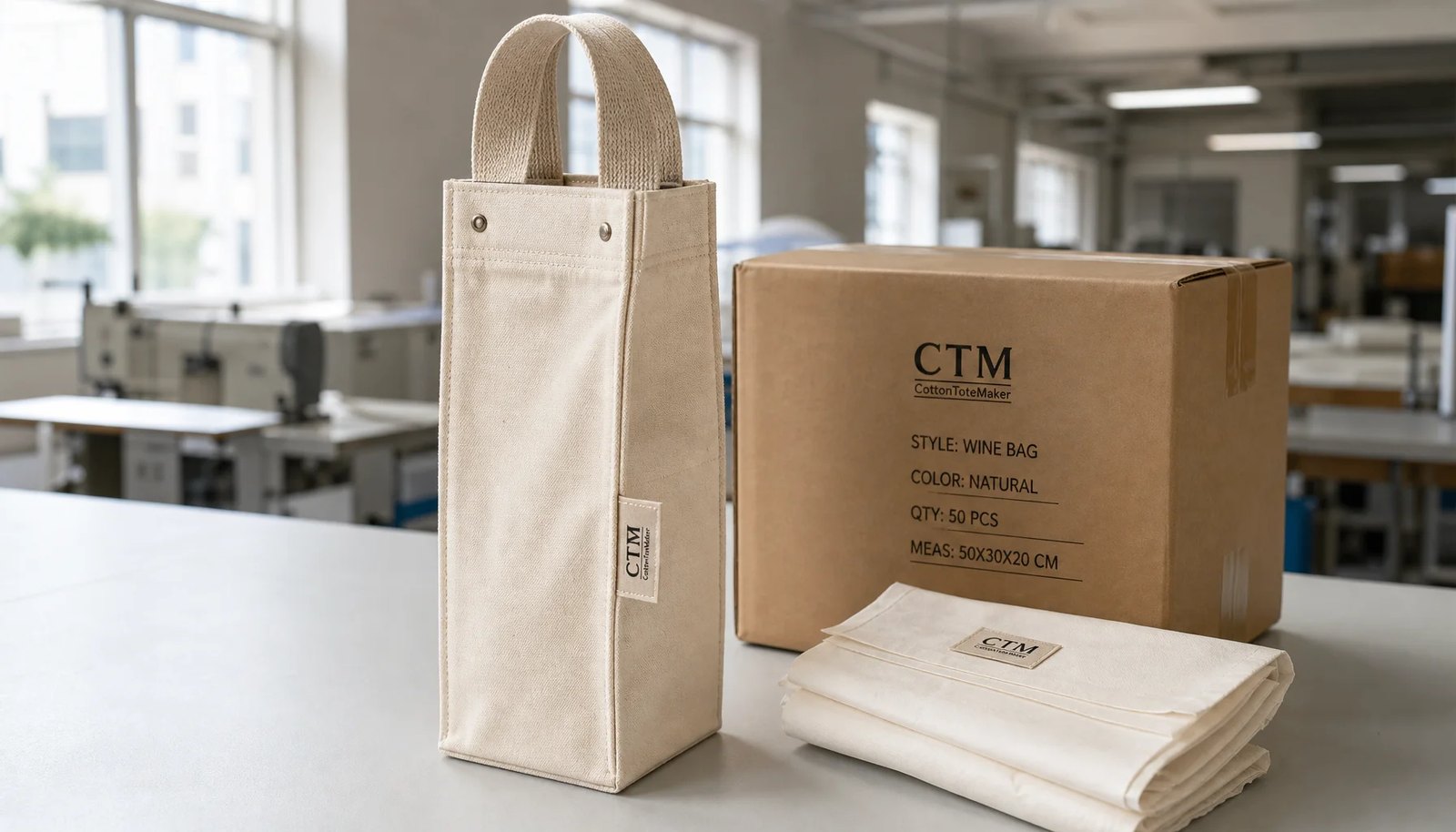
Why carton planning matters before artwork approval
The most common sourcing mistake with canvas wine carriers for subscription boxes is treating the carrier like a stand-alone gift item. In a subscription program, though, it behaves more like a shipping component. It has to survive sewing, printing, folding, kitting, carton compression, palletizing, and final delivery. If the carrier is too wide, too tall, too soft, or too bulky once folded, the shipping carton stops working long before the customer sees the brand message. That is why procurement should start with the carton and the bottle, then move to the carrier, and only then finalize decoration.
The sequence matters because every dimension influences the next one. Bottle height affects carrier height. Carrier height affects carton clearance. Carton clearance affects whether the lid closes cleanly or bulges under tape. A supplier can easily quote a beautiful sample that looks right on a table and still fail in a real pack-out because the dimensions were never tested together. When RFQs start with the actual bottle and carton, the quotes become easier to compare and the factory is forced to solve the real fit problem instead of guessing at it.
The carton itself should be treated as part of the spec, not just outer packaging. A carrier that looks sharp in isolation can still fail if the handle stack touches the lid, the gusset compresses against a divider, or the bottle shifts and creates a pressure point. For procurement teams, the real goal is not simply to buy a nice-looking canvas carrier. It is to buy a carrier that can be packed consistently, shipped economically, and reopened without damage in a subscription environment where the same problem repeats every month.
A useful sourcing brief should lock three things before art is approved: the bottle, the carton interior, and the carrier footprint. Then ask the supplier to prove the fit with a real pack-out photo set and measurements. If the supplier cannot explain the relationship between those three items in plain language, they probably do not yet understand the operational requirement. Buyers should favor factories that can turn product details into carton planning guidance, because that is what prevents downstream surprises and costly repacking.
For subscription programs, repeatability matters as much as aesthetics. One batch can be corrected. Twelve monthly shipments cannot. That is why carton planning belongs in the first conversation, not the last. Once the fit logic is stable, artwork and decoration become easier to approve because the carrier is no longer being judged as a standalone sample; it is being judged as a working part of a shipping system.
- Treat bottle fit and carton cube as part of the product spec.
- Use the subscription carton as the controlling dimension, not the carrier alone.
- Ask suppliers for a pack-out test photo set before artwork is frozen.
- Specify whether the carrier is packed flat, folded, or already inserted into the subscription kit.
- Require the supplier to show the full carton stack, not only the carrier close-up.
Choose fabric weight based on protection and pack efficiency
For canvas wine carriers, 12 oz is usually the practical starting point. It gives the carrier enough body to stand up inside a carton without feeling flimsy, while still staying manageable for folding, insertion, and freight. If the program is positioned as a premium gift or the carrier will travel through rougher fulfillment channels, 14 oz canvas is often the safer choice. The real question is not just how thick the canvas feels in hand. It is whether the carrier keeps its shape after repeated handling and still leaves enough room in the carton for inserts, filler, and closure tolerance.
Heavier is not automatically better. Once the fabric gets too heavy, the carrier becomes stiffer, bulkier, and more expensive to ship. In subscription box programs, a carrier that adds too much cube can raise freight cost more than it improves perceived quality. Buyers should compare unit price, folded thickness, and carton utilization together. Even a small change in canvas weight can alter the folded profile, which then changes how many units fit in a master carton and how much total cube the monthly program consumes.
The right fabric weight also depends on the intended feel of the product. A structured body usually holds the bottle more securely and presents better in the unboxing moment, but it may need slightly larger carton dimensions. A softer body may fold more efficiently, yet it can wrinkle, slouch, or look underpowered in a premium box. That is why buyers should ask the factory to quote the same bottle and the same carton interior across fabric options. Only then can the effect of weight be judged on equal terms.
When reviewing samples, inspect the raw hand feel and the folded profile. Some fabrics seem fine when hanging alone, but flatten badly in a master carton. Others look strong on a tabletop and then create edge pressure when the carton is sealed. A hand-feel impression is useful, but it is not enough. The sourcing decision should rest on measured thickness, finished dimensions, and carton fit, not on fabric vocabulary alone. Buyers should also ask whether the fabric is greige, dyed, pre-washed, or finished, because finishing can change both feel and packed thickness.
If the subscription program uses more than one bottle SKU, define the tolerance band in advance. A carrier that fits one bottle tightly may be unusable for a slightly wider or taller alternate bottle. Build the spec around the largest acceptable bottle dimension, then test the smaller one to confirm the fit does not become loose or unstable. That simple step reduces rework when marketing changes the assortment or a seasonal pack uses a different bottle profile.
- 12 oz canvas: balanced cost and structure for mainstream subscriptions.
- 14 oz canvas: stronger hand feel, better shape retention, higher cube cost.
- Ask for actual measured thickness after washing or finishing if the carrier is pre-shrunk or enzyme-treated.
- Request folded thickness and finished dimensions, not only cut size.
- Test the carrier with the largest bottle in the assortment first.
Specify construction details the factory can actually build consistently
Construction quality matters as much as material choice. For procurement buyers, the useful details are not vague words like durable or reinforced, but the exact stitch layout, seam allowance, and load-bearing points. A reliable wine carrier should define the handle reinforcement method, stitch count range, hem finish, and gusset depth in millimeters. That level of detail helps the factory quote the same build every time and gives QC a measurable standard to inspect against.
A common baseline is a self-fabric handle with box stitch plus a reinforcing bartack or cross stitch at the stress point. Ask the factory for the reinforcement length, stitch density, and minimum seam allowance at the handle join. If the supplier cannot state those numbers, the carrier may be depending on visual similarity instead of actual engineering. In a subscription environment, repeated lifting and carton handling can expose weak reinforcement quickly, especially at the handle base where stress concentrates.
The body structure should also be defined precisely. A single-bottle sleeve with side gussets can work well when the carrier must stay upright in a carton, but only if the gusset depth matches the bottle diameter and the print zone. If the gusset is too shallow, the bottle can compress the seam and distort the silhouette. If it is too deep, the carrier can become bulky and waste carton space. That is why buyers should ask for both cut size and finished sewn size. Seam allowance changes the final dimensions, and finished dimensions are what matter in the carton.
If the carrier includes an insert, divider, rivet, snap, or patch, those components should be shown in the quote with location and material description. Even small additions can affect carton stacking and assembly time. A rigid patch may improve brand perception but also create a pressure point inside the carton. A rivet can strengthen the handle but may add a hard contact point if the carrier is packed tightly against another item. The construction brief should separate what is functional from what is decorative so the factory can optimize for durability, packability, and appearance at the same time.
The cleanest way to manage construction risk is with a technical sketch that labels body width, body height, gusset depth, handle drop, handle width, reinforcement length, and seam allowance. Then require the sample to match that sketch before approving bulk. This removes ambiguity and makes supplier comparison much easier. It also helps the warehouse team because the same drawing can explain fit, fold direction, and pack sequence without guesswork.
- Ask for handle drop, handle width, reinforcement length, and seam allowance in millimeters.
- Require both cut size and finished sewn size.
- Match gusset depth to the largest bottle diameter in your assortment.
- Separate functional parts from decorative parts in the RFQ.
- Use a technical sketch to compare suppliers on the same geometry.
Print method choices that work on textured canvas
The right print method depends on artwork density, color count, expected order volume, and how often the carrier will be handled. Simple logos usually work best with screen print because the result is durable and repeatable across production runs. If the design has small text, gradients, or multiple colors and the order is short, heat transfer can work, but only if the supplier can control adhesion and edge quality on textured canvas. Buyers should also ask whether the print is applied before or after sewing, because that affects alignment, distortion, and seam-related ghosting.
Do not approve print from a flat artwork file alone. On canvas, the weave changes line sharpness, ink laydown, and apparent color density. A logo that looks crisp on screen may bleed, fill in, or lose detail on a real sample. Ask for cured print samples under normal lighting and a close-up photo of the logo edge, not just a full-product beauty shot. The procurement question is not whether one hand-picked sample looks good once. It is whether the factory can repeat the same result after multiple production days.
Screen print is often the easiest method to control for bulk subscription programs because it is straightforward to inspect. Even so, the buyer should ask about mesh count, ink type, curing temperature, and whether the factory performs a rub test after curing. These details matter because a logo that transfers during folding or smudges against carton board weakens the unboxing presentation. On textured canvas, poorly cured ink can also reveal the weave more than expected. That may be fine for a rugged look, but not for a premium brand.
If the program needs a more elevated finish, ask whether a woven label, PU patch, or embroidery is worth the added thickness inside the carton. Decorative upgrades can improve perceived value, but they also increase handle stiffness, add pressure points, or create sewing complexity. In a subscription box, every extra layer should earn its place. Ask the supplier to show where the decoration sits relative to the fold line and whether it affects carton closure or stacking. That simple check can prevent a branded detail from becoming a packing problem.
A useful tactic is to request two artwork versions: one optimized for screen print and one simplified for production reliability. Then ask the factory which version is more stable at your order quantity. This is not about handing over creative control. It is about forcing the supplier to identify where the production risk sits. Often, the result is a cleaner, more manufacturable artwork package that reduces revisions and gets the program moving faster.
- Screen print suits simple, repeatable branding.
- Heat transfer suits short runs but needs strict adhesion checks.
- Embroidery or woven labels can work for premium positioning, but they add cost, lead time, and thickness inside the carton.
- Ask what curing method is used and whether the factory performs rub and fold tests.
- Request close-up macro photos of the finished print edge on the real canvas.
MOQ logic and how it changes the quote
MOQ is usually driven by fabric sourcing, print setup, sewing efficiency, and packing labor. A one-color logo on stock-color canvas will usually support a lower MOQ than custom-dyed fabric with multiple print placements. If the supplier is quoting a low unit price but a high MOQ, that often means the factory is spreading setup cost across a larger run. Buyers should not assume the MOQ is arbitrary. It often reflects the point at which the factory can run the job without disrupting its material flow.
Procurement teams should look for the real trigger behind the MOQ. Is it the fabric roll minimum, screen-making charge, label sourcing, or carton material procurement? Once you know the trigger, you can negotiate a smarter order structure, such as one master body spec with separate seasonal print runs. That usually improves cash flow without weakening consistency. For example, a buyer may keep the body and construction fixed year-round, then vary only the print or label for campaign-specific launches. That reduces the number of moving parts while keeping the subscription box fresh.
MOQ also affects quality risk. Very low quantities can create a sample-like production run, which may not receive the same process discipline as a larger repeat batch. On the other hand, a very large MOQ can lock the buyer into inventory that becomes difficult to move if the brand changes packaging size or bottle format. The procurement decision should balance cost, demand confidence, and packaging stability. Ask the factory to explain where economies of scale begin and how the price changes at each volume tier.
When comparing suppliers, request a break at 1,000, 3,000, and 5,000 units, or whatever ladder is realistic for the program. That lets you see whether the quote is linear or whether there is a setup threshold that makes the next tier disproportionately attractive. If the factory cannot explain the price ladder, the buyer cannot tell whether the MOQ is a real manufacturing limit or simply a pricing strategy. Either way, the answer is useful because it helps you decide whether to split orders, place forecasts, or combine print runs across channels.
For seasonal subscription boxes, there is also a timing question. If the launch window is narrow, the MOQ should be assessed together with lead time and raw material reservation. A smaller MOQ that arrives late is worse than a slightly larger MOQ that can be booked into production on time. The right quote is the one that fits both the launch calendar and the carton plan.
In practice, the lowest-risk MOQ strategy is usually to freeze the body construction and one print method first, then change only the graphic or label if needed. That keeps the factory’s setup stable and makes future repeats easier. It also reduces the number of variables that can move MOQ upward at the last minute, which is often where procurement schedules get squeezed.
- Stock canvas and one-color logo usually reduce MOQ pressure.
- Custom dye, special lining, or trim changes can lift MOQ quickly.
- Ask for price breaks at 1,000 / 3,000 / 5,000 units so you can compare scaling logic.
- Ask what part of the MOQ is driven by fabric, print screens, labels, or cartons.
- Check whether the MOQ is tied to one colorway or one total order only.
Use a quote format that exposes real landed cost
A unit price alone does not tell you whether the program works. Canvas wine carriers for subscription boxes need quote data that includes fabric weight, print method, pack count, inner carton dimensions, master carton dimensions, and cubic measurement. Without those details, one supplier may look cheaper simply because they are packing fewer units per carton or using a looser dimension tolerance. Procurement buyers should insist on a quote format that makes the shipping carton visible, not just the product cost.
Separate product cost from logistics cost. If the carrier is even a little too wide or too tall, the carton cube can change enough to affect freight efficiency and warehouse storage. For buyers importing at scale, that difference can outweigh a small savings on ex-factory price. A good RFQ should ask for a complete packed specification so the receiving team, freight forwarder, and warehouse operator can all work from the same assumptions. That reduces the chance of a beautiful sample becoming an expensive carton problem later.
Ask for the answer in operational terms: how many carriers per inner pack, how many inners per master carton, what is the gross weight, and what is the estimated cubic meter per carton. Then compare suppliers on a like-for-like basis. If one supplier gives a lower price but cannot specify carton count or gross weight, the quote is incomplete. In procurement, incomplete is not cheaper; it is just unfinished. A proper landed-cost comparison should also include labels, tissue, inserts, and any pre-packing labor the factory performs before shipment.
Buyers should also ask whether the quoted carton dimensions are inner dimensions or outer dimensions. That detail matters for pallet planning and warehouse receiving. The same applies to gross weight versus net weight, which can change courier and sea-freight calculations. A strong quote should separate product spec, packing spec, and logistics spec. If those are mixed together, you cannot confidently compare suppliers or forecast the final landed cost.
The quote should also explain what is excluded. Are export cartons, moisture protection, polybags, or corner protection included? Is the price based on one artwork placement or multiple? Are special color-matching fees included? When the buyer gets those exclusions in writing, later change orders become easier to control. This is especially important for subscription-box programs because small packaging changes can ripple through the entire fulfillment chain.
A helpful habit is to ask every supplier to quote the same assumptions in the same order. That means one spec sheet, one packaging plan, one packing count, and one carton drawing. When the documents match, the decision becomes much clearer. When they do not, the lowest price is often the least comparable number in the room.
- Compare ex-factory price, not just sample-stage pricing.
- Require quoted carton dimensions and pack count in writing.
- Ask for estimated gross weight per carton to help freight planning.
- Confirm whether dimensions are inner or outer carton measurements.
- Request a clear list of inclusions and exclusions in the quote.
What a good sample approval process looks like
A proper sample process should include at least two stages: a pre-production sample and a carton pack sample. The first sample proves the carrier itself, including size, fabric feel, print quality, and stitch finish. The second sample proves that the carrier fits the bottle and can be packed into the subscription carton without crushing edges or forcing tape closure. For buyers sourcing canvas wine carriers for subscription boxes, the second sample is often the one that prevents expensive rework because it reveals the real interaction between product and carton.
Inspect the sample in the same sequence used in production. Measure the carrier opening, check bottle insertion and removal, verify handle length, and then close the carton with real inserts or filler. If the carton bulges or the carrier shifts inside, that is not a minor packaging issue; it is a spec failure that will show up in bulk. The sample should be evaluated on a workstation that mimics the warehouse environment, not just in a showroom photo setup. A real pack test uses the same bottle, the same board thickness, the same tape width, and the same closure method expected in production.
The sample package should include a written approval trail. Each sample should be identified by date, version, and any changes from the prior revision. Record which artwork was used, whether the print was pre- or post-sewn, and whether the sample was washed, pressed, or steamed. When there is a later dispute, this record helps both sides determine whether the bulk product followed the approved reference. Procurement teams should also archive pack-out photos that show the bottle seated, the carrier orientation, and the sealed carton top.
If the subscription box includes other components, test the carrier alongside those items instead of in isolation. A divider, card insert, tissue wrap, or internal tray can reduce usable space and change how the bottle sits. A sample that passes alone may fail once the full kit is assembled. This is why pack testing must reflect the actual assembly line order, not a simplified lab test. A strong supplier will understand that and may offer a pack-out photo set with ruler measurements, which is exactly the kind of documentation procurement teams need.
Do not rush approval because the production slot is tight. A bad sample approved under schedule pressure usually costs more than a short delay for revision. For repeat subscription shipments, the operational cost of a poor fit quickly outweighs the benefit of saving a few days. Good sample discipline protects the launch and makes future reorders easier because the supplier has a stable reference to follow.
- Approve dimensions with a tape measure, not by visual judgment.
- Use the real bottle, real inner packaging, and real carton in the pack test.
- Document the approved sample with photos, dimensions, and signed remarks.
- Track sample version numbers and any change from one revision to the next.
- Test the sample with the same fulfillment sequence used in the warehouse.
QC thresholds that prevent avoidable bulk rejects
The most useful quality checks for canvas wine carriers are simple and measurable. Stitch quality should be even at the handle joins and bottom corners. Print should remain aligned after folding. Edge trimming should not leave loose threads that snag on carton board or catch on other units during packing. If the carrier includes a label, the label position should be repeatable from piece to piece so the brand presentation stays consistent in the box. These are the details that turn a good-looking sample into a dependable bulk shipment.
Set acceptance criteria before bulk starts. Define what counts as dimensional variance, how much print shift is acceptable, and whether visible thread ends at the seam are allowable. Decide how many units per lot will be checked, what happens if one defect type repeats, and whether the factory must sort or replace rejects before shipment. Clear thresholds reduce disputes later, especially when the supplier is trying to meet a schedule and the buyer is trying to protect the retail presentation. The more clearly you define pass/fail logic, the less room there is for ambiguity after the goods are packed.
Handle security deserves special attention because it is a functional failure point. Ask for a pull test or at least a controlled load check using the bottle weight the carrier is expected to hold. Also inspect for seam puckering around the joins, because puckering can indicate uneven tension that may worsen under load. For the print, a basic rub test and fold test can reveal whether the cure is stable enough for packing and consumer handling. If the print cracks or transfers at the fold line, the carton may still ship, but the customer perception will suffer.
Inspect the finished dimensions after sewing, not just the cut pattern. Canvas can change slightly during stitching, pressing, or finishing, and that small change can alter pack fit. A carrier that is technically correct on the cutting table can still be too tight in the carton after seam allowance is added. This is where a measured QC sheet matters. It should include width, height, handle length, seam allowance, and any dimension critical to the carton interior. That sheet becomes the shared reference for future reorders.
For larger programs, consider a simple AQL-style inspection approach or a custom acceptance matrix tied to the product’s risk profile. Even if the supplier does not use formal AQL language, the buyer can still define sample size, defect categories, and escalation rules. What matters is consistency. A repeatable QC method protects the brand, lowers claim risk, and makes the supplier’s job easier because everyone knows which details matter most.
- Check handle stress points for skipped stitches and seam puckering.
- Inspect print cure by rub test and fold test on the sample.
- Measure carrier width after packing, not only before packing.
- Set defect categories and escalation rules before bulk starts.
- Verify finished dimensions after sewing and pressing, not only cut size.
Packing method: flat, folded, or pre-kitted
Packing method changes both carton cost and labor time. Flat-packed carriers usually save cube, but they take more kitting labor at the fulfillment center. Pre-folded or pre-kitted units reduce downstream handling, but they can add bulk and raise shipping costs. The right choice depends on how the subscription box is assembled and whether the carrier is inserted by the factory or by a third-party warehouse. For procurement teams, the question is not which format is easier to describe. It is which format keeps the overall program efficient once labor, freight, and storage are all counted.
For many wine subscription programs, the best balance is a flat-packed carrier with a clear fold sequence, bundled in inner packs that match the kitting line. That setup keeps the product tidy and helps the warehouse team count faster. If the buyer needs retail-ready presentation, then the packing spec should also define tissue wrap, polybag type, label placement, and carton divider use. Those details matter because the carrier may be handled multiple times before it reaches the consumer. The more standardized the folding and bundling method, the easier it is for the warehouse to maintain consistent cycle times.
There is also a quality angle to packing format. A carrier packed too tightly can create creases, imprint transfer, or shape memory that affects how it appears when the box is opened. A carrier packed too loosely can shift inside the carton, rub against other inserts, or arrive with wrinkled presentation. Ask the factory to show how the carrier is folded, whether a paper board insert is used, and whether each piece is protected from abrasion during transit. If the product is premium enough to deserve careful branding, it is also premium enough to deserve a packing method that protects the finish.
The packing plan should align with the actual warehouse workflow. If the warehouse team prefers to scan and assemble components by station, then the inner pack count should match station output. If the supplier is packing by order set, then the carton label should clearly identify the kit contents and sequence. Buyers should ask for a packing diagram that shows where the wine bottle, carrier, insert card, and void fill each go. That makes it easier to train staff and lessens the risk of assembly errors during peak fulfillment periods.
In some programs, the most effective answer is a hybrid. The factory ships carriers flat, but a local warehouse pre-kits them into order-ready sets after receiving them. That can reduce international freight while preserving packing control. It only works if the product spec is stable and the supplier’s flat-pack tolerances are tight. Otherwise, the warehouse team ends up sorting inconsistent pieces, which erodes the savings. The packaging method should therefore be chosen as a system decision, not just a product preference.
- Flat pack saves freight but adds assembly work later.
- Pre-kitted units simplify fulfillment but usually increase cube.
- Match inner pack size to the warehouse handling method.
- Ask for a folding sequence and protection method in writing.
- Define whether the factory or warehouse owns final kit assembly.
Lead time risk comes from materials, not just sewing
A realistic lead time should separate fabric sourcing, sample approval, printing, sewing, packing, and outbound booking. Many delays happen before sewing starts, especially when custom canvas color, woven labels, or print screens are not ready. If the supplier says production is fast but cannot identify which materials are in stock, the schedule is not yet dependable. For subscription launches, that distinction matters because the carton schedule, customer ship date, and marketing calendar all depend on the same delivery window.
The practical way to control lead time is to identify the longest dependency first. Is it the fabric dye lot, the print screen, the label, the carton supplier, or the sample approval cycle? Once you know the critical path, you can decide whether to simplify the spec or place materials earlier. For example, locking the body fabric while leaving the logo placement variable is often safer than locking a decorative feature that is hard to source. A buyer who understands the material path can often shorten lead time without compromising the final look.
For seasonal launches, the safest approach is to lock the standard body material and use one print execution that the factory can repeat without extra setup. This reduces the chance that an on-time sewing order still misses the ship window because a trim, label, or print plate is late. Buyers should also ask whether the supplier runs one production line for sampling and bulk or uses separate teams; that affects sample revision speed. A factory with separated sample and bulk processes may be more flexible for iteration, but you still need to know where handoff delays can occur.
Lead time should also include pack-out and carton booking. A carrier that is sewn quickly but cannot be packed because the master carton spec is unresolved is not actually ready. Ask the supplier to quote a calendar that shows sample approval date, material arrival date, sewing start, packing finish, inspection, and cargo readiness. The more detailed the timeline, the easier it is to identify slippage early. Buyers should also ask whether the supplier has contingency capacity for rush replacement if a sample fails late in the process.
For recurring subscription shipments, consistency is often more valuable than speed alone. A stable lead time with a slightly longer buffer is usually better than a volatile quick-turn promise. The reason is simple: subscription fulfillment depends on reliable cadence, and one late carton can affect downstream customer experience. When evaluating lead time, procurement teams should therefore ask not only when the first order can ship, but also how the supplier will support reorder timing and repeatability.
One practical safeguard is to ask the supplier to name the top three delay risks before the order is placed. That simple question often reveals whether the factory has thought through the project or is only quoting based on sewing time. If the answer is specific, the timeline is probably realistic. If the answer is vague, the schedule needs more scrutiny before the order is released.
- Material availability often controls the real lead time.
- Fast sewing does not help if print screens or labels are delayed.
- Build approval time into the schedule for sample corrections and carton tests.
- Ask for a timeline that includes pack-out and carton booking, not only sewing.
- Confirm whether the factory can support repeat orders on the same schedule.
Specification comparison for buyers
| Spec decision | Recommended option | When it fits | Buyer risk to check |
|---|---|---|---|
| Fabric weight | 12 oz canvas as the standard starting point; 14 oz for premium presentation or higher abrasion resistance | Best for most 750 ml subscription programs where the carrier must hold shape without creating excess carton bulk | If the factory quotes a finished weight without stating weave density, finishing, or pre-wash status, the actual hand feel and folded thickness can differ from the sample |
| Handle construction | Reinforced self-fabric handles with box stitch plus cross stitch or a dense bartack at each load point | Suitable when the carrier will be lifted during kitting, transit, and final handoff | Weak seam allowance, uneven bartacks, or short reinforcement length can fail under repeated lifting; ask for reinforcement length in millimeters |
| Body structure | Single-bottle sleeve with side gussets and top hem reinforcement | Works when the carrier must stay upright in a subscription carton and maintain a clean silhouette | Flat bodies can twist in transit; if gusset depth is not matched to bottle diameter, the bottle may rub the seam or compress the print zone |
| Print method | Screen print for one- or two-color logos; heat transfer only for short runs or detailed multi-color art | Best when repeat color consistency and low defect risk matter more than decorative effects | On textured canvas, poor cure control can cause cracking, smearing, or weave show-through; request rub-test results and cure method |
| Closure style | Open-top carrier with internal divider or sleeve insert when the carton also holds the bottle | Works when the carrier is one component inside a larger subscription kit carton | If the opening is too loose, the bottle can move during transit; if too tight, the bottle can scuff the seam or distort the carton closure |
| Carton pack-out | Flat-packed carriers nested in an inner pack, then loaded into a master carton with the bottle protection scheme defined | Useful for buyers optimizing cube, warehouse handling, and freight forecasting | Overstuffed cartons can crush the carriers; underfilled cartons can shift, so ask for pack count, gross weight, and external carton dimensions |
| MOQ route | Stock canvas, one size, one print location, one colorway | Good for launches, seasonal campaigns, and test orders | Custom dyeing, custom trim, embroidery, or multiple print placements can change MOQ materially; confirm the trigger item in writing |
| Sample stage | Pre-production sample plus a real carton pack sample with bottle inserted and carton sealed | Needed when the carrier must fit a specific bottle and a specific subscription carton | Approving only a flat sample can miss carton interference, top-closure pressure, or handle stack height issues |
| Supplier route | Direct factory with sample-room photos, pack-out photos, and measurable carton documentation | Best for buyers needing transparent quote structure and repeatable QC | Trading-only quotes may hide material substitution risk, pack-count limitations, or slower correction cycles |
Buyer checklist before sampling
- Confirm bottle diameter, bottle height, and acceptable bottle neck clearance before asking for pricing.
- Lock the canvas weight, weave, finish, handle reinforcement method, and print coverage before sample approval.
- Provide the exact subscription carton inner dimensions, target pack count per master carton, and preferred carrier orientation inside the carton.
- Request both a pre-production sample and a carton pack sample with the bottle inside the real shipping carton.
- Define acceptable seam strength, print cure, stitch density, folded thickness, and measurement tolerance in writing.
- Ask for packing photos, a measured carton specification sheet, and a sample reference number before bulk approval.
- Confirm whether the factory will pack by bottle, by carrier, or as separate components for your warehouse team.
- Get written confirmation of cartons per pallet, gross weight, outer carton dimensions, and estimated cube for freight planning.
Factory quote questions to send
- What canvas weight are you quoting in oz or GSM, and is it greige, dyed, pre-washed, or finished fabric?
- What is your MOQ by size, color, and print method, and which component changes the MOQ the most?
- Can you provide a pack-out layout showing carrier size, bottle size, inner pack count, and master carton dimensions?
- What print method do you recommend for this artwork, and what is the maximum print area before registration risk increases?
- Will you send a pre-production sample plus a pack-out sample with real bottle fit and carton-sealed photos?
- What is the standard lead time after sample approval, and which parts are at risk if material is not in stock?
- How many pieces per inner pack and how many inner packs per master carton are you quoting?
- What are the net weight, gross weight, and carton dimension tolerances for the packed goods?
- Can you confirm stitch method, reinforcement points, and inspection criteria for handle pull strength?
- If we need a revision, what is the cost and turnaround time for resampling, screen changes, or label changes?
Quality-control points to confirm
- Fabric weight matches the approved spec within the agreed tolerance and does not vary visibly between panels.
- Handle stitching uses the agreed stitch count, proper reinforcement at stress points, and no skipped stitches at load points.
- Print edges are sharp, ink is fully cured, and no cracking appears after controlled fold and rub tests.
- Carrier dimensions allow the bottle to sit correctly inside the subscription carton without forced compression.
- Seams are straight, thread tension is even, and no fraying appears at cut edges, label points, or gusset turns.
- Packed cartons match the approved count, net weight, and master carton dimensions used for freight planning.
- Top hem, gusset turn, and handle join are inspected for puckering, loose thread ends, or needle damage.
- Logo placement is checked against the physical approved sample, not only against artwork coordinates.
- Carton closure is tested with the real insert set to confirm tape seal, top clearance, and crush resistance.
- Random carton checks verify that carrier orientation, void fill, and count remain consistent across the run.