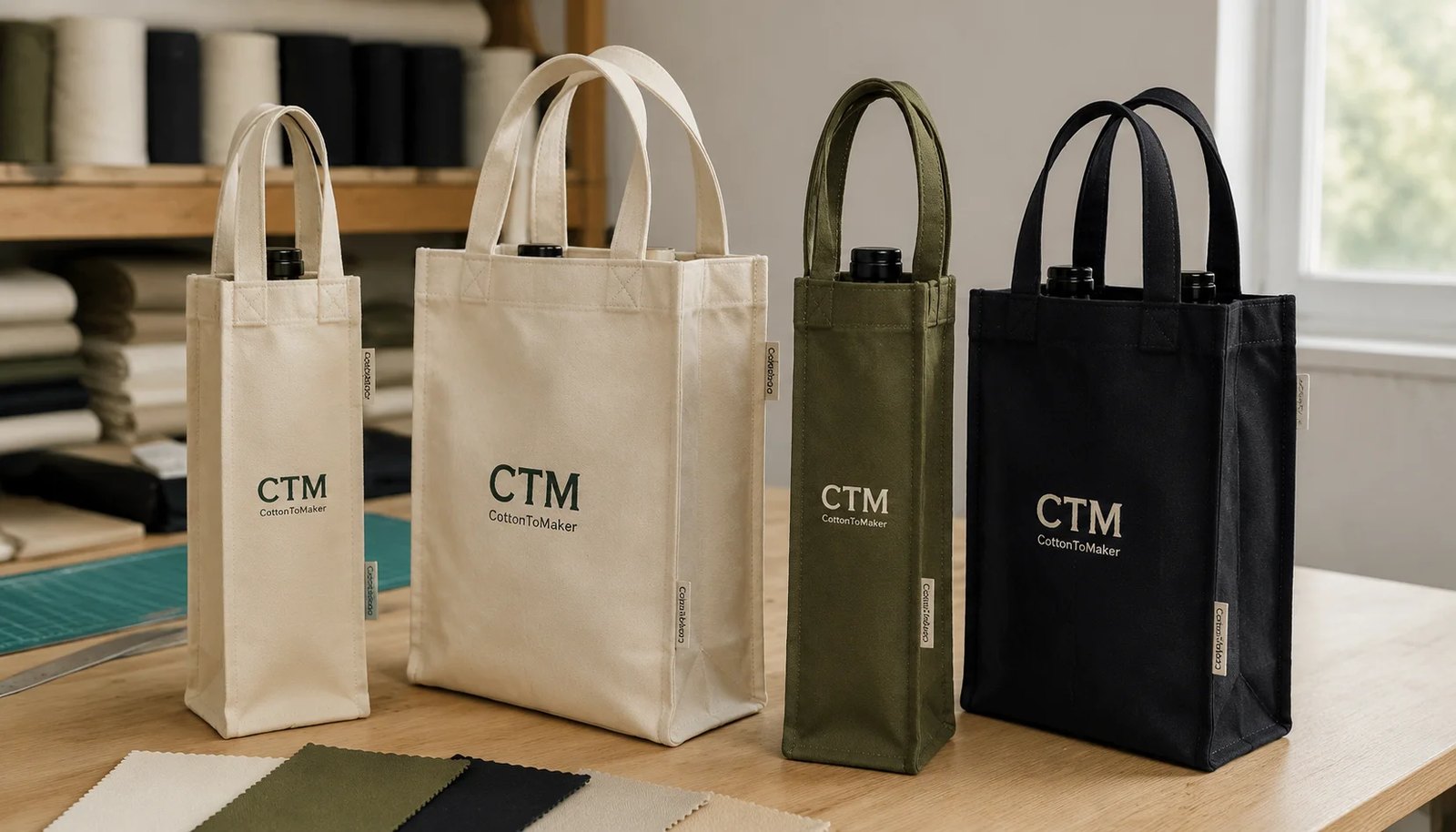
Why skincare brands need a different material spec than standard wine gift bags
The keyword says wine carriers, but many skincare programs use this format for bottle-shaped products, premium oils, bath products, boxed serums, or holiday gift bundles. That creates a sourcing mistake right away: buyers often copy a standard wine bag spec built for liquor retail, then discover the proportions, bottle protection, or branding finish are wrong for skincare. A liquor bag may only need to carry one heavy bottle for a short distance. A skincare gift carrier may need cleaner branding, softer hand feel, better shelf presentation, and more control over rattling between smaller containers.
The clear buying problem is material selection, because material determines structure, print result, durability, and freight cost at the same time. If the canvas is too light, the bag collapses and cheapens the set. If it is too heavy, unit cost and carton volume climb without improving actual performance. Skincare buyers usually want a bag that looks premium enough for gifting but still runs efficiently at medium MOQs. That usually means balancing body fabric, insert logic, and print method together rather than choosing fabric by feel alone.
- Standard liquor-bag assumptions often fail for skincare gift dimensions
- Fabric choice affects shape, print sharpness, protection, and freight CBM
- A good RFQ starts from packed product dimensions and gross filled weight
- Retail gifting needs cleaner presentation than many standard bottle carriers
Start with the pack-out format before choosing canvas weight
Most quote errors happen because the buyer requests a 'canvas wine carrier' without defining what will go inside. A one-bottle olive oil bag, a single boxed toner, and a two-piece serum set may all fit into roughly similar outer dimensions, but they need different structure. If the bottles are packed in rigid inner cartons, the canvas shell can be lighter because the inner carton already controls shape. If products are loose bottles or jars, the bag body and internal divider become much more important.
For skincare applications, 12 oz canvas, roughly 340-400 GSM finished, is often the safe middle ground for premium-looking carriers. It stands better than 8 oz fabric and takes screen print well without excessive strike-through. For lower-cost promotions, 8-10 oz fabric can work, but only if the set is boxed or if slight collapse is acceptable. Once buyers move above about 14 oz or 475 GSM, cost and shipping weight increase noticeably, while sewing becomes slower and edge finishing becomes bulkier. Heavy canvas makes sense only when the brand intentionally wants a rugged, utility look or needs the bag to stand almost like a structured gift tote.
- One boxed bottle set: 8-10 oz may be enough
- Unboxed glass bottles: 12 oz usually performs better
- Two-bottle premium set: 12 oz plus divider is a common balance
- Over 14 oz: use only when structure requirement justifies extra cost
How to match fabric construction to the skincare brand position
Not all canvas with the same nominal weight behaves the same way. Buyers should distinguish between plain canvas, cotton duck, and blends. Tighter weave usually gives better print surface and less distortion on tall narrow bags. Looser weave can feel softer and more natural, but fine artwork suffers and side seams may skew more easily. If the skincare brand leans clinical, minimalist, or premium apothecary, a tighter, cleaner canvas surface usually supports that look better than a soft promotional-grade fabric.
Natural canvas helps lower MOQ and shortens lead time because mills and factories usually keep stock greige or off-white materials. It also fits many skincare brands visually. The tradeoff is shade variation. One lot may look slightly cream while another looks more beige. If the logo uses delicate dark green, taupe, or muted pastel tones, buyers should define acceptable base cloth shade range early. Custom dyed canvas gives more visual control, but introduces lab dips, minimum fabric bookings, and more color risk between body fabric and handle webbing if they are sourced separately.
- Tighter weave = cleaner print and more stable shape
- Softer weave = lower cost feel but weaker fine graphic performance
- Natural canvas = faster and lower MOQ, but base shade can vary
- Custom dye = stronger brand alignment, but adds lead time and minimums
Material add-ons that matter more than buyers expect
The outer canvas is only part of the material selection. Many skincare carriers fail in transit because the bag was specified correctly but the internal protection was not. For a single tall glass bottle inside its own carton, a simple open-body bag may be fine. For two loose glass items, a stitched center divider or removable kraft board partition prevents clashing. Felt sleeves and EPE inserts can improve protection, but they also add labor, packing complexity, and unit volume. Use them only when the primary packaging truly needs cushioning.
Buyers should also think about the top opening, base support, and accessory material. A snap tab closure makes the bag look more premium on shelf, but the hardware adds a secondary assembly process and can scratch delicate coated cartons if poorly positioned. A sewn-in bottom board creates a straighter base, but if it is not removable, the bags pack less efficiently. In many skincare programs, the most practical route is a medium-weight canvas body, stitched divider if needed, and no permanent hard board unless the bag must stand perfectly for display.
- Loose bottles usually need a divider or sleeve, not just thicker canvas
- Snap closures improve presentation but add hardware and inspection points
- Bottom boards improve shape but increase shipping volume
- Choose insert level based on true fragility, not on visual preference alone
Print method and branding details that affect both cost and rejection risk
Skincare brands usually care more about logo cleanliness than beverage brands. On canvas, the easiest way to create avoidable defects is to use the wrong print method. Simple one-color or two-color logos should usually stay with silk screen printing. It handles medium and large runs efficiently, gives strong opacity on natural canvas, and is easier to control across repeats. Heat transfer can reproduce more detailed graphics, but on textured canvas it can show edge lift, artificial film feel, or poor conformity around seam areas. Digital printing has a place for complex visuals, but often makes less sense for a narrow wine-style bag unless the order is small and artwork complexity is non-negotiable.
Logo placement is another practical issue. On tall narrow wine carriers, a front-center logo can look skewed if the side seam torque pulls the panel. Buyers should define the print area from fixed seam or top edge references, not just supply artwork. Woven side labels are useful when the front graphic is intentionally minimal, but they require exact insertion location and can become crooked on narrow seams. If embossing or debossing is requested on a patch, remember that this usually means adding a PU, leather, or paper patch component rather than embossing directly into cotton canvas.
- Screen print is usually the best cost-control method for skincare logo bags
- Heat transfer suits complex graphics but may feel less premium on textured canvas
- Print position tolerance should be written into approval criteria
- Patch embossing is a separate component cost, not a direct canvas finish
MOQ logic: how to lower entry cost without buying the wrong bag
MOQ is not only a factory policy; it is a reflection of material routing. Buyers can usually lower initial quantity requirements by using stock natural canvas, standard body dimensions, simple screen print, and no custom hardware color. The moment you add custom dyed fabric, proprietary woven labels, special lining, rigid inserts, or multiple SKUs, the effective MOQ rises because each component now needs its own setup or minimum purchase. Procurement teams comparing quotes should separate true sewing MOQ from component MOQ. A factory may be willing to sew 500 pieces, but the fabric mill may require enough dyed yardage for 2,000 pieces.
A practical launch strategy for skincare brands is to validate the format with a standard-size first run, then customize deeper once sell-through is proven. For example, the first PO may use natural 12 oz canvas and one-color print. The second PO can add custom dyed fabric or upgraded closure after dimensions and market response are confirmed. This sequence avoids expensive mistakes where a highly customized bag is approved before anyone tests how well the actual skincare set fits, stands, and photographs at retail.
- Stock fabric and standard size are the easiest MOQ reducers
- Custom dye and inserts often drive MOQ more than sewing itself
- Compare component minimums separately from finished bag minimums
- Pilot the format first, then upgrade cosmetics on repeat orders
Sample approval: what to inspect before releasing bulk production
A pre-production sample should never be evaluated empty only. Buyers need a filled sample using the real bottle, carton, or closest weighted substitute. The sample should be loaded, carried, photographed upright, and packed into the proposed export carton. This reveals whether the handle drop is comfortable, whether the bag mouth opens wide enough for packing line staff, and whether the side seams distort when the product sits inside. It also shows whether the front print remains visually centered when the bag is loaded.
Do not rely on a beautiful salesman sample made from substitute material. A meaningful approval sample uses final or near-final fabric weight, final print process, and the intended sewing method. If the order uses natural canvas, approve the actual natural base shade. If using dyed canvas, approve lab dip and a sewn sample because color can shift after stitching, pressing, and printing. The sample stage is where buyers should lock practical tolerances, not just visual preference.
- Inspect the bag filled with real product weight
- Load test handles and seam pull by normal carrying motion
- Review print centering while the bag is actually packed
- Approve packing method, not just the bag itself
QC thresholds that prevent common production disputes
Canvas bags often get treated as simple products, but disputes happen because nobody defines what counts as acceptable. For skincare gift packaging, the visible front panel matters. A print that is 8 mm off-center may still be usable for a discount beverage promotion, but not for a premium skincare set. The same applies to body shape. Slight fabric slub is normal in cotton, yet severe panel skew or uneven gusset width changes shelf appearance. Good QC criteria turn subjective complaints into measurable standards.
Set tolerances for finished dimensions, print placement, handle spacing, visible stains, and needle damage on high-visibility areas. Also define what is major versus minor. A small hidden weave knot near the bottom seam may be acceptable. A crooked woven label on the front-facing side seam may not be. If the bag includes metal snaps or rivets, add salt-humidity or basic corrosion review if goods will pass through humid channels or long ocean transit. These are not luxury tests; they are simple ways to avoid receiving goods that photograph badly or fail during a seasonal launch.
- Set print placement tolerance in millimeters from fixed reference points
- Define acceptable and unacceptable natural slub or color variation
- Classify seam skips, oil marks, and skewed panels by defect level
- Include corrosion review for any metal trim in humid transit conditions
Packing decisions that change freight cost and retail readiness
Packing is often ignored until the final quote stage, but it can materially change landed cost. A flat-packed canvas carrier with no bottom board ships efficiently. Add a stitched-in divider, pre-inserted felt sleeve, or fixed board base, and carton cube rises quickly. If the bags are for e-commerce fulfillment or direct store delivery, the buyer may want each unit neatly folded with tissue or inserted card to preserve shape. That improves presentation but adds handling time and carton volume. Procurement teams should decide whether the bag is a retail-ready item or a secondary packaging component that will be filled locally.
For larger programs, request a carton plan from the factory before approval. This should show pieces per carton, carton dimensions, gross weight, net weight, and whether units are bundled in polybags or paper bands. If the destination market has packaging sustainability requirements, specify no individual polybag or ask for recycled poly. For natural canvas, interleaving may reduce dust transfer and ink offset during transit. This is especially relevant for dark printed logos on light fabric.
- Flat packing reduces CBM but may soften shape on arrival
- Assembled inserts improve readiness but increase freight cost
- Retail-ready folding standards should be approved before bulk
- Ink offset risk is higher on tightly stacked light-colored bags
Lead time planning and where schedule risk usually appears
A realistic lead time for canvas wine carriers depends less on sewing speed than on approvals and materials. Stock natural canvas with one-color print may move quickly once the sample is signed off. Custom dyed fabric, woven labels, metal hardware color matching, and protective inserts each add a dependency. Buyers should map the sequence: artwork approval, lab dip if applicable, sample sewing, sample shipment, revision, bulk material booking, print setup, cutting, sewing, final inspection, and export booking. Any one late approval can push the vessel cutoff.
The biggest schedule risk in skincare promotional programs is that the primary product and the bag are sourced separately but must arrive together. If the bottle, carton, or pump changes size after the bag sample is approved, fit problems appear too late. To reduce this, lock the packed-product dimensions before bulk bag cutting, or hold a final fit gate using the actual sellable unit. A short sample delay is cheaper than receiving thousands of carriers that do not fit the final skincare set cleanly.
- Custom dye and inserts create more lead-time exposure than basic sewing
- Bulk timing should be linked to actual packed-product approval
- Treat bag fit as a gate in the total gift-set timeline
- Late packaging changes can make a correctly made bag unusable
Specification comparison for buyers
| Spec decision | Recommended option | When it fits | Buyer risk to check |
|---|---|---|---|
| Base fabric weight | 12 oz canvas, about 340-400 GSM | Best for premium skincare bottle sets that need a stable upright body without adding heavy board structure | Some suppliers quote lower GSM cotton duck as '12 oz equivalent'; require tested finished GSM tolerance and fabric swatch approval |
| Economy fabric route | 8-10 oz canvas, about 270-320 GSM | Fits promotional launches, GWPs, or seasonal bundles where lower unit cost matters more than rigid shape | Bag may collapse after filling; test side panel sag, handle stretch, and print show-through before approving |
| Inner protection | No lining plus removable kraft divider or stitched center partition | Works when skincare bottles are already boxed or in thick primary packaging and the carrier is mainly presentation packaging | Without structure, glass containers can knock together; confirm actual pack-out method and drop test on filled samples |
| Premium protection | Cotton canvas shell with 2 mm felt or EPE sleeve insert | Useful for gift sets with glass serum bottles or fragile pump bottles during retail transport | Added inserts increase packing volume, handwork, and MOQ; confirm if insert is packed assembled or flat |
| Print method | Silk screen print for simple logo blocks; heat transfer only for photo-style graphics | Screen print is best for most brand marks on natural or dyed canvas and keeps bulk cost under control | Fine text on textured canvas can break up; request print line test, color standard, and rub test on final fabric shade |
| Color strategy | Stock natural canvas with black or dark green print | Best for lower MOQ programs, faster sampling, and reduced dye-lot risk for clean skincare branding | Natural cotton shade varies between lots; set an acceptable base shade range if color consistency matters |
| Handle construction | Self-fabric handles with box-X reinforcement, 2.5-3 cm width | Suitable for one-bottle and two-bottle skincare gift carriers under about 3 kg gross weight | Short stitch length and weak bartack substitute can fail under load; inspect stitch count and reinforcement placement |
| Closure option | Open top or snap tab closure | Open top suits fast retail packing; snap tab gives cleaner presentation for premium gifting | Metal snaps can mark products in transit and add assembly steps; verify nickel finish, attachment pull strength, and rust risk |
| MOQ route | Use stock fabric and standard size pattern for first run | Best for testing a new skincare gifting program before investing in custom dye, woven labels, or rigid inserts | Quote may look low until custom additions are added later; compare first-run spec versus scaled-up program spec line by line |
Buyer checklist before sampling
- Define the exact bottle format: one-bottle, two-bottle, or skincare gift set with carton dimensions, not just product name
- State target fabric weight in GSM or oz and whether tolerance is allowed after washing, dyeing, or printing
- Specify if the carrier must stand upright empty, semi-filled, or only when fully loaded
- List bottle material and fragility: glass, PET, pump, dropper, or carton-packed inner units
- Choose print method based on artwork complexity and actual fabric texture, not only logo color count
- Set handle width, finished drop length, and minimum reinforcement method such as box-X stitching
- Clarify whether dividers, inserts, lining, or padding ship assembled, inserted, or separately packed
- Approve a packed sample with real product weight before bulk production starts
- Confirm carton packing quantity, export carton size limit, and whether bags must ship flat or with tissue/interleaf
- Request quote separation for sample cost, tooling, print screens, inserts, labels, and master carton changes
Factory quote questions to send
- What finished fabric GSM will you guarantee after dyeing and printing, and what tolerance applies by production lot?
- Is the quoted body fabric 100% cotton canvas, cotton duck, or cotton-poly blend, and what test method do you use to verify composition?
- Does the price include divider, insert, snap, woven label, and inside care label, or are these quoted separately?
- What is the MOQ by color, print artwork, and size, especially if we use stock natural canvas versus custom dyed canvas?
- What print method are you quoting and what artwork limitations apply for small text, halftones, metallic ink, or Pantone matching?
- Can you provide a pre-production sample using final bulk fabric and final print setup rather than a digital approximation?
- How many pieces fit per export carton at the quoted packing method, and what is the estimated carton gross weight and CBM?
- What lead time applies for lab dips, sample approval, bulk fabric booking, printing, sewing, and final inspection?
- What in-line and final QC checks do you run for seam strength, size tolerance, color shade, print adhesion, and metal accessory finish?
- If a bag arrives with off-center print or collapsed shape, what defect threshold and claim window apply under your standard terms?
Quality-control points to confirm
- Finished size tolerance should be set by style, commonly within plus or minus 0.5-1.0 cm for width, height, and gusset
- Finished fabric weight should match approved range; large GSM drop usually changes stiffness, cost, and print appearance
- Handle attachment must show consistent box-X or approved reinforcement pattern with no skipped stitches or loose thread ends
- Print position should be measured from top edge and side seam; set acceptable deviation before production
- Print adhesion and crocking should be tested on dyed canvas, especially dark shades and heavy ink coverage
- Center divider or insert fit must be verified using real filled bottles so units do not tilt or rattle during movement
- Metal snaps, rivets, or eyelets should be checked for rust risk, burrs, plating damage, and secure attachment
- Export carton drop resistance matters if bags ship with inserts assembled; inspect inner packing to prevent crease marks and panel distortion