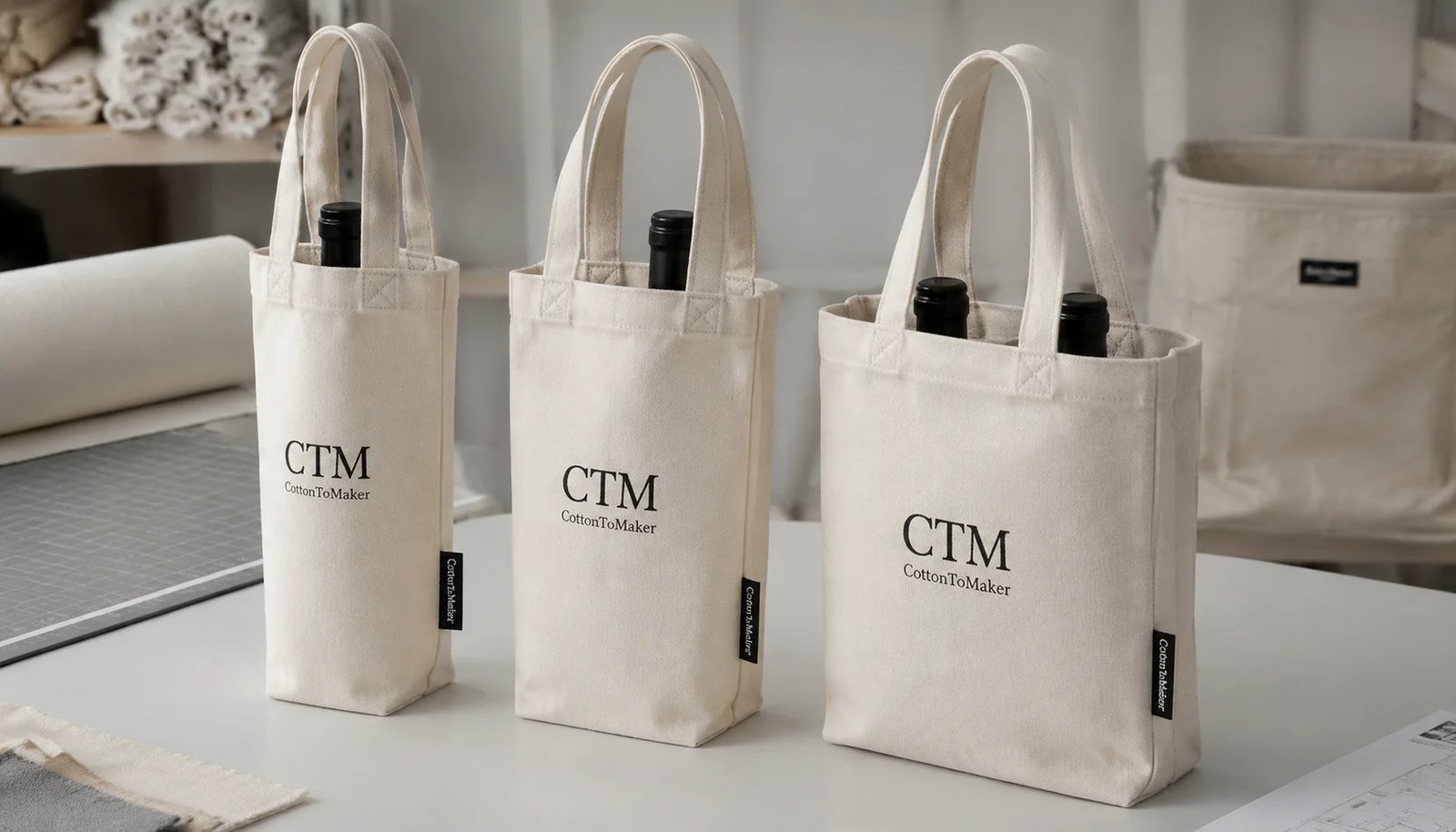
What problem this bulk pricing plan solves
Canvas wine carriers are increasingly used by skincare and wellness brands for more than wine. They work for tall glass bottles, body oils, fragrance, bath products, candle-and-mist bundles, press kits, hotel amenities, and seasonal retail gift sets. The buying problem is that many quotes treat the item as a simple promotional bag, while the actual use is closer to protective premium packaging. If the quote does not define the bottle load, divider, handle strength, and print standard, the lowest price can create breakage risk and a weak retail presentation.
A good canvas wine carrier RFQ should make the supplier price the real product, not an imagined light-duty bag. For skincare brands, the carrier often has to look clean on shelf, hold heavier glass packaging, and match brand colors more closely than a giveaway tote. This article focuses on how to build a bulk pricing plan that procurement teams can use to compare suppliers fairly and prevent specification gaps before sampling.
- Use this guide when the carrier holds bottle-shaped skincare, fragrance, candle, wellness, or gifting products.
- Treat the carrier as part of the product experience, not only as an outer bag.
- Price comparison must include fabric weight, structure, logo process, packing, inspection, and freight impact.
Start with the bottle load, not the bag photo
The most common sourcing mistake is sending a reference photo without the product dimensions. A wine carrier made for a standard 750 ml bottle may not fit a tall pump bottle, wide glass body oil, boxed fragrance, or two-piece skincare set. The internal width, gusset, height, and handle drop should be based on the finished product and any secondary packaging. If the bottle has a pump, cap, or fragile collar, the carrier height and opening shape matter more than the outside appearance.
For bulk pricing, provide the factory with the maximum filled weight and whether the consumer will carry one bottle, two bottles, or a complete gift set. A single 500 ml glass bottle with outer box can already be heavy; two glass bottles can put real stress on handle seams. If the factory only quotes from a picture, they may choose lighter canvas, a narrow gusset, and simple folded handles to win the price comparison.
- Share bottle diameter, height, shoulder shape, cap height, and filled weight.
- State whether the carrier must fit a boxed bottle or an unboxed bottle.
- For two-bottle carriers, define whether glass bottles may touch each other during transport.
- Allow enough opening width for easy packing by warehouse staff; a too-tight fit slows assembly and damages labels.
Fabric weight choices that affect price and performance
For canvas wine carriers used by skincare brands, 10 oz to 12 oz cotton canvas is usually the practical range. In GSM terms, that is roughly 340 to 410 GSM depending on weave and finishing. This weight gives a cleaner stand, better print surface, and stronger handfeel than light cotton sheeting. It is also still manageable for sewing small gussets, dividers, and reinforced handles. For a very soft, foldable gift bag, 8 oz can work, but it should not be assumed suitable for heavy glass unless tested.
Heavier 14 oz canvas can feel premium and structured, but it changes more than the unit price. It increases material cost, carton weight, needle pressure during sewing, and sometimes defect rate around tight corners. If the carrier needs to stand upright in retail displays, a heavier fabric or added lining may be justified. If the carrier is mainly used for gift kit handout or e-commerce insert packaging, 10 oz to 12 oz is often a better cost-performance choice.
- 8 oz canvas: suitable for light promotional use and low filled weight; higher risk of sagging.
- 10 oz canvas: common entry point for branded bottle carriers with moderate load.
- 12 oz canvas: stronger handfeel and better structure for retail skincare bundles.
- 14 oz canvas: premium and sturdy, but higher cost, heavier freight, and less forgiving sewing.
Single-bottle, two-bottle, and divided structures
A single-bottle canvas carrier is the simplest and normally the best starting point for one hero product. The cost is controlled because there is less sewing and fewer internal parts. The key details are gusset depth, bottom seam strength, and handle attachment. A flat sleeve without enough gusset may look fine empty, but once a round bottle is inserted it twists the side seams and makes the logo sit unevenly.
Two-bottle carriers need more attention. The center divider can be a sewn fabric wall, a partial divider, or a reinforced partition. For skincare bundles, a divider is not only a convenience feature; it prevents glass bottles from knocking together. The divider height should suit the bottle height, and the top edge should be finished neatly because consumers will see it when opening the bag. A cheap low divider may reduce price but creates noise, movement, and breakage risk.
- Single-bottle carrier: lowest labor cost and easiest inspection.
- Two-bottle carrier without divider: only suitable for non-fragile or boxed products.
- Two-bottle carrier with divider: better for glass skincare, fragrance, oils, and gift sets.
- Reinforced bottom panel: useful when bottle bases are heavy or sharp-edged cartons are used.
Logo and decoration methods for skincare branding
Screen printing is usually the most cost-effective method for canvas wine carriers in bulk. It works well for solid logos, simple ingredient statements, line art, and one to three brand colors. For natural canvas, black, dark green, brown, navy, and muted skincare palette colors usually print cleanly. Fine serif type, small ingredient copy, and very thin lines need artwork review because canvas texture can soften edges.
Heat transfer can reproduce gradients and more complex art, but it may feel less natural on canvas and can add cost. Embroidery gives a premium feel, but on small bottle carriers it can pucker fabric and limit fine detail. A woven side label is a good option when the brand wants a subtle retail look instead of a large front logo. For premium skincare, the best result is often a restrained screen print plus a small woven label, not maximum decoration coverage.
- Screen print: best for solid logos, larger quantities, and controlled unit cost.
- Heat transfer: useful for gradients or photo-like artwork; test handfeel and adhesion.
- Embroidery: premium but not ideal for tiny text or thin canvas panels.
- Woven label: clean for boutique skincare brands and avoids large ink coverage.
- Water-based ink can feel softer; plastisol-like heavier ink may improve opacity but can feel less natural.
MOQ and bulk price breaks that make commercial sense
MOQ depends on how custom the carrier is. A simple natural canvas single-bottle carrier with one-color print may be feasible at lower quantities because the factory can use available fabric and standard sewing settings. Once the buyer requests custom dyed canvas, a non-standard size, two-bottle divider, woven label, individual retail packing, or several artwork versions, the economical MOQ rises. The factory has to account for fabric sourcing, cutting efficiency, print setup, machine changeover, and packing labor.
For planning, buyers can request price breaks at 500, 1,000, 3,000, and 5,000 units using the same specification. This shows whether the price is driven mainly by setup cost or by material cost. If the price drops sharply from 500 to 1,000 units, setup and labor balancing are important. If the price barely moves after 3,000 units, fabric and decoration are probably dominating the cost. Do not compare a 500-unit custom dyed order with a 5,000-unit natural canvas quote and call it supplier competitiveness.
- Lower MOQ is realistic for natural canvas, simple size, and one-color print.
- Higher MOQ is normal for custom dyed canvas, special GSM, lining, or multiple SKUs.
- Request price breaks using the exact same approved specification.
- Separate one-time charges such as screens, labels, sampling, and artwork adjustment from the unit price.
Cost drivers buyers should see in every quote
A professional quote for canvas wine carriers should show more than a unit price. The major cost drivers are fabric weight, carrier size, divider construction, handle type, logo method, packing, quantity, and delivery terms. Even if the supplier does not list every factory cost internally, the sales quote should state what is included. Otherwise, a low quote may exclude individual packing, use lighter fabric, skip reinforcement, or assume a smaller logo.
For skincare brands, packing can be a bigger cost factor than expected. If the carriers are shipped flat in bulk cartons for local gift set assembly, the cost stays controlled. If each carrier needs a polybag, tissue wrap, hangtag, barcode, size sticker, and retail carton sorting by SKU, the labor and material cost increases. Freight is also affected because structured carriers and loose packing increase CBM even when the unit weight is moderate.
- Fabric: oz/GSM, color, finishing, shrinkage control, and wastage.
- Labor: handle reinforcement, divider, gusset, bottom panel, trimming, and inspection.
- Decoration: screen setup, number of colors, print area, curing time, label sewing.
- Packing: polybag, tissue, carton quality, carton marks, sorting, and barcode application.
- Logistics: carton CBM, gross weight, incoterm, delivery port, and shipment mode.
Sample approval should test the real bulk conditions
A sample is only useful if it represents the bulk order. For canvas wine carriers, the pre-production sample should use the actual fabric weight, actual handle construction, actual print method, and intended packing method. A prototype made from available fabric can help confirm size, but it should not become the final approval if the bulk fabric and print are different. Skincare packaging relies on visual consistency, so shade and print handfeel matter.
During sample review, load the carrier with the real product or a matching test weight. Observe how the side seams sit, whether the bottom distorts, and whether the handle is comfortable. For two-bottle versions, shake the filled carrier gently to see if bottles knock together. Check if the logo remains centered when the carrier is filled; some designs look centered when empty but shift when round bottles push the gusset outward.
- Approve size using real bottles or accurate dummies, not only a ruler measurement.
- Review logo after filling the carrier, because fabric tension changes placement perception.
- Test handle drop with the intended retail use: hand carry, over-wrist carry, or gift presentation.
- Keep the approved sample sealed and referenced in the purchase order.
QC thresholds for bulk production
Quality control should be written in measurable terms. For dimensions, practical tolerances may be plus or minus 5 mm on width and gusset and plus or minus 10 mm on height, unless the bottle fit requires tighter control. For fabric, GSM should not drift below the agreed range. For stitching, inspect skipped stitches, broken threads, loose bartacks, open seams, and uneven divider placement. Cosmetic issues on natural canvas should be judged against an approved shade and slub range, because natural cotton will not look like plastic-coated material.
The filled-load test is important. A carrier may look neat on an inspection table but fail when loaded with two glass bottles. The buyer should define a test weight based on the product load plus a safety margin. The handle can be hung for a set period and then inspected for seam opening, thread breakage, or fabric tearing. Print QC should include color, position, registration, curing, and rub resistance. A beautiful fabric bag with a smudged skincare logo will still be rejected at retail.
- Dimension tolerance: define by bag area and bottle fit sensitivity.
- Stitching: no open seams, no loose bartacks, no raw fraying edges in visible areas.
- Load test: use target filled weight plus safety margin, especially for two-bottle carriers.
- Print: compare to approved sample under consistent light and test for obvious rubbing loss.
- Packing inspection: verify carton marks, quantity per carton, moisture protection, and deformation risk.
Packing and shipping decisions that change landed cost
Canvas wine carriers are usually better shipped flat unless the retail presentation requires shaping. Flat packing reduces carton volume and protects the buyer from paying air or ocean freight for empty space. However, over-compression can create deep creases, crushed handles, and distorted dividers. The factory should propose a carton quantity that balances CBM efficiency with shape recovery. If the bags will go directly into retail stores or gift assembly lines, cleanliness and easy counting are also important.
Individual polybags keep natural canvas clean but add plastic cost and may conflict with sustainability positioning. A paper belly band, recycled polybag, or bulk carton liner may be more appropriate depending on the retail channel. For distributors, carton labeling should include SKU, color, quantity, PO number, carton number, and gross weight. For importers, carton dimensions and CBM per 1,000 units should be available before order confirmation so freight estimates are not guessed at the last minute.
- Bulk flat pack: lowest packing cost and usually best freight efficiency.
- Individual polybag: cleaner for retail handling but adds cost and plastic use.
- Tissue wrap or paper band: better presentation, slower packing speed.
- Carton liner: useful for moisture and dust protection during ocean shipment.
- Export carton strength should match filled carton weight and stacking conditions.
Specification comparison for buyers
| Spec decision | Recommended option | When it fits | Buyer risk to check |
|---|---|---|---|
| Supplier route for bulk pricing | Direct factory for 1,000+ units; trading company only if combining many unrelated items | Best for skincare brands planning repeat gift kits, launch events, or retail packaging with controlled specs | Quote may look cheaper if fabric GSM, lining, divider, and packing are omitted; compare line by line, not only unit price |
| Fabric weight | 10 oz to 12 oz cotton canvas, roughly 340-410 GSM, natural or dyed | Good balance for serum, body oil, candle, fragrance, or wine-shaped skincare bottles | 8 oz canvas can collapse with heavy glass bottles; 14 oz improves structure but increases cost, freight weight, and sewing difficulty |
| Carrier structure | Single-bottle sleeve with gusset or two-bottle carrier with center divider | Single style suits one hero product; two-bottle style suits cleanser plus toner, oil plus mist, or holiday bundle | Divider height and stitching must protect glass from knocking; low or loose divider creates breakage complaints |
| Handle construction | Self-fabric reinforced handle or cotton webbing handle with bartacks | Needed when filled weight exceeds 1.2 kg or the carrier is used as a reusable gift bag | Thin folded handles without reinforcement may pass empty inspection but fail during retail use |
| Logo method | Screen print for solid logos; heat transfer for gradients; woven side label for subtle premium branding | Screen print is usually most cost-effective for 1-3 color skincare branding on natural canvas | Ink migration, poor registration, or stiff print handfeel can make a premium skincare pack look promotional |
| MOQ logic | 300-500 units for simple plain stock-like styles; 1,000+ units for custom size, dyed fabric, divider, and branded packing | Useful for testing boutique retail programs before committing to seasonal replenishment | Low MOQ with full customization often means higher unit price, limited color control, or shared material stock |
| Packing format | Flat packed in export cartons with divider protected; individual polybag only if retail cleanliness requires it | Flat packing reduces freight volume and works for B2B gift kit assembly | Over-compressed packing can crease canvas and deform handles; loose packing raises carton volume and landed cost |
| Quality evidence | Pre-production sample, inline photos, AQL final inspection, and filled-weight handle test | Suitable for importers and retail buyers who need repeatable performance across bulk orders | A perfect showroom sample is not enough; bulk sewing tension, print shade, and carton packing must be controlled |
Buyer checklist before sampling
- Define the actual product load: bottle diameter, height, filled weight, cap shape, and whether glass-to-glass contact is allowed.
- Specify canvas weight in oz and GSM, not just the word canvas; include acceptable tolerance such as plus or minus 5%.
- Choose single-bottle, two-bottle, or multi-compartment structure before requesting price; divider and gusset construction change labor cost.
- State logo size, number of print colors, Pantone references, and whether artwork is solid, fine-line, gradient, or full coverage.
- Separate sample cost, mold or screen charge, unit price, packing cost, and freight estimate in the quote comparison.
- Require a pre-production sample made with actual fabric, actual handle, actual print, and actual packing method before bulk cutting.
- Set handle strength acceptance based on filled load, not empty bag appearance; include a hanging or pull test requirement.
- Confirm carton dimensions, units per carton, gross weight, and whether bags are flat packed or shaped with inserts.
- Build lead time from artwork approval and deposit date, not from the first email quotation date.
- Keep one approved sample at the buyer side and one sealed sample at the factory for bulk inspection reference.
Factory quote questions to send
- What canvas weight are you quoting in oz and GSM, and is it greige, natural bleached, dyed, or washed fabric?
- Is the quoted price for single-bottle, two-bottle, or divided construction, and what are the finished internal dimensions?
- What filled weight is the handle construction designed to carry, and where will bartacks or reinforcement stitches be placed?
- Which print method is included in the quoted unit price, and what is the maximum logo size before the print charge changes?
- What is the MOQ for this exact fabric color, size, divider structure, and logo method, not only for a generic wine bag?
- Can the pre-production sample be made using bulk fabric and final print ink, and how many working days are needed after artwork approval?
- What packing is included: bulk flat pack, individual polybag, tissue wrap, hangtag, barcode sticker, or retail-ready carton sorting?
- What are the carton size, units per carton, estimated gross weight, and CBM per 1,000 units?
- Which QC tests are performed before shipment, and can you provide inspection photos of print registration, handle bartacks, dimensions, and carton marks?
- What price breaks are available at 500, 1,000, 3,000, and 5,000 units using the same approved specification?
Quality-control points to confirm
- Finished dimensions should match the approved sample within practical tolerance, commonly plus or minus 5 mm for width and gusset and plus or minus 10 mm for height unless a tighter retail fit is required.
- Canvas GSM should be verified against the approved specification; large reductions in fabric weight are a common hidden cost-cutting issue.
- Handle attachment should pass a filled-load hanging test using the buyer's target weight plus a safety margin; inspect bartacks for skipped stitches and loose threads.
- Divider stitching on two-bottle carriers should be straight, secured at the top and bottom, and high enough to prevent bottle contact during normal handling.
- Logo print should match approved color standard, placement, size, opacity, and curing quality; rubbing should not create obvious ink loss.
- Seams should be neat with consistent stitch density, no open seams, no broken stitches, and no raw edges that can fray into the product area.
- Natural canvas should be checked for unacceptable stains, weaving defects, oil marks, heavy slubs, or color variation beyond the approved sample range.
- Packing should protect the carriers from moisture, crushing, odor transfer, and carton abrasion; carton marks should match the purchase order.