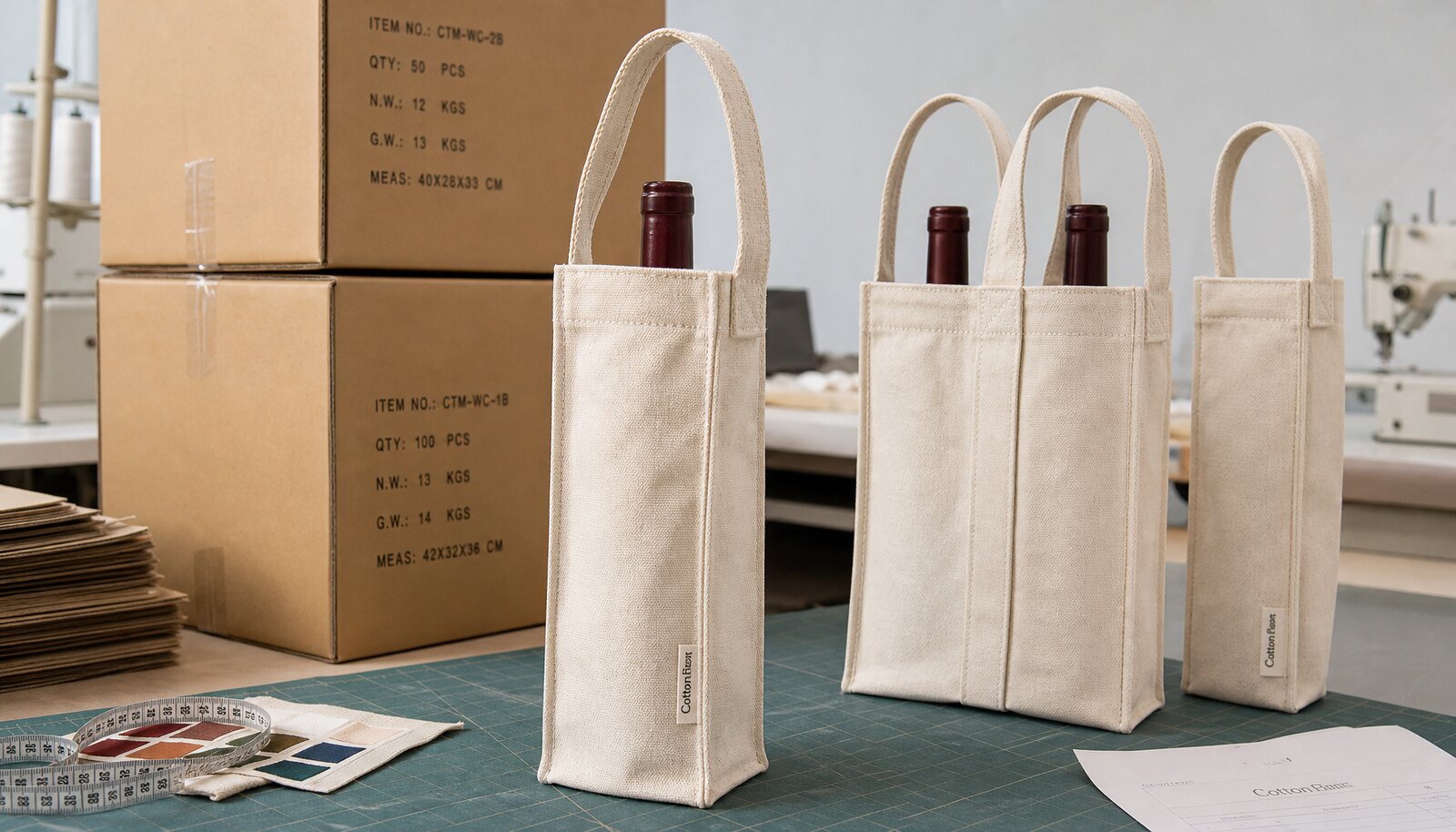
Why carton planning matters more than the carrier price
For canvas wine carriers in corporate gifting, the carton is not a side issue. It controls how many sets you can ship, how much freight you pay, and how many units survive the trip without wrinkles, edge crush, or print damage. Buyers often compare unit price first and discover too late that the cheapest carrier forces an oversized carton, extra dunnage, or a higher carton count per shipment. The real buying problem is not only the bag cost. It is whether the finished pack can move through warehousing, overseas freight, and final distribution without rework.
A practical quote must therefore start with the set format. One bottle, two bottles, or a mixed gifting set each creates a different packout. A one-bottle sleeve may look simple, but if it folds awkwardly or catches on the print, the shipping carton needs more room and better interleaving. A two-bottle carrier is structurally heavier and usually needs a stronger master carton. If you define the final shipment shape first, the factory can quote the bag, the insert, and the carton together instead of guessing around a loose spec.
- A low unit price can hide higher freight and packing waste.
- The packout decision should come before carton costing.
- Corporate gifting orders fail when the shipping format is guessed, not engineered.
Lock the carrier spec before you ask for carton pricing
The supplier cannot plan cartons correctly if the carrier dimensions are vague. Start with the bottle profile: standard Bordeaux, Burgundy, champagne, or a custom bottle with wider shoulders. Then define whether the canvas carrier is a snug sleeve, a structured bag with base depth, or a stitched set with divider panels. A 12 oz canvas carrier may be acceptable for lightweight promotional use, but many corporate gifting programs need 16 oz canvas to hold shape once the bottle is inside. The fabric weight changes not only the hand feel but also the folded thickness and the total carton load.
Do not quote only flat size. Ask for finished dimensions, internal clearance, and the exact stitch construction around the handle and base. If the bag is too tight, the bottle rubs the seam and the carrier looks deformed in the carton. If it is too loose, the product shifts during transit and the box count becomes unreliable. Good factories will also tell you whether the bag needs a lining, bottom board, or divider stitch to protect the bottle from carton pressure.
- Specify bottle diameter and bottle height, not just bottle volume.
- Request finished dimensions after sewing and trimming.
- Use 12 oz canvas only when the use case does not require structure retention.
- Use 16 oz canvas when the carrier must hold shape for gifting, display, or reuse.
Choose a packing architecture that matches the gift format
The most common mistake is designing the carrier and the carton separately. In a corporate gifting program, the packing architecture should move as one system: carrier, protective wrap, insert or divider, inner pack, then master carton. That sequence matters because each layer affects the next. A simple polybag may protect the fabric from dust, but it can also trap moisture if the warehouse climate is humid. Tissue adds presentation value, but it adds thickness and changes how many units fit in the carton. A branded insert card can improve the unboxing experience, but it can also bend if the carton is overfilled.
Think in terms of the final route. If the order ships by sea and then moves through a distributor warehouse, the master carton needs stronger compression resistance and more consistent fill. If the order goes directly to an event packer or retailer, the carton can be optimized for easy opening and faster carton count verification. Buyers should ask the factory to show one complete packout sample, not just the bag sample. If the full set does not close cleanly, the carton plan is not ready.
- Use one packout drawing for the carrier, insert, and master carton.
- Keep moisture-sensitive materials out of sealed polybags when humidity is a risk.
- Do not overfill cartons just to raise carton count per shipment.
Compare supplier routes before you compare unit prices
The cheapest quote is not always the factory with the best carton planning. A direct factory can usually control sewing, print registration, and fold method, which is ideal when the buyer wants stable dimensions. A factory plus a local carton converter may cost more in coordination, but it can solve strength or print issues if the master carton must meet a stricter retail or export requirement. A trading company can simplify communication, but only if they can pass through the technical details without changing the spec at each revision.
For urgent orders, a stock carrier supplier can work, but the buyer must accept less control over size tolerances and packing consistency. That route makes sense only when artwork is simple and the campaign is time-sensitive. For repeat corporate gifting programs, the best route is usually a factory that can quote the carrier, the logo method, and the carton build in one line item schedule. That lets procurement compare apples to apples and see where the real cost sits.
- Direct factory: best control over dimensions and repeat quality.
- Factory plus carton specialist: best when outer carton strength is the main risk.
- Trading company: useful for consolidation, but only if the technical spec is locked.
What the quote should expose about real cost drivers
A usable quote for canvas wine carriers should separate material, sewing, print, packaging, and carton costs. Buyers need to know whether the price assumes pre-shrunk canvas, what GSM the fabric is based on, how many print colors are included, and whether the carton price includes inner dividers or only the outer box. If the supplier gives a single all-in unit price, ask for the breakdown. Otherwise it is difficult to compare two offers when one includes a kraft insert, one includes polybags, and one quietly assumes a lighter fabric weight.
Quote data should also reveal MOQ logic. Some factories price by carrier MOQ, others by print MOQ, and others by carton size MOQ. That matters because corporate gifting orders often have multiple SKUs under one campaign. A buyer may need a 1-bottle carrier, a 2-bottle carrier, and a single color logo, but the carton count may differ for each line. The cleanest quote shows the minimum order per design, per print setup, and per carton configuration so the buyer can see where consolidation will save money.
- Ask for separate lines for fabric, sewing, print, packing, and carton.
- Confirm whether the quote assumes pre-shrunk or post-shrink measurements.
- Request MOQ by style, color, print setup, and carton layout.
- Insist on gross weight and carton count per master carton.
Sample approval should test fit, finish, and carton behavior
A sample is not approved because it looks close enough on the table. It is approved when it passes the real use case. Put the actual bottle inside. Close the carrier. Fold it the way the warehouse will fold it. Then pack the sample into the proposed carton and move the carton through basic handling. That exposes whether the seam bites into the bottle, whether the handle stands proud and distorts stacking, or whether the print rubs against neighboring pieces. For corporate gifting, buyers should also inspect how the sample presents when opened. A carrier that looks premium in hand but collapses in carton is not production-ready.
The sample should also validate the packaging sequence. If the carrier needs a tissue wrap, a belly band, or a divider board, the approved sample must include those items exactly as they will ship. Changing the packout after sample signoff is a common cause of delays because the carton size and gross weight change together. If the supplier wants to make the sample in a different thickness or with a lighter print, treat that as a separate revision. Approval should be based on the actual production route, not a prettier hand sample.
- Test with the final bottle, not a placeholder bottle.
- Pack the sample in the final carton before signoff.
- Reject samples that change shape, print appearance, or packout after folding.
- Approve only after the buyer and factory agree on the same measurement sheet.
Branding choices that survive packing and transit
Canvas wine carriers usually work best with a print method that suits the fabric surface and the brand's color discipline. Screen print is often the most practical for one or two spot colors because it holds up well on natural canvas and keeps the branding cost manageable. If the design is more refined, a woven label or side label can add a premium cue without loading the face panel with ink. Embroidery can look strong, but it may change the fabric drape and increase the chance of distortion when the carrier is folded into the carton.
Whatever method you choose, the artwork must be positioned with carton behavior in mind. A print too close to a fold line can crack where the bag compresses in transit. A label placed where the handle stacks can create a ridge and reduce carton efficiency. Buyers should request a production proof that shows exact placement, color references, and the final pack direction. For repeat programs, the same logo position should be retained across seasons unless there is a clear commercial reason to change it.
- Use screen print for stable, simple logos and repeat orders.
- Use woven or side labels when the brand wants less surface ink.
- Avoid placing artwork across folds, seams, or handle stress points.
Lead time risk comes from carton changes, not only sewing capacity
Many buyers underestimate how often a carton revision delays a bag order. The factory may have canvas in hand, but if the master carton size changes after sample approval, the whole packing schedule can move. That means new die lines, updated carton printing, revised pallet counts, and sometimes a new freight booking. For corporate gifting, where delivery dates are often tied to a campaign launch or event date, the carton should be frozen at the same time as the carrier artwork. Delaying that decision creates avoidable pressure on the line.
It also helps to break lead time into stages. A realistic schedule should show sample making, sample confirmation, material booking, print preparation, sewing, packing, and final dispatch. Buyers should ask what parts are on the critical path. If the print is the slowest item, the factory should reserve screens or digital setup early. If the carton is outsourced, carton lead time must be measured separately from bag sewing time. This is where many otherwise strong suppliers lose the schedule because the master carton arrives late or the wrong flute strength is booked.
- Freeze carton dimensions when the sample is approved.
- Separate sewing lead time from carton lead time.
- Ask which item is the schedule bottleneck before you issue the PO.
Build the RFQ so suppliers can quote the same thing
A good RFQ for canvas wine carriers should read like a production brief, not a marketing request. Include bottle dimensions, carrier size, canvas weight, print method, logo size, carton spec, packout, ship country, and the expected order split by SKU. If the order is for corporate gifting, say so clearly because it affects presentation, outer carton marking, and sometimes the acceptable finish level. The supplier should be able to respond with a matching spec sheet, a sample schedule, and a packout drawing. If they cannot, the quote is probably too vague to compare reliably.
The goal is not to force a factory into your preferred answer. The goal is to remove ambiguity before it becomes a claim or a delay. Buyers who send a complete RFQ usually get fewer revisions and cleaner pricing because the supplier is quoting a defined product rather than inventing one. In practice, that means you can compare two or three suppliers on the same dimensions, same fabric weight, same print method, and same carton count. Once the quote basis is controlled, procurement can judge quality and landed cost instead of guessing what is hidden in the line item.
- Include bottle dimensions, not only bottle volume.
- State the finished carrier spec and the carton spec in the same RFQ.
- Ask for a packout drawing and a revision-controlled sample sheet.
- Request the supplier's MOQ by style, print, and carton configuration.
Specification comparison for buyers
| Spec decision | Recommended option | When it fits | Buyer risk to check |
|---|---|---|---|
| Direct factory with carton design support | Use one factory that can cut, print, pack, and propose master carton layouts | Best for custom corporate gifting programs with changing pack counts or seasonal artwork | Confirm the factory has real carton sample capability, not only a sales promise |
| Factory plus local carton converter | Keep the wine carrier at the bag factory and buy cartons from a nearby packaging specialist | Useful when carton strength or print finish must meet a retail standard | Watch for split accountability if damage appears between carrier packing and carton supply |
| Trading company or sourcing agent | Use an agent only if they can consolidate bag, insert, and carton data into one controlled RFQ | Fits buyers who need multi-category sourcing and single-point communication | Risk of quote padding, hidden sub-supplier changes, and slow problem tracing |
| Stock carrier supplier | Choose only if artwork is simple and delivery is urgent | Works for temporary promotions or low-stakes internal gifting | Dimension drift and carton mismatch are common because stock inventory is rarely built to your exact packout |
| 12 oz canvas | Use for light-duty single-bottle carriers or lower-cost gifting | Fits short campaigns, mailer-style packs, or low freight exposure | Check handle reinforcement and seam recovery because thin canvas shows stress fast |
| 16 oz canvas | Use for premium gifting, repeated handling, and better structure in transit | Best when the carrier will be reused, photographed, or packed into higher-value sets | Higher unit weight changes carton count, gross weight, and freight cost |
| Screen print with 1 to 2 spot colors | Choose for clean branding on natural canvas and stable repeat runs | Fits logo-led corporate gifting with controlled color count | Approve registration, ink hand feel, and dry rub resistance before carton lock |
| Woven label or side label branding | Use when the brand wants a quieter, premium look that survives packing | Good for gift programs where the carrier is part of a longer shelf or reuse cycle | Verify label placement does not interfere with fold lines or carton nesting |
Buyer checklist before sampling
- Confirm bottle size, bottle shape, and total set count before the supplier quotes carton dimensions.
- Specify canvas weight in GSM or oz, seam allowance, handle reinforcement, and liner if any.
- State print method, color count, artwork size, and whether the logo must survive rubbing and folding.
- Define the packout: individual polybag, tissue, insert card, inner carton, master carton, or mixed set.
- Ask for finished sample dimensions, not just flat cut size.
- Request carton spec with board grade, flute type, burst or edge crush requirement, and gross weight target.
- Set acceptance criteria for stitching, print alignment, odor, moisture, and carton compression.
- Get production lead time broken into sample, material booking, bulk sewing, packing, and ship date.
Factory quote questions to send
- What finished bottle diameter and carrier clearance did you use to calculate the bag pattern?
- What GSM or ounce weight is quoted for the canvas, and is it before or after finishing?
- Can you show the carton dimensions, carton count per master carton, and estimated gross weight?
- Which print method are you proposing, and what is the setup cost for each color or position?
- What is the minimum order quantity for the carrier, the printed artwork, and the carton size?
- Will you pack each piece in a polybag, tissue, or insert, and is that included in the quote?
- What test or inspection standard do you use for stitching strength and carton compression?
- How many days are needed for sample approval, bulk production, and booking the final shipment?
Quality-control points to confirm
- Finished dimensions must fit the bottle with controlled clearance, not a loose or overstretched body.
- Handle stitches should be even, locked, and reinforced at stress points with no skipped stitching.
- Print registration must stay within the agreed tolerance and show no cracking, bleeding, or sticky surface.
- Fabric weight should match the approved sample and not drop below the buyer's minimum GSM or oz spec.
- Master cartons should survive stacking and normal handling without corner crush or panel bulging.
- Polybags or inserts must not trap moisture or leave odor on the fabric during storage.
- Outer labels, carton marks, and packing list quantities must match the approved packout exactly.