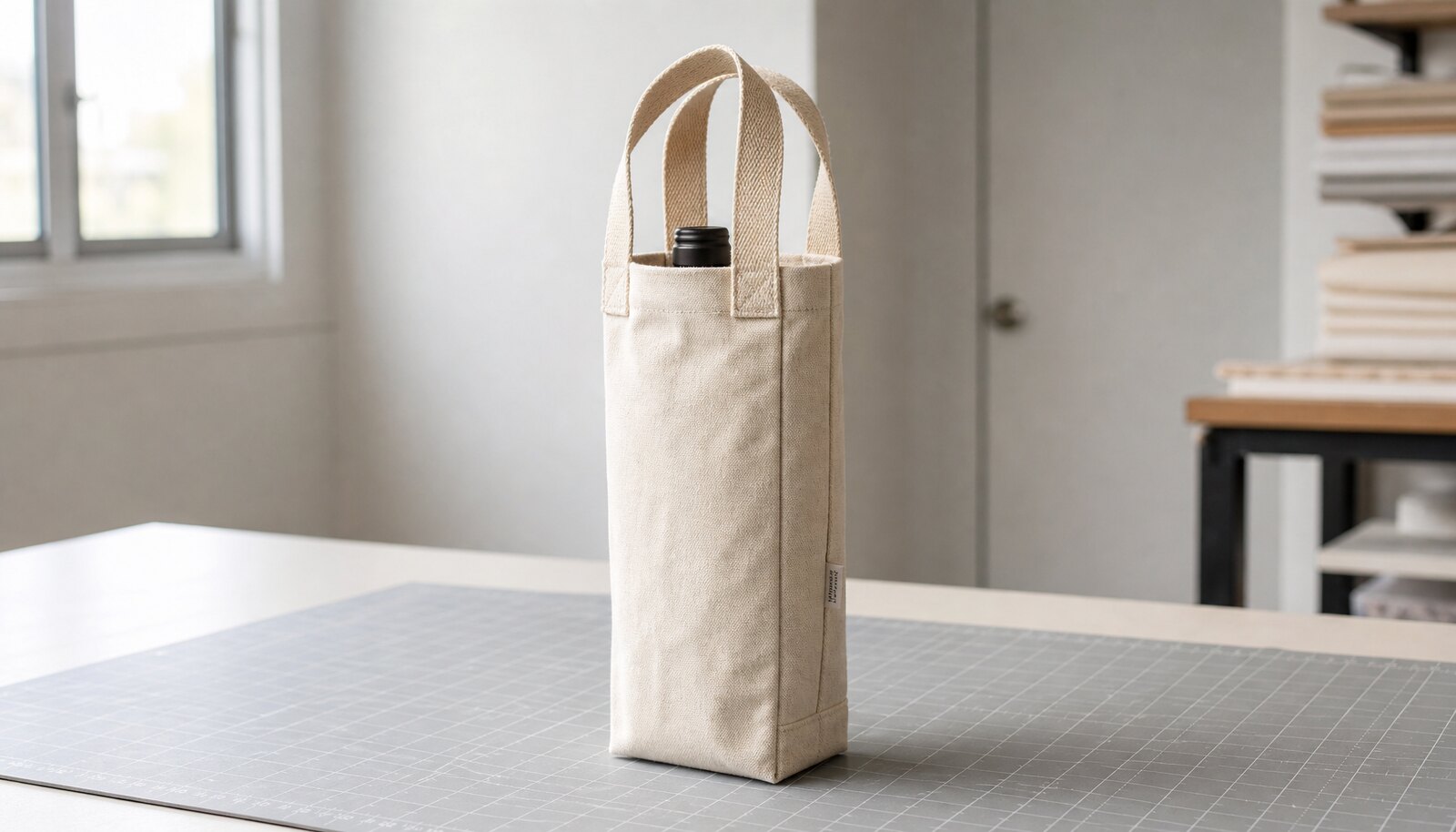
Why the RFQ needs more structure for gift shop bottle bags
Canvas wine carriers look simple, but procurement buyers know that simple products create the most quote noise when the brief is thin. A factory can price a “wine tote” in several different ways depending on whether it assumes a 750 ml bottle, a broader spirits bottle, a heavy-bottom glass bottle, a retail-ready pack, or a basic carry bag for warehouse handling. If your RFQ does not pin down those choices, the lowest quote can easily be the least comparable one.
Gift shop buyers have an extra challenge because the bag is not just a transport item. It is part of the shelf story. In museum shops, tourist stores, hotel retail, winery tasting rooms, and seasonal gift programs, the carrier has to work visually at shelf distance, survive customer handling, and still pack efficiently. That means the RFQ should describe the merchandising use, not just the physical object. The same carrier might need to stand upright beside a bottle on display, fit tissue or a gift tag, or look premium enough to justify a slightly higher ticket.
The practical sourcing goal is to make every supplier price the same item on the same assumptions. That is more important than writing a long brief. Include the bottle size, fabric weight, construction style, decoration method, packing format, and delivery target in one document. If you want the supplier to propose options, make that explicit too. Ask for an alternate price for a simpler build and a more premium build so you can compare the impact of structure instead of guessing at it later.
A better RFQ also reduces back-and-forth after sampling. When the supplier receives only a logo file, the first sample often comes back with the wrong opening width, an awkward handle drop, or a fabric that feels too thin for the retail position. That is not just a sample problem; it is a brief problem. The more clearly the RFQ describes the retail outcome, the fewer revisions you need to manage before production release.
For seasonal gift programs, the RFQ should include the sell-by window, not just the order date. If the product is meant for holiday selling, the supplier needs time for material buying, print approval, sample transit, and carton planning. Buyers who build those steps into the brief get cleaner schedules and fewer rushed substitutions.
Mini buyer rule: if a supplier can quote the carrier without asking what bottle it must fit, the RFQ is still too vague.
- Name the retail channel: gift shop, wine shop, museum store, hotel retail, or seasonal pop-up.
- Clarify whether the carrier is a standalone SKU or part of a gift set.
- Give one reference photo or one existing sample to anchor the build.
- State the required delivery window so the factory can plan materials and line capacity.
Start with bottle fit and merchandising use, not artwork
The first sourcing decision is the bottle, not the logo. A generic-looking canvas bag can still fail if the bottle diameter, shoulder shape, or overall height is outside the assumed range. The problem shows up quickly in production: the bag may be too tight at the neck, too loose at the base, or overly shallow once the bottle is inserted. For gift shop buyers, that matters because the product has to look intentional on shelf and still feel easy for the shopper to pick up.
Ask the supplier to quote against the actual bottle or a measured bottle spec, not just a “wine bottle” description. At minimum, share bottle height, widest body diameter, base diameter, and any unusual neck or shoulder profile. If the carrier must also fit sparkling wine, olive oil, spirits, or non-standard glass shapes, name those use cases separately. One bag can sometimes cover more than one bottle family, but only if the dimensions are intentionally designed around the largest likely bottle.
Merchandising use affects construction. A bag sold empty as a reusable souvenir can be softer and more forgiving than one sold with a bottle already packed inside. A carrier that sits in a retail display may need a structured base insert so it stands upright. A carrier that hangs on a hook may need a different handle drop than one that sits in a counter bin. If the bag is part of an in-store gift set, the inside dimensions must leave room for tissue, an insert card, or a neck tag without forcing the seams.
It also helps to define the target feel. Some gift shops want a value item that supports an impulse purchase price. Others want a more substantial reusable carrier that feels closer to a gift accessory. The quote should reflect that choice. A buyer can ask for one commercial build and one premium build so the team can see exactly how much structure costs. That is better than asking the factory to “make it better” without a measurable target.
A practical sample note is to ask the supplier to test the actual bottle plus any closure, capsule, or neck wrap that changes the effective dimensions. That small step catches many fit issues before bulk production starts.
- Measure bottle height, widest body diameter, and base diameter.
- State whether the carrier is for one bottle, two bottles, or mixed formats.
- Note whether the bag must stand upright on shelf or only carry safely in hand.
- Say whether the purchase is for empty carriers, bundled gift sets, or bottle-included merchandising.
Use fabric weight and finish as buying variables, not just price points
Canvas weight is one of the easiest spec lines to understand and one of the easiest to oversimplify. A 10–12 oz body can be perfectly suitable for value-oriented gift shop programs if the bag has a sensible build and the bottle is not unusually heavy. When the buyer wants a more premium retail feel, better shape retention, or a carrier that will be reused, 14–16 oz is often easier to merchandise because it holds its form better and looks less flimsy in the hand.
The key procurement point is to ask for the finished fabric spec. Canvas can be washed, dyed, coated, pre-shrunk, lined, or otherwise finished in ways that change both performance and price. If one supplier quotes raw weight and another quotes finished weight, the comparison is not clean. Ask whether the quoted weight is before or after finishing and whether the fabric is natural, bleached, dyed, or treated. A dyed or coated build may look better on shelf, but it can also change hand feel, lead time, and lot consistency.
Heavier fabric is not automatically better. It increases material cost and carton weight, which matters if the order ships by air or if your margin is tight. It can also make the bag feel too rigid for a lower-price gift assortment. Buyers should think in retail terms: does the expected selling price support the extra structure? A tourist shop with a modest ticket may favor a lighter, clean-looking bag; a premium boutique or winery store may gladly pay for a firmer carrier that looks more giftable.
Color control also belongs in the fabric spec. Natural canvas can vary in tone from lot to lot, and that is usually acceptable only if the buyer defines the tolerance in advance. For dyed canvas, ask for a reference sample or Pantone target and define what level of shade variation is acceptable between runs. If you plan to reorder later in the season, this matters more than many buyers expect because gift shop programs often need continuity across replenishment orders.
If you want the supplier to recommend a construction, ask them to quote two fabric options side by side: one value build and one premium build. That makes the cost difference visible instead of hidden inside a single line price.
- 10–12 oz: usually suitable for value gifts, promotions, and low-cost seasonal programs.
- 14–16 oz: usually better for premium gift shops, stronger shape retention, and repeat use.
- Ask whether the weight is finished weight or raw fabric weight.
- Confirm whether lining, coating, or pre-wash changes the final hand feel and price.
Compare construction options before you compare unit prices
A canvas wine carrier’s construction often determines how the product is perceived more than the artwork does. Two bags with the same logo can behave very differently depending on whether they are single-layer or lined, whether they have a bottom insert, and how the handles are reinforced. When buyers compare prices without comparing construction, they often end up selecting the wrong value point.
An unlined single-layer carrier is the simplest route. It is easier to source, faster to make, and usually the lowest-cost option when the print is simple and the bottle fit is straightforward. That works for value-oriented gift shop programs where the bag’s role is to carry the bottle and support the impulse purchase. A lined body or a double-layer base adds labor and material, but it improves shape retention and reduces the visible outline of the bottle. That makes the item look more intentional when it is sold as a gift accessory rather than only as a utility bag.
Handle build is another place where detail matters. Self-fabric handles keep the look cohesive and are often adequate if reinforcement is done properly. Webbing handles can improve comfort and durability, especially with heavier bottles, but they change the look and may move the product away from a softer gift-shop style. If the carrier will be reused, or if customer handling is rough, the reinforcement method should be explicit in the RFQ. Box-X stitching, bar-tacks, or equivalent stress-point reinforcement should not be left to factory preference.
Bottom design should match the merchandising plan. A flat base is inexpensive, but a structured insert helps the carrier stand upright and reduces tipping. That is particularly useful when the bag sits on shelf next to a bottle or inside a retail display tray. A buyer who wants a display-ready appearance should prioritize bottom structure before adding decorative extras that do little for function.
The most useful comparison question is not “Which is cheapest?” It is “Which construction supports the retail price point?” If the value is in low cost, keep the build simple. If the value is in premium shelf presentation, spend first on shape and reinforcement, not on decoration that may not improve sell-through.
- Unlined body: lower cost, faster to source, but less shape retention.
- Lined or reinforced body: better structure, higher perceived value, more labor.
- Bottom insert: useful for upright shelf display and bottle stability.
- Handle reinforcement: essential if the bag will be reused or loaded repeatedly.
Choose the branding method by artwork complexity and retail handling
The safest decoration method for most canvas wine carriers is still screen print, especially when the logo is simple and the fabric is natural canvas. It is easy to understand, it scales well for repeat orders, and it usually offers the best control over placement and ink coverage. For buyers managing seasonal assortments, screen print is often the least complicated route to a stable, repeatable product.
That does not mean every design should be forced into print. If the artwork has fine lines, gradients, or more complex detail, a heat transfer or other applied decoration may fit better. The tradeoff is that the buyer should pay closer attention to rub resistance, edge lift, and how the decoration looks after folding and packing. A complex design that looks good in the sample room can still fail in retail handling if the finish is not durable enough for repeated touching.
A woven label, sewn patch, or side label can be a good solution when the buyer wants a restrained premium look. Labels reduce the risk of misregistration on textured canvas and often work well when the brand story is minimal. The downside is that labels add sewing steps and change the visual language of the item. That can be a benefit if your store positioning is premium and understated; it can be a drawback if you want the bag to carry a bold seasonal graphic.
For short-run seasonal programs, decoration choice should also reflect the order cycle. If the product will not be reordered, a lower-complexity method may be enough. If it is a core SKU, it is worth spending more time on repeatability: locked artwork, clear placement measurements, and an approved color reference. Gift shop programs often fail when the second run is slightly off from the first because the supplier never had a precise decoration standard.
Good buyer practice is to ask how the factory cures the print, what their register tolerance is, and what happens if the first strike looks too light or too heavy. That tells you more about process control than a simple yes/no on whether they can print the logo.
- Screen print: best for simple graphics, repeat orders, and natural canvas branding.
- Heat transfer: useful for complex art or short runs, but requires rub testing.
- Woven label or patch: good for premium restraint and low-coverage branding.
- Do not overspecify large print areas unless you have checked fold lines and carton rub risk.
Set MOQ expectations around the real cost drivers
MOQ is not a single universal number. It changes with fabric sourcing, color setup, cutting efficiency, decoration method, and packing complexity. A factory may accept a lower MOQ for stock natural canvas with a one-color logo, then raise the minimum for custom dyeing, extra lining, or retail-specific packaging. Buyers who treat MOQ as a fixed answer often get surprised later when the supplier explains that the cost structure changed.
This is especially important for gift shops, where one season may require several designs but not huge volume in each design. If you ask for three graphics, you may accidentally trigger three separate minimums unless the base construction stays identical and only the branding changes. The RFQ should make that visible. If you want designs grouped into one production run, ask whether that changes the unit price, setup cost, or only the artwork handling.
The easiest way to keep MOQ manageable is to standardize the body and vary only the branding layer. Keep the same size, same fabric, same handle construction, and same insert style, then vary the woven label, hangtag, or small print element. That keeps the line efficient and reduces the risk of ending up with dead stock after the season ends. Buyers running assortments across multiple gift shop locations should pay close attention to this because small design differences can quickly become separate stock-keeping headaches.
Always ask whether the MOQ is quoted per design, per color, per size, or per combined shipment. Those are not interchangeable. A supplier may say yes to a total of 5,000 units but still require 1,500 per design or 2,000 per color. If the quote does not spell that out, it is not ready for clean commercial comparison.
A useful way to think about MOQ is as a set of thresholds rather than one number. The more variables you change at once, the more likely the MOQ climbs. Buyers who reduce the number of variables usually get better pricing and simpler replenishment later.
- One fabric, one size, one print method usually gives the lowest MOQ.
- Custom dye, lining, and complex packing each add setup pressure.
- Ask whether MOQ is per design, per color, or per combined shipment.
- If volumes are tight, customize labels or small print elements instead of the full body.
Build quotes so you can compare suppliers on the same basis
A useful quote breaks the product into components. If the supplier only gives one unit price, you cannot tell whether the offer is genuinely competitive or simply missing material, labor, or packing detail. For canvas wine carriers, request a line-by-line or at least assumption-by-assumption breakdown for fabric, cutting, stitching, handle reinforcement, decoration, inserts, and packing. That is the easiest way to compare offers that otherwise look similar.
The quote should also state trade terms clearly. EXW, FOB, or another Incoterm changes what is included in the headline price. Buyers often compare prices that are not on the same basis and then discover later that one supplier included export cartons, while another did not. Ask for carton dimensions, units per carton, gross weight, and net weight. In gift shop sourcing, those details matter because they affect freight, warehouse receiving, and shelf-ready packing decisions.
If you are comparing a direct factory with a trading company, ask both to explain the same cost components. A factory may have tighter control over production, while a trading company may simplify communication or combine multiple items into one shipment. Neither route is automatically better. What matters is transparency. If one supplier is much cheaper, look for differences in fabric weight, handle reinforcement, print method, or packing before assuming you found a better deal.
Good quotes also list assumptions and exclusions. For example: based on stock natural canvas, one-color screen print, one side only, standard polybag packing, and carton label included. That statement lets the buyer see what is actually covered. If the supplier cannot clearly state those assumptions, the risk shifts to your side after order placement. Procurement teams should insist that assumptions be written into the quote rather than left in email threads.
A useful review trick is to compare the carton spec first when one quote is much lower than the others. Hidden packing differences are one of the fastest ways a quote can look attractive while underpricing the real requirement.
- Request a cost split by body, handle, print, insert, and packing.
- Ask for carton dimensions, units per carton, gross weight, and net weight.
- Separate sample fee, tooling fee, and production unit price.
- Confirm the trade term before comparing quotes across suppliers.
A practical RFQ structure that gets cleaner answers
The best RFQs are organized in the same order every time so suppliers can answer them quickly and consistently. Start with a short product summary, then list the target bottle, dimensions, fabric spec, construction, decoration, packing, quantity, and delivery window. That sequence is simple for buyers and easy for factory teams to route to sampling, cutting, printing, and packing without rewriting the brief.
A useful RFQ should separate fixed specs from open options. Fixed specs are the items that must be built exactly: size, fabric weight, handle type, insert type, print count, and packing format. Open options are the items you want quoted as alternates: unlined versus lined, screen print versus label, standard carton versus retail-ready pack. This is especially helpful when you are still choosing between value and premium presentation.
A compact working structure might look like this: **Sample RFQ format** - Product: canvas wine carrier for one 750 ml bottle - Target channel: gift shop, wine retail, seasonal gifting, or tourism retail - Bottle fit: measured bottle dimensions or reference bottle photo - Fabric: oz or GSM, natural / dyed / coated / lined - Construction: handle type, bottom insert, seam reinforcement, gusset depth - Decoration: print method, artwork size, color count, placement - Packing: polybag, barcode, carton count, carton marks - Quantity: total volume and colorway split - Sample: pre-production sample with real bottle fit test - Delivery: approval date, production date, ship date This works because it forces the buyer to decide what is fixed and what is still negotiable. It also helps the supplier quote faster without guessing. If you need one version for a seasonal launch and one for core replenishment, keep the structure identical and only change the lines that differ. That makes quote comparison much easier across suppliers and across seasons.
A good RFQ is usually one spec sheet, one quote sheet, and one visual reference. It does not need to be long, but it does need to be specific. If the buyer is too broad, the quote comes back vague. If the buyer is too detailed without priorities, the supplier may answer the easiest parts and skip the rest. A balanced brief is more useful than a long one.
Keep a revision log as well. If you change the RFQ, date it and note what changed. That prevents suppliers from quoting different versions by accident and gives your team a clean record of what was approved.
- Use one product summary, one reference, and one spec list.
- Separate fixed specs from alternate options you want priced.
- Ask the factory to repeat back the assumptions in its own words.
- Keep a revision log so the team knows which RFQ version was sent.
Sample approval should test fit, finish, and packing together
Sample approval is where many RFQs either become solid procurement documents or remain just paperwork. For canvas wine carriers, the sample should not be approved only on appearance. The buyer needs to check fit with the actual bottle, handle comfort, stitch behavior, print placement, and the way the carrier packs into cartons. A bag that looks fine on a table can still fail once a bottle is inserted or once the packed carton goes through handling.
Ask for a true pre-production sample whenever the fit or decoration matters. A reference photo is not enough for a premium gift shop program, and a shipment sample is usually too late to correct meaningful issues. Once the sample arrives, test it with the actual bottle and any neck wrap, capsule, stopper, or gift insert that changes the effective size. If the carrier is supposed to stand upright on shelf, check that it does so with the bottle inside and that the silhouette still looks clean.
Use the sample review to catch issues that are hard to spot in a spec sheet. Check whether the opening is wide enough without stretching the seams, whether the handles feel balanced, whether the print sits away from fold lines, and whether the bottom insert actually improves stability. If a correction is needed, record it in writing and update the spec sheet rather than relying on verbal approval. That protects the bulk order from repeating the same mistake.
Packing should be part of sample approval too. A carrier that looks good naked can scuff inside a carton if the print rubs against rough paper or if the polybag traps moisture. Ask the factory to pack one test carton and inspect it after a simple handling or drop-style check aligned to your route. That will tell you if the packaging is fit for warehouse receiving or if the carton spec needs revision.
The sample stage is also the right time to confirm what the factory considers acceptable. Ask whether the production sample will be retained as the benchmark, who signs it off, and whether later inspection will compare to that sealed reference. The stronger that paper trail is, the easier it is to hold the supplier to the approved standard.
- Approve with the actual bottle, not just a visual check.
- Check fit, handle comfort, print placement, and shelf stability.
- Record all sample corrections in writing and update the spec sheet.
- Retain one signed reference sample as the production benchmark.
QC standards that are measurable enough to enforce
Quality control for canvas wine carriers should be written in measurable terms. Start with fabric. Agree the finished canvas weight tolerance before production, and inspect for visible defects that matter in gift retail: holes, heavy slubs, oil stains, uneven dyeing, or shade bands. If the product is natural canvas, define what level of color variation is acceptable between lots so the supplier does not treat broad shade differences as normal.
Stitching deserves a written standard too. Check seam straightness, stitch density, loose thread tails, and skipped stitches at handle joins, top seams, side seams, and bottom insert points. A practical acceptance reference is a minimum of 8–10 stitches per inch on visible load-bearing seams unless the approved construction requires something different. Reinforcement should be box-X, bar-tack, or another clearly identified method at each stress point. That makes it easier to inspect consistently.
Load testing should use the actual bottle or a close equivalent at the expected weight. Fill the carrier, lift it, set it down, and repeat. Watch for handle stretch, seam opening, bottle tipping, and distortion at the opening. If the carrier is meant to stand on shelf, test whether it remains upright with the bottle inside and whether the base insert actually supports the load. For gift shop buyers, shelf stability matters because the product is part of presentation, not only transport.
Decoration QC needs its own checks. Ask the supplier to confirm placement tolerance, color consistency, and curing method. Then test adhesion with a light tape pull, rub test, and fold test on the approved sample. If the print cracks, lifts, smears, or transfers during handling, it is not ready for retail. This is especially important on textured canvas where poor print work shows quickly.
Packing QC should confirm count accuracy, SKU separation, barcode readability, carton marks, and cleanliness. A carton should not crush the handles or rub the print against rough interior surfaces. If the route includes long transit, ask the factory to simulate a basic drop or transit check so you can see whether the packing holds up. The inspection standard should define what is acceptable, what is repairable, and what is rejectable before the factory starts cutting.
QC checklist snapshot: fabric, stitching, load, print, packing, carton, and retained sample. If any of those are missing, the inspection is incomplete.
- Use at least one physical load test with the actual bottle or close equivalent.
- Check stitch density and reinforcement on all load-bearing seams.
- Test print adhesion with rub or tape methods after curing.
- Inspect carton condition after a drop or transit-style simulation.
- Keep one signed reference sample as the production benchmark.
Specification comparison for buyers
| Spec decision | Option A | Option B | Procurement tradeoff | Cost / risk impact |
|---|---|---|---|---|
| Canvas body | 10–12 oz natural canvas | 14–16 oz heavier canvas | Lighter canvas works for value gifts and lower freight; heavier canvas holds shape better and looks more premium on shelf | Heavier fabric raises unit cost and carton weight, but usually improves presentation and reduces collapse risk |
| Construction style | Unlined single-layer body with bottom insert | Lined body or double-layer base | Unlined is faster and simpler; lined or reinforced builds improve perceived quality and bottle stability | Adds material, sewing time, and sometimes MOQ pressure; can improve retail sell-through for premium assortments |
| Handle build | Self-fabric handles with box-X reinforcement | Webbing handles or doubled handles with bar-tacks | Self-fabric keeps the look cohesive; webbing can improve comfort and durability on heavier bottles | Reinforcement adds labor but reduces tear risk at the top seam and during repeated carry tests |
| Bottle format | One 750 ml bottle | Two-bottle or mixed-format carrier | One-bottle carriers suit gift shops and impulse buys; multi-bottle versions work better for sets and hospitality gifting | More compartments mean more stitching, more structure, and more chances for fit variation |
| Branding method | 1–2 color screen print | Woven label, patch, or heat transfer | Screen print is usually best for simple logos and repeat orders; labels suit low-coverage branding or premium looks | Heat transfer can handle complex art but needs rub testing; labels may reduce print defects but change the visual style |
| Packing style | Polybag + SKU/carton labels | Retail-ready bundle pack or insert-ready carton | Basic polybag packing is cheaper and suitable for warehouse handling; retail-ready packing reduces store labor | Better packing lowers scuff risk and rework time, but can increase packing labor and carton volume |
| Supplier route | Direct factory | Trading company / consolidator | Direct factory is usually clearer for repeat specs and accountability; trading can help with consolidation or mixed baskets | Trading layers can blur responsibility for defects, but they may simplify multi-item holiday programs |
| Sample approach | Pre-production sample after material confirmation | Shipment sample or production reference photo only | A pre-production sample is safer when fit, print, and construction matter; a shipment sample is faster but less controlled | Skipping a true pre-production sample increases the risk of size drift, color mismatch, and handle failure |
| Lead-time planning | Standard repeat order with confirmed materials | New material, new artwork, or custom packing | Repeat orders are easier to schedule; custom inputs need buffer time for fabric, approvals, and carton prep | Rush schedules can force substitutions or incomplete QC unless the buyer locks specs early |
Buyer checklist before sampling
- Confirm the target bottle shape, bottle weight, and whether the carrier is for a standard 750 ml wine bottle, olive oil, spirits, or another glass format.
- Specify exact bag dimensions, gusset depth, handle drop, bottom insert style, and the minimum internal opening needed for insertion without forcing seams.
- Choose the canvas weight in finished oz or GSM and state whether the supplier must quote pre-wash, dyed, coated, lined, or unlined fabric.
- Define the decoration method, artwork size, print colors, Pantone references, and acceptable logo placement tolerance.
- Ask for a physical pre-production sample and insist on a real bottle fit test before production release.
- Confirm packing method, carton count, barcode format, retailer labels, and whether the goods must arrive shelf-ready or warehouse-ready.
- Request a quote split by body, handle, print, insert, and carton charges so unit prices can be compared cleanly.
- Set inspection criteria for stitch density, seam strength, print adhesion, stains, and carton drop performance before the factory starts cutting.
Factory quote questions to send
- What is the quoted fabric weight, and is that finished weight after washing, dyeing, coating, or lining?
- Is the MOQ based on one size, one print color, one fabric color, or the full combined order?
- Please separate the unit price into fabric, cutting, stitching, handle reinforcement, printing, insert, and packing if possible.
- What bottle dimensions did you use to calculate fit, and what is the maximum base diameter the carrier can accept comfortably?
- What is included in the sample fee, and can the pre-production sample cost be credited against the bulk order if approved?
- Please confirm your lead time after sample approval, and tell us what changes would extend it, such as artwork revisions or material sourcing.
- What packing configuration are you quoting: polybag, hangtag, barcode label, master carton count, and carton dimensions?
- What QC standard do you use, and can you share your defect thresholds for stitching, print alignment, and carton damage?
- Have you produced similar canvas bottle bags before, and can you share photos of reinforcement details, finished seams, and packed cartons?
- What trade term is included in the price, and are freight, export cartons, or customs documents included or excluded?
Quality-control points to confirm
- Fabric weight tolerance should be agreed before production; a practical control point is ±5% on confirmed finished GSM or oz weight unless the buyer specifies a tighter window.
- Visual fabric checks should reject holes, heavy slubs, oil stains, shade bands, and uneven dyeing that would be visible at shelf distance.
- Stitching should be inspected at handle joins, top seams, side seams, and bottom insert points; ask for consistent stitch density and no skipped stitches. A practical acceptance reference is a minimum of 8–10 stitches per inch on visible load-bearing seams unless the construction requires a different approved standard.
- Handle reinforcement should use box-X, bar-tack, or equivalent reinforcement at each stress point; pull tests should not show seam opening, thread breakage, or handle twisting beyond the approved sample.
- Print adhesion should be checked by tape test, light rub test, and folding test after curing. Reject prints that crack, smear, lift, or transfer color when the canvas is rubbed or folded as it would be in packing and retail handling.
- Print placement should be checked against the approved artwork with a visible tolerance window; text should not drift into seams, and logos should not be cropped by folding lines or side gussets.
- Finished dimensions should be measured on multiple pieces from the same lot, not just one sample. Size drift can make bottles too tight, too loose, or uneven in paired gift sets.
- Load testing should use the actual bottle weight plus a small margin where appropriate; the carrier should be able to hold the filled bottle without seam opening, handle stretch failure, or tipping that makes shelf display impractical.
- Carton testing should include a simple drop or transit simulation aligned to your shipping route. Check for crushed corners, broken handles, scuffed prints, and moisture exposure after packing and transport.
- Packing inspection should confirm count accuracy, SKU separation, barcode readability, carton marks, and cleanliness. Polybags should not trap excessive moisture, and printed surfaces should not rub directly against rough carton interiors.