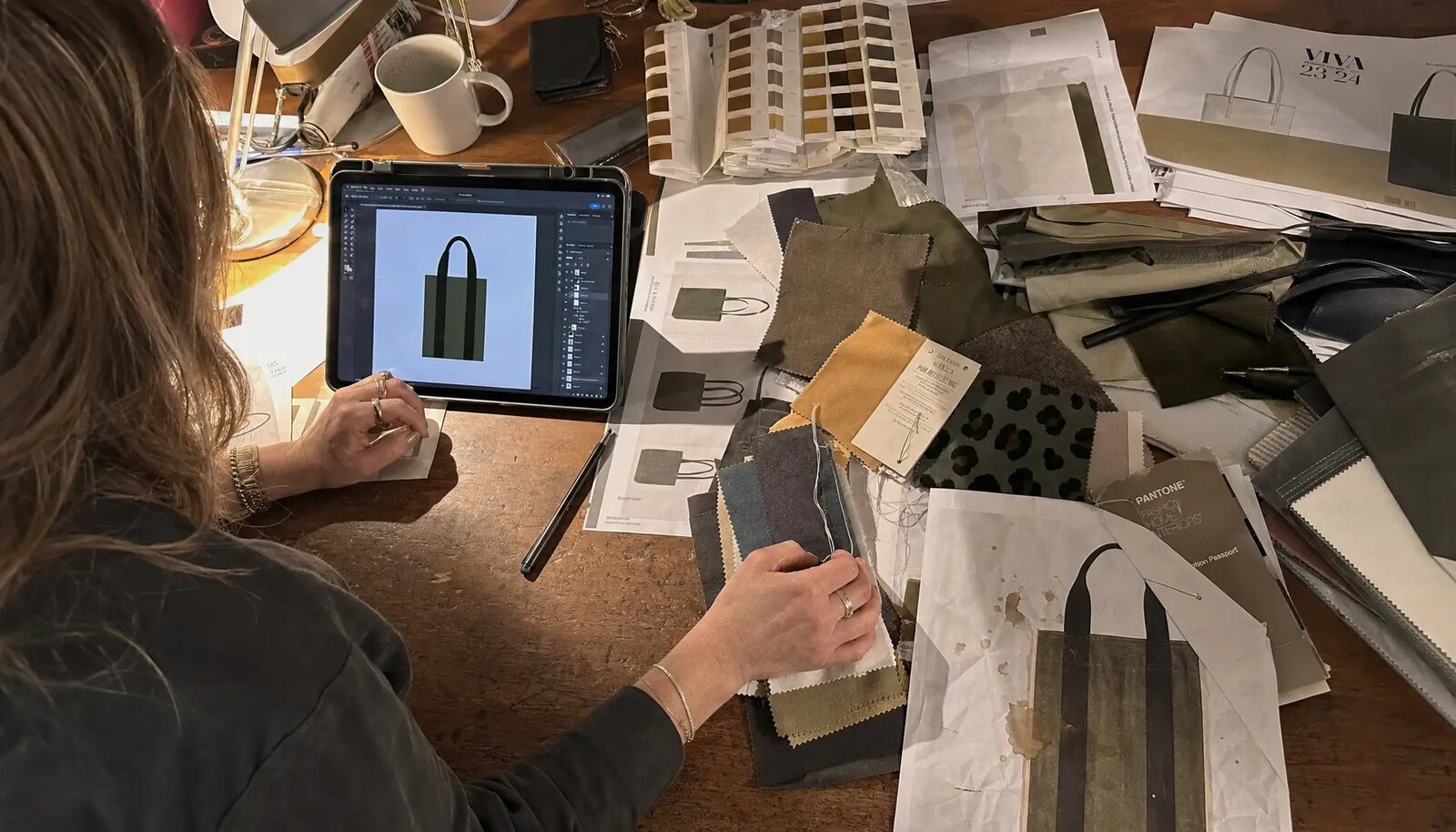
Why quotes drift on a simple carrier
Canvas wine carriers look simple in product photos, which is why pricing often drifts before buyers notice. One supplier may quote a light promotional sleeve with basic stitching. Another may price a retail-ready reusable carrier with heavier finished canvas, reinforced handle anchors, a better base, and a controlled packing method. The sample room photo can look close while the actual cost drivers are not close at all.
For eco apparel brands, the carrier usually has to do more than hold a bottle. It may support a holiday set, a corporate gift, a loyalty program, or a low-waste packaging story beside apparel. That makes the product part accessory, part packaging, and part brand signal. Procurement needs the RFQ to define the build clearly enough that suppliers price the same item, not their own interpretation of the category.
The goal is not to make the RFQ long. It is to make the right details measurable: bottle fit, finished GSM, handle construction, decoration, sustainability documents, packing, and QC thresholds. Once those details are fixed, unit price becomes easier to compare and sample revisions become less random.
- Treat missing fabric, handle, packing, or testing details as quote risk.
- Compare finished product specifications, not only photos and unit prices.
- Use the RFQ to remove interpretation before suppliers start sampling.
Start with bottle fit
The carrier should be designed around the bottle family it must hold. A 750 ml Bordeaux bottle, Burgundy bottle, and sparkling bottle have different shoulders, base diameters, and heights. A sleeve that looks tidy on one shape can stretch at the opening, twist at the base, or sit too low on another. If the program includes more than one bottle type, identify the primary fit and state the accepted secondary range.
Write fit requirements in measurable terms. Ask the supplier to confirm maximum bottle diameter, maximum height, and filled-bottle weight used for checking. For single-bottle carriers, the opening width and gusset depth usually determine whether loading feels smooth. For two-bottle carriers, the divider, base width, and total loaded weight become just as important as the outside dimensions.
Finished dimensions matter more than panel dimensions. Sewing allowance, pressing, washing, fabric relaxation, and handle attachment all change the final size. A useful RFQ gives finished height, width, depth, opening width, base width, and handle drop in millimeters, each with tolerance. For many small sewn carriers, plus or minus 5 mm on body size is a workable starting point, while opening width and handle drop often need tighter control.
- Name the reference bottle shape, not only 750 ml.
- Require maximum diameter, height, and filled-weight confirmation.
- Specify finished dimensions after sewing and finishing.
- For two-bottle carriers, define divider type and total loaded weight.
Specify canvas without overclaiming
Canvas weight is a major price and quality driver, but buyers should frame ranges carefully. Many sourcing programs for canvas wine carriers fall around finished 340-450 GSM, roughly 12 oz to 16 oz, but that is a typical range, not a universal rule. Lighter fabric can work for event giveaways or low-cost promotional runs. Heavier fabric can feel more substantial for retail use, but it may increase sewing difficulty, freight weight, and minimums.
The RFQ should ask for finished GSM, not only raw mill weight. Natural canvas, pre-shrunk canvas, dyed canvas, washed canvas, and recycled-content canvas can behave differently after cutting and sewing. If the carrier must hold shape, resist distortion, or present well on a shelf, ask the supplier to explain the finishing process and measurement point.
Color also needs control. Natural unbleached canvas can vary by cotton lot and finishing process. Dyed canvas adds shade, rub-fastness, and shrinkage checks. Washed canvas adds hand feel but can make dimensions and fold appearance harder to repeat. The buyer does not need every mill detail in the first email, but the quote should state enough to prove which fabric is being priced.
- Use finished GSM as the commercial comparison point.
- Frame 340-450 GSM as a typical sourcing range, not a fixed rule.
- Ask whether the quoted fabric is natural, dyed, washed, pre-shrunk, recycled-content, or organic.
- Require shade and shrinkage controls for dyed or washed programs.
Match construction to use
Handle construction is where inexpensive carriers often fail. A bottle is dense, and the user naturally lifts the carrier by the handle rather than supporting the base. For reusable or gift-grade programs, cotton webbing with sufficient width, attachment depth, box-x stitching, and bar-tacks is usually more appropriate than a minimal stitch line. The RFQ should state the handle width, drop, attachment length, reinforcement pattern, and thread type.
The base also deserves attention. A flat sleeve may be fine for low-cost packaging, but a carrier expected to stand upright needs a defined gusset, stable base, and seam finish. Two-bottle versions need a divider that reaches the correct height and remains aligned after loading. If the carrier will be placed into a gift box or shipped with apparel, packing flatness and fold memory should be part of the sample review.
Suppliers should quote the construction as a package, not as vague language such as reinforced handle. Ask them to describe the exact reinforcement included in the base price and what changes if the buyer upgrades the handle, adds a divider, changes webbing width, or moves from one bottle to two bottles.
- Specify handle width, drop, attachment depth, stitch pattern, and bar-tack placement.
- Define base construction if upright stability matters.
- For two-bottle styles, lock divider height, divider attachment, and loaded-weight test.
- Ask suppliers to price construction upgrades separately.
Verify sustainability documents
Eco apparel buyers should separate appearance from evidence. Natural canvas, kraft labels, and low-ink artwork may support a brand aesthetic, but they do not prove a sustainability claim. If marketing, packaging, retailer setup forms, or product copy mention recycled content, organic cotton, OEKO-TEX, restricted substances, or plastic-free packaging, procurement needs documents that support the ordered goods.
For recycled-content or organic claims, request the current certificate scope, certificate number, issue date, supplier name, and transaction record tied to the order. For OEKO-TEX or similar restricted-substance support, confirm the certified entity and product scope. If the certificate covers a mill but not the sewing factory, or a factory but not the fabric, the claim may need tighter wording or additional documentation.
Traceability should extend through production. Ask for fabric mill, roll ID, dye lot, cutting batch, print batch, sewing line, packing date, and final inspection date. If dyeing, printing, sewing, or packing is subcontracted, the supplier should identify the step and the responsible site. This makes later defect investigation practical and keeps claim files from depending on sales-language shortcuts.
- Do not rely on a logo screenshot as claim proof.
- Keep certificate scope and transaction records with the PO file.
- Define plastic-free packaging by material, not intention.
- Require subcontracted production steps to be named.
Choose decoration by artwork risk
Decoration quality on canvas depends on weave, ink coverage, artwork detail, and placement. A one-color screen print often works well for bold logos and repeat runs. It is efficient, familiar, and easy to inspect when the artwork has clean shapes. Fine lines, small text, multiple colors, and artwork near seams require more control over registration, opacity, and cure.
A woven label, sewn patch, or small side tab may suit an apparel brand better than a large print. These options can make the carrier feel closer to a soft-goods accessory, but they introduce separate setup, label MOQ, placement tolerance, and sewing consistency. Embroidery can look premium, yet it may pucker lighter canvas or distort small lettering. The best decoration route is the one that fits the artwork and the fabric, not simply the cheapest setup.
Approve decoration on the actual bulk canvas. A digital mockup is useful for placement, but it cannot prove ink behavior on textured cloth, label edge quality, or whether folding changes the way the logo presents. For claim-heavy or retail programs, keep the decorated strike-off and final pre-production sample in the approval file.
- Use screen print for bold, flat artwork and repeatability.
- Use woven labels or patches for a quieter apparel-accessory look.
- Keep tiny text and thin rules away from coarse canvas and seam areas.
- Approve strike-offs on bulk fabric before production release.
Use a supplier-fillable RFQ block
A strong RFQ gives suppliers a compact place to answer the same fields. This reduces back-and-forth and keeps the quote from becoming a narrative email that hides assumptions. The fields below can sit inside the sourcing brief or be sent as a supplier-fillable table.
Buyer fields should include: reference bottle, maximum bottle diameter, maximum bottle height, filled-bottle weight, one-bottle or two-bottle format, finished dimensions, target finished GSM, fabric finish, color, decoration method, artwork version, packing method, claim requirements, inspection standard, target MOQ, forecast range, target ship window, and destination.
Supplier fields should include: quoted unit price, currency, Incoterm, port, MOQ by body color, MOQ by decoration, MOQ by label or patch, sample cost, tooling or screen charge, carton or insert charge, sample lead time, bulk lead time, payment term, production site, subcontracted steps, testing included, claim documents included, certificate numbers, carton dimensions, carton weight, inner pack count, master carton count, and quote validity date.
- Add separate lines for MOQ, Incoterm, lead time, tooling, packaging, testing, and claim documents.
- Ask suppliers to mark assumptions instead of burying them in email notes.
- Require one-time charges and recurring charges to be itemized.
- Use the same RFQ block for all suppliers so quotes stay comparable.
Approve samples as production rehearsal
Sampling should prove the product, not merely the look. A pre-production sample should use the final fabric, final handle build, final decoration method, final dimensions, and final packing method. If the fabric, label vendor, stitch pattern, fold method, or packing material changes after approval, the approval is incomplete.
A good approval file includes the fabric swatch, decorated strike-off, measurement sheet, handle construction photo, packing mockup, barcode or carton label proof if relevant, and signed approval record by version number. Keep one sealed golden sample with the buyer file and one working reference with the supplier. This avoids arguments later about handle drop, print placement, shade, fold direction, or label position.
Test the sample with the actual bottle family. Load it, lift it, set it down, check the opening, inspect the base, and confirm that the carrier still looks acceptable after handling. For two-bottle styles, test both bottle positions and divider behavior. If the product fails the loaded-use check at sample stage, bulk production should wait.
- Freeze fabric before approving decoration.
- Approve the same packing method intended for bulk.
- Sign off by version number, date, and approver.
- Keep the golden sample tied to the PO and inspection file.
Set QC thresholds before bulk
Quality control becomes enforceable only when the buyer names the standard and the threshold. For lot sampling, ISO 2859-1 is a practical reference. A common starting point for canvas bottle carriers is critical defects at 0, major defects at AQL 1.0, and minor defects at AQL 2.5, adjusted if the retailer requires stricter limits. The PO should also include measurement tolerance, defect definitions, and functional test rules.
Inspection should cover measurement, fabric, shade, stitching, decoration, load performance, packing, and claim documents. Finished dimensions should be checked against the approved spec. Dyed or print-heavy goods should have rub-fastness expectations, such as ISO 105-X12 dry grade 4 minimum and wet grade 3 minimum, when relevant. If the brand makes a wash-related claim, request ISO 105-C06 or the retailer's required equivalent.
Handle-load testing needs more than a casual lift. For a single-bottle carrier, a 1.5 kg static hold for 60 seconds is a practical baseline when it matches the intended bottle. For heavier bottles or two-bottle styles, set the test at the declared maximum loaded weight plus an agreed safety margin, often 1.25x to 1.5x for an internal factory check. The pass rule should be clear: no seam opening, no broken stitches, no handle slip greater than 3 mm, and no distortion that prevents the bottle from fitting again.
- Write AQL, measurement tolerance, and load-test rules into the PO.
- Reject missing bar-tacks, skipped stitches, open seams, and loose thread tails over 5 mm.
- Use tools to check print placement; do not approve by eye alone.
- Verify carton count, barcode scan, carton marks, and claim documents before shipment.
Protect reorders from spec drift
Many problems appear on the second order, not the first. A supplier may change fabric rolls, label vendors, stitch settings, packing folds, or subcontracted production sites because the original approval file was not controlled. The reorder then looks similar until QA finds shade drift, weak handles, poor fold presentation, or missing claim documents.
Treat the approved specification as a controlled record. Reconfirm fabric source, finished GSM, color or natural shade range, decoration method, handle reinforcement, packing format, and claim documents before each repeat run. If the supplier changes a component or process, request a revised sample or targeted approval rather than assuming the previous golden sample still applies.
This discipline is especially important for apparel brands that repeat seasonal gift programs. A clean reorder file helps merchandising, procurement, QA, and suppliers work from the same reference. It also keeps sustainability claims current instead of letting expired certificates or vague material substitutions slide into the next production run.
- Version the spec sheet and approval sample.
- Reconfirm fabric, decoration, packing, and claim documents on every reorder.
- Refresh expired certificates before reusing sustainability copy.
- Treat supplier process changes as approval triggers.
Specification comparison for buyers
| Build route | Best fit | Verification focus | Tradeoff |
|---|---|---|---|
| Stock natural canvas + one-color screen print | Low-MOQ seasonal runs, welcome kits, and simple retail promos | Finished GSM, print adhesion, handle reinforcement, and batch shade consistency | Lowest setup cost, but can look promotional if the fabric is too light or the artwork is undersized |
| Pre-shrunk dyed canvas + woven label | Eco apparel brands wanting a quieter, more retail-ready accessory | Shrinkage control, colorfastness, label placement, and dye-lot traceability | Better brand finish, but dyeing and label setup usually raise minimums |
| Washed canvas + reinforced handle package | Gift sets and premium packaging where hand feel matters | Measurement after washing, seam recovery, handle-anchor strength, and fold consistency | More tactile and substantial, but adds labor and more room for variation |
| Recycled-content canvas with claim documents | Programs that need a substantiated sustainability claim in decks, hangtags, or retailer files | Current certificate scope, transaction certificate, composition proof, and chain-of-custody records | Useful for claim-led programs, but only if the supplier can document the ordered goods |
| Two-bottle reinforced canvas carrier | Wine sets, corporate gifting, and higher-load programs | Divider construction, base stability, total loaded weight, handle pull test, and carton compression | Higher perceived value, but dimensions, load testing, and packing need tighter control |
| Trading-house managed program | Small teams buying mixed packaging or needing consolidated vendor management | Which site owns fabric, printing, sewing, packing, inspection, and rework | Convenient, but subcontracting must be visible or defect tracing becomes slow |
Buyer checklist before sampling
- Define the reference bottle family first: 750 ml Bordeaux, Burgundy, sparkling, or another named bottle. If the carrier must fit more than one shape, name the primary bottle and the secondary fit range.
- Write finished dimensions in millimeters. Include height, width, gusset or depth, opening width, base width, and finished handle drop, with tolerance for each measurement.
- Specify finished fabric weight rather than only raw mill weight. State the target GSM, weave, color, finishing process, and whether the canvas is natural, dyed, pre-shrunk, washed, recycled-content, or organic cotton.
- Lock the loaded-use requirement. State the filled-bottle weight used for testing, whether the item is single-bottle or two-bottle, and the required pass rule for handle anchors and seams.
- Record the material claim path. If the buyer intends to reference recycled content, organic cotton, OEKO-TEX, plastic-free packaging, or other claims, require the certificate scope and transaction records that support the ordered goods.
- Confirm construction details: seam allowance, stitch length, thread type, seam finish, bottom reinforcement, handle width, handle length, attachment depth, box-x stitching, bar-tacks, and divider construction if relevant.
- Describe decoration exactly: artwork version, print size, placement, Pantone references, number of print colors, label type, patch size, and whether the first approval will be a strike-off, transfer sample, woven-label proof, or full pre-production sample.
- State the packing method: flat packed or retail folded, polybag allowed or plastic-free, insert card, barcode label, inner pack count, master carton count, carton mark text, and any retailer receiving label format.
- Separate one-time fees from recurring costs. Ask suppliers to itemize sample fees, screen setup, label setup, carton printing, insert card printing, folding labor, testing charges, and rush or revision charges.
- Ask for traceability at lot level: fabric mill, roll ID, dye lot, cutting batch, print batch, sewing line, packing date, and final inspection date.
Factory quote questions to send
- Which finished canvas GSM are you pricing, and is that weight measured after finishing or taken from the raw mill specification?
- What exact bottle family did you use for fit confirmation, and what maximum bottle diameter, height, and filled weight are included in the quoted size?
- What are the quoted finished dimensions, seam allowance, gusset depth, base width, opening width, and handle drop?
- Which handle build is included: webbing width, attachment depth, stitch pattern, reinforcement method, thread type, and bar-tack placement?
- For two-bottle variants, what divider, base reinforcement, and loaded-weight test are included in the quote?
- What decoration method is included, how many colors are priced, and what is the cost impact of one additional screen, plate, label version, or artwork placement?
- Which production steps are in-house and which are subcontracted? Please identify cutting, printing, sewing, packing, carton marking, and final inspection ownership.
- What MOQ applies separately to fabric color, body size, decoration version, label type, packing format, and carton print? Which line item drives the highest minimum?
- Can you provide certificate numbers, scope documents, and transaction records for any recycled, organic, OEKO-TEX, or restricted-substance claim you expect us to use?
- What sample lead time do you quote, how many revision rounds are included, and which approval must be signed before bulk production starts?
Quality-control points to confirm
- Use a written sampling plan tied to ISO 2859-1. A common starting point for this accessory type is critical defects at 0, major defects at AQL 1.0, and minor defects at AQL 2.5 unless the retailer or brand requires stricter limits.
- Check finished dimensions against the approved spec, not the cut pattern. A practical starting tolerance is plus or minus 5 mm for body height and width, plus or minus 3 mm for opening width and handle drop, with tighter limits if the carrier must fit a retail insert or gift box.
- Inspect the product under D65 lighting against the sealed golden sample. Reject visible shade drift between panels, mixed dye lots in one carton, or canvas that is materially darker, yellower, lighter, or more washed than the approved reference.
- Require dry-rub performance to ISO 105-X12 at grade 4 minimum and wet-rub performance at grade 3 minimum when the carrier uses dyed canvas or print-heavy decoration. If the brand makes a wash claim, request wash fastness to ISO 105-C06 at grade 3-4 or better, or the retailer's stricter standard.
- For fabric strength and seam performance, ask the supplier to reference ISO 13934-1 or ASTM D5034 for fabric tensile testing and to run an internal pull test on the handle anchors. The pass/fail rule should be agreed before bulk starts.
- For a single-bottle carrier, load test with the approved reference bottle or an equivalent 1.5 kg static weight for 60 seconds. Accept only if there is no seam opening, no handle slip greater than 3 mm, no broken stitches, and no lasting distortion that prevents refit.
- For heavier bottles or two-bottle carriers, test at the declared maximum loaded weight plus a safety margin agreed in the spec, commonly 1.25x to 1.5x for an internal factory check. Hold for 60 seconds and repeat lift cycles if the product is marketed as reusable.
- Inspect stitching for skipped stitches, broken threads, loose thread tails longer than 5 mm, incomplete bar-tacks, uneven box-x stitching, and handle anchors that are not sewn to the approved attachment depth.
- Check print placement with a measuring tool. A practical rule for a small panel is plus or minus 3 mm on placement and no visible registration shift between colors beyond 1 mm. Reject smudging, pinholes, edge bleed, poor cure, or print that sinks unevenly into the weave.
- Confirm packing count at inner pack and master carton level. Cartons should reconcile exactly with the packing list, barcode scans should pass on the approved label format, and carton marks should match the PO, style code, color code, and destination.