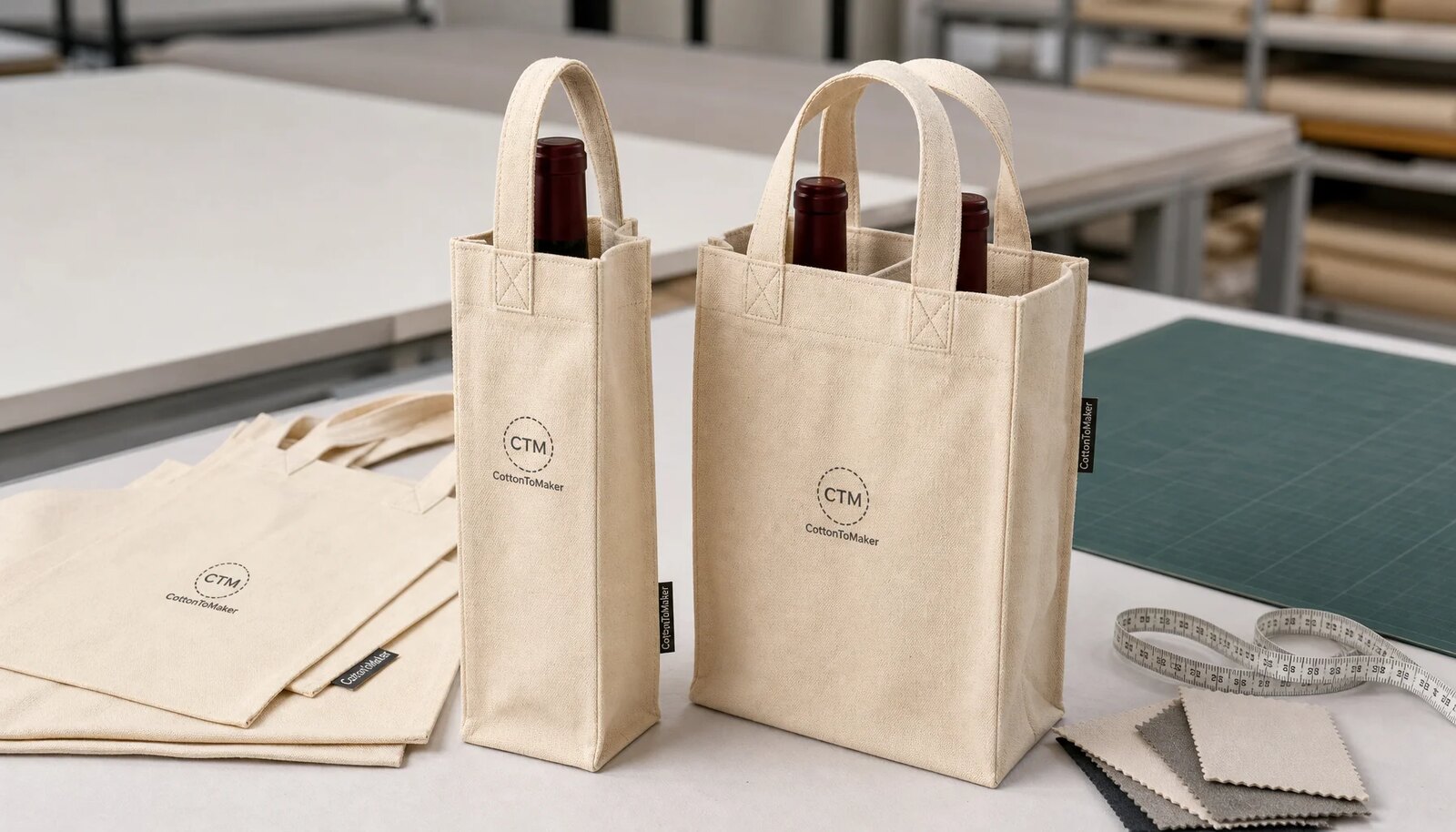
Start With the Buying Use Case
A canvas wine carrier for a craft fair is more than a narrow tote with a logo. It has to hold glass safely, look good on a busy table, carry a winery or sponsor mark clearly, and survive the trip from factory carton to booth checkout. That is why the RFQ should begin with the commercial setting, not only with a product photo. A winery tasting table, distributor booth, farm-shop retail shelf, gift basket counter, sponsor giveaway, and seasonal craft fair program each place different demands on fabric weight, handle comfort, divider design, print durability, packing, and labeling.
Many quote problems start with one vague line: “Please quote canvas wine bag.” One factory may price 8 oz promotional cotton with simple seams. Another may include 12 oz canvas, reinforced handles, a sewn divider, inner bundles, barcode labels, and export cartons. The numbers will look comparable, but the products will not be. A better canvas wine carriers RFQ template guide for craft fairs gives every supplier the same baseline and asks them to show upgrades separately.
Procurement teams should also state what matters most. A winery may care about handfeel, natural canvas texture, and brand color. A distributor may care more about carton cube, receiving labels, and repeat-order consistency. A craft fair organizer may need several artwork versions shipped to different event locations on a hard deadline. When the supplier understands the program, the quote usually becomes clearer: MOQ rules, sample steps, production timing, and packing assumptions are less likely to be guessed.
- Define the use case: retail resale, free gift with purchase, sponsor giveaway, winery carryout, or mixed craft fair distribution.
- State the program type: one-time event, seasonal repeat order, multi-location route, or ongoing wholesale replenishment.
- Identify the buyer priority: lowest unit price, premium structure, fast lead time, reduced plastic, or retail-ready labeling.
- Request one baseline specification with separate optional upgrades for heavier canvas, divider changes, labels, or retail packing.
- Keep one sealed approved sample with the buyer and one with the factory before bulk cutting starts.
Build the Size Around the Bottle
The bottle should drive the carrier size. A standard 750 ml Bordeaux bottle is not the same shape as a wider Burgundy bottle, a champagne bottle, a cider bottle, a spirits bottle, or an olive oil bottle. Even when the fill volume is identical, base diameter, shoulder height, and overall profile can change how the bottle slides into the bag. Too tight, and booth staff will force the bottle through the opening, stressing the side seams. Too loose, and the carrier looks oversized while the bottle shifts during carryout.
For a single-bottle carrier, ask for finished width, height, gusset or base depth, top opening clearance, handle drop, and the preferred amount of exposed neck. For a two-bottle carrier, add the compartment width after the divider is sewn, divider height, divider material, and attachment points. Do not rely only on outside bag width. A divider, seam allowance, and fabric thickness can reduce usable internal space enough to change the fit.
If the bottle shape is unusual, send a physical bottle or a drawing with measured dimensions. For mixed gift programs, decide which bottle is the priority and whether smaller bottles may fit slightly loose. A bag that tries to fit every possible bottle often becomes too wide for a clean retail presentation. If the empty carrier must stand upright on a craft fair table, state that requirement before sampling; a flat sleeve-style giveaway may not behave the same way as a structured display carrier.
- Measure the bottle: maximum body diameter, base diameter, total height, shoulder height, and preferred exposed neck height.
- Specify the fit target: snug retail presentation, easy booth insertion, or flexible fit for several bottle shapes.
- For two-bottle bags, define internal compartment width after divider sewing, not only the outside bag width.
- Ask the supplier to test with filled bottles or equivalent weight, not empty display props.
- Confirm whether the empty carrier must stand upright for merchandising on craft fair tables.
Choose Canvas by Measurable Specs
For many craft fair wine carrier programs, 10 oz to 12 oz cotton canvas, roughly 280-340 GSM depending on weave and finish, is a sensible starting range. It gives more body than light promotional cotton while staying foldable for export packing. An 8 oz canvas can work for short-use budget giveaways, but it may collapse around the bottle and show more strain at the handle roots. A 14 oz canvas can feel premium, yet it raises material cost, carton cube, freight cost, sewing difficulty, and the chance of hard print creases after folding.
Avoid fabric words that sound useful but are hard to inspect: rustic, thick, premium, heavy, natural. The RFQ should state fiber composition, GSM or ounce weight, weave where relevant, finish, color, and shrinkage expectation. Natural cotton canvas often has seed flecks, slubs, and shade variation. Those details can suit craft fair branding, but the buyer should approve the acceptable range. Bleached canvas gives a cleaner print ground and a brighter look, but it shows dirt more easily. Dyed canvas can support a more retail-ready color story, but it needs closer review for shade consistency, colorfastness, and logo opacity.
Decide whether the carrier is meant for repeated consumer reuse or mainly event carryout. If washing is expected, discuss washed or pre-shrunk canvas and confirm shrinkage expectations. If washing is not part of the use case, focus on structure, clean panels, print durability, and stable packing. For landed-cost comparison, request carton dimensions and CBM for each fabric option. Heavier fabric can affect freight and storage more than the unit-price difference first suggests.
- Budget option: 8 oz canvas for low-cost, short-use giveaways where structure is not the main requirement.
- Standard option: 10 oz canvas for many single-bottle craft fair carriers with reinforced handle stitching.
- Premium option: 12 oz canvas for two-bottle carriers, retail gift programs, and improved standing structure.
- Heavy option: 14 oz canvas only when higher cost, larger carton cube, and stricter print testing are acceptable.
- Approval requirement: confirm GSM, shade, finish, shrinkage expectation, fleck acceptance, and sample handfeel before production.
Engineer Handles, Seams, and Dividers
Most performance failures do not happen in the center of the front panel. They happen at the handle roots, bottom seam, side seam, or divider. A filled 750 ml glass bottle often weighs more than 1 kg depending on the glass and contents. A two-bottle carrier can put several kilograms of stress on handle attachments when a customer walks across a fairground or parking area. The RFQ should name the handle material, width, finished drop, attachment depth, stitch pattern, stitch density, and load-test requirement.
Handle construction also affects comfort and presentation. Self-fabric handles create a matched, cohesive look. Cotton webbing can improve consistency and may feel better in the hand under heavier loads. Either option needs a measurable reinforcement method. A box stitch, cross stitch, bar tack, or combined reinforcement should be visible on the approved sample and reflected in the production standard. Phrases like “strong handles” or “reinforced stitching” are not enough unless the supplier has a drawing, reference sample, or written stitch description.
Two-bottle canvas wine carriers need special attention because the divider is both a safety feature and a presentation feature. A divider that is too low may separate bottle bases while letting the shoulders hit each other. A loose or floating divider can twist during packing or bottle insertion. Specify divider height, divider GSM, attachment to base and/or side seams, and finished compartment width after sewing. Then test the sample with the actual bottle shape, not a lighter showroom substitute.
- Handle drop: define finished drop so the carrier is comfortable for hand carry without twisting or dragging.
- Handle width: specify enough width for comfort, especially on two-bottle carriers and heavier glass packaging.
- Reinforcement: require a named stitch pattern, stitch density target, or approved sample reference at handle roots.
- Bottom seam: inspect under load because bottle bases concentrate stress at lower corners.
- Divider: specify height, fabric weight, attachment points, and compartment width after sewing.
Control Printing on Textured Canvas
Canvas is not a smooth print surface. The weave, seed flecks, slubs, and finish can all change how artwork appears. Screen printing is usually the most predictable choice for bold logos, event names, sponsor marks, and winery branding with a limited number of solid colors. It is also practical for repeat orders once screens and color standards are approved. The RFQ should include print size, location, number of colors, Pantone or brand targets, minimum line weight, and whether the print crosses a fold or seam.
Heat transfer may help when artwork has gradients, small quantity splits, or higher detail. Digital printing can also be considered for complex graphics. Both methods need physical testing on the same production canvas because handfeel, edge lift, cracking, color match, and sharpness can vary. Fine serif type, thin rules, detailed illustrations, and QR codes are common risk areas. The weave can break edges or reduce scan reliability, so do not approve production from a digital mockup alone.
The safer approval route is a strike-off on production fabric, followed by a pre-production sample when placement and packing matter. Check ink opacity, edge clarity, registration, curing, rub resistance, and fold impact. The main logo should not sit on a hard packing crease if that crease will damage the artwork. If one order includes several artwork versions, each version needs a controlled file name, SKU, print-position standard, and carton label reference.
- Use screen print for bold logos, one to four solid colors, repeat orders, and consistent brand marks.
- Use heat transfer only after checking handfeel, fold resistance, edge adhesion, and color appearance on canvas.
- Use digital print for complex art only when exact color matching and fine edge sharpness are not assumed without samples.
- Flag artwork risks early: small QR codes, tiny serif text, thin lines, gradients, and low-contrast colors on natural canvas.
- Approve print by strike-off: color, opacity, edge clarity, registration, rub resistance, curing, placement, and fold impact.
Make MOQ and SKU Splits Visible
MOQ is rarely just a sales rule. It is tied to fabric purchasing, cutting efficiency, screen setup, sewing-line changeovers, packing separation, labeling, and export handling. A buyer may think they are ordering 5,000 pieces, but the factory may see two bag sizes, five artworks, two fabric colors, and three delivery destinations. That can behave like many small production lots. Ask whether MOQ applies per style, per size, per fabric color, per artwork, per shipment, or per purchase order.
For craft fair sourcing, the cleanest approach is usually to keep the base construction common and split only where there is a real commercial reason. For example, a buyer might approve one single-bottle carrier and one two-bottle carrier that share canvas, handle material, print method, folding method, and carton style. The factory can then consolidate fabric buying and reduce production confusion. If each fair location or winery partner needs its own logo, ask the supplier to show artwork setup charges clearly rather than hiding them inside the unit price.
Quote tiers should match how the buyer may actually purchase. Ask for 1,000, 3,000, 5,000, and 10,000 pieces, plus the cost effect of artwork splits and destination splits. Separate one-time charges from repeat-order charges, including screens, strike-offs, development samples, barcode labels, hangtags, and carton upgrades. A first order may look expensive because of setup; the repeat order may be easier to justify if those costs do not recur.
- Ask for MOQ by category: style, size, color, artwork, shipment, and total purchase order.
- Request split pricing for shared construction with several printed versions and clear setup charges.
- Separate fixed costs: screens, strike-offs, sample fees, testing, barcode labels, hangtags, and carton upgrades.
- Limit SKU complexity when delivery dates are fixed or artwork approval may be late.
- Ask which costs repeat on reorders and which are one-time development or setup costs.
Include the Right RFQ Fields
A strong RFQ reads like a compact production brief. It gives the supplier enough information to price the same product, identify cost drivers, and flag weak points before sampling. Include buyer details, product category, bottle basis, finished dimensions, fabric, construction, handles, divider, decoration, packing, labeling, quantity split, inspection standard, shipping term, sample requirement, and target delivery date. Missing fields tend to return later as revised pricing, sample delays, or quality disputes.
The quote should also support landed-cost comparison. Unit price is only one part of the decision. Procurement teams need pieces per carton, carton dimensions, gross weight, net weight, CBM, loading port, Incoterm, lead-time trigger, and quote validity. A supplier quoting bulk flat packing is not comparable to one quoting inner bundles and barcode labels. A supplier quoting FOB is not comparable to one including different local charges unless the assumptions are written down.
Ask for a written exception list with every quote. If the supplier cannot meet the requested GSM, finished-size tolerance, print placement, carton count, sample timing, or packing method, they should say so directly. This helps prevent silent substitutions, such as lighter fabric, shorter handles, lower dividers, weaker cartons, or a different folding method. The goal is not only to collect prices; it is to remove ambiguity before the purchase order is placed.
- Product fields: capacity, bottle dimensions, finished size, gusset, handle, divider, seam style, and tolerance.
- Material fields: composition, GSM, finish, color, shrinkage expectation, and approved swatch reference.
- Decoration fields: print method, colors, artwork file, print area, placement, setup charges, and strike-off requirement.
- Packing fields: fold method, inner pack, polybag rule, labels, carton size, quantity, weight, and CBM.
- Commercial fields: quantity tiers, MOQ split rules, Incoterm, port, payment term, lead-time trigger, and quote validity.
Use Samples to Catch Real-World Problems
Physical samples matter because a wine carrier has to fit, carry, stand, fold, and display. A photo can show shape. A digital mockup can show approximate artwork. Neither one confirms handle comfort, divider behavior, fabric stiffness, print opacity, or whether the carrier stands neatly on a craft fair table. A new construction should begin with a blank fit sample. Artwork-sensitive orders should include a printed strike-off. A new supplier, new size, or retail-facing program should move to a full pre-production sample before bulk cutting.
Sample review should imitate actual craft fair handling. Insert the approved bottle, lift the carrier several times, set it on a table, remove and reinsert the bottle, and fold the carrier using the proposed packing method. For two-bottle versions, test with two filled bottles or equivalent weight. Watch for bottles hitting each other, handles twisting, dividers shifting, tight openings, crooked prints, low logo placement, or a hard crease across the artwork.
Write sample comments in measurable terms. Instead of saying the handle feels short, state the required handle drop. Instead of saying the logo is too low, give the distance from the top edge, bottom seam, or centerline. Instead of saying the divider is weak, specify revised divider height, fabric weight, or attachment point. After approval, seal one reference sample at the factory and keep one with the buyer. Mark it with date, version, artwork file, fabric swatch reference, handle spec, divider spec, folding method, and approval record.
- Fabric swatch: approve GSM, shade, finish, flecks, handfeel, and print suitability before bulk cutting.
- Blank fit sample: confirm bottle fit, standing structure, handle comfort, seam construction, and divider geometry.
- Printed strike-off: approve color, opacity, edge clarity, registration, rub resistance, and artwork position.
- Pre-production sample: approve final fabric, print, sewing, labels, folding method, and carton packing before bulk.
- Sealed sample: keep matched references with buyer and factory for inspection and dispute resolution.
Plan Packing and Distribution Early
Canvas wine carriers often pass through several hands before they reach the customer: factory, importer, distributor, regional warehouse, fair organizer, winery, retailer, or booth team. Packing has to protect the product and make receiving simple. Flat packing saves space, but too much compression can bend handles or create permanent creases through printed panels. If the bag has a structured gusset or divider, the folding method should be approved during sampling rather than improvised at the packing line.
The right packing format depends on who receives the goods. Bulk export packing works for warehouse-controlled replenishment and large single-SKU orders. Inner bundles make counting easier for event teams and reduce mixed-SKU errors. Paper bands can give a cleaner retail presentation without individual polybags. Individual polybags protect against dust and moisture but add cost, labor, and may conflict with packaging-reduction goals. The RFQ should say whether polybags are required, restricted, or prohibited, and whether warning statements or recycling marks are needed.
Carton labels are a practical procurement control. Each master carton should show purchase order, SKU, capacity, artwork, fabric color, quantity, gross weight, carton number, and destination when shipments are split. If mixed cartons are allowed, the packing list should show the exact mix and the carton label should make it obvious. Weak labeling can turn acceptable production into a receiving problem, especially when multiple craft fairs or winery locations are working against fixed dates.
- Bulk packing: lowest cost for warehouse-controlled replenishment and large single-SKU orders.
- Inner bundles: useful for counting booth inventory and allocating stock by fair location.
- Paper bands: a cleaner retail option when individual plastic bags are not desired.
- Barcode labels: necessary when retailers or distributors require SKU-level receiving scans.
- Carton data: request pieces per carton, dimensions, gross weight, net weight, CBM, and pallet estimate early.
Inspect Function, Finish, and Cartons
Quality control for canvas wine carriers should combine measurement, visual review, functional testing, and packing verification. AQL-based final inspection can be used for random sampling, but the checklist must reflect the actual risks of a bag carrying glass. Critical issues include unsafe construction, sharp contamination, wrong product, severe mildew, or handle failure that could drop a bottle. Major issues include wrong GSM, incorrect dimensions beyond tolerance, weak seams, broken stitches, wrong artwork, poor print adhesion, dirty front panels, wrong labels, or missing dividers. Minor issues may include trimable loose threads or slight natural fabric variation if the approved standard allows it.
Load testing should be agreed before production, not argued during inspection. Define test weight, duration, number of pulls or static-hold time if used, and pass/fail conditions. A practical test uses the intended filled bottle weight plus a safety margin, with attention to handle roots, side seams, bottom seam, and fabric elongation. For two-bottle carriers, test with two bottles or equivalent weight. The method does not need to be complicated, but it does need to be repeatable. Lifting an empty sample by hand proves very little.
Print inspection should happen after curing. Inspectors should review color under neutral light, registration, edge clarity on canvas texture, ink coverage, rub resistance, bleeding, and transfer to adjacent panels after folding. Open packed cartons during inspection to confirm fold method, inner count, carton labels, barcode placement, and whether bottom-layer bags are crushed. The approved sealed sample should be available for comparison from cutting through final inspection.
- Critical defects: unsafe handle failure, wrong product, contamination, severe mildew, or construction unable to hold bottle weight.
- Major defects: wrong GSM, wrong size, broken stitches, missing divider, dirty front panel, poor print adhesion, or wrong SKU label.
- Minor defects: trimable loose threads, small approved flecks, or slight cosmetic variation within agreed tolerance.
- Functional tests: load test, handle pull check, bottle fit check, divider position check, and table-standing check.
- Packing checks: carton quantity, inner bundle count, fold method, label accuracy, barcode placement, and carton strength.
Specification comparison for buyers
| RFQ decision | Recommended specification | Use case fit | Procurement risk to control |
|---|---|---|---|
| Bottle basis | Quote against actual bottle dimensions: maximum diameter, base diameter, total height, shoulder profile, and required exposed neck height | 750 ml wine, cider, olive oil, spirits, champagne, sparkling wine, and mixed gift bottle programs | Catalog wine-bag sizes may not fit wider Burgundy, champagne, or spirits bottles; poor fit causes clinking, difficult insertion, unstable display, or returned stock |
| Finished size tolerance | State finished W/H/gusset tolerance before sampling; a typical commercial target is ±5 mm for width/height/gusset and ±10 mm for handle drop unless handmade variation is approved | Repeat B2B orders where buyers need consistent fit, packing counts, and retail presentation | Unstated tolerance lets suppliers ship bags that are close on paper but too tight for bottles or uneven on booth tables |
| Fabric weight | 10 oz to 12 oz cotton canvas, approximately 280-340 GSM depending on weave and finish, with swatch approval and GSM verification method | Most craft fair wine, cider, olive oil, and gift-bottle carriers needing structure plus foldability | Thin canvas collapses around glass; very heavy canvas increases unit cost, carton CBM, freight, needle stress, and print-fold risk |
| Bag capacity | Quote single-bottle and two-bottle carriers as separate line items with separate dimensions, load test weights, divider specs, and carton counts | Programs offering both impulse carryout bags and premium two-bottle gift sets | A combined price hides different sewing labor, load stress, divider cost, material usage, and export packing volume |
| Divider construction | For two-bottle carriers, specify divider height, fabric GSM, width after sewing, and attachment points at base and/or side seams | Two glass bottles carried together through busy indoor or outdoor craft fairs | Low, floating, or loose dividers allow bottle shoulders to strike each other and may fail under weight |
| Handle reinforcement | Specify handle material, width, drop, attachment depth, stitch pattern, stitch density, and load-test requirement | Reusable wine carriers, outdoor walking routes, distributor programs, and heavier sparkling bottles | Weak handle roots, narrow straps, and shallow attachment are common failure points; “reinforced” is not enough without detail |
| Print method | Screen print for solid logos; heat transfer or digital print only after strike-off, rub check, fold check, and line-detail review | Winery logos, event graphics, sponsor marks, seasonal artwork, and retail gift programs | Canvas weave can break fine lines, QR codes, and small serif text; color opacity and registration vary by finish |
| MOQ structure | Keep base construction common and split only by artwork, fabric color, or destination where order volume supports it | Importers, wineries, distributors, craft fair organizers, and retailers managing multiple event accounts | Too many small SKU splits increase setup charges, line changeovers, mixed-carton risk, and approval delays |
| Packing and labels | Flat-pack export cartons with approved fold method, inner bundles where needed, SKU labels, carton marks, and optional barcode or paper band | Warehouse receiving, fair allocation, winery retail, and distributor replenishment | Over-compression creases printed panels; weak carton labeling causes receiving errors and missed event allocations |
Buyer checklist before sampling
- Define the commercial use: retail resale, winery carryout, sponsor giveaway, gift-with-purchase, event allocation, or distributor replenishment.
- Identify the bottle type before approving size: Bordeaux wine, Burgundy wine, champagne/sparkling, cider, olive oil, spirits, or mixed retail bottles.
- Send bottle dimensions with the RFQ: maximum body diameter, base diameter, total height, shoulder height or shoulder shape, and required exposed neck height.
- State finished bag dimensions and tolerances for width, height, gusset/base depth, top opening, handle drop, handle width, divider height, and print placement.
- Choose fabric by measurable specification: composition, GSM or ounce weight, weave, finish, color, shrinkage expectation, and natural fleck/slub acceptance.
- Separate single-bottle and two-bottle carrier quotes when dimensions, divider construction, load requirements, sewing steps, or carton counts differ.
- Lock handle material, handle width, handle drop, attachment depth, stitch pattern, and stitch density because these control comfort and breakage risk.
- Require two-bottle divider details: divider fabric, height, attachment to base/side seams, compartment width after sewing, and whether divider reaches bottle shoulders.
- Provide vector artwork with print size, placement distance from edges, Pantone or brand color targets, minimum line weight, and required print method.
- Request a printed strike-off on production fabric and review opacity, registration, edge clarity, rub resistance, curing, and fold impact before bulk printing.
Factory quote questions to send
- What exact canvas construction is quoted: fiber composition, GSM or ounce weight, weave, finish, color, shrinkage expectation, and whether the fabric is natural, bleached, dyed, washed, pre-shrunk, or treated?
- What finished-size tolerances are included for width, height, gusset/base depth, top opening, handle drop, handle width, divider height, and print placement?
- Which bottle dimensions did you use for fitting, and can you confirm whether the sample stands securely with the actual filled bottle or equivalent filled weight?
- What handle material, width, drop, attachment depth, stitch pattern, stitch density, and reinforcement method are included at the handle attachment points?
- For two-bottle carriers, what divider fabric, divider height, compartment width, and attachment method are quoted, and is the divider sewn into the base, side seam, or both?
- What static load test do you perform for the handles, side seams, bottom seam, and divider, including test weight, duration, number of cycles if any, and pass/fail criteria?
- Which print method is quoted, how many colors are included, what setup charges apply, and what artwork limitations should we check on textured canvas?
- Can you provide a strike-off on the final production canvas, and what is your acceptable color tolerance, print placement tolerance, and curing/rub-test procedure?
- Does MOQ apply per style, per size, per fabric color, per artwork, per shipment, or per purchase order, and what price change applies to each split quantity?
- What price tiers can you quote at 1,000, 3,000, 5,000, and 10,000 pieces, and which costs are one-time charges versus repeat-order charges?
Quality-control points to confirm
- Finished size should be measured against the approved sample and specification sheet; a practical commercial target is ±5 mm for width, height, and gusset/base depth, ±10 mm for handle drop, and ±3 mm to ±5 mm for print placement unless a different tolerance is agreed.
- Fabric GSM should be verified by mill report or by cutting and weighing a known fabric area from bulk material; visual handfeel alone is not reliable for comparing 8 oz, 10 oz, 12 oz, and 14 oz canvas.
- Fabric condition should be checked before cutting for shade variation, excessive seed flecks, heavy slubs, stains, odor, mildew, oil marks, weaving defects, and colorfastness risk on dyed canvas.
- Bottle fit should be tested with the approved bottle or equivalent dimensions and filled weight; inspectors should check insertion, removal, standing stability, clinking, exposed neck height, and top-opening clearance.
- Handle attachment should pass the agreed static load test with the intended bottle weight plus safety margin; there should be no seam opening, fabric tearing, broken stitches, distorted box-stitching, or handle elongation beyond the agreed limit.
- Bottom seams and side seams should be inspected under load because bottle weight concentrates at the base and lower corners during customer carryout, especially on two-bottle carriers.
- Two-bottle dividers should be centered, tall enough to separate bottle bodies and shoulders, sewn securely to agreed construction points, and not twisted after folding or insertion of bottles.
- Print approval should include color match under neutral light, ink opacity on natural or dyed canvas, registration tolerance, edge clarity, rub resistance after curing, no bleeding through the panel, and no hard crease through key artwork after packing.
- Needle holes, skipped stitches, broken stitches, loose threads, uneven top edges, twisted handles, crooked dividers, dirty panels, and incorrect label placement should be classified as critical, major, or minor before inspection.
- Carton labels should match SKU, artwork, capacity, quantity, purchase order, destination, gross weight, carton number, and total carton count; mixed cartons should be avoided unless the packing list clearly identifies the split.