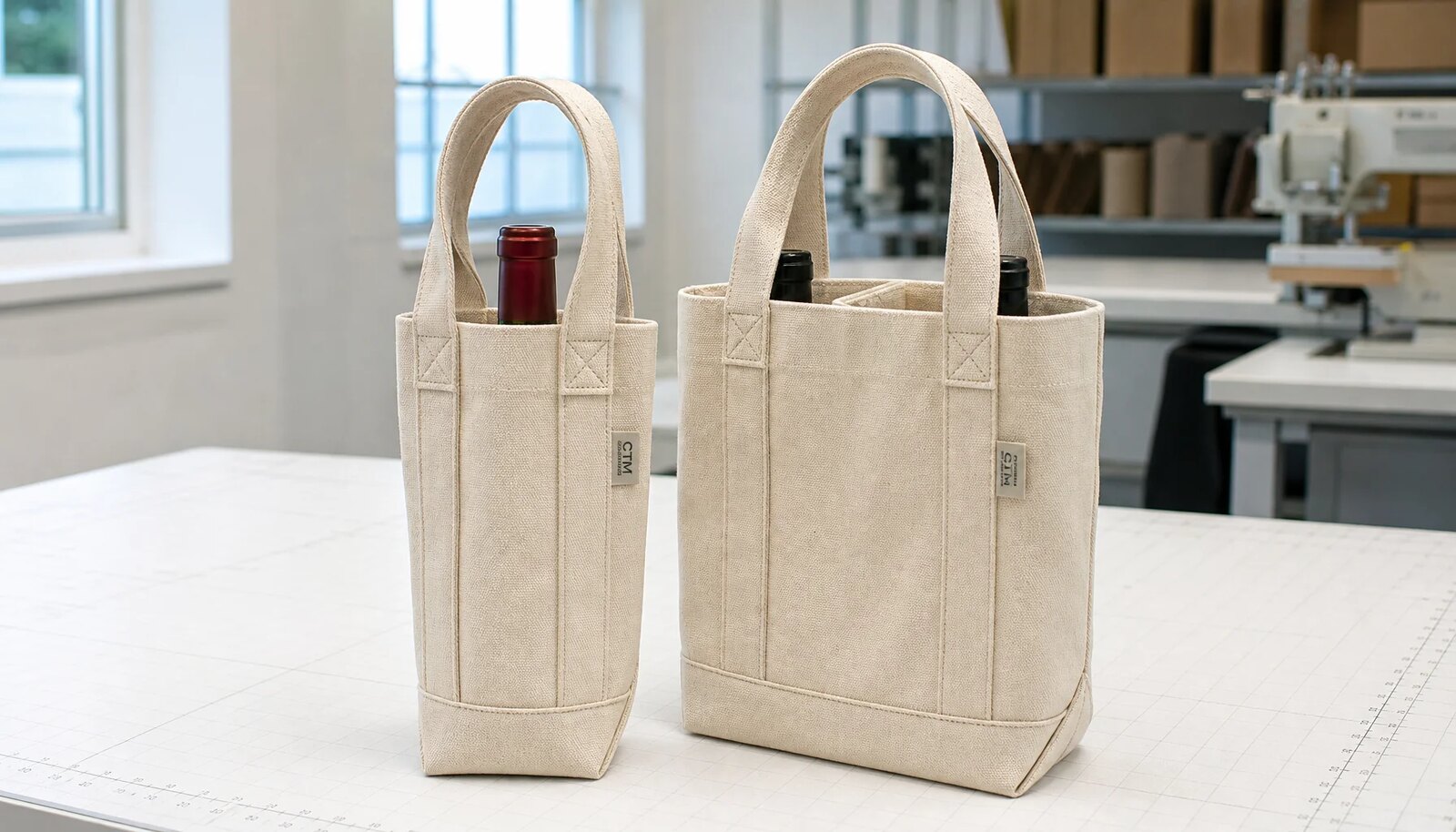
Start With the Event Job, Not the Logo
A canvas wine carrier looks simple until it reaches the event floor. Then it has to do several jobs at once: present the bottle neatly, survive handling, protect the label, move through a packing line, and carry a sponsor or venue brand without looking crooked or improvised. Many sourcing problems begin with a brief that says only "canvas wine bag with logo." That is not a production brief. It is a starting note.
Before requesting prices, write down how the carrier will actually be used. A seated gala gift, trade show handout, tasting-room pair, hotel-room amenity, retail pop-up gift, and VIP welcome kit each put different pressure on the product. Some carriers are loaded at the factory. Others are filled by event staff during a narrow setup window. Some sit on tables where structure matters. Others are handed out quickly, where handle strength and packing sequence matter more.
This is where a canvas wine carriers quality inspection checklist for event planners becomes useful. It should connect the event plan to measurable requirements: bottle size, loaded weight, finished dimensions, handle construction, logo tolerance, carton packing, and receiving checks. The more public the event, the less room there is for vague approval.
- Record event type, loading location, handout point, destination count, and final in-hand date.
- State whether the carrier is decorative packaging, a guest carry item, a transport item, or all three.
- Confirm whether guests receive the carrier empty, pre-loaded, or assembled on site.
- Test the hardest expected condition, such as the heaviest bottle, longest carry, tightest carton packing, or fastest loading window.
Measure the Bottle Before Sizing the Carrier
The phrase "fits a 750 ml bottle" is not precise enough for procurement. Bottle shapes vary. A 750 ml Bordeaux bottle is often narrower than Burgundy and sparkling bottles, and height can vary enough to affect neck clearance, handle comfort, and carton fit. If the bottle has a textured label, foil capsule, wax seal, or wide shoulder, a generic carrier can create scuffing or slow down loading.
Ask the winery, sponsor, or beverage partner for the bottle dimensions early. Measure maximum diameter, total height, shoulder height, neck diameter, label area, and filled weight. If the event kit includes two different bottles, measure both. Then decide the finished internal size and opening clearance based on the largest practical bottle, not the easiest one.
Do the fit test under real handling. A bottle may slide into the carrier on a table but become awkward when the bag is lifted, tilted, placed in a carton, or carried across a venue. For two-bottle carriers, listen and feel for bottle knock. If the divider collapses or twists, the design needs correction before bulk production.
- Measure maximum diameter, total height, shoulder height, neck diameter, label position, and filled weight.
- Do not approve a wide-bottle order using only a Bordeaux-style sample carrier.
- Allow enough clearance for label protection and quick loading, not only static fit.
- Photograph the approved bottle inside the sample from front, side, top, and loaded-carry angles.
Convert the Creative Brief Into a Factory Spec
Creative language helps internal teams align, but factories need measurable instructions. Words like "premium," "sturdy," "rustic," or "clean" should be translated into fabric GSM, canvas finish, finished dimensions, handle width, handle drop, stitch type, logo size, packing method, and inspection criteria. Otherwise, each supplier fills in the blanks differently, and the lowest quote may not be for the same product.
Use finished measurements after sewing, not only flat pattern dimensions. Include body width, depth or gusset, height, opening width, bottom width, handle length, handle drop, divider height and width, and logo placement from fixed reference points. For many event orders, +/-5 mm is a practical starting point for critical dimensions such as opening width, divider position, logo placement, and handle drop. Less critical body areas may tolerate +/-10 mm if appearance and fit are not affected.
Keep the spec sheet attached to the commercial order. A sample approved in email is easy to misread later, especially when marketing, procurement, fulfillment, and the factory all touch the job. The purchase order should reference the final spec, artwork file, color standard, approved sample photos, packing method, carton marks, and QC checklist.
- Assign a product code to every version, including bottle count, fabric color, logo version, and destination if relevant.
- Use fixed measurement points for logo placement, such as distance from top edge, bottom seam, side seam, or center line.
- Write tolerances for body size, handle drop, divider position, and decoration placement.
- Attach vector artwork, color references, approved sample photos, and packing requirements to the PO.
Specify Canvas Beyond the Ounce Number
Canvas terminology can be slippery in international sourcing. Suppliers may quote ounces, GSM, yarn count, or broad phrases such as "heavy cotton canvas." The ounce number is useful only when it is tied to a measurable material. Request both the supplier's ounce description and actual GSM, plus the tolerance used in bulk production. If possible, approve a swatch from the intended bulk lot, not a showroom remnant.
A basic reusable single-bottle carrier may use canvas around the 10 oz to 12 oz range when seams and handles are properly reinforced. A more structured gift often moves toward 14 oz to 16 oz, or uses lining, interlining, stiffening, or a bottom insert. Heavier fabric is not automatically better. A stiff fabric with poor stitching can fail at the handle. A heavy bag packed too tightly can arrive creased and distorted.
Finish matters as much as weight. Natural canvas can show seed flecks, slubs, and shade variation. Bleached canvas looks cleaner but can show dirt more easily. Dyed canvas needs shade control and colorfastness checks. Washed canvas may feel softer but stand less crisply. Coated or laminated canvas can add structure or moisture resistance, but may affect odor, handfeel, print adhesion, and sustainability expectations.
- Request both ounce description and measured GSM, with the supplier's accepted tolerance.
- Ask whether fabric weight is measured before or after washing, coating, lamination, or finishing.
- Confirm greige, natural, bleached, dyed, washed, coated, laminated, lined, stiffened, or pre-shrunk status.
- Review shade, fleck level, odor, handfeel, weave consistency, and stiffness against the approved sample.
Engineer Handles, Seams, and Dividers for Load
The handle is usually the highest-risk part of a loaded wine carrier. A body panel can feel substantial while the handle root is still underbuilt. Specify the handle material, width, drop, attachment position, seam allowance, stitch pattern, and reinforcement method. Cotton webbing is common and straightforward to inspect. Self-fabric handles can look more integrated, but they need enough folded layers and clean sewing.
Do not treat stitching as a small detail. Inspect stitch density, thread tension, back-tacking, bar-tacking, seam allowance, and loose thread trimming. The most important areas are handle roots, side seams, bottom seams, top hem, divider seams, and any reinforced patch. A box stitch, cross stitch, or bar-tack must be straight, secure, and placed where the load actually pulls.
Two-bottle carriers need stricter review because the weight and movement both increase. The divider should keep bottles separated, stay upright, and remain anchored when the bag is lifted or set down. A divider that looks fine when empty may collapse under load. Test with real bottles or equivalent dummy weights, then lift, walk, tilt gently, and set the carrier down several times.
- Define handle width, handle drop, handle material, attachment pattern, seam allowance, and reinforcement method.
- Inspect handle roots for straight sewing, balanced tension, sufficient fabric capture, and clean bar-tacks or box stitches.
- Use a static hang test and a short carry test with weight above the intended bottle load.
- For two-bottle carriers, check divider attachment, base support, bottle separation, handle twist, and glass-to-glass contact.
Match Decoration to Artwork and Handling
Decoration is not only a branding choice. It affects cost, lead time, defect risk, and how the product ages after the event. Screen printing is often efficient for bold logos and limited-color artwork, but canvas texture changes how ink behaves. Fine lines, small type, and large solid areas may not match the PDF proof. Ink can look uneven over slubs, lose opacity on darker fabric, or fail if curing is poor.
Woven labels, side tags, and patches can create a durable, retail-like finish, especially for smaller marks. They also add checks: label size, edge quality, stitch security, yarn color, placement tolerance, and MOQ. Embroidery can work on heavier canvas, but dense logos may pucker the panel or make small text hard to read. Heat transfers can give crisp detail, but adhesion, edge lift, flexibility, and handfeel need testing on the chosen canvas.
Approve decoration on a physical sample. Use the final fabric or the closest available bulk material, and evaluate it under normal viewing conditions. Brand colors printed on natural canvas will not look exactly like coated paper or a screen. That is acceptable if everyone approves the real outcome before production starts.
- Use screen print for bold marks, simple event logos, and limited-color artwork.
- Use woven labels, side tags, or patches for smaller premium branding and repeat programs.
- Avoid tiny reversed text, hairline rules, and low-contrast colors unless the decorated sample proves they work.
- Perform dry rub, light damp rub, flex, fold, and packing checks before approving production.
Make Supplier Quotes Truly Comparable
A useful quote should read like a simplified bill of materials. It should identify fabric, finish, lining if any, handle material, reinforcement, divider or bottom insert, decoration method, packing method, sample fee, setup fee, MOQ, lead time, carton data, and incoterm. If those points are missing, the unit price is not ready for comparison.
MOQ can sit in several places. Fabric, dyed color, woven labels, patches, printed decoration, and custom packing may each have separate minimums. A 500-piece private event may be better served by stock natural canvas and a simple print. A larger multi-venue program may justify custom fabric, woven labels, or destination-specific carton packing. Ask suppliers to explain what changes at each price break.
Incoterms should be compared carefully. EXW, FOB, CIF, DAP, and DDP prices do not include the same responsibilities. DDP may be convenient for event buyers without import infrastructure, but it should still name the destination, freight basis, duty assumptions, and delivery scope. FOB may suit buyers with logistics partners and more control over freight. The right choice depends on timeline, internal capability, and risk tolerance.
- Require all suppliers to quote the same dimensions, GSM, finish, handle construction, decoration, packing, quantity, and incoterm.
- Separate unit price from setup charges, sample fees, tooling, inspection, freight, duty, and local delivery.
- Ask whether MOQ applies per style, color, logo, label, patch, divider option, shipment, or destination.
- Collect carton dimensions, gross weight, units per carton, and packing method before comparing landed cost.
Approve Samples in Practical Stages
One sample rarely answers every sourcing question. A blank fit sample can confirm body shape, bottle clearance, handle drop, divider behavior, and basic standing structure before decoration is added. A decorated sample can confirm logo scale, placement, color, opacity, and print or label behavior. A pre-production sample should represent the actual bulk order as closely as possible, including bulk fabric, thread, handles, divider, decoration, and packing.
Write sample comments in specific language. "Looks better" does not help a sewing line. "Increase handle drop from 120 mm to 140 mm," "move logo up 15 mm," "widen gusset by 8 mm," or "use stiffer divider material" gives the factory something to execute. Mark every sample with a version number and date so teams do not approve different versions by accident.
Review samples as if event setup has already begun. Load the bottle, add the insert or hang tag, lift the carrier, walk with it, place it on a table, check the lean, and inspect whether the label rubs against the opening. Then pack the sample as bulk goods will be packed. Compression, folding, and decoration cure time can reveal issues that do not show in a quick desk review.
- Use a blank sample for fit and construction before spending time on decoration details.
- Require the pre-production sample to match bulk materials, trim, sewing, decoration, and packing.
- Write revisions as dimensions, tolerances, material changes, or construction changes.
- Keep one approved physical sample and matching photos for final inspection and receiving checks.
Build QC Around Production Stages
Final inspection matters, but it is late in the process. For fixed-date events, the best quality control catches repeat problems before the full lot is finished. Start with incoming material inspection: canvas GSM, shade, fleck level, odor, stains, moisture, coating, lining, and obvious weave defects. Then check cutting accuracy and first-off sewing before production continues at scale.
In-line inspection should look for defects while they can still be corrected. For canvas wine carriers, this includes seam consistency, handle reinforcement, divider alignment, print placement, curing, thread trimming, mixed logo versions, and operator variation. If the order has multiple sponsor logos, venues, or destinations, version control should be checked during production, not only when cartons are sealed.
Define defect severity before inspection. Critical defects include safety issues, broken handles, sharp foreign objects, mildew, wrong product, wrong logo, or conditions that make the carrier unusable. Major defects include weak stitching, wrong size outside tolerance, crooked logo beyond tolerance, poor print cure, severe stains, unstable divider, incorrect assortment, and carton count errors. Minor defects may include small removable thread ends or slight natural canvas variation within the approved standard.
- Incoming check: GSM, shade, odor, stains, moisture, coating, lining, and fabric defects.
- First-off check: finished size, bottle fit, handle reinforcement, stitch density, divider position, and logo placement.
- In-line check: repeated sewing defects, mixed versions, print cure, thread trimming, and packing consistency.
- Final check: random finished goods, AQL defect classification, carton count, carton marks, packing list, and approved sample comparison.
Control Packing, Cartons, and Receiving
Packing is not an afterthought for event planners. It affects labor, presentation, freight cost, and setup speed. Decide whether carriers should ship flat, folded, bundled, individually polybagged, paper-banded, or pre-kitted. Individual polybags can protect against dirt and moisture, but they add waste and unpacking time. Plastic-free packing may support an event policy, but it requires cleaner cartons and better moisture control.
Carton quantity should match the distribution plan. A carton of 25 or 50 units may be easier for venue staff to carry, count, and stage than an oversized carton, though smaller cartons may increase freight and packing material. Carton marks should include PO number, product code, color, logo version, quantity, destination, carton number, and total carton count when needed.
Plan receiving before the shipment arrives. The receiver should confirm carton count, visible carton damage, product version, random unit condition, moisture, odor, and compression. Event goods have little recovery time. A short receiving inspection on arrival is far better than finding mixed versions, crushed dividers, or missing cartons during setup.
- Set carton quantity based on venue handling, distribution, and freight cost, not supplier habit alone.
- Confirm carton marks, carton sequence, destination sorting, and packing list format before shipment.
- Avoid over-compression that creates permanent creases, distorted handles, crushed dividers, or warped bases.
- Check incoming cartons immediately for count, damage, moisture, odor, version mix, and visible product defects.
Specification comparison for buyers
| Spec decision | Recommended option | When it fits | Buyer risk to check |
|---|---|---|---|
| Bottle fit standard | Approve the carrier using the actual event bottle or a measured dummy with the same maximum diameter, height, shoulder, and filled weight. | Winery activations, sponsor bottles, tasting pairs, VIP dinners, hotel-room drops, launch gifts, and gift-with-purchase programs. | A generic 750 ml claim is not enough. Bordeaux bottles may be narrower than Burgundy or sparkling bottles, so poor fit can cause tight loading, label scuffing, leaning, or excess sway. |
| Finished size tolerance | Use +/-5 mm for critical dimensions such as opening width, base, divider position, logo placement, and handle drop; allow +/-10 mm only where fit and branding are not affected. | Custom-sized carriers, close bottle fits, repeat orders, and programs with strict brand placement standards. | Loose tolerances make supplier quotes hard to compare and allow a good sample to become inconsistent bulk production. |
| Canvas body weight | Request both the supplier's ounce description and measured GSM, with a written GSM tolerance. Use swatches from the intended bulk lot. | Basic reusable carriers, structured gift bags, or carrier styles that must stand neatly on registration tables or in photos. | Ounce ratings are not always stated the same way across markets. A heavier fabric can still fail if the handles, seams, or packing are weak. |
| Fabric finish | Define whether the canvas is greige, natural, bleached, dyed, washed, coated, laminated, lined, stiffened, or pre-shrunk. | Events with specific color, handfeel, sustainability, print, or presentation expectations. | Natural flecks, shade variation, odor, coating feel, shrinkage, and print adhesion can all change the final look even when the quoted fabric weight seems correct. |
| Handle construction | Specify cotton webbing or self-fabric handles, handle width, handle drop, seam allowance, and box stitch, cross stitch, bar-tack, or patch reinforcement. | Loaded handouts, guest carry, back-of-house packing, and two-bottle formats. | Handle failure usually comes from poor sewing and weak reinforcement, not fabric weight alone. |
| Single-bottle layout | Use an open-top carrier with stable base, enough neck clearance, and a cavity matched to the chosen bottle. | One bottle plus a card, hang tag, tasting note, sponsor insert, or small collateral piece. | Undersized openings slow event packing. Oversized cavities let the bottle lean and can make the presentation feel cheaper. |
| Two-bottle layout | Use a center divider anchored to the base or side seams, reinforced bottom construction, and stronger handle attachment. | Tasting pairs, hospitality gifts, sponsor sets, and premium event packs. | Two bottles increase load and bottle movement. Inspect divider stiffness, base sag, handle twist, and glass-to-glass contact. |
| Decoration method | Use screen print for bold marks; woven labels, side tags, or patches for durable premium branding; embroidery only after testing panel distortion. | Simple logos, reusable gifts, repeat event programs, and brand-controlled sponsor merchandise. | Check ink curing, registration, small text clarity, label position drift, thread puckering, and color difference on a decorated physical sample. |
| Supplier route | Use custom factory production for controlled dimensions and structure; use stock blanks plus logo only for rush or low-complexity programs. | Buyers balancing MOQ, lead time, customization, inspection access, and budget. | Stock blanks can change between batches. Custom production needs stronger material standards, pre-production samples, and written QC criteria. |
Buyer checklist before sampling
- Measure the real bottle's maximum diameter, total height, shoulder height, neck diameter, label position, and filled weight before requesting quotes.
- Define the carrier format: single bottle, two bottle, divider, open top, drawstring, flap, bottom insert, lined body, laminated body, stiffened body, or flat-pack style.
- Lock finished dimensions with tolerances, including width, depth or gusset, height, opening width, bottom width, handle drop, divider position, and logo placement.
- Specify canvas by both ounce description and measured GSM where possible, and ask whether the supplier's tolerance is +/-5%, +/-8%, or another stated range.
- Confirm whether the canvas is greige, natural, bleached, dyed, washed, coated, laminated, lined, stiffened, or pre-shrunk.
- Approve handle material, handle width, handle length, handle drop, attachment method, bar-tack or box-stitch location, seam allowance, and stitch density.
- State the expected loaded use: one 750 ml bottle, two 750 ml bottles, heavier sparkling bottle, added inserts, hang tags, or gift-kit contents.
- Choose decoration based on artwork and durability: screen print, heat transfer, embroidery, woven label, cotton patch, leather-like patch, or side tag.
- Provide vector artwork, Pantone or brand color references, print area size, logo center line, and placement measurements from fixed carrier edges.
- Require a physical fit sample using the actual event bottle or an agreed dummy, not only a digital mockup or supplier photo.
Factory quote questions to send
- What exact canvas will be used for bulk production, stated as ounce weight and measured GSM, and what GSM tolerance do you allow?
- Is the canvas greige, natural, bleached, dyed, washed, coated, laminated, lined, stiffened, or pre-shrunk, and can you provide a swatch from the intended bulk lot?
- What are the finished dimensions after sewing, and what tolerance applies to width, gusset or depth, height, opening width, base width, divider position, and handle drop?
- Which bottle shape was used for your fit test, and can you test our actual bottle or a dummy matching our maximum diameter, height, shoulder, and filled weight?
- What handle construction is included in the quoted price: self-fabric, cotton webbing, reinforced tape, folded handle, box stitch, cross stitch, bar-tack, or patch reinforcement?
- What handle width, handle drop, seam allowance, and stitch density will be used on the main seams, handle roots, top hem, bottom seam, and divider seams?
- For two-bottle carriers, how is the divider attached, what material or stiffness is used, and how do you prevent bottle knock and divider collapse?
- What decoration method is quoted, what ink, thread, label, patch, or transfer type is used, and what curing, heat-press, or finishing process applies?
- What is the logo placement tolerance, measured from the top edge, bottom seam, side seam, center line, or handle center?
- What color reference will production use: Pantone, thread card, woven-label yarn reference, ink drawdown, lab dip, or approved physical sample?
Quality-control points to confirm
- Bulk canvas weight is measured against the approved GSM band from multiple cut panels where possible, and the fabric does not feel limp, overly stiff, loosely woven, stained, damp, or inconsistent across rolls.
- Fabric shade, natural fleck level, odor, coating, lining, and handfeel match the approved swatch and pre-production sample within the agreed standard.
- Finished carrier dimensions match approved tolerances for width, depth or gusset, body height, opening width, base width, handle drop, divider position, and logo location.
- The actual bottle fits without forcing, label scuffing, neck interference, excessive side sway, bottom bulging, or visible distortion when the carrier is lifted.
- Top hems are straight, corners are clean, side seams are aligned, bottom seams sit flat, and the body stands acceptably for the agreed fabric weight and structure.
- Main seams have consistent stitch density, straight sewing lines, balanced thread tension, no skipped stitches, no broken threads, no seam slippage, and no unraveling at stress points.
- Handle roots include the approved reinforcement, box stitch, cross stitch, bar-tack, or patch; seam allowance is adequate and thread ends are trimmed cleanly.
- A loaded carrier passes a practical static hang test and short carry test using a weight above the intended bottle load, with no tearing, handle distortion, or seam opening.
- Two-bottle carriers keep bottles separated; dividers sit flat, do not twist, do not collapse, and do not allow glass-to-glass impact during normal carrying.
- Logo size, color, opacity, placement, and registration match the approved sample and artwork reference within the stated tolerance.