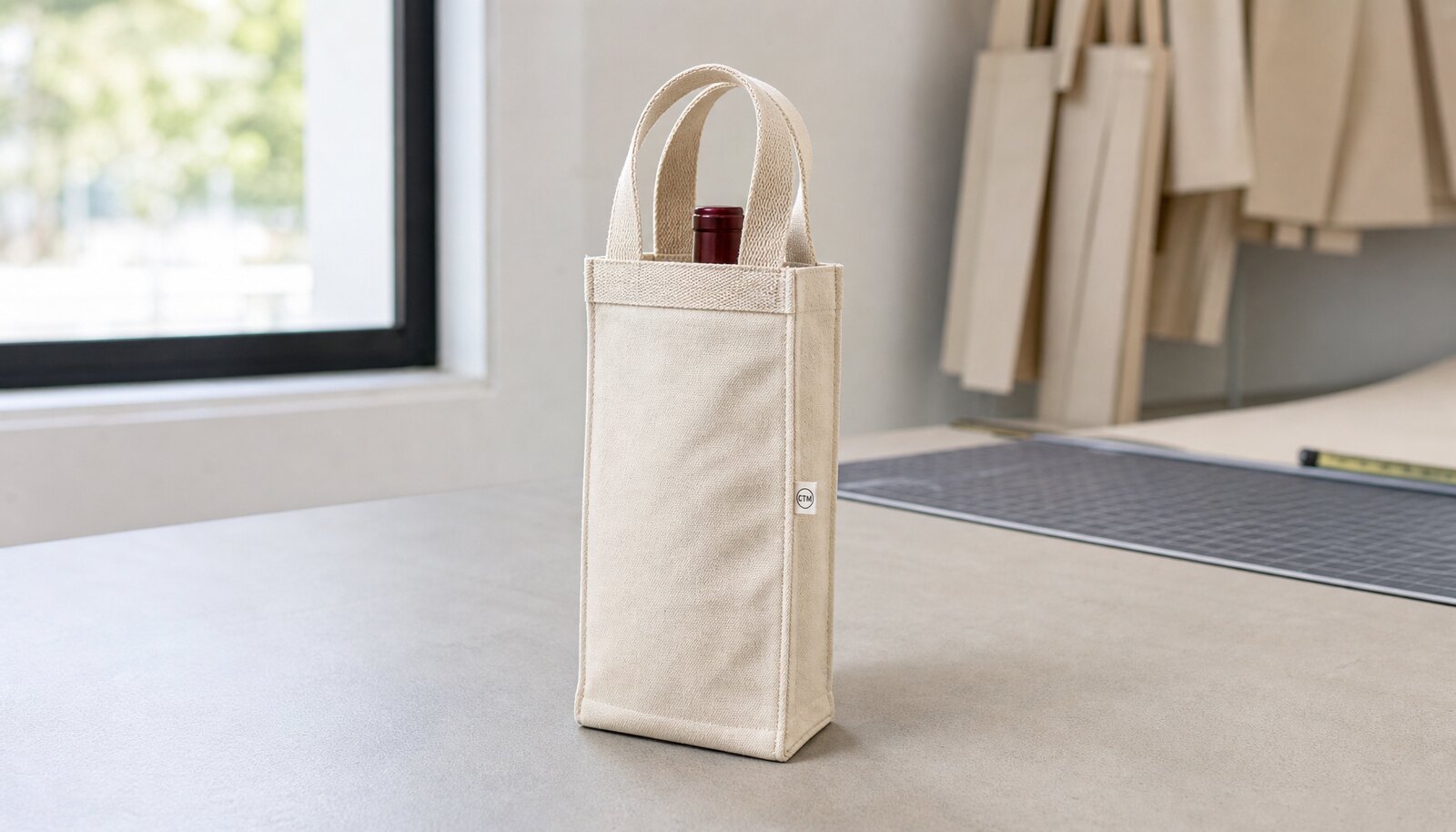
Why Corporate Gifting Exposes Weak QC Fast
Corporate gifting turns a simple canvas wine carrier into a brand presentation item. The recipient may never know the supplier, but they will notice a crooked logo, limp fabric, twisted handles, a chemical odor, or a bag that creases across the printed mark. Unlike ordinary retail packaging, corporate gifts are often staged together at events, packed into kits, delivered to executives, or photographed by internal teams. That makes variation easy to see. Ten carriers that are individually acceptable can look poor when placed side by side if the print position, fabric shade, or handle drop shifts from unit to unit.
The inspection mindset should combine two requirements: the carrier must look gift-ready, and it must safely carry glass. A bag with clean print but weak handle stitching is not acceptable. A strong bag with inconsistent logo placement also fails the purpose of corporate gifting. For procurement buyers, the practical goal is to prevent systematic defects before they multiply across cartons. One random loose thread is a sorting issue. A whole carton with short bartacks, under-cured print, or folded logos pressed against rough canvas is a production-control issue.
The most useful quality inspection checklist for corporate gifting is written before production starts. It should define the golden sample, measurable tolerances, visual defects, packing method, carton labels, and shipment release requirements. If those standards are created only after the goods arrive, the buyer is left arguing subjective quality. A clear standard lets both sides know what must be corrected before the order reaches the event, warehouse, or client delivery schedule.
- One unit pulled from any carton should match the golden sample in fabric shade, shape, handle length, logo position, and packing presentation.
- A carrier that looks acceptable when empty still needs a filled-bottle load check because failure often appears at the handle attachment or base seam.
- Packed units should open cleanly without permanent wrinkles, trapped odor, moisture marks, print transfer, or carton dust on the gift-facing surface.
- Visible defects should be judged in the way recipients will see the product: front logo panel, handle symmetry, opening shape, and overall presentation.
Build the RFQ Around the Bottle, Not Just the Bag
A weak RFQ often starts with only a target bag size and a logo file. That is not enough for a wine carrier because bottle dimensions vary. A standard 750 ml Bordeaux bottle, a wider Burgundy bottle, a sparkling wine bottle, and a heavy premium bottle can all create different stress points. The opening may be wide enough for one bottle but tight at the shoulder of another. A base that supports a slim bottle may allow a wider bottle to bulge, distort the side seam, or tilt the carrier when set down.
Procurement buyers should define the actual bottle profile before discussing price. The RFQ should include bottle diameter, shoulder width, overall height, filled weight, and whether the bottle will be inserted by the factory, a distributor, an event team, or the recipient. If the gift also includes a card, hang tag, tissue wrap, necker, corkscrew, or insert, those components affect fit and packing. A carrier that works in isolation can become too tight once the bottle is dressed for gifting.
Finished bag dimensions also need tolerances. Canvas can shrink, stretch, or relax depending on finishing and sewing tension. A useful specification states finished height, finished width, gusset depth, handle width, handle drop, opening width, seam allowance, and acceptable tolerance. For example, a buyer might allow a small dimension variation but set a stricter tolerance for logo position and handle drop because those are more visible. This turns the RFQ from a price request into a production brief.
- Send the supplier the exact bottle dimensions and photos of the intended bottle shape from front and side views.
- Specify whether the carrier must fit only one approved bottle or a range of bottle types used by regional teams.
- Define finished dimensions and tolerances in writing instead of relying on a sample photo or generic product size.
- Include all gift-kit components that must fit with the bottle, such as tags, cards, tissue, inserts, or protective sleeves.
Choose a Sourcing Route That Can Prove Control
The right supplier route depends on order size, timeline, customization level, and the buyer's tolerance for coordination. A direct bag factory is usually the strongest option when the buyer needs one accountable party for canvas sourcing, cutting, sewing, printing, packing, and inspection. This route is especially useful when the order has a fixed event date or when the brand team requires tight control over logo placement and material feel. The buyer can ask production questions directly and require corrective action without waiting for multiple parties to align.
A trading company or sourcing agent can still be useful, particularly for mixed gift sets that include bags, bottles accessories, paper packaging, and inserts from different factories. The risk is that quality ownership can become unclear. If the print is outsourced, the sewing factory may blame the decorator. If packing is done by a third party, the factory may not inspect the final gift-facing condition. Buyers should not reject traders automatically, but they should require a clear map of who performs each step and who pays for rework when defects appear.
Local decorators and fulfillment partners can make sense for small domestic runs, quick turns, or late-stage logo application. However, the base carrier must still be inspected. A blank stock bag may vary by batch, and local decoration cannot fix weak fabric, poor seam allowance, or a handle that is not designed for a filled bottle. The safer sourcing route is the one that can show production control with samples, photos, inspection records, and named responsibility.
- Ask where cutting, sewing, printing, label application, folding, and carton sealing physically happen.
- Request production-line photos or short videos for cutting, sewing, printing, and packing, not only polished sample-room images.
- Confirm who signs the golden sample, who approves rework, and who pays if defects exceed the agreed tolerance.
- If multiple suppliers are involved, require one commercial owner to coordinate inspection records and corrective actions.
Fabric Weight, Weave, and Hand Feel Set the Quality Baseline
For many single-bottle canvas wine carriers, 12 oz / 340 gsm canvas is a practical baseline when the bag has good seam construction and proper handle reinforcement. It gives enough body for standard 750 ml bottles without making the carrier unnecessarily heavy. For executive gifting, holiday programs, or heavier bottles, 14 oz / 400 gsm canvas often feels more substantial and photographs better. Lighter canvas can be acceptable for low-cost promotional use, but it tends to collapse, wrinkle, and reveal the bottle shape through the fabric.
GSM is only one part of the fabric decision. A tightly woven 340 gsm canvas may print more cleanly and hold shape better than a loose 380 gsm fabric. Buyers should inspect weave density, surface slubs, yarn contamination, shade consistency, and finishing. Natural canvas can vary in fleck level and undertone, which may be acceptable for a rustic look but not for a polished corporate program. Dyed canvas adds another risk: shade variation between fabric lots or between sample and bulk.
The sample should be handled the same way the recipient will handle it. Insert a filled bottle, lift the bag, set it on a table, remove the bottle, fold the carrier, and reopen it. Watch whether the fabric rebounds or holds hard creases. Check whether the logo panel remains flat or puckers near seams. If the carrier has a base board, lining, laminate, or divider, inspect whether stiffness creates sharp corners or seam stress. Premium is not only heavier fabric; it is a balanced construction that looks deliberate and performs under load.
- Request a real fabric swatch with GSM, weave type, color reference, and finishing notes before approving the sample.
- Compare fabric shade under consistent light because natural canvas and dyed canvas can shift noticeably between lighting conditions.
- Check whether the fabric stands neatly enough for presentation without becoming so stiff that folding causes permanent crease marks.
- Ask whether the production run will use one fabric lot and how the supplier controls shade if multiple rolls are required.
Stitching and Handle Construction Carry the Real Risk
The handle is the highest-risk area on a canvas wine carrier because it carries the full weight of glass and liquid. Many weak bags look fine when empty, then fail only after the bottle is inserted and carried. Buyers should define handle width, handle material, handle drop, attachment position, reinforcement method, thread type, stitch density, and bartack length. A wide, soft cotton webbing handle may feel comfortable, while folded canvas handles may match the body fabric better. Either can work if the attachment is strong and repeatable.
Common reinforcement options include bartacks, X-box stitching, double rows, or a combination of folded seam and tack reinforcement. The best choice depends on design and fabric weight, but the inspection standard should be measurable. The factory should not simply say 'reinforced handle.' Procurement buyers should ask how many stitches, how long the bartack is, where it is placed, and whether the handle end is secured into the top hem or only surface-stitched. Loose thread trimming also matters because corporate gifts should not arrive looking unfinished.
Load testing does not need to be complicated, but it needs to be written into the inspection plan. Sampled units should be tested with a filled bottle or approved equivalent weight. The test should include a lift, a short hang, and a check after folding and reopening because transit folds can stress handle attachment points. After the test, inspect for thread popping, fabric tearing, seam opening, handle twist, and deformation around the upper edge. If the factory refuses a basic filled-bottle test, the buyer should treat that as a warning sign.
- Define handle drop so recipients can carry the bag comfortably without the bottle neck hitting the hand.
- Inspect bartack placement and length across multiple units because a short or misplaced tack reduces strength even when the stitch looks dense.
- Check top hem alignment and handle symmetry from the front view, since uneven handles are highly visible in gift staging.
- Require load-test photos or inspection notes showing tested units, weight used, test duration, and post-test condition.
Branding Must Survive Production, Packing, and Handling
Branding is where corporate gifting quality becomes most visible. Screen print is usually the most efficient option for simple logos, large marks, and one- or two-color artwork on canvas. It can deliver clean coverage at scale when the artwork is prepared correctly and the print is cured properly. Buyers should define logo size, placement, print color, artwork file type, acceptable position tolerance, and whether the logo should sit on the front panel, side label, handle, or insert.
Other branding methods can be appropriate when the brief calls for a more premium or longer-use item. Woven labels are durable and consistent, but placement must be straight and stitching must be tidy. Embroidery can feel elevated, yet it may pucker lighter canvas or distort thin lettering. Heat transfer can handle complex artwork and small runs, but it is more sensitive to edge lift, abrasion, and cracking. The right method depends on artwork complexity, quantity, budget, and how the carrier will be packed and handled before gifting.
Inspection should go beyond first-glance appearance. Print should be checked for registration, pinholes, bleeding, overspray, color shift, opacity, curing, and rubbing. A fold test is important because wine carriers are often packed flat or semi-flat. If the logo lands on a fold line, the print may crack, transfer, or develop a shiny pressure mark. Buyers should also check whether the print panel is smooth after a bottle is inserted. Some designs look good flat but distort when the bag is loaded.
- Keep logos away from major seam tension points, hard fold lines, and areas likely to rub against carton walls.
- Use Pantone or approved color references where brand consistency matters, and approve bulk color under the same light used for sample review.
- Ask the supplier to test print rub after folding, light abrasion, and bottle insertion, not only immediately after curing.
- Reject branding defects such as visible edge lift, misregistration, crooked labels, thread nests, puckering, stains, or uneven ink coverage.
Use Sample Gates Instead of Informal Approval
A sample process should protect the buyer from approving a beautiful object that cannot be repeated in production. The first development sample may confirm size and concept, but the pre-production sample should match the final material, thread, handle construction, branding process, and packing fold. If any major component is substituted, the sample should be treated as informational rather than final approval. This is especially important when the factory uses stock canvas for a quick sample but plans to purchase bulk fabric after order confirmation.
The golden sample should become the physical standard for inspection. Both buyer and supplier should keep signed or clearly identified reference pieces. The buyer's sample should be measured, photographed, and recorded with notes on accepted tolerances. The supplier's sample should be available on the production line so operators can compare fabric shade, logo position, handle placement, and fold method. Without a golden sample, final inspection becomes a debate about memory and email attachments.
A useful sample gate also records what is not approved. For example, the buyer may approve the bag size but reject the print color, or approve the fabric but request longer handles. Each revision should state the exact change and whether a new physical sample is required. Procurement teams should avoid vague language such as 'looks good, proceed' when important items remain open. Clear sample approval saves time because it reduces interpretation during bulk production.
- Label each sample version with date, material, print method, revision number, and open issues.
- Measure finished dimensions, handle drop, logo location, and opening width on every approval sample.
- Photograph the logo with a ruler or measurement reference so placement tolerance is clear.
- Do not release bulk cutting until the supplier has written approval on fabric, construction, branding, packing, and carton marks.
Packing Is a Quality-Control Item, Not an Afterthought
Packing can damage a perfectly good canvas wine carrier. Corporate gifting orders often move through export cartons, freight forwarders, warehouses, fulfillment teams, event venues, or distributor networks before the recipient sees them. Each handling step adds risk. Poor folding can crease the logo. Rough stacking can crush corners. Loose packing can cause rubbing and ink transfer. Damp cartons can create odor or moisture marks on natural canvas. For procurement buyers, packing is part of the product specification.
The right packing method depends on the presentation level and distribution route. A simple individual polybag may be enough for standard export protection if the bag is clean, dry, and folded consistently. Paper wrap, tissue, belly bands, or insert cards can improve presentation, but they add labor and can create pressure marks if placed poorly. Premium packing should be tested, not assumed. The sample should include the actual fold, insert placement, inner count, and carton arrangement that bulk production will use.
Carton specification also affects cost and quality. Buyers should confirm pieces per carton, carton dimensions, net weight, gross weight, carton strength, labeling, and whether pallets are required. Overpacked cartons can deform the bags and make warehouse handling difficult. Underpacked cartons increase freight volume and allow sliding. Carton labels should support receiving checks, especially for programs with multiple colors, logos, destinations, or delivery dates. A gift order can fail operationally even when the bags themselves are well made.
- Specify fold direction so the logo is not pressed into a hard crease or rough seam surface.
- Define individual packing, inner bundle count, master carton count, desiccant use if needed, and carton label format.
- Request pre-shipment photos showing the open carton, packed layers, carton marks, and sealed cartons.
- Check for odor, moisture, dust, crushed corners, mixed counts, and print transfer before approving shipment release.
Quote Review Should Expose the Full Cost Stack
A procurement-ready quote should be more than a unit price. It should identify fabric weight, fabric color, finished size, handle construction, branding method, print size, packing method, MOQ, sample fee, setup fee, lead time, carton data, payment term, Incoterm, and exclusions. When those items are missing, the buyer cannot compare suppliers fairly. A lower unit price may simply exclude screen setup, individual packing, carton labels, sample freight, inspection cooperation, or export documentation.
MOQ and lead time usually move with specification complexity. A factory may accept a lower MOQ for stock natural canvas and one-color screen print, but require a higher MOQ for custom-dyed fabric, special webbing, woven labels, multi-location branding, or custom packing inserts. Buyers should separate the base carrier cost from customization costs. That structure makes it easier to decide whether a premium feature is worth the added cost, time, and minimum quantity.
Lead time should be quoted from artwork approval and deposit, not from the first inquiry. A practical timeline includes artwork check, sample production, sample shipping, sample approval, material booking, cutting, sewing, printing or label application, packing, final inspection, and shipment readiness. If the order is tied to an event date, the buyer should also allow time for freight booking, customs, delivery appointment, and receiving inspection. A schedule with no inspection or transit buffer is a risk, even if the quoted production time sounds attractive.
- Compare suppliers using the same Incoterm, currency, payment term, packing level, and inspection requirement.
- Ask whether sample charges, screen charges, label development, packing inserts, carton upgrades, and freight are included or excluded.
- Request carton dimensions and gross weight early because landed cost can change when packing volume changes.
- Require milestone dates in the quote so delays can be identified before the event or gifting deadline is at risk.
Final Inspection Should Be Measurable and Documented
Final inspection should compare production units against the signed golden sample and written defect list. The inspector should pull samples from different cartons, not only the top of one carton. For larger orders, sampling should include different production times, different operators if known, and different pallet positions. The goal is to find whether defects are isolated or systematic. A few random loose threads may be sorted. Repeated crooked print, short handles, weak bartacks, or shade drift across cartons requires corrective action before shipment.
Inspection points should cover measurement, appearance, function, packing, and documentation. Measure finished dimensions, handle drop, opening width, and logo placement. Inspect fabric shade, stains, odor, weave flaws, slubs beyond the approved look, and surface contamination. Check stitching, seam allowance, loose threads, skipped stitches, bartack security, handle symmetry, and base reinforcement. Test bottle fit and filled-bottle load on sampled units. Review packing for fold consistency, inner count, carton count, carton marks, and gross weight.
Defects should be classified before inspection starts. Critical defects may include handle failure, unsafe construction, wet or moldy goods, or wrong branding. Major defects may include incorrect size, severe logo misplacement, print cracking, open seams, or wrong packing. Minor defects may include small loose threads, slight canvas slubs within the approved natural look, or tiny marks outside the main viewing area. The buyer and supplier should agree on tolerance levels and disposition: rework, sorting, replacement, discount, or shipment hold.
- Use the golden sample during inspection, not only PDF artwork or previous email photos.
- Record defect type, severity, quantity affected, carton number, and photos showing scale or measurement.
- Include a load test and bottle-fit check in the inspection plan because visual inspection alone does not prove usability.
- Do not approve shipment until corrective actions, replacement quantities, or written concessions are confirmed.
Specification comparison for buyers
| Spec decision | Recommended option | When it fits | Buyer risk to check |
|---|---|---|---|
| Sourcing route for the first order | Direct factory with in-house or clearly controlled sewing, printing, and packing | Corporate gifting programs where one supplier must own sample accuracy, logo execution, and carton release | If print or packing is subcontracted, require named responsibility for rework, inspection records, and defect replacement |
| Fabric weight | 12 oz / 340 gsm canvas for standard single-bottle carriers; 14 oz / 400 gsm for premium or heavier-bottle programs | Standard 750 ml wine bottles, executive gifts, distributor kits, and repeated handling before presentation | Low GSM can sag, show bottle outline, wrinkle around the logo, or feel promotional rather than gift-grade |
| Canvas construction | Tight plain weave or twill canvas with controlled shrinkage and shade consistency | Orders where the logo must print cleanly and the carrier should stand upright enough for presentation | GSM alone can mislead; loose weave fabric may distort, stretch at seams, or absorb ink unevenly |
| Branding method | One-color screen print for most corporate logos; woven label, patch, or embroidery for premium repeat-use gifts | Artwork is simple, color consistency matters, and the carrier may be photographed or reused | Heat transfer can lift at edges; embroidery can pucker lighter canvas; labels need straight placement and secure stitching |
| Handle reinforcement | Double-layer cotton webbing or folded canvas handles with bartacks or X-box reinforcement | Glass bottles, event handouts, mailer kits, or any use where recipients carry the bottle away from the venue | Weak bartacks often pass visual checks but fail under filled-bottle load, especially after folding and transit |
| Carrier format | Single-bottle carrier with confirmed opening width, base support, and bottle-diameter tolerance | Executive gifts, tasting kits, holiday programs, and retail partner giveaways | Oversized bottles rattle and damage the shape; tight openings tear near the neck or make insertion awkward |
| Packing method | Individual polybag or paper wrap plus structured master carton with count labels and carton marks | Export orders, distributor stock, fulfillment warehouses, and orders with longer transit or multiple handling points | Loose folding can cause print rub, permanent creases, corner crush, odor transfer, or mixed-count cartons |
| QC ownership | Inline factory checks plus final inspection against a signed golden sample and written defect list | Orders above a few hundred units, visible brand programs, or fixed event-date deliveries | A third-party inspection after packing can miss hidden seam defects unless sampling includes unpacking and load checks |
| Lead time control | Milestone-based timeline: artwork freeze, sample approval, bulk cutting, print completion, packing, final inspection, shipment release | Programs tied to board meetings, client events, holiday gifting, or distributor launch calendars | Late artwork changes, custom material sourcing, and packing inserts can add days even when sewing capacity is available |
Buyer checklist before sampling
- Confirm the exact bottle type, bottle diameter, shoulder shape, overall height, and filled weight before requesting quotes.
- Define the carrier format: single bottle, two bottle, divider style, gusseted tote, sleeve, or presentation bag with reinforced base.
- Approve target fabric weight, weave, shade, and finishing using a real swatch or pre-production sample, not a stock fabric photo.
- Freeze logo size, logo position, artwork file, color reference, branding method, and acceptable placement tolerance before bulk cutting.
- Require a golden sample made with final canvas, final thread, final handle construction, final print method, and final packing fold.
- Keep one signed reference sample with the buyer and require the supplier to keep the matched reference on the production line.
- Specify handle width, handle drop, attachment method, bartack length, stitch density, and a filled-bottle load test.
- Check that the bag opening and base fit the actual bottle without tearing, stretching, rattling, or distorting the logo panel.
- Lock the packing method, fold direction, inner count, master carton size, carton marks, barcode labels, and gross weight in writing.
- Ask for lead time by milestone: artwork approval, sample approval, material booking, bulk start, print completion, packing, inspection, and shipment readiness.
Factory quote questions to send
- What exact canvas weight, weave, yarn composition, color, and finishing are you quoting for this carrier?
- Is the canvas from stock, custom dyed, or purchased after order confirmation, and can you hold the same lot for the full order?
- What finished dimensions, handle drop, opening width, gusset depth, and seam allowance are included in your quote?
- Is printing, embroidery, woven label application, and final packing done in-house or subcontracted, and who is responsible for rework if defects appear?
- Which branding method do you recommend for this artwork, and what are the limits for line thickness, color matching, print area, and registration tolerance?
- What is the MOQ by canvas color, print method, label type, and packing method, and does the MOQ change if we add inserts or carton labels?
- Can you provide a pre-production sample made with final material, final print, final handle construction, and final packing, and what is the sample charge and timing?
- How are the handles reinforced, what stitch type is used, and what filled-bottle pull test or hanging test do you perform before packing?
- What packing method is included in the unit price: individual polybag, paper wrap, tissue, belly band, insert card, divider, inner carton, or only master carton bulk pack?
- What carton dimensions, pieces per carton, net weight, gross weight, and carton mark format are included in the quotation?
Quality-control points to confirm
- Measure finished height, width, gusset, handle drop, opening width, and base dimensions against the signed golden sample before approving bulk release.
- Check canvas GSM, weave tightness, shrinkage behavior, odor, shade consistency, and visible slubs across multiple rolls or cartons.
- Verify bottle fit using the actual bottle profile or approved dummy bottle, including insertion ease, standing stability, and neck clearance.
- Inspect print position, color match, edge sharpness, curing quality, rub resistance, fold resistance, and alignment across left, right, and center placements.
- Review woven labels, patches, or embroidery for straight placement, secure stitching, loose threads, puckering, frayed edges, and color consistency.
- Inspect handle stitching, bartack length, X-box shape, seam allowance, stitch density, thread tension, skipped stitches, and loose thread count.
- Perform a filled-bottle hanging or lift test on sampled units to confirm load safety and handle stability after the bag has been folded and reopened.
- Check inside seams and base reinforcement for exposed raw edges, weak overlock, glue marks, hard corners, or stress points that could scratch labels.
- Confirm the fold, individual packing, insert placement, and carton packing do not crease the logo, transfer ink, deform the bag, or create moisture risk.
- Review carton marks, carton count, barcode labels, inner count, gross weight, and carton dimensions before export release.