Why canvas wine carriers need a buyer-specific checklist
Canvas wine carriers look simple, but procurement teams quickly discover that the product combines soft goods, load-bearing seams, print decoration, and retail presentation in one small item. For boutique wineries, the carrier is often more than transport packaging. It sits on the tasting-room counter, becomes part of the gift experience, and may be reused by customers after the sale. That means the buyer is not just purchasing fabric and stitching; they are buying perceived brand quality and functional reliability at the same time.
This is why a generic tote-bag checklist is not enough. Wine bottles have a narrow base, a heavier center of gravity than many retail items, and a shape that can shift during carry. A carrier may look fine when empty and still fail once two bottles are loaded. The difference usually shows up in the seam behavior, handle reinforcement, divider accuracy, and carton packing. If those points are not defined in the RFQ, the supplier will fill in the gaps with their own assumptions.
For boutique wineries, the buying goal is usually a balance of presentation, durability, and manageable MOQ. The carrier must feel substantial enough to support premium positioning, but not so expensive that it turns into dead inventory. It also needs to be repeatable. When a winery reorders a year later, the new batch should look and perform like the original instead of drifting in fabric weight, print placement, or carton pack count. That is the real purpose of a quality inspection checklist: it turns a visually appealing sample into a repeatable procurement spec.
- Treat the carrier as a construction item, not only as printed merchandise.
- Define bottle fit, carry performance, and shelf appearance before asking for pricing.
- Use the checklist to protect reorder consistency, not just first-order approval.
Start with the bottle, then build the carrier around it
The best place to begin is the bottle, not the bag. Ask which bottles the winery actually wants to carry: standard 750 ml Bordeaux, broader Burgundy bottles, sparkling wine, or mixed shapes for gift sets. A carrier cut for a narrow bottle may pinch or tilt on a wider bottle, while a roomy pattern can make the bottles move too much during carry. If the program includes more than one bottle style, the supplier needs that information before pattern making starts.
The internal layout also matters. A two-bottle carrier may use a stitched divider, a base insert, or a double-wall construction. Each option affects cost, sewing time, and how easily the bottles go in and out. A divider that looks neat in a flat sample can twist when the bag is loaded. That is why the buyer should always test with actual bottles, not just with a flat dimension sheet. If the supplier is unwilling to do that, they are probably optimizing for appearance, not function.
For boutique wineries, bottle presentation is often part of the selling logic. The carrier may be handed to guests at tasting events, placed in a retail bag at checkout, or bundled into a holiday gift set. In these use cases, the top opening, handle drop, and standing stability matter as much as the print. A carrier that tips over on the counter or collapses when empty does not support a premium brand even if the logo is accurate.
- Confirm the exact bottle shapes to be tested during sample approval.
- Ask whether the design uses a stitched divider, insert, or double-wall body.
- Check whether the carrier stands upright empty and stays balanced when loaded.
Fabric selection: GSM, weave, finish, and shade control
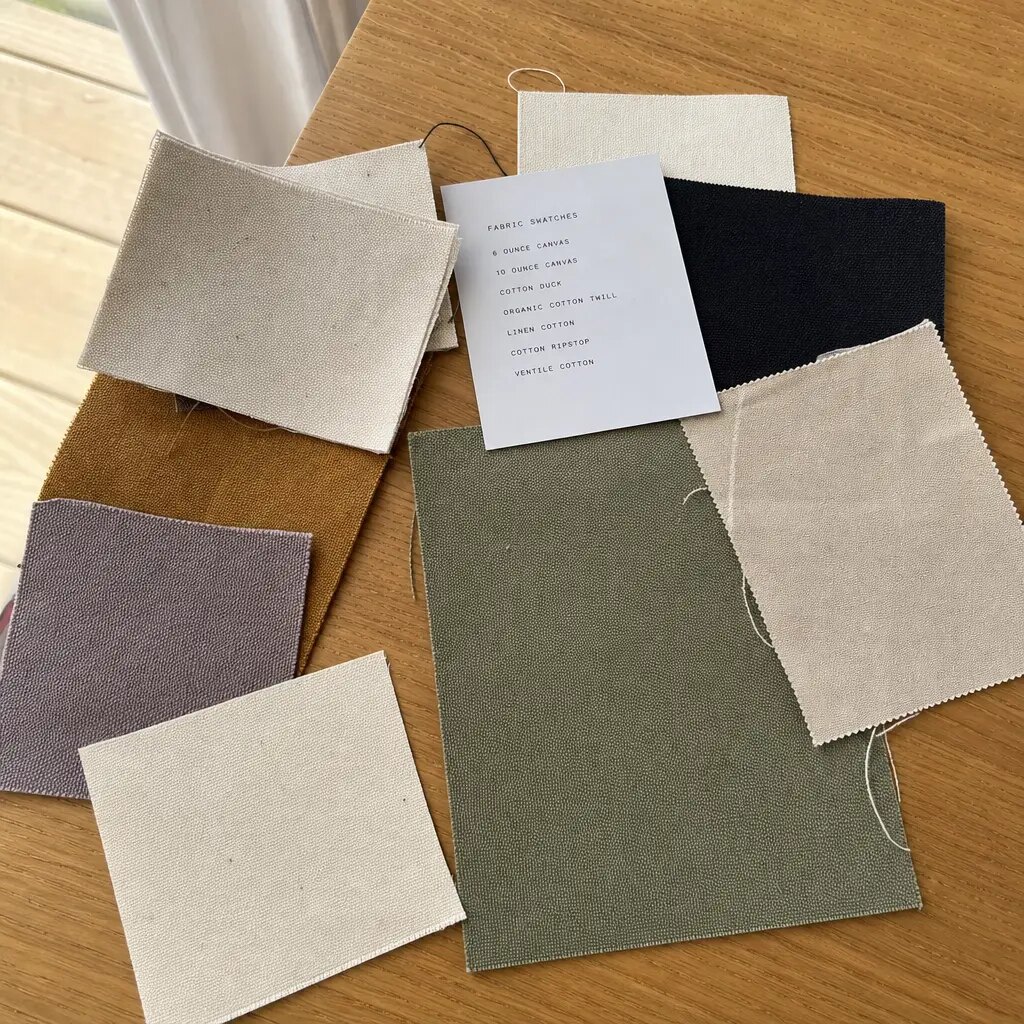
For procurement purposes, the word canvas is too broad to be useful on its own. The buyer needs a fabric weight target, a weave description, and a finish expectation. A practical range for many wine carriers is roughly 340–450 GSM, which is often described by suppliers as about 12–16 oz depending on local measurement practice. Lower weights can reduce cost and make sewing easier, but they often feel soft and can lose shape around the bottle base. Higher weights create a better retail hand feel but may make seams bulkier and increase labor time.
The right weight depends on the program. A tasting-room retail carrier usually benefits from a firmer, more structured body. If the carrier is part of a short promotional give-away, a lighter build might be acceptable as long as the bottle fit and handle security remain sound. The important thing is not to rely on supplier vocabulary such as “thick,” “heavy duty,” or “premium canvas.” Those words do not tell you whether the final product will hold shape or how much sewing tolerance the line can actually maintain.
Fabric finish is another hidden variable. Natural unbleached canvas may be suitable for a rustic winery look, but it can vary in tone between rolls. Bleached or dyed canvas gives a more uniform look, but it may cost more and take longer to source. If the brand is sensitive to color, request a shade reference and a clear rule for acceptable roll-to-roll variation. The supplier should also tell you whether the fabric is pre-shrunk or whether dimensional change after handling is expected. That detail matters if the carrier has a tight fit around the bottle necks.
A serious quote should state the exact fabric specification and not just the color. Buyers should also ask where the cloth comes from. If the fabric is sourced externally, request the mill or fabric trader information and confirm whether the same lot will be used for bulk. When natural canvas is involved, ask for roll images or a fabric sample showing the real weave density, because loose weave can make print edges less crisp and can also weaken seam hold around stress points.
- Use GSM or oz in every RFQ and sample note.
- Define acceptable shade variation for natural canvas.
- Ask whether the cloth is pre-shrunk, finished, or expected to settle after production.
Construction details: the parts that actually fail in use
The weakest canvas wine carriers usually fail at the seams, not at the logo. Handle attachment is the first area to review. A folded canvas handle with box-X or bar-tack reinforcement is the safest standard because it spreads load across a wider area of fabric. If the supplier offers a more decorative stitch pattern, the buyer should ask whether it is still load-bearing or only cosmetic. A decorative stitch that looks tidy but carries no load is not an acceptable substitute.
The top edge also deserves close attention. Puckering at the mouth opening often means the seam allowance is inconsistent or the handle reinforcement is pulling the panel inward. This may seem minor on a flat sample, but on a shelf or in a tasting room it gives the product an unfinished look. The same is true for bottom shape. A carrier with no real base support may fold under the bottle’s weight and become hard to stand up for display or packing.
Divider construction is another area that needs a real test. A divider that is simply tacked into place can drift during use. If the bottles touch inside the carrier, they can knock together during walking or transport. For premium winery packs, the divider should keep the bottles separated without making insertion difficult. That usually means a pattern that balances hold, spacing, and easy loading. Ask the factory to show the stitching path and let you inspect the divider with filled bottles inside.
Handle length and drop also need to be written down. If the handle is too short, the carrier presses against the wrist and feels awkward. If it is too long, the bag swings too much. The finished length should be consistent from left to right, and both handles should attach at the same height. Buyers often overlook this because the carrier looks symmetrical in the photo. In production, though, small asymmetries are easy to spot and can trigger complaints from retail buyers.
A useful rule for this product category is simple: any structural feature that affects bottle load, grip, or upright display should be measurable in the spec sheet. If the factory cannot tell you the handle width, seam allowance, or reinforcement pattern, they may still make something usable, but you will have less control over repeatability.
- Specify handle width, finished drop, and reinforcement method in measurable terms.
- Reject top-edge puckering and asymmetrical handle positioning.
- Inspect the divider with actual bottles, not just as an empty stitched seam.
Decoration choices and the real cost drivers behind them
Most boutique winery buyers begin with the artwork, but the decoration method should be chosen after the base carrier is defined. Screen printing is usually the best fit for simple logos, short text, and one- or two-color art on natural canvas. It offers good opacity and predictable cost on repeat runs. Heat transfer or digital printing can handle fine detail, gradient effects, or more complex seasonal art, but these methods can bring new issues such as surface feel, edge durability, and longer setup discussions.
The real commercial question is not simply which decoration looks best. It is which one keeps the order stable at the requested quantity. Screen print typically becomes more economical as the quantity grows, but the buyer should ask how the supplier handles color changes, extra locations, or larger imprint areas. A front logo plus a side label is not the same as a single centered print, and the pricing should reflect that difference. Some suppliers include one screen in the price and then charge separately for every extra position or color. Others bundle setup costs into the unit price and make the small-run quote appear cheaper at first glance.
The quality check for print should be tied to the artwork type. Bold logo art should be inspected for alignment, opacity, and edge sharpness. Small text should be reviewed at a realistic viewing distance, not only from a close-up camera. If the artwork is highly detailed, ask the supplier for a strike-off or pre-production print. That sample should be compared against the approved file under neutral daylight, not warm showroom lighting. The goal is to see how the ink or transfer behaves on the actual canvas texture.
Decoration also affects durability. If the winery expects the carrier to be reused, the buyer should ask whether the print can tolerate rubbing, folding, or repeated handling. A decorative finish that looks good on day one but cracks or transfers under light use is a false economy. For procurement, the safer rule is to match the decoration method to the expected service life and to the retail role of the carrier.
- Use screen print for simple, bold branding and repeatable production.
- Ask for a strike-off or decorated sample before full bulk approval.
- Check whether extra print locations, extra colors, or oversized art change the quote materially.
How to read quotes and spot hidden price drivers
A useful supplier quote should tell the buyer enough to reconstruct the product. If it only lists a unit price, it is not yet a procurement quote; it is an invitation to guess. The quote should show fabric weight, size, handle construction, decoration method, packing method, sample terms, and the basis of the price. Without that detail, there is no way to compare one supplier against another because each may be offering a different build standard.
One of the biggest cost drivers is material weight. Going from a lighter canvas to a firmer fabric can raise the price, but it can also reduce defect risk and improve shelf appeal. Another major driver is decoration setup. Screen printing often involves screen or plate charges, setup labor, and possible second-location fees. Packing also matters: individual polybags, inserts, barcode labels, and retail-ready cartons all add labor and material cost. For a boutique winery, those costs can be worth paying if the carrier goes directly onto retail shelves or into premium gift packaging.
The useful way to compare quotes is to build a simple price ladder. Ask for the same item at 300, 500, and 1,000 pieces if possible. This shows whether the supplier is spreading setup cost efficiently or whether the order is carrying a high fixed-charge burden. A sharp drop at higher quantity is normal. A very flat price curve can mean the factory is either already close to efficient capacity or has padded the low-quantity quote to protect margin. Neither is inherently bad, but you need to know which one you are buying.
A good quote also reveals where the supplier is flexible and where they are not. If the quote breaks out sample cost, remake cost, and freight, the buyer can plan for approval risk more realistically. If the supplier refuses to separate these items, that often signals weak cost transparency. For branded winery goods, transparency is not just a nice-to-have; it is how you keep reorders and seasonal refreshes under control.
- Normalize all quotes to the same fabric, size, print, and packing spec before comparing price.
- Request a ladder at 300, 500, and 1,000 pieces to see the real cost curve.
- Ask which charges are one-time setup costs and which are recurring per piece.
Choosing between a factory, a trading layer, and a local print route
For buyers who want consistent construction, a direct factory is usually the strongest option. You can verify the sewing line, the sample room, and the packing area, which means you can tie the approved sample to the actual production method. That matters when the carrier includes a divider, special handle reinforcement, or a tighter-than-normal bottle fit. If the sample comes from one source and the bulk is made somewhere else, the risk of drift goes up.
Trading companies are useful when the buyer needs project coordination or mixed product sourcing, but they can also obscure who actually makes the carrier. That becomes a problem when something changes after approval. If the trader cannot show the real factory, the sample room process, or the actual production line, you may end up approving a sample that is not truly representative of bulk output. The buyer should ask for the maker’s identity, production photos, and a confirmation of whether the bulk run will stay in the same plant.
A local print shop or decorator can be sensible for fast replenishment if the base carrier is already standard and the brand only needs simple branding. But that route is less suitable when the carrier itself is custom-shaped, has a structured divider, or needs strict carton packing. Many local decorators are good at imprinting blanks, not engineering bottle carriers. The buyer should not assume that quick response equals strong manufacturing capability.
A hybrid route can work well: a factory produces the blank carrier to a controlled spec, and decoration is handled closer to the buyer if artwork changes often or the program is seasonal. This can reduce brand-management friction, but it adds handoff risk. The buyer then needs to define who inspects the blanks, who approves print placement, and who is responsible if the decorated carrier is damaged or misaligned. Hybrid sourcing is practical, but only if the responsibility map is written clearly before the first order.
- Ask who actually sews the bulk order, not only who sends the quote.
- Verify sample-room control and whether the sample maker is the bulk production team.
- Use local decoration only when the base carrier spec is already proven and stable.
Sourcing table: how to choose the right route for your winery program
A useful sourcing comparison should show more than spec bullet points. It should help the buyer decide which route fits the order size, the artwork complexity, and the amount of QC control needed. For boutique wineries, the most common decision is whether to prioritize lower friction and speed, or tighter control over structure and repeatability. The answer depends on how the carrier will be used and how visible the brand mark needs to be at retail.
Below is a buyer-oriented comparison of the main sourcing routes. The point is not that one route is always better. The point is that each route changes who controls the sewing, the decoration, the approval sample, and the carton outcome. That is what procurement teams need to see when they are deciding where the risk sits.
- Judge sourcing routes by control, not only by price.
- Tie the sample approval and bulk production to the same maker whenever possible.
- Do not mix routes unless the responsibility split is written into the order.
Sample approval: what to inspect before a bulk order is released
The pre-production sample should be treated as the physical contract. It is not enough to confirm that the logo looks acceptable. The buyer should measure the finished dimensions, load actual bottles, check whether the carrier stands and carries properly, and inspect seam behavior when the bag is filled. A flat sample can mislead you because the real performance only appears when the fabric is under stress.
Use the sample to test the opening size and the divider alignment. Insert the intended bottle type, then check whether the necks rub against the top seam, whether the base folds correctly, and whether the handle balance feels even. If the carrier twists or leans, the problem is often in the pattern, not the sewing finish. This is the right time to fix it. Changes after bulk starts are much more expensive and can damage schedule confidence.
Artwork approval deserves the same discipline. Compare the strike-off or print sample against the approved file under daylight or a neutral inspection lamp. Check logo placement from a realistic viewing distance, not only with a ruler. If the print is off-center by a small amount, that may still be acceptable on a large tote bag, but on a narrow wine carrier it can be obvious. Record the approved sample with photos from front, back, top, and side views, then store the measured dimensions with the order file so future reorders can be matched to the same reference.
If the supplier cannot provide a sample-room workflow or wants to move directly from image approval to bulk, that is a warning sign. A reliable factory should be able to show how a sample is made, who approved it, and how the same pattern is protected for bulk. That is especially important for wineries that plan to reorder seasonal designs or repeat the carrier as part of gift packaging year after year.
- Approve samples with real bottles loaded inside.
- Measure the sample and photograph it from multiple angles.
- Require a signed master sample or digital approval record tied to the same spec version.
Packing, carton layout, and warehouse receiving are part of quality
Packing is often treated as the last step, but for canvas wine carriers it is part of quality. If the carriers are compressed too tightly, the handles can deform and the print area can pick up crease marks. If they are packed too loosely, the carton may waste freight space or shift during transit. Buyers should choose the packing method based on the product’s route to market. Retail-facing orders may justify individual polybags to keep dust off and preserve appearance. Wholesale or distribution orders may favor bulk inner packs for efficiency, but only if the carton can still protect the shape.
Carton dimensions deserve the same attention as fabric weight. A carton that is too heavy becomes awkward to handle and more likely to burst or deform during stacking. A carton that is too large can increase freight cost and internal movement. Ask the supplier for carton size, gross weight, pieces per carton, and whether the cartons are oriented upright or flat. Those details help the buyer judge warehouse handling and shipping cost before the order is locked.
Labeling is another common source of avoidable problems. The carton mark should match the SKU, quantity, color, and destination instructions on the purchase order. If the buyer uses a warehouse receiving system, the barcode or carton label format should be confirmed before bulk. If the carriers are sold in retail, the individual pack and the outer carton may need different label structures. These are small details, but they cause big delays when missing. In procurement terms, packing is not after-sales paperwork; it is part of the product definition.
- Specify inner pack count, outer carton count, and carton orientation.
- Confirm whether the carrier ships retail-ready, bulk-packed, or with polybag protection.
- Align carton marks and barcodes to the buyer’s warehouse receiving rules.
Specification comparison for buyers
| Sourcing route | Best for | Buyer advantages | Main tradeoff / risk | What to verify before awarding |
|---|---|---|---|---|
| Direct factory with sewing line and sample room | Repeat programs, custom sizing, stronger QC control, and orders where construction details matter | Better visibility into fabric source, stitch method, and packaging; easier to lock approvals against the real production line | May require more detailed RFQ work and a clearer forecast; some factories prefer higher MOQ or fewer artwork changes | Ask for factory photos, sample-room workflow, line capacity, in-line inspection method, and recent product photos that match your spec |
| Trading company / sourcing agent | Multi-category buying, buyers needing bilingual coordination, or programs with frequent artwork revisions | Useful project management, easier coordination across multiple items, can combine packaging or accessory orders | The real maker may be hidden, sample control can be weaker, and construction changes may not be communicated clearly | Confirm the actual factory name, audit photos, who owns the pattern and sample, and whether the same plant will sew your bulk order |
| Local decorator / print shop | Short-run replenishment on a standard base carrier, urgent event programs, or domestic fulfillment | Fast turnaround for simple decoration and small repeat runs | Usually limited control over body construction, divider accuracy, and carton efficiency; can become expensive on custom structure | Check whether the blank carrier is factory-made or traded in, what print process is used, and whether they can provide a production sample from the same equipment |
| Hybrid sourcing: blank from factory, decoration locally | Programs that need controlled carrier construction but flexible regional branding | Separates structural quality from decoration speed; useful when artwork changes often | Two-vendor coordination adds receiving and responsibility risk if print damage or size mismatch occurs | Define who owns the blank spec, who inspects blanks, and which party is responsible for print alignment and final packout |
| Factory-direct with third-party QC | Higher-value branded orders where rejection cost is high | Best for measurable QC, loading tests, carton checks, and photo reporting before shipment | Requires a disciplined inspection plan and clear defect limits; otherwise reports become generic | Agree on acceptance limits, sampling plan, photo angles, carton criteria, and whether bottle-load testing is part of the inspection |
| Material | cotton canvas, jute, felt, nonwoven, or laminated paper sized to bottle diameter, weight, and condensation risk | Before price comparison | Different cloth weights, backing, or certification claims make quotes hard to compare | |
| Construction | bottle fit, bottom reinforcement, handle or cord strength, divider option, seam allowance, and upright stability | Before sampling | Weak stress points create returns and failed inspections | |
| Decoration | screen print, hot stamp, woven label, embroidery, or paper label positioned for curved bottle presentation | Before artwork approval | The wrong method can crack, bleed, pucker, or fail on the chosen fabric |
Buyer checklist before sampling
- Confirm bottle format first: 750 ml Bordeaux, Burgundy, champagne, or mixed bottles. A carrier that fits standard bottles may fail on wider shoulders or taller necks.
- State the exact carrier configuration: single-bottle, two-bottle, four-bottle, or split-compartment gift carrier. Do not assume the supplier will choose the right pattern.
- Specify fabric weight in GSM or oz, plus color finish: natural unbleached, bleached, dyed, or pigment-printed. If the look matters at retail, define the acceptable shade range.
- Lock the handle spec: width, finished drop, fold style, top-edge reinforcement, and whether the handles are self-fabric or webbing.
- Define seam and reinforcement details in measurable terms: box-X, bar-tack count, top stitch spacing, bottom seam allowance, and whether stress points must be double-stitched.
- Choose the decoration method based on artwork complexity and run size: screen print for simple branding, heat transfer or digital for fine details, woven label for premium positioning, or a combination if the budget supports it.
- Set the print placement with a drawing: front panel distance from top seam, centered or offset logo, second-location print, and any side label or care mark.
- Approve the divider and bottle-contact areas using real bottles. Check whether bottles touch, whether necks interfere, and whether the carrier stands upright when empty.
- Write carton requirements before quoting: units per inner pack, inners per carton, carton dimensions target, gross weight target, carton markings, and whether the product ships retail-ready or bulk-packed.
- Require sample-room evidence: blank sample, decorated sample, and close-up photos of stitching, handles, and seam ends before bulk production starts.
Factory quote questions to send
- What is the exact fabric specification, including GSM/oz, weave style, and whether the cloth is pre-shrunk or finished for dimensional stability?
- Can you show close-up photos of the handle attachment, top seam, bottom seam, and divider stitch on a recent production sample from your own line?
- What stitch reinforcement do you use at the handle base and stress points: box-X, bar-tack, or double-seam, and how many reinforcement passes are included?
- What is your MOQ by color, by artwork version, and by packing configuration? Please give price at 300, 500, and 1,000 pieces if possible.
- What is included in the quote price: blank carrier, print setup, strike-off, sample, packaging, carton marks, and shipping to the port or warehouse?
- What is the print method, how many colors are included, what is the screen or plate charge, and what changes the price if artwork is enlarged or moved to a second location?
- Can you confirm the actual factory that will sew the order, and can you share factory registration details, production-line photos, and sample-room photos?
- How do you control sample-room approval versus bulk production? Who signs off on the master sample, and how are pattern changes recorded?
- What is the production lead time after sample approval, and which steps are longest: fabric booking, printing, sewing, finishing, or carton loading?
- What is the carton specification: pieces per carton, carton dimensions, gross weight, palletization if any, and how are barcode or SKU labels applied?
Quality-control points to confirm
- Use measurable size tolerances, not vague visual approval. For a finished wine carrier, define acceptable variance for overall length, width, and height; a practical buyer standard is typically within +/- 0.5 cm for smaller dimensions and tighter control for print placement, unless the supplier proves a different tolerance by sample and pre-production measurement.
- Measure stitch density on a defined area, such as stitches per inch or stitches per 3 cm, and require consistency across left and right seams. Loose density, skipped stitches, or visibly uneven tension should fail the sample.
- Inspect reinforcement at the handle base and top edge. Box-X or bar-tack areas should be complete, symmetrical, and free of loose thread ends. If the handle folds or lifts away from the body when loaded, treat it as a defect.
- Set print registration limits before bulk. For a simple centered logo on a narrow front panel, define acceptable off-center movement and edge clearance; if the logo creeps too close to the seam or top edge, the carrier will look misaligned at retail distance.
- Check print clarity under neutral light. Fine text, thin lines, and small brand marks should remain legible without obvious feathering, smudging, or color gap. Compare the print to the approved strike-off, not to an imagined ideal.
- Run a load test with actual bottles or bottle-weight equivalents. A serious inspection should check handle security, seam behavior, and body deformation under a filled load; if the carrier cannot hold shape without stress marks, reject it or request redesign.
- Verify bottle fit with the intended bottle shape. The bag should allow insertion and removal without forcing the necks against the top seam or making the divider twist. For two-bottle designs, confirm that bottles do not clash during a shake test.
- Inspect divider alignment and base support. The divider must sit straight, keep bottles separated, and not collapse into the center after loading. A loose divider often signals weak pattern control.
- Assess fabric defects by panel, not just by roll. Acceptable natural canvas variation is normal, but stains, slubs in critical logo zones, holes, loose weave, or obvious shade jumps between panels should be recorded and limited.
- Check handle length consistency on both sides. Unequal handles can make the carrier tilt when lifted, which is a visible quality defect and can affect load balance.