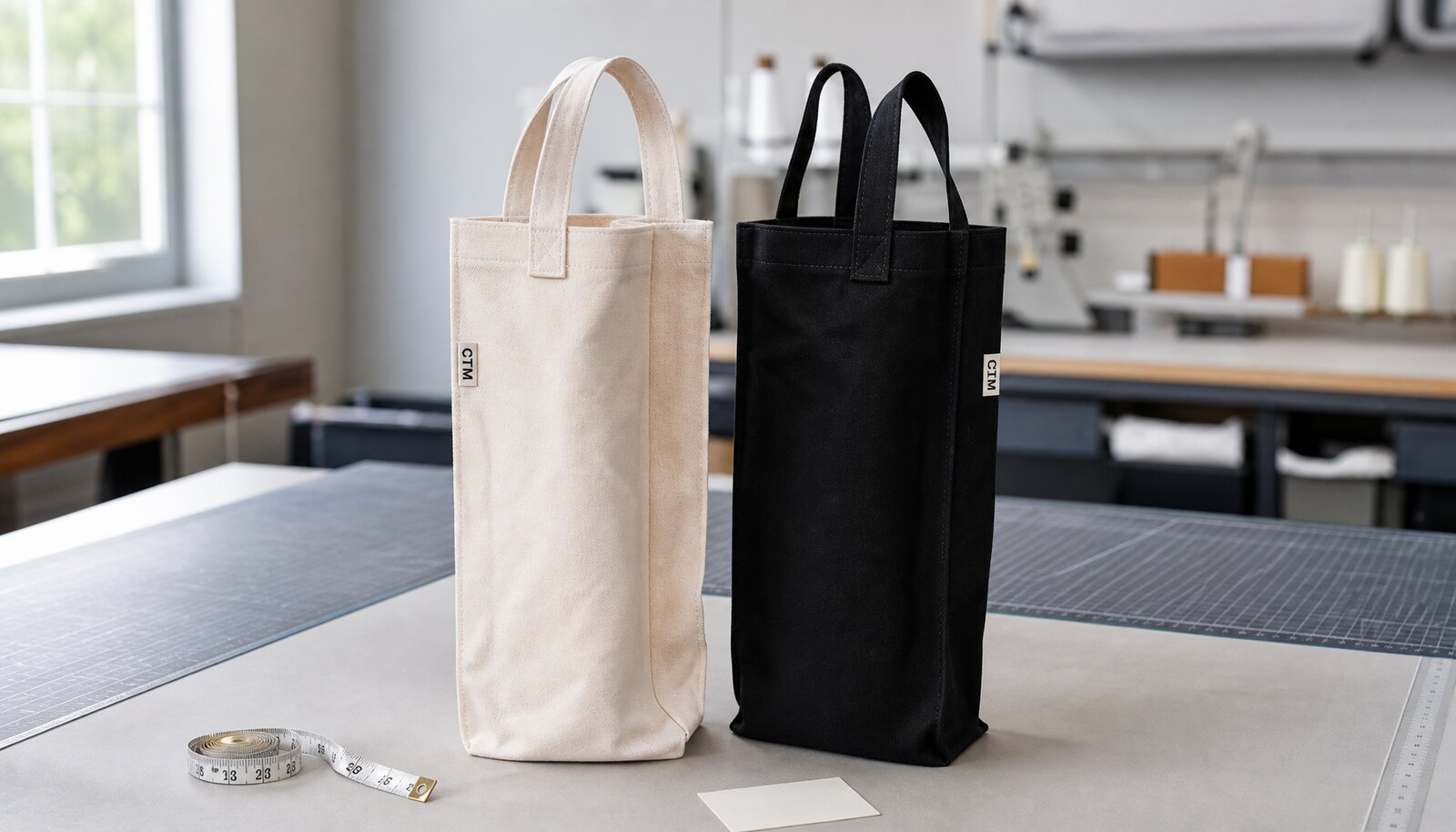
Why print proofing matters more on wine carriers than on flat totes
A canvas wine carrier is harder to control than a flat tote because the bottle creates internal pressure, the base folds under load, and the seams pull the panel out of shape. A logo that looks centered in artwork can move once the bag is sewn and filled. For gift shop buyers, proofing is not about aesthetics alone. It is a control step that protects sell-through, presentation, and the margin on a small accessory SKU.
The usual failures are not dramatic. They are small misses that show up after production starts: the print sits too low once the seam allowance is added, fine text softens on coarse canvas, or the ink rubs during packing. If the approval is based only on a PDF, the buyer is approving a flat image, not a sewn retail item. The useful proof is the one that combines the material, construction, and actual bottle profile that will be sold with the carrier.
- Treat the carrier as a sewn retail item, not a flat printed pouch.
- Approve artwork in the loaded condition, not only on an empty panel.
- Use the proof to check what the customer will see on shelf, at checkout, and when the set is opened.
Start with the retail use case before you lock the artwork
Before the supplier touches the artwork, define how the gift shop will use the carrier. Is it a standalone add-on item, part of a gift basket, or a bottle sleeve sold with a label or hang tag? That changes print size, panel placement, and whether the carrier needs a structured base or a more decorative finish. The bottle itself matters too. A standard 750 ml bottle, a taller specialty bottle, and a wider sparkling bottle do not stress the same parts of the bag.
This is where many proofing mistakes start. A supplier can print a centered logo on a flat sample and still miss the mark once the carrier is loaded. Ask for artwork dimensions in relation to the finished bag size and the filled condition. If the item is meant for premium gifting, decide whether the store wants a minimal brand mark or a stronger seasonal design. That choice affects the number of colors, the print method, and whether the setup cost is justified.
- Confirm bottle size, bottle shape, and whether the carrier must fit a label-heavy or wider-neck bottle.
- Define whether the SKU is a standalone retail item or part of a bundle.
- Set the visual style first so the supplier does not optimize the wrong dimension.
Fabric weight, weave, and finishing determine how the print will read
For most gift shop programs, 12 oz canvas, about 400 gsm, is a practical starting point. It has enough body to feel structured without pushing freight or handling cost too high. It also usually prints cleanly enough for simple brand marks and seasonal copy. If the carrier needs a more premium feel, 16 oz canvas, around 540 gsm, can be the better choice because it stands up on shelf, resists collapse, and gives the item more visual authority.
The finish matters as much as the weight. A loose weave can soften small text, let ink sink unevenly, and make the product look less precise than the artwork suggests. Pre-shrunk or pre-washed fabric can reduce later size movement, but it can also affect how crisp a small print appears. Ask for the fabric spec in writing: weight, weave or construction, whether the cloth is dyed before or after cutting, whether the same lot will be used for all colorways, and what tolerances apply to weight and weave variation. That is the difference between a useful quote and a quote you cannot compare reliably.
- Use 12 oz canvas when you need a balanced, cost-conscious retail SKU.
- Use 16 oz canvas when the carrier needs a stiffer hand and a more premium shelf profile.
- Do not approve tiny lettering on coarse weave fabric unless the print method can hold the detail.
Choose the print method based on repeatability, not just setup cost
Screen print is usually the default for canvas wine carriers because it gives the best mix of opacity, repeatability, and unit economics once the setup is in place. It works well for logos, simple illustrations, and seasonal copy with one or two colors. The proofing issue is that the print must be checked on the sewn product. A flat strike-off can confirm color and edge sharpness, but it cannot fully predict how the artwork will behave on a curved, stitched panel.
DTF or heat transfer can be useful when the artwork has more detail or when the order is too small to justify a full screen setup. Those methods bring different risks: a plastic hand feel, lift at fold lines, or cracking where the carrier flexes around a loaded bottle. If a supplier suggests a lower-cost method, compare the whole commercial picture: setup fees, rework risk, reorder volume, and whether the result still looks like a gift-shop item rather than a giveaway. The best method is the one that holds up on the actual bag, not the one with the cheapest line item.
- Use screen print for clean brand marks and repeat orders.
- Use transfer-based methods only when the artwork really needs the detail or the run is short.
- Test after folding, loading, and packing, because weak cure or edge lift usually shows up there.
Build the sample ladder so approval is based on evidence, not assumption
The safest sample sequence is blank sample, strike-off, then sewn pre-production sample. Each step answers a different question. The blank sample checks fabric weight, handle feel, stitch finish, and bottle fit. The strike-off checks color, opacity, fine detail, and whether the print process can actually hold the artwork. The sewn pre-production sample proves how the finished carrier behaves once stitching tension, panel alignment, and final folding are added. If a supplier wants to jump straight to bulk approval from artwork alone, the buyer is taking avoidable risk.
Use the exact bottle that will be sold or displayed with the carrier. If the store program uses a broader neck, a longer body, or a gift set with a label that adds diameter, that bottle should be part of the sample review. Keep the approved sample sealed and tied to the PO. If the supplier later changes the canvas lot, alters the handle tape, or shifts the print placement, there should be one reference point that everyone can inspect against.
- Reject sample reviews that do not include the actual bottle fit.
- Keep one sealed approved sample as the production reference.
- Tie the sample version, artwork file, and PO to the same approval record.
Write the RFQ so every supplier is pricing the same thing
An RFQ for canvas wine carriers needs enough detail for factories to quote the same spec across every line item. That means more than body color and logo size. Include canvas weight in gsm, weave or fabric finish, body dimensions, bottle-fit target, handle length, handle reinforcement, and whether the base needs extra structure. The artwork file should be named clearly and linked to the approved version, not sent as a vague attachment with no revision control. If the buyer expects pre-shrunk or washed fabric, say so explicitly because that changes cost and yield.
The quote should also separate the charges that are easy to miss. Ask for sample cost, setup cost, color-change cost, carton upgrades, and packing changes on separate lines. If the supplier uses stock fabric, ask which parts are stocked and which parts require a lot-specific purchase. If the same body spec is used for multiple customers, ask how your print version will be prevented from mixing with another order. Procurement teams get cleaner comparisons when the RFQ forces each supplier to answer the same questions in the same order.
- Specify fabric, size, print method, pack format, and bottle fit in one RFQ package.
- Separate one-time setup charges from recurring unit cost.
- Ask for lead time at sample stage and bulk stage, because those are often different.
Compare suppliers by accountability, sample cost, and landed-cost risk
A direct factory is usually the strongest option when the program needs tight control over fabric, print, sewing, and final inspection. It gives the buyer a clearer approval path and fewer handoffs. The tradeoff is that the buyer needs sharper questions up front, because the factory will quote to the spec it receives. A trading company can help when the order spans several product families or when sourcing support is needed, but responsibility can get split if one party manages the order and another party makes it. A local decorator using imported blanks can work for short-run or urgent orders, but blank quality and final pack standards need close checking.
Do not compare these routes by unit price alone. A lower ex-factory quote can disappear once sample fees, tooling, reproofing, freight volume, carton changes, and defect handling are added back in. Sample cost is especially important: a quote that looks cheaper but charges for every revision may cost more than a supplier that includes one correction cycle. Ask who owns defects at each step, who pays if the print drifts after strike-off, and who is responsible if the body color changes because the fabric lot changes. That is the real commercial comparison behind the quote.
- Compare total landed cost, not just ex-factory price.
- Ask who owns the sample, the screens or plates, and the final inspection record.
- Require defect responsibility to be stated in writing, especially for print drift and fabric lot variation.
Set QC thresholds that a factory can actually inspect against
Quality control should be written as measurable acceptance criteria, not broad language like clean print or good finish. Start with placement: define the acceptable tolerance from the top hem, the side seam, and the center line. For a standard canvas wine carrier, plus or minus 5 mm is a practical starting point, but a premium retail program may need tighter control. Then define what is a hard reject. Misregistration, missing coverage, visible ink bleed, and obvious placement drift should be called out before production starts.
The same logic applies to stitch quality and pack quality. If handle reinforcement is critical, say so. If a loose thread or slight tonal shift is acceptable but scuffing, tackiness, or print transfer is not, write that into the inspection sheet. Ask the factory what internal tests they run before shipment. A dry rub test, a fold-and-load check, and a short bottle-fit test are useful because they mimic the way the carrier will actually be used. The more specific the QC language, the easier it is to resolve a dispute without arguing about taste.
- Set a placement tolerance before the first sample is approved.
- Define hard rejects for transfer, smear, misregistration, and structural failure.
- Ask for the factory's pre-ship check and make them name the method, not just the result.
Treat packing and transit as part of proofing, not a separate issue
Canvas wine carriers can be damaged after print approval if the packing plan is weak. Tight packing lowers freight cost, but it can increase crease marks, handle crush, and print transfer between units. The risk gets higher when printed faces are packed against each other without separation. For gift shop buyers, the cost of a damaged appearance is not only returns; it is also the retail effect of a product that looks tired before it reaches the shelf.
Define the packing format at the quote stage. Ask whether the supplier will use tissue, a polybag, a card insert, or a separator sheet, and whether the pack count changes with colorway. If the carrier is part of a gift set, the packing spec should protect the full presentation, not just the bag. Carton dimensions matter because they drive cubic freight cost, and carton strength matters because it affects handle deformation and panel crush. A good proofing process includes the way the product will arrive, not only the way it prints.
- Keep printed faces from rubbing during transit.
- Tie carton count and carton size to the freight quote before approval.
- Confirm that retail labels, barcodes, and hang tags do not scuff the print.
Close the loop with written approval, version control, and a clean handoff
The final step is to make the approval durable. A verbal yes is not enough when the order moves from sampling to production. Issue a written sign-off that names the approved artwork version, the approved fabric spec, the approved print method, and the exact sample reference. Attach photos of the front, back, side, inside, and folded condition so the factory has one record of what was approved. If there are any deviations after sign-off, even if they seem minor, the supplier should notify the buyer before bulk starts.
This is where procurement protects margin. Version control keeps the order from drifting when multiple stakeholders are involved, and it helps the warehouse or store team know what is arriving. If the design is seasonal or tied to a gift-shop promotion, keep the record in a place that merchandising, QC, and replenishment can all access. A clean handoff reduces disputes later because everyone can trace the product back to the same approved proof, the same PO, and the same packing standard.
- Approve in writing with the exact artwork version attached.
- Keep one sealed sample and one photo set as the production reference.
- Require supplier notice for any material, print, or packing change after approval.
Specification comparison for buyers
| Spec decision | Recommended option | Commercial reason | Buyer risk to check |
|---|---|---|---|
| Sourcing route | Direct factory with in-house printing and sewing | Best when one factory owns fabric, print, sewing, and final inspection. That keeps the approved sample tied to the same production line. | Ask whether any step is subcontracted. If it is, require the subcontractor's name, process step, and inspection responsibility in writing. |
| Sourcing route | Trading company coordinating multiple factories | Useful for mixed product lines or when sourcing support is needed across categories. | Check whether the quote comes from the trader or the actual maker. Mixed responsibility can hide where a defect really originated. |
| Sourcing route | Local decorator using imported blanks | Fits urgent regional runs or very small promotional programs. | Check blank consistency, handle strength, seam finish, and whether the pack standard matches retail expectations. |
| Sample package | Blank sample, strike-off, and sewn pre-production sample | Each sample answers a different question before bulk cutting begins. | Ask who pays for revision samples if the supplier misses the approved spec versus if the buyer changes artwork. |
| Tooling and setup fees | Separate screen setup, color change, and revision charges on the quote | Makes startup cost visible and prevents unit price from looking lower than the real landed cost. | Clarify whether setup is one-time, per version, or recharged after proof approval changes. |
| Fabric weight | 12 oz canvas, roughly 400 gsm | A practical midpoint for gift shop wine carriers that need structure without looking overly heavy. | Ask whether the fabric is pre-shrunk or washed before cutting, and whether lighter colors show through under dark ink. |
| Fabric weight | 16 oz canvas, roughly 540 gsm | Better for premium retail sets, stronger shelf presence, and a stiffer bottle support feel. | Confirm whether the heavier cloth changes carton count, freight volume, sewing time, or handle comfort. |
| Print method | 1 to 2 color screen print | Usually the best balance of cost, opacity, and repeatability for logos and short seasonal copy. | Approve cure quality, edge sharpness, and registration on the sewn panel, not only on a flat strike-off. |
| Print method | DTF or heat transfer | Works for short runs or detailed artwork where screen setup is harder to justify. | Test for cracking, lift on folds, and any plastic hand feel that can make the carrier look less retail-ready. |
Buyer checklist before sampling
- Confirm the exact canvas weight, weave density, and whether the fabric is pre-shrunk, pre-washed, or cut from raw cloth.
- Lock the print method, number of colors, Pantone targets, and artwork version before the supplier starts screens, plates, or transfers.
- Request a blank sample, a print strike-off, and a fully sewn pre-production sample with the intended bottle fit.
- Measure logo placement from the top hem, side seam, bottom fold, and center line so the factory works to a fixed tolerance.
- Specify handle length, handle reinforcement, seam allowance, and whether the base needs an insert, board, or extra stitching.
- Define the pack format, inner pack count, carton dimensions, retail label location, and whether printed faces need separation.
- Ask for MOQ by body color, print version, and carton pack, not only the headline factory MOQ.
- Approve the pre-production sample in writing and keep photos of front, back, side, inside, and folded views attached to the PO.
Factory quote questions to send
- What is the exact canvas weight in gsm, and what is the weave count or fabric construction you are quoting?
- Is the fabric pre-shrunk, washed, or calendared before cutting? If not, what size movement should we expect after finishing?
- Which print method will you use, how many colors are included, and what setup or tooling fees apply per version?
- What is the MOQ by design, by body color, and by print color count?
- What sample charges apply for a blank sample, a strike-off, and a sewn pre-production sample, and are any charges credited to bulk?
- Can you provide the placement tolerance for the logo from the top hem, side seam, and center line?
- What cure, adhesion, or abrasion tests do you run on the print before shipment, and what is your pass/fail rule?
- How do you pack each unit, how many per inner pack, and what carton dimensions do you expect for the confirmed order volume?
- Who owns defect responsibility if the bulk run differs from the approved sample because of fabric lot variation, print drift, or sewing shift?
- Can you attach photos of the approved reference sample to the PO and to the final inspection record so the line has one source of truth?
Quality-control points to confirm
- Logo placement matches the approved sample and stays within the agreed tolerance, typically no more than +/- 5 mm on a standard front panel unless the spec requires tighter control.
- Print registration is clean at panel joins, curved seams, and folded edges, with no double image, bleed, or missing stroke on fine text.
- Ink is fully cured and does not smear, tack, or transfer after a dry rub with white cloth and after folding the carrier around a standard bottle shape.
- Color matches the approved reference on the agreed canvas base, with no unapproved shade shift across body panels or between lots.
- Stitching is even and secure, with no skipped stitches, loose ends longer than the buyer allows, or weak reinforcement at handle stress points.
- Bottle fit is verified with the intended bottle type, not only with a generic test bottle, and the carrier should not strain the print when loaded.
- Seam allowance, handle length, and base structure match the signed sample and do not drift between pre-production and bulk.
- Carton count, barcode, SKU label, and color sorting match the purchase order and the approved packing list.
- Outer cartons protect the product from crush, corner damage, and handle deformation during normal transit handling.
- Any critical nonconformance, such as misplacement, ink transfer, or structural failure at the handle, should trigger hold-and-review before shipment release.