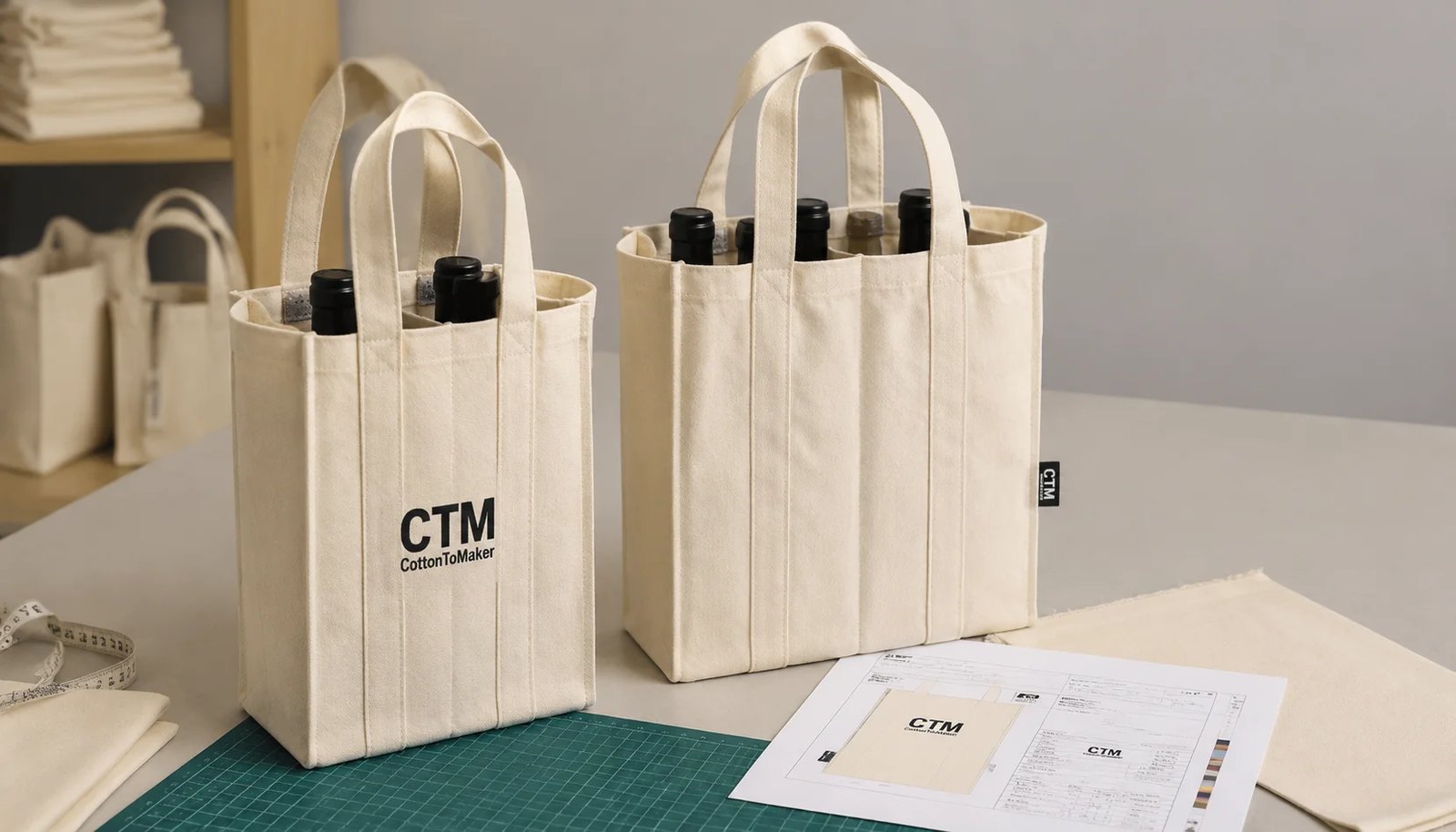
Why print proofing matters more on canvas wine carriers
Canvas wine carriers look simple, but they combine three risk areas in one product: branded print, load-bearing construction, and bottle compartment accuracy. For natural grocers, the bag often sits at the wine aisle, checkout counter, seasonal display, or gift section. A small print shift or weak handle is visible to store staff and customers immediately. Unlike a flat tote, a wine carrier is handled while carrying glass bottles, so a cosmetic problem can quickly become a product safety and store operations problem.
The most common sourcing mistake is approving a flat artwork mockup and assuming the bulk goods will match. Canvas absorbs ink differently from coated paper, natural cotton shade changes by lot, and the print area can distort after sewing if the artwork sits too close to a seam or divider stitch line. A useful print proofing checklist should connect artwork approval with fabric, sewing, load testing, and packing. Procurement teams get better quotes when the RFQ tells the factory what has to be proven before production, not only what the front logo should look like.
- Treat the printed carrier as a load-bearing retail item, not only a promotional bag.
- Approve print on the actual canvas weight and shade intended for bulk production.
- Build the proof around finished bag measurements, not an isolated flat panel mockup.
- Include divider, handle, and bottle-fit checks in the same sample approval step.
Start the RFQ with bottle use, not just bag size
A canvas wine carrier RFQ should identify the bottle types that the stores actually sell. A standard 750 ml wine bottle is not the same as a wide burgundy bottle, sparkling wine bottle, cider bottle, olive oil bottle, or specialty vinegar bottle. Natural grocers often sell mixed bottle categories, so a 4-bottle carrier that fits slim wine bottles may fail with premium olive oil or sparkling cider. The factory needs the bottle diameter, height, and expected loaded weight to engineer the divider and handle correctly.
Finished bag dimensions should be given as outside size and compartment size. Outside width and height help estimate fabric consumption and carton volume. Compartment width and depth decide whether the product works at store level. If the carrier will be used for gift packs, include whether the bottles are sleeved, wrapped, tagged, or combined with paper filler. Those details affect divider height, handle drop, and how the printed logo remains visible after the bag is filled.
- For 2-bottle carriers, specify center divider height and whether both bottles must be fully separated.
- For 4-bottle carriers, provide compartment width and depth, not only total base dimension.
- For 6-bottle carriers, confirm loaded weight and whether an added bottom panel is required.
- For mixed grocery use, test with the widest bottle expected in the retail program.
Fabric weight and canvas finish affect print and structure
For reusable canvas wine carriers, many buyers land between 10 oz and 12 oz cotton canvas, roughly 320-400 GSM depending on yarn, weave, and finishing. An 8 oz canvas can be used for low-cost promotional bottle bags, but it may collapse when standing empty and may show more wrinkling around divider seams. A 14 oz canvas gives a premium hand feel and stronger body, but it raises material cost, sewing resistance, carton weight, and freight cost. The right choice depends on whether the carrier is a paid retail item, a gift-with-purchase item, or a seasonal branded display unit.
Natural unbleached canvas fits the positioning of many natural grocers, but it is not a perfectly controlled color. Cotton seed flecks, beige tone variation, and small slubs are normal. These features can make a bag look authentic, but they also change how ink appears. Black, dark green, navy, and single-color earth tone prints usually perform well. Light pastel prints may look dull unless the ink system and print passes are adjusted. If the brand requires a precise logo color, the buyer should approve a physical fabric swatch and printed strike-off instead of relying on a screen PDF.
- 8 oz / about 260 GSM: budget promotional use, less body, lower freight weight.
- 10 oz / about 320 GSM: common balance for reusable wine carriers with screen print.
- 12 oz / about 380-400 GSM: stronger retail feel, better standing shape, higher cost.
- 14 oz and above: premium structure, but confirm needle size, seam bulk, and carton weight.
Choose the print method before approving artwork
Screen printing remains the practical choice for most canvas wine carriers used by grocers and distributors. It handles bold logos, simple taglines, one to three solid colors, and larger front-panel branding at a controlled cost. Water-based ink gives a softer hand feel on cotton canvas, while plastisol or heavier ink systems can give stronger opacity but may feel more raised. For natural canvas, dark one-color screen print is usually the safest and cleanest result.
Heat transfer may be useful for fine gradients, small multi-color illustrations, or short runs with complex artwork, but it should be tested carefully on textured canvas. Transfers can appear too glossy for natural grocery branding, and edges may lift if pressure, temperature, or dwell time are not controlled. Embroidery is possible for premium bottle carriers, but it is usually better for small logos or patches because stitch density can pucker canvas and increase unit cost. The print proofing stage should confirm the method, print size, ink hand feel, color accuracy, and durability before bulk production.
- Use screen print for solid logos, strong contrast, and larger front panel graphics.
- Use heat transfer only after reviewing gloss level, edge adhesion, and cracking resistance.
- Use embroidery for premium small marks, not large filled logo blocks on wine carrier panels.
- Avoid placing fine text over heavy canvas texture unless the factory proves line clarity.
The print proof should control placement, color, and curing
A reliable proof is more than a digital layout. It should show the artwork printed at final size on the same canvas type and shade planned for production. The proof should measure logo position from stable reference points such as top edge, side seam, bottom seam, or handle attachment line. Visual centering is not enough because canvas panels can shift slightly during sewing, especially around dividers and reinforced handles. A practical tolerance for many retail carriers is within 3-5 mm for placement, but the final tolerance should match the logo size and panel construction.
Color approval should be handled with a signed physical proof or clear tolerance against a Pantone reference. Natural canvas changes perceived color, so a Pantone printed on coated paper is only a guide. Ink curing also needs attention. Poorly cured ink may pass an initial visual check but fail during rubbing, moisture exposure, carton compression, or store handling. The factory should perform a rub test and, where the buyer expects reusable use, a light moisture or hand-wash simulation. The goal is not to make canvas wine carriers laundry products unless specified; the goal is to avoid ink transfer and early print failure.
- Set print placement tolerance before production, for example plus or minus 3-5 mm where construction allows.
- Keep artwork at least 15-20 mm away from seams, folds, box corners, and divider stitch lines.
- Approve ink hand feel and coverage on the real canvas surface.
- Use rub, tape, and moisture checks to verify curing before bulk goods are packed.
Construction details that change cost and failure risk
Wine carriers fail most often at the handle, bottom seam, divider join, or upper edge where the carrier flexes during loading. A cheap quote may reduce handle width, remove reinforcement stitching, lower fabric weight, or simplify the divider. These changes are not always obvious on a photo, so procurement teams should define construction details in the RFQ. Handle material can be self-fabric, cotton webbing, or contrast webbing. Self-fabric looks consistent but adds sewing labor and bulk. Cotton webbing is efficient and strong, but color and texture must match the brand position.
Divider construction deserves equal attention. Some factories sew simple vertical partitions; others use cross dividers, reinforced base seams, or removable divider inserts. For grocery retail, stitched dividers are usually more stable and less likely to be misplaced. However, they also affect folding and packing. If the bag must arrive flat and open cleanly in store, the sample should be folded and unfolded several times. The buyer should also test whether a cashier can load bottles quickly without the divider collapsing.
- Handle width commonly ranges from about 25 mm to 38 mm depending on load and design.
- Cross-stitch or box-X reinforcement is preferred for loaded multi-bottle carriers.
- Bottom panels can improve stability for 4-bottle and 6-bottle formats but add fabric and sewing cost.
- Bound top edges improve durability and appearance, while simple folded hems reduce cost.
MOQ logic and cost drivers behind the factory quote
MOQ is not only one total order quantity. For canvas wine carriers, MOQ is usually affected by fabric color, fabric weight, bag size, print version, print color count, label type, and packing method. A buyer ordering 3,000 units may think the order is simple, but if it is split into three bag sizes, two logo versions, and two ink colors, the production becomes several smaller runs. That affects cutting efficiency, screen setup, line change time, and inspection sorting.
A clean quote should separate the main cost drivers so the buyer can compare suppliers properly. Fabric consumption and sewing complexity usually drive the base cost. Printing cost depends on artwork size, color count, number of screens, print position, and whether panels are printed before or after sewing. Packing cost changes with carton size, inner polybag requirements, divider protection, barcode labels, and retailer routing labels. Freight cost depends heavily on carton volume because canvas wine carriers with dividers can be bulky even when not heavy.
- Request pricing by size: 2-bottle, 4-bottle, and 6-bottle versions should not be averaged blindly.
- Separate one-color print, two-color print, and heat transfer pricing.
- List setup charges separately so repeat-order economics are clear.
- Include estimated carton dimensions and gross weight in the first quote round.
- State whether the quote includes sample cost, pre-production proof, export carton, and standard labels.
Sample approval should simulate store handling
The pre-production sample should be made from the actual bulk fabric or the closest available production fabric, using the same print process, thread, handle, and divider construction. A salesman sample made from substitute fabric can help review size, but it should not be the final approval for a branded natural grocer program. The signed sample becomes the factory reference for sewing, print, and packing. If the buyer approves only photos, later disputes over shade, print hand feel, or divider stiffness become difficult to resolve.
Store handling should be part of the sample review. Load the carrier with the actual bottle mix, lift it repeatedly, place it on a counter, open the dividers, and check whether the print stays visible when filled. For multi-bottle carriers, check balance when only one or two compartments are loaded. A bag that tips over easily can create store frustration even if it passes a simple dimension check. Also review whether hangtags, sewn labels, or barcode stickers interfere with the logo or retail display.
- Measure finished size after sewing, not before sewing.
- Test loaded handle comfort and seam stress with filled bottles.
- Review print alignment with the carrier standing upright and lying flat.
- Fold and unpack the sample to see how dividers recover after carton packing.
- Sign and date the approved sample, including any approved deviation notes.
Packing plan for grocer distribution centers and store allocation
Packing affects how the carriers arrive and how quickly a distribution center can allocate them. Flat packing saves space, but dividers may crease if the fold line runs through the compartment structure. Nested packing can protect shape better but may increase carton volume. For large retail programs, SKU separation is critical. A carton containing mixed 2-bottle and 4-bottle versions, or mixed logo colors, creates receiving errors and store allocation delays. Each carton should identify SKU, size, logo version, quantity, gross weight, net weight, and country of origin as required.
Plastic-free packing may be preferred by natural grocers, but it needs to be practical. If individual polybags are removed, the buyer should define how the fabric will be protected from dust and moisture during factory storage, inland transport, and ocean shipment. A master carton liner or paper wrap may be enough for some programs. For light natural canvas, avoid direct contact with printed cartons or colored inserts that may transfer color. Carton compression is also relevant because divider deformation can make the product look poor at store opening.
- Do not mix different print versions in the same export carton unless the distribution center requests it.
- Use carton markings that match the purchase order and packing list exactly.
- Protect natural canvas from dust, moisture, and color transfer during transit.
- Review carton cube early because divider construction can increase landed cost through volume.
- Confirm whether retailer routing labels, barcodes, or inner pack counts are required.
Lead time risk is usually caused by approvals, not sewing
The production schedule for canvas wine carriers includes more than bulk sewing time. Artwork review, screen making, fabric sourcing, lab dip or swatch approval, sample making, sample shipment, buyer review, pre-production corrections, bulk cutting, printing, curing, sewing, trimming, inspection, packing, and export booking all consume time. A factory may quote a normal production lead time after sample approval, but the calendar risk often sits before approval. If artwork files are incomplete or the print proof is rejected twice, the ship date moves even if the sewing line is available.
For importers and distributors, the safest schedule separates milestones. A realistic planning example may include several days for artwork review, one to two weeks for a pre-production sample depending on material availability, buyer approval time, then several weeks for production after deposit and final sample approval. This is not a delivery promise; it is a way to structure a timeline. If the order is seasonal, tied to harvest promotions, holiday wine gifting, or a store opening, the approval deadline should be written into the purchase order.
- Freeze artwork before screen making to avoid repeated setup charges.
- Approve fabric shade and print proof before bulk cutting.
- Reserve extra time for dyed canvas, custom labels, or complex multi-color artwork.
- Schedule inspection after full packing, not while goods are still loose on the line.
- Link the ex-factory target date to the latest acceptable proof approval date.
Specification comparison for buyers
| Spec decision | Recommended option | When it fits | Buyer risk to check |
|---|---|---|---|
| Fabric weight | 10 oz to 12 oz cotton canvas, roughly 320-400 GSM depending on weave | Retail natural grocer wine programs needing a reusable bag with enough body to stand during packing | Too light fabric may collapse at checkout; too heavy fabric increases carton weight and freight cost |
| Bottle format | 2-bottle, 4-bottle, or 6-bottle layout with stitched internal dividers | Stores selling mix-and-match wine, cider, olive oil, vinegar, or gift bottle bundles | Divider width must match actual bottle diameter, not only nominal 750 ml capacity |
| Print method | Water-based screen print for 1-3 solid colors; heat transfer only for fine gradients or small complex logos | Natural grocer branding that needs a soft hand feel and better alignment on canvas texture | Unproofed transfers can look glossy on natural canvas and may crack if curing is poor |
| Artwork placement | Centered front panel print with at least 15-20 mm clearance from seams, folds, and divider stitch lines | Most retail logo applications and promotional carrier programs | Logos placed too close to edge seams distort after sewing and packing |
| Handle construction | Self-fabric or cotton webbing handles with cross-stitch reinforcement | Reusable carriers expected to hold 2-6 glass bottles safely | Handle pull strength must be tested with loaded bottles, not judged by appearance |
| Color and fabric finish | Natural unbleached canvas for eco-positioning; dyed canvas only when brand color control is critical | Natural grocers, farm shops, wine clubs, and organic retail programs | Natural canvas has shade variation; buyer should approve tolerance instead of expecting paper-white consistency |
| MOQ logic | MOQ separated by bag size, fabric color, and print color count | Importers combining 2-bottle and 4-bottle versions under one program | Supplier quotes may hide setup cost if sizes or prints are split after approval |
| Packing method | Flat packed or nested by unit with divider protected; export carton marked by SKU and print version | Distribution centers requiring scan-ready cartons and easy store allocation | Crushed dividers and unsegregated logo versions create store-level receiving problems |
| Proof approval | Pre-production sample with actual fabric, actual print ink, actual handle, and real divider stitching | Any branded retail order where print color, alignment, and load performance matter | Digital mockups alone cannot confirm ink absorption, logo sharpness, or bottle fit |
Buyer checklist before sampling
- Define the bottle count per carrier: 1, 2, 4, or 6 bottles, including the actual bottle diameter and height range used in stores.
- Specify fabric as cotton canvas with target weight in oz or GSM, not only as 'heavy canvas' or 'eco cotton'.
- Confirm whether natural unbleached canvas shade variation is acceptable and set an approved reference swatch.
- Provide vector artwork with Pantone references, finished print size, placement from top edge, and clearance from seam lines.
- Choose print method based on artwork: screen print for solid retail logos, heat transfer for complex gradients, embroidery only for small premium runs.
- Require one pre-production sample using actual material, actual ink, actual handles, and stitched dividers before bulk cutting.
- Load test the approved sample with filled bottles for handle strength, divider fit, balance, and bottom seam stress.
- Define acceptable print tolerance: position, color variation, edge sharpness, ink coverage, and curing performance.
- State packing method clearly: flat, nested, inner polybag or no polybag, units per carton, carton markings, and SKU separation.
- Request a quote that separates fabric, printing, divider construction, labels, packing, carton, sample, and tooling/setup costs.
Factory quote questions to send
- What canvas weight in oz and GSM are you quoting, and is it greige, washed, dyed, or natural unbleached fabric?
- What are the finished dimensions of each bottle compartment, including width, depth, height, and divider construction?
- Which print method are you pricing, and what is the maximum print area included before extra screen or handling charges apply?
- How many screens, films, molds, or setup items are needed for the submitted artwork?
- Can the pre-production sample be made from bulk fabric and printed with the same ink or transfer process used in production?
- What is the MOQ by size, fabric color, logo version, and print color count?
- What handle material, width, length, and reinforcement stitch pattern are included in the quote?
- What load test standard will the factory use for a 2-bottle, 4-bottle, or 6-bottle carrier?
- How are dividers protected during packing so they do not arrive folded, collapsed, or misaligned?
- What are the estimated carton dimensions, gross weight, net weight, and units per carton for each SKU?
Quality-control points to confirm
- Fabric weight measured against approved GSM or oz range before cutting, with shade compared to approved swatch.
- Finished compartment size checked with real bottle samples or bottle gauges, including tolerance for larger sparkling, cider, or oil bottles.
- Print position measured from fixed seams or top edge, not by visual centering only.
- Print color compared under consistent lighting against approved Pantone or signed physical proof.
- Ink curing checked by rub test, tape test, and light wash or moisture exposure where relevant.
- Handle attachment inspected for stitch density, back tack quality, skipped stitches, and reinforcement pattern.
- Loaded carrier tested for balance, handle comfort, seam stress, and divider movement.
- Cartons drop-checked or compression-reviewed where dividers and handles may deform during ocean shipment.
- Packing list, carton marks, SKU labels, and logo version labels matched against the purchase order before shipment.