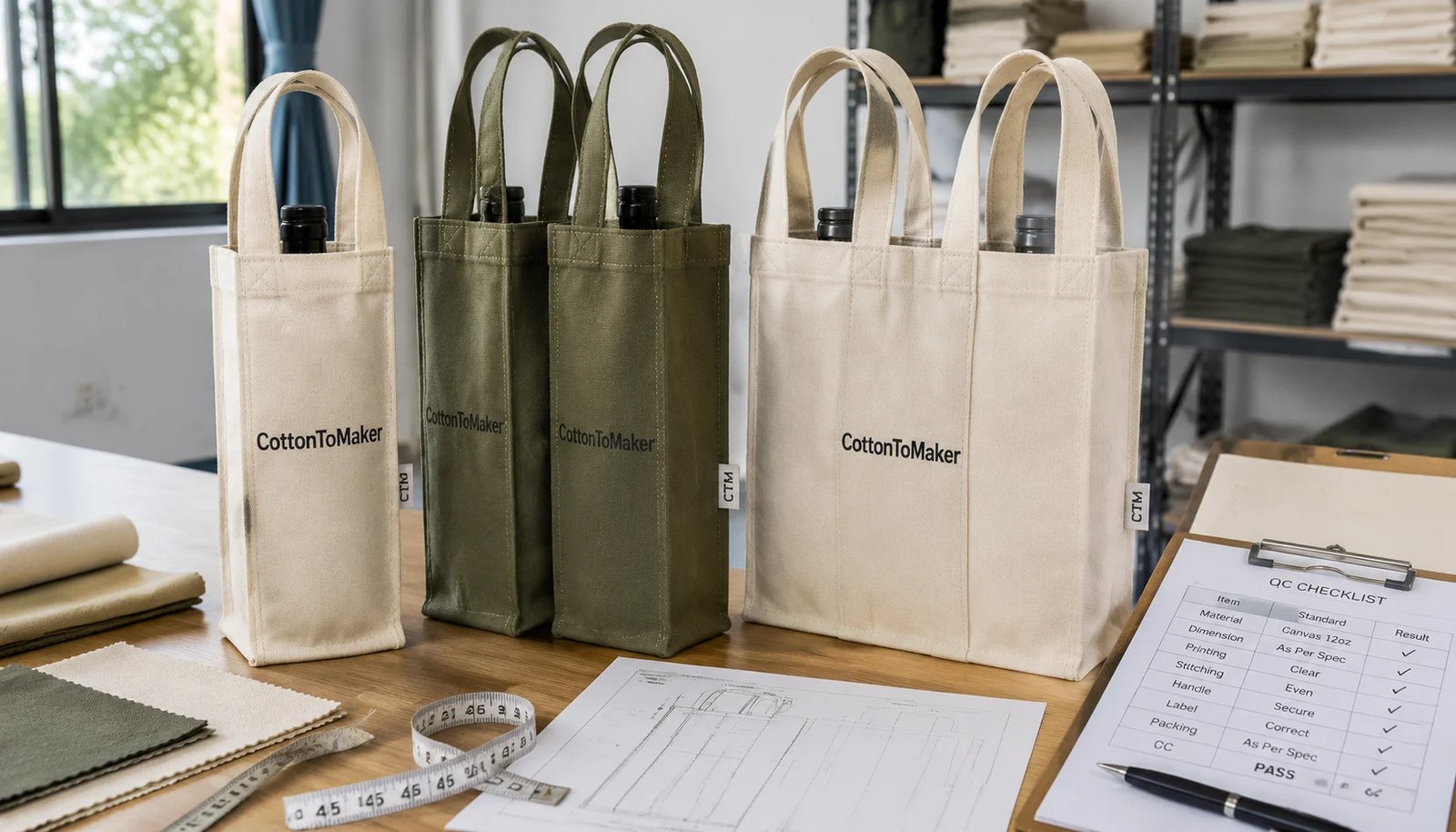
Why lead time planning is the real buying problem for canvas wine carriers
Canvas wine carriers look simple, but seasonal retail programs expose every weak assumption in the timeline. Natural grocers often buy these bags around holiday gifting, in-store wine events, loyalty promotions, or bottle-and-bag merchandising sets. In those windows, a late bag is not a minor inconvenience. It can block a full promotion because the bottle assortment, shelf card, and distribution center allocation are all linked to one arrival date.
The most common sourcing mistake is treating canvas wine carriers like generic tote bags with a short make time. Wine carriers usually need more structure, more sewing control, and more fit validation because they hold heavy, breakable products. A quote that says 30 days without stating fabric status, sample sequence, print queue, and packing assumptions is not enough for a buyer trying to protect a launch calendar.
- Lead time risk increases when one order includes multiple bottle formats, colors, or regional SKUs.
- Gift-oriented retail deadlines leave little room for remake if bottle fit or print placement is wrong.
- Production planning should start from in-store date backward, not from PO date forward.
- The slowest component is often fabric preparation or sample approval, not sewing.
Start with the bottle profile before you choose the bag spec
For wine carriers, the bottle defines the bag, not the other way around. Standard 750ml still wine bottles are relatively easy to fit, but natural grocers may also carry sparkling wine, olive oil, kombucha gift bottles, or local glass products with wider shoulders and different neck heights. If the RFQ only says 'wine bag', suppliers will often quote to a standard body width that may not fit your actual assortment.
A practical RFQ includes bottle height, base diameter, widest body diameter, and target carry weight. If one bag must fit more than one bottle family, state the full range. This matters for gusset width, body depth, handle length, and whether a divider is needed in double-bottle styles. It also affects packing efficiency because a wider gusset can reduce units per carton.
- Typical single-bottle body uses 10oz to 12oz canvas, around 280-340 GSM.
- Two-bottle carriers often need either a center divider or wider gusset with stronger bottom stitching.
- Handle drop should reflect actual use: short carry for bottle gifting or longer shoulder carry for grocery add-on sales.
- If bottles are unusually tall, request a fit sample with inserted dummies before bulk approval.
Fabric weight, finish, and color choice all change the schedule
Buyers often focus on cost per bag first, but lead time usually starts with fabric route. Natural canvas in common weights can be easier to source than custom dyed canvas, especially when the factory already runs those weights for bag production. A stock natural 10oz or 12oz canvas may move quickly into cutting, while a Pantone-matched olive, burgundy, or deep green body can add dyeing time, shade approval time, and replacement risk if the first lot misses tolerance.
Fabric weight also affects output. Heavier canvas can improve bottle support and premium feel, but it cuts and sews slower. If the bag includes a divider, piping, or inside lamination, production capacity drops further. For natural grocers, 10oz to 12oz canvas is usually the practical middle ground unless the bag is intended for repeated heavy use or premium gift presentation. If eco positioning matters, clarify whether you need recycled content, organic claims, or only an unbleached natural look. Those are different supply routes with different documentary and scheduling requirements.
- Approximate practical range: 8oz to 14oz canvas, roughly 230-400 GSM.
- Natural/unbleached fabric may shorten lead time if stock is available, but shade can vary lot to lot.
- Custom dyed colors add queue time and require shade approval standard.
- Washed or softened finish can improve hand feel but may change size stability and print sharpness.
Print method should be selected for speed, artwork stability, and reorder control
Most canvas wine carriers for grocery retail are best quoted with screen print, especially for one-color logos or simple artwork panels. Screen printing is usually the most stable route for medium and high volume orders and gives predictable cost scaling by print color and print location. It also works well with natural brand aesthetics where buyers want a clean logo rather than heavy graphics.
Heat transfer, digital printing, or embroidery may suit some premium concepts, but they introduce different risks. Digital printing can offer detail, yet color consistency between runs on textured canvas needs close control. Embroidery adds a premium effect but can distort lighter canvas panels and slows production. Woven labels are useful when artwork is small and placement discipline matters. For lead time planning, the safest route is often one-color screen print plus a woven side label if additional branding is needed.
- Screen print cost usually scales by number of colors, print area, and number of panels.
- Fine lines and small reversed text can fill in on textured canvas; simplify artwork for repeatability.
- Request print placement tolerance, for example plus or minus 5mm from seam or top edge reference.
- Ask whether strike-off approval is digital only or physical on actual fabric.
MOQ logic is often hidden in the quote and can distort your plan
A supplier may quote an attractive unit price based on total quantity, then apply practical minimums later when the order is split by body color, print design, or regional packaging. For wine carriers used in natural grocers, these splits are common. One banner program may use one print, while local private labels or distributor packs use another. The real MOQ is therefore not just the total order. It is the minimum efficient run for each fabric and printing setup combination.
To compare quotes fairly, buyers should request MOQ logic in plain structure. For example: minimum by style, minimum by color, minimum by print design, and minimum for custom carton labels. This avoids last-minute surcharges when marketing decides to divide one order into more SKUs. It also helps forecast whether combining nearby designs into one body color can shorten lead time by reducing changeovers.
- Separate MOQs may apply for fabric dyeing, printing screen setup, labels, and packaging inserts.
- Small split runs can increase both price and lead time even if the total order volume is high.
- If the factory uses stock natural canvas, MOQ pressure may shift from fabric to print and packaging.
- A mixed-SKU order should be quoted with an assortment matrix, not one blended unit price only.
Sample approval should prevent production delay, not create it
Sampling is where many programs lose time because the approval path is too vague. A buyer who asks for 'one sample' may end up waiting through multiple hidden stages: raw material swatch, print strike-off, sewn proto, pre-production sample, and packed sample. Each stage can be useful, but only if it resolves a specific risk. For canvas wine carriers, the big risks are bottle fit, print appearance on the actual fabric texture, handle comfort, and carton packing efficiency.
A better approval route is short and targeted. Start with fabric swatch approval if color or recycled-content claim matters. Then review a print strike-off on the chosen canvas. After that, approve a pre-production sample made to bulk spec, including reinforcement and label placement. If the order has retail-ready carton or barcode requirements, add one packed sample stage. This sequence reduces back-and-forth and stops the common mistake of approving a sample built with substitute fabric.
- Do not approve print color from screen image only if body color is custom dyed.
- Use actual or dummy bottles in fit photos from front, side, and top view.
- Record approved dimensions, fabric GSM, print size, and handle drop on the sample approval sheet.
- If there is a divider, inspect bottom anchor stitching and bottle separation in use.
Packing details are part of lead time planning, not an afterthought
Packing decisions directly affect production flow and warehouse handling. Flat-packed wine carriers are standard, but the way they are folded, bundled, labeled, and cartoned can add labor and create distribution problems if left undecided. Natural grocers and distributors often need SKU-level assortments by region, body color, or promotion. If carton labeling logic arrives late, a finished order may sit waiting for revised marks or repacking instructions.
Carton design also matters because wine carriers with reinforced handles and gussets can bulk up faster than plain totes. If the factory compresses too many pieces into one carton to hit a freight target, gussets can crease and printed areas can offset. State your maximum carton gross weight, target carton dimensions if palletization matters, and whether inner bundles are required for DC counting efficiency.
- Common packing route is flat packed by style and color, bundled, then export carton packed.
- Set carton gross weight limit if your warehouse prefers manual handling, for example under a stated threshold.
- Barcode label position should be tied to the outer carton and, if needed, inner bundle.
- If mixed packs are needed for store kits, define assortment ratio before bulk starts.
Build a realistic production calendar instead of relying on one total lead time
A useful lead time plan breaks the project into components. For example: fabric booking or release, dyeing if needed, print strike-off, sample sewing, approval turnaround, bulk cutting, printing queue, sewing, finishing, inspection, packing, and loading. Without this breakdown, buyers cannot see where to add buffer or where to compress by making earlier decisions. A factory saying '45 days after approval' may still need another two weeks for fabric if the canvas color is not stocked.
For grocery and gift programs, work backward from the required in-store date and include importer-side steps such as vessel booking, ocean transit, customs clearance, drayage, and DC intake appointment. If the order has multiple SKUs, identify whether one late color can hold the whole shipment. In some cases, partial shipment by ready SKU is worth planning in advance, but only if the cost impact is acceptable.
- Stock natural canvas with simple print usually shortens the path versus custom dyed multicolor programs.
- Public holidays at source and destination should be plotted early, especially before peak gifting seasons.
- Approval delays on artwork or carton marks often consume more days than actual sewing.
- If ship windows are narrow, ask the factory for weekly capacity visibility, not only a final ETD.
QC thresholds for wine carriers should reflect load and shelf presentation
Quality control on a wine carrier cannot stop at basic appearance. The product carries glass weight, may be lifted repeatedly, and sits in a retail environment where clean branding and upright shape matter. A buyer should define acceptance criteria that match the use case: secure handles, consistent body size, intact divider on double-bottle styles, no major print flaws on front panel, and no severe shade variation across visible store stock.
Inspection also needs to account for realistic defects versus non-critical natural fabric character. Unbleached canvas can show minor flecks, and some buyers accept that as part of the natural look. What should not be accepted are oil marks on key display panels, excessive seam waviness that distorts bottle fit, open stitching at stress points, or cartons packed so tightly that the products arrive permanently creased.
- Use load-oriented seam review at handle attachment and bottom seam intersections.
- Set visual standard for acceptable natural slub or cotton specking if using unbleached canvas.
- Require print opacity and edge clarity standard on the front-facing panel.
- Include packaging inspection for carton marks, count accuracy, and inner assortment.
Use quote data to compare landed value, not only ex-factory unit price
When buyers compare suppliers, the cheapest ex-factory quote can be the most expensive landed option if it hides slower fabric sourcing, higher carton cube, or weak QC support that leads to rework. For wine carriers, a slightly higher quote using the right GSM, stable print method, and optimized packing can lower overall program cost by reducing claims, avoiding emergency air freight, and improving pallet efficiency.
Quote comparison should therefore be line-based. Review fabric spec, print setup charges, sample cost and revision policy, packing assumptions, carton data, inspection support, and actual MOQ split rules. If a supplier will only quote one broad lead time and one broad unit cost, the buyer does not yet have enough information to compare commercial risk. Good quote data should let you estimate not just piece price, but likely delivery reliability and total logistics burden.
- Compare carton dimensions and units per carton to estimate freight cube impact.
- Note whether print screens, labels, and sample charges are one-time or repeat-order costs.
- Review whether the quoted price includes reinforced handles, divider, and barcode labeling.
- A reorder using stock fabric and retained screens may have a different lead time and cost profile than first production.
Specification comparison for buyers
| Spec decision | Recommended option | When it fits | Buyer risk to check |
|---|---|---|---|
| Fabric weight | 10oz to 12oz canvas, about 280-340 GSM | Best balance for grocery gift programs, bottle support, and printable surface without excessive bag weight | Below about 8oz or 230 GSM can collapse under glass bottle load; above 14oz may increase sewing time, carton weight, and freight cost |
| Bottle format | Single-bottle carrier with bottom gusset and divider-free body | Fastest production and simplest packing for seasonal promos or entry-price private label | If bottle diameter range varies too much, fit complaints increase; give min and max bottle circumference in RFQ |
| Two-bottle construction | Center stitched divider panel in same canvas or lighter 6oz internal separator | Useful for premium gifting and higher basket value in natural grocers | Divider adds labor and line balancing time; weak top join area can fail if bartack reinforcement is missing |
| Handle style | Self-fabric webbing-style stitched handles with X-box reinforcement | Most common for grocery retail where buyers want a consistent cotton look | Short handles without sufficient stitch back length can tear under repeated carry; ask for handle pull-test standard |
| Print method | 1-color screen print for front panel branding | Most economical for medium and high volume with simple logo artwork | Registration shifts on textured canvas; fine lines may fill in; request print size tolerance and cured ink rub test |
| Decoration upgrade | Woven side label plus small screen print | Good for cleaner shelf presentation and lower risk than large multicolor artwork | Side label placement can drift; require placement tolerance such as plus or minus 5mm from seam reference |
| MOQ structure | MOQ by body color and print design, not only total order quantity | Helps estimate true production feasibility across mixed store programs | A quote that ignores color split may hide later surcharges for separate dye lots, screens, or carton labels |
| Packing method | Flat packed in PE-free inner bundles with export carton by style and color | Works for importers supplying distribution centers that relabel by SKU | Over-compression can crease print and distort gussets; ask max units per carton and packed carton gross weight |
| Lead time route | Bulk after approved pre-production sample and print strike-off, with vessel booking buffer | Best for buyers importing around holiday wine promotions and regional distribution windows | Factories may quote sewing lead time only; exclude fabric greige booking, dyeing, printing queue, and inland transit at your own risk |
Buyer checklist before sampling
- State bottle type clearly: standard 750ml wine, sparkling bottle, olive oil bottle, or mixed assortment, with bottle diameter and height range.
- Specify canvas weight in oz and GSM, color standard, and whether recycled cotton content is required or only conventional cotton canvas.
- Define construction: single bottle, two bottle, or six bottle tote; include gusset width, divider requirement, seam finish, and handle drop.
- Name the print method and artwork count by panel, plus target print size, ink color reference, and whether inside label or woven side label is needed.
- Break MOQ by SKU, body color, and print design so the quote reflects actual production splitting.
- Request sample stages in sequence: material swatch, print strike-off, pre-production sample, and if needed packed carton sample.
- Set packing rules: units per inner bundle, carton dimensions, carton gross weight limit, barcode label position, and assortment rules by SKU.
- Include required QC points such as seam security, print adhesion, size tolerance, handle reinforcement, odor standard, and carton drop resistance.
- Ask for a line-item lead time map from fabric booking through final inspection and container loading, not one total number only.
- Add ship window, destination port, and whether partial shipment is acceptable if one SKU runs late.
Factory quote questions to send
- What is the exact canvas specification quoted, including yarn count if relevant, oz/GSM tolerance, cotton content, and whether the fabric is stock greige or made to order?
- Is the quoted lead time based on stock fabric color, fresh dyeing, or a custom Pantone match? State calendar days for each route.
- How is MOQ applied: per style, per color, per print colorway, or per shipment? List surcharge triggers for split runs.
- What print method is included in the quote, and what artwork limitations apply for line thickness, coverage area, and registration tolerance on canvas texture?
- Does the sample cost include revised pre-production sample after artwork adjustment, or only one initial sample?
- What sewing reinforcement is standard at handle attachment and divider joints: bartack, X-box, backstitch length, and thread type?
- What are the standard size tolerances for width, height, gusset, and handle drop after sewing and final pressing?
- What packing configuration is quoted: units per carton, net and gross weight per carton, carton dimensions, and inner packing material?
- What AQL or in-house inspection standard is used before shipment, and can the factory support third-party inspection timing without delaying ETD?
- Which parts of the timeline are outside factory control, such as fabric dye queue, public holiday shutdowns, print plate preparation, or port congestion?
Quality-control points to confirm
- Fabric weight should stay within agreed tolerance, commonly around plus or minus 5 percent of target GSM.
- Body size and gusset dimensions should meet approved sample tolerance, commonly plus or minus 0.5cm to 1cm depending on style.
- Handle attachment must include specified reinforcement and show no skipped stitches, thread breaks, or seam grin under normal pull.
- Center divider in two-bottle bags must be stitched straight and securely anchored at bottom seam with no open gap that allows bottle collision.
- Screen print should show clean edges, acceptable opacity, no severe pinholes, and no offset transfer inside folded bags.
- Ink curing should pass dry rub and light damp rub standard agreed in the PO, especially for dark inks on natural canvas.
- Canvas surface should be free of major oil stains, mildew odor, visible weaving faults on front panel, and unacceptable shade variation within one shipment.
- Cartons must match shipping marks, SKU assortment, barcode placement, and gross weight limit stated in the order instructions.