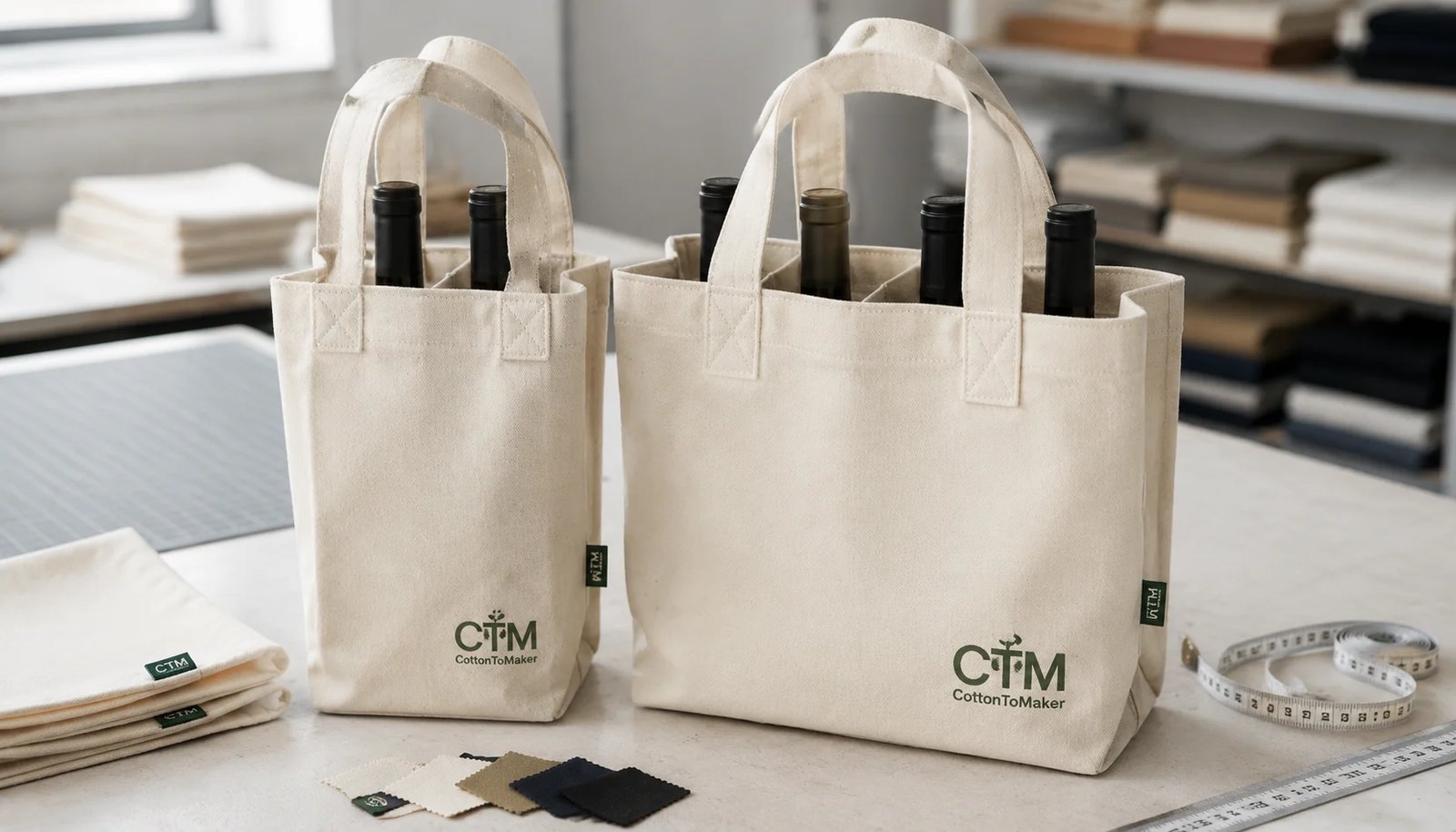
Procurement Goal
Canvas wine carriers for natural grocers are load-bearing retail packaging, not ordinary promotional totes. They must carry rigid glass bottles through checkout counters, parking lots, back rooms, and customer reuse without handle failure or bottle contact. A weak carrier can create broken product, safety concerns, store complaints, and brand damage.
The procurement goal is to translate a natural-looking bag into measurable performance. A quote that says "12 oz canvas wine bag" is not enough. Buyers need bottle count, fabric GSM, handle construction, divider attachment, print method, packing rules, and durability acceptance criteria written into the RFQ before factories price the order.
- Define performance first: bottle count, loaded weight, bottle diameter, and reuse expectation.
- Separate structural requirements from branding details so both are inspected.
- Use the approved sample as a reference, but add numeric pass or fail criteria.
- Require evidence after testing, not only production photos with finished goods stacked on a table.
Carrier Format
The right format depends on the store use case. A 2-bottle carrier is often used for gifts, tastings, and curated pairings. A 4-bottle carrier is more suitable for repeat retail use and weekly purchases. A 6-bottle carrier needs more careful engineering because loaded weight, divider stress, handle pressure, and carton weight all rise quickly.
Natural grocers usually want a carrier that visually fits beside cotton totes, produce bags, and other reusable packaging. Natural canvas, recycled cotton blends, organic cotton canvas, and muted dyed canvas can all work, but none of those choices replaces construction testing. Softer fabric may feel better in hand, while firmer fabric may stand better when loaded.
- 2-bottle carrier: prioritize presentation, divider accuracy, and comfortable hand carry.
- 4-bottle carrier: balance strength, retail price, print area, and carton efficiency.
- 6-bottle carrier: require heavier construction, stronger handles, higher lift-cycle testing, and lower carton piece counts.
- Single-bottle sleeve: treat as a separate gift-pack format with lighter load requirements.
Fabric And Material Specification
For most reusable canvas wine carriers, 10 oz to 12 oz cotton canvas, roughly 340 to 410 GSM, is a practical starting range. Lighter 8 oz to 10 oz canvas can be acceptable for single-bottle sleeves or short-term promotions, but it should not be assumed strong enough for 4-bottle or 6-bottle retail use. Premium programs may use 12 oz to 14 oz canvas, but heavier fabric also increases sewing difficulty, carton weight, and cost.
Ask suppliers to quote both ounce weight and GSM because regional quoting habits vary. Also clarify whether the fabric is greige, unbleached, dyed, washed, coated, recycled, or organic. Dyeing and washing can change shrinkage, handfeel, print absorption, and finished dimensions. If any environmental claim matters to the program, request documentation before approving artwork or packaging copy.
- Entry promotional use: 8 oz to 10 oz canvas only after loaded testing passes.
- Standard reusable carrier: 10 oz to 12 oz canvas with reinforced seams and handles.
- Premium or paid retail carrier: 12 oz to 14 oz canvas if sewing quality and carton weight remain acceptable.
- Material data to collect: GSM, composition, finish, color tolerance, shrinkage tolerance, and documentation for any sustainability claim.
Commercial Supplier Comparison
A useful commercial comparison should look beyond the cheapest unit price. A stock-canvas factory may offer the fastest path for a pilot program, while a custom dye supplier may be better for brand color control. A factory with in-house printing may reduce handoff risk, while an exporter may help consolidate store allocations across several SKUs.
Before selecting a supplier, normalize the specification. Two quotes are not comparable if one uses 10 oz stock canvas with straight-line handle stitching and another uses 12 oz canvas with bartacks, fixed dividers, and stricter inspection. Ask each supplier to requote against the same fabric, construction, print, packing, and QC requirements.
- Compare supplier capability by material access, sewing quality, printing control, QC evidence, packing discipline, and communication speed.
- Ask whether MOQ is per total order, per carrier size, per fabric color, per print design, or per shipment.
- Treat outsourced printing as a risk point unless one party accepts responsibility for final quality.
- Use landed cost per approved usable unit, not only FOB unit price.
Construction Details
The main failure points are handle attachments, top hems, divider seams, bottom corners, and side seams. Handles sewn only into a folded top edge may look clean when empty but tear when the customer lifts a loaded bag sharply. Better construction uses cotton webbing handles secured with box stitch, cross-stitch, or bartack reinforcement at each stress point.
Dividers are equally important. Loose dividers may be acceptable in a light gift sleeve, but reusable grocery carriers should have dividers secured into the side or bottom structure. Divider height should reduce bottle-to-bottle impact, especially with wider Burgundy-style bottles. The bottom should sit flat when loaded so the carrier does not twist or tip at checkout.
- Handle width: commonly 25 mm to 38 mm, selected by bottle count and comfort target.
- Handle drop: define hand-carry, wrist-carry, or longer carry style before sampling.
- Reinforcement: require bartack, box stitch, or cross-stitch at every handle attachment point.
- Divider height: specify a finished measurement and test against the widest bottle style.
- Bottom structure: boxed or gusseted base should stay stable under full load.
Durability Test Checklist
Durability testing should be simple enough for factory QC to repeat, but precise enough to prevent subjective approval. Use real 750 ml bottles or weighted cylinders that match actual bottle diameter and filled weight. Load the carrier to intended capacity, then test static holding, dynamic lifting, divider separation, seam strength, handle strength, and print resistance.
Set acceptance criteria before the sample is produced. A practical example is full load plus 20 percent safety margin for a 30-minute static hold, followed by 100 lift cycles for 2-bottle and 4-bottle carriers or 150 cycles for 6-bottle carriers. After testing, reject any sample with handle tearing, seam opening, divider detachment, visible fabric rupture, or print damage outside the approved tolerance.
- Static load: intended load plus 20 percent for 30 minutes with no structural failure.
- Dynamic lift: 100 cycles for 2-bottle or 4-bottle carriers; 150 cycles for 6-bottle carriers.
- Handle pull: at least 150 N per handle attachment for standard formats unless your risk standard requires higher.
- Seam pull: at least 80 N on side, bottom, and divider seams with no opening or excessive slippage.
- Bottle rub: 60 seconds of normal movement with no glass-to-glass impact through the dividers.
- Print rub: 20 dry rub cycles and 10 damp wipe cycles with no heavy transfer or lost legibility.
Print And Brand Control
Water-based screen print is often the best match for natural grocer branding when artwork is simple and limited to one to three colors. It keeps the handfeel closer to canvas and avoids a thick plastic surface. Heat transfer can work for small details, gradients, or complex artwork, but buyers should test cracking, edge lift, and whether the finish suits the store's natural packaging standards.
Print placement needs production control. Logos printed too close to a bottom gusset may crease during flat packing. Artwork placed over seams can lose definition. The RFQ should state print method, print size, color reference, placement from finished edges, acceptable registration tolerance, and whether each SKU uses the same design.
- Screen print: best for bold logos, limited colors, and softer handfeel.
- Heat transfer: useful for detail, but test edge lift and cracking after folding.
- Embroidery: premium but can pucker heavy canvas and increase cost.
- Woven label: useful for subtle branding or multi-SKU programs.
- Reject evidence: visible ink transfer, heavy misregistration, cracked print, wrong color, or logo outside placement tolerance.
Sample Approval Evidence
A sales sample can show general workmanship, but it may not prove production readiness. The approval sample should use final fabric, final handle, final divider, final print method, final label, and final packing method. If any component is substituted, mark the sample as reference only and do not use it as the production standard.
Request evidence that proves compliance. Useful evidence includes a scale photo of loaded test weight, a short video showing lift cycles, close-up photos of handle attachments after testing, divider seam photos, print-rub cloth photos, measurement photos with a ruler, and carton packing photos. Reject staged photos that do not show the tested weight, stress points, or post-test condition.
- Measure finished width, height, gusset, divider spacing, divider height, and handle drop.
- Load with real bottles and record twisting, sagging, and upright stability.
- Inspect stitch density, seam allowance, bartack placement, thread trimming, and needle damage.
- Compare print color to the approved reference under consistent light.
- Keep one signed sample at the factory and one with the buyer or inspector.
Packing And Distribution
Packing must protect shape and print while staying practical for distribution centers and store receiving teams. Flat packing is common, but over-compression can crease printed panels and crush dividers. Heavy canvas carriers should not be packed only to maximize carton quantity; carton gross weight and handling limits matter.
Natural grocers may request reduced plastic, but the replacement method must be defined. Paper banding, kraft inner wraps, or bulk inner packing can work when cartons still protect goods from moisture, dust, and rubbing. Carton marks should identify PO, SKU, color, print version, quantity, gross weight, net weight, carton size, country of origin if required, and destination if store allocation is used.
- Set a maximum carton gross weight based on DC handling rules, commonly no more than 15 kg to 18 kg unless your operation allows more.
- Pack by SKU unless mixed cartons are explicitly approved with a packing list format.
- Protect printed panels from abrasion against carton walls, staples, straps, or neighboring units.
- Check that dividers are not crushed by carton compression.
- Approve carton marks and barcode placement before bulk packing begins.
Lead Time And Inspection
Lead time should be counted from the last approval point, not from the inquiry date. The clock usually starts after deposit, final artwork, approved sample, confirmed fabric, approved packing instructions, and any required material documentation. Dyed fabric, custom labels, outsourced printing, store-specific carton marks, and third-party inspections can all add schedule risk.
For many bulk programs, sample timing may be 7 to 14 days after spec lock, and production may be 25 to 45 days after sample approval, depending on quantity, material availability, and factory load. Build in time for one correction round. A failed load test, wrong print color, or carton mark revision can easily consume the buffer that seasonal wine promotions need.
- Inspection plan: define critical, major, and minor defects before production starts.
- Example AQL: critical defects zero tolerance, major defects AQL 2.5, minor defects AQL 4.0.
- Critical defects: unsafe handle failure, wrong material, contamination, or severe structural failure.
- Major defects: weak seams, wrong logo color, incorrect dimensions, missing bartacks, wrong carton marks, or mixed SKUs.
- Minor defects: loose threads, slight wrinkles, small non-structural print variation, or trim issues within agreed limits.
- Fastest low-risk route: stock natural canvas, standard carrier size, simple screen print, approved carton plan, and clear buyer authority.
Specification comparison for buyers
| Supplier or material option | Best fit | Commercial advantage | Procurement risk to verify |
|---|---|---|---|
| Stock natural cotton canvas supplier | Short lead time programs, pilot orders, single-color logo runs, and standard 2-bottle or 4-bottle formats | Lower setup risk, faster sampling, easier MOQ negotiation, and fewer dye lot variables | Confirm actual GSM, fabric roll availability, shrinkage range, handle webbing quality, and whether repeat orders can match the approved sample |
| Custom dyed canvas supplier | Store brand color programs, seasonal campaigns, or multi-SKU retail launches requiring controlled color | Better brand alignment and SKU differentiation when color consistency matters | Require lab dip approval, dye lot tolerance, colorfastness checks, MOQ per color, and extra lead time before cutting |
| Organic or recycled cotton canvas option | Natural grocer programs with sustainability requirements or private-label packaging standards | Supports material claims when documentation is available and consistent across production lots | Request transaction certificates or recycled-content documentation where applicable; reject vague claims without material traceability |
| Heavy-duty 12 oz to 14 oz canvas construction | Reusable paid retail bags, 4-bottle and 6-bottle carriers, gift sets, and higher perceived value programs | Stronger body, better upright shape, and more premium handfeel | Check sewing capability, needle damage, carton weight, print absorption, and whether the added fabric cost improves actual load performance |
| Jute or jute-cotton alternative | Rustic gift packaging or low-detail branding where natural texture matters more than print sharpness | Distinct natural appearance and potential cost advantage for some simple formats | Compare print clarity, fiber shedding, odor, seam smoothness, and bottle abrasion against cotton canvas before switching |
| Factory with in-house printing | Programs with repeat logos, tight sample rounds, and fewer handoffs between sewing and print approval | Better control over print placement, color matching, and rework timing | Ask for print-rub test records, screen setup charges, print area limits, and photos showing registration on the actual carrier shape |
| Factory using outsourced printing | Complex artwork, specialty transfer, embroidery, or finishing not available in the sewing factory | Can access better specialty decoration capabilities without changing sewing supplier | Require responsibility for defects in writing; reject split accountability between sewing factory and printer when print cracks, shifts, or stains occur |
| Exporter or trading partner managing multiple factories | Multi-SKU programs, mixed materials, store allocations, and buyers needing consolidation support | Can coordinate sourcing, QC, packing, and shipment across several production sources | Verify factory identity, inspection access, sample retention, and whether each production site follows the same approved specification |
| Low-cost promotional bag supplier | Short-term event use, low bottle count, or non-reusable giveaway programs | Lower unit price when the carrier is not expected to carry repeated heavy loads | Do not use for paid reusable retail carriers unless it passes the same static load, lift cycle, handle pull, and seam inspection criteria |
Buyer checklist before sampling
- Define bottle count, maximum bottle diameter, target loaded weight, and whether the carrier must stand upright when full.
- Specify canvas in both oz and GSM; include composition, color, finish, shrinkage tolerance, and any required material documentation.
- State handle width, handle drop, stitch pattern, bartack or box-stitch reinforcement, and whether reinforcement patches are required.
- Set divider height, divider spacing, bottom attachment method, and minimum clearance for the widest bottle style in the assortment.
- Require sample testing with real 750 ml bottles or weighted cylinders matching the expected diameter and filled weight.
- Use numeric QC criteria: static load, hold duration, lift cycles, seam pull force, rub cycles, dimensional tolerance, and AQL level.
- Approve a pre-production sample made from final fabric, final handle, final divider, final print method, and final packing method.
- Request evidence that proves compliance, such as measured load-test photos, short videos of lift cycling, inspection sheets, and close-ups of stress points after testing.
- Reject samples with handle tearing, divider detachment, seam opening, skipped bartacks, heavy print transfer, stains, wrong carton marks, or unapproved material substitution.
- Compare quotes against the same spec, including fabric GSM, reinforcement, divider construction, print method, carton quantity, inspection requirement, and delivery terms.
Factory quote questions to send
- What is the exact canvas weight in oz and GSM, and is the fabric natural, dyed, washed, coated, organic, recycled, or otherwise treated?
- What bottle diameter, bottle height, and loaded weight does your standard pattern support for 2-bottle, 4-bottle, and 6-bottle versions?
- How are dividers attached to the side seams and bottom seam, and what is the finished divider height and spacing?
- What handle material, width, drop length, stitch pattern, reinforcement patch, and bartack count are included in the quoted price?
- Can you test the sample at the requested load, hold time, lift cycle count, seam pull force, and print rub cycles, then record the results?
- Which print method is quoted, what is the maximum print area, how many colors are included, and what setup charges apply for screens, transfers, or embroidery?
- What MOQ applies per fabric color, per print artwork, per carrier size, and per shipment, and what surcharges apply below standard MOQ?
- Can the pre-production sample be made with final fabric, final handle, final divider, final print, final label, and final packing?
- What evidence will you provide during production: fabric inspection photos, cutting photos, handle reinforcement close-ups, load-test video, final QC report, and carton mark photos?
- How many pieces are packed per carton, what are the carton dimensions and gross weight, and can cartons be packed by SKU, store allocation, or destination?
Quality-control points to confirm
- Static load test: load to intended capacity plus 20 percent safety margin; hold hanging by handles for 30 minutes with no handle tear, seam opening, bottom distortion beyond approved sample, or divider detachment.
- Dynamic lift test: lift and lower the fully loaded carrier by the handles for 100 cycles for 2-bottle and 4-bottle formats, or 150 cycles for 6-bottle formats; no broken stitches, skipped bartacks, or visible fabric rupture.
- Handle pull check: each handle attachment should withstand at least 150 N pull for standard 2-bottle and 4-bottle carriers, or a higher buyer-approved force for 6-bottle carriers, without stitch failure or fabric tearing.
- Seam pull check: side seam, bottom seam, and divider seam should withstand at least 80 N hand-pull or gauge-pull force without opening, yarn breakage, or seam slippage exceeding the approved tolerance.
- Bottle rub check: load with actual bottle shapes and walk or swing gently for 60 seconds; bottles should remain separated by dividers without glass-to-glass impact during normal movement.
- Print dry rub test: rub the printed logo 20 cycles with a clean dry white cotton cloth; no heavy transfer, cracking, or loss of legibility.
- Print damp wipe test: rub the printed area 10 cycles with a lightly damp white cloth; no objectionable bleeding, sticky surface, or color transfer that would stain nearby carriers.
- Dimensional tolerance: finished width, height, gusset, divider spacing, and handle drop should stay within plus or minus 5 mm unless the signed sample sets a tighter tolerance.
- Visual workmanship check: no oil stains, mildew odor, loose threads over 10 mm, broken yarns, needle cuts, crooked logo placement, or exposed raw edges outside approved design.
- Carton review: packed cartons should stay within the buyer's gross weight limit, protect printed panels from abrasion, and keep dividers from being crushed by over-compression.