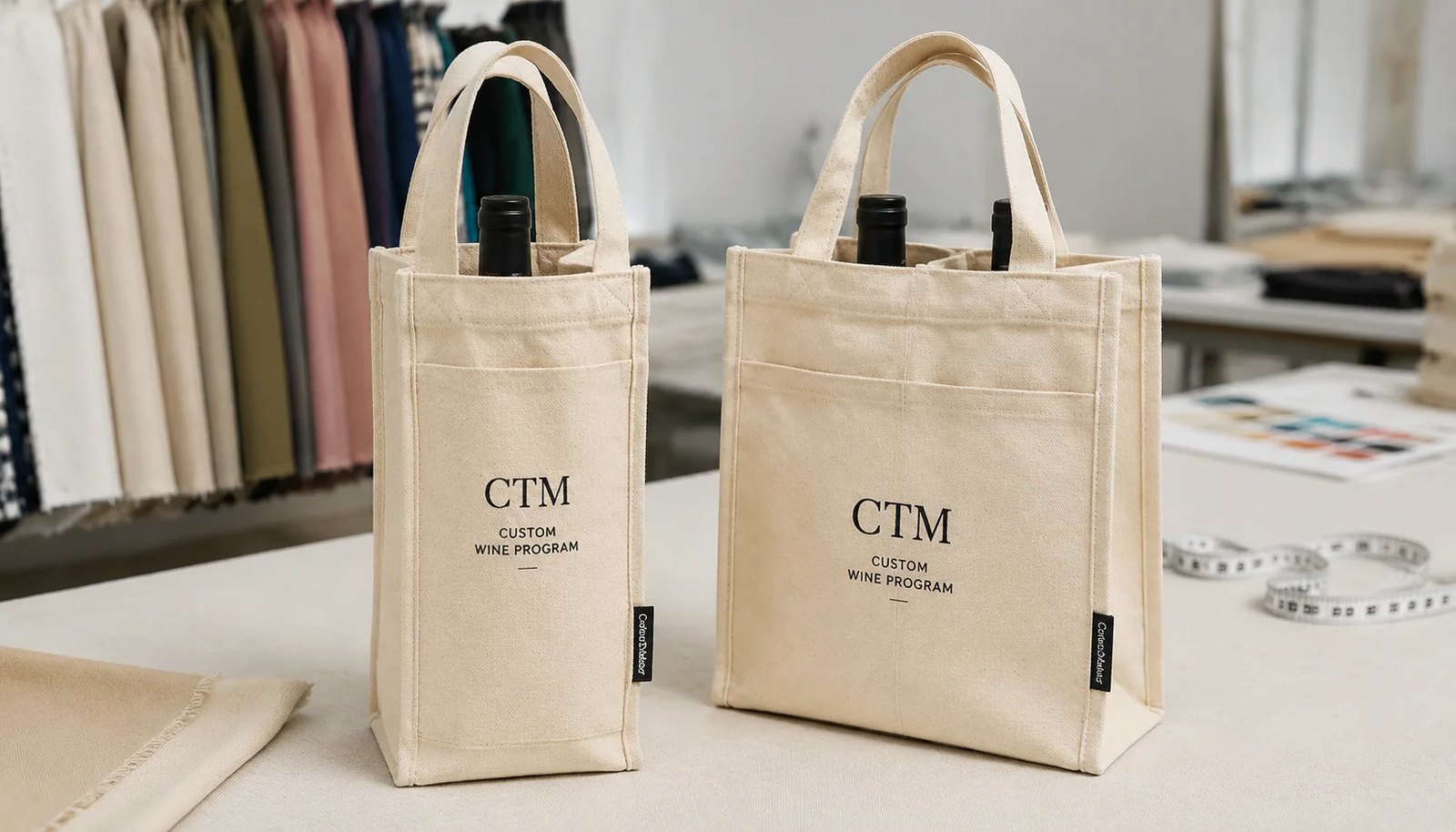
Start with the real MOQ question, not the lowest number
For liquor retailers, MOQ negotiation is not really about forcing a supplier to accept the smallest quantity. The real question is: what is the lowest quantity that still gives a reliable wine carrier program? A canvas bottle bag can appear simple, yet the production cost is shaped by fabric stock, print setup, sewing time, divider construction, packing method, and how many artwork versions must be separated.
This matters because a weak MOQ deal usually fails later in the process. The first quote may look attractive, then the supplier adds cost after reviewing bottle dimensions, revises lead time after learning the fabric must be dyed, or lowers construction quality to keep the number workable. Procurement teams should aim for a stable MOQ structure, not a headline MOQ that collapses during sampling.
For buyers searching wholesale canvas wine carriers for liquor retailers moq negotiation guide, the useful mindset is to treat MOQ as a set of linked minimums. There may be one minimum for fabric, another for printing, another for each logo variation, and another for retail packing. Once those are visible, negotiation becomes much more practical.
- Separate MOQ into body construction, fabric color, print artwork, and packing configuration.
- Ask suppliers which specification changes lower MOQ without reducing functional performance.
- Treat unusually low MOQ offers as a signal to inspect fabric weight, handle reinforcement, and hidden setup fees.
- Use annual demand estimates where possible; even if the first PO is small, a forecast often improves factory cooperation.
Define bottle fit before discussing price
Bottle fit should be fixed before the first serious quotation. Many buying errors come from requesting a 'standard wine carrier' without identifying the actual bottle profile. A Bordeaux bottle, Burgundy bottle, Champagne bottle, and heavy-glass spirits bottle may all be sold by the same retailer, but they do not behave the same inside a canvas bag.
If the bottle data is vague, suppliers often quote from an existing pattern. That can be acceptable for a simple one-bottle wine bag, but it is risky for two-bottle formats, premium gift sets, or stores that sell both wine and liquor. A bag that is slightly too narrow slows checkout and frustrates store staff. A bag that is too loose looks cheap and allows bottle impact.
The fastest way to improve both MOQ negotiation and quote accuracy is to send dimensions early. Diameter, total height, neck shape, and closure type all help. For mixed programs, identify whether the bag must fit only one bottle family or a range. When fit is uncertain, require a blank sample before printed sample approval.
- Provide bottle diameter and total height in millimeters, not only a product name.
- Flag unusual shapes such as Champagne shoulders, broad Burgundy profiles, or squat liquor bottles.
- For two-bottle bags, state whether both compartments must fit the same bottle or different SKUs.
- Ask the supplier to note the tested bottle size directly on the sample approval sheet.
- Do not approve bulk solely from drawings when bottle presentation is part of the retail offer.
Choose the right supplier type and sourcing geography
One gap in many buying guides is the difference between working with a direct manufacturer and a trading company. Both can be workable, but the risks are different. A manufacturer with in-house cutting and sewing usually answers technical questions faster and has better control over pattern changes, line setup, and in-process quality. A trading company may be useful when the buyer is combining several product categories or wants one contact to coordinate multiple factories.
The key issue is not whether a trading company is 'good' or 'bad'. It is whether responsibility is clear. If a trading company manages sampling, production, and final inspection tightly, the model can work. If it cannot explain fabric source, print method, sewing site, or QC process, then MOQ discussions become vague and execution risk rises.
Sourcing geography also matters because stock fabric availability, labor cost, and print capability differ by region. Buyers should ask where sewing happens, where the canvas is sourced, and whether printing is in-house or subcontracted. This is especially important for liquor retailers with repeat seasonal programs, because a supplier that depends on temporary subcontracting may struggle to repeat the same quality and lead time.
- Ask directly: manufacturer, trading company, or trader with dedicated factory partner?
- Request factory city or region and whether cutting, printing, and sewing are under one management system.
- Check whether the supplier keeps stock natural canvas or must purchase fabric only after PO confirmation.
- If the supplier is a trader, ask who controls PP sample sign-off and final inspection release.
- Prefer suppliers that can explain bottle-bag experience in practical terms, not only general tote-bag capability.
Use stock materials strategically to lower MOQ
The easiest path to a lower opening order is usually stock material. For canvas wine carriers, that often means natural cotton canvas already held by the supplier or commonly available from a local fabric market. If the program accepts standard widths, natural shade variation within reason, and a common weight such as 10 oz or 12 oz, the supplier avoids a custom fabric run and MOQ drops materially.
Custom dyeing changes the negotiation. Once a brand-specific fabric color is required, the dyelot minimum often replaces the sewing minimum as the real barrier. That is why many successful launch programs start with natural canvas and custom branding through print or labels, then move to dyed fabric only after sell-through is proven.
Stock trims matter too. Standard cotton webbing, common sewing thread colors, and standard woven labels usually support lower MOQs than special trims. Buyers sometimes focus only on fabric while ignoring how custom accessories rebuild the minimum order burden.
- Natural stock canvas typically gives the fastest and most flexible MOQ path.
- Dyed fabric should be reserved for programs with stronger volume confidence or repeat cadence.
- Ask which fabric weights and widths the supplier currently carries, not only what they can source.
- Confirm whether stock fabric can be reserved between sample approval and PO placement.
- Use custom print or labels first if brand impact is needed but volume is still uncertain.
Know which specifications push MOQ up fastest
Not every customization affects MOQ equally. Buyers often assume that size is the main factor, but in practice, fabric color, artwork splits, and retail packing can be more disruptive than a small dimensional change. For example, keeping one bag body but splitting the front logo across five store groups may still be workable. Requiring five different dyed bodies, five hangtags, and five barcode labels will usually rebuild the order into five smaller factory jobs.
Construction complexity also matters. A single-bottle carrier with a simple side gusset and reinforced self-fabric handles is straightforward. A two-bottle carrier with an internal divider, contrast binding, outer pocket, and premium finishing uses more operations, creates more inspection points, and often demands a higher practical minimum to keep unit cost sensible.
Strong procurement work means preserving the elements that protect performance while trimming the custom details that only add friction. For liquor retail, the non-negotiables are fit, load strength, and clean branding. Many decorative details can wait until the program proves itself.
- Highest MOQ pressure points often include dyed fabric, many artwork splits, custom labels, and individual retail packing.
- Two-bottle structures usually carry a higher effective minimum than one-bottle styles.
- Keep one shared body pattern where possible, then vary print rather than construction.
- If testing demand, remove nonessential pockets, linings, contrast trim, or unusual hardware.
- Ask for cost impact line by line so specification changes can be evaluated commercially.
Build a practical MOQ scenario table before negotiating
Instead of asking one supplier for one price, buyers should request several commercial scenarios. This creates a negotiation framework rather than a yes-or-no discussion. It also reveals which supplier actually understands the job. A capable supplier can usually explain how MOQ changes if the buyer uses stock fabric, reduces print colors, combines artwork, or accepts folded packing.
This approach is especially valuable for chains and distributors that need several logos or regional versions. The base body may be shared, but each added screen, label, or barcode can add labor or setup. Seeing those changes in scenario form helps procurement choose the right launch strategy.
A useful scenario comparison is not just technical. It should show what the buyer gains, what risk appears, and when each option fits. That is more actionable than a spec-only comparison table because it supports internal approval with merchandising, operations, and logistics teams.
- Request at least three quote paths: stock natural launch version, branded repeat version, and premium retail-ready version.
- Ask suppliers to identify which MOQ driver is dominant in each scenario: fabric, print, sewing, or packing.
- Use the same bottle dimensions and target construction across all scenarios so comparisons stay fair.
- Model annual demand separately from first-order demand to show future scale potential.
- Keep a written record of what each scenario excludes, especially setup, sampling, and packing fees.
Negotiate on the right levers and protect the wrong ones
Good MOQ negotiation gives the supplier scheduling or standardization advantages without reducing the functional standard. The best levers are usually accepting stock natural canvas, consolidating body size, limiting print colors, grouping artwork versions, or allowing a realistic delivery window so the factory can combine production with similar fabric runs.
The wrong levers are the ones that remove the safety margin from a weight-bearing bag. That includes reducing fabric weight without retesting, weakening handle reinforcement, skipping the PP sample, or accepting vague packing because the unit price looks better. Liquor retailers carry glass; visible product damage or handle failure at checkout creates immediate customer-facing risk.
Procurement teams should also watch language such as 'same as sample' if no measurable standard sits behind it. Negotiation works better when performance expectations are written clearly. If a supplier knows the buyer will check handle load, size tolerance, and print placement against agreed thresholds, there is less room for misunderstanding.
- Flexible levers: stock fabric, shared bag body, lower print color count, combined artwork run, practical lead time.
- Sometimes flexible: carton quantity per size, fold style, or label placement if retail operations agree.
- Not flexible: handle reinforcement method, divider security, bottle fit, final approved dimensions, and print durability.
- Not flexible: switching to lighter canvas after sample approval without written approval and retest.
- Use measurable pass criteria rather than descriptive phrases such as 'good quality' or 'strong handle'.
Compare quotes like a buyer, not like a shopper
Two suppliers can present similar unit prices and still be offering very different programs. One may quote 10 oz stock canvas and folded bulk packing; another may be using 12 oz fabric, flatter packing, and stronger handle reinforcement. One may include final inspection and setup charges; another may leave those outside the unit price. That is why quote normalization is essential.
For wholesale canvas wine carriers, the quote sheet should cover both product and logistics. Fabric weight, size, divider construction, handle width, print method, and packing all affect outcome. Carton dimensions, gross weight, and estimated CBM affect landed cost. Without this information, unit price comparison alone is misleading.
A smart RFQ asks suppliers to break down what changes with volume. Trial orders, target orders, and annual program volumes can have meaningfully different economics. Procurement can then decide whether to launch with a simplified first run or commit to a stronger annual framework.
- Collect itemized data for unit price, setup charges, sample charges, and special packing charges.
- Require carton dimensions and gross weight before supplier selection, not after production.
- Ask what assumptions the quote is based on: stock fabric, one-color print, flat packing, or one destination.
- Review whether artwork split fees apply per logo, per color, or per screen reset.
- Compare lead time from the same starting point: after deposit, artwork approval, and PP sample sign-off.
Make quality control executable with real thresholds
QC guidance is only useful if it can be executed by a factory, third-party inspector, or in-house team. For canvas bottle carriers, the strongest controls are the ones tied directly to use: dimensions, load-bearing points, divider stability, print integrity, and packing condition. Generic textile checks are not enough because this is a weight-bearing promotional packaging item, not a simple cotton pouch.
At minimum, the inspection plan should define AQL, measurement tolerances, and simple performance tests. AQL 2.5 major and 4.0 minor is a common commercial starting point if the buyer does not have a stricter standard. Width and gusset tolerance matter because a few millimeters can change bottle fit. Handle strength should be tested with realistic load, not only visual review.
It also helps to define what constitutes a major defect in this product category. Handle detachment, divider failure, severe misprint, incorrect dimensions that block bottle insertion, and wrong barcode data are all commercially significant. Slight natural canvas shade variation may be acceptable if agreed in advance; wrong dyelot color for a branded program is not.
- Use approved sample retention so inspectors have a physical standard for comparison.
- Measure width, gusset, and height on multiple units across the inspection lot.
- Run practical load tests on random samples using real bottles or equivalent weight.
- Check print adhesion and edge clarity on the actual canvas texture, not only color appearance.
- Review packing density so lower layers are not crushed and cartons stay within weight limits.
- Classify defects in writing before production so there is less argument at shipment stage.
Use samples and FAQs to extend commercial insight, not repeat basics
Sampling should answer business questions as well as technical ones. A blank fit sample confirms dimensions quickly and cheaply. A printed development sample shows whether the artwork scale and print method suit the canvas texture. A PP sample made from bulk fabric is the key control point before mass cutting. Each stage has a purpose; skipping stages often shifts risk into production where changes are more expensive.
The most useful follow-up questions are commercial. Can the same body run support multiple logos later? Will the chosen packing method increase warehouse handling time? If the launch program sells well, can the supplier reserve the same fabric source for repeat orders? These questions add more value than repeating whether screen print is cheaper than transfer print, because they affect continuity and program growth.
For liquor retailers, repeatability matters. A holiday gift bag that succeeds once may become a recurring item. Buyers should therefore use the first order to build a sourcing file: approved swatches, tested dimensions, load results, packing photos, quote assumptions, and supplier response quality. That file makes second-round MOQ negotiation much easier.
- Approve bottle fit first, then appearance, then bulk-match PP sample.
- Retain approved fabric swatches and print samples for repeat-order reference.
- Record what was accepted on natural canvas shade, print placement, and fold method.
- Ask suppliers how repeat orders will be handled if the same fabric stock is unavailable later.
- Treat the first order as the foundation for a cleaner annual sourcing program, not just a one-time buy.
Specification comparison for buyers
| MOQ scenario or sourcing choice | Typical commercial upside | Common hidden cost or risk | Best use case |
|---|---|---|---|
| Stock natural canvas, one size, one-color screen print | Lowest practical setup burden and fastest quoting | Limited brand differentiation; natural shade may vary slightly by lot | Trial orders, seasonal store promotions, simple house-brand programs |
| Stock natural canvas, same bag body, multiple artwork versions | Can split one production run across regional logos or store names | Per-artwork screen charges and carton sorting fees can erode savings | Chains needing several logos with the same dimensions and packing |
| Custom-dyed canvas, one artwork | Stronger brand presentation and cleaner shelf impact | Dyelot minimums often become the real MOQ and can extend lead time | Established programs with repeat ordering, not first tests |
| Single-bottle format | Lower sewing complexity and easier carton packing | May not transfer well to mixed spirits or gift-set bottles | Core wine stores with standard 750 ml bottles |
| Two-bottle format with sewn divider | Higher perceived value and better gift suitability | More labor, more seam stress, and stricter fit testing needed | Holiday packs, memberships, and premium checkout bundles |
| Manufacturer with in-house cutting and sewing | Usually better control over sampling, production changes, and process QC | Some factories are less flexible on very small custom runs if line efficiency is poor | Buyers prioritizing execution, repeatability, and technical accountability |
| Trading company with several partner factories | Can be useful for mixed product programs or smaller combined buying | Risk of weak technical answers or unclear factory responsibility | Buyers needing broad sourcing support across many bag types |
| Supplier using stock fabric library | Can reduce MOQ and speed sample approval | Stock may not match repeat orders exactly unless swatches are retained | Short lead-time launches and lower-volume tests |
| Retail-ready individual polybag and hangtag packing | Cleaner store delivery and easier barcode handling | Higher labor cost, more plastic use, and larger landed cost per unit | Direct-to-store or premium programs with presentation requirements |
Buyer checklist before sampling
- Define the exact bottle family before RFQ: Bordeaux 750 ml, Burgundy, Champagne, 1 L spirits, or mixed gift bottles.
- State whether the carrier must fit one bottle only, two identical bottles, or two different bottle shapes in one bag.
- Specify target fabric weight in both oz and GSM, for example 10 oz / about 280 GSM or 12 oz / about 340 GSM.
- Confirm whether stock natural canvas is acceptable or whether the program requires dyed canvas matched to a brand color.
- Ask if the supplier is a manufacturer, a trading company, or a trading company managing a nominated factory; require this in writing.
- Request the factory location or sourcing geography and whether fabric, printing, and sewing are handled in one site or subcontracted.
- Confirm finished size, gusset, divider type, handle width, handle drop, and handle reinforcement method on the quote sheet.
- State print method preference only if necessary; otherwise ask the supplier to quote the most suitable option for your artwork and quantity.
- Ask for pricing to be broken out by unit price, setup charges, sample charges, packing charges, and carton data.
- Clarify how MOQ is applied: per total PO, per SKU, per artwork, per fabric color, per size, or per shipment split.
Factory quote questions to send
- Are you quoting as the direct manufacturer or as a trading company, and which production steps are done in-house versus subcontracted?
- What city or region is the sewing factory in, and where are the canvas fabric and printing sourced?
- What stock fabric options do you hold now for natural or dyed canvas, and what are the current widths, weights, and minimum usable quantities?
- What is the lowest workable MOQ if we use stock natural canvas, one standard size, and one-color screen print?
- If we keep the same bag body and split logos across several stores, what is the minimum per artwork and what extra setup charges apply?
- What is the quoted fabric weight in both oz and GSM, and what tolerance do you allow on bulk fabric weight?
- What load test do you perform on handles for one-bottle and two-bottle bags, and what pass standard in kilograms and minutes do you use?
- What AQL level do you normally use for final inspection, and can you support AQL 2.5 major / 4.0 minor if required?
- What sample sequence will you provide: blank fit sample, printed development sample, and pre-production sample made from bulk fabric?
- How many pieces fit per export carton, what are the carton dimensions and gross weight, and how does packing change if we request flat versus folded units?
Quality-control points to confirm
- Use a defined final inspection standard, commonly AQL 2.5 for major defects and 4.0 for minor defects, unless the buyer’s compliance manual states otherwise.
- Control finished width and gusset to within plus or minus 5 mm, and height to within plus or minus 7 mm, because bottle fit is more important than normal tote tolerance.
- Check bulk fabric GSM against the approved sample with an agreed variance, commonly within plus or minus 5 percent.
- For one-bottle carriers, conduct a handle load test with at least 3 kg suspended for 1 hour; for two-bottle carriers, at least 5 to 6 kg for 1 hour, with no stitch opening, seam cracking, or handle detachment.
- Use reinforced handle attachment such as box stitch or bartack, with stitch density and thread type matched to the approved sample.
- For two-bottle styles, confirm divider alignment and secure top and bottom attachment so bottles do not contact each other during normal carrying.
- Run a practical drop test on a filled or equivalent-weight sample from about 60 cm onto a flat surface, primarily to check seam integrity and divider security, not to replace transit testing.
- Keep front logo placement within plus or minus 3 mm from approved artwork position on small panels, or within the written tolerance agreed at PP sample stage.
- Check print adhesion by dry rub and tape pull appropriate to the print method; reject flaking, cracking, or obvious ink lift on the approved test area.
- Review needle holes, skipped stitches, broken threads, oil marks, puckering, and seam twist, especially around handle roots and gusset joins.