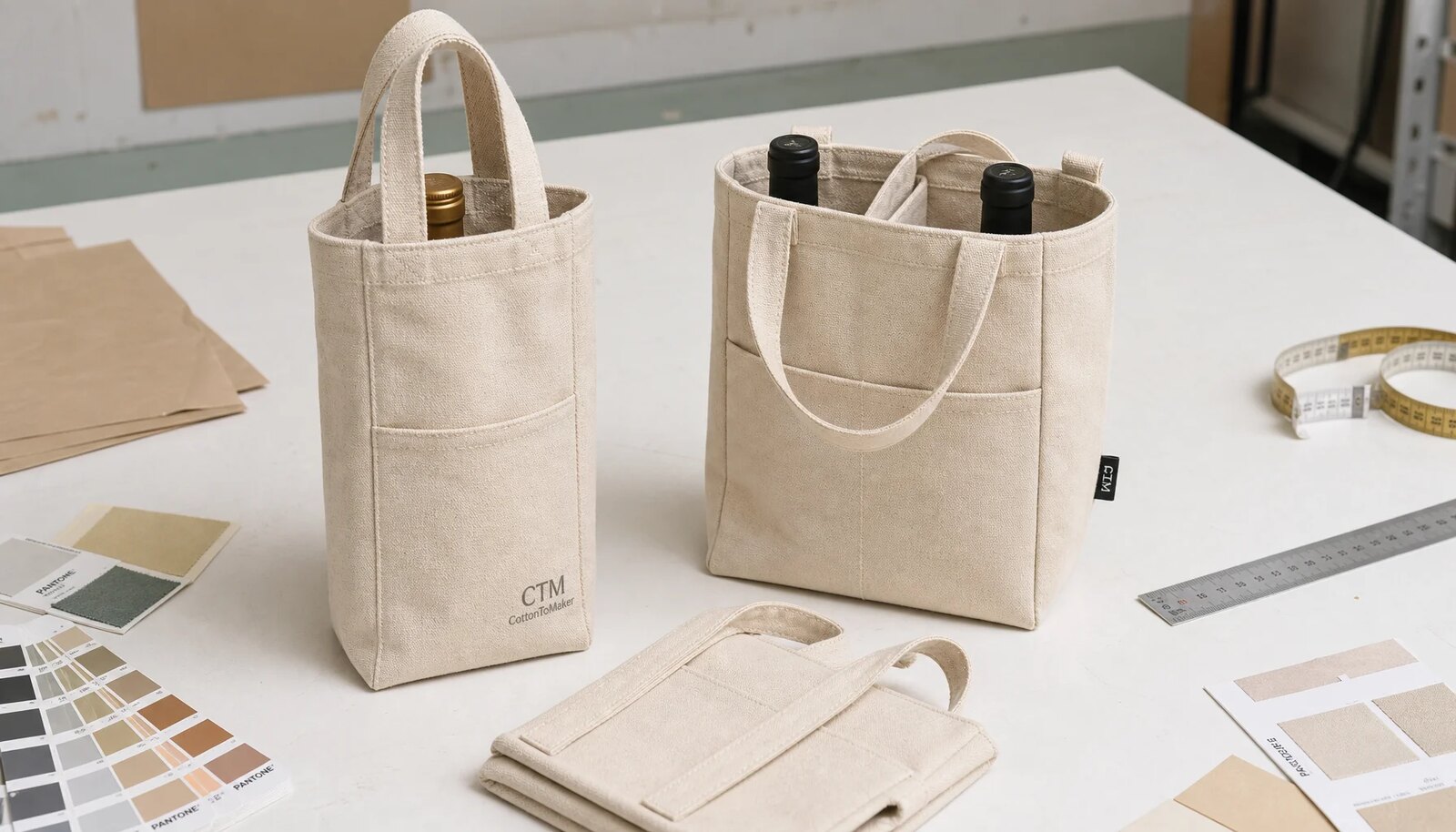
Read MOQ as a Production Map
A canvas wine carrier looks simple until the order is split across hotel properties, outlet names, bottle formats, packing styles, and launch dates. The MOQ is not just a number the factory picks to start a negotiation. It usually reflects fabric roll minimums, cutting-table setup, print screen setup, label purchasing, handle webbing, divider construction, sewing-line efficiency, packing material purchases, and inspection time.
That is why a supplier may quote 300 pieces, 500 pieces, 1,000 pieces, or 3,000 pieces for what appears to be the same carrier. Each figure can be valid under a different production plan. A natural canvas single-bottle bag with one screen print and loose bulk packing is not the same factory job as a two-bottle divider carrier with property-specific labels, barcode stickers, hangtags, and split delivery.
For hotel retail buyers, the stronger negotiation is not simply asking for a smaller number. It is asking what creates the number. Separate the total program MOQ from the minimum per logo, size, fabric color, label version, packing method, and shipment release. Once those drivers are visible, procurement has real levers: combine allocations, pay one-time screen charges separately, use one carton plan, or place a blanket order with staged releases.
Do not reduce MOQ by removing the features that make the carrier safe and saleable. Adequate canvas weight, reinforced handles, bottle fit, a stable base, clear logo placement, and protective packing should stay in the spec. The savings should come from fewer changeovers, cleaner approvals, and shared components.
- Treat MOQ as a setup and cost structure, not only a bargaining target.
- Ask the supplier to show minimums by total order, logo, size, color, packing, and delivery split.
- Consolidate fabric, handle tape, thread, label stock, ink color, and carton format where possible.
- Negotiate screen charges, sample charges, and split-delivery terms separately from sewing cost.
- Keep bottle safety, handle reinforcement, and inspection requirements out of the cost-cutting list.
Start With the Retail Use Case
The same canvas wine carrier can be a good fit for one hotel program and the wrong fit for another. A boutique shelf item needs a tidy fold, a consistent logo face, a barcode location, and cartons that receiving teams can sort quickly. A welcome amenity carrier may need faster staff packing and dependable loaded carry more than a hangtag. A conference gift may be moved by banquet staff in large batches before a guest ever touches it.
This context changes both construction and MOQ. A simple single-bottle natural canvas carrier with one-color screen print may be easy to quote at a lower quantity. A two-bottle carrier with divider, woven side label, hangtag, barcode sticker, individual polybag, and split property allocation creates more setup work. Neither approach is automatically right or wrong; the issue is whether the spec matches the channel.
Hotel storage conditions also deserve attention. Back-of-house areas often need flat folded goods, limited carton weights, readable carton marks, and clean SKU separation. Boutique retail may require hangtags facing one direction and barcode labels that scan without unpacking the whole carton. Resort or humid-climate properties should think about dust and moisture protection for natural canvas so bags do not arrive with odor, mildew marks, or handling stains.
Define the use case before requesting price. Suppliers can quote better when they know whether the bag must sit upright on a shelf, hang from a display peg, be pre-packed with wine, travel in a gift room, or support repeat sales after the first launch.
- Hotel boutique: prioritize fold consistency, barcode placement, logo quality, and shelf presentation.
- Guest amenity: prioritize fast packing, clean handling, and reliable loaded carry.
- Restaurant or wine-shop retail: prioritize bottle fit, hang display, and repeat replenishment.
- Event gifting: prioritize carton sorting, staff handling, and short lead-time reliability.
- Luxury property retail: consider heavier canvas, subtle label branding, and tighter visual inspection.
Confirm Bottle Fit Before Artwork
A logo proof can be perfect while the carrier fails around the bottle. A 750 ml Bordeaux bottle, Burgundy bottle, Champagne or sparkling bottle, Riesling-style tall bottle, 375 ml half bottle, and magnum differ in shoulder shape, diameter, height, and center of gravity. One carrier may stand squarely with a Bordeaux bottle and lean forward with a sparkling bottle.
For hotel retail, this is more than a technical issue. A carrier that tilts, twists, or stretches around the bottle looks cheaper on the shelf and feels unreliable in the guest's hand. It can also distort the printed panel after the artwork has already been approved, which is an expensive problem to discover late.
The RFQ should state the target bottle family and whether the carrier must fit one format or a controlled range. Approve a blank fit sample before opening print screens or producing labels. The blank sample should confirm usable width, height, gusset depth, base shape, divider position, handle drop, insertion ease, standing balance, and loaded comfort.
Two-bottle carriers need an even closer review. The divider should stop glass-to-glass contact during ordinary carry, not merely divide the base at the bottom. The bottles should sit evenly, the base should not collapse inward, and the handles should feel comfortable with two full bottles. If mixed bottle types are expected, test the widest and tallest bottles before committing to bulk dimensions.
- Use real bottles or approved dummy bottles for sample approval, not measurements alone.
- Measure finished dimensions after sewing because seams and gussets change usable space.
- Check loaded standing balance on a flat surface and watch whether the base twists.
- For two-bottle carriers, confirm divider height, divider attachment, and glass separation.
- Reject samples where the bottle distorts the printed panel or pulls the base seam out of shape.
Specify Canvas Weight and Finish
Fabric choice carries a lot of the buyer's quality signal. For many hotel retail canvas wine carriers, 10 oz to 12 oz cotton canvas, about 340-410 GSM, is a practical working range for 750 ml bottle use. It has enough body to feel retail-ready while still folding reasonably for export cartons and back-of-house storage.
Lighter canvas can work for promotional use, but buyers should be cautious below about 280 GSM if the carrier is expected to feel premium or hold its shape when loaded. The base may sag, the panel may wrinkle around the bottle, and the product can feel temporary. Heavier canvas can look more substantial, but above about 450 GSM it may create bulky seams, needle stress, larger folds, heavier cartons, and more freight volume.
Ask how the quoted weight is measured. Is the GSM from greige fabric, finished fabric, washed fabric, or the mill's nominal roll data? Finishing changes hand feel, shrinkage, shade, and final size. Natural unbleached canvas is often the easiest path for lower MOQ because it is more commonly stocked, but it still needs an approved shade range. Dyed, pigment-dyed, washed, organic, or recycled canvas may require higher material minimums, longer booking time, and tighter shade control.
The PO should include tolerance language. A practical spec may include a GSM tolerance, shrinkage expectation, and approved fabric swatch or lot sample. For hotel groups selling across multiple properties, uncontrolled shade variation can make the same branded retail item look inconsistent even when the sewing is acceptable.
- Ask for fabric weight in both oz and GSM to reduce misunderstanding between markets.
- Confirm whether fabric weight is before or after washing, dyeing, or finishing.
- Use natural canvas when the brand can accept controlled shade variation and wants easier MOQ reduction.
- Treat dyed or washed canvas as a separate material program with shade approval and longer lead time.
- Include fabric defects in QC: stains, odor, heavy slubs, broken yarns, shade panels, and mildew marks.
Build for Loaded Use
A canvas wine carrier is a load-bearing item, not a flat promotional tote with a bottle inside it. The important areas are the base, side seams, divider if used, handle attachment, stitch quality, and the way the bag behaves when lifted repeatedly. A defined gusset or boxed bottom helps the bottle sit correctly and spreads weight more evenly than a flat seam.
Handle reinforcement needs exact wording. Phrases such as strong handle or reinforced stitching are too vague for a purchase order. Ask whether the supplier is quoting bartack, box stitch, cross-stitch, double-row lockstitch, reinforcement patches, or standard straight stitching only. The approved method should appear on both the sample and the bulk lot.
Stitch density also matters. Too few stitches can reduce seam strength; too many can perforate heavy canvas and weaken the load point. Procurement teams do not need to engineer the sewing line, but the factory should commit to a clear construction method and inspect for skipped stitches, broken threads, loose tails, needle damage, seam slippage, and uneven topstitching.
For two-bottle formats, the divider is part of the safety and quality story. It should be anchored well enough that bottles do not slide under it or knock together during ordinary carry. The base should support the added weight without twisting. If the divider is only decorative, guests will notice the first time two bottles shift against each other.
- Specify boxed bottom, gusseted bottom, or flat construction instead of relying on photos.
- Define handle material, width, drop length, stitch pattern, and attachment area.
- Use bartack, box stitch, cross-stitch, or another approved reinforcement at loaded handle points.
- For two-bottle carriers, secure the divider at enough points to prevent bottle contact.
- Inspect seam quality inline before the full lot reaches final packing.
Choose Branding That Matches MOQ
Screen printing is still the practical default for many hotel retail canvas wine carriers. Hotel marks are often one or two solid colors, and screen print can look clean on natural canvas when the artwork is sized correctly. The MOQ pressure comes from setup: each color, logo, and artwork size may require its own screen, proofing step, alignment check, and sorting control.
For multi-property programs, woven labels can be a smarter structure. One shared bag body can run in a larger, cleaner lot, while branding changes through a side label, front patch, or neck label. Labels have their own MOQ and lead time, but they may reduce repeated screen setup and make property-level splits easier to manage.
Embroidery can look premium, especially for luxury properties, but it should be sampled on the actual canvas. Some panels pucker, some need backing, and some small lettering loses clarity. Heat transfer and digital print can support complex artwork or smaller runs, but they must be tested on textured fabric. Transfers may show film edges or crack on folds; digital print may differ in opacity, hand feel, and abrasion resistance.
The branding decision should not be made by MOQ alone. A low setup option that looks like an afterthought on canvas can weaken the retail product. Ask the supplier to show physical samples of the proposed logo method on the same or very similar canvas weight.
- Use screen print for solid one- or two-color logos with consistent artwork size.
- Use woven labels when several hotel properties can share one bag body.
- Sample embroidery for puckering, backing visibility, and thread color accuracy.
- Test transfers and digital prints for fold cracking, scratch resistance, and surface feel.
- Set logo tolerance by measurement from sewn edges, not only by visual center.
Negotiate MOQ Without Weakening Quality
The cleanest MOQ negotiation is a cleaner production plan. Factories are more likely to support a lower first order when the buyer reduces changeovers and approval uncertainty. One canvas color, one thread, one handle tape, one print color, one print position, one master construction, and one carton format can make a small order easier to accept.
Hotel groups have a useful advantage here. Instead of placing separate micro-orders for each property, they can build one consolidated production lot with property-level allocation. If demand is credible, a blanket PO with scheduled releases may also help. The key is to put the release schedule, storage responsibility, and artwork rules in writing rather than relying on a vague promise of future volume.
Separate setup costs from unit costs during negotiation. Paying a screen charge, label setup, or sample charge upfront can make the unit price and MOQ more transparent. It also prevents a supplier from hiding setup recovery inside every unit, which becomes awkward on repeat orders.
Avoid weak levers. Removing bartacks, using an untested lighter fabric, skipping the blank sample, approving from photos only, or accepting unclear carton data may reduce the first quote but increases the chance of defects, repacking, delay, or guest complaints. In hotel retail, the carrier carries the property name as much as the bottle.
- Consolidate by shared fabric, webbing, thread, logo color, and packing method.
- Ask for one production lot with split allocation instead of many micro-lots.
- Pay setup charges separately when it keeps the unit price and MOQ transparent.
- Use a repeat-order forecast only when the first specification is stable and documented.
- Do not trade away handle reinforcement, bottle-fit sampling, or final inspection for a lower MOQ.
Compare Quotes Line by Line
Two canvas wine carrier quotes can look close on unit price and still describe very different goods. One supplier may include 12 oz canvas, bartacked handles, a divider, screen setup, hangtag, barcode sticker, export cartons, and a printed pre-production sample. Another may be quoting 8 oz canvas, standard straight stitching, no divider reinforcement, loose bulk packing, and no carton data.
Procurement should compare the full offer, not only the ex-factory unit price. Ask for fabric specification, construction details, reinforcement method, print method, setup charges, MOQ by variable, sample charges, packing method, carton data, lead time basis, payment terms, and inspection responsibility. If those lines are missing, the comparison is not ready.
Carton data deserves special attention. Folded volume can shift with canvas weight, gusset depth, divider structure, and whether the bags are bulk packed, banded, polybagged, or hangtagged. Gross weight also matters for hotel receiving teams, distributors, and event staff. A low unit cost can lose its advantage if the goods arrive bulky, poorly marked, or difficult to sort.
Ask what is excluded. Barcode stickers, artwork proofing, screens, pre-production samples, export cartons, carton marks, inland freight, and inspection support may not be included unless the quote says so. Line-iteming these points keeps negotiation factual and prevents late-stage surprises.
- Require fabric weight, finish, construction, and reinforcement details in the quote.
- Separate print setup from print unit cost and sewing unit cost.
- Show MOQ by total order, size, fabric color, logo, label, packing, and delivery split.
- Request carton dimensions, pieces per carton, gross weight, net weight, and estimated CBM.
- List included and excluded items: hangtags, barcode labels, polybags, carton marks, samples, screens, and inland freight.
Control Samples and QC
A practical approval path has three steps: blank fit sample, printed pre-production sample, and packing confirmation. The blank sample proves the physical carrier before artwork cost is committed. It should be checked for bottle insertion, finished size, handle drop, gusset, base stability, divider function, seam strength, and standing balance.
The printed sample locks the visible retail details. Review logo size, position, ink color, opacity, edge sharpness, label placement, and how the print behaves when the bag is folded. Natural canvas changes perceived color, so a paper proof is not enough. Use Pantone references, drawdowns, fabric swatches, or a signed physical sample under consistent lighting.
Packing confirmation protects the final handoff. Check fold direction, paper band, hangtag, barcode, polybag, carton mark, carton quantity, and whether the carrier still looks clean after packing and unpacking. A beautiful sample can still fail retail if the fold line cracks the ink or the carton plan makes receiving difficult.
The approved sample should become a controlled reference, not just a photo buried in an email thread. Keep one signed or clearly identified sample with the factory and one with the buyer or inspection agent. Written approval should also include tolerances. Finished width and height may start at plus or minus 5 mm where construction allows; gusset may need plus or minus 5-8 mm; handle drop may need plus or minus 10 mm; print placement may need plus or minus 3-5 mm depending on the panel and sewing variability. Confirm the actual tolerance with the supplier before placing the PO.
QC should cover incoming fabric, inline sewing, print checks, and final packed inspection. If using AQL sampling, classify defects before production begins. Unsafe handle failure, wrong logo, mold, severe stains, and unusable bottle fit should be critical. Open seams, visible print shift, wrong packing, and major stains should be major. Small thread tails or slight shade variation inside the approved range may be minor.
- Approve a blank fit sample before print setup for new sizes or bottle formats.
- Approve a printed sample against physical color and placement references, not only a digital proof.
- Keep golden samples at both factory and buyer side for dispute resolution.
- Define critical, major, and minor defects before bulk production starts.
- Inspect fabric, sewing, print, and packing as separate checkpoints.
Plan Packing, Timing, and Landed Cost
Packing is where many hotel retail programs quietly lose margin. Flat folding can reduce CBM and storage volume, but the fold line must not damage the printed logo or create a permanent crease across the front panel. Individual polybags protect natural canvas from dust and moisture, but they add material, labor, and sometimes warning-label requirements. Paper bands and hangtags improve retail presentation, yet they also need artwork approval and can become schedule blockers if started late.
Carton marks should support the way hotels actually receive goods. If bags are split by property, outlet, event, SKU, or logo version, the carton mark should make that clear without opening every carton. Ask for carton dimensions, gross weight, net weight, pieces per carton, and estimated CBM before comparing quotes or choosing an MOQ.
Lead time should be quoted by stage: sample making, sample approval, material booking, print setup, bulk cutting, printing, sewing, inline QC, final inspection, packing, and export handling. Confirm when the clock starts. Some suppliers count from deposit; others count from final artwork, fabric arrival, printed sample approval, or all approvals completed. A low MOQ does not automatically mean a short schedule, because screens, labels, hangtags, dyed fabric, and packing materials can take similar preparation time at small and large quantities.
Model landed cost before finalizing MOQ. A low trial order spreads screen charges, sample charges, inland freight, customs handling, international freight, inspection, and packing setup over fewer units. A heavier or bulkier carrier may support a higher retail price, but it can also increase carton CBM. Compare at least two scenarios: a lower-risk trial quantity and a more efficient program quantity allocated across properties or released in stages.
- Control the fold line so it does not cross the main logo unless tested and approved.
- Request carton dimensions, gross weight, pieces per carton, and estimated CBM before comparing quotes.
- Confirm whether production lead time starts after deposit, artwork approval, sample approval, or material arrival.
- Include setup, sample, packing, inspection, freight, duty, and repacking costs in landed-cost comparison.
- Use split delivery or property allocation when it improves inventory control without creating too many production versions.
Specification comparison for buyers
| Spec decision | Recommended option | When it fits | Buyer risk to check |
|---|---|---|---|
| Supplier route | Direct sewn-bag factory with wine carrier, bottle bag, or structured tote experience | Best for hotel retail programs that need reliable bottle fit, custom branding, repeat replenishment, and carton-level consistency | A general tote supplier may quote aggressively but miss divider function, base stability, loaded handle strength, or retail folding requirements |
| MOQ structure | Negotiate around shared material lots and setup groups, then define the minimum per logo, size, or SKU | Works when single-bottle and two-bottle carriers share canvas, thread, webbing, ink color, label stock, and carton format | The factory may still charge separate cutting, screen, label, or packing setup fees when dimensions, artwork positions, or packing formats differ |
| Fabric weight | 10 oz to 12 oz cotton canvas, about 340-410 GSM before finishing unless otherwise stated | Good balance for 750 ml bottle carry, hotel boutique shelves, wine-shop counters, welcome gifts, and event retail | Below about 280 GSM can sag or feel promotional; above about 450 GSM can increase seam bulk, folded volume, needle stress, and freight CBM |
| Fabric tolerance | State GSM tolerance, shrinkage expectation, and approved shade range in the PO | Useful when natural, dyed, washed, organic, or recycled canvas is part of the brand presentation | Uncontrolled shade panels, washing shrinkage, or fabric weight drift can change fit, logo appearance, and perceived quality |
| Print method | Screen print for solid logos; woven label for shared bodies; transfer or digital only after sample testing | Screen print suits one- or two-color hotel marks on textured canvas; labels help multi-property programs share one bag body | Low-MOQ digital methods may raise unit cost, look less integrated on canvas, or show cracking and fold marks if untested |
| Construction | Boxed bottom or defined gusset, reinforced base seam, and bartack or cross-stitch at handle joins | Needed for 750 ml bottles, two-bottle carriers, amenity bundles, and retail items handled by guests or staff | Flat tote-style construction can twist, lean, or distort when loaded; weak handle attachment is the most practical failure point |
| Sample path | Blank fit sample first, then printed pre-production sample, then packing confirmation | Controls dimensions, divider, handle length, logo placement, folding, and retail presentation before bulk cutting | Skipping the blank sample hides bottle-fit and standing-balance issues until after print approval or bulk production |
| Packing format | Flat folded with controlled fold line, paper band, barcode sticker, hangtag, or individual polybag as the channel requires | Flat folded lowers freight and back-of-house storage volume; individual packing suits retail scanning and dust protection | Over-tight folding can crease ink; loose bulk packing can soil natural canvas; missing barcode or carton data can disrupt receiving |
| Lead time basis | Quote sampling, material booking, printing, sewing, inline QC, final inspection, packing, and export handling separately | Gives hotel procurement a realistic schedule for openings, seasonal retail windows, wine events, and gifting campaigns | A single lead-time number can hide buyer-approval delays, dyed-fabric lead time, label production, or packing material approval |
Buyer checklist before sampling
- Define the exact bottle family before quoting: 750 ml Bordeaux, Burgundy, Champagne or sparkling, Riesling or tall slim, 375 ml half bottle, magnum, or a mixed-fit requirement.
- State the channel clearly: hotel boutique shelf sale, guest welcome amenity, minibar upsell, restaurant retail, winery partnership, conference gifting, or staff-packed event use.
- Specify fabric in both oz and GSM where possible, and state whether the quoted weight is before washing, after finishing, or based on supplier nominal stock.
- Confirm fabric finish: natural unbleached, bleached, dyed, washed, organic cotton, recycled cotton blend, or cotton-poly blend, including shade tolerance expectations.
- Request finished dimensions after sewing, including width, height, gusset depth, base shape, divider allowance, handle drop, and pocket dimensions if any.
- Set a bottle-fit test using real bottles or approved dummy bottles, including insertion ease, standing balance, divider separation, and handle comfort when loaded.
- Require handle details: webbing or self-fabric handle, width, length, attachment area, stitch pattern, bartack count if used, and whether reinforcement patches are included.
- Limit artwork versions during MOQ negotiation; group properties by the same print color, logo size, print position, label size, and packing format where possible.
- Request a blank fit sample before a printed sample when the carrier size, divider, base construction, or bottle family is new.
- Set print acceptance criteria for position tolerance, Pantone or approved-sample color, opacity, edge sharpness, rub resistance, and cracking after controlled folding.
Factory quote questions to send
- What is your standard MOQ for this canvas wine carrier by total order, by size, by fabric color, by artwork, by label version, and by packing format?
- Which variables force a higher MOQ: dyed fabric, washed finish, custom canvas weight, custom webbing, woven label, multi-color print, divider, barcode packing, or split delivery?
- Can single-bottle and two-bottle carriers share the same canvas roll, webbing, thread, ink, label stock, and carton format to reduce MOQ pressure?
- What fabric weight are you quoting in oz and GSM, and is that measured before finishing, after washing, or from supplier nominal roll data?
- What GSM tolerance and shrinkage range should we expect on bulk fabric, and how will you check incoming fabric rolls?
- Is the quoted fabric greige, natural unbleached, bleached, dyed, pigment-dyed, washed, organic, recycled, or blended, and how will shade variation be controlled between lots?
- What finished-size tolerance can you hold for width, height, gusset, handle drop, divider position, and print placement?
- What handle reinforcement is included in the price: bartack, box stitch, cross-stitch, double-row lockstitch, reinforcement patch, or standard straight stitch only?
- What load test do you recommend for a loaded one-bottle and two-bottle carrier, and how many samples will be tested during production?
- How many print screens are required, what is the setup charge per screen, and can screen charges be amortized across split property orders or repeat orders?
Quality-control points to confirm
- Finished size tolerance should be written in the spec. A practical starting point is plus or minus 5 mm for width and height, plus or minus 5-8 mm for gusset, and plus or minus 10 mm for handle drop, adjusted for construction complexity.
- Bottle fit must be tested with the buyer's target bottle family. Check insertion, removal, standing stability, bottom distortion, divider spacing, and whether the printed panel warps when the bag is loaded.
- Loaded carry testing should exceed normal use. For a one-bottle 750 ml carrier, test at least the bottle weight plus a safety margin; for two-bottle carriers, test with two full bottles and repeated lift cycles rather than one static lift only.
- Handle attachment should include bartack, box stitch, cross-stitch, or another approved reinforcement. Inspect for skipped stitches, broken threads, loose tails, needle damage, and inconsistent stitch density.
- Divider panels should be secured at the base and side seams so bottles do not knock together during ordinary carry. Divider height should be high enough to separate the bottle bodies, not only the bases.
- Fabric inspection should check GSM, weave consistency, oil marks, heavy slubs, broken yarns, mildew odor, shade panels, dye streaks, needle holes, and stains that are visible on natural canvas.
- Print color should be checked against Pantone, approved drawdown, fabric swatch, or signed physical sample under consistent lighting. Natural canvas can change perceived color, so paper proofs alone are insufficient.
- Print adhesion should pass dry-rub and light-scratch checks suitable for retail handling. If the bag is folded after printing, inspect the approved fold line for cracking, transfer, or permanent crease marks.
- Logo position should be measured from fixed sewn edges, pocket top, or seam reference points. Do not rely only on a flexible panel center because canvas panels can shift during sewing.
- Cutting and sewing should be inspected inline, not only after packing. Early checks catch wrong gusset depth, handle length mismatch, divider misalignment, and upside-down labels before the full lot is finished.