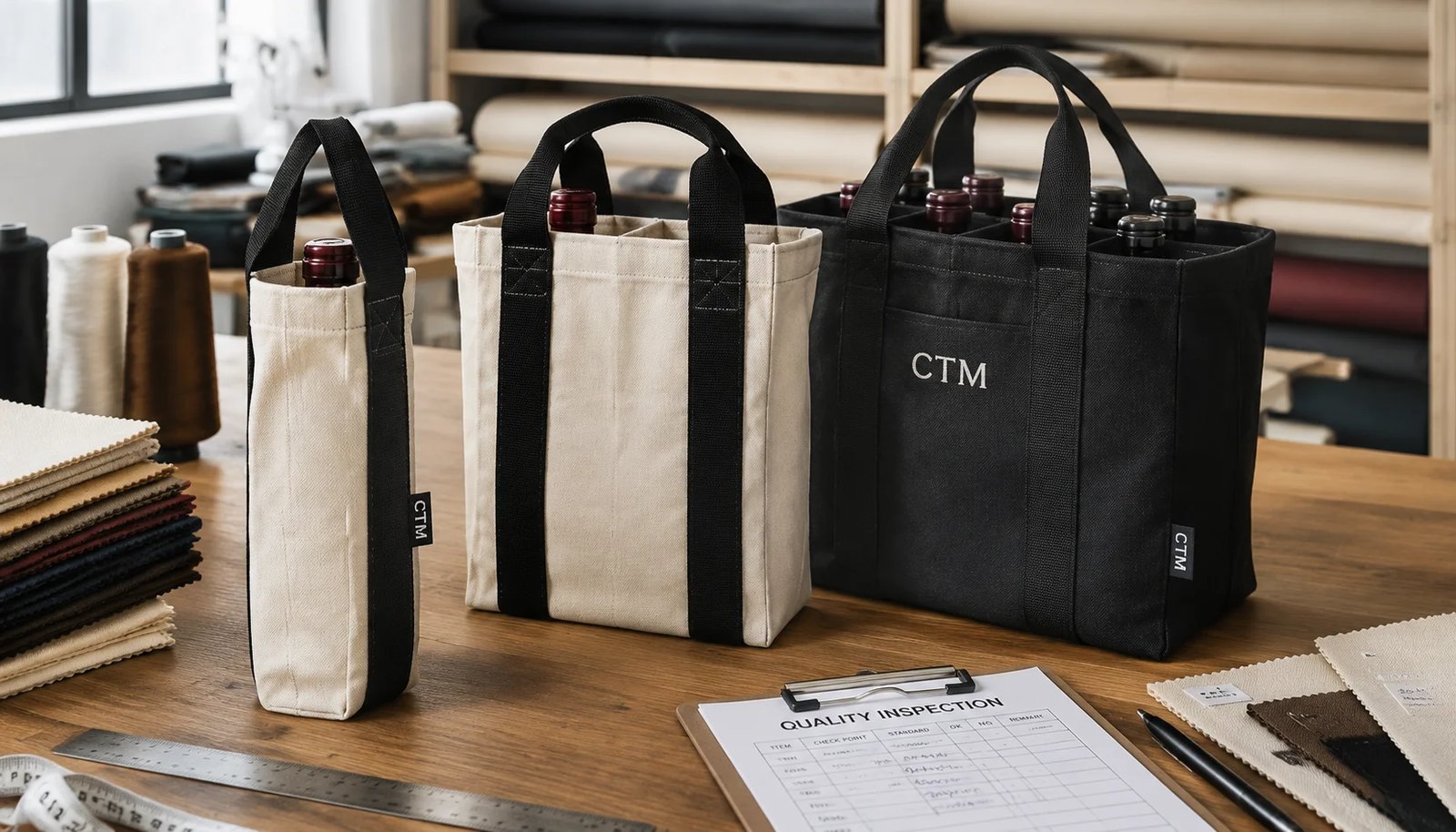
Why MOQ gets difficult on canvas wine carriers
MOQ on canvas wine carriers is rarely just a sales policy issue. It is tied to how the factory buys fabric, how efficiently pieces can be cut, how many sewing operations are required, and whether the bag must safely carry heavy glass. A plain promotional tote often has two body panels and simple handles. A bottle carrier usually needs a more exact width-to-gusset ratio, stronger load-bearing seams, and in many cases dividers or a reinforced base. Those extra operations make small runs less efficient, which is why suppliers may sound flexible on a generic canvas bag but become cautious once the word wine carrier is introduced.
For liquor retailers, the real commercial issue is not simply getting the lowest possible minimum accepted. It is securing a realistic opening quantity that still protects merchandising quality, bottle safety, and reorder consistency. If MOQ is pushed down without understanding the factory's cost structure, the supplier may recover margin elsewhere through lighter fabric, smaller print coverage, less reinforcement, oversimplified packing assumptions, or weaker scheduling priority. On paper, the MOQ looks solved. In practice, the buyer inherits more quality and delivery risk.
This is especially relevant for store groups testing gift-bag programs, holiday bundles, winery merchandise corners, or private-label wine club packaging. These buyers often want conservative first orders because sales velocity is uncertain. That is reasonable. But the order still needs to be engineered as a bottle-carrying product, not treated like a low-risk shopper tote. Procurement teams that frame MOQ negotiation around total program feasibility usually get better outcomes than teams that focus only on reaching a specific piece count.
A useful mindset is to ask which cost blocks can be shared and which cannot. Fabric programs, stock trims, and common print methods may be shareable across SKUs. Custom dyeing, unique divider engineering, or unusual packaging may not be. Once that distinction is clear, MOQ discussion becomes more commercial and less adversarial.
- Low MOQ becomes harder when the bag includes dividers, piping, contrast webbing, custom dyed fabric, or special inserts.
- Natural canvas with one-color print usually gives the most flexibility for opening orders and repeat replenishment.
- MOQ can often be reduced if one base construction is shared across multiple SKUs or store programs.
- A low MOQ is only useful if the bag still meets bottle weight, visual merchandising, and warehouse handling needs.
Start with the right construction before negotiating quantity
MOQ is easiest to negotiate when the specification is commercially realistic. For many liquor retail programs, 12 oz canvas, roughly 340 GSM, is the practical center point. It usually provides enough body for a premium look, enough structure for one or two standard 750 ml bottles, and reasonable sewing efficiency. It also tends to print well with standard screen-print methods. Going too light can create sagging, wrinkled logo panels, and a cheaper hand feel. Going too heavy can increase material cost, carton weight, and sewing difficulty without delivering proportionate retail value.
The next step is to define the actual use case. A single-bottle gift bag, a two-bottle divider tote, and a six-bottle grocery-style carrier are different products from a factory costing perspective. Handle width changes. Seam reinforcement changes. Divider labor changes. Base stability becomes more critical as the load increases. If a buyer sends an RFQ asking only for a canvas wine carrier, each supplier will make different assumptions, and quote comparisons become unreliable from the start.
Bottle format also matters. Some programs are built around standard 750 ml still wine bottles. Others need room for sparkling bottles, wider shoulders, gift tubes, or mixed bundles. A bag that works for one bottle silhouette may fail for another if gusset depth or divider spacing is too tight. The more precisely the intended bottle format is defined, the easier it is for the supplier to quote the right construction and defend a realistic MOQ.
Retail context should guide the build. A checkout upsell bag can be simpler and more compact than a wine-club pickup carrier. A giftable winery merchandise bag may need a cleaner exterior and stronger branding panel. A six-bottle grocery-style carrier may prioritize function, upright stability, and handle comfort over decorative finishing. Starting with the intended use protects both cost and quality decisions later in the negotiation.
- Single bottle: often 10-12 oz canvas, bottom gusset, 25 mm webbing or self-fabric handles if the load is light and the bag is narrow.
- Two bottle: usually 12-14 oz canvas, wider base, stronger top seam reinforcement, and optional center divider or stitched partition.
- Six bottle: typically 12-16 oz canvas, internal stitched dividers, reinforced base, and webbing handles preferred for comfort and durability.
- If sparkling bottles or gift tubes are involved, ask the supplier to quote dimensions around the largest actual pack format rather than a generic wine bottle assumption.
The cost drivers that really control MOQ
Buyers often assume fabric is the main reason MOQ stays high. In reality, for lower-volume canvas wine carriers, inefficiency and setup can be larger obstacles than raw material alone. Screen printing requires screens, alignment, and setup labor. Small production runs may still need a full machine setup for only a few hundred pieces. Cutting multiple small lots from several colors or dimensions creates more waste than one consolidated run. Sewing lines lose rhythm when the order contains mixed body sizes, different divider structures, several labels, and changing handle lengths.
Construction complexity also affects labor more than many buyers expect. A simple single-bottle bag may be a straightforward cut-and-sew process. A two-bottle carrier with divider and bottom panel adds operations. A six-bottle carrier with reinforced seams and insert pocket adds still more. Each extra operation matters at low volumes because there are fewer units over which to spread line setup and supervision time. This is one reason why two suppliers can quote similar unit prices at 3,000 pieces but very different opening terms at 300 pieces.
Accessory choices are another hidden cost driver. Stock natural canvas is usually easier than custom dyed canvas. Stock black webbing is easier than custom dyed webbing matched to a Pantone. A sewn side label is easier than a custom woven brand label with its own development process. A one-color print is easier than a multi-color transfer or large-area graphic. None of these details is unreasonable on its own, but together they can move an order from commercially flexible to commercially rigid.
The most practical way to negotiate is to separate fixed and variable cost blocks. Fixed costs include print screens, pattern modification, sample development, and any custom trim setup. Variable costs include fabric consumption, webbing, thread, inserts, labor minutes, and packing materials. Once buyers understand that structure, they can decide whether to absorb some fixed cost upfront in exchange for lower MOQ or better repeat-order terms. That is more transparent than demanding a lower minimum while hidden surcharges are buried elsewhere in the quote.
- Main fixed cost blocks: print screens, pattern setup, sample making, custom dye lab dips, woven label setup, and sometimes special insert tooling.
- Main variable cost blocks: canvas consumption, webbing, thread, reinforcement materials, inserts, sewing time, trimming, and export carton packing.
- Custom dyed fabric and custom dyed webbing can create separate MOQ thresholds from the sewing MOQ.
- Multi-color branding, several SKUs in one run, or mixed accessory colors increase low-volume complexity quickly.
MOQ negotiation tactics that work better than demanding a lower number
The most effective MOQ lever is consolidation. If a retailer wants a single-bottle checkout bag, a two-bottle holiday bag, and a gift-set version, it often helps to align them under one material and trim program. Shared natural canvas, shared handle color, and shared print method allow the supplier to combine fabric planning and line scheduling even if finished sizes differ. This is usually easier for a factory to support than granting a low minimum on one isolated SKU with fully custom components.
Another strong tactic is staged customization. Buyers can ask the factory to produce blank sewn bodies from a shared fabric run and then customize by print or label later. This lowers the supplier's material risk because unfinished bodies may be easier to allocate across variants. It also protects the buyer if one concept underperforms in stores. A launch that starts with stock natural canvas and one-color branding is often easier to scale or revise than a launch built around custom dyed bodies and multiple print versions.
Forecast language matters too. Factories respond better when buyers explain whether the first order is a market test, a seasonal event, or the start of an annual program. If there is a credible replenishment path, even if the opening order is modest, the supplier may be more flexible on MOQ or setup charges. The key is not to exaggerate forecast volume, but to present the commercial roadmap clearly enough that the factory can see repeat potential.
Buyers can also trade simplicity for flexibility. Using stock webbing instead of custom dyed webbing, keeping one common woven label across several SKUs, simplifying print colors, or accepting a separate setup charge can all help unlock a lower opening quantity. By contrast, asking for low MOQ while requesting custom color matching, multiple body sizes, and premium finishing often produces a quote that looks possible but is loaded with caveats.
Finally, negotiate total cost of entry rather than piece count alone. A supplier may refuse a nominal MOQ reduction but agree to lower setup charges, spread sample costs over bulk, or allow multiple sizes under one fabric commitment. Those concessions can be more valuable than a simple minimum-number win.
- Combine sizes under one material program wherever possible.
- Keep one handle material and one accessory color across all variants in the first run.
- Use stock natural or black canvas before requesting custom dye lots.
- Accept setup charges openly if that unlocks lower minimums and clearer costing.
- Discuss annual forecast range and reorder intent, even if the first release quantity is modest.
- Ask whether blank bodies can be produced first and printed by variant later.
How to compare quote data without being misled by a low unit price
A low unit price is only meaningful if the underlying assumptions match. In canvas wine carriers, suppliers can quote very different constructions under similar wording. One may price 12 oz canvas with 25 mm cotton webbing and box-cross reinforcement. Another may price 10 oz canvas with self-fabric handles and no explicit reinforcement detail. Both quotes may say canvas wine bag. Only one may be suitable for carrying heavy glass reliably.
Procurement teams should normalize key specifications before ranking suppliers. At minimum, compare fabric weight in GSM, body dimensions, gusset width, handle material, handle width, handle drop, print size, print color count, divider inclusion, insert inclusion, packing quantity, carton dimensions, sample charges, and stage-by-stage lead time. If one supplier quotes based on stock material and another on dyed-to-order material, note that separately. If one quote includes print setup and another excludes it, that should be visible immediately.
Freight cube deserves more attention than it usually gets. Wine carriers with deep gussets, inserts, or internal dividers can consume far more carton volume than flat promotional totes. Two ex-works quotes that differ by only a few cents may reverse position once carton efficiency and freight are considered. This is especially important for lower-value bag programs where delivered cost per unit is tightly watched.
Sample charges should also be separated clearly. Buyers often receive one blended sample figure without knowing whether it covers a rough prototype, a true pre-production sample, or only a print strike. For bottle-carrying products, that distinction matters. A cheap sample that does not represent final construction can create false confidence and expensive corrections later.
The cleanest comparison process is to build a quote matrix and force every supplier response into the same categories. That exposes where one supplier is genuinely more efficient and where another is only omitting cost or detail.
- Normalize fabric in GSM, not only in oz wording.
- Break out setup charges instead of burying them in unit price.
- Compare carton cube, carton gross weight, and units per carton, not only piece price.
- Note whether the quote is based on stock material, greige stock, custom dye, or woven-to-order fabric.
- Separate prototype sample, pre-production sample, and shipment sample in cost review.
- Check whether quoted handles, inserts, dividers, and labels are fully included or only implied.
Sampling and approval points that reduce MOQ risk
When MOQ is low, every production mistake hurts more because there are fewer units over which to spread correction cost. That makes sample approval more important, not less. A digital artwork proof is useful for logo position and copy accuracy, but it does not validate body structure, handle comfort, stitch quality, or the way the bag behaves under bottle weight. A physical pre-production sample should use the actual canvas weight, actual webbing or handle material, and the intended print method. If the supplier substitutes a similar stock fabric for convenience, the sample may fail to reveal shrinkage, body collapse, shade variation, or print behavior that appears in bulk.
For bottle carriers, sample review should include simple functional testing. Insert the intended bottle type and check upright stability, side seam strain, top opening clearance, and carrying comfort. If the bag has dividers, verify that bottles do not collide when lifted and that divider tops do not collapse inward excessively. If the bag has a base insert or insert pocket, check whether the insert sits flat after the bag is folded, packed, reopened, and loaded again.
Retailers should also review samples in the way the product will actually be handled. A bag that looks good standing on a desk may behave differently after being folded into cartons, transported, unpacked at a distribution center, stacked in a back room, and put onto a store display. Print surfaces can crease. Divider panels can deform. Handles can pick up twist memory. Reviewing only the front-facing hero view misses practical issues that surface later in operations.
Approval records matter. Once a sample is accepted, key measurements and visual standards should be documented: body width, gusset, height, handle drop, print placement, reinforcement method, and any acceptable natural canvas variation. Keeping one sealed approval sample for reference during inline and final inspection is a simple but valuable control, especially when the opening order may lead to repeats with the same supplier.
- Approve a physical PPS sample made with production fabric and production handle attachment method.
- Test with actual bottle formats: standard 750 ml, sparkling bottle, magnum-adjacent promo format, or gift pack if relevant.
- Record print position, handle drop, gusset width, divider spacing, and base fit on the approved sample.
- If dyed fabric is used, approve the color standard separately from the sewn sample when needed.
- Keep one sealed approval sample as the reference for inline and final QC.
Print method and branding choices that affect MOQ and repeatability
Screen printing remains the most practical branding option for many canvas wine carrier programs because it balances cost, repeatability, and durability on textured fabric. One-color and two-color logos on natural canvas are usually the safest route for launch orders. They keep setup manageable, preserve a clean retail look, and generally scale well into repeat production. For procurement teams, that means fewer variables to control in both MOQ discussion and QC review.
Heat transfer can be useful for short-run multicolor artwork, seasonal visuals, or highly graphic promotions, but buyers should understand the tradeoffs. Transfer films can sit differently on canvas texture than direct print. Fold lines may become more visible over time. Large transfer areas can also feel less natural than a direct ink print on a cotton body. If transfer is being considered mainly to support a small launch quantity, test it on the actual fabric and fold pattern before approval.
Alternative branding routes such as embroidery, woven labels, or patches can work well for premium positioning, but they have different cost and consistency profiles. Embroidery adds labor and may distort lighter fabric if backing is not managed correctly. Woven labels can be efficient if several SKUs share the same body and only the brand ID changes. Patches create another trim supply stream and may raise MOQ if the patch itself is custom. None of these options is wrong, but each should be assessed as part of the total entry cost, not only the aesthetics.
Placement discipline matters as much as method. Large edge-to-edge graphics demand tighter registration control and can increase rejection risk on natural-fiber fabric that moves slightly during printing. A centered front print panel within practical margins is easier for factories to execute consistently. This is especially important for repeat orders where logo alignment and shelf appearance must remain stable across batches.
For B2B buyers, the smartest first run is often the simplest one that still carries the brand well. Strong retail branding does not require maximum decoration. It requires a method the supplier can repeat reliably at the target order size.
- Best low-MOQ branding route: 1-color screen print on natural canvas with stock webbing.
- Premium but costlier route: embroidery or patch branding on heavier canvas bodies where distortion risk is lower.
- Woven labels are useful when multiple SKUs share one body and only the label identity changes.
- Always specify print size, Pantone target, location, and acceptable placement tolerance in the RFQ and PO.
- Ask for a photo or physical review of printed fabric after folding if the bag will be flat packed tightly.
Packing, carton planning, and warehouse realities buyers often miss
Packing method has direct impact on landed cost and warehouse usability. Flat packing is standard for canvas wine carriers, but the exact fold method should suit the bag structure. Single-bottle bags can compress efficiently. Divider bags, reinforced bases, and webbing handles can trap air or create bulky folds if there is no planned packing method. If a supplier quotes an attractive ex-works price but uses oversized cartons or poor pack density, delivered cost can rise materially.
Warehouse handling rules should be built into the spec early. Multi-bottle carriers with inserts and heavy fabric can create cartons that are denser than expected. If the distribution center has a carton weight ceiling, state it in the RFQ and PO. If store-ready inner packs are needed, define the inner quantity, labeling format, and assortment logic before production starts. Late changes in carton structure are expensive and can disrupt loading efficiency.
Many buyers request individual polybags by default, but this deserves review. Individual poly can increase labor, material use, and carton volume without adding much value for a warehouse-distributed retail program. In some cases, poly is justified for hygiene, barcode scanning, or direct-to-consumer presentation. In other cases, bulk inner packing by dozen or by store-ready bundle is more efficient and easier to receive. The right answer depends on the downstream handling model, not habit.
Carton marking should also be treated as a procurement detail, not an afterthought. If store destination labels, assortment marks, or barcode labels are needed, they must be aligned with the supplier before packing starts. Incorrect marks can delay receiving even when product quality is acceptable. For low-MOQ test runs, that kind of administrative friction can be disproportionately costly.
The broader point is that a bag program is not finished when the unit cost is agreed. It must still move through cartons, freight, warehouse receipt, store allocation, and merchandising without avoidable waste.
- Request carton dimensions, pieces per carton, and gross/net weight at quote stage.
- Set a maximum carton weight that matches your DC handling rule.
- If store-ready assortment is needed, specify inner pack counts, barcode labels, and carton marks early.
- Avoid unnecessary individual poly packing unless compliance, hygiene, or presentation truly requires it.
- Ask how divider bags are folded to control carton cube and reduce deformation.
Lead time planning and the schedule traps behind small custom orders
Low MOQ does not automatically mean short lead time. Small custom orders are often fitted between larger bookings, and custom components can still create a full critical path. Dyed webbing, custom labels, print screens, inserts, and sample approvals each add their own timing. A supplier who gives one simple lead-time number without showing the stages may not yet have mapped the bottleneck clearly.
The safest approach is to split lead time into checkpoints: artwork approval, sample development, material booking, trim confirmation, bulk cutting, sewing, printing, inspection, packing, and dispatch. This stage-based view allows buyers to see where flexibility exists and where delay risk is highest. In many programs, the biggest slip does not come from sewing. It comes from late print approval, unresolved logo color questions, or waiting for custom trims that were not essential in the first place.
Seasonality is especially important for liquor retailers. Holiday gifting, year-end promotions, and event-based launches create congestion at exactly the moment buyers want agility. If the order supports a Q4 program, locking materials and capacity early can matter more than pushing harder on MOQ. Factories are generally more open to flexibility when they can slot the work predictably rather than treat it as a last-minute insertion.
Buyers should also distinguish ex-factory date from warehouse-ready date. Carton labeling, booking freight, and receiving into a distribution center all add time after production is complete. Working backward from the actual launch date provides a more realistic timeline and supports better decisions about whether stock materials should be used to reduce risk.
If repeat business is likely, ask the supplier what can be standardized for future runs. Reserved print screens, repeat material references, and fixed packing methods can reduce future lead time even if the first order requires more coordination.
- Stock natural canvas and stock black webbing usually shorten material lead time.
- Custom dye and woven labels can add one to three weeks depending on the supply chain.
- PPS approval delays often create more schedule slip than actual sewing time.
- Book against warehouse receipt or store launch date, not only ex-factory target.
- Ask which components can be standardized for faster replenishment on repeat orders.
QC thresholds and acceptance criteria for bottle-carrying bags
Canvas wine carriers should be inspected as load-bearing packaging accessories, not just promotional bags. Visual appearance matters, but seam integrity, handle reinforcement, and base stability matter more because failure can damage glass merchandise and customer trust. A minor natural slub in canvas may be acceptable. A missed bartack at the handle is not. The QC plan should clearly separate cosmetic tolerance from functional failure points.
Start with material verification. Confirm the agreed canvas weight, fabric shade, and any approved natural-variation standard. Then check construction: finished width, height, gusset, divider placement, handle length, and reinforcement method. If the bag includes a base insert or insert pocket, inspect fit and flatness after folding and reopening. For printed bags, verify placement, levelness, color match, and whether ink behavior remains acceptable after the bag has been packed flat.
Load testing should be simple but relevant. A random sample from the production lot should be loaded with the intended bottle count and approximate weight, then lifted repeatedly under normal carrying conditions. The purpose is not to create a laboratory test. It is to confirm that seams do not open, dividers do not detach, handles do not distort, and the bag maintains basic carrying stability. For a six-bottle carrier, comfort and strain at the top seam are especially important.
Acceptance criteria should be written into the PO or quality agreement whenever possible. Generic phrases like inspect as per normal standard are too vague for a product that holds breakable goods. If print placement tolerance is plus or minus 5 mm, state it. If handle drop must match within a defined tolerance, state it. If divider misalignment that allows bottle collision is a major defect, state it. Written standards reduce dispute risk and make the inspection more objective.
For buyers running initial launches, a balanced QC approach is best: strict on functional points, commercially realistic on approved natural-canvas variation. That protects brand performance without imposing unnecessary rejection on a natural material.
- Critical defects: broken stitches at handles, open seams, wrong size causing bottle instability, severe print smearing, missing dividers where specified.
- Major defects: skewed print beyond tolerance, uneven handle lengths, divider attachment weakness, visible fabric damage, insert pocket misfit.
- Minor defects: small natural slubs, slight shade variation on approved natural canvas, or minor thread ends away from load-bearing areas.
- Use a random load test in final inspection based on intended bottle count and weight.
- Retain the approved sample at inspection as the comparison standard for print, construction, and overall shape.
Specification comparison for buyers
| Spec decision | Recommended option | When it fits | Buyer risk to check |
|---|---|---|---|
| Fabric weight | 12 oz canvas, about 340 GSM | Best balance for most single- and double-bottle retail programs where the bag must feel substantial but still pack efficiently | Below 10 oz may sag after loading glass bottles; above 16 oz can increase freight, sewing difficulty, and unit cost without clear retail benefit |
| Bag format | Single-bottle flat gusset bag with bottom panel | Good for checkout gifting, winery merchandise, and branded upsell near POS | Flat body with no stable bottom can tip on shelf, wrinkle the print area, and feel too flimsy once a full bottle is inserted |
| Multi-bottle construction | 6-bottle carrier with internal stitched dividers and reinforced base insert pocket | Useful for holiday promotions, wine club deliveries, and mixed bottle transport programs | Divider attachment points and base seams must be load-tested; otherwise seam burst and bottle collision become real failure risks |
| Handle material | Cotton webbing, 25 to 30 mm width, cross-stitched into body seam | Preferred for comfort and better load spread on 2- to 6-bottle carriers | Self-fabric handles on heavier loads can twist, stretch, and cut into the top seam if not properly reinforced |
| Print method | 1-color screen print on natural canvas; heat transfer only for short-run multicolor artwork | Screen print suits repeat orders and gives the most predictable unit cost at scale | Heat transfer can crack on fold lines; screen print needs Pantone target, print size, and placement tolerance defined in advance |
| MOQ route | Blank body shared material run with custom print added later | Best for buyers needing lower opening MOQ on new SKU tests or regional launches | Supplier may quote low MOQ but recover margin through setup fees, separate carton costs, or higher sample charges; compare total program value |
| Sampling stage | Pre-production sample using actual fabric, actual print, and actual handle construction | Necessary before bulk when bottle load, seam placement, and print registration matter | Prototype in substitute canvas can hide shrinkage, shade shift, body collapse, or stiffness problems that appear in bulk |
| Packing plan | Flat packed in export carton with inner poly by dozen only if retail hygiene requires it | Cuts freight cube and works for most warehouse receiving programs | Individual poly packing increases labor, carton volume, and sustainability objections without adding much value for many B2B buyers |
| MOQ negotiation lever | Negotiate by total fabric consumption across related SKUs, not by one SKU only | Works when retailer wants single, double, and gift-set sizes in one seasonal program | If dimensions, colors, or trims vary too much, shared cutting efficiency may be overstated by the supplier |
Buyer checklist before sampling
- Define bottle count per SKU: single, double, four-bottle, or six-bottle, because handle load, divider construction, and base reinforcement change quickly with weight.
- State fabric clearly in both oz and GSM, for example 12 oz canvas / about 340 GSM, so quote comparisons stay aligned across suppliers.
- Specify whether natural canvas shade variation is acceptable or whether dyed black, navy, or another color is required.
- Write print method into the RFQ: screen print, heat transfer, embroidery, or woven label, including color count, print area, and print side.
- Request finished size with tolerance, gusset width, bottom panel depth, and divider construction if used.
- Include handle width, handle drop, handle attachment method, and whether handles are self-fabric or cotton webbing.
- Clarify if a base insert, PE board, cardboard stiffener, removable insert, or no insert is allowed.
- Set sample approval stages: digital artwork proof, physical prototype if needed, physical pre-production sample, and bulk swatch if dyed fabric is used.
- Define packing details: units per inner, units per carton, carton marks, barcode labels, and maximum carton weight for warehouse handling.
- Tell suppliers whether the opening order is a market test, seasonal program, chainwide rollout, or annual replenishment item; this changes realistic MOQ discussion.
Factory quote questions to send
- What is your true MOQ by construction type: single-bottle, double-bottle, divider style, and reinforced multi-bottle carrier?
- Can you combine multiple sizes or colorways under one total fabric MOQ, and what minimum applies per SKU after consolidation?
- What canvas weight are you quoting in both oz and GSM, and is the fabric stock, greige, dyed to order, or woven to order?
- Does the quote include shrinkage allowance, cutting loss, and wastage assumptions, or are those excluded from the costing?
- Which print method are you costing, how many colors, what print size, and what setup charges apply at low volume?
- Are webbing handles stock color, dyed to match, or custom dyed, and how does that change MOQ, lead time, and price?
- What seam construction is used at handle connection points, and do you reinforce with bartack, box stitch, cross stitch, or multiple rows?
- Can you provide a recommended load limit by bag type, and have you produced similar bottle carriers with the same construction?
- What sample stages are charged separately: blank prototype, printed pre-production sample, color lab dip, woven label strike-off, and shipment sample?
- How are bags packed per inner and outer carton, and what are the estimated carton dimensions, gross weight, and CBM?
Quality-control points to confirm
- Fabric weight must stay within agreed tolerance, commonly plus or minus 5 percent if not otherwise specified in the PO or material spec.
- Finished dimensions must stay within stated tolerance, especially width, gusset, base depth, divider width, and handle drop.
- Print placement should be centered and level within agreed tolerance, such as plus or minus 5 mm on the front panel unless a different standard is approved.
- Pantone match or approved shade standard should be recorded before bulk printing, especially for logo-critical retailer programs.
- No skipped stitches, loose threads, seam grin, needle damage, or exposed raw edges at load-bearing areas.
- Handle attachment reinforcement must be consistent on all units, with no missed bartacks, weak cross stitching, or unequal handle lengths.
- Divider seams must be secure and aligned for multi-bottle styles; bottles should not collide in normal carry position.
- Bottom panel and insert pocket, if specified, must sit flat without twisting, buckling, or shifting after folding and re-opening.
- Carton count, assortment, barcode labels, and carton marks must match PO, packing list, and warehouse receiving requirements.
- Random load test from the production lot should show no seam opening, excessive body distortion, or handle deformation under intended bottle weight.