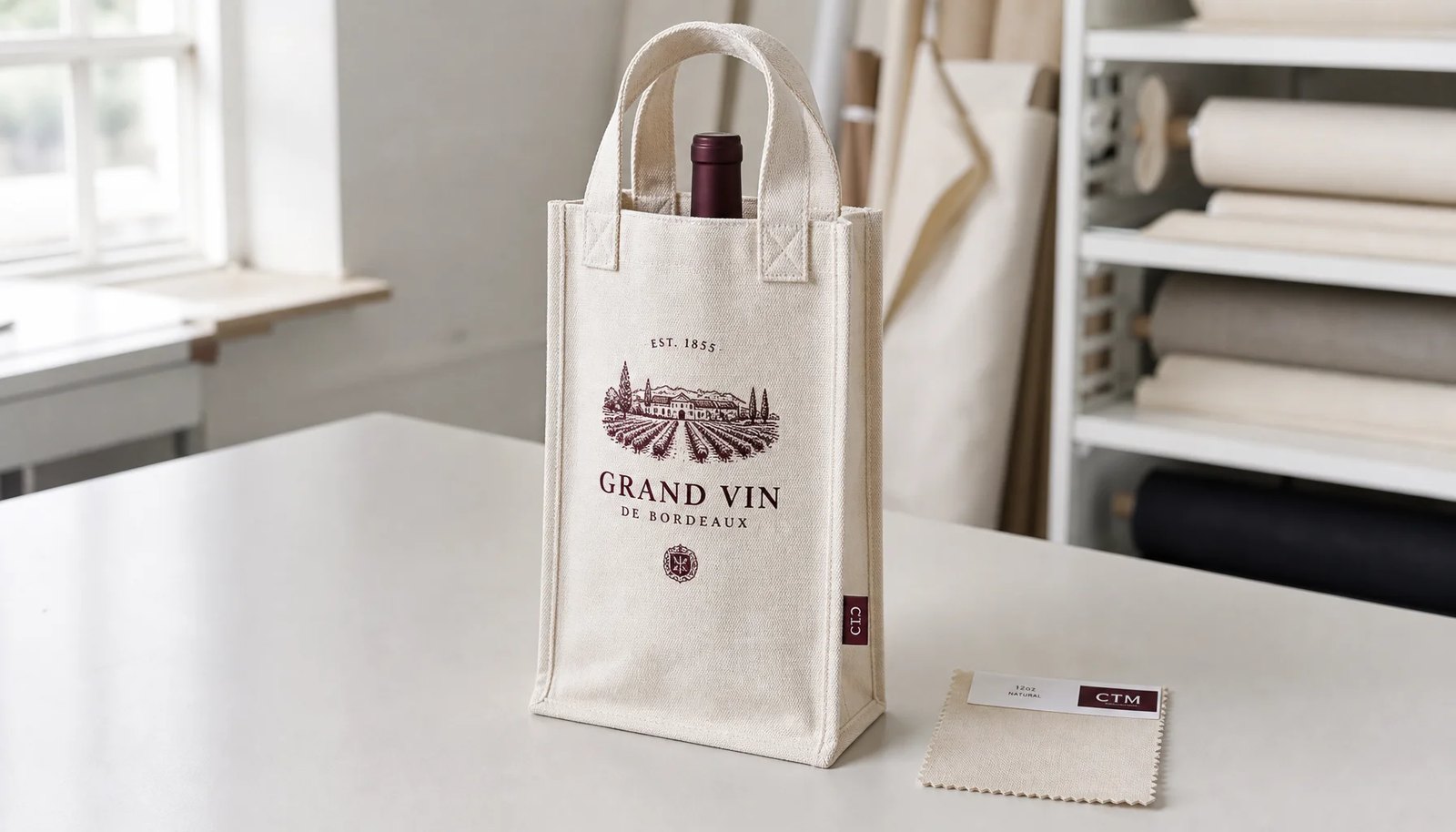
Use MOQ as a Spec Conversation
MOQ is rarely just a number on canvas wine carriers. It is the visible result of fabric availability, cutting yield, sewing setup, decoration setup, component minimums, packing labor, and the factory's willingness to interrupt standard production. A request for 300 natural canvas carriers with one black screen print is not equivalent to 300 carriers in custom dyed fabric with lining, woven labels, multiple carton marks, and retail packing.
For procurement teams, the useful question is not simply how low the supplier can go. The useful question is which part of the specification creates the minimum. Once that is visible, you can negotiate with a real tradeoff: simplify the decoration, choose stocked fabric, keep one artwork version, or accept a higher price for a smaller first run.
A strong canvas wine carriers MOQ negotiation guide for trade show exhibitors should therefore start with product control. Define the carrier clearly, quote the same spec across suppliers, and only then negotiate quantity, price, and delivery terms. Otherwise, the lowest quote may only be cheaper because it quietly removed fabric weight, reinforcement, packing protection, or service content.
- Treat MOQ as a production outcome, not a standalone discount request.
- Freeze bottle fit, fabric, handle, decoration, and packing before comparing quotes.
- Negotiate around the driver: fabric, component, sewing, print, or packing.
Start With the Bottle and Use Case
Standard 750ml wine bottles are not identical. Bordeaux bottles are straighter, Burgundy bottles are wider through the shoulder, and sparkling bottles can be wider and heavier. Spirits bottles may introduce square shoulders or unusual bases. If the carrier must fit a named promotional bottle, use that bottle as the standard rather than relying on a category description.
The RFQ should include maximum bottle diameter, total height, shoulder shape if relevant, and filled weight. Also define whether the carrier is meant to fit one controlled bottle tightly or several bottle families more generously. A universal fit can be useful for show giveaways, but it may look less tailored around slimmer bottles. A snug fit may look premium but can create receiving complaints if a later bottle version changes slightly.
Trade show use adds its own handling path. The carrier may move from factory carton to advance warehouse, from warehouse to booth, from booth to attendee, and then into luggage, a hotel room, or an office. It does not always need retail-level durability, but it must survive loaded carrying, short-distance handling, and presentation under bright booth lighting.
- Provide measured bottle diameter, height, and filled weight in millimeters and grams.
- Approve fit with the largest or heaviest intended bottle if one bag covers several formats.
- Decide whether presentation fit or universal compatibility matters more for the event.
Specify Canvas So Quotes Match
Canvas is often described in ounces, but buyers should request the supplier's GSM range and a swatch reference. Ounce language can vary by mill, finish, and local convention. Two suppliers may both quote 12oz canvas while delivering different hand feel, opacity, stiffness, or shrink behavior.
For many single-bottle canvas wine carriers, 12oz to 14oz canvas is a practical starting point when the goal is a sturdy promotional carrier with efficient sewing and good printability. Heavier options, such as 16oz canvas, can feel more substantial and stand more firmly, but they may add material cost, sewing time, needle wear, and minimums for matching components. Lining, binding, padding, or base boards can improve presentation, yet each adds another operation to sample, price, and inspect.
Color is another MOQ lever. Natural canvas or a stocked color is usually easier for a first trade show order than a custom dyed brand shade. If brand color is mandatory, ask whether the fabric is stocked, piece dyed, yarn dyed, or custom produced, and build lab dip approval into the schedule.
- Ask for ounce description, GSM range, weave, finish, shrinkage note, and swatch reference.
- Use stocked fabric colors when schedule and MOQ control matter more than exact fabric shade.
- Treat lining, binding, base inserts, and custom dyeing as cost and MOQ variables.
Choose Decoration by Quantity Reality
Decoration can make or break MOQ. One-color screen print on one flat panel is usually the cleanest first-order baseline because it avoids extra components and keeps the sewing pattern unchanged. Specify print size, print location from seam references, artwork color, and whether the print must avoid folds, seams, or high-stress areas.
More complex branding can still be appropriate. Multi-color screen print may need registration checks. Embroidery can require backing and may distort lighter canvas. Woven labels, cotton patches, and leather-look patches can add a premium finish, but they often carry separate tooling, component minimums, and sewing labor. Procurement should ask for each decoration as a priced option rather than assuming it is a simple substitution.
For exhibitors, visibility matters more than decoration complexity. A clean logo with strong contrast may read better in a booth or aisle than a detailed mark that is expensive to produce and hard to see. When MOQ is tight, simplify decoration before weakening handles, seams, or base reinforcement.
- Quote one-color, one-position screen print as the baseline.
- Define logo size, placement, color, and tolerance before sampling.
- Ask whether labels, patches, embroidery, and transfers have separate minimums or tooling.
Build an RFQ That Stops Drift
A useful RFQ makes guessing difficult. Include bottle data, finished carrier dimensions, internal dimensions, canvas target, fabric color, handle construction, reinforcement, closure if any, decoration method, logo size, packing method, destination terms, and required delivery date. If those fields stay open, suppliers will fill the gaps differently and the comparison will be muddy.
Ask for MOQ in layers: per body color, per artwork, per fabric weight, per label or patch, per construction change, and per packing style. This tells you whether the bottleneck sits with the fabric mill, print setup, sewing line, component supplier, or carton supplier. It also helps avoid a common problem: one supplier agrees to a lower finished quantity but later raises the minimum when artwork or packing details arrive.
Commercial data belongs in the same RFQ. Request currency, incoterm, payment terms, sample fee, tooling fee, sample lead time, production lead time after approval, carton dimensions, pieces per carton, gross weight, and CBM. Ask for EXW and FOB at minimum. DDP can help budget, but only if destination, shipment mode, duties, taxes, and exclusions are clear.
- Send one controlled spec sheet to every supplier.
- Request MOQ by material, artwork, component, construction, and packing variable.
- Compare quotes using the same incoterm, currency, approval stage, and carton data.
Read Quotes by Driver
A low unit price is not enough information. A buyer needs to know what is included in the price and what is charged separately. Ask the supplier to identify fabric, decoration, handle material, reinforcement, lining, label or patch, packing, carton configuration, sample fees, screen charges, and tooling charges. Most factories will not share a full cost sheet, but a usable quote should show what product and service level it covers.
Once the driver is clear, negotiation becomes practical. If label MOQ is the issue, use screen print for the first event. If fabric color is the issue, use natural canvas with brand-color ink. If sewing complexity is the issue, remove lining or simplify the base while keeping bartacks and stress reinforcement. If packing labor is the issue, move from individual polybags to inner packs unless dust control or kitting requires otherwise.
Also compare total delivered reality, not only unit cost. A quote that excludes packing protection, uses EXW while another uses FOB, or omits carton data can become expensive when the show date approaches. For event programs, receiving accuracy and predictable handling are part of the purchase.
- Ask what is included, excluded, and optional before unit-price comparison.
- Find the MOQ driver before asking for a lower quantity.
- Do not compare EXW, FOB, and DDP as if they cover the same cost base.
Negotiate With Specific Tradeoffs
Specific requests get better answers than broad pressure. Instead of asking whether the supplier can lower MOQ, ask: if we keep one natural canvas body, one black screen print, no lining, standard handles, and bulk inner packing, can you support a smaller first order with reorder pricing? That gives the factory a clear production scenario to evaluate.
Tiered pricing is useful when internal demand is uncertain. Ask for prices at the target quantity, the supplier's standard MOQ, and one higher efficiency quantity. The bands should reflect real use: booth giveaways, VIP kits, distributor meetings, sales rep samples, and post-show follow-up inventory. If the higher tier creates a meaningful unit-price drop and the extra inventory has a planned use, it may be better than forcing a very small run.
Avoid splitting the first order unless there is a business reason. Multiple artwork versions, languages, fabric colors, or carton marks can make each version inefficient. Where possible, keep the sewn carrier identical and handle market differences through removable inserts, outer labels, or event-specific carton marks approved at packing stage.
- Trade complexity for quantity only where it protects the buyer's priorities.
- Request tiered pricing tied to real event and post-event demand.
- Keep the sewn carrier identical across markets when compliance allows.
Use Samples as Control Documents
A sample is not just a visual approval. It is the control document for bulk production. The approved sample should match intended production in fabric, handle material, thread, reinforcement, decoration, dimensions, and packing fold. If a sample uses substitute fabric or a temporary logo method, label it as a layout or prototype sample, not final approval.
Sample review should cover fit, appearance, strength, and packing. Fit means the bottle inserts and removes without excessive force. Appearance means the logo is placed from reliable seam references and the fabric shade looks acceptable in practical lighting. Strength means the handle and base show no visible failure after the agreed load check. Packing means the fold does not crease the logo panel or deform the handle.
Before releasing bulk production, record the approved sample version, date, dimensions, fabric reference, decoration method, artwork file, approved changes, and unresolved issues. A clearly photographed golden sample or retained physical sample reduces disputes during inspection and reorder.
- Separate prototype, artwork sample, pre-production sample, and retained production sample when schedule allows.
- Do not treat a substitute-material sample as final bulk approval.
- Record sample approvals in the PO file with photos and measured dimensions.
Set QC Before Cutting Starts
Quality control should be measurable before production begins. Key checkpoints include finished dimensions, bottle fit, fabric weight, shade consistency, handle strength, stitch quality, print placement, decoration durability, stains, odor, and packing accuracy. For simple sewn carriers, buyers often discuss plus or minus 5mm on key dimensions and plus or minus 3mm to 5mm on simple logo placement, subject to supplier confirmation.
Stitching deserves close attention because the carrier is lifted while loaded. Inspect bartacks or reinforcement at handle attachments, seam security around the base, stitch density near the opening, and whether thread tails are trimmed to the agreed standard. Define unacceptable defects such as open seams, skipped stitches, broken bartacks, fabric tears, uneven handles, and visible needle damage.
Decoration QC should be equally clear. Screen print should not show excessive bleeding, tacky ink, pinholes, heavy buildup, transfer marks, or cracking after normal flexing. Labels and patches should be straight, securely sewn, and free from fraying. If third-party inspection is used, set AQL levels and classify critical, major, and minor defects before the inspector arrives.
- Agree dimensional and print placement tolerances before the PO is released.
- Check handles and base seams under loaded conditions, not only on empty bags.
- Use reject examples for stitching, print, stains, odor, and packing errors.
Pack for the Show Path
Packing should be designed for the route to the booth, not only for factory dispatch. A flat fold may save freight, but a fold across the logo can create a visible crease. Tight cartons can deform handles or transfer ink. Loose cartons waste freight and may allow movement damage. The PO should define fold method, pieces per inner pack, individual polybag use if needed, carton quantity, carton size, gross weight, and carton marks.
Trade show receiving adds deadlines and rules. Many events have advance warehouse cutoffs, material handling forms, booth number requirements, show-site receiving restrictions, and overtime charges. If cartons need to be consolidated with booth kits, display hardware, bottles, printed inserts, or sales literature, decide whether consolidation happens at the factory, a 3PL, the exhibitor office, or the show contractor.
Carton labels should support fast receiving: item name, PO number, quantity per carton, carton sequence, gross weight, destination reference, booth number if available, and version code if there are approved variations. For repacking after the show, consider whether leftover carriers need resealable inner packs, spare cartons, or simple inventory labels. Event teams remember products that arrive clean, countable, and easy to move.
- Approve fold method so the logo panel and handles arrive presentable.
- Confirm advance warehouse deadlines, booth numbers, receiving rules, and consolidation needs early.
- Require carton dimensions, pieces per carton, gross weight, CBM, and clear carton marks before freight booking.
Specification comparison for buyers
| Quote scenario | Typical MOQ pressure | Cost or lead-time impact | Negotiation move |
|---|---|---|---|
| Stock natural canvas, one-color screen print, one bottle size | Lowest pressure because material, cutting, sewing, and print setup stay simple | Usually the cleanest baseline for comparing suppliers and reducing first-order risk | Ask for tiered pricing at target quantity, supplier standard MOQ, and one reorder quantity |
| Custom dyed canvas in brand color | Fabric mill or dye lot can drive MOQ beyond the sewing line minimum | Adds lab dip approval, shade risk, and possible extra weeks before cutting | Use stocked natural or black for the first show, then reserve custom dye for repeat volume |
| 16oz canvas with lining and base insert | More sewing operations and separate components can raise MOQ | Higher unit cost, slower sampling, and more inspection points | Keep reinforcement only where needed: handle stress points and base stability before adding full lining |
| Woven label or sewn patch instead of screen print | Label or patch supplier may have its own minimum | Tooling, component lead time, and sewing labor can exceed the bag factory's minimum | Quote screen print as the baseline and label or patch as a priced upgrade |
| Multiple logos, markets, or carton mark versions | Each version can fall below efficient production quantity | More setup time, higher error risk, and more complex receiving | Keep the carrier identical and separate versions only at removable label or carton level when possible |
| Individual polybag, retail-style packing, or kit insertion | Packing labor and materials can become a separate bottleneck | Adds handling time and can change carton size, CBM, and show delivery cost | Use bulk inner packs unless presentation, dust control, or kitting requires individual packing |
| Air freight to meet show date | Production MOQ may be unchanged, but total landed cost rises quickly | Compressed sample approval, higher freight cost, and less time for inspection | Freeze artwork early, approve carton data before production, and ship advance inventory by sea when schedule allows |
Buyer checklist before sampling
- Confirm the exact bottle family before RFQ: Bordeaux, Burgundy, Champagne or sparkling, spirits, or a named bottle with measured diameter and height.
- State the maximum filled bottle weight used for handle and base load checks.
- Specify internal width, gusset depth, height to opening, and neck clearance in millimeters.
- Request canvas details in both ounce language and supplier-stated GSM range, with a physical swatch or approved reference.
- Define fabric color as natural, bleached, dyed, printed, or stocked color; do not assume color has no MOQ effect.
- Limit the first order to one body color, one artwork version, one decoration method, and one packing method where possible.
- State decoration method, print size, Pantone or artwork color, placement from seams, and placement tolerance.
- Ask whether screen setup, label tooling, sample fee, sample freight, and carton mark charges are included or separate.
- Require MOQ broken down by body color, artwork version, fabric weight, lining, label or patch, carton print, and packing method.
- Request price tiers at practical bands tied to show demand, sales kits, distributor samples, and likely reorder volume.
Factory quote questions to send
- What is your MOQ per body color, artwork version, fabric weight, and construction change?
- Which item drives the MOQ: fabric mill, cutting room, sewing line, print setup, label supplier, packing material, or another component?
- What exact canvas are you quoting: ounce description, GSM range, weave, finish, shrinkage behavior, and swatch reference?
- What maximum bottle diameter, bottle height, and filled weight does this carrier support?
- What handle material, handle width, handle drop, stitch pattern, bartack count, and reinforcement are included?
- What decoration method is included, what is the maximum print area, and what logo placement tolerance can you hold in bulk?
- If we change from screen print to woven label, cotton patch, or embroidery, what changes in MOQ, tooling, unit price, and lead time?
- Will the sample use bulk-intended fabric, thread, handle material, decoration process, and packing fold?
- What sample stages do you recommend, and which sample becomes the production approval standard?
- What are the EXW and FOB prices, carton dimensions, pieces per carton, gross weight, CBM, production lead time, and sample lead time?
Quality-control points to confirm
- Canvas weight matches the agreed GSM range or approved swatch, and hand feel is consistent across inspected cartons.
- Fabric color matches the approved lab dip or sample within the agreed shade tolerance, with no obvious panel-to-panel shading on the same carrier.
- Finished dimensions match the PO and approved sample, with a written tolerance such as plus or minus 5mm on key body measurements unless otherwise agreed.
- Inside width, gusset depth, and height are checked with the intended bottle type for insertion, removal, neck clearance, and upright presentation.
- Handle drop, handle width, stitch pattern, bartack placement, and reinforcement match the approved sample.
- Handle attachment passes a filled-bottle hanging and carry check using the agreed load, with no seam creep, popped stitches, tearing, or distortion.
- Base reinforcement, if specified, stays centered and flat after loading and short transport simulation.
- Stitching is consistent in visible and stress areas, with no skipped stitches, broken thread, open seams, uneven top opening, or loose tails beyond the trim standard.
- Print or label placement stays within the agreed tolerance, commonly plus or minus 3mm to 5mm for simple panel decoration when the factory confirms it can hold that range.
- Decoration has no excessive bleeding, tackiness, cracking after flexing, transfer marks, crooked labels, fraying edges, or packing-related abrasion.