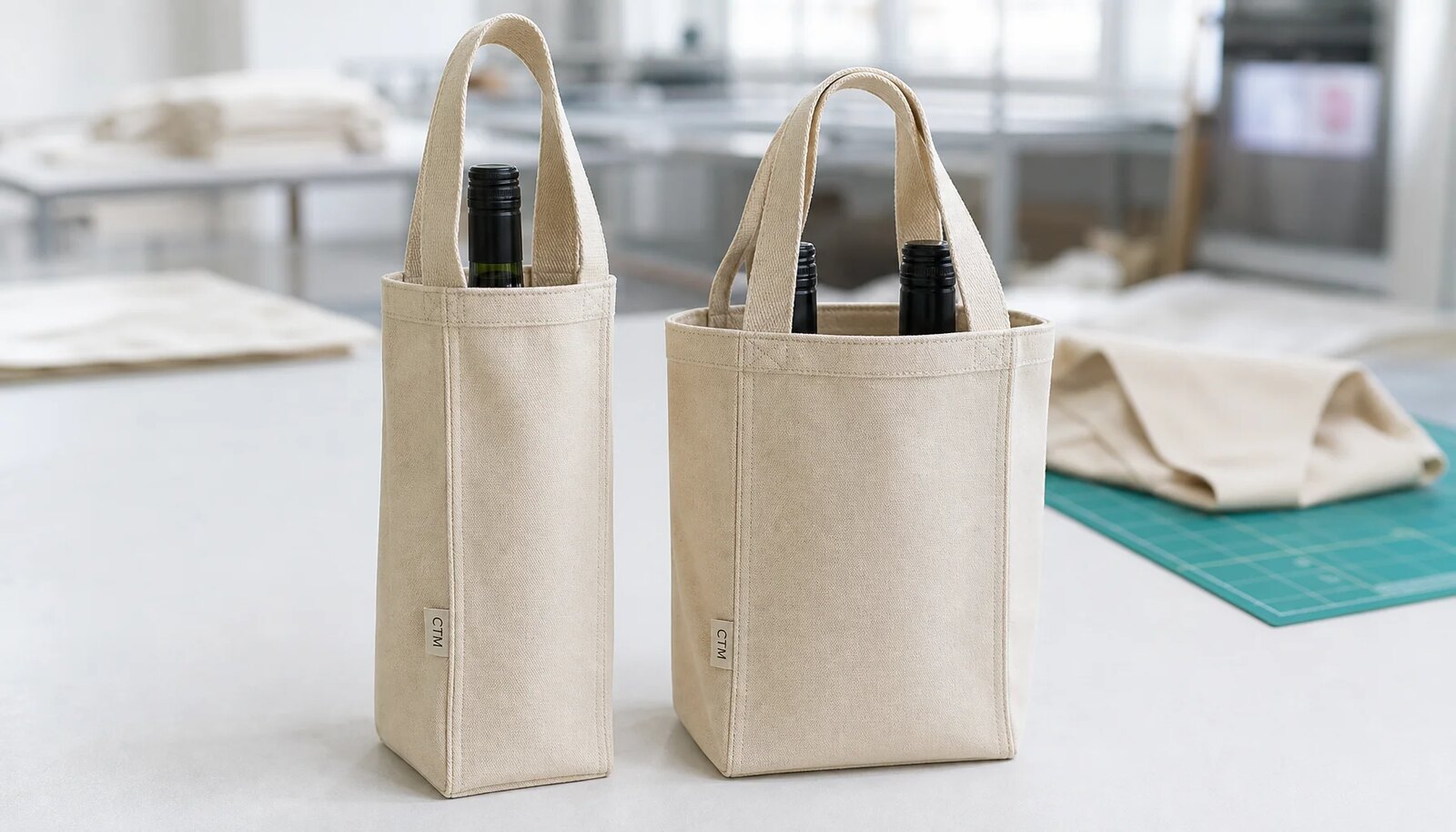
Start With the MOQ Driver
The minimum order quantity is not one number hiding in the supplier's price list. For custom canvas wine carriers, MOQ can come from fabric roll purchasing, cutting yield, sewing setup, screen-print setup, woven label minimums, custom dyeing, carton format, or the number of logo versions. A stock natural single-bottle carrier with one screen print is a different production job from a 16 oz two-bottle carrier with a sewn divider, base insert, woven label, hangtag, barcode sticker, and individual packing.
Event planners have less room for vague sourcing because the delivery date is fixed. A sponsor dinner, winery activation, hotel room drop, tasting kit, or conference reception cannot wait for a second production cycle. The right opening question is: which part of this exact specification creates the MOQ? If custom dyed fabric is the constraint, changing the hangtag will not help. If the woven label supplier has a high minimum, switching to a screen print may reduce pressure.
Send a stable RFQ before negotiating. One finished size, one fabric weight, one decoration method, one packing format, one destination, and one delivery date will produce cleaner answers. Mention repeat potential only if it is real; suppliers can often quote a lower reorder MOQ after the first approved production run because the pattern, artwork, and packing standard are already set.
- Ask which specification detail creates the MOQ before negotiating price.
- Separate true minimum drivers from optional adders such as hangtags, labels, and individual bags.
- Keep the first RFQ stable so suppliers quote the same carrier.
- Discuss reorder MOQ after the first production run is approved.
Define the Bottle Before the Bag
The bottle is the first specification. Wine bottles vary enough to create real production risk. A standard 750 ml Bordeaux bottle is often narrower than Burgundy or Champagne-style bottles, while tall Riesling-style bottles may create height and balance issues. Heavy glass changes handle stress. Tissue wrap, neck tags, sleeves, inserted cards, and foil protection all affect mouth opening and interior space.
Send the supplier the bottle diameter, total height, filled weight, shoulder shape, neck length, foil cap size, and label position. If several bottles may be used, identify the widest and heaviest as the fit standard. If sponsors or regions will supply different bottles, state whether one carrier must fit all of them or whether each version has its own bottle profile.
Then define the use case. A one-evening handout can use a lighter, simpler construction if the bottle fit and handle reinforcement are sound. A winery retail carrier or premium sponsor gift needs better body structure, cleaner seam finishing, and a base that does not sag. A two-bottle tasting set must keep bottles separated while the guest lifts, walks, sets the carrier down, and picks it up again.
- Use the widest and heaviest bottle as the fit standard for mixed programs.
- Include tissue, sleeve, card, neck tag, and foil details in the RFQ.
- State whether the carrier is event packaging, merchandise, retail packaging, or premium gifting.
- Load-test the sample with the intended bottle, not an empty display.
Write a Quote-Ready Spec
Weak RFQs create misleading comparisons. One supplier may assume 10 oz natural canvas, a stock pattern, and bulk packing. Another may include 12 oz bleached canvas, reinforced bottom panels, and individual bags. The lower quote may simply describe a weaker or less complete product.
A procurement-ready RFQ should include capacity, finished dimensions, fabric weight, fabric color, handle material, handle length, reinforcement method, decoration method, artwork size, print position, packing format, quantity ladder, delivery destination, and required arrival date. If the supplier should recommend dimensions based on the bottle, ask for that first, then freeze the approved size before sampling.
Fabric language should be specific. Use both oz and GSM where possible: 10 oz / about 340 GSM, 12 oz / about 406 GSM, or 16 oz / about 542 GSM. Ask whether the quoted weight is greige, finished, post-wash, or only a category estimate. Natural, bleached, stock dyed, custom dyed, organic cotton, and recycled-content canvas can change MOQ, lead time, shade control, and cost.
Decoration needs the same discipline. A one-color screen print on one panel is usually the most MOQ-friendly route. Multi-color printing, embroidery, woven labels, stitched patches, large solid ink areas, and second-side artwork add setup and QC points. Ask for the base carrier price plus separate adders so premium details do not blur the core cost.
- Quote the same finished carrier across all suppliers.
- Use oz and GSM, and ask what stage of fabric the weight describes.
- Separate base carrier, decoration, labels, inserts, packing, samples, and freight.
- Confirm artwork size, PMS target, location, and placement tolerance before sample approval.
Use Quantity Ladders
One price at one quantity does not show where negotiation is possible. Ask for the same exact specification at 300, 500, 1,000, and 2,000 units when practical. The ladder shows where setup costs, material purchasing, sewing efficiency, packing labor, and carton volume actually move.
The ladder only works if the product stays identical. Do not compare 10 oz canvas at 300 units with 12 oz canvas at 1,000 units unless those are clearly marked as separate options. Ask for quote lines for the base carrier, decoration, divider or insert, label or patch, packing material, packing labor, carton data, sample charge, and freight if included.
Event demand is rarely round. If the event needs 420 carriers and the 500-unit bracket is much better, the extra units may cover late registrations, sponsor follow-up, VIP additions, damaged cartons, or post-event gifting. If the design includes a date and cannot be reused, the exact needed quantity may be smarter even at a higher unit price.
Negotiate with changes the factory can act on. Ask whether the 500-unit price can apply at 400 units if you keep stock natural canvas, one print color, one carton format, and bulk packing. Ask whether MOQ drops if the woven label becomes a screen print. Ask whether a shared carrier body across sponsor logos can count toward one production minimum.
- Request 300, 500, 1,000, and 2,000-unit pricing for the same spec.
- Look for the quantity point where the unit price meaningfully changes.
- Use extra units only when they have operational or reuse value.
- Ask for reorder pricing and reorder MOQ after the first run.
Control Version Splits Early
Event orders often multiply after the first quote. A 1,000-unit order can become five 200-unit versions when sponsors, VIP tiers, regions, or destination-specific inserts are added. To the factory, each logo, fabric color, label, carton label, or packing instruction may behave like a separate SKU.
Standardize the carrier body wherever possible. Keep the same canvas, finished dimensions, handle, divider, base insert, and packing format. Then vary the easiest branding element: print, hangtag, belly band, removable card, or insert. A print change still has setup, but it is usually easier than changing fabric or construction.
Ask how mixed versions count toward MOQ. Can 1,000 total units across four print versions share one production minimum if the base carrier is identical? Is there a per-version minimum? Are there separate screen charges, label charges, or packing charges? Can cartons be packed and labeled by version? These questions prevent receiving errors when the order reaches the warehouse or venue.
Artwork control matters as much as production control. File names, logo placement diagrams, print colors, carton labels, and purchase order lines should match. If a sponsor logo is approved late, decide whether that version can ship separately or whether it delays the full order.
- Treat every fabric color, logo, label, and packout as a possible separate MOQ until confirmed.
- Use one shared carrier body when sponsor versions are needed.
- Ask for per-version setup charges and per-version minimums.
- Require carton labels showing SKU, logo version, quantity, and destination.
Verify Supplier Capability
A low quote is not useful if the supplier cannot control sewing, decoration, and packing. Ask what is made in-house and what is subcontracted. Many suppliers coordinate screen printing, embroidery, woven labels, fabric dyeing, or final packing through partners. Subcontracting is common, but responsibility must be clear before the purchase order is placed.
Do not rely only on generic factory claims. Ask for dated photos of current sewing lines, cutting tables, in-process canvas goods, inspection sheets, and finished packing for similar bottle bags or canvas carriers. Compare those details with the quoted process: if the quote includes woven labels and screen printing, ask who manages those steps and where inspection happens after each one.
Audit language should be specific. A broad social compliance audit does not prove the supplier can hold logo placement tolerance or divider strength. Ask whether the supplier keeps approved samples, measurement sheets, fabric swatches, print strike-offs, and packing photos for repeat orders. For larger programs, ask who signs off on pre-production samples and who approves corrective action.
Supplier fit depends on the order. A direct cut-and-sew factory is stronger when construction control matters. A sourcing agent can help with multi-item welcome kits. Stock blanks with local decoration can save a rush event, but only if the blank passes bottle fit and loaded handle checks before branding begins.
- Confirm in-house cutting, sewing, inspection, and sample retention.
- Identify subcontracted dyeing, printing, embroidery, labels, patches, and packing.
- Ask for dated production evidence relevant to sewn canvas bottle bags.
- Clarify who owns corrective action before placing the order.
Approve Samples Under Load
A canvas wine carrier is not approved because it looks good empty. Load it with the actual bottle or a weighted dummy matching diameter, height, and filled weight. The bottle should slide in without scraping the label, forcing the mouth opening, or stretching the seams. The loaded carrier should stand upright and feel balanced when lifted.
For a two-bottle carrier, test both compartments together. Carry it, tilt it, set it down, and check whether the divider keeps bottles separated. Review divider height, stiffness, seam attachment, and base behavior. A divided carrier can look neat when empty and still twist, sag, or allow bottles to touch under normal handling.
Check material and workmanship on the approval sample. Confirm canvas weight, color, hand feel, handle material, handle width, stitch type, seam finishing, divider construction, label placement, and print quality. Look inside for loose threads, raw fraying, skipped stitches, shallow seam capture, needle damage, and weak reinforcement.
The final approval sample should be production-intent: intended canvas, handle construction, print or label, divider or base insert, and representative packing. If timing forces partial approval by photo, document exactly which elements were physically approved and which were approved by image, measurement, or written spec.
- Approve the sample loaded, not empty.
- Use the actual bottle or a matching weighted dummy.
- Check divider separation, base stability, handle balance, and upright standing.
- Keep approval photos, measurements, artwork, and written comments together.
Inspect Event-Critical Defects
Quality control should focus on the failures that matter in use: weak handles, poor bottle fit, unstable bases, bottles touching inside two-bottle carriers, crooked logos, dirty fabric, wrong carton counts, and mixed sponsor versions. A clean logo does not rescue a carrier with handle stitching that fails under load.
Set the sampling plan before production. For many sewn-goods inspections, buyers use ANSI/ASQ Z1.4 or ISO 2859-1 with General Inspection Level II and agreed AQL levels. Critical defects can include unsafe handle failure, open structural seams, exposed sharp insert edges, or unusable bottle fit. Major defects can include wrong dimensions, weak divider attachment, dirty fabric, under-cured print, wrong logo, or wrong carton count. Minor defects may include small thread ends or slight natural shade variation within limits.
Handle reinforcement needs a written standard. Confirm whether the approved sample uses bartack, box-X, or another stitch pattern. Inspection should check placement, attachment depth, stitch density, skipped stitches, broken threads, loose ends, and shallow seam capture. For heavier bottles and two-bottle carriers, include a loaded lift and hold check using the intended weight.
Print QC should cover color, placement, cure, and durability. Canvas texture can soften print edges, but ghosting, heavy bleeding, cracking, smearing, ink transfer, obvious skew, and under-cured ink should be rejected according to the agreed standard. Add a simple dry rub check when carriers will be stacked, folded, or handled in bulk.
- Agree on sampling level, AQL, and defect classifications before production.
- Prioritize loaded bottle fit and loaded handle performance.
- Inspect two-bottle dividers with both compartments loaded.
- Check carton counts, version labels, and packing condition before shipment release.
Control Packing and Cartons
Packing can change the real cost of a canvas wine carrier order. Bulk flat packing is efficient when carriers will be filled near the venue or warehouse. It can reduce carton cube and packing labor. But if the carrier must be gift-ready, retail-ready, barcode-ready, or sorted for several destinations, individual packing, tissue, hangtags, barcode stickers, inner cartons, or version-specific labels may be necessary.
Ask for carton dimensions, units per carton, net weight, gross weight, and packing photos before awarding the order. Two-bottle carriers with dividers or base inserts can take more space than expected. Heavy canvas increases gross weight. Carton cube and weight affect international freight, domestic handling, warehouse receiving, and event-site setup.
Write packout instructions in operational language. State whether carriers ship flat or open, whether handles are tucked, whether hangtags are attached, where barcode stickers go, whether each unit is polybagged, whether tissue is included, and whether cartons are sorted by logo version or destination. Avoid vague phrases such as gift packed unless the supplier provides a photo standard you approve.
If no individual polybags are allowed, ask how the factory will protect against dirt, moisture, abrasion, and print transfer. If polybags are required, confirm material, warning text if applicable, barcode placement, and whether the printed face is protected inside the carton.
- Compare unit price together with carton cube, packing labor, and handling risk.
- Request packing photos, carton dimensions, units per carton, and gross weight.
- Specify folding, hangtags, barcodes, tissue, polybags, and carton labels.
- Separate logo versions and destinations unless mixed cartons are approved.
Plan Lead Time by Gates
Event procurement needs a calendar with approval gates, not only a production estimate. Build the schedule around RFQ clarification, artwork preparation, sample making, sample transit, sample approval, material purchase, cutting, decoration, sewing, inspection, packing, freight booking, customs if applicable, domestic delivery, and final kitting.
Ask for lead time after sample approval and material confirmation, not only after purchase order issue. A supplier may quote 20 to 30 production days, but that may exclude artwork delays, sample revision, lab dips, label production, inspection, freight, or customs. Woven labels and custom dyed canvas can add separate timelines.
Freeze fabric, construction, decoration, and packing before bulk production starts. Late changes can reset the pattern, add label MOQ, require new print screens, change carton cube, or slow packing. A late switch from one bottle to two bottles is not a small revision; it can become a new product.
For fixed-date events, create a backup path early. Decide whether you would simplify decoration, use stock natural canvas, approve by photo, split shipment, upgrade freight, reduce packing complexity, or move extra units into a later gifting phase. Ask the supplier for the latest practical dates for artwork lock, sample approval, production start, inspection, and shipment release.
- Schedule artwork, sample, production, inspection, freight, and kitting as separate gates.
- Ask for lead time after sample approval and material availability.
- Freeze core specifications before bulk production.
- Keep a backup plan for simplified decoration, split shipment, or upgraded freight.
Specification comparison for buyers
| Decision area | Practical default | Use when | Buyer risk to check |
|---|---|---|---|
| Supplier route | Direct cut-and-sew factory | You need control over pattern, fabric weight, handle reinforcement, divider construction, inspection, and repeat-order consistency | Verify in-house cutting and sewing, sample retention, inspection records, and which processes are subcontracted |
| Supplier route | Trading company or sourcing agent | You are buying a full event kit with several items and need one coordinator | Confirm who approves samples, who owns corrective action, and whether defects are repaired before shipment or only credited later |
| Rush route | Stock blank plus local decoration | The event date is close and the carrier shape can be standard | Test bottle fit, loaded handle strength, print adhesion, and carton count before decorating the full batch |
| MOQ lever | Stock natural canvas with one-color print | You need a lower minimum and faster approval path | Check whether the lower MOQ depends on bulk packing, limited print size, or no SKU split |
| MOQ lever | Shared body across sponsor versions | Several logos are needed for one event program | Confirm per-version screen charges, carton labels, packing separation, and minimum units per logo |
| Fabric weight | 10 oz / about 340 GSM canvas | Single-bottle event handouts, room drops, or short-carry gifting | Check body collapse, seam stretching, transparency, and whether the base needs added support |
| Fabric weight | 12 oz / about 406 GSM canvas | Most branded one- or two-bottle programs needing structure, price balance, and reusability | Confirm finished GSM tolerance, shade range, shrinkage, and whether the quoted weight is greige or finished fabric |
| Fabric weight | 16 oz / about 542 GSM canvas | VIP gifting, boutique retail, wine clubs, and heavier two-bottle carriers | Expect higher cost, heavier cartons, slower sewing, and less crisp print edges on textured fabric |
| Construction | Gusseted single-bottle carrier with reinforced handles | A standard 750 ml bottle must stand upright and be easy to distribute at scale | Measure mouth opening, base width, loaded balance, and fit with the actual bottle |
Buyer checklist before sampling
- Confirm bottle profile before pricing: volume, diameter, total height, filled weight, shoulder shape, neck length, foil cap size, and label position.
- Identify whether the carrier must fit only a standard 750 ml bottle or also Burgundy, Champagne-style, tall Riesling-style, sleeved, tissue-wrapped, or neck-tagged bottles.
- Define the carrier format: flat sleeve, gusseted single-bottle carrier, two-bottle carrier, sewn divider, removable divider, reinforced bottom, closure, hangtag, or retail pack.
- Specify canvas by oz and GSM, such as 10 oz / about 340 GSM, 12 oz / about 406 GSM, or 16 oz / about 542 GSM, and ask whether this is finished fabric weight.
- State fabric color and sourcing: natural, bleached, stock dyed, custom dyed, organic cotton, recycled-content blend, or color-matched fabric with shade tolerance.
- Set practical tolerances for finished dimensions, handle placement, print placement, and label placement before sample approval.
- Define handle material, width, finished length, carry style, attachment depth, bartack or box-X reinforcement, and loaded handle test expectation.
- Define decoration method, color count, artwork size, print location, PMS target, label size, patch position, hangtag, barcode, and approved artwork file format.
- Ask suppliers to separate quote lines for base carrier, decoration, label or patch, divider or insert, sample, packing materials, packing labor, carton data, and freight if quoted.
- Request the same spec at 300, 500, 1,000, and 2,000 units when practical so MOQ pressure and price breaks are visible.
Factory quote questions to send
- What is the MOQ for this exact combination of fabric weight, finished size, handle construction, divider, decoration method, SKU split, and packing format?
- Which part of the spec is driving MOQ: fabric roll minimum, cutting yield, print setup, label MOQ, sewing line efficiency, packing labor, carton format, or version split?
- Can you quote the identical spec at 300, 500, 1,000, and 2,000 units so we can see the real price break without hidden material or packing changes?
- Which production steps are in-house, and which are subcontracted, including dyeing, printing, embroidery, woven labels, patch production, inspection, or final packing?
- Can you show recent production evidence for similar sewn bottle bags, including dated sample photos, cutting tables, sewing line photos, inspection sheets, or packing photos?
- What is the exact canvas weight in oz and GSM, and is it greige fabric weight, finished fabric weight, post-wash weight, or a category estimate?
- What tolerances apply to finished fabric GSM, shrinkage, finished dimensions, handle placement, print placement, and label placement?
- If custom dyed fabric is requested, what is the fabric MOQ, lab-dip process, strike-off requirement, lead time, and shade tolerance?
- For a two-bottle carrier, what divider height, divider material, attachment method, base insert material, and bottle diameter range are included?
- What inspection standard can you support, including AQL level, defect classification, loaded handle check, carton drop or handling check, and pre-shipment inspection timing?
Quality-control points to confirm
- Use a defined acceptance sampling plan, such as ANSI/ASQ Z1.4 or ISO 2859-1 General Inspection Level II, with AQL levels agreed before production.
- Classify critical defects as issues that can make the carrier unsafe or unusable, such as handle detachment, open structural seams, exposed sharp insert edges, or wrong bottle fit.
- Classify major defects as issues likely to affect event use or brand presentation, such as crooked logos, weak divider attachment, dirty fabric, wrong SKU, wrong carton count, or under-cured print.
- Classify minor defects as small appearance issues within agreed limits, such as light thread ends, small slub variation, or slight shade variation on natural canvas.
- Verify canvas weight against the agreed oz or GSM range, and check fabric rolls for shade consistency, odor, oil marks, heavy slubs, uneven dyeing, and unexpected stiffness before cutting.
- Measure finished height, width, gusset depth, base width, mouth opening, divider position, handle length, and logo placement against written tolerances.
- Check bottle fit with the actual bottle or approved weighted dummy so labels are not scraped, necks are not forced, seams are not stretched, and the loaded carrier stands upright.
- Run a loaded handle test using the intended bottle weight, with lift, hold, tilt, and set-down checks appropriate to the carrier type and event use.
- For two-bottle carriers, load both compartments and confirm the divider keeps bottles separated, the base stays flat, and the carrier does not twist under normal handling.
- Inspect carton packing before shipment release, including units per carton, version labels, carton strength, moisture protection, print-transfer prevention, and reasonable drop or handling checks.