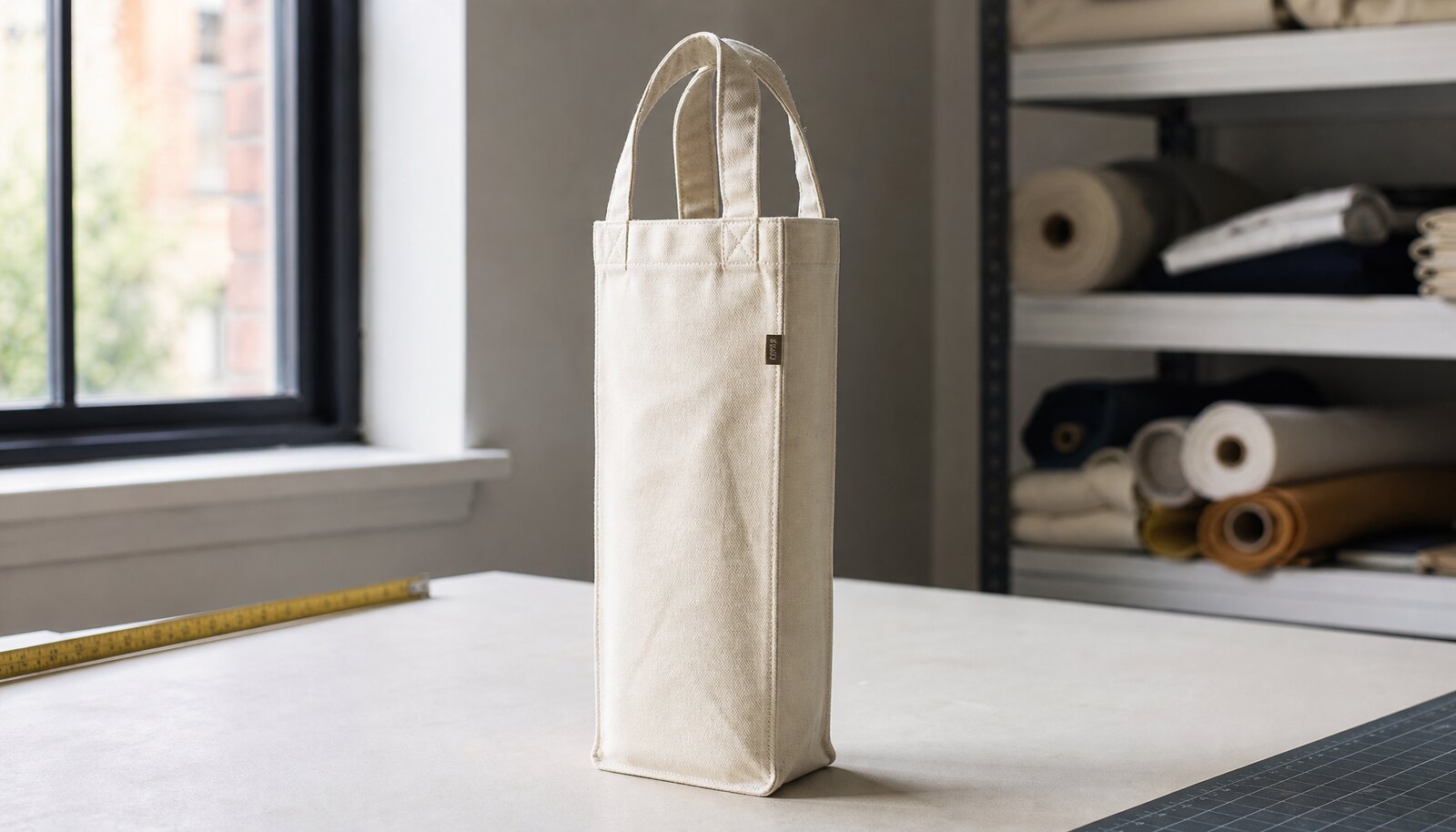
Why MOQ for canvas wine carriers is rarely just a quantity number
For canvas wine carriers, the MOQ usually reflects how many variables the factory must freeze before cutting the first panel. A simple carrier with one logo color and one fabric color may be manageable at a lower run, but the number changes fast once you add lining, reinforcement, a divider, a woven label, or multiple print positions. Buyers often focus on unit price and miss the real lever: each extra production step can create its own minimum because the factory needs to recover setup time, material booking, and labor balancing.
The practical mistake is asking for a lower MOQ without telling the factory which specification can move. If the bag must hold a 750 ml bottle securely, look at the structure first, not the artwork second. A good RFQ separates the non-negotiables from the flexible items so the supplier can propose a workable minimum instead of guessing. In corporate gifting, that difference matters because a carrier that looks inexpensive but fails in presentation or transit creates a bigger loss than a slightly higher MOQ.
- Lock bottle type before discussing production minimums.
- Treat fabric weight, logo method, and packing style as the main MOQ drivers.
- Use one clear spec sheet instead of sending several vague quote requests.
The spec choices that move MOQ the most
Canvas weight is the first decision to settle. Ten-ounce canvas is often enough for light gifting and short-distance distribution, but 12 oz usually gives a better handfeel and cleaner standing shape for corporate presentation. Fourteen-ounce canvas feels more premium and hides wrinkles better, yet it increases material cost and can slow sewing. If the program is for executive gifts or holiday sets, a heavier body paired with reinforced handles often justifies a higher MOQ because it reduces reject risk during packing and transport.
Decoration choice is the second major driver. One-color screen print is normally the lowest-friction route for MOQ, especially if the logo is bold and high contrast. Embroidery, woven labels, and debossed patches add a premium finish, but each option changes setup, labor, and inspection time. Buyers should compare decoration on durability and packing efficiency, not aesthetics alone. A carrier that looks simple on screen can become expensive if the logo needs extra registration or if the print must avoid seams and handles.
- 10 oz to 12 oz canvas: workable for lower-cost gifting and lighter freight.
- 12 oz to 14 oz canvas: better for premium positioning and shape retention.
- Single-color screen print: usually the easiest path for lower MOQ.
- Woven label or embroidery: better for premium brand feel, but more setup-heavy.
How factories build the MOQ, line by line
A factory does not calculate MOQ from a single formula. It is usually built from fabric booking, cutting efficiency, print setup, sewing line changeover, and carton packing logic. If the carrier uses one fabric color and one print color, the factory may combine your order with another job or use leftover booking from a standard canvas program. If your spec requires a unique shade, custom lining, or a special width, the supplier may need a dedicated fabric purchase, which pushes the minimum upward even if the sewing is simple.
The right way to negotiate is to ask where the threshold sits for each component. For example, the factory may accept a low MOQ for blank carriers but require a higher number for printed carriers, or it may accept mixed sizes only when the same fabric and same artwork are used. This is where buyer leverage matters: if your event program can live with one colorway, one size, and one print position, the supplier can often reduce MOQ without changing the core structure. If you want to reduce quantity, trade off complexity rather than asking for a discount on every element at once.
- Ask for MOQ by fabric, by print, and by carton configuration.
- Separate the cost of cutting loss from the cost of decoration setup.
- Use one size and one colorway if you need the lowest realistic minimum.
A practical supplier comparison for corporate gifting buyers
The best sourcing route depends on what problem you are solving. If you are buying a single branded gift for a company event, a trader with access to a capable factory may be enough. If you are building a recurring retail or distributor program, a direct factory relationship usually gives better control over repeat quality, fabric consistency, and change management. The cost of a direct factory quote can look higher at first because it shows production reality more clearly, while a trader may quote a softer entry price and add fees later through revision cycles or packing changes.
For procurement teams, the smarter comparison is not just price per unit. Compare who owns sampling, who books fabric, who approves artwork, who handles QC, and who is responsible if cartons arrive with the wrong fold or missing inserts. Canvas wine carriers for corporate gifting often fail on small details: the bottle neck rubs through the top, the logo sits too close to the seam, or the handle length changes from sample to bulk. Those are sourcing-route problems, not only manufacturing problems.
- Direct factory: better for repeat orders and specification control.
- Trader: useful for bundled categories or compressed timelines.
- Local printer: sometimes useful for very small runs, but check bottle fit and stitching quality.
Use quote structure to negotiate the MOQ instead of only the unit price
When a factory sends a quote, read it as a production map. The important items are not just the ex-works price and the quoted minimum. Look for fabric type, GSM or ounce weight, print process, sampling charges, carton details, and whether the supplier included loss allowance. If those items are vague, the MOQ is probably vague too. Buyers often get a number that sounds low until the supplier revises it after art approval, then the final minimum rises because screens, cutting loss, or special packaging were not included in the first line.
A good negotiation tactic is to ask for two quote tiers: one at your target MOQ and one at a cleaner break point. This shows whether the factory is pricing for true small batch work or simply protecting itself against setup loss. If the difference between 500 and 1,000 units is small, the supplier may already have fabric logic that fits your program. If the gap is large, reduce complexity first: move to a standard canvas color, simplify the print, or drop one packaging component. That is a more reliable lever than pushing harder on unit price alone.
- Request a quote tier at target MOQ and a second tier at a better price break.
- Make sure sample, plate, screen, and carton changes are shown separately.
- Treat vague line items as a warning sign, not as a negotiation win.
Sample approval should prove fit, print, and packing together
For canvas wine carriers, sample approval is not just about logo appearance. A usable sample should confirm bottle fit, seam placement, handle comfort, edge finish, and the way the carrier folds into cartons. If the sample is printed well but the bottle scratches against a loose side seam, the bulk order is not ready. Ask for a pre-production sample that reflects the actual fabric weight and the final packing method, not a hand-made presentation sample with temporary shortcuts.
If the carrier includes reinforcement, divider boards, or an internal sleeve, test those parts with the real bottle shape. Some 750 ml bottles have wider shoulders or taller necks, which changes how the carrier loads and how the top edge closes. A sample that fits a standard Bordeaux bottle may perform badly with a heavier Burgundy profile. Buyers should approve against the bottle they will actually ship or gift, not a generic bottle photo. This is one of the easiest places to prevent a costly bulk error.
- Approve the actual bottle fit, not only the artwork proof.
- Check handle length under load and not just on the table.
- Use the final carton pack method during sample review if possible.
Packing choices can quietly change your minimum and your freight
Packing is often treated as a finishing detail, but it affects both MOQ and landed cost. Flat packing lowers carton volume and usually makes export easier, yet some corporate programs need the carrier pre-assembled for event fulfillment. If the supplier must insert boards, fold the carrier a specific way, or pack by color or branch, labor goes up and so does the practical minimum. The quote should show whether the bags are nested flat, semi-assembled, or fully assembled before carton loading.
Carton planning also matters for damage control. A wine carrier that rubs against a bottle during transport may be fine in a local handover but fail in cross-border shipping. If the order moves through a distributor network, ask for the carton size, pack count, and whether the factory will add polybags, tissue, or separators. The wrong packing method can inflate freight more than the decoration itself, especially when carriers are bulky and low in compression.
- Flat-packed goods usually help reduce freight and carton count.
- Pre-assembled packing can increase labor and raise MOQ.
- Confirm carton dimensions before approving the final quote.
Lead time risk is usually caused by fabric and print setup, not sewing
Buyers often underestimate how little of the schedule is actually sewing time. For canvas wine carriers, the longer steps are fabric sourcing, color approval, printing setup, sample sign-off, and packing coordination. A supplier can sew a simple carrier quickly once the material is on site, but that does not help if the fabric is still in booking or if the print screen is being revised after artwork changes. A realistic planning window for small to mid-sized corporate orders is often measured in weeks from sample approval, not days.
The schedule becomes more fragile when there is more than one variable. A new fabric shade, a second logo color, or a custom insert can push the launch by a full production cycle if the supplier has to source parts separately. Buyers should build a timeline with hard gates: artwork freeze, sample approval, material booking, bulk cutting, print approval, mid-line QC, and final packing. If those gates are not named, the supplier may still deliver, but the order can drift without warning and the buyer absorbs the delay.
- Expect fabric booking and print setup to consume more time than actual sewing.
- Freeze artwork before asking for a final schedule.
- Build one buffer for sample revision and another for export packing.
How to compare landed cost without getting fooled by the first quote
The first price line is rarely the true cost. For canvas wine carriers, landed cost can move with fabric weight, decoration method, carton density, sampling charges, inspection fees, and the packing format you choose. Two suppliers can show the same unit price while one quote includes polybags, inner dividers, and export cartons and the other does not. A fair comparison starts by normalizing the spec: same fabric weight, same logo color count, same packing count, same bottle fit, same destination terms, and same sample assumptions.
Once the spec is aligned, compare the quote break points instead of only the headline number. A supplier that is slightly higher at 500 units may become the better buy at 1,000 units if the second tier drops faster. That matters in corporate gifting because reorders are common. If your buying pattern has seasonal spikes, the best supplier is often the one that gives you a repeatable process and stable quality at the second or third order, not the one that wins a one-time low MOQ bid.
- Normalize spec before comparing prices.
- Include sample and packing costs in the landed-cost view.
- Look at reorder economics, not only the first shipment.
A negotiation workflow that works in real sourcing cycles
Start with a precise RFQ: bottle type, carrier dimensions, fabric weight, decoration method, packing format, delivery window, and artwork file. Then ask the factory to quote the target MOQ, the next price tier, and the sample charge separately. If the supplier comes back with a high minimum, do not immediately push on price. Instead, ask which element is driving the floor and which change would reduce it most efficiently. That forces the conversation toward production logic instead of bargaining theater.
A workable compromise is often a spec trade, not a rate fight. You may keep the same logo and reduce the carrier to a standard fabric weight. Or you may keep the premium canvas and simplify to one print color. The important part is to protect the gift experience while letting the factory run a sensible line. For corporate gifting, the best MOQ negotiation outcome is usually a stable, repeatable product that can be reordered without reengineering the spec every time.
- Send one clean RFQ with all production variables in writing.
- Ask for the MOQ driver, not only the MOQ number.
- Trade complexity for quantity only when the final gift value still holds.
Specification comparison for buyers
| Spec decision | Recommended option | When it fits | Buyer risk to check |
|---|---|---|---|
| Sourcing route | Direct cut-and-sew factory | Best when you need control over fabric weight, handle reinforcement, and print placement across a repeat corporate program | MOQ can be higher if the factory must open new fabric orders or new print screens just for your item |
| Sourcing route | Trader with factory network | Useful for mixed SKU programs, urgent launches, or buyers who need one quote across multiple bag styles | Margins and handoff risk can hide the real production source, so verify who owns fabric booking and QC |
| Fabric weight | 10 oz to 12 oz canvas | Good for light corporate gifts, short runs, and lower freight cost when the bottle is a standard 750 ml size | Too light for sharp bottle edges or long-distance shipping unless you add lining or edge binding |
| Fabric weight | 12 oz to 14 oz canvas | Best balance for premium gifting, better stand-up shape, and fewer complaints about wrinkling or distortion | Higher material cost and slightly longer sewing time; confirm whether the quote uses true finished GSM or greige weight |
| Decoration method | 1 to 2 color screen print | Best for logo-driven corporate gifting where unit cost and repeatability matter more than tonal detail | MOQ may rise with each print color because of screen setup, registration test, and extra curing passes |
| Decoration method | Woven label, embroidery, or debossed patch | Fits premium programs where the carrier should feel more like a gift accessory than a disposable pack-in | Check stitch density, label washability, and whether decoration adds labor that pushes MOQ higher |
| Structure | Flat carrier with divider insert | Fits simple internal gifting kits and faster packing because the bottle can be inserted after print and QC | Bottle movement in transit can damage necks unless the divider board or foam insert is sized correctly |
| Structure | Gusseted or padded carrier | Best for higher-value wine, heavier bottles, or when the carrier also needs shelf appeal at events | More fabric and more sewing operations increase cost and can reduce the lowest workable MOQ |
Buyer checklist before sampling
- Confirm bottle size, bottle shape, and whether the carrier must fit 750 ml only or also magnum formats.
- Lock the fabric weight, lining, and handle spec before asking for a price, because these three items usually drive MOQ and cost more than the logo.
- Send a vector logo and state the print method you prefer, such as screen print, woven label, embroidery, or heat transfer.
- State whether you need flat-packed carriers, nested packing, or assembled packing with inserts already inside.
- Ask the factory to quote both your target MOQ and a better-price tier at a higher quantity so you can see the break point.
- Request photos or video of similar wine carrier production, especially handle stitching, bottom reinforcement, and print alignment.
Factory quote questions to send
- What MOQ applies separately to fabric color, logo color, and carton label changes?
- Does your quote include fabric shrinking allowance, cutting loss, and lining waste, or are those added later?
- Which decoration method gives the best balance of MOQ, lead time, and logo durability for this carrier?
- How many sample rounds are included, and what parts of the sample are charged separately, such as plates, screens, or courier fees?
- What is the standard carton pack count, carton size, and gross weight for export?
- What inspection standard do you use for stitch density, print placement, and handle pull strength?
- If we reduce MOQ, which component changes first: fabric sourcing, print setup, packing method, or lead time?
- What delivery window do you need after sample approval, and what part of the schedule is most likely to slip?
Quality-control points to confirm
- Fabric weight matches the approved swatch, with no obvious thin spots, slubs, or color drift between panels.
- Handle stitching is even, bartacks are secure, and the top edge does not distort when a standard bottle is inserted.
- Logo placement stays within the approved tolerance and the print does not crack, blur, or ghost after curing.
- Bottle fit is snug enough to reduce movement but not so tight that the carrier is difficult to load during event packing.
- Bottom seams and side seams hold shape under weight, with no skipped stitches or loose threads near stress points.
- Carton pack count, barcode label, and inner packing method match the approved export spec.
- Pre-production sample, size set, and production sample are all aligned before bulk cutting begins.
- Final inspection confirms that all units in the lot use the same fabric lot and the same approved decoration method.