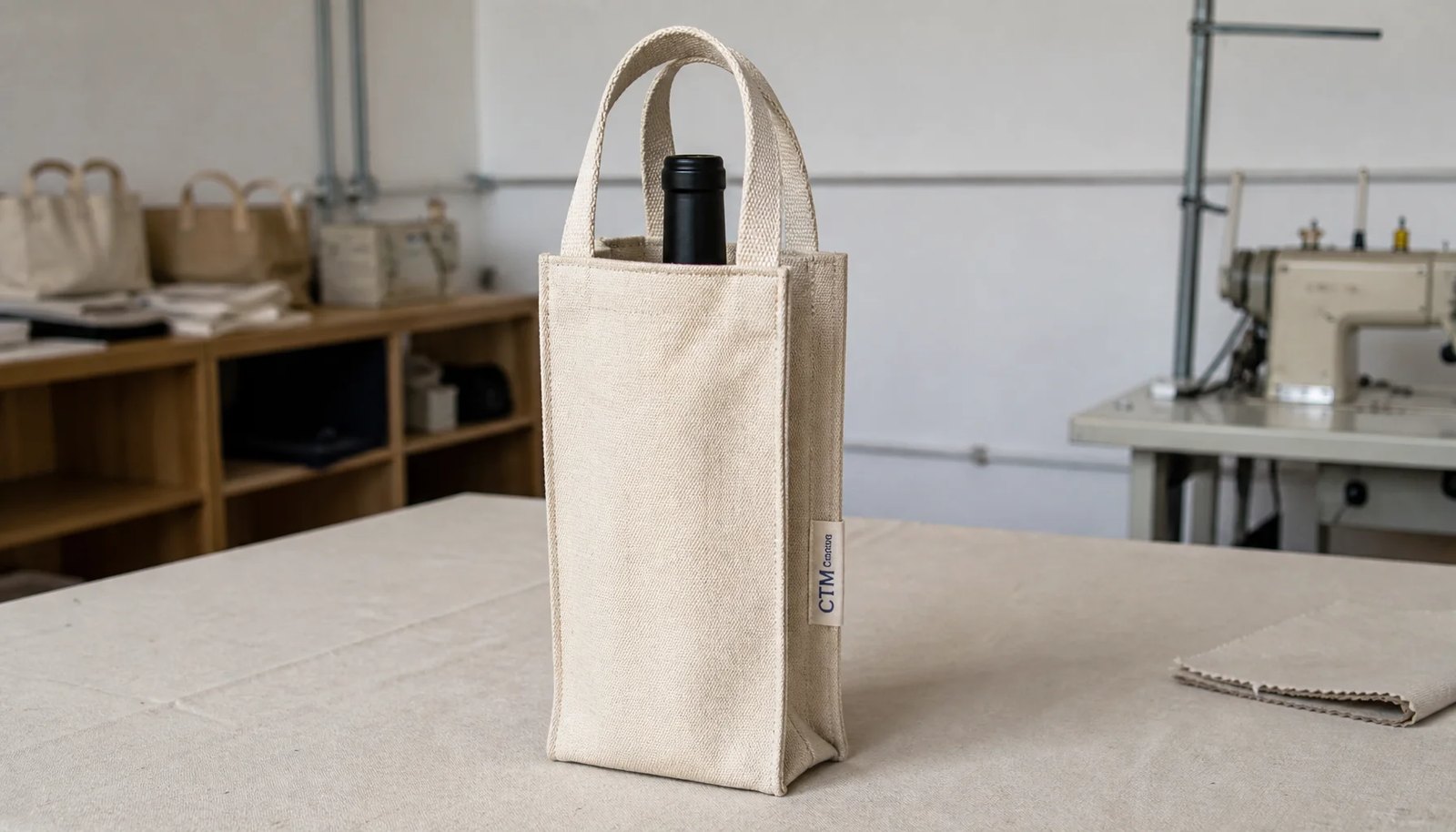
Why material choice matters in a wine subscription box
A canvas wine carrier in a subscription box is not just packaging. It has to fit the bottle, survive warehouse handling, look intentional at unboxing, and stay consistent when the program repeats. If the fabric is too light, the carrier can slump around the bottle and feel disposable. If it is too heavy, it adds bulk, increases carton cube, and slows pack-out without giving the buyer much visible value.
For procurement teams, the real job is to balance four things at once: fit, presentation, fulfillment speed, and reorder stability. That is why material selection needs to happen before artwork approval and before bulk pricing becomes the only focus. A carrier that looks good in a deck but fails the box-fit test becomes a rework item, not an asset.
Canvas also behaves differently from paperboard or synthetic pouch materials. The weave can affect print crispness, the finish can affect fold memory, and the fabric weight can change how the carrier sits inside the mailer. Those details matter more in subscription boxes because the item is handled, packed, shipped, and opened as part of a repeated system, not as a one-off retail gift.
The most reliable sourcing sequence is simple: measure the bottle and outer box first, then set the carrier dimensions, then choose the fabric and decoration. That order keeps the spec tied to the real pack-out problem instead of an abstract style preference. It also gives buyers a fair way to compare suppliers because every quote is answering the same use case.
For most box programs, the goal is not the fanciest canvas. The goal is a carrier that prints cleanly, folds predictably, passes QC, and reorders without drifting. In practice, that is what makes a canvas wine carrier useful to the buyer and not just attractive to the design team.
- Pick the fabric for structure first, then print behavior, then hand feel.
- Treat the carrier as both a gift item and a fulfillment component.
- Compare suppliers against the real bottle, box, and fold sequence, not a mockup.
Start with the bottle and the box, not the tote
The carrier spec has to follow the bottle size, label stack, and box geometry. A standard 750 ml bottle may fit a narrow carrier, but a Burgundy bottle, a tall sparkling bottle, or a bottle with a high capsule can need more width or gusset depth. If the bag is too snug, the body distorts and the seams carry the load. If it is too loose, the bottle shifts inside the box and the presentation looks unfinished.
Measure the bottle with the full label and capsule in place. Then measure the usable inside dimensions of the subscription box, including any insert card, sleeve, divider, or tissue. Buyers should ask for three numbers from the supplier: cut size, finished size, and packed size. Those numbers are not the same because sewing, turning, pressing, and folding all change the usable footprint.
A common mistake is approving a flat pattern and assuming it will behave the same after sewing. It will not. A carrier that looks perfect in a pattern file can lose width or height once seams are turned and pressed. The sample needs to be sewn, pressed, and packed the way the factory will ship bulk. That is the only version that shows whether the carrier truly fits the box.
For a one-bottle subscription program, 12 oz canvas is often the most balanced starting point. It gives enough body to feel intentional without making the insert bulky. Fourteen oz makes sense when the carrier is meant to be kept and reused, or when the design needs more structure. Ten oz can work for lighter promotional use, but only if the real bottle fit, fold shape, and carton cube still pass.
Before the order is released, set tolerance bands for the key dimensions. Ask the factory to state acceptable deviation on width, height, gusset, and handle drop. That gives QC a pass/fail basis and avoids subjective arguments when bulk samples arrive. It also helps the warehouse plan because the fold and box fit stay predictable across production lots.
- Measure bottle, label, and capsule together.
- Verify the carrier against the real subscription box, not just the bottle.
- Use a sewn, pressed, production-style sample for approval.
- Set dimension tolerances before mass production starts.
Fabric weight, weave, and finish: the actual tradeoff
Fabric weight matters, but it is only one part of the spec. Two suppliers can both quote 12 oz canvas and still deliver very different results if one uses a looser weave, softer finish, or less consistent yarn. On canvas wine carriers, weave consistency often affects print clarity and seam tracking more than nominal weight does. A tighter weave usually gives cleaner edges, better body, and less visual noise around the logo.
A practical buyer range is usually 10 oz, 12 oz, or 14 oz. Ten oz lowers fabric cost and keeps the carrier light, but the bag can feel soft and less premium unless the pattern is carefully built. Twelve oz is the best starting point for many subscription-box programs because it balances body, printability, and freight. Fourteen oz is better when the carrier is part of the product story and should survive repeated use outside the box.
Finish changes both feel and performance. Raw natural canvas gives a rugged look. Pre-washed or enzyme-softened fabric feels less stiff and can improve first touch, but it may change finished dimensions and reduce body. Bleached or brightened cloth can improve logo contrast, but it also changes the visual tone and can make lot-to-lot variation easier to see. Buyers should not choose finish by feel alone; choose it based on how the item needs to behave in the box and in production.
Ask for both oz and gsm in the quote. Also ask for weave type and weave count if the mill can provide them. That matters because print registration, seam behavior, and durability all depend on how the fabric is built, not only on how heavy it sounds in the RFQ. If the carrier needs small text or thin rules, a tighter and more stable weave is usually worth a modest cost increase.
Color consistency is another hidden variable. Natural canvas varies across lots, and softened finishes can change the apparent shade. If the carrier will be reordered, ask how the factory controls lot matching and whether one production run will be cut from one fabric lot or split across multiple lots. For repeat programs, that control matters more than saving a small amount on the first purchase.
- Ask for both oz and gsm.
- Request weave type and weave count where available.
- Compare color consistency across lots if the carrier will be reordered.
- Judge fabric by weight plus weave plus finish, not weight alone.
Choose the print method from the artwork, not from habit
Canvas has texture, so the decoration method has to match the artwork and the order pattern. Screen print is still the most dependable option for simple logos, solid fills, and recurring programs because it gives strong ink deposit and repeatable results. If the design is one or two colors and the carrier is likely to reorder, screen print is usually the safest procurement choice.
Heat transfer can work for short runs or more complex multicolor artwork, but it needs more scrutiny. On folded or reused carriers, transfer layers can crack, lift, or show edge wear if the adhesive and top film are not specified correctly. Woven labels, sewn patches, and embroidery can feel more premium and often wear well, but they add cost and can affect foldability or bulk. That tradeoff matters when the carrier still has to sit flat inside a box.
The artwork should be designed for the fabric, not just for a screen. Fine serif type, tiny legal text, and hairline rules are risky on textured canvas. Buyers should ask for minimum line thickness and minimum text size before approval. If the supplier cannot tell you the thinnest line they can reproduce cleanly on the chosen cloth, the artwork is probably too detailed for reliable production.
A better spec is usually a simple logo with enough clear space around it that the weave does not chew up the edge. If the carrier will be folded in the box, ask the factory to show where the print lands relative to the fold line on the sample. That is one of the fastest ways to catch a logo that looks good flat but disappears or creases when packed.
Ask what ink or transfer system is being quoted and how the supplier checks cure or adhesion. Buyers do not need lab language; they need to know whether the print survives folding, packing pressure, and basic abrasion. A method that looks sharp on day one but fails after a few fold cycles is a poor fit for a reusable wine carrier.
- Use screen print for flat logos and repeat orders.
- Use heat transfer only when artwork complexity justifies the risk.
- Use woven labels, sewn patches, or embroidery when durability matters more than lowest cost.
- Specify minimum line thickness and text size so the logo survives canvas texture.
Construction details that separate a sample from a shippable product
A carrier can look correct in a sample photo and still fail in production because the sewing spec is too loose. The usual failure points are handle attachment, top hem stability, gusset symmetry, print drift, and seam consistency. Procurement teams should treat these as written specifications, not style preferences. If the construction is not documented, the factory will make a reasonable assumption, and that assumption may not match the box program.
Handle attachment deserves the most attention. Require bartacks or reinforced stitch boxes at every stress point where the handle meets the body. Ask for handle width, handle drop, attachment length, and reinforcement type. If the carrier is meant to be lifted after unboxing, the handle anchor is the main defense against seam pop. A weak anchor can pass a casual visual check and still fail under a simple load test.
Stitch appearance should also be defined. Ask for a target stitch density per inch, the allowed loose-thread limit, and whether backtack or bartack reinforcement is required at the top edge, handle anchor, and bottom seam. If the carrier includes a sewn label or side tag, specify its placement tolerance from the top edge or center seam. On natural canvas, even a small placement drift stands out because the eye catches asymmetry quickly.
A practical QC test is to load the carrier with the actual bottle and hang it briefly for a pull check. The bag should hang straight, the seams should not twist, and the handle should not pull unevenly side to side. Then inspect the bottom seam for diagonal stress lines or distortion. If the body warps under a normal bottle load, the bag is overbuilt in one area and underbuilt in another.
If the carrier includes a divider, sleeve, or insert, confirm that it does not buckle the side walls or force the bottle off center. Extra features often create more variation than they are worth. In a soft goods item, every extra panel, closure, or label adds another assembly step and another chance for error. The strongest spec is usually the simplest one that still meets fit, branding, and handling requirements.
- Specify stitch density and reinforcement at each load point.
- Approve the exact sew construction with a physical sample.
- Test the loaded carrier for straight hang and seam stability.
- Check top hem, bottom seam, and gusset symmetry under load.
MOQ logic and supplier route: what actually changes cost
The cheapest quoted unit price usually comes from the supplier that already runs similar canvas products at scale, but price alone is not the right comparison. For subscription boxes, the real cost includes setup, artwork changes, packing labor, carton cube, and the risk of re-approval. A direct factory usually gives the cleanest repeatability once the spec is stable. A trading source can help when the buyer wants multiple items under one commercial contact, but it can also add margin and weaken control over sewing detail unless the actual factory is clear and accountable.
MOQ should be read as a commercial structure, not just a number. A 1,000-piece order with one fabric, one logo, and one pack method is much easier to price than the same quantity split into several colors or label styles. Buyers should compare quotes on the same assumptions: same fabric weight, same finish, same logo method, same seam construction, same packing, and same carton count. If one quote looks cheaper, check whether it quietly excludes the features the program actually needs.
Variant creep is one of the biggest hidden costs. Every added color, label, closure, or retail pack style creates more setup work and more inventory risk. If the subscription box changes every month, keep the carrier stable and vary the insert card or sleeve instead. That is usually a better commercial choice than redesigning the carrier for each drop. A stable carrier also reduces the chance that a reorder comes back slightly different because the material lot or operator changed.
Ask the supplier to break the quote into fabric, sewing, print, label, inner packing, master carton, and any special handling. If the quote is one lump sum, you cannot tell whether the price is being driven by fabric, labor, or pack-out complexity. Itemized pricing is especially useful when the buyer needs to lower cost later without changing the whole design. It shows which lever is real and which one is just noise.
For recurring programs, repeatability is worth more than the lowest MOQ headline. A carrier that can be reordered from the same spec, the same folding method, and the same carton plan is often cheaper over time than a lower-MOQ option that needs fresh approval each season. That is the logic procurement teams should use when the product is part of a subscription box, not a one-off gift set.
- Lower MOQ often means fewer options, not lower total cost.
- Each added color, label, or packaging variant can create a separate setup burden.
- Ask whether MOQ is per design, per color, per pack style, or per total order.
- Standardize the carrier when possible and vary the insert card or sleeve instead.
Comparison of sourcing routes for subscription-box wine carriers
Use the route comparison below to align supplier type with the stage of the program. The right route depends on how stable the spec is, how many variants the box needs, and whether the supplier can handle final packing. If the wrong route is chosen, the buyer often pays later through slower approvals, freight surprises, and weak control over lot consistency.
Direct factory sourcing usually works best when the carrier spec is already defined and the program will reorder. It gives the buyer better visibility into sewing, packing, and inspection. A trading source can work when the launch has mixed items or when the buyer wants one contact across several packaging components. But even then, the buyer should ask who actually sews the carrier, who packs it, and who signs off on final inspection.
If the seller says the factory can do pack-in-box service, confirm the workflow with a written sequence or a photo of the packed carton. A surprising number of packaging issues come from assumptions about fold direction, insertion order, or print orientation. In a subscription box, a small pack-sequence error can slow fulfillment for every future order. The right supplier route is the one that reduces ambiguity, not the one that sounds easiest in the quote email.
For recurring purchases, ask whether the supplier can hold the same fabric lot, same print setup, and same carton configuration across reorder batches. If they cannot explain that clearly, they may be fine for a one-time project but weak for a subscription program that depends on consistency. Accountability matters here more than price. The buyer needs a clear answer to the question: if something changes, who notices, who approves it, and who fixes it?
A practical decision rule is simple. Use a direct factory when the spec is stable and repeat orders are likely. Use a trading source only when the buyer genuinely needs sourcing flexibility across multiple items and the route still gives direct visibility into the factory and QC process. If the supplier cannot name the sewing site, the pack method, and the inspection owner, the route is not ready for procurement approval.
- Direct factory: best for stable specs, repeat orders, and pack-out control.
- Trading source: useful for mixed programs, but confirm who owns QC.
- Hybrid route: only works if the sewing factory is clearly named and accountable.
- Ask who sews, who packs, and who signs off on final inspection before PO release.
Sample approval should test feel, fit, and production realism
A useful sample process starts with the right sample type. For canvas wine carriers, a digital proof is not enough. Ask first for a blank physical sample to check fabric hand feel, seam shape, bottle fit, and folding behavior. Then request a fully printed pre-production sample with final artwork, label, and packing method. If the supplier skips the blank sample, you can approve the wrong base construction and discover the problem only after the bulk order is released.
Review the sample in the real use case, not only on the table. Insert the actual bottle, close the subscription box, and simulate the pack-out pressure the carrier will face in fulfillment. Check whether the print distorts when folded, whether the handle drop feels balanced when loaded, and whether the folded bag stays centered in the outer carton. If it jams, wrinkles, or shifts under realistic packing, it is not approvable yet.
The sample should also follow the real production sequence. If the factory folds before packing, see the fold line and fold direction. If the carrier is inserted before the bottle, verify that workflow. If the box includes tissue, a card, or a sleeve, confirm that those items do not force the carrier to wrinkle or tilt the bottle. Sample approval has to mirror the actual line process because a nice-looking sample can still fail when repeated hundreds of times.
Record the approved version in writing. Save the approved fabric description, print size and placement, measured dimensions, fold orientation, and sample date. If possible, retain one sealed reference sample and one working sample. On reorder, those samples become the benchmark for color, feel, and construction. Without them, every later discussion turns subjective and slows the PO cycle.
If the supplier proposes a change in color, print placement, or finish, ask for a revised sample instead of approving it verbally. Physical approval is much stronger than email approval for a textile item like this, especially when the bag is going into a subscription program where later batches may be compared against the first run.
- Confirm final dimensions after pressing, not only cut size.
- Test with the actual bottle type and any sleeve or insert used in the box.
- Approve print placement by measurement from seam and top edge.
- Ask for both a blank sample and a fully printed production-style sample.
Packing and carton planning affect damage rates
Canvas carriers are soft goods, but packing choices determine whether they arrive looking premium or wrinkled. Flat packing usually protects the print better and keeps the carton cube smaller. If the carrier must be pre-folded for faster fulfillment, define the fold line, fold direction, and print orientation so every unit sits the same way in the box. That consistency matters both for unboxing and for warehouse speed.
Carton size is part of the product spec because it drives freight and receiving efficiency. A carton that is too large raises dimensional weight and can crush the fabric edges. A carton that is too tight can crease the print area or distort the fold. Buyers should require the quote to include unit pack, pieces per carton, carton dimensions, and gross weight. If the fulfillment center has a preferred packing method, document it before production starts instead of hoping the factory guesses correctly.
There is a tradeoff between protection and labor. Extra wrapping can reduce scuffing, but it also slows pack-out and adds waste. In many programs, a clean flat fold with just enough protection to prevent rub is the best balance. The right answer depends on whether the carrier is a one-time insert or a reusable keepsake, and whether the warehouse wants speed or extra presentation protection.
Ask the supplier to explain how the carton will be packed in practice, not just how many pieces fit. If the logo faces outward in the packed unit, confirm that it will not rub against another printed surface during transit. If a belly band or polybag is used, define the material thickness so it does not create unnecessary waste or static cling. The goal is a packing method that protects the carrier without forcing the warehouse to rework units on arrival.
For subscription buyers, carton planning is not separate from material selection. It affects visual quality, damage rate, and freight spend. If the carrier folds poorly or the carton is oversized, the savings from a lower fabric cost disappear quickly. That is why packing details should be compared alongside the material quote, not after the purchase decision is already made.
- Specify how the carrier should be folded and oriented in the carton.
- Keep carton fill dense enough to protect shape without over-compressing print.
- Match inner pack to the receiving workflow at the fulfillment center.
- Ask for carton dimensions and gross weight before approving freight assumptions.
Lead time, risk points, and landed-cost comparison
A canvas wine carrier program still needs time for fabric booking, sample approval, production, packing, and export loading. Lead time expands if the fabric is custom dyed, if the print uses multiple screens, or if the supplier waits for final artwork before buying materials. Buyers should separate the schedule into fabric lead, sample lead, production, and ship-out so one delay does not hide another. That matters in subscription launches, where a missed week can disrupt the whole fulfillment calendar.
Landed cost is more than the factory quote divided by quantity. Add print setup, inner packing, carton packing, export carton volume, inspection cost if used, and freight impact from the actual compressed size. A slightly higher unit price can still win if the carrier packs flatter, prints cleaner, and reduces damage or rework. For subscription boxes, the cheapest bag on paper can become the most expensive item in the box if it slows fulfillment or creates rejects.
A useful buying method is to build a side-by-side quote sheet with the same assumptions: same fabric, same finish, same logo method, same packing, same carton count, and same destination terms. Then note any supplier-specific risk, such as custom color matching, artwork revisions, or add-on labels. That keeps the decision anchored in comparable data instead of vague claims about quality or speed.
Ask the supplier to name the critical path. Common risk points are fabric availability, print approval, sample revisions, carton artwork approval, and packing changes. If the supplier cannot name those points, they are probably not managing the project tightly enough. Good suppliers know which step can run in parallel and which step will stop the line. That makes scheduling more realistic and helps the buyer plan around the actual bottleneck.
When comparing landed cost, include the cost of reorders. A slightly more expensive but more repeatable spec can save money if it avoids re-approvals, lowers rejection rates, and keeps the same carton plan for every run. For subscription programs, the better option is often the one that stays stable across months, not the one that looks cheapest on a single PO.
- Compare quoted price, actual carton cube, and estimated freight together.
- Budget for sample revisions if artwork or fold position changes.
- Keep a contingency for reprint or replacement if the first lot fails inspection.
- Split the schedule into fabric lead, sample lead, production, and ship-out.
Specification comparison for buyers
| Buyer outcome | Spec range or decision rule | Best fit | Buyer risk to check |
|---|---|---|---|
| Fits the bottle and outer box | Measure bottle with label and capsule; then set finished carrier size from the box insert and fold method; 12 oz canvas is a common starting point | One-bottle subscription programs with fixed mailer dimensions | A carrier can fit the bottle but still fail the pack-out if the fold is too bulky or the gusset is too wide |
| Keeps shape without overbuilding | 10 oz for light promo use, 12 oz for most subscription-box programs, 14 oz when the carrier must feel reusable or hold structure | Programs where presentation matters but freight cube still needs control | Thicker fabric can improve body but increase carton size, fold memory, and pack labor |
| Print stays readable on textured cloth | Use tighter plain weave, simple art, and line/text limits the factory can actually hold on canvas | Repeat programs with a small logo or one-color art | Tiny text, hairlines, and low-contrast art can blur or fill in on textured weave |
| Holds up to customer reuse | Ask for reinforced handle attachment, bartacks or box stitch, and a load check with the actual bottle | Premium box sets and keepsake-style programs | Handle anchors often fail first if the load point is not reinforced at sewing stage |
| Supports reorder consistency | Lock fabric lot control, finish, fold direction, and carton pack method before the PO | Programs that reorder the same carrier across seasons or vintages | A cheap first run can become expensive if each reorder needs a new approval or lot match review |
| Keeps freight and fulfillment predictable | Require packed dimensions, gross weight, pieces per carton, and the exact inner pack orientation | High-volume subscription operations with fixed warehouse workflow | Loose packing, oversized cartons, or inconsistent folding can raise freight and slow the line |
Buyer checklist before sampling
- Measure the bottle with label, capsule, and any neck embellishment in place before you ask for bag dimensions.
- Confirm the carrier must fit flat, folded, or nested with another insert inside the outer box.
- Lock the fabric spec in both oz and gsm, plus weave type and finish, before comparing suppliers.
- Approve one sewn physical sample using the final fabric, print method, fold, and carton pack method; do not approve from a rendering alone.
- Specify finished width, height, gusset, handle drop, and acceptable tolerances so QC can judge against numbers.
- Define handle construction clearly: handle width, attachment length, reinforcement type, and whether box stitch, bartack, or both are required.
- Set artwork limits for line thickness, minimum text size, safe zone from seams, and placement tolerance from the fold line.
- Ask whether the factory cuts the batch from one fabric lot or multiple lots and how it manages shade consistency.
- Request quote separation for fabric, print, sewing, label application, inner packing, carton packing, and special handling.
- Confirm carton dimensions, gross weight, and pieces per carton so freight estimates use real pack-out data.
Factory quote questions to send
- What is the exact fabric spec in oz and gsm, and can you share weave type, weave count, yarn count if available, and finish state?
- Is the canvas raw, pre-washed, enzyme-softened, bleached, or otherwise treated before sewing?
- What print method are you quoting, how many colors are included, and what setup charges apply per artwork position?
- What is the MOQ for the carrier itself, and does MOQ change by color, print, label, or packing method?
- What finished-size tolerance do you allow on width, height, gusset, handle drop, and seam placement after pressing?
- What shrinkage have you measured after finishing or washing, and how much cut allowance do you build in?
- How are the carriers folded and packed in the carton, and what are the pieces per carton at the quoted gross weight?
- What sample do you provide first: blank physical sample, printed pre-production sample, or both?
- What inspection standard do you use for stitch quality, print alignment, odor, stains, loose threads, and handle strength?
- Can you keep the same fabric lot and print setup on repeat orders, and what happens if a lot change is unavoidable?
Quality-control points to confirm
- Fabric weight is within the approved target range on the supplier sheet or incoming verification.
- Finished dimensions stay within the approved tolerance after sewing and pressing, including width, height, gusset, and handle drop.
- Seams are even, with no skipped stitches, seam wandering, or loose thread bundles that affect appearance or strength.
- Each handle anchor includes the agreed reinforcement and shows no thread gap, edge pop, or stitch lift in a manual pull check.
- The carrier hangs straight with the representative bottle loaded, without visible twist or uneven stress at the seams.
- Print placement matches the approved sample within the agreed tolerance from seam and top edge.
- Artwork is clean on the canvas surface, with no bleed, ghosting, pinholes, or excessive edge fuzzing at normal viewing distance.
- Minimum print detail is realistic for the substrate; tiny text and hairline rules are rejected if the supplier cannot reproduce them cleanly on sample.
- The sample survives folding, packing pressure, and basic dry rub without visible cracking, peeling, or transfer to a white cloth.
- Carton count matches the packing list, and the packed carton does not crush the logo zone into permanent creases.