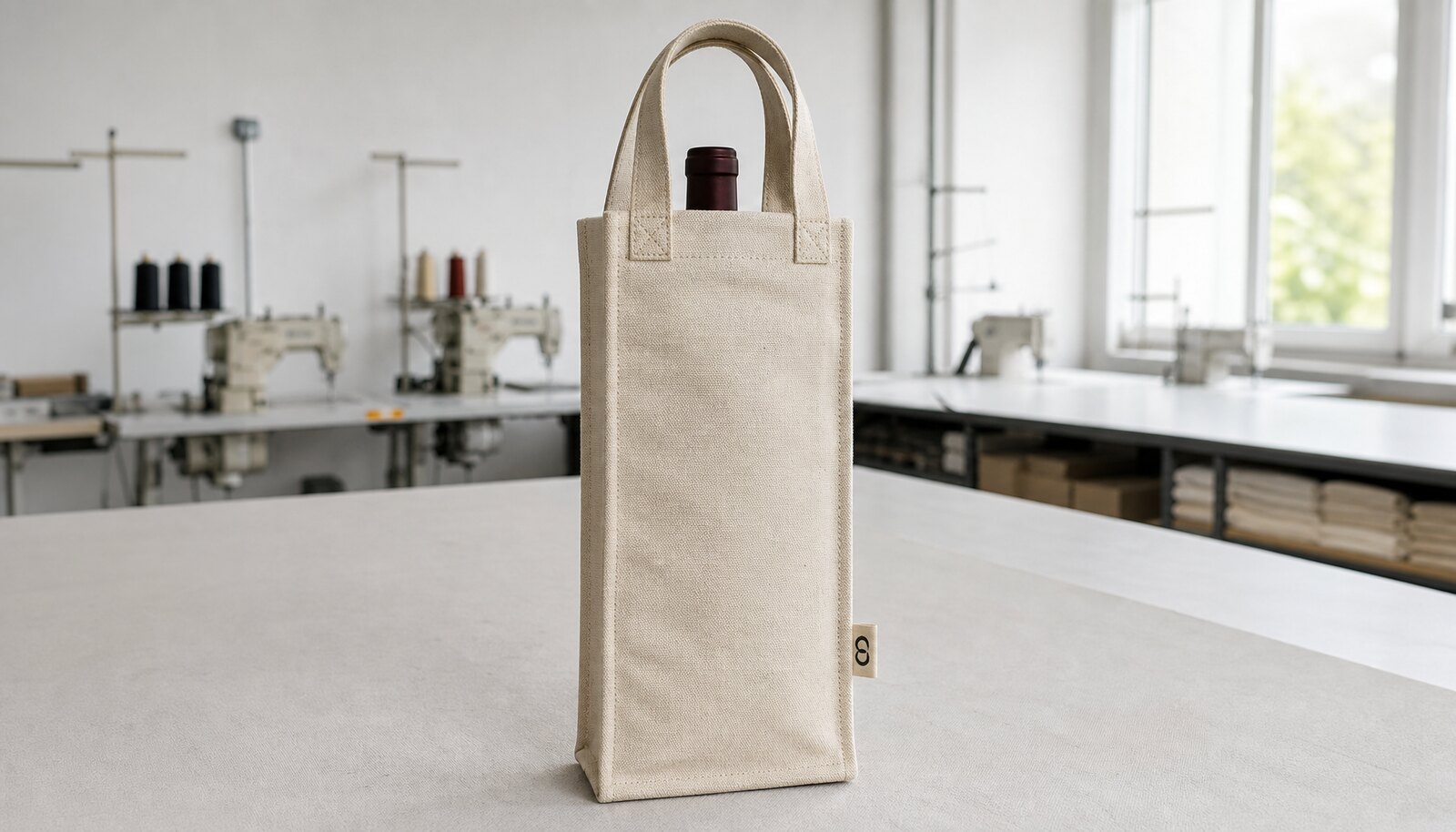
What gift shop buyers actually need from a canvas wine carrier
A canvas wine carrier is not just a bottle sleeve with handles. For gift shops, it has to do three jobs at once: present the bottle well at retail, protect it during carry and checkout, and stay cost-controlled enough for seasonal or repeat purchasing. If the carrier feels flimsy, it weakens the gift value. If it is overbuilt, the margin disappears before the product reaches the shelf. The right material choice starts with how the carrier will be sold, not just how it looks in a sample photo.
The first decision is the bottle profile and the retail role. A shop selling a local premium red in a gift set usually needs a heavier canvas with cleaner finishing and better print consistency. A tourist shop with fast-turn souvenir stock may accept a simpler build if it still stands upright, folds flat, and looks neat in a display basket. The buying error is to approve a generic tote and assume it will work for every bottle and every shelf setting.
- Single-bottle retail display: prioritize structure, clean front-panel branding, and shelf stability.
- Gift-with-purchase or event merchandising: prioritize low unit cost, fast restock, and simple decoration.
- Premium wine gifting: prioritize hand-feel, stitch quality, and a presentation finish that reads as intentional.
- Mixed bottle assortment: prioritize opening size, shoulder clearance, and reinforcement around the top edge.
Fabric choices that actually change the result
For canvas wine carriers, the most useful shell options are 100 percent cotton canvas, cotton/poly canvas, and recycled cotton canvas. Cotton canvas gives the most classic look and usually prints well, especially with simple logos. Cotton/poly blends can reduce wrinkling, improve dimensional stability, and sometimes lower cost, but they can change the hand-feel and take ink differently. Recycled cotton or organic cotton can support a sustainability story, but buyers should expect more attention to shade variation and supply consistency.
Weight matters, but weave and yarn quality matter too. A dense plain weave in the 12 to 16 oz range, or roughly 400 to 540 GSM, is usually the practical zone for gift shops. Below that range, the carrier can collapse around the bottle or telegraph the bottle shape too sharply. Above that range, the piece gets stiffer, more expensive to sew, and harder to fold flat for export. Ask for the actual fabric spec, not just the finish name, because two suppliers can both say heavy canvas while using very different yarn counts and weave density.
- 100 percent cotton: best for a natural look, easy branding, and a traditional gift-shop feel.
- Cotton/poly blend: useful when you want less wrinkling and a slightly tighter dimensional tolerance.
- Recycled cotton: useful for sustainability-led retail, but verify shade bands and batch consistency.
- Organic cotton: attractive for premium positioning, but confirm that the certification claim matches the paperwork you need.
Finish, shrinkage, and sewing construction are where most mistakes show up
Pre-shrink and wash finish are not cosmetic details. If the shell is not stabilized, the carrier can twist after packing, and the lining may contract at a different rate than the outer fabric. Ask whether the canvas is pre-shrunk, enzyme-washed, stone-washed, calendared, or left in a raw state. For a lined carrier, the shell and lining should be tested together so you do not approve a sample that looks fine on day one and then puckers after the first moisture exposure or handling cycle. For gift shop buyers, shrink mismatch is one of the fastest ways to turn a neat retail item into a returned complaint.
Construction details should be written into the quote. A common and practical seam allowance on load seams is about 10 mm, but the important point is consistency and how the edge is finished. On the handle anchors and side seams, look for dense stitching in the 7 to 9 stitches-per-inch range, plus bartacks or a box-x reinforcement pattern where the load transfers into the body. That is the section that fails first if the carrier is underspecified. Also confirm whether the top edge is turned and topstitched, bound, or left with a raw internal finish, because each option changes both appearance and labor cost.
- Ask whether the canvas is raw, pre-shrunk, washed, or calendared before you compare quotes.
- Use a defined seam allowance such as 10 mm and confirm whether the supplier measures it before or after edge finishing.
- Require dense reinforcement at handle anchors, not just one neat line of sewing.
- If the carrier includes lining, test shell and lining together for shrink and torque, not as separate materials.
Match the build to the retail price point
The best buying table for canvas wine carriers is not a list of specs; it is a comparison of build stacks. Budget carriers usually rely on a 12 oz shell, little or no lining, one-color screen print, and simple handles. They can work well for seasonal promotions or lower-price wine departments, but the buyer has to accept lighter structure and a more utilitarian interior. Mid-tier carriers move to a 14 oz pre-shrunk shell, a thin lining, stronger webbing handles, and better reinforcement. That is often the sweet spot for gift shops because it balances shelf appearance, usability, and unit cost.
Premium carriers are about presentation as much as function. A 16 oz washed shell, a cotton lining or light padding, stitched-in reinforcement, and woven labels or embroidery can create a giftable product that holds its shape and feels deliberate. The tradeoff is cost and process complexity. Higher GSM, extra layers, and decoration upgrades all add sewing time and carton bulk. If the bag is going next to a bottle, a ribbon, and a gift card, the premium build can make sense. If it is a counter item sold on price, the same build may be too expensive for the intended margin.
- Budget build: best when shelf price pressure is high and the carrier is a supporting item, not the main gift.
- Mid-tier build: usually the safest default for year-round gift shop replenishment.
- Premium build: strongest for branded wine sets, tourist retail, and higher-margin merchandising.
- When comparing tiers, keep the bottle size, print method, and packing style identical so the quote is truly comparable.
Branding and decoration should follow the fabric, not the other way around
The decoration method has to fit the canvas texture and the order size. Screen printing is usually the most efficient path for bold logos, simple seasonal art, and repeat orders, especially when the design stays flat and the print area is predictable. Heat transfer can be useful for shorter runs or multiple artwork variations, but it needs testing on textured canvas because edge crispness, cracking, and hand-feel can vary. Embroidery and woven labels add perceived value and can help a natural canvas carrier look more curated, but they also add setup time and can distort if the panel is too small or the stitch density is too aggressive.
The important procurement point is repeatability. A gift shop buyer does not just need one acceptable sample; they need the same logo placement, color behavior, and finish across the whole run. Define the print area, color count, placement tolerance, and whether the art can cross a seam or must stay on a flat panel. If your artwork has fine text, gradient detail, or thin lines, test it on the actual fabric before you approve the bulk order. Many bad quote comparisons happen because one supplier is pricing a clean one-color screen print while another is quoting a more expensive but visually different transfer build.
- Screen print: best for simple art and predictable unit economics.
- Heat transfer: useful for shorter runs, but test edge quality and wash or rub behavior if relevant.
- Embroidery: premium look, but confirm the panel can support the stitch density without puckering.
- Woven label: good when you want the carrier to stay natural and let the label do the branding.
Quote structure and supplier route matter as much as the unit price
For this product, direct factory sourcing usually makes the most sense when the buyer wants a private-label wine bottle carrier with controlled fabric weight, custom size, and repeat orders. It gives you the best chance of specifying the shell, lining, handles, and decoration exactly. Trading companies can help when the order is small, mixed, or still being defined, but the convenience can hide the actual source material and limit visibility into QC ownership. Stock importers are fastest for urgent replenishment, yet they rarely give the buyer much control over exact GSM, shade, or packaging details.
The better way to compare suppliers is to force every quote onto the same structure. Ask for shell fabric, lining, handles, decoration, packing, and carton count as separate lines. Then compare the same bottle fit, same seam finish, same print method, and same packing format. If one quote is cheaper because it omits lining or uses a simpler handle anchor, that is not a lower cost for the same product; it is a different product. Buyers who lock the spec early usually spend less time chasing misunderstandings later in sampling and production.
- Direct factory: best for material control and repeatability.
- Trading company: useful for flexibility, but verify who owns the fabric and the QC standard.
- Stock importer: useful for speed, but expect less control over the exact finish and brand details.
- If a supplier will not separate setup cost from piece price, the quote is hard to benchmark.
Sample approval needs to test fit, feel, and compliance, not just appearance
A pre-production sample should be treated as a working approval tool. It has to use the exact shell fabric, lining, handle material, print method, and label that will go into bulk production. A similar sample in a different canvas weight or with a different decoration method is not good enough to lock the order. The sample also needs to be tested with the actual bottle SKU, because a standard 750 ml bottle can vary in shoulder width, height, and base thickness depending on the winery or region. If the bottle must be forced into the carrier, the design is not approved yet.
Compliance and safety checks should be aligned to the market, not guessed. For U.S. retail, buyers often want dye and ink compliance statements, and some products also need attention to state-specific requirements such as Prop 65 if the materials or coatings trigger concern. For EU or UK sales, ask for relevant REACH-aware declarations on dyes, inks, and finishing agents. If the carrier includes metal hardware, check that the finish does not create corrosion or staining risk. Also confirm odor, residue, and any washing or finishing claim before bulk approval, because gift-ready products should not arrive with chemical smell or surface contamination.
- Use the exact bottle SKU for sample fit approval.
- Check whether the carrier slides on cleanly and stands without leaning or seam strain.
- Confirm decoration placement, label location, and color match under normal retail lighting.
- Ask for the compliance paperwork that matches the destination market and the materials actually used.
QC acceptance should include concrete defect limits
Gift shop buyers need defect rules that can be executed at the factory, not just broad language like good quality or no defects. Start by setting dimensional tolerances for width, height, handle drop, and opening clearance. Then define the cosmetic limits: how much shade variation is acceptable for natural canvas, whether slubs are allowed, whether minor weave irregularities are acceptable on the back panel, and what automatically becomes a reject. If the carrier is sold as gift packaging, even small flaws can matter because the buyer sees the product as part of a curated presentation, not as a utility tote.
The most common problems are easy to specify against. Reject visible stains, oil marks, holes, broken stitches, crooked handles, and print outside the defined placement window. If the quote uses AQL, put the level in writing and tell the factory which problems are critical, major, and minor. A practical acceptance approach is zero tolerance for safety or function failures, limited tolerance for cosmetic issues that do not affect shelf presentation, and a clear rework or replacement rule for any bag outside the written dimensions. The key is consistency: the factory should know what happens before the first carton is sealed, not after the shipment lands.
- Measure the same dimensions on every approval sample and bulk inspection batch.
- Set a clear print-placement tolerance and do not let it drift from sample to production.
- Treat broken stitching, holes, and major stains as automatic rejects.
- If you accept natural canvas variation, define the acceptable range for slubs and shade difference in writing.
- Inspect the first packed carton before the rest of the run is released.
Packing and carton loading can quietly change the economics
Canvas wine carriers are usually shipped flat, but flat-packed does not mean arbitrary. The fold line affects how the front panel looks when the buyer opens the carton and puts the product on shelf. A fold through the logo or through a padded insert can create a permanent crease or distorted presentation. For gift shop programs, the goal is to keep the carrier compact enough for efficient freight while preserving the structure that makes it look like a premium item once opened. The fold direction, tissue insert, and polybag choice should be agreed before mass packing starts.
Carton loading should be concrete. For example, a 14 oz single-bottle carrier might ship 50 pieces per master carton in a 60 x 40 x 35 cm carton if it is flat-packed with simple inner wrapping, while a padded version may only fit 30 to 40 pieces because the bulk is higher. That change affects freight and storage much more than many buyers expect. Ask the factory to give you carton dimensions, gross weight, and a pallet pattern, and request a sample packed carton photo so you can see whether the goods arrive tidy or crushed. The best packing plan is the one that protects the print, keeps the product presentable, and does not waste cube.
- Agree the fold direction before bulk packing begins.
- Require carton labels with SKU, quantity, lot number, and PO reference.
- Ask for units per carton and gross weight, not just carton size.
- If shelf presentation matters, approve the packed appearance as part of the sample sign-off.
Landed cost is where margin is really won or lost
Factory unit price is only one part of the story. Landed cost should include sample charges, print or plate setup, fabric finishing, lining upgrades, inner packing, carton cost, inland freight, export documents, and any rework risk caused by a vague spec. A slightly higher factory quote can still be the better commercial decision if it reduces defects, packs more efficiently, or avoids a last-minute rush. For gift shop buyers, the real question is not whether the carrier is cheap at the factory gate; it is whether it lands on time, looks right on shelf, and supports the retail margin after all logistics are added.
A final RFQ should be short enough to execute and specific enough to remove guesswork. The best quotes are the ones that can be copied into a purchase order without interpretation. Include bottle size, shell fabric, lining choice, handle spec, decoration method, seam allowance, stitch density, packing format, carton target, and inspection standard. When those details are locked, the supplier can quote the same product every time, and the buyer can compare offers without assuming that every low price means the same thing. That is especially important for canvas wine carriers, where small changes in structure and finish create large changes in the perceived retail value.
- Compare landed cost, not just ex-factory price.
- Keep one version of the spec sheet for every supplier so quotes stay comparable.
- Allow time for artwork approval and sample correction before seasonal deadlines.
- If the shipment is time-sensitive, ask which step is most likely to slip and build buffer into the schedule.
Specification comparison for buyers
| Build tier | Typical material stack | Best fit | Tradeoffs and buyer checks |
|---|---|---|---|
| Budget | 12 oz cotton canvas shell, unlined or thin nonwoven backing, one-color screen print, self-fabric or basic webbing handles | Seasonal promos, impulse gift packaging, and price-sensitive shop counters | Lower structure and a rougher interior finish; check shrinkage, handle pull, and print bleed on the actual bottle size |
| Mid-tier | 14 oz pre-shrunk cotton canvas shell, thin cotton lining, cotton webbing handles, reinforced bottom and handle anchors, screen print or woven label | Year-round gift shop programs that need better shelf presence without premium labor costs | Adds cost and sewing time; verify lining shrink compatibility, seam allowance, and print placement tolerance |
| Premium | 16 oz washed cotton canvas or cotton/poly canvas, cotton lining or padded insert, bar-tacked webbing handles, embroidery or woven label, tissue-wrapped presentation | Curated wine gifts, branded retail sets, and higher-margin displays | Stiffer hand-feel and higher MOQ risk; check odor, colorfastness, carton bulk, and whether the bottle still fits cleanly |
| Eco-led | Recycled cotton or organic cotton canvas, low-impact dyes, minimal decoration, paper-based packing | Retailers selling a sustainability story or local artisan assortment | Supply consistency can be harder; confirm certifications, shade bands, and whether recycled fiber affects print sharpness |
| Material | cotton canvas, jute, felt, nonwoven, or laminated paper sized to bottle diameter, weight, and condensation risk | Before price comparison | Different cloth weights, backing, or certification claims make quotes hard to compare |
| Construction | bottle fit, bottom reinforcement, handle or cord strength, divider option, seam allowance, and upright stability | Before sampling | Weak stress points create returns and failed inspections |
| Decoration | screen print, hot stamp, woven label, embroidery, or paper label positioned for curved bottle presentation | Before artwork approval | The wrong method can crack, bleed, pucker, or fail on the chosen fabric |
| MOQ | Base MOQ plus change drivers | During quote review | Custom colors, trims, and packing can change minimums |
Buyer checklist before sampling
- Confirm the bottle profile first: standard 750 ml, Burgundy, Champagne, or a mixed assortment with wider shoulders and a taller neck.
- Lock the shell weight in oz or GSM and ask for the actual fabric construction, not just the word heavy duty.
- Decide whether you need no lining, a thin lining, or a padded insert before asking for prices.
- Specify the pre-shrink or wash finish you expect, especially if the bag includes lining, contrast trim, or printed decoration.
- State the seam allowance, stitch density, and reinforcement method you want on load-bearing seams and handle anchors.
- Prepare artwork in vector format and give the exact print area, Pantone reference, and acceptable color variance.
- Define your acceptance tolerances for size, print placement, odor, thread trimming, and fabric defects before sample approval.
- Ask for carton dimensions, units per carton, gross weight, and pallet pattern before you approve freight planning.
- Request a pre-production sample with the exact fabric, handle, label, and print method that will be used in bulk.
- Ask the supplier to separate shell fabric, lining, handles, decoration, and packing so you can compare quotes on the same basis.
Factory quote questions to send
- What exact fabric composition, weave, and weight are you quoting for the shell and any lining, and is the canvas pre-shrunk or washed after weaving?
- What seam allowance, stitch count, and reinforcement pattern do you use at the side seams, top edge, and handle anchors?
- Can you quote the shell, lining, handles, print, label, and packing as separate line items so we can compare offers fairly?
- What is your MOQ by color, by print method, and by artwork version, and does a second print color change the setup fee?
- What shrinkage range do you allow after finishing, and how do you control matching between shell fabric and lining?
- What defect limit do you use for slubs, stains, broken stitches, misprints, needle holes, and loose threads before carton packing?
- Which compliance or safety documents can you provide for dyes, inks, coatings, or finishing chemicals for the destination market?
- How many units fit in one master carton at the quoted size, and what is the carton weight and palletization pattern?
- Can you show photos or inspection data from a recent production run with a similar fabric weight and decoration method?
- What part of the lead time is most likely to slip: fabric sourcing, print setup, sample approval, or final packing?
Quality-control points to confirm
- Measure the bag against a defined spec sheet at the same points every time: width, height, handle drop, opening width, and internal bottle clearance.
- Accept size only within the tolerance you set in the PO, such as plus or minus 6 mm on key dimensions, rather than a vague close enough standard.
- Check the shell fabric for visible slubs, dye streaks, shade shift, oil marks, and needle damage before the goods are packed.
- Require straight, even stitching on load seams, with no skipped stitches, loose thread tails, or puckering at the handle anchor points.
- Verify the handle reinforcement method: box-x plus bartack, dense bartacks, or another agreed pattern, with both sides matching.
- Inspect print edges on the textured canvas surface for feathering, cracking, poor registration, or uneven ink coverage.
- Test the sample with the actual bottle SKU to confirm the carrier opens and closes cleanly and does not force the seams or distort the opening.
- Check odor, lint, and surface contamination on the approved sample and on the first bulk cartons, especially if the carrier is sold as gift-ready packaging.
- Confirm that label placement, care tag text, and origin marking match the approved artwork and any retail marking rules for the destination market.
- If you use AQL or a defect grid, put the numbers in writing and make sure the factory understands which issues are critical, major, and minor.