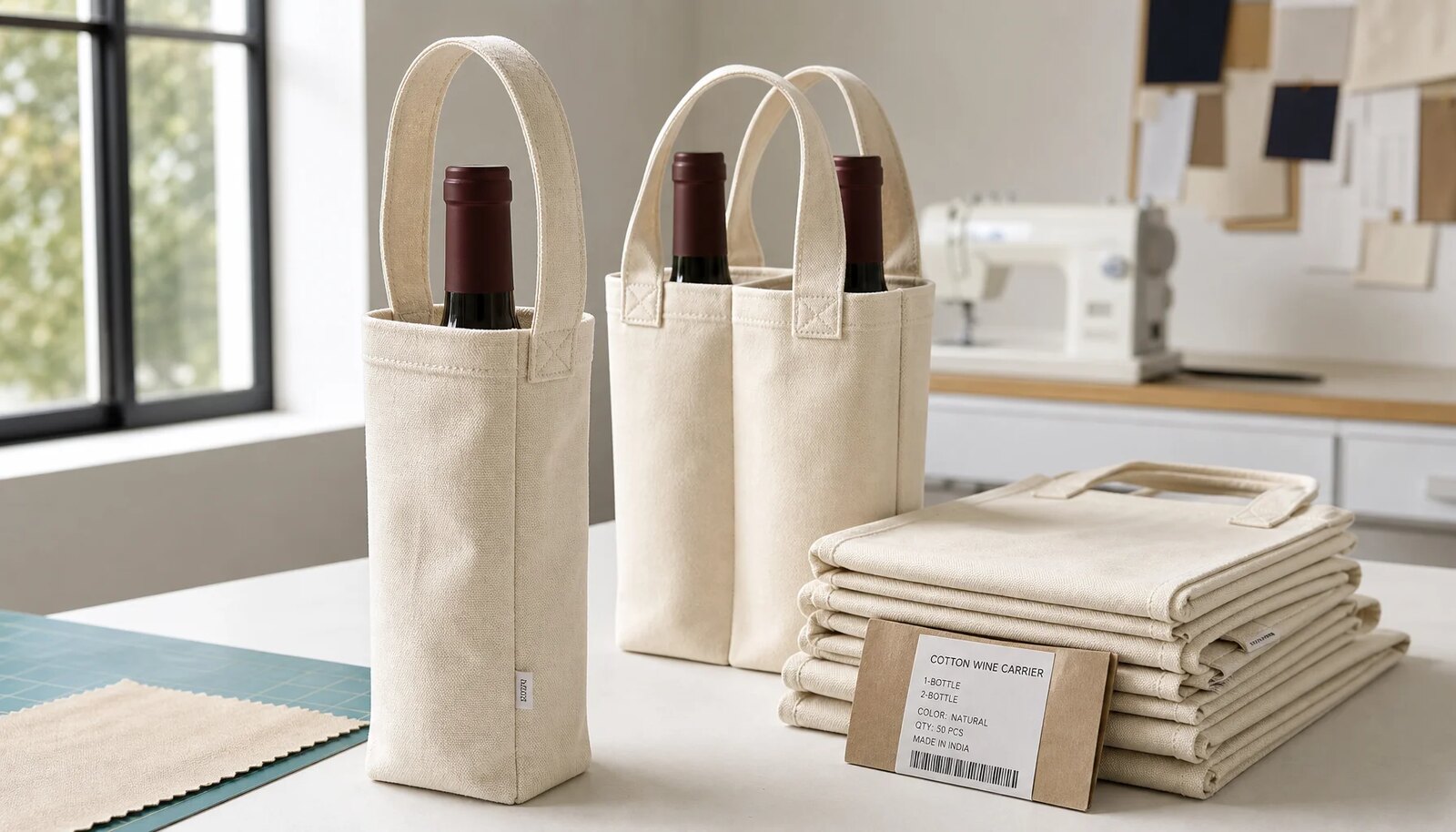
Start With The Event Route, Not The Product Name
Canvas wine carriers appear in supplier catalogs under many names: wine tote, bottle bag, canvas bottle carrier, reusable wine gift bag, two-bottle wine bag, and tasting room carrier. Those labels help with browsing. They do not, by themselves, create a reliable procurement specification. A wedding favor, a winery retail bag, a corporate dinner gift, and a sponsor kit can all be made from cotton canvas, yet each one may need a different fabric weight, handle construction, decoration method, packing format, and inspection plan.
Begin with the route the carrier will take. Will it be handed out empty at a tasting table? Pre-packed with a bottle at a warehouse? Displayed on a retail shelf? Moved to a hotel welcome desk and handled by event staff before guests ever see it? Each step adds stress. The more the bag is filled, stacked, transported, unpacked, and carried, the more attention you should give to bottom construction, handle reinforcement, carton packing, and receiving checks.
The intended impression matters too. A low-cost canvas carrier can be appropriate for a short-use sponsor handout. The same build may feel under-specified if the carrier is presented as a premium gift or winery club item. Instead of asking for a generic canvas wine carrier with logo, describe the job the product must do and the standard it must meet. That gives factories less room to quote their cheapest default pattern and more reason to price the correct construction.
- State the channel: tasting room, wedding, corporate dinner, hotel welcome, trade show, winery club pickup, retail shelf, or sponsor kit.
- Describe the handling route: factory pack, warehouse receiving, venue repack, staff handoff, guest carry, retail display, or courier shipment.
- Define the target impression: short-use giveaway, reusable branded item, premium gift packaging, or retail merchandise.
- Confirm whether the carrier will be supplied empty, pre-packed with bottles, or packed on-site by event staff.
Turn Bottle Details Into Fit Specs A Factory Can Use
Bottle fit is where many event orders start to drift. Wine bottles are not interchangeable. A standard Bordeaux bottle is often straighter and narrower than many Burgundy bottles. Champagne and sparkling wine bottles can be wider, heavier, and taller around the closure. Dessert wine, olive oil, and specialty bottles may change both height and balance. A sample that looks fine in a catalog photo can become tight at the shoulder, shallow at the base, or awkward to carry once the actual bottle is inserted.
Give the supplier measurements, not only bottle names. At minimum, provide bottle height, maximum body diameter, shoulder width, closure height, and filled weight. If the bottle will include a foil, neck label, hang tag, wrap, gift card, or ribbon, include that in the approval test. For a single-bottle carrier, the core measurements are usable internal height, internal width, gusset depth, opening clearance, bottom width, and handle drop. For a two-bottle carrier, the divider is part of the fit system, not an optional extra.
Tolerances should be realistic for sewn cotton goods. A practical starting point is around +/-10 mm for overall height, width, and gusset on simple constructions, with tighter tolerances such as +/-5 mm for print or label placement when the factory confirms it can hold them. Heavy canvas, washed fabric, curved seams, and manual sewing all affect what is achievable. Set the tolerance in writing before sampling so the approval discussion stays objective.
- Provide bottle height, maximum diameter, shoulder width, closure height, punt or base shape if relevant, and filled weight.
- Ask the factory to confirm the largest bottle the pattern can accept without seam strain or difficult insertion.
- For two-bottle carriers, specify divider height and attachment so bottles remain separated during normal carrying.
- Test with filled bottles during sample approval; empty bottles do not reveal the same handle pull, base sag, or balance issues.
Choose Canvas Weight By Finished Performance
Fabric weight should be stated as a finished specification. Phrases like heavy canvas or premium canvas are too vague for B2B buying. Suppliers may quote fabric in ounces per square yard, GSM, or internal mill codes. As a working reference, 8 oz is roughly 271 GSM, 10 oz is roughly 339 GSM, 12 oz is roughly 407 GSM, and 14 oz is roughly 475 GSM. Still, the number can shift depending on whether the fabric is greige, dyed, washed, coated, or otherwise finished.
For many event wine carriers, finished 10 to 12 oz cotton canvas is the safest starting point. It has enough body to feel reusable without becoming overly stiff, expensive, or heavy in cartons. An 8 oz class fabric can work for large promotional giveaways where cost and speed matter most, but it may collapse around the bottle and show more stress at seams. A 14 oz duck canvas gives a stronger premium feel, yet it can be harder to fold, slower to sew, heavier to ship, and more likely to show needle marks or fold memory.
Do not judge the material by weight alone. A dense 10 oz canvas with proper handle reinforcement can outperform a loose 12 oz canvas with weak stitching. Ask for a physical swatch before the full sample and keep the approved swatch as a receiving standard. Check hand feel, weave density, thickness, slub level, surface cleanliness, odor, color, and printability. If the carrier is printed, the best material is not only strong; it also accepts the decoration cleanly.
- Use 8 oz class only when low cost and short-use distribution are more important than structure or premium feel.
- Use finished 10 to 12 oz canvas for most reusable event carriers, winery bags, and corporate gift programs.
- Use 14 oz class canvas when premium structure and longer reuse justify higher sewing cost, stiffness, and carton weight.
- Ask whether the quoted fabric weight is greige, finished, dyed, washed, coated, or measured from a recurring stock fabric.
Select Stock Color Or Custom Dye Without Surprises
Color decisions affect price, lead time, and inspection. Natural canvas is often the easiest route because it is widely available, flexible across event themes, and straightforward to brand. Stock dyed colors such as black, navy, burgundy, forest, or grey can look more aligned with a venue, winery, or sponsor identity. The caution is simple: stock color names are not universal. One supplier's natural, off-white, black, or burgundy may not match another's.
Custom dye is worth considering when brand color is central to the program, but it needs more control. The process normally involves lab dips, buyer approval, bulk dyeing, shade checks, and sometimes a fabric MOQ that is higher than the bag order. Natural cotton may also show slubs, shade variation, or unevenness after dyeing, especially in darker shades. The PO should identify the approved lab dip, bulk shade tolerance, and whether shade bands or visible lot variation are major defects.
Think about decoration at the same time as color. White or light ink on dark canvas may need an underbase or extra print pass. Fine lines and small sponsor text can sink into a coarse weave. Natural canvas may warm or mute printed colors compared with a paper proof. A print strike-off on the exact fabric color is the practical approval tool. Digital proofs help with placement; they cannot prove ink opacity, edge sharpness, or real color on cotton.
- Use stock natural canvas when lead time, cost, and broad event compatibility matter most.
- Use stock dyed canvas when the color supports the brand and a physical swatch is approved before sampling.
- Use custom dye only after confirming fabric MOQ, lab dip timing, bulk shade tolerance, and possible re-dye schedule impact.
- Approve print color on the actual fabric color, not only from a digital proof or paper Pantone reference.
Reinforce The Stress Points That Actually Carry The Load
A canvas wine carrier does not need reinforcement everywhere. It needs reinforcement where the load travels. The most important points are handle joins, strap ends, upper side seams, bottom corners, gusset seams, base panel, and divider attachment. Reinforcing those areas usually improves performance more than adding a cosmetic lining, oversized patch, or extra trim that does not support the bottle weight.
Handle construction deserves a clear line in the spec. Options include bar tacks, box stitches, cross stitches, backstitching, wider seam allowance, and internal reinforcement patches. Cotton webbing handles are often practical and consistent for event orders. Self-fabric handles can look cleaner but rely heavily on sewing quality and fabric thickness. Rope handles can suit decorative gift styles, though knots, holes, and attachment points must be checked under load.
The base is another common failure point because a filled bottle concentrates weight in a small area. A simple folded bottom may be enough for a same-day handout. For pre-packed bottles, retail display, or two-bottle carriers, consider a reinforced bottom seam or base insert. Inserts may be greyboard, cardboard, PP sheet, PE sheet, or fabric-covered board. Specify whether the insert is loose, removable, sewn-in, or hidden between layers, because each option changes cost, appearance, and inspection.
- Specify reinforcement at handle joins, strap ends, bottom corners, gusset seams, and divider attachment before adding cosmetic features.
- Define stitch pattern and thread color in the spec sheet; do not leave handle strength to the factory's default.
- Use a base insert when the carrier must stand upright, hold shape on a table, or support pre-packed bottles.
- Check whether the base insert material is acceptable for the buyer's sustainability, washability, and import requirements.
Decide When Lining, Dividers, And Inserts Are Worth Paying For
Lining can make a canvas wine carrier feel more finished. It hides seams, improves the inside view, and may reduce abrasion against bottle labels or finishes. It also adds cost, sewing time, bulk, and another layer that can wrinkle or reduce internal space. For many event orders, neat internal seams or clean binding are more efficient than a full lining. Add lining because it solves a presentation or protection problem, not because it sounds premium on a spec sheet.
Dividers are more functional. When two glass bottles share one carrier, bottle-to-bottle contact is a real risk. A divider that is too low, too soft, or poorly attached may not prevent knocking during normal walking. A divider that is too thick can make insertion difficult and reduce usable width. Ask how the divider is anchored: side seam, base seam, top seam, or a combination. Then test it with two filled bottles, not with empty display bottles.
Foam and padding should be used carefully. They can help with light scuff protection, but they also add thickness, may trap heat, change recyclability discussions, and reduce internal capacity. For most event carriers, a better first solution is accurate fit, a stable divider, strong base support, and well-placed reinforcement. If padding is required, define material, thickness, placement, and any buyer-specific compliance review before the supplier quotes.
- Add lining when the inside will be visible, the gift standard is premium, or bottle finish protection matters.
- Use bound seams or clean internal finishing when full lining adds cost without improving the event outcome.
- Specify divider material, height, width, thickness, and attachment method for every two-bottle carrier.
- Avoid foam or padding unless the handling route justifies it and the reduced internal capacity has been tested.
Match Decoration To Artwork, Fabric Texture, And Reuse
Decoration should be chosen before suppliers quote because it changes the production sequence. Screen print is usually the practical choice for bulk canvas wine carriers with simple event branding. It works well for one or two colors, clear logos, venue names, sponsor marks, and event dates. The RFQ should include print size, placement, color count, Pantone or brand references, and the number of artwork versions.
Canvas is not a smooth paper surface. It is woven, textured, and sometimes slubby. Very fine type, hairline rules, small sponsor logos, gradients, photographs, and low-contrast color combinations can lose clarity. Dark canvas may need extra attention to opacity. A strike-off on the selected fabric is the best way to approve real output before the order moves into production.
If the carrier should be reused after the event, consider smaller and more permanent branding. A woven label, cotton label, small embroidery, patch, or internal printed tag can feel less like single-use advertising than a large dated print. These choices bring their own procurement details: label MOQ, color limits, patch material approval, sewing strength, and placement tolerance. The quote should state whether label production, label wastage, and label attachment are included.
- Use screen print for scalable event logos, short text, and one to two color designs.
- Use woven labels, cotton labels, patches, or small embroidery when the carrier should remain useful after the event.
- Avoid tiny text and crowded sponsor layouts on coarse canvas unless the supplier proves legibility on a strike-off.
- Define print placement tolerance, commonly around +/-5 mm to +/-10 mm depending on size, construction, and factory capability.
Build An RFQ That Produces Comparable Quotes
A vague RFQ creates prices that look comparable but are not. If the request says only canvas wine carrier with logo, one supplier may quote 8 oz natural canvas with a basic print. Another may quote 12 oz canvas with reinforced handles. A third may include individual packing, a divider, or a woven label. The lowest price may simply be missing the items that matter to the event.
Separate technical specifications from commercial terms. The technical side should cover finished size, usable internal dimensions, bottle fit, fabric weight, fabric color, handle style, reinforcement, divider, insert, lining, decoration, labels, packing, tolerances, and QC expectations. The commercial side should cover MOQ, sample fee, setup charges, lead time, incoterm, payment terms, quote validity, repeat-order pricing, and ownership of artwork or tooling where relevant.
Option pricing is useful for event planners because it turns tradeoffs into visible numbers. Ask for a base quote, then request adders for 12 oz instead of 10 oz canvas, a divider, a base insert, a woven label, individual poly-free packing, carton barcode labels, or retail-ready packing. Some upgrades will be too costly for the program. Others may be inexpensive enough to include, especially if they reduce event-day risk.
- Request the same incoterm, packing basis, decoration method, and inspection requirement from every supplier.
- Ask for itemized costs for fabric, sewing, decoration, labels, inserts, packing, cartons, samples, and setup charges where possible.
- Require MOQ by fabric color, artwork version, label version, style, and packing version.
- Ask suppliers to list exclusions so missing items are visible before supplier selection.
Approve Samples With Tolerances, Strike-Offs, And A Load Test
Sample approval should be technical, not just visual. The pre-production sample should use the same fabric route, color, decoration method, label, handle, reinforcement, divider, insert, and packing method intended for bulk production. If the sample uses substitute fabric or a different print process, label it as a shape sample only. Do not let it become the final production standard without another approval step.
A strong approval package includes a fabric swatch, print strike-off, label or patch sample, full carrier sample, and packing sample when the schedule allows. Keep one signed physical standard for receiving inspection and ask the factory to keep a matching standard. Photos are useful for communication, but they cannot confirm fabric weight, hand feel, shade, odor, or loaded-use performance.
The load test is simple and often revealing. Insert the actual filled bottle, lift the carrier, walk with it, set it down, and repeat the cycle. Watch the handle joins, seam strain, base sag, bottle swing, and opening shape. For a two-bottle carrier, test both bottles and listen or feel for contact. If the bag must stand upright on an event table, test it on a similar surface. A carrier that passes a flat photo review may still fail when used by a guest.
- Approve physical fabric, print, label, full sample, and packing sample before bulk cutting whenever the schedule allows.
- Record target dimensions and tolerances for height, width, gusset, handle drop, print placement, label placement, and divider position.
- Reject sample approval language that allows bulk fabric, print method, or reinforcement to change without buyer approval.
- Run the load test with real filled bottles and event accessories such as neck tags, wraps, or gift cards.
Define Inspection Criteria Before Production Starts
Quality control is easier when defects are defined before production. For canvas wine carriers, critical defects usually include unsafe handle failure, severe seam opening, wrong artwork, wrong SKU, sharp or contaminating materials, mildew odor, and packing that makes the goods unusable for the event. Major defects may include wrong dimensions outside tolerance, crooked print, poor ink curing, loose divider, broken stitches, severe stains, wrong label placement, or missing base insert. Minor defects may include small thread ends, slight shade variation within the approved standard, or tiny slubs allowed by the canvas standard.
Many buyers use AQL inspection levels for sewn goods. The exact level depends on buyer policy and order risk, but the important step is to define the sampling plan, defect classes, and acceptance criteria before final inspection. AQL language alone is not enough. The checklist should include bottle-fit testing, loaded carry checks, print rub checks, packing count, carton marks, and separation of artwork versions.
Inline checks can prevent expensive rework. Decorated panels should be inspected before sewing because a print defect is harder to fix after assembly. First-off sewing samples should be reviewed before the line produces the full lot. Final inspection should cover both product and packing. For fixed-date events, schedule inspection early enough to allow correction. Finding defects after the shipment window closes is not a quality plan; it is a crisis.
- Define critical, major, and minor defects in writing before bulk production.
- Check decorated panels before sewing starts, especially for sponsor logos, print curing, registration, and placement.
- Include loaded carry testing in inspection, not only flat measurement and visual checks.
- Require carton count, SKU separation, artwork-version separation, and barcode checks when the order has multiple versions.
Specification comparison for buyers
| Spec decision | Recommended option | When it fits | Buyer risk to check |
|---|---|---|---|
| Supplier route | Direct sewn-bag factory or bag supplier that manages fabric, cutting, decoration, sewing, packing, and final inspection under one PO | Best for event planners, wineries, agencies, and procurement teams that need one accountable source for multi-SKU event orders | Ask which steps are subcontracted, who approves subcontracted print or dye work, and who pays for rework if print, sewing, or packing fails inspection |
| Default canvas weight | Finished 10 to 12 oz cotton canvas, roughly 340 to 407 GSM depending on the supplier's conversion and finishing route | Good baseline for single-bottle and many two-bottle event carriers where reuse, clean shape, and controlled cost all matter | Confirm finished weight after dyeing or washing, not only greige fabric weight; ask for swatch weight, weave, and hand-feel approval before sampling |
| Economy fabric route | 8 oz class cotton canvas or heavier cotton sheeting, roughly 270 GSM, with reinforced handle joins and adequate seam allowance | Useful for short-use giveaways, sponsor handouts, and large events where low unit cost and fast production are the main goals | Check limp body, visible bottle outline, seam distortion, print bleed, and weaker perceived value if the carrier is positioned as a gift |
| Premium structure route | 14 oz duck canvas or dense twill canvas, roughly 475 GSM, with tested sewing, reinforced base, and controlled fold packing | Fits premium gifting, winery retail merchandise, heavier bottles, and longer reuse expectations | Check stiffness, fold memory, needle marks, slower sewing output, higher freight weight, print coverage on textured fabric, and MOQ by color |
| Bottle-fit route | Pattern developed from buyer-provided bottle dimensions and verified with filled bottles during sample approval | Required when the order includes champagne, Burgundy, wide-shoulder bottles, tall dessert bottles, olive oil bottles, or mixed sets | Generic sample patterns may be too tight at the shoulder, too shallow at the base, or too short after closure, neck tag, or foil is added |
| Color route | Stock natural, black, navy, forest, burgundy, or other recurring factory colors before custom dye is considered | Best when lead time and price stability matter and the event logo can carry most of the brand identity | Stock names are not universal; approve physical swatches under D65 or consistent daylight conditions and keep an approved shade standard |
| Custom dye route | Dyed-to-order canvas with lab dip approval, bulk shade tolerance, shrinkage check, and clear fabric MOQ in the PO | Appropriate when brand color is mandatory for a sponsor, venue, winery club, or premium hospitality program | Risk of fabric MOQ exceeding bag order, rejected lab dips, shade drift between lots, longer lead time, and color variation on natural cotton slubs |
| Decoration route | One or two color screen print on flat panels before sewing, using vector artwork and approved print strike-off | Most practical for bulk event quantities, simple logos, dates, sponsor marks, and venue branding | Check ink curing, dry and wet rub resistance when relevant, registration tolerance, opacity on dark fabric, and setup charges per color or artwork version |
| Reusable branding route | Sewn woven label, cotton label, small embroidery, debossed leather-look patch, or small printed internal tag | Useful when the carrier should remain tasteful after the event and avoid looking like single-use advertising | Check label MOQ, color limits, attachment strength, placement tolerance, needle damage, patch compliance, and whether label waste is included |
Buyer checklist before sampling
- Define the event channel: tasting room sale, winery club pickup, corporate dinner gift, wedding favor, sponsor kit, hospitality welcome bag, trade show handout, or retail merchandise.
- Lock the bottle profile before pricing: Bordeaux, Burgundy, champagne, sparkling wine, dessert wine, olive oil bottle, or mixed set; provide height, maximum diameter, shoulder width, closure height, and filled weight.
- State the target finished size and usable internal dimensions: height, width, gusset depth, bottom width, divider width, opening clearance, and handle drop.
- Specify measurement tolerances, for example +/-5 mm for small placement details and +/-10 mm for overall sewn dimensions where appropriate for the construction.
- Specify finished canvas weight in oz and/or GSM and ask whether it is measured before or after dyeing, washing, coating, or shrink-control finishing.
- Choose the fabric route: stock natural canvas, stock dyed canvas, recurring mill color, or custom dyed canvas with lab dip, bulk shade approval, and fabric MOQ stated.
- Confirm whether the carrier must stand upright when filled; if yes, specify bottom construction, base insert material, insert thickness range, and whether the insert is loose, removable, sewn-in, or covered.
- Define handle construction: self-fabric strap, cotton webbing, rope, stitched strap, strap width, finished handle drop, stitch pattern, thread color, and bar-tack or box-stitch reinforcement.
- Select decoration before requesting price: screen print, heat transfer, digital print, woven label, cotton label, embroidery, patch, hang tag, internal tag, or mixed branding.
- Provide vector artwork, Pantone or brand color references, print size, placement drawing, print tolerance, version count, and sponsor-logo priority for every artwork layout.
Factory quote questions to send
- What is the finished fabric weight in oz and GSM, and is that measured after dyeing, washing, coating, or other finishing?
- What is the weave and fabric route: plain canvas, duck canvas, twill, cotton sheeting, recycled cotton blend, stock fabric, recurring mill program, or custom sourced lot?
- What is the MOQ by style, fabric color, artwork version, label version, and packing format, and does fabric MOQ differ from bag MOQ?
- Can you provide a physical fabric swatch or cutting from the proposed material before sample making, and will bulk production use the same fabric route?
- What bottle dimensions were used for the pattern, and can the carrier fit our actual bottle height, maximum diameter, shoulder width, closure height, and filled weight?
- What are your standard tolerances for finished height, width, gusset, handle drop, divider position, print placement, label placement, and shade variation?
- Which reinforcement points are included in the quoted unit price: handle joins, upper side seams, bottom corners, base panel, gusset seams, divider attachment, and strap ends?
- What thread type and approximate stitch density will be used, and are bar tacks, box stitches, backstitching, or binding included?
- Does the price include a base insert, lining, divider, foam layer, internal binding, bottom board, removable board cover, or bottle separator, and what material is used for each part?
- Which decoration method is included, how many colors are included, what is the maximum print size, and what are setup charges per color, screen, label, or artwork version?
Quality-control points to confirm
- Verify fabric against the approved standard for finished weight, weave density, hand feel, surface finish, color, odor, coating or washing consistency, and visible contamination.
- Check fabric before cutting for stains, holes, broken yarns, excessive slubs, shade bands, streaks, oil marks, mildew odor, inconsistent coating, and roll-to-roll shade variation.
- Measure cut panels and finished carriers: height, width, gusset, bottom width, opening clearance, handle drop, strap width, divider width, and label or print placement.
- Use the buyer's actual filled bottles for fit tests, including closure, foil, neck label, tag, or wrap if these will be present at the event.
- For two-bottle styles, check divider height, divider attachment, bottle separation, and whether bottles contact each other during normal walking and set-down movement.
- Inspect stitch density, seam allowance, backstitching, thread tension, skipped stitches, loose threads, needle holes, seam puckering, and thread color consistency.
- Check reinforcement at handle joins, strap ends, bottom corners, side seams, base seams, gusset seams, divider seams, and any load-bearing label or patch attachment.
- Perform a loaded carry check using the target bottle count and weight; check handle distortion, seam strain, base sag, side pull, tilting, and recovery after set-down.
- Confirm print registration, ink coverage, edge sharpness, color match, opacity, curing, dry rub resistance, and cracking or flaking after folding and light handling.
- Inspect woven labels, cotton labels, patches, embroidery, hang tags, barcode stickers, and insert cards for correct artwork, orientation, placement, and secure attachment.