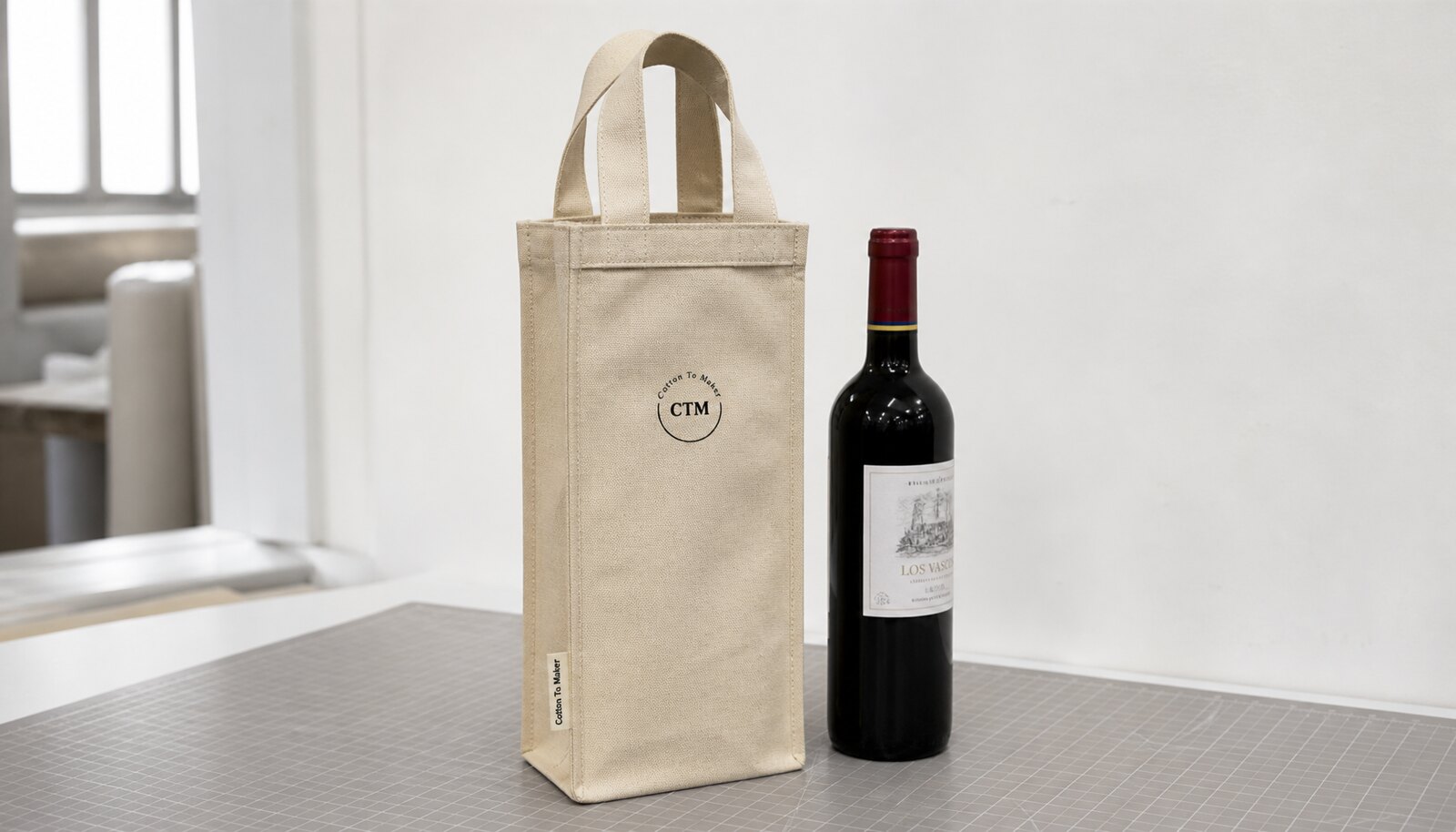
1. Start With the Bottle, Not the Bag Photo
A canvas wine carrier is small, but the sourcing brief should begin like a packaging brief: with the product it must hold. A standard 750 ml Bordeaux bottle is often around 295-310 mm high and 73-78 mm in diameter, but Burgundy, Champagne, sparkling, and heavy-glass bottles can be shorter, wider, heavier, or broader through the shoulder. These figures are only reference points; buyers should measure the actual bottle used in the gift program.
That measurement step protects the presentation. A carrier that looks neat on a slim bottle may strain around a wider bottle, rub the label, or collapse at the base. If the gift is filled by event staff or a fulfillment warehouse, tight openings slow packing and increase handling damage. If the loaded carrier must sit on a display table, base width and gusset shape matter as much as fabric weight.
Record total bottle height, base diameter, widest shoulder diameter, neck diameter, label thickness, and any sleeve, wax seal, hangtag, card, opener, tissue wrap, or insert added before packing. If the carrier goes inside an outer gift box, confirm the box's internal size after the bottle is inserted. A carrier can fit the bottle and still fail the final carton.
Moisture should also be discussed early. Chilled bottles can create condensation, and untreated cotton canvas may absorb dampness or pick up marks. The answer is not always coated fabric. A liner, paper wrap, dry packing process, or event-handling instruction may be simpler and cheaper.
- Send suppliers an actual bottle or a dimensioned drawing with height, base, widest diameter, shoulder shape, and neck clearance.
- State whether the carrier holds one bottle, two bottles, or a bottle plus opener, card, food item, or glass.
- Confirm whether the loaded carrier must stand upright, fit in an outer box, or ship direct to recipients.
- Specify finished dimensions in millimeters, not only a reference photo or flat panel size.
- Tell suppliers whether bottles may be chilled, damp, wrapped, sleeved, or pre-packed before insertion.
2. Choose Canvas Weight by Use Case
Canvas weight is the central material decision in a canvas wine carriers material selection guide for corporate gifting. It affects structure, hand feel, sewing speed, print clarity, folding bulk, carton volume, and unit cost. Ask for both ounces per square yard and GSM because suppliers in different markets use different labels. As broad reference points, 8 oz is about 270 GSM, 10 oz about 340 GSM, 12 oz about 400 GSM, and 14 oz about 475 GSM. These conversions vary by weave and finish, so the quote should state finished fabric weight.
An 8 oz canvas can work for economy event distribution or tasting programs where the carrier is mainly a branded wrap. It is not automatically poor quality, but it is softer and more likely to distort around a heavy or wide bottle. For most one-bottle corporate gifts, 10 oz canvas is a safer starting point because it usually gives enough body without making the bag bulky.
A 12 oz canvas feels more substantial and supports premium reusable positioning. It is useful when the carrier must stand cleaner, be photographed, or remain in use after the event. A 14 oz canvas should be selected only when the design needs that structure, such as two-bottle builds or reinforced bases. Heavier fabric can increase needle wear, top-opening stiffness, folded thickness, and freight volume.
Weight alone does not prove strength. A tightly woven 10 oz canvas can feel more stable than a loose 12 oz canvas. Natural unbleached canvas may show seed flecks and slubs. Washed canvas may feel softer but shrink more. Dyed canvas improves brand-color options but increases shade-control risk. Coated or waxed canvas may help with moisture but can add odor, crease marks, or print-adhesion issues.
- Use 8 oz/270 GSM mainly for budget programs where a softer carrier is acceptable.
- Use 10 oz/340 GSM as the default baseline for standard one-bottle corporate gifting.
- Use 12 oz/400 GSM for stronger reusable feel and cleaner standing shape.
- Use 14 oz/475 GSM only when the construction justifies added sewing bulk and carton volume.
- Ask whether the quoted weight is finished fabric weight and whether finish changes shrinkage or hand feel.
3. Specify Construction at the Load Points
Most wine carrier failures happen where the load concentrates: handle attachments, top hem, side seams, bottom gusset corners, divider seams, and the base. A filled 750 ml bottle can weigh roughly 1.2-1.6 kg depending on glass weight. Two bottles can bring the carried load to about 2.5-3.2 kg before cards, openers, packaging, or food items are added. These are practical planning ranges, not universal limits.
The construction spec should therefore be more detailed than 'reinforced handles.' Identify handle material, width, drop, attachment method, stitch type, thread color, top hem depth, seam allowance, bottom gusset, and divider structure. Cotton webbing handles are repeatable and efficient. Self-fabric handles look cohesive but add bulk, especially in 12 oz or heavier canvas.
For hand carry, a handle drop around 100-130 mm is often practical, but the loaded sample should decide. Too short pinches fingers; too long lets the bottle swing. Ask whether handle ends use bar tacks, box stitches, cross stitches, dense backstitching, or a combination. On heavy canvas, bulky folds and needle marks are common concerns. On light canvas, tearing around stitch lines is a bigger risk.
Two-bottle carriers need fixed dividers, not just a loose separator, when the gift must feel secure. The divider should be anchored to the base, side seams, top seam, or a combination depending on the pattern. A removable base board can improve standing shape, but it changes folding, carton count, recycling claims, and inspection points.
- Define handle material, handle width, handle drop, hem depth, gusset size, seam allowance, and thread color.
- Ask for the exact reinforcement method at handles, dividers, and bottom corners.
- Load-test the sample by lifting, setting down, and carrying it in normal conditions.
- For two-bottle carriers, confirm divider width, attachment points, clearance, and bottom stability.
- Use a reinforced base only when standing presentation is worth the extra bulk and packing cost.
4. Match Branding to the Canvas Surface
Branding is usually what the recipient notices first, so the logo method should be chosen with the fabric surface in mind. Screen printing works well for bold solid logos, one- or two-color artwork, and repeat bulk orders. It is often economical, but canvas texture affects edge sharpness. Fine type, thin rules, tight registration, and large flood prints are harder on slubbed or loosely woven fabric.
Approve a strike-off on the actual production canvas. A logo that looks crisp on paper or smooth test cloth may look broken on rough natural canvas. Pantone references are useful, but cotton absorbs ink differently from coated paper, and unbleached canvas shifts color warmer. For strict brand programs, review the result under consistent lighting and keep the approved strike-off for inspection.
Heat transfer or digital transfer can help with gradients, many colors, or short regional runs. The risks are different: film edge, cracking at fold lines, heat marks, peeling, odor, and rub resistance. If the carrier will be folded with pressure on the logo, pack the sample in the approved fold for several days before approving bulk.
Embroidery, woven labels, cotton labels, leather-like patches, and sewn badges can create a more premium or subtle look. They also add sewing operations and inspection points. Dense embroidery may pucker light canvas or distort a narrow panel, so stitch count, backing, logo size, and placement tolerance should be reviewed before production.
- Use screen print for bold artwork, repeat orders, and straightforward cost control.
- Use transfer methods for multi-color artwork only after fold, rub, odor, and adhesion checks.
- Use embroidery or patches when tactile branding is more important than large print area.
- Measure logo placement from fixed edges or centerline and define tolerance in millimeters.
- Keep artwork away from gusset folds, heavy seams, and packing crease lines unless intentional.
5. Treat Sustainability Claims as Specifications
Sustainability language in corporate gifting should be handled as a specification, not a decoration. Natural unbleached cotton canvas is practical and familiar, but it may show seed flecks, slubs, and shade variation. Those traits can support a natural material story only if the buyer has approved them on a swatch. Otherwise, they become subjective inspection disputes.
Recycled cotton canvas may have more visible fiber variation and less shade uniformity, depending on blend and yarn quality. If recycled content is part of the marketing claim, ask what documentation is available and whether it applies to the actual fabric lot. A general supplier statement is not the same as verified recycled-content support for the order.
If certifications, restricted substance rules, azo-free dyes, REACH-related declarations, Prop 65 review, brand RSL compliance, or PVC-free requirements apply, include them in the RFQ. Adding compliance requirements after sampling can change fabric, ink, transfer film, patch material, lead time, and price.
Coated, waxed, laminated, or water-resistant canvas should be selected for a clear performance reason. These finishes can reduce moisture absorption or change perceived value, but they may introduce wax crease marks, chemical odor, delamination, or print adhesion problems. For chilled bottles, an inner wrap or moisture-controlled packing process may be a cleaner solution.
- Approve natural canvas only after reviewing slubs, seed flecks, shade, and print result.
- Use recycled canvas only when appearance and documentation both match the buyer's claim.
- Put compliance requirements in the RFQ before sampling, not after price approval.
- Test coated or waxed canvas for odor, crease marks, folding behavior, and print adhesion.
- Store approved swatches and documents with the final production approval file.
6. Select the Right Supplier Route
The sourcing route determines how much control the buyer has over fabric, construction, decoration, packing, and reorders. A direct factory is usually best for custom dimensions, repeatable sewing, larger volumes, custom dyed canvas, and annual programs. The tradeoff is that factories may require higher MOQs, clearer approvals, and fewer last-minute variants.
A trading company can be useful for low-MOQ programs, stock materials, mixed SKUs, or coordination across sewing, decoration, and packing vendors. The key is transparency. Ask which steps are controlled directly and which are subcontracted. If the sample is made in one workshop and bulk production moves elsewhere, the approved construction can drift.
A local decorator fits very small pilots, executive personalization, or last-mile logo additions when blank carriers are already available. This route is fast, but blank stock may not fit the actual bottle or meet the buyer's packing standard. Test the blank carrier loaded before approving decoration.
A sourcing agent may help when the order has many destinations, artwork versions, compliance documents, and packing rules. Their value is coordination, but the buyer still needs itemized costs and clear responsibility for defects, sorting, replacement, or credit.
- Choose a direct factory for custom material, repeatability, volume pricing, and construction control.
- Choose a trading company for speed, stock fabrics, mixed SKUs, and smaller starting quantities.
- Choose a local decorator only after checking blank carrier fit, seam strength, and packing quality.
- Choose a sourcing agent when coordination complexity is the main challenge.
- Ask who controls fabric, cutting, sewing, decoration, packing, inspection, claims, and reorders.
7. Read the Quote Beyond Unit Price
A useful quotation should make the product visible. For canvas wine carriers, cost is driven by finished fabric weight, fabric finish, cutting yield, handle type, reinforcement method, divider construction, base support, logo setup, decoration time, sewing complexity, folding method, individual packing, carton strength, and freight volume. A quote that says 'natural canvas wine bag with logo' is not enough for comparison.
Normalize every quote by incoterm, destination, quantity, artwork split, packing method, and inspection responsibility. EXW, FOB, CIF, DDP, and courier quotes cannot be compared directly. A lower ex-factory price may become more expensive after inland trucking, export handling, documents, freight, duties, and destination charges.
For landed cost, request carton dimensions, units per carton, gross weight, net weight, and CBM per 1,000 units. Canvas carriers are not fragile, but heavy fabric, stiff bases, and bulky handles reduce carton efficiency. A slightly cheaper bag can cost more once storage, fulfillment, and freight are included.
Separate one-time and recurring costs. Screen charges, embroidery digitizing, transfer setup, patch molds, sample fees, courier fees, pattern charges, lab dips, and retail packing artwork may not repeat. Fabric, cutting, sewing, decoration, packing labor, cartons, and routine inspection usually repeat. This helps compare first-order cost with reorder cost.
- Compare quotes on the same incoterm, destination, quantity, artwork count, and packing plan.
- Require finished fabric weight, dimensions, reinforcement, logo method, and carton data in every quote.
- Separate setup and sample costs from recurring production costs.
- Compare CBM per 1,000 units and gross weight before choosing a volume supplier.
- Reduce MOQ pressure by simplifying color, artwork versions, trims, and packing before downgrading fabric.
8. Approve Samples as Production Evidence
A first prototype can confirm direction, but a pre-production sample should prove the production method. It should use the same canvas, handle, thread, reinforcement, divider, closure, branding method, and packing direction planned for bulk. If a supplier substitutes a different fabric or logo process to move quickly, label that sample as a concept sample only.
Load the sample with the actual bottle. Check whether the bottle slides in smoothly, whether the neck clears the top opening, whether the base stands straight, and whether the handle feels balanced. For two-bottle carriers, insert both bottles and carry the sample gently to confirm that the divider prevents knocking and does not shift.
Inspect the logo with the bottle inside because the panel may curve and change the apparent center. Fold the carrier exactly as it will be packed and check whether print, transfer, embroidery, label, or patch falls on a crease or pressure point. This is especially important for large prints and heat transfers.
Make the approval record measurable. Record finished height, front width, side gusset, bottom gusset, top opening, handle drop, handle width, logo size, logo placement, divider width, and folded pack. Agree tolerances before cutting, especially when the carrier must fit a gift box or display upright.
- Treat substitute fabric or substitute branding as concept approval only.
- Test with the real bottle, insert, card, outer box, and packing method where possible.
- Measure key dimensions and logo placement before approving bulk production.
- Set tolerances for size, print placement, shade, stitching, odor, and packing.
- Keep signed samples, swatches, strike-offs, and packing photos as inspection references.
9. Pack for Presentation, Transit, and Sorting
Packing affects recipient experience, landed cost, and warehouse efficiency. Bulk master carton packing is usually enough for distributor, event, or warehouse programs where the end user never sees individual packaging. Individual polybags, paper bands, hangtags, belly bands, barcode stickers, and insert cards can improve presentation or SKU control, but they add approval steps and inspection points.
Folding direction is a quality decision. A carrier can look excellent upright and arrive with a permanent crease through the logo if packed poorly. Heavy canvas, embroidery, patches, and base boards all affect how flat the carrier can be packed. Ask suppliers to fold away from the printed panel where possible and avoid hard pressure on transfer edges.
Moisture and odor control matter because cotton absorbs humidity and carton smells. Finished bags should be fully dry and cured before packing, especially after washing, coating, printing, or heat transfer. For long sea transit or humid-season storage, ask about dry storage, desiccant use, carton liners if needed, and whether cartons are kept off damp floors.
Carton instructions should be part of the purchase order: inner pack count, master carton quantity, carton dimensions, net weight, gross weight, carton strength, carton marks, SKU separation, barcode placement, and pallet requirements. For multi-logo orders, clear carton marks prevent warehouse teams from opening every carton to separate regions or departments.
- Use bulk cartons for event and warehouse programs without individual presentation needs.
- Use individual packaging, bands, tags, or barcode labels only when the channel requires them.
- Approve folding direction and carton compression before bulk packing.
- Specify curing time, odor checks, dry storage, desiccant, and moisture controls where needed.
- Confirm carton dimensions, gross weight, strength, marks, and SKU separation before production.
10. Write an RFQ Factories Can Price Without Guessing
A strong RFQ removes guesswork and reduces padded pricing. Include bottle dimensions, target carrier style, finished size, canvas weight, fiber composition, fabric finish, body color, handle material, handle drop, reinforcement method, divider details, base support, closure, logo method, artwork size, color count, placement, quantity by SKU, packing method, carton requirement, destination, incoterm, inspection requirement, and target delivery date.
Artwork should be production ready. Send vector files for screen print, embroidery, woven labels, and patches whenever possible. Provide Pantone references if color matters, but approve the result on canvas. List every logo version and quantity separately. A 5,000-piece order can become complex when split across regions, languages, carton labels, and delivery dates.
Lead time should be broken into steps: material sourcing, swatch or lab dip, strike-off, sample, correction, pre-production approval, bulk cutting, decoration, sewing, final inspection, packing, export documents, and shipment handover. Many lead times start only after deposit, artwork approval, and sample approval. For holiday mailings, conferences, board events, or sales launches, state the latest acceptable arrival date and work backward.
Quality standards should be named before production. For larger orders, buyers may use ANSI/ASQ Z1.4 sampling with agreed inspection level and AQL limits, such as 0 critical, 2.5 major, and 4.0 minor, when appropriate to buyer risk. Define critical defects such as mold, sharp objects, wrong logo, unsafe odor, or severe contamination. Define major defects such as wrong fit, weak handle reinforcement, wrong SKU, or visible logo failure.
- Include bottle data, finished dimensions, canvas GSM or oz, fabric finish, construction, branding, packing, incoterm, destination, and delivery date.
- List quantity by SKU, logo version, body color, packing type, and delivery destination.
- Ask suppliers to break lead time into material, sample, approval, production, inspection, packing, and handover stages.
- Name inspection standard, AQL limits if used, defect definitions, and required inspection photos.
- Require suppliers to list exclusions such as courier, bank fees, inspection, palletization, duties, taxes, or destination charges.
Specification comparison for buyers
| Spec decision | Recommended option | When it fits | Buyer risk to check |
|---|---|---|---|
| Economy event handout | 8 oz to 10 oz natural cotton canvas, approximately 270-340 GSM | Tasting events, distributor giveaways, and short-use programs where the bag is mainly a branded wrap | Confirm loaded fit, handle reinforcement, and print legibility; lighter cloth can distort around wider or heavier bottles |
| Standard corporate gift | 10 oz cotton canvas, approximately 340 GSM, with boxed bottom gusset | Most one-bottle corporate gifting programs needing reusable feel without premium bulk | Verify finished fabric weight, shade, shrinkage, standing shape, and logo clarity on production fabric |
| Premium reusable gift | 12 oz canvas, approximately 400 GSM, with reinforced handle points | Executive gifting, retail-style presentation, and annual programs where hand feel matters | Check folded thickness, carton CBM, seam bulk, top-opening stiffness, and needle marks |
| Two-bottle carrier | 12 oz to 14 oz canvas, approximately 400-475 GSM, with fixed divider | Two 750 ml bottles, bottle plus accessory, or structured gift set | Test with real bottles; divider width, base support, and handle balance are frequent failure points |
| Custom dyed body color | Factory route with fabric mill or dye-house control | Large programs needing closer brand-color matching or repeat-order consistency | Require lab dip, bulk shade tolerance, dye-lot control, and minimum dye quantity before price approval |
| Natural or recycled story | Unbleached cotton canvas or documented recycled cotton blend | Sustainability-focused programs that accept visible slubs, seed flecks, or shade variation | Define acceptable surface variation and request documentation before using recycled-content claims |
| Fine-detail logo | Screen print on smoother canvas, woven label, or sewn patch | Small text, thin lines, strict brand standards, or subtle executive branding | Approve a strike-off on production fabric; rough canvas can break fine edges and shift perceived color |
| Multi-color artwork | Heat transfer or digital transfer after fold and rub testing | Short runs, gradients, regional logos, or several artwork colors | Check film edge, cracking, heat marks, odor, adhesion, and performance after the approved fold |
| Low MOQ or many logo versions | Stock carrier plus decorator, trading company, or local finishing route | Pilots, department gifts, regional variants, or low quantity per logo | Confirm setup charges, approval steps, carton separation, blank-stock availability, and reorder consistency |
Buyer checklist before sampling
- Measure the actual bottle: finished height, base diameter, widest shoulder diameter, neck diameter, label thickness, wax seal, sleeve, hangtag, or insert added before packing.
- Specify finished carrier dimensions in millimeters: height, front width, side gusset, bottom gusset, top opening, handle width, and handle drop; avoid relying on photos or flat panel size only.
- Choose canvas by finished weight and construction: 8 oz/270 GSM, 10 oz/340 GSM, 12 oz/400 GSM, or 14 oz/475 GSM are useful reference points, but finished fabric weight should be confirmed by the supplier.
- State fabric condition: natural, bleached, dyed, washed, recycled, coated, waxed, laminated, lined, or blended, and request compliance or recycled-content documents before sample approval.
- Define load-point construction: handle material, handle width, bar tack or box stitch, top hem, bottom seam, divider attachment, and optional base board.
- Confirm whether the carrier must hold one bottle, two bottles, a bottle plus accessory, or a bottle inside an outer gift box, and whether it must stand upright when loaded.
- Select logo method, artwork size, color count, Pantone target, placement from edges or centerline, and whether branding may cross folds, seams, or gussets.
- Request a pre-production sample using the same production fabric, handle, thread, reinforcement, divider, closure, branding process, and packing method planned for bulk.
- Set measurable tolerances before cutting: for soft sewn goods, major dimensions may use approximately +/- 10 mm unless tighter fit is required; logo placement often needs a separate +/- 3-5 mm range on narrow panels.
- Ask suppliers to separate unit price from setup, sample, courier, screen, digitizing, mold, label, pattern, inspection, packing, pallet, freight, duty, and destination charges.
Factory quote questions to send
- What is the finished canvas weight in oz and GSM, fiber composition, weave, finish, color process, and expected shrinkage after cutting and sewing?
- Is the quoted weight based on greige fabric or finished fabric, and will washing, dyeing, coating, or lamination change hand feel, shade, shrinkage, or print adhesion?
- Will the pre-production sample use the same canvas, handle material, thread, reinforcement, divider, closure, branding process, and packing method as bulk production?
- What is the MOQ by fabric color, canvas weight, logo version, print method, divider construction, packing method, and shipment lot?
- Which branding method is included, and what screen, plate, embroidery digitizing, transfer setup, patch mold, woven label, or color-change charges apply per artwork?
- What are the finished dimensions: height, width, bottom gusset, side gusset, top opening, handle drop, handle width, divider width, divider attachment points, and allowed tolerance?
- How are handle ends reinforced, and what stitch type, stitch density, bar tack length, box stitch size, thread type, and stress-point standard are used?
- For two-bottle carriers, how is the divider fixed, what clearance is allowed between bottles, and has the pattern been tested with the buyer's actual bottle dimensions?
- What are the packing units, folding direction, inner pack, master carton count, carton dimensions, net weight, gross weight, carton strength, and CBM per 1,000 units?
- How many calendar days are needed for swatch or lab dip, strike-off, sample making, sample correction, pre-production approval, bulk cutting, decoration, sewing, packing, inspection, and export handover?
Quality-control points to confirm
- Measure finished height, width, side gusset, bottom gusset, top opening, handle drop, and divider position against the approved sample; tolerance should be agreed before production.
- Check loaded fit with the actual bottle or a verified dummy matching height and widest diameter; the bottle should slide in without forcing seams or distorting the divider.
- For one-bottle carriers, verify that the base sits flat and the loaded bag can stand upright on a level surface for at least 30 seconds without twisting or collapsing.
- For two-bottle carriers, insert both bottles and gently lift, set down, and swing the carrier; bottles should not knock hard against each other or push the divider out of alignment.
- Inspect handle attachments for correct reinforcement, including bar tack, box stitch, cross stitch, or dense backstitching; reject loose threads, skipped stitches, open seams, broken stitch lines, and weak back-tacks.
- Check stitch density, seam allowance, thread color, and seam margin against the approved sample; visible changes can reduce strength and make repeat orders inconsistent.
- Compare logo size, placement, levelness, and color to the approved strike-off; print placement tolerance should be defined in millimeters before inspection.
- Rub printed or transferred logos with a clean dry white cloth and inspect after folding in the approved packing direction; reject cracking, peeling, ink transfer, film lifting, blurred edges, or residue.
- Check embroidery, patches, woven labels, and badges for puckering, loose edges, wrong stitch color, backing visibility, glue marks, sharp corners, and panel distortion.
- Review fabric shade under consistent lighting against the approved swatch; separate acceptable natural slubs from stains, oil marks, dye streaks, mildew, or dirty handling marks.