Procurement Context: A Small Carrier Can Create Event Risk
A canvas wine carrier for a trade show exhibitor has a simple job on paper: hold the bottle and show the logo. In real event use, that job is less simple. The carrier may be loaded by temporary staff behind a booth, carried through a crowded hall, placed in a buyer meeting room, packed into a distributor sample kit, or shipped direct to a venue where nobody has time to rework cartons. It has to carry glass safely, keep the label presentation clean, and still look like a deliberate branded gift.
The sourcing problem is that many quotes sound identical while the actual product is very different. One supplier may price 8 oz cotton, narrow handles, basic straight stitching, and bulk packing. Another may price 12 oz canvas, 30 mm cotton webbing handles, reinforced attachment points, a fixed divider, individual packing, carton labeling, and a documented inspection plan. Both may be described as a canvas wine carrier. They are not the same buying decision.
For B2B procurement teams, material selection should connect the bottle, the event workflow, the brand expectation, and the supplier's production control. Heavier canvas can improve structure, but it also increases carton volume and makes seam intersections harder to sew. Dyed canvas can look more on-brand, but it adds lab dip timing and colorfastness risk. A divider can reduce bottle contact, but only if it is tall and stable enough for the actual bottle shape. A clear RFQ keeps suppliers quoting the same article instead of guessing around a photo.
- For booth giveaways, prioritize fast handout handling, stable construction, clear logo placement, and carton quantities that event staff can manage.
- For buyer meeting gifts, prioritize clean sewing, controlled shade, stronger body fabric, and presentation packing that looks intentional on a table.
- For distributor sample programs, prioritize repeatable dimensions, load strength, divider performance, carton marks, and repacking efficiency.
- For retail or wine-club gifts, prioritize fabric body, finishing consistency, label protection, individual packing, and consumer-facing presentation.
- For direct-to-venue shipments, treat carton labeling, carton weight, inspection timing, and packing protection as part of the product specification.
Start With Bottle Fit Before Artwork
Bottle fit should be confirmed before the print layout, handle color, or fabric finish. A standard 750 ml Bordeaux bottle, sloped-shoulder Burgundy bottle, Champagne bottle, spirits bottle, olive oil bottle, and tall specialty beverage bottle all sit differently inside a carrier. A shape that looks tidy around a narrow wine bottle may strain the side seam around a wider bottle. A carrier that covers a Bordeaux bottle neatly may leave a sparkling bottle sitting too high.
Give the supplier measurable bottle data in the RFQ: height, base diameter, maximum body diameter, shoulder width, filled weight, label height, neck finish, and whether the neck should be exposed or covered. Filled 750 ml glass wine bottles often weigh about 1.2 kg to 1.5 kg depending on glass weight. Sparkling wine and spirits bottles may be heavier. A two-bottle carrier can easily exceed 3 kg before tasting cards, tissue, or small accessories are added.
Canvas has limited stretch, and finished internal space changes through shrinkage, seam allowance, pressing, and folded seam thickness. If the carrier is too tight, staff may need to force the bottle in, which can wrinkle labels, distort the printed panel, or stress the side seam. If the carrier is too loose, the gift may look weak and the bottle can shift while being carried. Trade show loading should be quick, but the finished product still needs to feel controlled.
Fit should always be reviewed in the intended use condition. If the bottle neck remains visible, the exposed height should look deliberate across units. If a drawcord or flap closes above the bottle, confirm clearance over the cork, foil, screw cap, pourer, or decorative neck label. For two-bottle formats, the divider needs testing with the real bottles because it controls contact more than the outer body panel does.
- Send bottle height, base diameter, maximum diameter, shoulder width, filled weight, and label position with the RFQ.
- State whether the carrier must cover the full bottle, leave the neck exposed, or close above the bottle with a drawcord or flap.
- If the program includes mixed bottles, test the sample with the largest bottle and the heaviest bottle, not only the most common one.
- Check that the bottle inserts easily without pulling the side seam, wrinkling the label, or distorting the printed logo panel.
- For two-bottle carriers, verify that the divider protects the label and shoulder area, not only the bases.
Canvas Weight: Use Oz and GSM Together
Canvas is often described by ounce weight, but B2B buyers should also request GSM. In practical sourcing, 8 oz canvas is often around 270 GSM, 10 oz around 340 GSM, 12 oz around 410 GSM, and 14 oz around 475 GSM. These are helpful reference points, not universal standards. Yarn count, weave density, washing, dyeing, coating, and finishing can change how the same nominal ounce weight feels and performs.
For many canvas wine carriers used by trade show exhibitors, 10 oz to 12 oz is the practical center. A 10 oz canvas can work well for single-bottle giveaways when handles are reinforced and the print is not fighting heavy seam distortion. A 12 oz canvas gives more body for two-bottle carriers, buyer gifts, and programs where the recipient may reuse the carrier after the event. Both options can be cost-effective when dimensions and packing are controlled.
An 8 oz canvas may be acceptable for a tight budget, lighter bottles, empty display packaging, or very short-use promotional packaging. It is less forgiving with filled glass. The base can sag, the front panel can crease around the bottle, and large printed artwork may look less stable once the carrier is loaded. If 8 oz is selected, reinforcement becomes more important, not less.
A 14 oz canvas can make the carrier feel premium, but it changes the production conversation. Thick fabric creates bulky points at handles, bottom corners, divider seams, and drawcord channels. The factory may need different needle size, thread, stitch length, seam allowance, or sewing sequence. Heavy canvas also increases carton volume and can crease if compressed too tightly. Ask to see a packed sample, not only a flat sample photo.
- Specify both ounce weight and GSM on the quote sheet, then ask whether GSM is measured before or after finishing.
- Use 10 oz to 12 oz canvas as the starting point for most filled-bottle trade show programs.
- Use 8 oz only when bottle weight, expected use, reinforcement, and presentation standards make the lighter structure acceptable.
- Use 14 oz when the carrier itself is part of the gift value and the program can accept more freight, bulk, and sewing complexity.
- Agree on fabric weight tolerance before production; plus or minus 5 percent by GSM is a practical starting point for discussion.
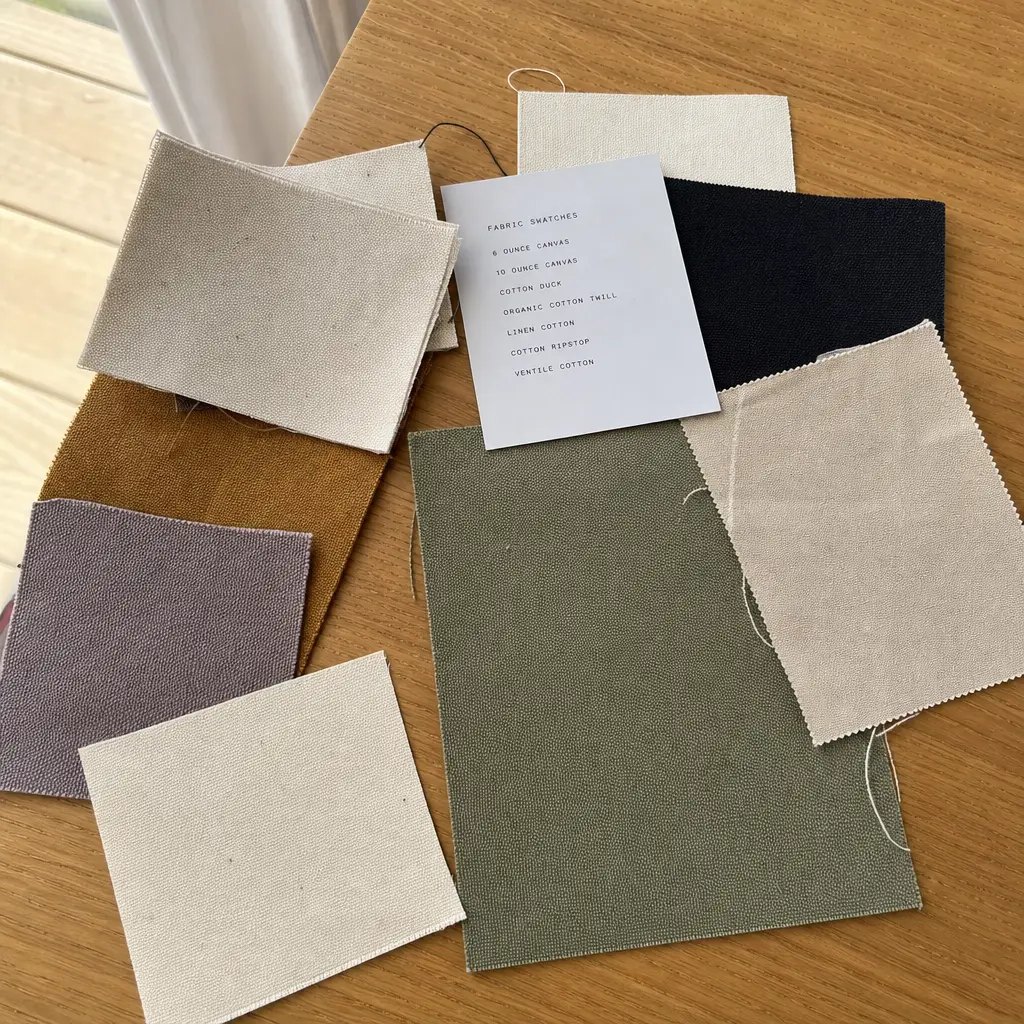
- Request a physical swatch from the intended production material because hand feel and stiffness cannot be judged from GSM alone.
Fabric Finish: Natural, Bleached, Dyed, Recycled, or Laminated
Natural unbleached canvas is common for wine and food programs because it gives a warm, tactile look and usually supports straightforward one-color printing. It fits wineries, craft beverage exhibitors, organic food brands, and farm-to-table promotions. The tradeoff is shade variation. Natural cotton can move from cream to grey-beige across lots, yarn sources, and finishing batches.
Bleached canvas gives a cleaner background and stronger contrast for bright or detailed logos. It can be useful when brand color accuracy matters or when the carrier sits next to polished retail packaging. It also shows dirt, fold marks, oil spots, and warehouse handling more easily. If the carrier is light-colored, packing cleanliness and carton protection deserve more attention.
Dyed canvas is right when the bag color is part of the brand system, event theme, or retail presentation. It requires lab dip approval, bulk dye lot control, and colorfastness review. Dark dyed canvas should be checked for crocking because dye transfer can mark light wine labels, paper sleeves, white cartons, or printed literature. If the supplier cannot explain how rubbing risk will be checked, add that question to the RFQ before sample approval.
Recycled cotton blends and organic cotton can support procurement goals, but the material name alone does not prove performance. Recycled blends may show more fiber flecks, shade variation, or strength differences. Organic cotton may require documentation if the buyer intends to make a claim. Laminated or coated canvas can add structure or moisture resistance, but it may change print adhesion, sewing behavior, odor, and recyclability. Treat each finish as a production material, not just a marketing label.
- Approve natural canvas by physical swatch and define how much shade variation is acceptable in bulk.
- Use bleached canvas when print contrast matters, but inspect for stains, handling marks, and packing cleanliness.
- Use dyed canvas only after lab dip approval and a review of dry and wet rubbing risk against labels and paper materials.
- Ask whether recycled cotton affects tensile strength, surface specks, print clarity, or shade consistency.
- Confirm certification and labeling requirements before requesting organic cotton, especially if the finished carrier will carry a sustainability claim.
- For laminated or coated canvas, test odor, print adhesion, folding marks, and seam bulk before approving production.
Construction Details That Carry the Load
Most failures happen at handle attachments, top edges, bottom corners, or divider seams rather than in the middle of the fabric panel. The carrier is holding concentrated weight from a rigid glass bottle while being lifted, swung, set down, and sometimes carried through a show hall for a long stretch. The specification should show how the load travels through the handle, seam, base, and body.
Handle width matters. Cotton webbing around 25-30 mm wide is usually more comfortable and stable for a full bottle than narrow tape. Handle drop matters too. Too short can feel cramped; too long can let a heavy bottle swing. For two-bottle carriers, balance should be tested with two filled bottles because an empty sample can feel fine and still behave poorly under load.
Handle reinforcement should be visible in the approved sample and named in the spec. Box stitching, cross stitching, bartacks, or a suitable combination can spread stress better than one straight line of stitching. Thread color and stitch neatness also affect perceived quality. A strong but messy bartack may pass a load test and still be wrong for a premium buyer gift.
Bottom and divider construction need the same discipline. A boxed or gusseted bottom can improve standing stability. A reinforced base panel can reduce sagging on lighter fabric. In a two-bottle carrier, the divider should be fixed so it does not twist or collapse when bottles are inserted. If it separates only the bases while the shoulders touch, it may not protect labels or glass surfaces well enough.
- Specify handle material, width, length, drop, placement, stitch pattern, thread color, and reinforcement method.
- Ask the supplier to state the static load test method, weight, duration, and pass/fail criteria before production.
- Check the loaded sample while hanging, while being carried, and while standing on a table.
- Review bottom corners for distortion because the bottle base creates pressure at the lowest seam points.
- For two-bottle carriers, confirm that the divider is centered, attached securely, and tall enough for the bottle shape.
- Avoid leaving handle placement to factory judgment when the carrier will hold heavy bottles or two-bottle sets.
Logo Method: Print Limits on Real Canvas
Screen printing is usually the practical starting point for canvas wine carriers. It works well for solid logos, simple brand marks, and trade show quantities. One-color and two-color prints are common. Buyers should provide vector artwork, Pantone references, print size, print position, and required clearance from side seams, handle stitching, bottom folds, and divider seam lines.
Canvas texture affects edge sharpness. Slubs, weave ribs, and natural fiber variation can soften fine text, thin outlines, QR codes, and reverse details. That may be acceptable for a relaxed brand look, but it should be approved deliberately. If the artwork includes a small tagline, region text, certification logo, website, or QR code, ask the supplier for minimum line width and minimum text height on the selected fabric.
Heat transfer can support multicolor artwork, gradients, photographic detail, or small marks that screen printing cannot reproduce cleanly. Review edge feel, gloss level, flexibility, adhesion, and whether the transfer looks too plastic on natural canvas. Embroidery can look premium for a small monogram or simple mark, but it is rarely the best choice for large filled artwork on a bottle carrier because it can add puckering, stiffness, and cost.
Print placement should be approved on a filled carrier. A logo centered on a flat sample can curve, tilt, or sit too low once the bottle is inserted. Dark dyed canvas may require underbase printing or heavier ink deposit to reach opacity, which changes cost and hand feel. Large ink coverage needs curing and packing review because insufficiently cured print can stick, smell, or transfer under carton pressure.
- Request a print strike-off on the selected canvas when color, opacity, fine detail, or dark fabric is involved.
- Keep artwork away from side seams, bottom folds, top hems, handle attachments, divider stitching, and thick seam intersections.
- Confirm Pantone matching expectations and remember that printing on natural canvas will not match coated paper exactly.
- Test QR codes only at final printed size and on the final material; do not approve them based on a digital mockup.
- Review print rub, cracking, odor, and set-off after the sample has been packed under realistic pressure.
- Approve print position with the real bottle inserted so the visible logo panel reflects actual use.
MOQ, Price Breaks, and Hidden Cost Drivers
MOQ is rarely one clean number. A canvas wine carrier order may have separate minimums for fabric purchase, fabric dyeing, cutting, sewing, print setup, custom handle webbing, drawcord, belly bands, and individual packing. A stock natural canvas carrier with one-color screen print can usually be quoted more flexibly than a custom dyed two-bottle carrier with matching webbing, reinforced divider, and retail packing.
Price comparison should begin only after the specification is normalized. A low quote may be based on lighter fabric, reduced dimensions, narrow handles, no reinforced divider, smaller print area, bulk packing, or limited inspection. A higher quote may simply include the stronger product the program actually needs. Ask suppliers to itemize the assumptions instead of sending only a unit price.
The main cost drivers are predictable: fabric weight, fabric color, dimensions, two-bottle construction, divider type, handle width, closure style, print color count, artwork size, packing format, and carton requirements. Small dimensional changes can affect fabric consumption significantly across thousands of units. Wider handles or a reinforced base add material and labor, but they may reduce failure risk. Individual packing costs more, but it can protect printed surfaces and simplify controlled distribution.
One-time and non-unit charges matter too. Screen charges, lab dip fees, sample fees, courier cost, artwork adjustment, inspection cost, special carton marks, and inland freight may sit outside the quoted unit price. For fair comparison, calculate total program cost and include carton volume and gross weight, especially when goods ship direct to a show site, decorator warehouse, or third-party logistics provider.
- Request price breaks at realistic quantities such as 500, 1,000, 2,500, and 5,000 pieces with the same specification held constant.
- Ask which part of the spec creates the MOQ: fabric, dyeing, sewing, printing, webbing, accessories, packing, or carton labeling.
- Separate one-time setup charges from unit price so supplier comparisons are not distorted.
- Ask for carton dimensions and gross weight with each quote because freight and event handling can change the real landed cost.
- Do not accept a lower price until fabric GSM, dimensions, handle construction, print method, divider, and packing have been confirmed.
- Build schedule risk into the cost decision when dyed fabric, lab dips, custom accessories, or direct-to-venue delivery are required.
Sampling Sequence and Approval Controls
A strong approval process separates material, print, construction, and packing decisions. The clean sequence is fabric swatch or lab dip, print strike-off, sewn pre-production sample, packed sample, and then bulk production approval. Not every program has time for every step, but buyers should know which risk they are accepting when steps are compressed.
The fabric swatch confirms GSM, shade, texture, stiffness, odor, and finish. The print strike-off confirms ink color, opacity, edge sharpness, adhesion, and curing on the actual material. The sewn sample confirms bottle fit, handle comfort, seam quality, divider function, standing shape, and print placement after the bottle is inserted. The packed sample shows how the carrier behaves in the carton, including creasing, print transfer, divider deformation, and handle marks.
A sample should be tested with the real bottle, not photographed empty and approved from a distance. Insert the bottle, lift the carrier, hold it for a short period, set it down repeatedly, and inspect the seams afterward. For two-bottle carriers, test with two filled bottles and check whether they contact each other at the base, body, shoulder, or neck. If a paper band, polybag, or inner carton is planned, review that presentation exactly as it will ship.
The approval sample should be measurable. Record finished height, width, gusset, bottom panel, handle drop, divider height, print position, and any closure dimensions. Keep a signed or sealed sample with the buyer and supplier. This becomes the reference for final inspection and avoids subjective debates when fabric shade, stitching, or print placement varies slightly across production.
- Approve fabric swatch or lab dip before bulk fabric is purchased or dyed.
- Approve print strike-off before the full sewn sample when artwork detail, dark fabric, or brand color is important.
- Approve the sewn sample only after inserting and carrying the real bottle or bottle set.
- Measure the approved sample and write tolerances into the production specification.
- Review the sample after packing compression, especially for heavy canvas, dividers, drawcords, and large print areas.
- Keep one signed approval sample with the supplier and one with the buyer or inspection team.
QC Standards for Fabric, Sewing, Print, and Load
Quality control should be agreed before cutting. A canvas wine carrier carries glass, so inspection needs to go beyond a quick visual review. The QC plan should cover incoming fabric, cutting accuracy, sewing, handle reinforcement, divider function, print quality, packing, and carton condition. The buyer should also define critical defects because unsafe handle failure or wrong bottle fit is more serious than a minor thread end.
Incoming fabric inspection should confirm GSM, shade, width, surface quality, holes, stains, odor, dye streaks, and finishing consistency. Natural canvas may include minor specks or yarn variation, but the buyer and supplier should define acceptable material character versus defect. Dyed canvas should be checked for shade consistency and rubbing risk before it touches labels, white cartons, or paper inserts.
Sewing inspection should verify seam allowance, stitch length, skipped stitches, broken thread, top edge finishing, bottom corner shape, handle placement, bartack quality, and finished dimensions. Measurement points should be consistent. Measure body width at the same height, handle drop from the top edge to the handle apex, and divider height from the inside bottom seam. A practical sewn-product tolerance may be plus or minus 5 mm to 10 mm depending on dimension and construction, but it should be agreed in advance.
Load testing should reflect real use. Use the filled bottle weight plus an agreed safety allowance and define test duration, lift position, and pass/fail criteria. After the test, inspect handle stitches, fabric around the attachment point, top edge, side seams, and bottom corners. Print inspection should include color, opacity, registration, placement, curing, odor, rubbing, and set-off after packing pressure.
- Set AQL level, defect categories, sample size, and critical defects before production starts.
- Classify handle failure, open seams, wrong material, severe odor, mildew, and unsafe bottle fit as critical issues.
- Check GSM and shade before cutting so material problems are not discovered after sewing.
- Run in-line checks on handle reinforcement and divider alignment before thousands of pieces are completed.
- Inspect print after curing and again after packing pressure if large ink coverage or dark fabric is used.
- Open finished cartons during inspection to confirm count, folding method, moisture protection, and carton marks.
Packing, Cartons, and Direct-to-Venue Handling
Packing affects product condition, landed cost, and event workflow. Canvas wine carriers can ship flat in bundles, individually polybagged, wrapped with paper belly bands, or packed as part of a larger gift kit. The right choice depends on whether goods go behind a booth, to distributor branches, to retail shelves, to a fulfillment center, or directly to a trade show warehouse.
Flat bundle packing reduces carton volume and can work well for bulk booth giveaways. The risk is creasing, especially with heavier canvas, printed surfaces, dividers, and reinforced bases. Individual polybags protect against dust and rubbing but add material, cost, and booth unpacking time. Paper bands can improve presentation and reduce plastic use, but they must not hide the logo, crush the carrier, slide off, or tear during handling.
Carton specifications should be part of the quote. Request pieces per carton, carton dimensions, gross weight, net weight, carton material, inner packing, moisture protection, and carton marks. Carton gross weight should be practical for event staff. Overpacked cartons can split, crush lower layers, or slow booth setup. Moisture protection may be needed for long ocean transit, humid storage, or warehouse conditions where natural cotton can absorb odor and moisture.
Direct-to-venue shipments need operational labeling. Carton marks may need event name, booth number, company name, PO number, style, color, quantity, carton count, destination, and handling notes. A well-made carrier can still create a procurement problem if cartons cannot be identified quickly at the show site. Ask the supplier for carton mark artwork or a packing list draft before final shipment.
- Choose flat bundles when low carton volume and fast bulk storage matter more than perfect presentation.
- Choose individual polybags when cleanliness, print protection, or controlled distribution matters more than unpacking speed.
- Use paper bands only after testing band size, print visibility, carton pressure, and handling durability.
- Confirm carton dimensions and gross weight before freight quoting and event storage planning.
- Specify carton marks for PO, event, booth, style, color, quantity, carton count, and destination when goods ship to a venue or 3PL.
- Inspect packed cartons for creasing, print transfer, moisture, count accuracy, and carton strength before release.
Specification comparison for buyers
| Spec decision | Recommended option | When it fits | Buyer risk to check |
|---|---|---|---|
| Main body fabric | 10 oz to 12 oz cotton canvas, approximately 340-410 GSM, with GSM tolerance agreed in writing | Most exhibitor wine gifts, distributor handouts, tasting kits, and buyer meeting packs holding one or two filled 750 ml bottles | Ounce labels are not always used consistently; verify actual GSM, finished hand feel, shrinkage, and whether the quoted weight is before or after finishing |
| Economy fabric | 8 oz cotton canvas, approximately 270 GSM, with reinforced handle points and carefully sized bottle fit | High-volume single-bottle giveaways, empty display carriers, or short-duration promotional packaging where cost and carton volume matter most | Loaded bottles can distort the base, wrinkle the print panel, or pull side seams if dimensions, base shape, and handle reinforcement are not upgraded |
| Premium fabric | 14 oz canvas around 475 GSM, or 12 oz canvas with reinforcement at base, handle, and divider stress points | VIP gifts, retail resale, wine club presentation, premium exhibitor kits, and two-bottle formats that need more structure | Thick seam intersections can cause skipped stitches, needle marks, uneven folding, higher carton volume, and slower sewing unless construction is adjusted |
| Fabric color and finish | Natural unbleached canvas for warm material character; bleached or dyed canvas when print contrast or brand color control is more important | Natural works for wineries, food brands, organic programs, and craft beverage exhibitors; dyed canvas fits brand campaigns or seasonal color stories | Natural shade varies by lot; dyed fabric needs lab dip approval, crocking review, shrinkage check, and confirmation that dark fabric will not rub onto labels |
| Handle specification | 25-30 mm cotton webbing or matching canvas handles, with box stitch, cross stitch, bartack, or another approved reinforced sewing method | Full-bottle hand carry, booth giveaways, distributor sample runs, and programs where visitors may walk with the carrier for long periods | Narrow handles or single-line stitching can cut into the hand, tear at the top seam, or shift when carrying two bottles |
| Divider design | Fixed canvas divider sewn into the base and side or top seam path; reinforced or padded divider for premium two-bottle styles | Two-bottle wine, spirits, olive oil, or mixed sample sets where bottle-to-bottle contact should be reduced | A loose divider may twist during packing; divider height should protect labels and shoulder contact, not only separate bottle bases |
| Print method | Screen print for solid logos; heat transfer for detailed multicolor art; embroidery only for small premium marks | Screen print is usually the most cost-effective trade show option for bold logos and one- to three-color artwork | Canvas texture, dark fabric, fine reverse text, QR codes, large ink areas, and seams near the print can reduce clarity or color accuracy |
| Closure style | Open top for fast exhibitor handout; drawcord for retail gifting; snap, flap, or button only when needed for presentation | Open top is efficient behind a booth; drawcord improves dust protection and presentation when bottles are pre-packed | Closures add labor, reduce usable bottle height, and may interfere with foil, caps, pourers, or tall specialty bottles |
| Packing format | Flat bundles for booth stock; individual polybag, paper sleeve, belly band, or inner carton for cleaner presentation | Flat packing lowers volume; individual packing protects print and helps event staff distribute controlled quantities | Over-compression can crease stiff canvas, deform dividers, transfer ink, or create handle marks; review a packed carton before shipment |
Buyer checklist before sampling
- Define the exact bottle type before quoting: 750 ml Bordeaux, Burgundy, Champagne, sparkling wine, spirits, olive oil, mini bottle, magnum, or mixed sample set.
- Record filled bottle weight, total height, maximum body diameter, shoulder width, base diameter, label height, neck finish, cap or cork height, and whether the neck should remain exposed.
- State target carrier type: one-bottle, two-bottle, flat-bottom, gusseted, drawcord, divider, padded divider, reinforced base, front pocket, or retail banded presentation.
- Specify fabric by both oz and GSM, with an acceptable GSM tolerance such as plus or minus 5 percent unless the supplier proposes a different measurable range.
- Identify material finish: natural unbleached cotton, bleached cotton, dyed canvas, recycled cotton blend, organic cotton, laminated canvas, washed canvas, or coated canvas.
- Ask for shrinkage, shade variation, and crocking expectations before approving dyed or washed canvas, especially for dark colors near light bottle labels.
- Provide final vector artwork, Pantone references, print size, print position, safe distance from seams, and any minimum readable text size required by brand guidelines.
- Set handle material, width, handle drop, placement, stitch pattern, thread color, and static load requirement using the actual filled bottle weight plus a safety allowance.
- For two-bottle carriers, specify divider height, attachment points, bottom alignment, and whether bottles must avoid contact at the shoulder as well as the base.
- Approve a physical sample with the real bottle inserted, carried, set down, and packed before bulk cutting, especially for Champagne, spirits, olive oil, or two-bottle programs.
Factory quote questions to send
- What exact fabric weight are you quoting in oz and GSM, and is the GSM measured before washing, after finishing, or on the final approved material?
- Is the fabric stock natural canvas, bleached stock, mill-dyed canvas, garment-dyed fabric, recycled cotton blend, organic cotton, laminated canvas, or custom-finished material?
- What GSM tolerance, shade tolerance, width tolerance, and shrinkage range will apply to the bulk fabric, and how will these be checked before cutting?
- What bottle dimensions and filled weight did you use to set the finished carrier dimensions, and what are the finished tolerances after sewing and pressing?
- What are the finished width, height, gusset, bottom panel, handle drop, handle width, divider height, and print area included in this quote?
- What handle material, webbing width, stitch type, bartack or box-stitch size, thread type, and reinforcement method are included in the quoted unit price?
- For two-bottle carriers, how is the divider attached, how high does it reach, and will it reduce bottle contact at the shoulder and label area during normal hand carry?
- Which print method is included, how many colors are quoted, what Pantone matching process will be used, and what print tolerance is acceptable for placement?
- Can you provide a print strike-off on the selected canvas before the sewn sample, especially for dark fabric, fine text, large coverage, or brand-critical color?
- What minimum line width, minimum text height, and QR code size can you hold reliably on this canvas texture at the requested print location?
Quality-control points to confirm
- Fabric GSM should match the approved specification within the written tolerance, commonly plus or minus 5 percent unless the buyer and supplier approve another measurable range.
- Fabric shade should be checked against the signed swatch or lab dip under consistent lighting, with natural cotton variation accepted only within the agreed boundary.
- Fabric surface should be checked for holes, oil marks, stains, severe slubs, weaving bars, dye streaks, coating defects, and odor before cutting starts.
- Finished carrier dimensions should be measured at agreed points: total height, body width, gusset, base width, handle drop, divider height, and print position.
- Dimensional tolerance should be written before production; for sewn canvas bags, buyers often need a practical tolerance such as plus or minus 5 mm to 10 mm depending on size and construction.
- Handle attachment should pass a static load test using the real filled bottle weight plus safety allowance, with no seam opening, thread break, fabric tearing, or handle slippage.
- For two-bottle carriers, test with two filled bottles inserted and carried normally; the divider should remain upright and reduce direct glass contact at base, body, and shoulder area.
- Stitching should be checked for skipped stitches, loose threads, broken thread, uneven bartacks, needle damage, exposed raw edges, twisted handles, and inconsistent seam allowance.
- Print should be inspected for color, opacity, registration, edge sharpness, placement, curing, cracking, odor, set-off, and rubbing after normal handling and packing pressure.
- Dark dyed canvas should be checked for dry and wet rubbing risk where it may contact light labels, paper sleeves, gift cards, white cartons, or event literature.