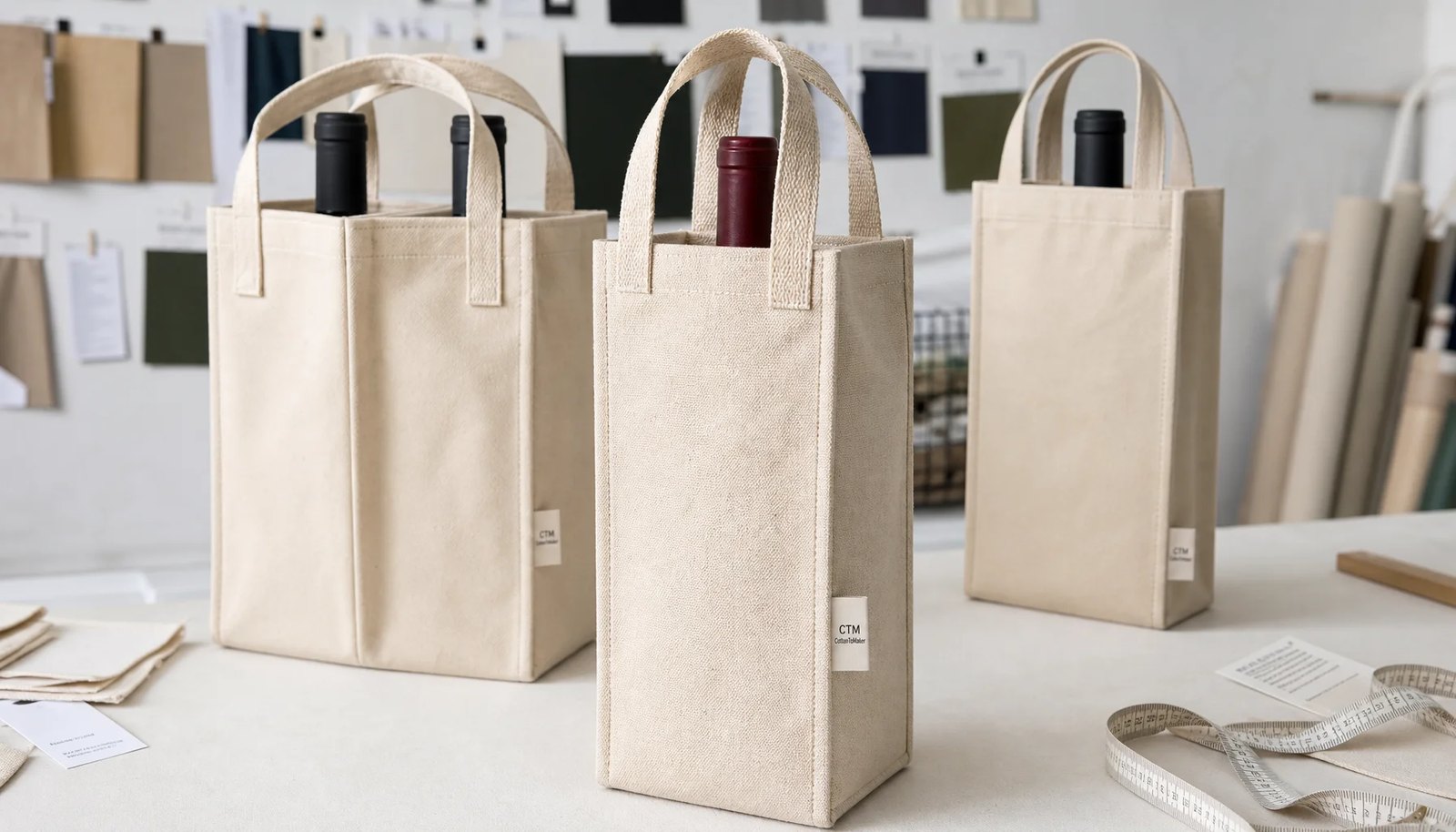
Start with the bookstore selling use, not only the fabric swatch
A canvas wine carrier for a university bookstore is not the same buying problem as a general promotional bottle bag. The product must work as retail merchandise, event packaging, and a licensed-brand item. It may sit near alumni gifts, graduation merchandise, campus picnic items, or local wine collaborations. That means the material decision affects shelf stability, logo clarity, hand feel, packing volume, and retail returns.
The first RFQ mistake is asking for a canvas wine bag without defining the bottle and sales format. A standard 750 ml wine bottle, a champagne bottle, and a wider craft beverage bottle do not share the same diameter. If the carrier is too narrow, staff will force bottles into the bag and stress the side seams. If it is too wide, the bottle leans, the bag looks cheap on shelf, and the printed logo may wrinkle around the curve.
- For single-bottle retail gifting, prioritize a stable base, clean front print area, and comfortable handle drop.
- For two-bottle alumni or holiday packs, require a sewn divider and enough fabric stiffness to keep bottles separated.
- For bookstore checkout impulse sales, avoid overly heavy canvas that raises retail price without visible value.
- For licensed university marks, protect a flat print zone and avoid seam interference through the logo area.
Choose canvas weight by structure, shelf presence, and freight impact
Most university bookstore wine carriers work best in the 10 oz to 12 oz canvas range, roughly 340 to 407 GSM depending on mill conversion and finishing. This range gives enough body for a filled carrier while still sewing cleanly and packing efficiently. An 8 oz canvas may be acceptable for a very simple giveaway sleeve, but it often looks soft when empty and may not stand upright for retail display.
Moving to 14 oz or heavier canvas can feel premium, but it is not automatically better. Heavy canvas increases material cost, makes seam turns bulkier, can reduce print sharpness on rough yarns, and adds carton weight. For bookstores ordering several hundred to a few thousand units, the freight difference can affect landed cost more than the unit quote suggests. The better approach is to approve a fabric that meets the carrying test and shelf appearance, not just the heaviest ounce number.
- 8 oz canvas: suitable for low-cost event packaging, but weak shelf structure and lower perceived retail value.
- 10 oz canvas: good entry retail choice for single-bottle carriers with screen print.
- 12 oz canvas: stronger hand feel for bookstore merchandise and two-bottle structures.
- 14 oz canvas: use when premium positioning is needed, but review sewing bulk, MOQ, and freight.
- GSM should be written in the spec because ounce descriptions vary between suppliers and markets.
Natural, dyed, washed, or recycled canvas each changes the quote
Natural unbleached canvas is often the safest starting point for university bookstore wine carriers. It has a familiar academic merchandise look, works with many school colors, and avoids the lab dip cycle required for custom dyed fabric. It also makes small quantity programs easier because the supplier can use stocked greige or natural canvas rather than dyeing a custom lot.
Dyed canvas is useful when the buyer wants the carrier to match navy, maroon, forest green, black, or another campus color. The tradeoff is color control. Dark colors can rub onto light clothing or paper hangtags if crocking is poor. Washed canvas can improve softness but may shrink, twist, or create a more casual surface that is harder for fine logo printing. Recycled cotton canvas may support sustainability goals, but the buyer should expect more variation in yarn shade and surface texture.
- For natural canvas, define acceptable slub level and whether seed flecks are acceptable near the logo.
- For dyed canvas, approve lab dips under daylight and store lighting before bulk fabric dyeing.
- For washed canvas, approve finished dimensions after washing, not only before-wash cut dimensions.
- For recycled canvas, request a physical swatch because texture and shade variation are part of the material.
- For light logos on dark fabric, test opacity and edge sharpness before confirming the print method.
Bottle fit and construction details prevent most field complaints
Wine carrier complaints usually come from simple construction misses: the base is too narrow, the handle is uncomfortable, the divider is too low, or the bottle neck shifts when carried. A good carrier should load easily, stand reasonably straight when empty, and hold the bottle without forcing pressure into one seam. Finished dimensions should be based on the real bottle profile the bookstore expects to sell or package.
For a standard single 750 ml wine bottle, many buyers use an approximate finished height around 34 to 38 cm and a gusset around 8 to 10 cm, but the exact size depends on bottle diameter and desired neck exposure. Two-bottle carriers need more attention. A divider that only covers the lower third of the bottles may not stop upper-body glass contact. A full-height or substantial mid-height divider costs more sewing time but gives better protection and a more stable retail feel.
- Require finished inner width and gusset, not just flat cut size.
- Place the front print panel away from heavy seam curves and bottom folds.
- Use reinforced stitching at handle ends because the load is concentrated there.
- For two-bottle styles, define divider height and whether it is sewn into the base.
- Test with filled bottles because empty bottle testing hides handle strain and balance problems.
Print method should match licensed artwork and canvas texture
Screen printing is usually the practical choice for canvas wine carriers when the artwork is a university seal, bookstore logo, mascot wordmark, alumni event mark, or simple one-to-three-color design. It gives stable cost, good durability, and predictable bulk production. However, canvas is not smooth paper. Very fine lines, small serif text, and reversed details may fill in or break depending on fabric texture and ink deposit.
Heat transfer can reproduce multicolor graphics and gradients, but it may look less integrated with natural canvas and can feel like a patch if the film area is large. Embroidery adds premium value for small marks but is not ideal for large detailed seals, and dense embroidery can pucker lighter canvas. Woven labels are useful for side branding or compliance information, but they should not replace the main licensed logo if the bookstore expects clear shelf branding.
- Provide vector artwork with Pantone references instead of low-resolution campus logo files.
- Keep small legal or licensing text off rough canvas unless the supplier proves it in a strike-off.
- For dark fabric, specify underbase printing if bright logo colors must stay accurate.
- For natural canvas, approve ink absorption and edge sharpness on the actual production fabric.
- Define print placement from seams and top edge to avoid disputes during final inspection.
Use MOQ logic that fits bookstore demand and factory reality
The MOQ for canvas wine carriers is driven by fabric sourcing, cutting efficiency, print setup, label setup, and packing requirements. A supplier may accept 300 pieces for a natural canvas single-color screen print because fabric is available and setup is simple. The same supplier may require 500 to 1,000 pieces for dyed canvas, custom labels, multiple artwork versions, or a two-bottle construction with more labor time.
University bookstores often want several small versions: bookstore logo, alumni weekend logo, graduation mark, and maybe two school colors. That can create hidden cost if each version needs a separate screen, separate packing, and separate carton marks. A better sourcing plan is to standardize the base carrier material and construction, then decide which artwork versions justify separate runs. If demand is uncertain, start with one core SKU and one seasonal artwork rather than four underfilled variants.
- MOQ per style controls cutting and sewing efficiency.
- MOQ per fabric color controls dyeing and material purchase.
- MOQ per artwork controls screen setup and print changeover.
- MOQ per packing format controls barcode, hangtag, and carton sorting work.
- Combining styles in one shipment can reduce logistics cost but may not reduce production setup cost.
Sample approval should include fit, fabric, print, and packed condition
A single pretty photo sample is not enough for this product. The approval path should separate the key risks. First, a blank fit sample confirms dimensions, gusset, divider, handle drop, and standing shape. Second, a fabric swatch or lab dip confirms material and color. Third, a print strike-off confirms logo size, ink color, edge definition, and artwork placement. Finally, a pre-production sample combines all approved components before bulk cutting.
Bookstore buyers should keep one sealed approved sample and provide one to the inspection team or receiving warehouse if possible. This avoids arguments about natural canvas shade, print placement, or handle length after production. If the order includes hangtags, barcode stickers, or individual bags, the packed sample should also be approved. Packing can change how the carrier looks at store receiving; tight folds may crease the logo or distort the base.
- Fit sample: test with the exact bottle type and filled weight.
- Fabric approval: record GSM, color, texture, and finish.
- Print strike-off: approve ink color, coverage, line clarity, and curing.
- Pre-production sample: confirm all construction and branding details together.
- Packed sample: verify folding method, tag location, barcode readability, and carton arrangement.
Packing choices affect sell-through, warehouse handling, and landed cost
Packing is not an afterthought for canvas wine carriers. Natural cotton canvas can pick up dust, carton fibers, or moisture marks if bulk packed carelessly. At the same time, individual polybagging every unit can add cost, plastic use, labor, and carton volume. The right option depends on how the bookstore receives goods: direct-to-store cartons, central warehouse distribution, online order fulfillment, or event-kit assembly.
For many bookstore programs, bulk packing with clean paper interleaving is enough if the carrier is not pure white and does not include delicate hangtags. Individual recycled polybags or paper sleeves are more useful when the carrier has a light fabric color, retail barcode, hangtag, or e-commerce picking requirement. Cartons should not be overloaded. Wine carriers with reinforced handles and structured bases can become permanently creased if compressed for weeks during ocean freight or warehouse storage.
- Define units per inner bundle and units per export carton.
- Request carton dimensions and gross weight before comparing freight.
- Keep printed panels flat or lightly folded away from sharp creases.
- Use moisture protection appropriate to shipping route and season.
- Confirm carton marks include SKU, artwork version, quantity, and destination information.
Lead time risks come from approvals, not only sewing capacity
A simple natural canvas wine carrier can move quickly after approvals, but university bookstore programs often lose time before production starts. Trademark approval, artwork cleanup, lab dips, sample courier time, barcode assignment, internal purchase order routing, and event-date changes can consume more calendar days than sewing. Buyers should build the schedule backward from the campus selling date, not from the factory's sewing estimate.
A realistic timeline has separate gates: RFQ clarification, sample development, artwork approval, material booking, bulk production, inspection, packing, export, and inland delivery. Peak periods around graduation, football season, reunion events, and holidays can tighten factory capacity and freight space. If the carrier is tied to a fixed event, the RFQ should state the required in-hands date and whether partial shipment is acceptable.
- Allow time for university trademark review before approving bulk printing.
- Do not release bulk fabric cutting until the fit sample and artwork placement are locked.
- Dyed fabric adds lab dip and bulk color approval risk.
- Custom woven labels and hangtags can run on separate supplier timelines.
- Final inspection should be scheduled before the goods are needed at the forwarder.
Compare supplier quotes by total specification, not the lowest unit line
Two quotes for canvas wine carriers can look similar while covering different products. One may use 8 oz canvas, bulk packing, one-color print, and no divider reinforcement. Another may include 12 oz canvas, dyed fabric, two-color print, individual barcode bagging, and stronger handles. The unit price alone does not tell the buyer which quote will land correctly at the bookstore.
A useful quote comparison normalizes the same fabric GSM, construction, print colors, sample requirements, packing, carton quantity, Incoterm, and lead time. Buyers should also separate one-time charges from repeat-order costs. Screen charges, sample charges, label setup, and artwork cleanup may matter on the first order but not the reorder. Freight should be compared using carton dimensions and gross weight, especially if the product has a wide gusset or individual packing.
- Unit price should state included fabric weight, print colors, and packing method.
- Setup charges should be separated from repeatable production cost.
- Carton data should be supplied before final landed-cost comparison.
- Incoterms must match; FOB, EXW, CIF, and DDP quotes are not interchangeable.
- Payment terms and inspection access can be as important as a small unit price difference.
Specification comparison for buyers
| Spec decision | Recommended option | When it fits | Buyer risk to check |
|---|---|---|---|
| Main canvas weight | 10 oz to 12 oz cotton canvas, about 340-407 GSM | Best balance for university bookstore retail carriers holding one or two standard 750 ml bottles | Below 8 oz may collapse at shelf display; above 14 oz may raise freight and sewing cost without improving sell-through |
| Bottle capacity structure | Single-bottle style for gifting; two-bottle style with sewn divider for alumni packs | Single-bottle SKU works for price-sensitive impulse purchase; two-bottle SKU works for events and premium merchandise | Loose or thin dividers allow bottle impact; divider height should protect glass contact through most of the bottle body |
| Fabric finish | Natural unbleached canvas or dyed school color with colorfastness control | Natural canvas suits bookstore sustainability positioning; dyed canvas suits licensed color programs | Dyed lots need lab dip approval and crocking tests, especially dark navy, black, maroon, and red |
| Handle construction | Self-fabric handles, 2.5-3.0 cm width, reinforced box stitch or cross stitch | Appropriate for filled glass bottles and repeated retail handling | Decorative narrow handles can cut into hands and fail at the top seam under bottle weight |
| Print method | Screen print for solid logos; heat transfer only for small multicolor artwork; embroidery for premium but limited detail | Screen print is usually the most stable cost option for bookstore logos and alumni marks | Artwork with fine reversed lines may fill in on canvas; licensed marks require pre-production print approval |
| Base and side gusset | Flat base with 8-10 cm gusset for single bottle; wider gusset and divider for two-bottle | Improves standing display on retail shelves and reduces bottle tilt | Too narrow a base makes the carrier fall forward on shelf; too wide wastes carton volume |
| MOQ logic | 300-500 pcs per artwork for simple screen print; higher MOQ for dyed fabric or custom weave label | Works for bookstore seasonal orders, alumni weekend, graduation, and holiday gift programs | Combining many small colorways may trigger multiple setup charges and uneven color availability |
| Retail packing | Bulk pack with paper interleaving, or individual recycled polybag when barcode cleanliness is required | Bulk saves packing cost; individual bagging protects light canvas and hangtags in warehouse handling | Unprotected natural canvas can pick up carton dust; over-tight packing can crease printed panels |
Buyer checklist before sampling
- Define the bottle format first: 750 ml wine, champagne, spirit bottle, or mixed bottle set, because diameter and height change the gusset and divider pattern.
- Select fabric by performance and shelf appearance, not only ounce weight; request GSM, weave density, shrinkage expectation, and whether the canvas is washed or unwashed.
- Decide whether the bookstore needs a single-bottle gift carrier, two-bottle alumni pack carrier, or both as separate SKUs.
- Provide licensed artwork in vector format with Pantone references, maximum print area, and the approval path for university trademark review.
- Specify handle width, handle drop, stitch pattern, and minimum load test instead of accepting a supplier's default handle.
- Request one fit sample with real bottles and one printed sample or strike-off before bulk fabric cutting.
- Confirm carton quantity, carton dimensions, gross weight, and whether units are bulk packed, individually bagged, tagged, or barcoded.
- Align delivery date with campus selling window and add time for artwork approval, sample revision, production, inspection, and inland delivery.
- Compare quotes using the same Incoterm, packing method, fabric weight, print colors, and carton assumptions.
- Reserve approved production samples and signed artwork files as control references for reorders.
Factory quote questions to send
- What exact canvas weight will be used in GSM and ounces, and is the weight measured before or after dyeing or washing?
- Is the quoted fabric natural, bleached, dyed, or recycled-content canvas, and what colorfastness or shrinkage test data can be provided?
- What bottle size was used to build the pattern, and what are the finished inner dimensions of the carrier and divider?
- What is the handle width, handle length, stitch type, and recommended safe loading weight for a filled carrier?
- Which print method is included in the quote, how many print colors are priced, and what is the maximum print area?
- Are screen setup charges, sample charges, plate charges, woven label charges, hangtag charges, and barcode labeling charges included or separate?
- What is the MOQ per style, per fabric color, and per artwork, and can styles share fabric to reduce material waste?
- What sample sequence is proposed: blank prototype, fabric lab dip, print strike-off, pre-production sample, and sealed production sample?
- What is the production lead time after final sample approval, and what assumptions could extend it during peak campus season?
- What are the carton dimensions, units per carton, gross weight, and recommended packing method for retail distribution?
Quality-control points to confirm
- Fabric weight tolerance should normally stay within an agreed range such as plus or minus 5 percent from approved GSM.
- Finished size tolerance should be defined before production, commonly plus or minus 0.5 cm for width and height on small wine carriers.
- Bottle fit must be tested with the buyer's target bottle profile, not only a generic slim wine bottle.
- Handle attachment must pass a practical static load and lift test using filled bottles for the intended capacity.
- Divider stitching on two-bottle carriers should keep glass surfaces separated during normal carrying movement.
- Print placement should stay within the approved tolerance, and logo color should match the approved Pantone or physical strike-off.
- Printed panels should not show heavy ink bleeding, pinholes, misregistration, or cracking after normal flexing.
- Natural canvas should be inspected for oil stains, dark yarn contamination, heavy slubs on the logo area, and odor.
- Cartons should pass visual compression and handling checks, with no overpacking that crushes handles or creases the printed face.
- Final inspection should include packed-carton verification: SKU, barcode, quantity, hangtag, polybag decision, and carton mark.