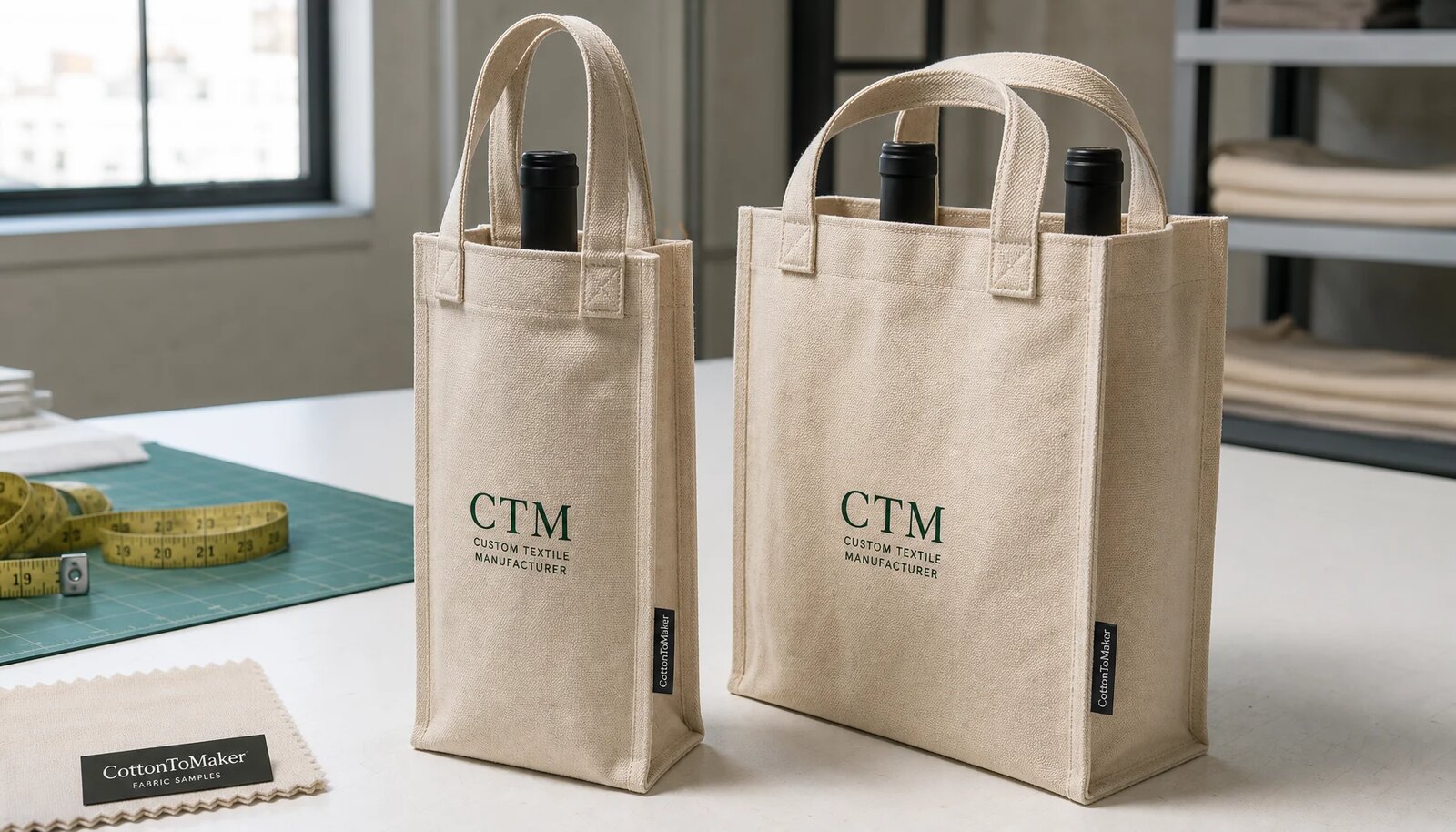
Start With the Craft Fair Use Case
Canvas wine carriers used at craft fairs are not ordinary tote bags with a bottle inside. They get handled in tight spaces, packed flat for transport, hung from hooks, stacked behind a booth table, and picked up by shoppers who judge quality in a few seconds. A logo can look centered on a digital proof and still end up buried under a handle seam, bent around a bottle shoulder, or creased across a fold line after bulk packing. That is why placement is a production question, not a graphic-design preference.
For procurement teams, the real objective is repeatability. The carrier has to look consistent after cutting, sewing, decoration, folding, shipping, loading, and display. If the buyer does not define the carrier format, bottle dimensions, decoration method, safe zone, tolerance, sample sequence, packing plan, and inspection method, the supplier will fill in those blanks with whatever is easiest for the factory. That usually produces a bag that is technically acceptable but commercially awkward.
Craft fair programs also have different commercial roles. A winery may want a bold front mark that reads from across a table. A boutique buyer may prefer a smaller woven label that feels more retail and less promotional. A distributor serving multiple vendors may need one body style with several logo versions. A private-label retail order may need barcodes, hang tags, or mixed pack allocations by store or event. The logo position should follow that commercial reality, not the other way around.
- Define whether the carrier is resale merchandise, event packaging, private-label gifting, or a promotional giveaway.
- Judge the logo with a real bottle inside the carrier, not only on an empty flat sample.
- Specify whether carriers will be displayed hanging, standing loaded, stacked in crates, or bundled for booth kits.
- Keep the main logo away from handle seams, gusset folds, divider seams, boxed bottom folds, and packing crease lines.
- Request sample photos flat, loaded, hanging, carried by hand, and standing on a table before bulk approval.
Define Bottle Fit Before Logo Size
Bottle fit drives the safe logo zone more than artwork size does. A single 750 ml carrier may have a front panel that is only 100-130 mm wide once seam allowance, side movement, and bottle curvature are accounted for. A double-bottle carrier can offer a wider face, but the divider seam, internal stitch line, or boxed base may interrupt the printable area in ways a flat mockup will not show.
Craft fair sellers also move beyond standard wine. Cider, mead, spirits, olive oil, vinegar, syrups, and specialty beverages can differ in height, shoulder angle, diameter, punt shape, and filled weight. A tall bottle can pull the fabric upward and make a centered logo appear too low. A wide bottle can stretch the front panel and push artwork toward the seams. A heavy bottle increases stress at the base and handle, which can affect how reinforcement should be placed around the print zone.
Treat bottle data as a sourcing input, not a note in the margin. Provide the maximum diameter, total height, filled weight, and whether the carrier must stand upright when loaded. If the same carrier must fit several bottles, approve the logo against the largest diameter and heaviest filled format. That avoids the common mistake of approving a neat empty sample that never reflects real use.
- Single-bottle carrier: best for checkout packaging, lower freight volume, and simple front branding.
- Double-bottle carrier: better for gift sets but needs stronger handles, a stable base, and divider-aware logo placement.
- Mixed bottle program: approve fit using the tallest bottle, widest diameter, and heaviest filled weight.
- Divider construction: confirm whether the divider is sewn into the base, side seam, top edge, or loosely inserted.
- Boxed bottom: improves tabletop display but creates fold lines that should stay outside the print area.
- Handle length: check whether the handle falls forward and covers the logo when the carrier hangs from a peg.
Specify Canvas Weight and Finish Precisely
Canvas is often quoted by ounce weight, while import teams may compare it by GSM. In practical sourcing terms, 10 oz cotton canvas is commonly around 340 GSM and 12 oz is commonly around 407 GSM, although actual values vary by weave, yarn count, finishing, and the supplier's conversion method. For reusable craft fair wine carriers, the useful commercial range is usually 10-12 oz because it balances bottle support, print stability, hand feel, foldability, and carton efficiency.
Lower weights, such as 6-8 oz, can reduce unit cost and freight weight, but they may wrinkle around the bottle and look more like promotional packaging than retail stock. That wrinkle shows up in the logo area, which makes even a well-placed print look uneven. Heavier fabrics, such as 14 oz, can feel premium, but they also increase fabric cost, sewing difficulty, needle wear, seam bulk, and carton weight. If the buyer wants that heavier feel, handles and stitch settings should be matched to the fabric from the start.
Finish matters just as much as weight. Natural and unbleached canvas can mute ink color and show cotton flecks. Bleached canvas gives a cleaner background but may not fit a rustic brand. Dyed canvas often needs a more opaque ink system, an underbase, or a different decoration method to keep light logos legible. Washed or slub-heavy canvas can look handmade, but the buyer should expect looser print edges than on a smoother weave. These tradeoffs should be approved on the actual fabric swatch, not only on a digital mockup.
- Specify both oz and GSM so suppliers do not quote lighter fabric under a vague canvas description.
- Use 10 oz canvas when cost, foldability, and reliable screen printing are the main priorities.
- Use 12 oz canvas when the carrier is sold as a reusable retail item or premium gift package.
- Approve logo color on the actual bulk fabric color and finish, not on paper or a white digital proof.
- Avoid fine text over heavy slubs, high-variation flecks, seams, or gusset movement areas.
- Ask for shrinkage, dye fastness, and fabric lot control when dyed or washed canvas is quoted.
Build a Production-Ready Logo Safe Zone
Reliable placement starts with the construction, not the artwork file. For many canvas wine carriers, the safe area sits below the handle reinforcement and above the bottom fold or boxed base. For a single-bottle carrier, a logo in the 70 x 90 mm to 90 x 120 mm range is often safer than a larger mark that pushes into seams or folds. For a double-bottle carrier, 110 x 110 mm to 130 x 130 mm may work if the divider seam does not cut through the visible face.
The drawing should show exact distances from the top opening, handle seam, side seam, bottom fold, and divider seam. It should also define whether measurements are taken from the logo center, top edge, or bounding box. Without that detail, a supplier may center the print visually on a flat panel while the buyer expects it centered on the loaded carrier. Those are not the same thing, and the difference shows up immediately once a bottle is inserted.
Tolerance needs to match the material. Soft canvas moves. Sewing shifts. Handle bulk pulls panels slightly off square. For manually positioned screen print on canvas, plus or minus 5 mm is often realistic. Tighter control may be possible with fixtures, guides, or added inspection, but it should be confirmed before pricing. Artwork that only works when every unit is perfectly square usually fails in production.
- Keep the logo at least 15-20 mm away from side seams and gusset folds where possible.
- Keep the logo below handle box stitching or bartacks so it does not look trapped under reinforcement.
- Keep the logo above the bottom fold line to avoid distortion when the carrier stands loaded.
- Use a smaller mark for circular borders, thin rules, small text, tight spacing, or detailed icons.
- Approve both measured placement and real-use appearance with a bottle inserted.
- Define whether the logo is centered on the front panel, the visible loaded face, or the full flat pattern.
Choose the Decoration Method by Risk
Screen printing is usually the default for canvas wine carriers because it is economical, durable enough for bulk programs, and well suited to bold one- or two-color logos. It works best with solid shapes, clear line weights, and limited color registration. The supplier should confirm minimum line thickness, minimum text height, ink type, curing method, and whether an underbase is needed for dyed fabric. If those details are not written down, the finished result can look acceptable in a sample room and weak in production.
Heat transfer is useful when artwork includes gradients, small illustrations, seasonal graphics, or several colors that would require too many screens. It can be a practical choice for short runs or event-specific art. The tradeoff is surface feel and long-term wear. Transfer edges may look glossy, feel plastic, lift on an uneven weave, or crack after repeated folding if the adhesive system is not suited to canvas.
Embroidery can create a premium look, but it is not the right answer for every carrier. Dense stitch counts can pucker narrow panels, stiffen the front face, and leave needle holes where a soft bag should stay flexible. Embroidery works best for small logos, initials, simple lettering, or heritage marks on 10 oz or heavier canvas. A digitized file made for caps or thick garments should not be sent straight into a flat canvas program without adjustment.
Labels and patches are useful when the brand needs a quieter identity. A woven side label can travel across several bag styles. A printed cotton label gives a softer natural finish. Sewn patches add texture, but they also add thickness, alignment checks, edge stitching, and extra carton pressure risk. If multiple branding elements are used together, define one as primary so the bag does not look crowded.
- Screen print: best for simple logos, repeat orders, stable unit cost, and strong front-panel visibility.
- Heat transfer: best for multicolor artwork, gradients, small runs, and event-specific graphics.
- Embroidery: best for small premium marks on heavier canvas, away from seams and folds.
- Woven label: best for subtle private-label programs and multi-style brand consistency.
- Sewn patch: best for premium texture but adds thickness, alignment inspection, and carton pressure risk.
- Hang tag: best for barcode, care notes, country-of-origin details, pricing, or seasonal storytelling.
Make Supplier Quotes Comparable
A usable quote breaks the carrier into clear cost buckets. If the bag body, decoration, and packing are blended into one line, procurement cannot tell whether a price difference comes from fabric weight, handle construction, divider design, ink colors, logo size, label MOQ, sample charges, carton plan, or freight assumptions. Canvas wine carriers look simple, but small specification changes can move cost and defect risk in a way that matters at volume.
MOQ should be defined at the level the factory actually produces. A supplier may accept a lower MOQ for blank natural canvas carriers but require a higher quantity for dyed fabric, custom labels, multiple logo versions, or efficient screen setup. If one order includes several craft fair vendor logos, ask whether the MOQ applies per total order, per style, per logo, per fabric color, per print color, per label version, or per shipment. That answer changes the economics more than the headline price does.
Production sequence also affects cost and placement. Printing flat panels before sewing can improve print access and logo quality, but it requires accurate sewing after decoration. Printing finished bags can reduce panel-matching problems, but it limits the print area near seams and gussets. Embroidery may be done before sewing or after sewing depending on machine access. Those assumptions belong in the RFQ so the buyer is comparing like with like.
- Fabric line item: oz, GSM, fiber content, weave, color, finish, shrinkage control, and dyeing cost.
- Construction line item: finished dimensions, gusset, boxed bottom, divider, handle length, reinforcement, seam allowance, and stitch details.
- Decoration line item: method, logo size, number of colors, print sides, setup fees, artwork fees, sampling fees, and tolerance.
- Label line item: label type, size, fold style, MOQ, color count, lead time, and insertion point.
- Packing line item: inner bundles, individual packing, tissue, barcode, hang tag, and carton marking.
- Commercial line item: MOQ basis, sample time, production lead time, payment terms, inspection point, and shipment terms.
Approve Samples With Measurable Comments
The first sample should prove construction, not decoration alone. Load the carrier with the intended bottle, lift it by the handle, set it on a table, hang it from a peg, and fold it the way it will be packed. If the bottom collapses, the handle twists, the opening stretches, or the bottle leans, the logo placement cannot solve the underlying product problem. A good print on a weak bag is still a weak bag.
The decorated pre-production sample should be close to bulk in every meaningful way. It should use the final canvas weight, fabric color, logo size, ink or thread color, handle construction, sewing method, label position, and packing direction. A digital proof is useful for layout, but it cannot show absorbency, seam bulk, curing quality, or how the logo behaves when the bottle tension pulls the panel. That is why procurement should never skip the physical sample stage for a new bag style.
Sample feedback should be written in measurements. Instead of saying move the logo up slightly, write move the logo center 10 mm upward, keep logo width at 85 mm, and maintain at least 20 mm clearance from the bottom fold. Instead of saying the print is too dark, reference the approved Pantone target, the ink drawdown, the fabric swatch, or the acceptable shade range on natural canvas. Measurable comments keep the next sample from fixing one problem while creating another.
For repeat programs, retain one approved decorated sample, one plain construction sample, one fabric swatch, one placement drawing, one packing photo, and the approved carton mark. Those references matter when the supplier changes fabric lots, ink batches, print operators, sewing lines, or packing teams. Reorders drift when the original standard is only remembered verbally.
- Measure logo distance from top opening, handle seam, side seam, divider seam, and bottom fold.
- Photograph the sample flat, loaded, hanging, carried by hand, and standing on a table.
- Rub the print with a dry white cloth and a lightly damp cloth to screen for obvious curing problems.
- Check whether the logo remains visible when the handle falls forward or the carrier hangs from a peg.
- Confirm that the decorated pre-production sample is the control standard for bulk inspection.
- Record approval comments with dimensions, color references, and tolerance, not only subjective wording.
Set Bulk QC Thresholds Before Production
Canvas wine carriers are simple enough that bulk defects can be easy to underestimate, but the issues that do occur are visible to shoppers immediately. The main inspection points are logo position, logo tilt, print color, print adhesion, seam strength, handle reinforcement, bottle fit, loose threads, stains, fabric flaws, labels, and packing marks. A buyer who checks only carton count can still receive a shipment that looks inconsistent on a booth table.
Placement tolerance should be written before production starts. For many custom canvas wine carriers, plus or minus 5 mm is a practical tolerance for manually positioned screen printing. If the brand wants tighter alignment, the supplier should confirm fixture use, measurement point, inspection method, and any added cost. The tolerance should say whether the measurement is taken from the top opening, handle seam, side seam, logo center, or bottom fold. Without that, inspection arguments begin later than they should.
Defect classification helps prevent subjective disputes. Wrong logo, wrong print side, upside-down decoration, unsafe handle failure, severe stains, and unusable bottle fit should be treated as critical defects. Major defects can include visibly tilted logos, placement outside tolerance, cracking prints, seam openings, missing labels, broken handles, and heavy fabric flaws across the branding area. Minor defects may include small thread ends, slight natural cotton flecks, mild shade variation, or tiny print specks within the approved sample range.
Functional testing should reflect actual use. A carrier intended for one filled bottle should be loaded with the target bottle or equivalent weight and lifted repeatedly by the handle. A double-bottle carrier should be tested with two filled bottles or equivalent weights, not one bottle centered in the bag. Inspect the logo after loading because fabric tension can reveal distortion that is not visible on an empty carrier.
- Critical defects: wrong logo, wrong side, upside-down print, unsafe handle failure, severe stain, or unusable bottle fit.
- Major defects: logo visibly tilted, placement outside tolerance, print cracking, seam opening, missing label, or skipped reinforcement.
- Minor defects: small thread ends, slight natural slubs, minor print specks, or mild shade variation within the approved range.
- Functional check: load with target bottle weight and inspect handle seams, bottom seams, divider, and panel distortion.
- Print check: compare color, adhesion, edge quality, opacity, and registration against the approved decorated sample.
- Packing check: inspect cartons for clean condition, correct marks, dry interior, and protection against print transfer.
Control Packing to Protect the Logo
Packing choices affect both landed cost and logo condition. Canvas wine carriers are often shipped flat to save space, but folding directly through the printed area can create creases. Dark screen prints or freshly decorated goods can transfer if they are packed too tightly before full curing. For darker inks, dyed canvas, humid transit, rush schedules, or large logo areas, face-to-back stacking, tissue separation, or longer curing time before carton closure can reduce blocking and offset risk.
Craft fair buyers may need products pre-bundled for the people who actually distribute them. A distributor may want inner packs of 25 or 50 units so vendors receive pre-counted bundles. A retail buyer may need hang tags, barcode stickers, price labels, care labels, or country-of-origin markings depending on the sales channel and destination. These details belong in the RFQ because they affect labor time, carton size, repacking work, and inspection scope.
The carton plan should match receiving and event handling. Very heavy cartons are awkward to move. Over-compressed cartons can crease the logo or flatten boxed bottoms. Loose packing can increase freight volume and allow rubbing in transit. Ask for carton dimensions, gross weight, net weight, units per carton, inner bundle count, and stacking orientation before approving the packing method. The goal is not just to ship cheaply. It is to receive a bag that still looks intentional when it comes out of the carton.
If the carrier will stand upright at the craft fair, packing should not crush the base structure. If it will hang from a peg, the handle should not be bent in a way that hides the logo or leaves a permanent crease. If it is sold as a retail gift bag, the front logo area should arrive clean, flat, and free from transfer marks. That is a packaging requirement, not a finishing detail.
- Flat bulk pack: lowest cost and efficient carton use, but protect printed faces from crease and transfer.
- Inner bundles: useful for craft fair kits, regional sales teams, wholesale allocation, and inventory counting.
- Individual packing: improves cleanliness but adds cost, plastic use, unpacking time, and waste-management concerns.
- Tissue or paper separation: useful for large dark logos, high humidity routes, or rush schedules after printing.
- Carton marking: include style number, logo version, quantity, gross weight, carton count, and destination reference.
- Retail-ready packing: confirm hang tags, barcode placement, price labels, care labels, and any required compliance markings.
Finalize a Procurement-Ready Spec Sheet
Before the order is placed, turn the discussion into a controlled specification sheet. The spec should include the carrier drawing, finished dimensions, fabric details, decoration artwork, placement measurements, tolerances, sample status, packing plan, carton marks, inspection points, and commercial terms. This document becomes the reference for quoting, sampling, production, QC, and reorder comparison. Without it, the team will rely on memory, and memory is a weak sourcing control.
The best spec sheets are short in language but exact in measurement. Replace terms like standard handle, centered logo, strong stitching, and good packing with real dimensions, stitch requirements, placement references, and carton quantities. Include the approved logo file name and version so an old file does not get used by mistake. If multiple vendor logos are included, list each version, quantity, placement, and pack allocation separately so the factory does not generalize the job.
A final review should compare quote, sample, and spec sheet line by line. The fabric weight in the quote should match the sample. The logo size on the artwork should match the placement drawing. The MOQ should match the number of logos and colors. The packing plan should match the display and distribution requirement. This is the simplest way to avoid the common sourcing failure where the sample is approved under one assumption and bulk production is priced or packed under another.
- Attach a flat technical drawing with logo bounding box, measurement points, and plus or minus tolerance.
- Attach final artwork files with Pantone references, logo size, decoration method, and print side.
- List bulk quantities by style, fabric color, logo version, label version, and packing allocation.
- Define the approved sample as the control standard for fabric hand feel, logo color, placement, and sewing.
- Confirm sample lead time, bulk lead time, inspection timing, carton data, and shipment terms in writing.
- Use the same spec sheet for reorders to prevent drift in canvas weight, print position, handle construction, and packing.
Specification comparison for buyers
| Spec decision | Recommended option | When it fits | Buyer risk to check |
|---|---|---|---|
| Single-bottle front logo | Place the main mark on the upper-middle front panel, commonly 60-90 mm below the top opening or handle reinforcement, inside a 70 x 90 mm to 90 x 120 mm safe print zone. | Best for craft fair resale, winery checkout packaging, tasting-room giveaways, farm shop packaging, and booth displays where the carrier is hung or carried by hand. | The logo can warp if it sits too close to handle bartacks, side gusset folds, bottom creases, or the bottle curve after loading. Check the loaded sample, not just the flat panel. |
| Double-bottle front logo | Use a wider centered zone, often 110 x 110 mm to 130 x 130 mm, only if the divider seam and panel construction leave a flat print surface. | Useful for wine pairs, cider sets, olive oil gift packs, holiday bundles, and higher-value retail gifting. | The divider seam can break the print field into two visual zones. Two loaded bottles can pull the front panel unevenly and make a centered logo appear off-level. |
| Side seam label | Use a woven, cotton, or recycled cotton label inserted into the side seam, usually 25-35 mm wide, with simple high-contrast artwork. | Works for premium craft brands, minimalist private-label packaging, and programs using one brand label across multiple bottle bag styles. | Small text may become unreadable. Label MOQ, weaving setup, color limits, and separate label lead time can make small runs less efficient than print. |
| Screen print | Use 1-2 spot colors, bold artwork, clear line weights, and ink tested on the actual canvas color, weave, and finish. | Most economical for repeat craft fair programs, simple logos, medium-volume bulk orders, and front-panel visibility. | Fine lines can fill in on coarse canvas. Under-cured ink can crack, rub off, block, or transfer inside cartons. |
| Heat transfer | Use when artwork needs gradients, photographic detail, small event graphics, or several colors that would be inefficient in screen print. | Helpful for seasonal artwork, short runs, multicolor illustrations, and event-specific logos. | Transfer edges may feel plastic, lift on uneven weave, gloss differently from the canvas, or show poor adhesion after folding. |
| Embroidery | Limit embroidery to small marks, initials, or simple lettering on 10 oz or heavier canvas, away from seams and high-stress folds. | Suitable for premium wine clubs, gift boutiques, heritage marks, and programs where texture matters more than large print area. | Dense stitch counts can pucker narrow panels, create needle holes, stiffen the front, and reduce usable logo detail. |
| Canvas weight | Specify both oz and GSM; 10-12 oz cotton canvas is the practical range for most reusable craft fair wine carriers. | Balances bottle support, print stability, retail hand feel, foldability, carton efficiency, and common price positioning. | Quotes that say only standard canvas may hide 6-8 oz fabric that feels weak when loaded and wrinkles through the logo. |
| Handle and base construction | Require reinforced handles, controlled stitch length, bartacks or box stitching where appropriate, and a base matched to loaded bottle weight. | Important when the carrier will be sold as a reusable item instead of used as disposable packaging. | A good logo cannot compensate for handles that twist, seams that open, a divider that tears, or a boxed bottom that collapses on a craft fair table. |
| Packing for printed panels | Pack flat with printed faces protected by full curing time, face-to-back stacking, tissue, or interleaving when needed. | Important for dark inks, humid routes, dyed fabric, rush packing, large logos, or retail-ready delivery. | Warm or uncured prints can block, offset, crease, or transfer to adjacent carriers during ocean freight, truck transit, or warehouse storage. |
Buyer checklist before sampling
- Confirm the use case: resale gift bag, winery giveaway, checkout packaging, event merchandise, booth display item, or multi-vendor private-label program.
- Confirm bottle format before artwork approval: one 750 ml bottle, two 750 ml bottles, or mixed formats such as wine, cider, mead, spirits, vinegar, syrup, or olive oil.
- Provide target bottle height, maximum diameter, filled weight, shoulder shape, punt/base style, and whether the bottle must stand upright in the loaded carrier.
- Specify finished carrier dimensions: width, height, side gusset, bottom gusset, handle length, opening width, divider position if any, and usable bottle height.
- Specify canvas weight in both oz and GSM, such as 10 oz around 340 GSM or 12 oz around 407 GSM, instead of vague terms such as standard, heavy, or premium canvas.
- Define fabric type and finish: greige, natural, unbleached, bleached, dyed, washed, recycled cotton blend, laminated, pigment coated, or slub canvas with visible flecks.
- Select the logo method before price comparison: screen print, heat transfer, embroidery, woven label, printed cotton label, sewn patch, hang tag, or a combination.
- Mark the safe logo zone on a flat technical drawing and keep artwork away from handle seams, side seams, gusset folds, divider seams, boxed bottom folds, and packing crease lines.
- State logo width and height, print side, distance from key seams, Pantone or ink references, print order, label location, and acceptable placement tolerance in the RFQ.
- Ask whether panels are decorated before sewing or finished carriers are decorated after sewing, because the process affects alignment, print area, unit cost, and defect risk.
Factory quote questions to send
- What exact canvas weight are you quoting in oz and GSM, and what is the fiber content, weave type, fabric color, and finish?
- Are you quoting greige, natural, bleached, dyed, washed, laminated, recycled blend, or another finish, and will bulk fabric be from one lot or multiple lots?
- What are the finished dimensions, including width, height, side gusset, bottom gusset, handle length, opening width, divider placement, and usable bottle height?
- What maximum bottle diameter, bottle height, and filled weight has this construction been designed or tested to carry?
- What stitch length, seam allowance, handle reinforcement, bartack or box-stitch pattern, and thread type are included in the quoted construction?
- What is the maximum reliable logo area for this single or double wine carrier without crossing handle stitching, side gussets, bottom folds, or divider seams?
- Will you print on flat panels before sewing or decorate finished carriers after sewing, and what placement tolerance can you hold for each process?
- Which decoration method do you recommend for this artwork: screen print, heat transfer, embroidery, woven label, printed cotton label, sewn patch, or hang tag, and what limitations apply?
- What minimum line thickness, minimum text height, and minimum spacing do you recommend for this canvas weave and decoration method?
- What are the setup charges, per-color charges, sample charges, embroidery digitizing charges, label mold or weaving charges, and cost impact if the logo increases by 20 mm in width?
Quality-control points to confirm
- Logo placement tolerance should be defined by measurement point; plus or minus 5 mm is commonly practical for manual screen print on canvas panels unless the factory confirms fixtures and a tighter control method.
- Main front logos should not overlap handle reinforcement stitches, divider seams, side gussets, side labels, boxed bottom folds, or fold lines used for packing.
- Logo tilt should be judged against the finished loaded carrier, not only the raw panel edge, because soft canvas can shift during sewing and loading.
- Ink color should be checked against the approved Pantone reference or physical swatch under consistent lighting, with natural canvas color and absorbency considered in the approved shade.
- Screen print edges should remain readable at the approved viewing distance; fine text, borders, and registration should match the decorated pre-production sample.
- Dry rub testing should show no obvious ink transfer onto a white cloth after reasonable rubbing; damp rub should not create severe fading, smearing, or color migration for the chosen ink system.
- Heat transfers should be checked for edge lift, trapped bubbles, scorching, cracking after folding, excessive plastic hand feel, and adhesion on the actual canvas weave.
- Embroidery should be checked for puckering, skipped stitches, thread breaks, backing visibility, uneven density, loose threads, and needle damage on the front panel.
- Handle seams should show no broken stitches, skipped bartacks, loose thread clusters, seam opening, or obvious distortion after loaded hanging and hand-carry simulation.
- Bottle fit should be checked with the actual target bottle diameter, shoulder shape, height, and filled weight, not only with an empty carrier or generic glass bottle.