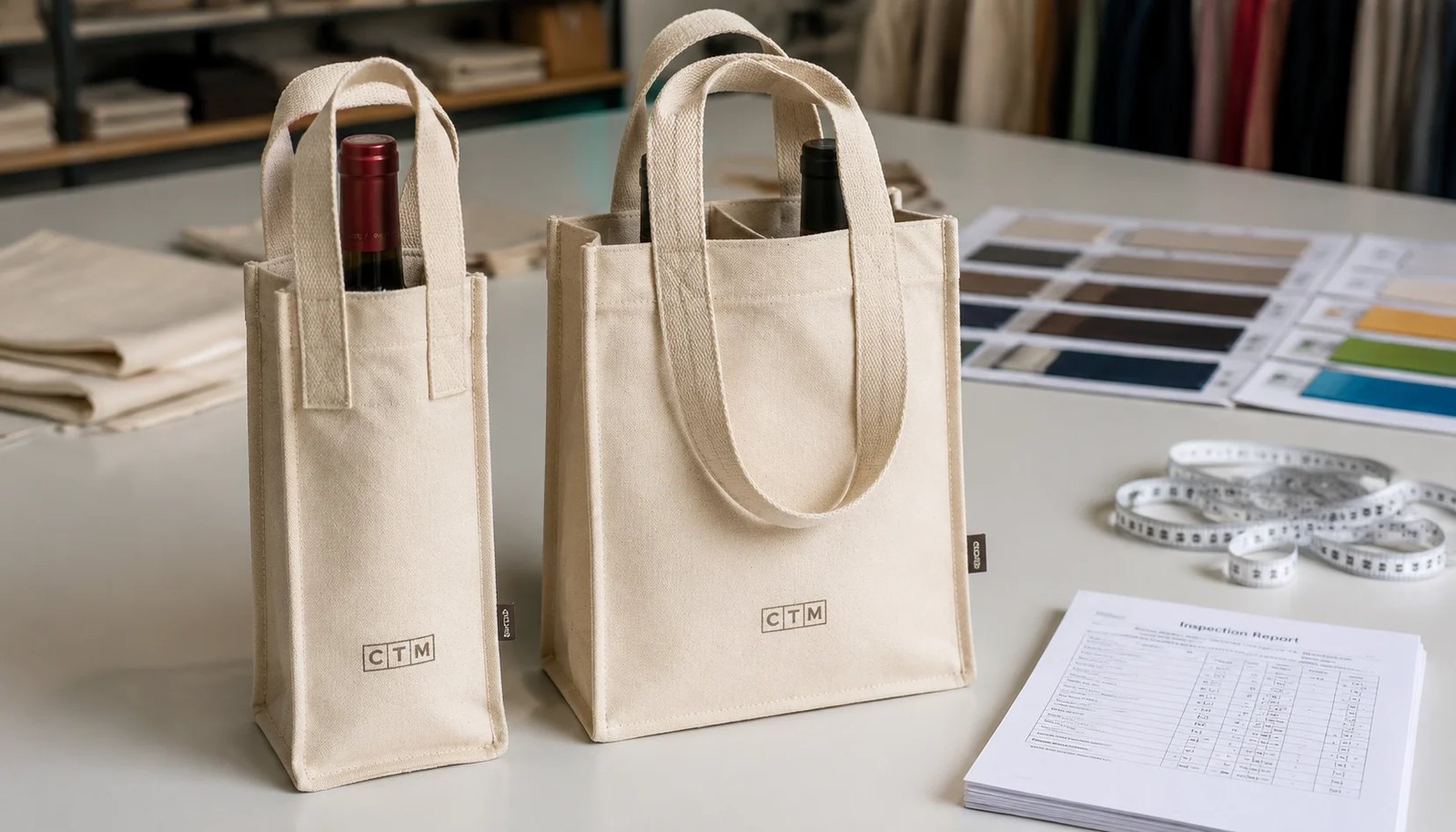
The Buying Problem
Canvas wine carriers look simple, but liquor retail use is harsher than many tote bag applications. A carrier may be filled at checkout, swung by one handle, placed on a car floor, reused for groceries, or given as a branded gift. If the handle tears or the divider fails, the problem is not only a damaged bag. It can become broken glass, product loss, and a brand complaint at store level.
For procurement teams, the main issue is that many supplier quotes describe the bag visually but not mechanically. A line such as 12 oz canvas wine bag with logo does not prove the bag can carry two bottles repeatedly. A better RFQ converts the intended retail use into fabric, stitching, print, packing, and inspection requirements that factories can price and test.
- State whether the carrier is for checkout sale, gift packaging, club subscription, tasting event, or reusable retail bag.
- Define expected load by bottle count and bottle size, including heavier spirits or sparkling bottles if relevant.
- Separate appearance requirements from durability requirements so suppliers cannot substitute a good-looking but weak construction.
- Use a sealed sample as the control for bulk production, but also document measurable acceptance criteria.
Start With Bottle Fit
A durability checklist should begin with bottle geometry. Wine bottles are not all the same shape. Bordeaux, Burgundy, Champagne, spirits, and 1.5 L bottles can have different shoulder profiles, base diameters, and heights. A carrier that fits a standard 750 ml wine bottle may be too tight for sparkling wine or too shallow for tall spirits packaging.
For retail buyers, the most useful specification is not only finished bag width and height. Include maximum bottle diameter, bottle height range, and whether the neck should remain exposed. If the carrier is used for two bottles, the divider panel needs enough height and stiffness to stop glass contact while still allowing easy packing at the checkout counter.
- For a single 750 ml wine carrier, define internal width and gusset after sewing, not only flat panel size.
- For two-bottle carriers, specify divider height, divider seam type, and how the divider is anchored at the base.
- For premium liquor bottles, test square, round, and tapered bottles because corners can stress side seams.
- If gift tissue, hang tags, or bottle neck cards are added, include that extra space in the fit sample.
Fabric Weight And Handfeel
Canvas wine carriers usually sit in the 10 oz to 16 oz range, roughly 340 GSM to 540 GSM depending on fabric construction. For most liquor retail programs, 10 oz to 12 oz canvas is a practical balance. It feels substantial, prints well, folds for packing, and does not create excessive seam bulk. Heavier 14 oz to 16 oz canvas can work for premium reusable carriers, but the price, sewing difficulty, and carton volume rise quickly.
The buyer should not treat fabric weight as the only durability measure. A tightly woven 10 oz canvas may perform better than a loosely woven heavier fabric. Natural canvas can also vary by batch in slub, seed marks, shade, and shrinkage. If the product is sold or displayed as a branded retail item, approve the fabric swatch before confirming print color because ink appearance changes on natural, bleached, and dyed canvas.
- Use 10 oz to 12 oz canvas for mainstream retail wine carriers where cost and packability matter.
- Use 14 oz canvas when the carrier is positioned as a long-life reusable gift item and freight cost is acceptable.
- Request GSM or oz, fabric width, color treatment, and shrinkage information in the quote.
- Avoid vague descriptions such as thick canvas or premium cotton unless the supplier also gives measurable data.
Handle And Seam Testing
The handle area is the first failure point on many canvas wine carriers. Two full 750 ml bottles can weigh around 2.5 kg to 3 kg including glass, and real users do not carry them gently. The handle may be twisted, pulled sideways, or lifted quickly from a counter. A factory sample should be tested with more load than normal use, because production variation and repeated handling reduce the safety margin.
A practical acceptance standard is to load the sample to at least three times the expected filled weight for a short static test, then perform a swing or jerk test at the expected retail load. The goal is not laboratory certification for every order; the goal is to expose weak seams before production. Look for stitch popping, fabric tearing near the needle holes, handle elongation, and seam opening at the top hem.
- Require box stitch, cross stitch, bartack, or another visible reinforcement method at handle attachment points.
- Set stitch density before bulk production; heavy canvas usually needs strong thread and consistent stitch length.
- Reject samples where the handle is only caught inside a narrow folded hem without reinforcement.
- For two-bottle carriers, test one-sided loading because customers may remove one bottle and carry the bag unbalanced.
Divider And Bottom Strength
A two-bottle canvas wine carrier is only as good as its divider. If the divider is too low, the bottles hit each other. If it is too soft, it collapses. If it is not securely sewn into the bottom and side seams, it tears after repeated insertion. This is especially important for liquor retailers because glass-on-glass contact can damage labels, create noise, and increase breakage risk.
The bottom construction also needs attention. A simple flat bottom can be acceptable for a single bottle, but multi-bottle styles benefit from a folded boxed bottom, double-layer base, or reinforcement insert. If the bag must stand upright on a retail counter, base stability matters as much as load strength. A carrier that tips over during checkout creates operational friction for store staff.
- Specify whether the divider is self-fabric canvas, laminated canvas, PP board covered with fabric, or another reinforcement.
- Confirm whether the divider is sewn into the base seam or only attached to side panels.
- Test with the heaviest expected bottle type, not the easiest standard bottle.
- Include upright stability in sample review when the bag will be displayed filled in store.
Print Durability
Most canvas wine carriers use screen printing because it is reliable for solid retail logos and simple promotional artwork. Heat transfer can handle finer detail, but it needs careful testing on textured canvas and may be less suitable for repeated folding or abrasion. Embroidery is possible for small premium marks, although it adds cost and can pucker lighter canvas if backing and thread tension are not controlled.
The durability issue is not only whether the logo looks sharp on day one. Printed carriers may be stacked, folded, rubbed against bottles, or exposed to light moisture. Poorly cured ink can transfer onto cartons or other bags. Thick ink can crack across fold lines. The buyer should approve a print strike-off and then a sewn sample, because print placement can shift after gussets, seams, and handles are formed.
- For screen print, define Pantone reference, print size, location tolerance, number of colors, and whether underbase is required.
- For dark canvas, allow for opacity testing because one print pass may look weak.
- Perform dry rub testing and fold testing on the cured print before approving bulk production.
- Keep logos away from heavy seam folds unless the design intentionally accepts distortion.
MOQ And Cost Drivers
MOQ for canvas wine carriers is usually driven by fabric sourcing, dyeing, printing setup, cutting efficiency, and sewing line changeover. Natural canvas with one-color print normally has a lower MOQ than custom dyed canvas with several print designs. If a buyer wants multiple store logos, the factory may allow a shared fabric MOQ but apply separate print setup charges and minimums by artwork.
A useful quote comparison separates the base bag cost from the variables. That means fabric weight, reinforced bottom, divider construction, handle type, print method, number of print colors, individual packing, carton strength, and inspection requirements should each be visible. Without that detail, the lowest quote may simply remove reinforcement or use lighter fabric.
- Request price breaks at realistic quantities, such as 1,000, 3,000, 5,000, and 10,000 pieces if they match your forecast.
- Clarify whether MOQ applies per size, per color, per artwork, or per shipment.
- Ask whether leftover fabric can be used for repeat orders or whether shade variation will require fresh approval.
- Compare total landed cost, not only unit price, because heavier canvas increases carton weight and shipping volume.
Sample Approval Workflow
Do not rely on a beauty sample that was made with available fabric and approximate sewing. For a retail wine carrier, sample approval should move from material confirmation to construction confirmation to final pre-production control. A fabric swatch confirms weight and color. A print strike-off confirms logo color and curing. A fit sample confirms bottle size, handle comfort, and divider function. A pre-production sample confirms the exact combination that bulk production will follow.
The sealed sample should be signed or otherwise recorded with photos, measurements, and material notes. Procurement teams often lose control when artwork is approved by marketing, fabric is approved by sourcing, and the factory starts bulk production from incomplete instructions. Keep one combined approval record so quality control can inspect against the same target.
- Measure the sample after sewing and record finished dimensions in the approval sheet.
- Load the sample with real bottles and photograph handle, base, divider, and print condition after testing.
- Keep approved fabric, thread, webbing, label, and print references with the sealed sample.
- Do not approve bulk production until any sample change is reflected in the quotation and purchase order.
Packing And Carton Plan
Packing affects both product appearance and landed cost. Canvas wine carriers can usually be packed flat, but the method depends on handle length, gusset structure, divider stiffness, and print position. Over-compression saves carton space but can create hard creases across printed panels. Loose packing protects shape but raises freight volume. The right answer depends on whether the goods go directly to retail stores, distribution centers, or promotional kitting.
For importers, carton data should be part of the first serious quote, not an afterthought after production. Ask for pieces per carton, carton dimensions, gross weight, net weight, carton board strength, and whether inner polybags are required. If the buyer wants to reduce plastic, define paper banding, master polybag, or no individual packing before the supplier calculates labor and packing material.
- Use flat packing for most open-top carriers when print creasing can be controlled.
- Use carton dividers or lower packing quantity for structured multi-bottle carriers with stiff internal dividers.
- Place printed panels face-to-face only if rub testing confirms no transfer.
- Mark cartons by SKU, color, artwork, purchase order, and quantity to reduce receiving errors.
Lead Time Risk
Lead time for canvas wine carriers is affected by fabric availability, dyeing, sample revision, print curing, sewing capacity, inspection, and export booking. A simple natural canvas carrier with one-color print can move faster than a custom dyed heavy canvas carrier with multiple bottle formats. The most common schedule mistake is treating supplier production time as the whole timeline while ignoring artwork approval, sample shipping, and pre-shipment inspection.
For seasonal liquor retail programs, the delivery date is often fixed by store promotion windows. Build the schedule backward from the in-warehouse date, not from the factory ship date. Include buffer for sample revisions, fabric shade approval, public holidays, container availability, and customs clearance. When the launch is close, simplify the specification rather than forcing a rushed custom construction.
- Separate sample lead time, bulk production lead time, inspection time, and transit time in the purchase plan.
- Freeze artwork before cutting fabric if print placement depends on finished panel size.
- Avoid late changes to handle length, divider structure, or carton packing because they can restart sampling.
- For repeat programs, approve fabric and construction early, then release store artwork in batches if the supplier can manage print scheduling.
Specification comparison for buyers
| Spec decision | Recommended option | When it fits | Buyer risk to check |
|---|---|---|---|
| Fabric weight | 10 oz to 12 oz cotton canvas, roughly 340-400 GSM | Most retail wine carriers carrying one or two 750 ml bottles with a premium but still foldable feel | Very light canvas can sag around the bottle base; very heavy canvas may raise freight cost and make seams bulky |
| Bottle capacity | Single-bottle or two-bottle carrier with measured divider panel | Single-bottle bags suit gift counters; two-bottle carriers suit promotions and higher basket value | Divider height and stitch strength must stop bottles knocking together during walking or car transport |
| Handle construction | Self-fabric handles with box stitch or cross reinforcement at the top edge | Retail customers carry by hand for short distances, but handles still need load testing beyond expected bottle weight | Handles sewn only into a folded hem can tear when the bag swings with two glass bottles |
| Bottom reinforcement | Double-layer base or folded boxed bottom with bartack at stress corners | Useful for 1.5 L bottles, sparkling wine, or multi-bottle retail promotions | A flat tote-style bottom without reinforcement can distort and make bottles lean |
| Print method | Screen print for solid logos; heat transfer only after wash and rub testing; embroidery for small premium marks | Screen print works for liquor retail branding, store logos, and seasonal graphics on canvas | Thick ink can crack on folded seams; poor curing can transfer color onto light fabric |
| Closure choice | Open top for counter sales; drawstring or snap tab only when the bottle must stay covered | Open carriers are faster for checkout and lower cost; closure adds perceived gift value | Metal snaps and cords add inspection points and can scratch bottle labels if badly placed |
| Packing method | Flat packed with carton dividers or bundled by capacity and color | Best for importers consolidating several bag styles in one shipment | Over-compression can crease printed panels, deform handles, and make store presentation look cheap |
| Supplier route | Factory-direct for custom construction; trading company for mixed small orders; local printer for urgent logo changes | Choose based on order size, number of styles, and how much construction control is needed | A low quote may exclude fabric test data, reinforced sewing, export carton quality, or pre-production samples |
Buyer checklist before sampling
- Define bottle type before quoting: 750 ml wine, 1 L spirits, 1.5 L magnum, or mixed retail use.
- State the required canvas weight in oz or GSM and require the supplier to quote the actual fabric construction.
- Specify finished bag dimensions with bottle diameter allowance, not only flat cutting size.
- Require handle load testing at least 3 times the expected filled weight for a short static test and a swing test.
- Add divider strength requirements for two-bottle and four-bottle carriers.
- Approve print color, curing, rub resistance, and placement on a real sewn sample, not a flat fabric strike-off only.
- Set acceptable seam tolerance, stitch density, loose thread limits, and bartack placement before bulk production.
- Request carton dimensions, gross weight, packing quantity, and compression method for landed-cost comparison.
- Reserve time for one pre-production sample after artwork and fabric are confirmed.
- Require final inspection photos showing load test, dimensions, print, packing, and carton marks before shipment.
Factory quote questions to send
- What canvas weight, yarn construction, and shrinkage range are included in this quotation?
- Is the quoted fabric greige, dyed, bleached, or natural, and can it meet our color and odor requirements?
- What is the maximum bottle diameter and filled weight the proposed carrier is designed to hold?
- Which seams are double-stitched, which points are bartacked, and how many stitches per inch will be used?
- Does the quote include a reinforced bottom or divider panel, and what material is used for reinforcement?
- Which print method is included, how many colors are priced, and what curing or rub test will be performed?
- What is the MOQ by fabric color, print design, and bag size, and how does price change at the next quantity break?
- What sample types are included: fabric swatch, print strike-off, fit sample, pre-production sample, or full sealed sample?
- What packing quantity per carton, carton size, gross weight, and pallet loading plan are assumed in the quote?
- What lead time starts after deposit, artwork approval, fabric arrival, or sealed sample approval?
Quality-control points to confirm
- Finished bag dimensions within agreed tolerance, commonly plus or minus 5 mm for width and height and plus or minus 8 mm for gusset depth.
- Fabric weight verified against the approved swatch, with no obvious thin spots, oil marks, mildew odor, or heavy slub variation outside the approved look.
- Handle pull test completed on random samples with no seam opening, fabric tearing, or stitch popping.
- Divider panel tested with filled bottles inserted and removed repeatedly without separating from the base or side seam.
- Print rub test completed after curing, with no unacceptable transfer on dry cloth and no cracking after moderate folding.
- Stitch density consistent, commonly 8-10 stitches per inch for heavy canvas seams unless the design requires another standard.
- Bartacks or reinforcement stitches placed at handle ends, divider stress points, and bottom corners according to the approved sample.
- Metal parts, snaps, eyelets, or cords checked for burrs, sharp edges, rust risk, and secure attachment.
- Cartons drop-tested or at least compression-reviewed for export handling when the order moves by sea freight or mixed consolidation.
- Final packed cartons match purchase order marks, SKU labels, inner packing, and total quantity before the balance payment or shipment release.