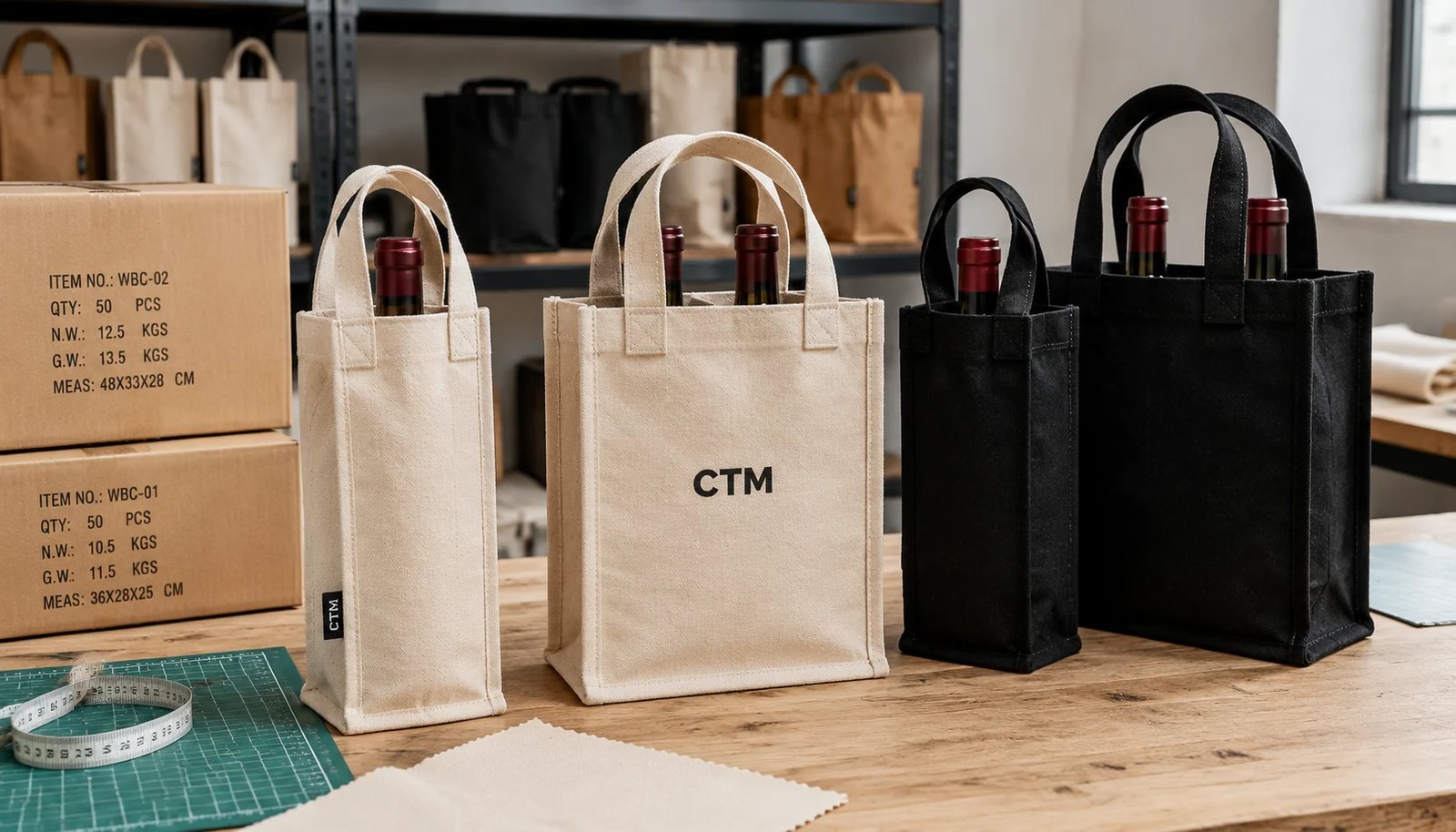
Why the carton packing plan should be set before you compare unit price
When liquor retailers source canvas wine carriers, piece price is only part of the buying decision. The bag still has to fit the intended bottle, hold the load safely, present well at checkout, and arrive in sellable condition. A quote that looks attractive on an ex-works basis can become costly once the cartons reach your warehouse with transfer marks, crushed handles, or gross weights your receiving team dislikes.
That is why the carton packing plan needs to be discussed at the same time as the bag spec. These products are soft goods built to carry rigid, heavy glass. They compress during packing, then take stress the moment a filled bottle is dropped in. If you approve the sample without defining the shipping condition, you leave too much room between what looked fine on the table and what actually works in stores.
For B2B procurement teams, the cleaner approach is to lock the functional spec and logistics spec together. Approve bottle fit, canvas GSM, handle reinforcement, print method, and finished dimensions alongside pieces per carton, gross-weight cap, board grade, liner requirement, pallet pattern, and shipping marks. Once those points are written into the RFQ, supplier offers become easier to compare and shortcuts are easier to spot.
- Use landed-cost logic, not piece-price logic only.
- Treat carton count, carton size, and gross weight as sourcing decisions, not shipping afterthoughts.
- Ask suppliers to quote with a written packing assumption so offers are truly comparable.
Start with bottle geometry, because '750 ml' is not a usable spec by itself
A canvas wine carrier should be built around the real bottle, not the category name. A 750 ml Bordeaux bottle, Burgundy bottle, Champagne bottle, prosecco bottle, or 700 ml spirits bottle may all sit in the same retail program, yet their diameters, shoulders, neck lengths, and filled weights differ enough to change the pattern. Those differences affect insertion ease, how the top opening sits, and where the seams take stress.
Many liquor retailers would prefer one universal bag because it simplifies ordering and store replenishment. Sometimes that works well. Sometimes it creates a bag that technically fits several bottles but feels awkward in use. If the approved pattern is based on a narrower bottle only, wider bottles can push the gusset out, distort the front panel, and shift the apparent print position once loaded. The bag may still pass a casual review while performing poorly in stores.
The better RFQ gives measurable bottle inputs. Include actual filled height, maximum body diameter, shoulder profile, and filled weight for each bottle family. Then state the presentation goal. Do you want the neck exposed for quick handoff at checkout, or a deeper set for gifting? Do you need the bag to stand when loaded, or is a softer drape acceptable? Those answers influence dimensions, base shape, and even carton cube once the bags are folded.
- Provide real bottle samples or dimensioned drawings when possible.
- Approve fit with the largest bottle in the range, not the most common bottle only.
- Record acceptable neck exposure and top opening appearance on the approved sample.
Write fabric specifications in measurable terms: composition, GSM, and tolerance
The word canvas is too broad for a purchase order. One supplier may quote 100% cotton canvas. Another may quote a recycled blend. Another may use a polyester-cotton construction and still describe it as canvas. Those options can all look similar in an email summary while performing differently in print quality, shrinkage, handfeel, and lot consistency.
For many single-bottle liquor retail programs, 320-340 GSM cotton canvas is a practical starting point. It usually gives enough structure for a filled bottle without creating unnecessary folding bulk. Lighter fabric can work for short promotions, but it needs closer review of seam construction and expected end use. Heavier 380-420 GSM fabric can create a more substantial feel, though it may reduce pieces per carton and raise gross weight faster than buyers expect.
Tolerance matters as much as the headline weight. If a PO says only '320 GSM,' the supplier still needs to know what variation is acceptable in bulk. Many buyers ask for a fabric tolerance around ±5% where factory capability supports it, but whatever standard you use, put it in writing. It also helps to request an expected finished bag weight range, since pattern size, strap width, and seam allowance can shift the final piece even when the base fabric appears close.
- State fabric composition explicitly, not just 'canvas.'
- Use GSM and oz together to reduce misunderstanding across markets.
- Require a written bulk tolerance for fabric weight and finished bag weight.
Focus on the true failure points: handles, base seams, and divider attachment
If a canvas wine carrier fails in use, the problem is usually structural rather than cosmetic. The load path starts with the bottle weight, passes through the base seam, and ends at the handle attachment points. Checkout staff may lift these bags repeatedly. Customers may carry them by one hand over short distances. That repeated stress concentrates at the lower corners, upper side area, and strap roots.
This is where vague wording becomes risky. Terms like 'strong handles' or 'reinforced stitching' do not tell your QC team what to inspect. A better spec names the handle material, cut width, finished width, number of folded layers, total length, handle drop, attachment length, and reinforcement method. For many liquor retail bags, a finished width around 2.5-3.5 cm is common, but width alone does not guarantee performance. The real question is how the strap is anchored and how consistently it is sewn.
Bottom construction deserves the same level of detail. A squared bottom with a sound seam allowance often distributes weight better than a narrow plain seam. If the bag must stand for gifting displays, an insert or base support panel may help, but it also adds cost and folding thickness. Two-bottle styles bring another variable: the divider. It should separate glass effectively without pulling loose from the base when both compartments are loaded.
- Define handle width, handle drop, attachment length, and reinforcement method in the PO.
- Treat bottom-corner seam quality as a functional checkpoint.
- For two-bottle bags, inspect divider attachment under load, not empty only.
Branding choices affect both appearance and packing performance
For most liquor retailers, screen printing remains the most practical branding method for canvas wine carriers. It is usually cost-effective for one-color and two-color logos, and it works well on standard cotton canvas when the art is not overly complex. In many factories, the print goes on the cut panel before sewing. That is efficient, but it also means the buyer should judge placement on the finished bag, not just on the flat panel.
On gusseted bags, small sewing variations can make a centered print look visually off once the bag is assembled. That is why placement tolerance should be measured from finished sewn reference points such as the top edge and side seam, rather than only from artwork position on the cut component. This simple change removes a lot of avoidable discussion later during inspection.
Print curing is directly linked to the carton packing plan. If ink is not cured properly, folded printed areas can transfer, block, or pick up lint during transit. Retailers that want no individual polybags need to be especially careful here. A useful approval flow is simple: review a strike-off, confirm curing, run a dry-rub check, and then review a packed-carton photo or mock pack showing which printed surfaces touch each other. Other logo methods can work too, but they should be quoted separately because they change cost, handling, and packing behavior.
- Measure print placement from finished sewn edges.
- Ask whether print faces will contact other bags inside the carton.
- Use no-poly packing only after curing and rub-resistance are verified.
Understand MOQ by separating fabric, print, and packing variables
MOQ can look confusing on this product because buyers often ask for one minimum while factories are managing several different thresholds. Fabric sourcing, dyeing, print setup, labels, and carton variation all influence what the supplier can produce efficiently. If the quote shows only a single MOQ figure, important cost drivers stay hidden.
Fabric color is often the first driver. Natural canvas and some stock shades, such as black, may be available with lower minimums. Custom-dyed colors usually introduce dye-lot minimums and color approval time. If a liquor retailer wants multiple seasonal shades, each color may effectively behave like its own program even if the bag size and construction stay unchanged.
Packing variation is another quiet MOQ driver. The bag body may be identical, but different barcode labels, destination marks, hang tags, or store-specific carton assortments still create extra handling steps. Those steps add labor and increase the chance of mixed SKUs. In many B2B programs, it is more efficient to standardize the construction and limit packing variants unless the distribution system clearly requires them.
- Ask for MOQ by color, artwork, label version, and carton-mark version.
- Consolidate construction when possible, then vary artwork only where necessary.
- Treat store-specific packing variants as a cost driver, not a free admin detail.
Build the master carton around gross weight, folded bulk, and warehouse reality
For single-bottle canvas wine carriers, suppliers may propose anything from 50 to 100 pieces per carton. That range is only a starting point. The best carton count depends on fabric weight, bag dimensions, handle bulk, divider construction, print sensitivity, and your receiving rules. A heavy two-bottle style should not be packed the same way as a light natural-canvas one-bottle bag.
The real question is not how many pieces can be forced into a carton. It is whether that carton stays manageable, stackable, and protective throughout the journey. Overpacked cartons can flatten handles, leave pressure marks on printed panels, and exceed preferred handling weight in the warehouse. Underfilled cartons waste cube and can increase corrugated cost per unit. Buyers should therefore set a target count range and a maximum gross weight before asking for final packing confirmation.
Carton specification needs to be documented just as clearly as the bag itself. For export programs, many buyers prefer a 5-ply carton with an inner liner, especially for sea shipment or humid routes. Request outer dimensions, piece count, net weight, gross weight, board construction, and sealing method in the quote. With those numbers, logistics teams can estimate pallet count and freight usage before the order is placed.
- State a maximum gross-weight cap per carton before quotation approval.
- Use lower carton counts for heavy canvas, two-bottle bags, or styles with inserts.
- Require carton dimensions and board construction in the supplier quote.
Take the packing plan one level further: pallet layout and container efficiency
A strong carton packing plan does not stop at the master carton. It should also show how those cartons behave on pallets or inside a container. Liquor retailers and distributors often receive on pallets, so carton dimensions that waste pallet space or create unstable stacks can add hidden labor and damage risk even if the carton itself is acceptable.
Before production starts, ask for a preliminary pallet layout based on the quoted carton size. Useful numbers include cartons per layer, layers per pallet, total pallet height, pallet gross weight, and pallet count for the order. If the goods will ship floor-loaded, the total CBM still needs to be calculated from the real carton dimensions rather than from assumptions. Small changes in carton length or width can materially change loading efficiency over a larger run.
This is also the right stage to approve shipping marks and external labels. If PO numbers, SKU labels, destination marks, or barcode formats are left open until goods are packed, rework becomes expensive very quickly. A disciplined B2B process signs off carton artwork and pallet label rules before bulk sealing begins.
- Request estimated pallet count and total CBM with the quotation.
- Check pallet overhang and height against warehouse rules.
- Approve shipping marks before the first production carton is sealed.
Approve the sample in loaded form and in packed form
A pre-production sample is useful, but it does not prove the order unless you review it in the same condition the goods will be used and shipped. For canvas wine carriers, that means approving final fabric, final print or label method, final handle construction, and bottle fit with a real filled bottle. Then it means checking how the bags will actually be folded and packed.
Loaded evaluation matters because empty bags hide problems. A bag can look symmetrical on the table and then twist once the bottle is inserted. The top opening may become too tight. The base may sag. The handles may pull at an angle that feels awkward in hand. These issues are easy to miss if the sample review stops at appearance only.
For larger runs, a packing mock-up or packed-carton sample is worth requesting. It helps catch print-to-print contact, crushed handles, omitted liners, weak carton corners, or inconsistent fold direction before thousands of units are sealed. From a claims-prevention standpoint, approving the shipping condition in advance gives the buyer a much stronger reference for final inspection.
- Approve with a real filled bottle, not a flat or empty sample only.
- Review folding direction and print contact in a carton mock pack.
- Keep sealed reference samples at both buyer and factory.
Use QC checkpoints that match real retail complaints and receiving failures
Quality control for canvas wine carriers should mirror the way the product fails in real retail use. In practice, that means focusing on bottle fit, seam security, handle performance, print condition, count accuracy, and carton integrity. Cosmetic consistency still matters, but it should not distract from structural issues that make the product unusable or slow down receiving.
Start with dimensional control on finished sewn bags. Measure height, width, gusset depth, base width, top opening, handle total length, and handle drop against the approved spec. Slight textile variation is normal, but the tolerance needs to be agreed before bulk production starts. A small dimensional miss can become a real defect when the intended bottle binds during insertion or strains the side panel once loaded.
Load verification should use the intended bottle weight or an equivalent test load. Inspect for seam opening, thread breakage, handle distortion, lower-corner stress, and divider pull where applicable. Then move to print checks: color, coverage, edge quality, placement on the finished bag, and dry-rub resistance. Finally, inspect packed cartons for count, liner use, fold consistency, carton marks, and gross weight. If no-poly packing is specified, open random cartons and check the actual contact surfaces for transfer or blocking.
- Classify handle failure, seam opening, severe transfer, wrong count, and mixed labeling as major defects.
- Measure on finished sewn goods, not on cut panels or art files.
- Inspect random packed cartons, not finished bags only.
Specification comparison for buyers
| Spec decision | Recommended option | When it fits | Buyer risk to check |
|---|---|---|---|
| Primary bottle fit | Approve pattern against the largest actual bottle in the program, using filled bottle dimensions and weight | Liquor retailers carrying Bordeaux, Burgundy, Champagne, prosecco, or 700-750 ml spirits in one shared bag program | A bag approved on an empty sample can bind at the shoulder, flare at the top, or overload seams once a full bottle is inserted |
| Fabric weight | 320-340 GSM cotton canvas for mainstream single-bottle retail programs; 380-420 GSM only when a heavier handfeel is required | Good balance of structure, folding bulk, print surface, and carton efficiency for most checkout and gifting use | Generic 'heavy canvas' wording can hide lighter fabric substitution; require GSM tolerance and finished bag weight check |
| Fabric composition | 100% cotton canvas or clearly declared recycled-cotton blend with stated percentage | Programs where print result, shrinkage, and customer handfeel matter | Unstated blends can alter strength, shrinkage, color uptake, and print adhesion |
| Bottom structure | Squared bottom with reinforced bottom seam; optional bottom insert only when stand-up presentation is required | Single-bottle carriers that need reliable load distribution without excessive bulk | An insert can improve shape but adds cost, fold thickness, and carton cube; weak seam without insert still fails under load |
| Handle construction | Self-fabric handles, finished width 2.5-3.5 cm, with box-X or bartack reinforcement and defined stitch count | Retail checkout use, repeat loading by staff, and reusable customer take-home bags | Handle width, attachment length, and reinforcement are often quoted vaguely; 'double stitch' alone is not enough detail |
| Divider decision | No divider for one bottle; stitched center divider for two-bottle bags; padded divider only when glass collision risk justifies it | Two-bottle gifting, mixed bottle bundles, and premium presentation | A thin divider can look compliant but provide little separation; divider seam pull at bottom must be checked |
| Logo method | 1-color or 2-color screen print on cut panel before sewing for most retail logos | Programs needing economical branding, repeatability, and broad color coverage | Finished-bag placement can visually shift after sewing; agree tolerance from top and side seams on sewn bag |
| Individual packing | No individual polybag with carton liner, or recycled polybag only if retailer receiving or print protection requires it | Sustainability-focused retail programs with fully cured print and clean receiving conditions | No-poly packing increases risk of ink transfer, dust pickup, and humidity marks if curing or liner protection is weak |
| Master carton count | 50-80 pcs per carton for most single-bottle styles; 20-40 pcs for heavy canvas or two-bottle styles | Warehouse receiving where cartons must stay manageable and stackable | Too many pieces can push gross weight too high, flatten handles, and distort gussets |
Buyer checklist before sampling
- List every bottle format the carrier must fit, including nominal fill size, actual filled height, maximum body diameter, shoulder shape, and filled weight. Do not use bottle category names alone.
- State whether one universal bag must fit multiple bottle families or whether separate SKUs are acceptable for Bordeaux, Burgundy, Champagne, or spirits.
- Specify target fabric composition and weight, for example 100% cotton canvas at 320-340 GSM, and require bulk fabric tolerance such as ±5% GSM or an agreed finished-piece weight range.
- Define finished bag dimensions with tolerances after sewing, including body height, body width, gusset depth, bottom width, top opening, handle total length, and handle drop.
- Set handle requirements: strap construction, finished width, attachment length, reinforcement type, thread type, stitch density or minimum stitch quality expectation, and whether raw edges are allowed on the inside.
- State bottom construction clearly: plain seam, reinforced seam, boxed corner, base panel, or removable insert. If the bag must stand on shelf, say so explicitly.
- Provide artwork as vector files with Pantone or approved color reference, print size, location from finished seams, color count, and acceptable print placement tolerance on the sewn bag.
- Decide in advance whether no-poly packing is acceptable. If yes, require cured-ink verification, carton liner, clean folding method, and packed-carton photo approval.
- Set master carton rules before quoting: target pieces per carton, maximum gross weight, board grade, moisture liner, carton sealing tape width, and required shipping marks.
- Request a packing layout that shows fold direction, print-to-print contact points, handle placement, liner use, and carton dimensions. This should be approved before mass packing.
Factory quote questions to send
- What exact fabric composition are you quoting, and what bulk fabric weight tolerance can you hold? Please state GSM, oz equivalent, and expected finished bag weight.
- What bottle dimensions and filled weight was your quoted pattern built for? Please provide maximum recommended bottle diameter, body height, and neck exposure on the finished bag.
- What are the finished bag dimensions after sewing, and what tolerance will you apply to height, width, gusset, and handle drop in bulk production?
- What handle specification is included in the quote: cut width, finished width, number of layers, attachment length, reinforcement method, thread count or thread type, and sewing machine process?
- What internal load test do you use for this style? Please describe test weight, lift duration, number of cycles if any, and pass/fail standard for handle attachment and bottom seam.
- Is the print applied before sewing or after sewing? What placement tolerance can you hold on the finished gusseted bag, measured from top edge and side seam?
- What ink system are you using, how is it cured, and what rub-resistance check do you perform before approving no-polybag packing?
- How many pieces per master carton are included in the quote, and what are the carton outer dimensions, net weight, gross weight, and board construction?
- Is the quoted carton 3-ply or 5-ply, what liner or flute grade is proposed, and is a moisture barrier liner included for sea shipment?
- Can you provide estimated cartons per pallet, pallet height, and total CBM based on the quoted carton size so we can compare logistics cost accurately?
Quality-control points to confirm
- Measure finished bag height, width, gusset, top opening, base width, handle total length, and handle drop against approved spec. Record actual measurements and compare with written tolerances.
- Verify fabric identity and weight against approval standard. If fabric testing is outsourced, confirm composition report or mill declaration matches the PO.
- Perform bottle-fit verification using the intended filled bottle or approved dummy of equivalent dimensions and weight. Check insertion ease, neck exposure, top opening shape, and side-panel strain.
- Load check handle and base assembly with the intended bottle weight. Inspect for stitch opening, thread breakage, seam grin, bottom distortion, and excessive handle angle change after lifting.
- Inspect handle reinforcement for skipped stitches, incomplete box-X, weak bartacks, short attachment length, uneven strap width, exposed raw folds, and loose thread tails at stress points.
- Check side seams, bottom seams, and divider seams for seam allowance consistency, raw-edge fray, needle damage, puckering, and asymmetry that affects bottle sit or visual presentation.
- Verify print color, coverage, edge sharpness, opacity on dark and light canvas as applicable, curing, and finished-bag placement from sewn edges rather than from flat panels alone.
- Run a dry-rub check on dark ink areas when no-polybag packing is planned. Also inspect packed contact surfaces for transfer, blocking, lint pickup, or pressure marking.
- Confirm labels, barcode stickers, warning labels, hang tags, and side labels match the PO and are positioned consistently without twisting, logo obstruction, or incorrect SKU assignment.
- Open random cartons to verify actual count, folding direction, print-facing arrangement, liner use, moisture protection, desiccant requirement if specified, carton mark accuracy, and sealing consistency.