Why Lead Time Fails on Bookstore Wine Carriers
Canvas wine carriers look simple, but university bookstore orders usually involve more approval points than a plain promotional bag. The product may carry a licensed mark, an alumni association logo, a bookstore logo, or artwork tied to a graduation, homecoming, donor event, or local vendor program. Each approval step can be short by itself, but together they create the real schedule.
The common planning mistake is to count only the sewing lead time after purchase order release. For an imported canvas wine carrier, the calendar should include artwork cleanup, fabric confirmation, strike-off printing, pre-production sample approval, bulk material booking, cutting, sewing, printing or print-panel sequencing, final inspection, export packing, ocean or air freight, customs, and delivery to the bookstore or distribution center.
- For a fixed campus event, plan backward from the required in-store date, not the factory shipment date.
- For licensed artwork, add internal approval time before bulk printing starts.
- For first-time wine carrier styles, allow more sample time than a repeat tote bag order.
- For multi-campus distribution, add time for carton marks, store allocation labels, and receiving instructions.
Start With the Retail Use, Not the Bag Shape
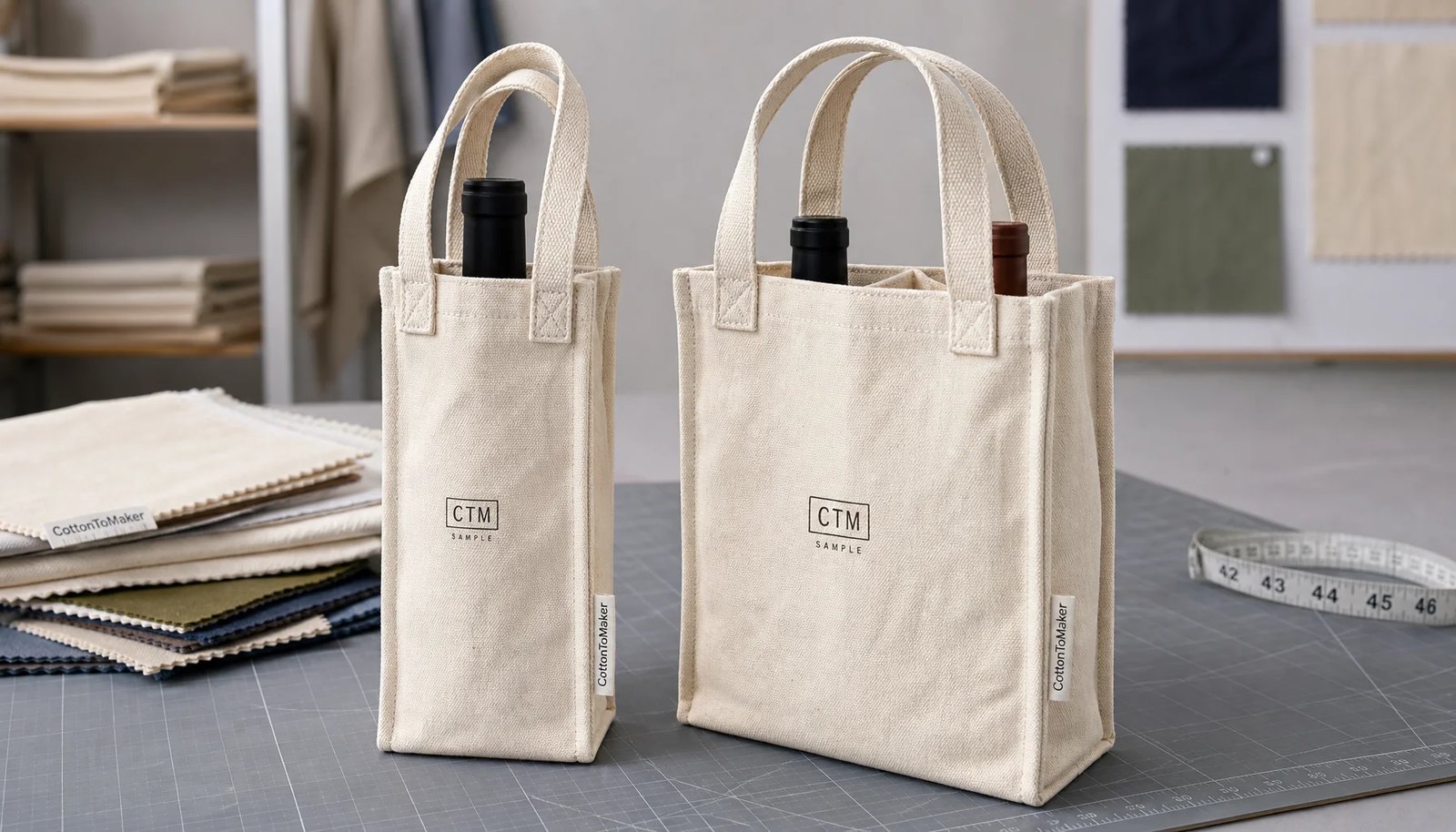
A bookstore wine carrier can be a gift wrap item, a reusable retail package, a donor event giveaway, or a paid merchandise accessory. Each use points to a different construction. A wine gift table may need a bag that stands upright empty and photographs well on shelves. A carrier bundled with bottles needs better divider control and handle strength. A low-cost checkout add-on may accept lighter fabric but still needs clean print and reliable stitching.
Before requesting prices, define the selling or distribution situation. The supplier can then recommend the right fabric, divider, handle, and packing method. Without that context, quotes will drift toward the cheapest interpretation of 'canvas wine bag', which often means thinner material, weak handle reinforcement, and no allowance for retail presentation.
- Single-bottle carrier: better for simple gifting, lower freight volume, and smaller retail price points.
- Two-bottle carrier: better for alumni bundles, holiday packs, and premium presentation, but needs a real divider.
- Tall narrow profile: useful for standard 750 ml bottles but must be checked against wider local bottles.
- Flat-bottom construction: improves shelf display but increases sewing steps and packing volume.
Fabric Weight and GSM Choices That Change the Schedule
For university bookstore retail quality, 10 oz to 12 oz cotton canvas, roughly 340 to 407 GSM, is a practical starting range. It has enough body for a wine bottle and enough surface stability for screen printing. Lighter canvas can work for giveaway-level budgets, but it wrinkles more easily and may feel out of place beside licensed apparel, drinkware, and gift merchandise.
Fabric choice affects lead time because mills may not hold every weight, color, and finish in stock. Natural canvas is usually faster than custom-dyed canvas. Bleached white can improve print brightness but may show dirt during handling. Dyed campus colors can be attractive, but they add color matching risk, lab dip approval, and possible minimum fabric requirements.
- Use 10 oz canvas when the buyer wants balanced cost, printability, and retail feel.
- Use 12 oz canvas when the bag must stand better on shelf or support premium gift positioning.
- Avoid quoting only by fabric name; write both oz and GSM in the RFQ.
- Request the supplier's available stock colors before building a schedule around custom dyeing.
Artwork and Print Proofing Can Control the Critical Path
Campus logos often contain fine lines, small type, outlines, mascots, or shield details. On canvas, the woven surface is less smooth than paper or coated polyester, so very small elements can fill in or look rough. Screen printing is usually the most stable method for one to three solid colors. Heat transfer may be useful for gradients or small multicolor graphics, but buyers should evaluate hand feel, edge durability, and whether the finish matches the bookstore's merchandise standards.
The proofing route should be written into the schedule. A digital mockup is useful for layout, but it is not proof that ink will sit correctly on the chosen canvas. A print strike-off on the selected fabric is the safer approval point for logo size, color, and edge clarity. Bulk printing should not start until the bookstore or licensing reviewer signs the strike-off or pre-production sample.
- Provide vector artwork with fonts outlined and Pantone references listed.
- State print size in inches or centimeters, not only 'front logo'.
- Measure logo position from the top opening, side seam, and bottom edge on the finished bag.
- Approve a physical strike-off if school color accuracy matters.
MOQ Logic for Campus Retail Programs
Minimum order quantity is not just a supplier preference. It is connected to fabric purchasing, cutting efficiency, print setup, line scheduling, and packing labor. For canvas wine carriers, 500 to 1,000 pieces per artwork or color is often more efficient than very small runs. Smaller quantities can be possible, but the unit price may rise because setup time and material handling are spread across fewer bags.
University bookstores should compare MOQ against the sales window. A graduation or holiday carrier may sell strongly for a few weeks and then slow down. A school-branded evergreen wine carrier may reorder in smaller batches if the supplier can reserve fabric and screens. The RFQ should separate first order MOQ, reorder MOQ, and mixed artwork rules so buyers can plan without overstocking.
- Clarify whether MOQ applies per style, per fabric color, per print artwork, or per shipment.
- Ask if multiple bookstore logos can share one fabric lot but require separate print setup charges.
- Use annual forecast data to negotiate repeat-order flexibility instead of forcing one large first order.
- Treat very low MOQ offers carefully when print quality and fabric consistency are important.
Sample Approval Should Mirror Bulk Production
A useful sample is not only a pretty reference photo. It should answer the technical questions that can become bulk defects: does the bottle fit, does the divider stop glass contact, does the handle feel balanced, does the logo sit straight after sewing, and does the bag look good when packed and unpacked? The sample should use the quoted fabric weight or a clearly labeled substitute if final fabric is not yet available.
The safest sequence is digital layout, material swatch, print strike-off, then pre-production sample. For repeat orders, the buyer may shorten the sequence, but only when the same fabric, artwork, size, and supplier line are being used. For first orders tied to a dated event, skipping sample steps may appear to save time but often creates a larger delay when bulk goods need sorting or rework.
- Test the sample with the actual bottle diameter and height expected in store.
- Check whether the loaded bag hangs straight or twists from handle imbalance.
- Review the inside divider seam, not only the front print.
- Keep one signed approval sample at the factory and one with the buyer for inspection comparison.
Packing Choices Affect Store Readiness
Wine carriers are often handled by receiving staff who are not part of the original buying conversation. Packing must therefore support easy counting, clean storage, and quick replenishment. Flat packing is common, but heavy compression can crease canvas and leave fold marks across printed panels. For retail presentation, the front panel should arrive clean, the logo should not be rubbed by rough carton surfaces, and the bags should be grouped by artwork and color.
Polybag policy should be decided early. Some bookstores want individual polybags for dust protection and barcode handling. Others avoid individual plastic and prefer bulk inner packs with paper bands or recyclable protection. Either route can work, but it must be quoted and tested because packing method affects labor, carton size, freight volume, and receiving speed.
- Define pieces per inner pack and pieces per master carton.
- Require carton marks that identify style, artwork, color, quantity, and purchase order number.
- Avoid carton weights that are uncomfortable for bookstore receiving teams.
- Add barcode stickers or hangtags only after placement and scan requirements are confirmed.
Build the Lead Time Calendar From Approval Gates
A practical import schedule for a first-time canvas wine carrier is often 10 to 14 weeks from final artwork and sample approval to in-warehouse delivery, depending on shipping method and season. That does not mean every factory needs 14 weeks to sew the goods. It means the buyer's real calendar must include decisions that happen before and after sewing.
The lead time should be divided into gates: RFQ data completion, sample production, sample review, bulk material booking, production, inspection, export, international freight, customs, and domestic delivery. When each gate has an owner and due date, the buyer can see where the schedule is at risk. This is more useful than a single promise such as 'production lead time 30 days'.
- RFQ and quote comparison: allow several working days if artwork and packing data are complete.
- Sampling and strike-off: allow time for courier transit and campus approval routing.
- Bulk production: count from signed pre-production sample and deposit, not from first email.
- Freight and delivery: separate factory completion date from bookstore receiving date.
Quote Data Needed to Compare Suppliers Fairly
Two canvas wine carrier quotes can look close on unit price while representing different products. One may include 12 oz canvas, reinforced handles, screen setup, export cartons, and pre-shipment inspection support. Another may use lighter canvas, exclude setup charges, or assume bulk packing that the bookstore cannot use. Procurement teams need quote data in comparable lines, not only a total price.
A strong supplier quote should identify material, construction, print, sample, MOQ, packing, carton data, production lead time, and trade terms. If freight is being compared, carton dimensions and gross weight are essential because a stiff two-bottle carrier can occupy more volume than expected. Landed cost decisions should include duties, freight, domestic delivery, receiving labor, and overstock risk.
- Separate unit price, screen charge, sample charge, and packing adders.
- Request carton size, quantity per carton, net weight, and gross weight before freight comparison.
- Confirm whether the price is EXW, FOB, CIF, DDP, or another term.
- Compare suppliers using the same fabric weight, print size, and packing method.
QC Thresholds for a Retail-Ready Wine Carrier
Quality control should focus on the defects that affect safety, brand presentation, and receiving efficiency. For wine carriers, the high-risk areas are handle attachment, divider construction, bottle fit, print placement, print durability, fabric stains, and carton compression. A cosmetic tolerance may be acceptable for natural canvas slubs, but loose stitching at the handle is not acceptable because the loaded bag carries glass.
The inspection standard should be agreed before production. Buyers can use a general random inspection approach, but the checklist should include product-specific tests. A simple loaded carry test, bottle fit test, logo position measurement, and carton drop review can prevent many avoidable claims. The approved sample should remain the reference for fabric hand feel, print color, stitching layout, and overall finish.
- Reject handle stitching with skipped stitches, broken thread, loose bartacks, or weak box stitching.
- Measure finished dimensions and handle drop against the approved sample and specification sheet.
- Inspect divider seams for height, alignment, and separation function.
- Check print edges for cracking, smudging, pinholes, color shift, and incorrect placement.
Specification comparison for buyers
| Spec decision | Recommended option | When it fits | Buyer risk to check |
|---|---|---|---|
| Fabric weight for bookstore retail use | 10 oz to 12 oz cotton canvas, approximately 340 to 407 GSM | Suitable for one or two standard 750 ml bottles and gives enough body for shelf display | Thin 6 oz to 8 oz canvas may reduce unit cost but can sag, wrinkle, and look underbuilt next to licensed merchandise |
| Bottle capacity and divider structure | Single-bottle carrier for gift tables; two-bottle carrier with stitched divider for alumni and holiday bundles | Use single-bottle units for wine club gifts and two-bottle units for higher basket value promotions | Loose or short dividers allow glass bottles to knock together during retail handling and customer carryout |
| Print method for campus marks | Screen print for solid one to three color logos; heat transfer only for complex small graphics | Best when the bookstore needs school color control and repeated reorders | Fine crest details can fill in on coarse canvas unless artwork is simplified and strike-off approved |
| Handle construction | Self-fabric canvas handles with box stitching or reinforced bartack | Works for retail bags expected to carry bottle weight without a disposable feel | Handle drop, stitch density, and thread strength are often missing from low-price quotes |
| MOQ planning | Plan 500 to 1,000 pieces per color or artwork for efficient production, with a smaller test run only if surcharge is accepted | Fits semester campaigns, alumni weekends, holiday gift tables, and regional bookstore distribution | Very low MOQ quotes may hide higher print setup cost, local blank sourcing, or inconsistent fabric lots |
| Packing format | Flat packed with paper divider protection, then export carton by artwork and color | Best for bookstore receiving teams that need easy count verification and clean shelf replenishment | Over-compressed cartons can crease canvas panels and distort printed areas before display |
| Sampling route | Digital layout first, fabric and print strike-off next, pre-production sample before bulk cutting | Needed when logos, school colors, and licensed marks require internal approval | Skipping the pre-production sample saves a few days but can lock in wrong logo position or weak divider construction |
| Lead time buffer | Build a 10 to 14 week calendar from final artwork approval to in-warehouse date for import orders | Realistic for campus retail launches tied to graduation, homecoming, holidays, or local wine events | Counting only factory sewing time ignores proofing, material booking, inspection, customs, and domestic delivery |
Buyer checklist before sampling
- Define the launch date, in-store date, and required receiving date before requesting quotes.
- Specify bottle count, bottle size, divider type, finished bag dimensions, and handle drop.
- State fabric weight in oz and GSM, not only 'canvas', so suppliers quote comparable material.
- Provide artwork files, Pantone references, print size, print location, and licensed logo rules.
- Decide whether the carrier must stand upright empty for shelf display or only function as a carry bag.
- Require a print strike-off on the selected canvas before approving bulk printing.
- List packing requirements by unit, inner pack, carton count, carton marks, and barcode needs.
- Request production lead time from approved pre-production sample, not from initial inquiry date.
- Confirm whether quote includes sample cost, mold or screen charge, export carton, and inspection support.
- Reserve time for bookstore, licensing, athletics, or alumni department approval if campus marks are used.
Factory quote questions to send
- What fabric weight in oz and GSM is included in the quote, and is it greige, dyed, bleached, or natural canvas?
- What are the finished dimensions, handle width, handle drop, divider height, and divider stitching method?
- Which print method is quoted, how many colors are included, and what is the maximum print area?
- Is the quoted MOQ per order, per color, per artwork, or per shipping carton configuration?
- What is the sample sequence and timing for blank sample, print strike-off, and pre-production sample?
- When does the production lead time start: deposit date, artwork approval, material arrival, or signed pre-production sample?
- What packing is included, including polybag policy, carton size, carton weight, divider protection, and carton labeling?
- What QC checkpoints are performed for fabric defects, print color, stitching strength, divider position, and carton counts?
- What quote data can be separated for unit price, setup charge, sample charge, inland freight, export fees, and shipping terms?
- What production capacity is reserved during peak campus retail season, and how long is the quotation valid?
Quality-control points to confirm
- Fabric weight must be checked against approved swatch with tolerance agreed before bulk cutting.
- Finished dimensions should stay within a practical tolerance such as plus or minus 5 mm for key panels and handle drop.
- Print color should be compared against approved Pantone or signed strike-off under consistent light, not from phone photos only.
- Logo position should be measured from top edge and side seam on the sewn bag, not only from the flat panel artwork.
- Handle attachment should use reinforced stitching with no skipped stitches, loose thread loops, or cracked print under stress.
- Divider height and seam alignment should prevent bottle contact during normal retail handling.
- Cartons should be clean, dry, correctly marked, and not packed so tightly that front panels arrive creased.
- Random inspection should include bottle fit testing with the buyer's target bottle shape where possible.