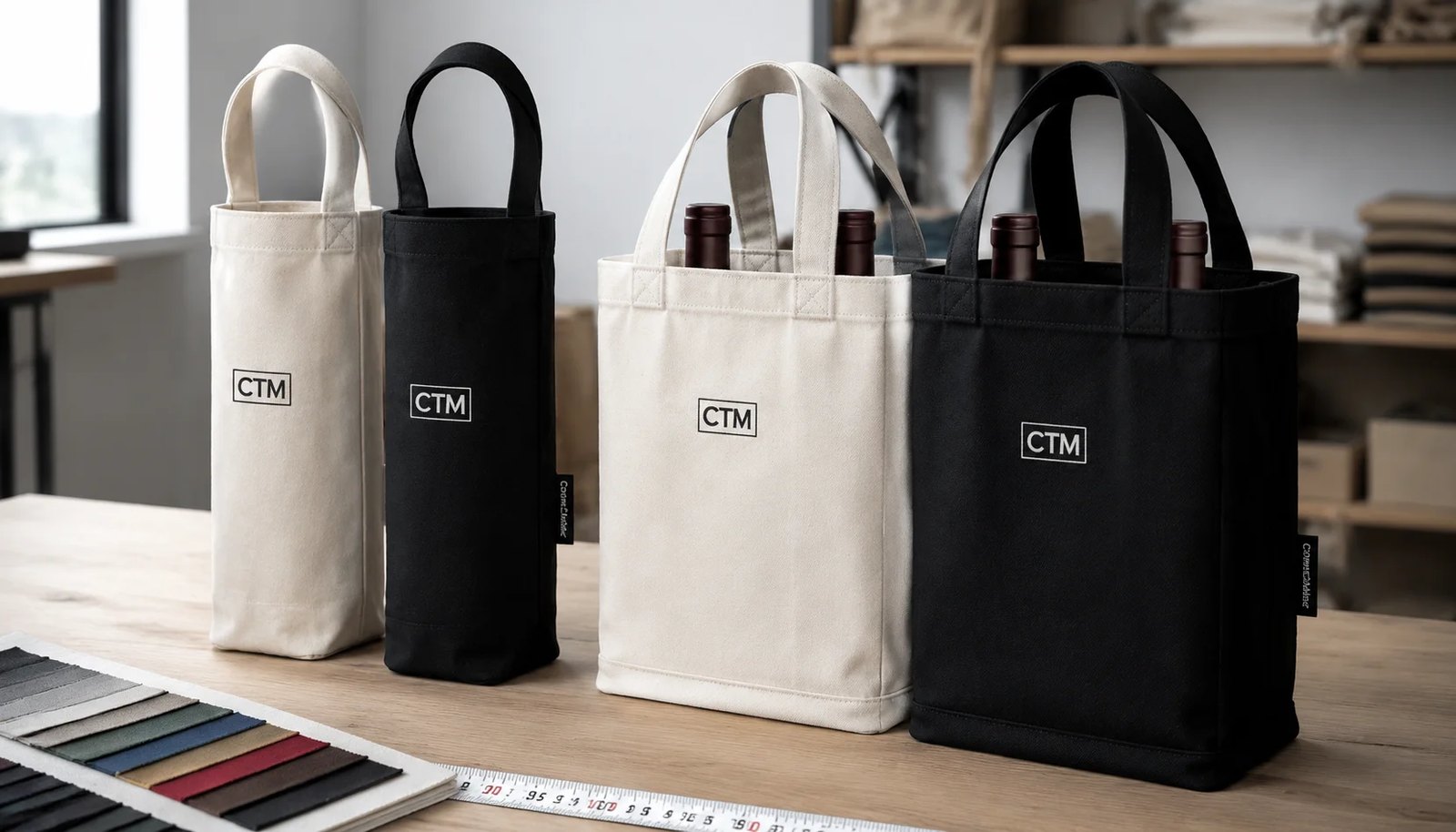
Why lead time goes wrong on canvas wine carrier orders
Canvas wine carriers look straightforward, but they often run late because buyers treat them like basic totes. They are not. Bottle format changes the base, gusset, handle load, and divider construction. Retail launch timing also tends to be seasonal: holiday gifting, winery tourism, corporate gifting, and in-store promotions all create peak pressure on sewing lines and printing schedules. A quote that says 30 days is not a full schedule. It is usually only the bulk production window after approvals are complete and materials are ready.
The main planning mistake is compressing pre-production decisions into the production window. If bottle size, print file, fabric color, and packing details are still moving, the factory cannot reserve material or finalize markers. For liquor retailers and distributors, that usually means the order enters the line later than expected, and any issue found at PP sample stage pushes shipment again. Lead time planning works best when the buying team separates design-final date, sample-approval date, bulk start, inspection booking, and ex-factory target instead of asking for one promise date.
- Common hidden delays: waiting for final bottle dimensions, custom dyed fabric, unapproved print artwork, hangtag sourcing, and mixed-SKU carton planning
- Peak periods often affect sewing and printing more than fabric supply
- Shorter quoted lead time is not useful if approval gates are missing from the schedule
Start with the bottle and retail use case, not the bag
A single-bottle wine carrier for standard 750 ml Bordeaux bottles has very different requirements from a two-bottle carrier for mixed wine and spirits gifting. If the retailer may use the same bag for sparkling wine, wider Burgundy bottles, or tall olive oil bottles, the dimensions need to reflect the largest approved format. Otherwise the factory will sample to one bottle and the store team will later discover tight fit, poor balance, or top exposure. That is not a sewing defect; it is an incomplete brief.
The first RFQ line should state actual bottle dimensions and intended use: in-store gift wrap add-on, retail merchandise, event giveaway, winery direct sales, or distributor holiday set. This determines whether the carrier needs a divider, stronger webbing handle, wider base, or cleaner print presentation. Buyers who only send a rough bag size usually receive quotes that are impossible to compare because each supplier assumes a different bottle profile and strength requirement.
- Specify bottle height, body diameter, and whether the neck must sit above or below the bag opening
- State if the bag is for one-way gift presentation or repeated consumer reuse
- For spirit bottles, note if glass is square, heavy-base, or unusually wide
- If using tissue, insert cards, or gift filler inside, include that in dimension planning
Fabric GSM and construction choices that affect schedule and sell-through
For most wine retail programs, 12 oz to 14 oz canvas, roughly 340 to 400 GSM, is the practical range. It gives enough body to stand better on shelf and support bottle weight without moving into an overly heavy premium build. Lighter 8 oz to 10 oz fabric can work for low-cost promotions, but it tends to wrinkle more, show bottle corners, and feel less substantial in-store. Heavier 16 oz and above may be justified for premium gifting, yet freight cost and sewing difficulty rise, especially on seams with dividers and folded handles.
Fabric choice also affects speed. Natural canvas programs are generally simpler because they avoid fabric dyeing lead time and shade approvals. Dyed black or navy can be efficient if the mill or factory keeps stock greige and repeat shades, but custom color matching introduces extra steps. If the brand needs exact color coordination with holiday packaging, put that into the timeline from the start. A late request to match Pantone on dyed canvas can disrupt the entire calendar more than any sewing issue.
- Typical commercial range: 340 to 400 GSM for structured wine carriers
- Natural canvas usually has the least color risk and often shorter material prep time
- Dyed canvas may need shade band approval if color consistency matters across store sets
- Open seams, heavy fabric bulk, and needle marks become more visible as GSM rises
Print method decisions that change both cost and lead time
Most retail wine carrier logos are best handled by screen print. It gives good opacity on canvas, stable per-unit cost at volume, and a durable look for simple branding. It also works well for one- or two-color seasonal graphics. Heat transfer is useful for complex artwork, photos, or very short runs, but textured canvas can make transfer edges more visible and adhesion less forgiving. Digital direct print is possible on some cotton constructions, though output consistency depends on pretreatment and is less common for basic bag factories focused on sewn goods.
From a scheduling perspective, screen printing requires approved artwork separation, screen setup, and often a strike-off if color or placement matters. This is manageable if planned early. Problems start when the buyer sends low-resolution artwork, changes print size after prototype approval, or adds a second print position on gusset or back panel after the quote is issued. Those changes can affect both setup and sewing sequence, especially if the bag body must be printed before certain seams are closed.
- Best default for bulk retail orders: one-color or two-color screen print
- Request a print strike-off when coverage, line thickness, or dark fabric opacity matters
- Define print placement tolerance, for example plus or minus 5 mm from approved centerline
- Large solid areas on canvas may need underbase or multiple passes, affecting cost and drying time
MOQ logic: where buyers misread the quote
MOQ on canvas wine carriers is rarely just one number. Buyers should separate fabric MOQ, print MOQ, and SKU-level sewing economics. A supplier may say 1,000 pieces MOQ, but that can mean 1,000 pieces of one fabric color with one print setup, not 250 pieces each across four different sizes. If your retail assortment includes single-bottle, double-bottle, and black or natural variants, the real MOQ structure may change the unit price sharply.
The easiest way to compare suppliers is to quote the same demand pattern: for example, 3,000 total pieces split across two SKUs, one natural fabric, one print artwork, packed by SKU. Then ask for break pricing at 1,000, 3,000, and 5,000 pieces. This exposes whether the supplier is pricing efficiently from material utilization and screen setup, or simply giving a flat estimate. For importers, this also helps evaluate whether consolidating SKUs into one fabric color saves enough to offset any merchandising compromise.
- Ask whether MOQ is per style, per color, per artwork, or per shipment
- Mixed-SKU programs may still work if dimensions are close and fabric/print are shared
- Very low MOQ quotes often exclude PP sample, custom labels, or exact packing work
- Request volume tiers so procurement can compare the marginal savings of larger commitments
A practical timeline from RFQ to ex-factory shipment
A workable schedule for imported canvas wine carriers usually includes more than the factory's bulk lead time. A typical path may look like this: 2 to 5 days for quote alignment and artwork review, 5 to 10 days for prototype or revised sample if dimensions are still open, 3 to 7 days for print strike-off or label approval, 5 to 7 days for PP sample, 25 to 40 days for bulk production depending on quantity and complexity, then inspection and booking. This is not a promise; it is a planning frame. The exact timing depends on whether materials are stock, how many SKUs are in the order, and whether packing is basic export or retail-ready.
The biggest timing gain usually comes from reducing approval loops, not pressuring the factory after materials are committed. If you need a fixed in-store date, move decisions earlier rather than demanding a shorter bulk lead time. For example, approving natural fabric instead of custom dyed black might save more time than cutting one week from sewing. Likewise, using one-color screen print with standard side label is usually faster than adding woven neck tags, swing tags, and insert cards supplied by separate vendors.
- Build in courier time if physical samples must move internationally
- Reserve inspection window before the final week if shipment is date-critical
- Bulk lead time often starts only after PP sample and deposit approval
- Packing extras can add labor days even when sewing is already complete
Sample approval: what to verify before bulk starts
Sample stage is where buyers can prevent most delivery disputes. A prototype confirms concept, but the PP sample should be treated as the manufacturing standard. It needs the agreed fabric weight, print method, thread color, handle construction, divider treatment, labels, and packing notes wherever possible. If the PP sample is made from substitute material because stock was not ready, note that clearly and approve only the dimensions and construction points that can be judged fairly.
For wine carriers, load behavior matters more than a flat table look. The PP sample should be evaluated with the actual bottle or an agreed bottle equivalent placed inside. Look at opening width, bag balance while carried, divider movement in a two-bottle format, and whether the print distorts around the bottle curve. This is where many buyers notice that the handle drop is too short for easy carrying or that the base depth is insufficient for a wider bottle type.
- Measure body width, height, gusset, and handle drop against approved tolerance
- Test with the actual intended bottle format, not only empty bag dimensions
- Review print position on both empty and loaded bag condition
- Confirm labels, barcode placement, carton marks, and any retail ticketing before bulk starts
Packing details that can quietly add cost and delay
Packing is often treated as an afterthought, but for retail programs it can reshape the production schedule. Flat-packed export packing is the fastest and cheapest route: a set quantity per polybag if needed, then master cartons by SKU. Once the buyer adds insert cards, hangtags, barcode stickers, tissue stuffing, or pre-formed retail presentation, labor increases and line balancing changes. These are not small extras when quantities are large.
Procurement teams should evaluate whether value-added packing is better done at origin or in the destination market. If the destination DC can apply hangtags or insert bottle care cards at lower risk, origin packing can stay simple and the factory can focus on sewing consistency. But if the retailer requires exact store-ready receipt by SKU and barcode, put that into the RFQ and quote comparison from the start. A cheap unit price is misleading if one supplier excludes the final presentation work your DC must still pay for.
- Flat pack lowers cube and usually shortens finishing time
- Barcode sticker location should be defined to avoid covering logo area or seam line
- Carton gross weight matters if using denser 14 oz plus fabric in large quantities
- Mixed carton assortments save storage steps for some retailers but increase factory packing complexity
Quality control thresholds that matter for retail bag programs
Retail buyers usually focus on visible defects first, but wine carriers also need functional thresholds. Handle pull strength, divider stability, and seam integrity under load should be part of approval language. A carrier that looks clean in carton photos can still fail in use if reinforcement is weak or stitch density is inconsistent. Because bottle weight is concentrated, stress appears at handle insertion points and the upper side seam much faster than on standard promotional totes.
It helps to define acceptance criteria in commercial language rather than broad statements like 'good quality.' For example, no major print smudging on front panel, no skipped stitches longer than an agreed length, paired handles within a specified length tolerance, and no seam opening after an agreed static load test using a filled bottle equivalent. Even if the order is inspected to a normal AQL, these functional criteria tell the factory what matters most and reduce the risk of debating defects after arrival.
- Focus QC on front-panel print area, handle reinforcement, top opening width, and gusset stitching
- Use a loaded-bag review during inspection for at least a sampling of units
- Natural canvas can contain small slubs; decide what is acceptable on print-facing panels
- Request measurement records for critical points on first bulk run of a new style
Comparing quotes beyond unit price: landed-cost thinking
A supplier that is lower on ex-factory price may still be more expensive once freight, rework, and schedule risk are included. Heavier fabric raises carton weight. More rigid retail packing increases cube. A custom dyed black bag with transfer print may appear premium, but if it introduces extra approvals and a split shipment risk, the margin benefit can disappear during peak season. Buyers should compare quotes line by line: fabric GSM, print colors, label type, sample stages, packing assumptions, carton dimensions, and lead time trigger date.
One useful method is to convert each quote into a landed-cost worksheet using estimated freight and internal handling assumptions. Add likely extras such as destination relabeling, missing barcode application, or emergency partial air shipment if the schedule is tight. This is especially relevant for seasonal liquor retail. Missing the gifting window by one week can be more expensive than paying a slightly higher source price from a supplier with stronger sample discipline and better carton accuracy.
- Compare estimated carton count and gross weight, not only piece price
- List which quote includes PP sample, labels, and final barcode application
- Note if the supplier lead time excludes fabric dyeing or buyer-supplied trims arrival
- Use a risk-adjusted view when the selling season is fixed
Specification comparison for buyers
| Spec decision | Recommended option | When it fits | Buyer risk to check |
|---|---|---|---|
| Fabric weight | 12 oz to 14 oz canvas, about 340 to 400 GSM | Best for retail-ready single and double bottle carriers that need structure without becoming too heavy | Below about 300 GSM the bag can collapse and show bottle outlines; above 450 GSM lead time and freight weight often rise with limited retail benefit |
| Bottle capacity format | Single bottle for promotions, two-bottle divider style for gift sets | Single bottle works for high volume seasonal programs; two-bottle styles fit holiday gifting and higher ticket baskets | If bottle dimensions are not locked early, divider width and base depth may fail on sparkling or wider spirits bottles |
| Inner construction | Self-fabric divider stitched into base for two-bottle styles | Useful when bottles may knock together in transit from store to customer | Loose dividers or top-only stitched dividers can shift during use and generate retail complaints |
| Handle method | Cross-stitched webbing or folded self-fabric handles with X-box reinforcement | Webbing suits heavier wine and spirit bottles; self-fabric works for lower-cost wine gift bags | Quotes that omit stitch pattern or handle insertion depth may look cheaper but fail in load testing |
| Print method | Screen print for simple logos; heat transfer only for photo artwork or short runs | Screen print is usually the most stable choice for medium and large runs on canvas | Heat transfer can crack or show edge lifting on textured canvas; large solid screen areas may need strike-off approval for coverage |
| Color route | Natural canvas body with one-color print where timing is tight | Faster for repeat orders and less dye-lot complexity | Dyed black, navy, or custom Pantone fabric can add material sourcing time and shade-approval risk |
| MOQ strategy | Shared MOQ by fabric color across sizes if supplier allows | Useful for brand owners running mixed store assortments without overbuying one SKU | Some factories quote low MOQ per order but require full MOQ per size, print, and colorway, which changes unit economics |
| Retail packing | Flat packed in export carton with size sticker by SKU, optional inner poly only if required | Efficient for store DC receipt and lower freight cube | Pre-inserted tissue, hangtags, or bottle shapers increase packing labor and can add several days in peak season |
| Lead time path | PP sample approval before bulk, then inline photo update and pre-shipment AQL inspection | Best for import programs where launch date matters more than shaving a few days | Skipping PP approval to save time often causes print placement, handle length, or carton mark errors that cost more to fix later |
Buyer checklist before sampling
- Lock bottle dimensions early: diameter, height, neck shape, and whether sparkling, Burgundy, or spirit bottles will be included
- Specify canvas weight in GSM or oz, not only 'thick canvas'
- State whether fabric must be natural, dyed stock color, or custom shade matched
- Define print method, print size, print position tolerance, and whether print strike-off approval is required
- List handle material, width, finished drop, and reinforcement stitch requirement
- For two-bottle bags, specify divider construction and whether divider must be stitched into the base
- Approve a pre-production sample made in bulk-like material, not just an early prototype
- Confirm MOQ logic by SKU, color, print, and carton assortment
- Set packing method: flat pack quantity, polybag rule, barcode labels, carton marks, and store-ready sorting
- Build time into the schedule for artwork approval, PP sample courier, inspection booking, and vessel cutoff
Factory quote questions to send
- What is the exact fabric specification in GSM, weave, and cotton content for the quoted price?
- Is the quoted MOQ per SKU, per color, per print artwork, or combined across a program?
- Does the lead time start from deposit date, artwork approval date, or PP sample approval date?
- Are dyed fabric and webbing sourced from stock or made to order, and how many days does that add?
- What print method is included, how many colors, and is there extra setup cost for inside or gusset printing?
- Will the divider in two-bottle styles be stitched into the bottom seam or only attached at the top?
- What handle reinforcement is included: bartack, X-box stitch, stitch count, and insertion depth?
- What sample stages are available: proto, print strike-off, PP sample, and shipping sample?
- What export packing is included in the quote, and what options add labor time such as hangtags or insert cards?
- Can the factory provide inline production photos or measurements before finishing the full run?
Quality-control points to confirm
- Fabric GSM within agreed tolerance and consistent shade across the lot
- Finished bag dimensions within agreed tolerance, especially base depth and bottle entry width
- Handle length pair matched and securely reinforced with clean stitch pattern
- Print placement centered to approved artwork position and color density consistent
- No raw seam exposure, skipped stitches, oil marks, or heavy slub concentration on front print area
- Divider seam secure and bottom attachment firm for two-bottle styles
- Load test sample passes agreed weight threshold without handle distortion or seam opening
- Carton assortment, SKU labels, and barcode application match packing list and purchase order