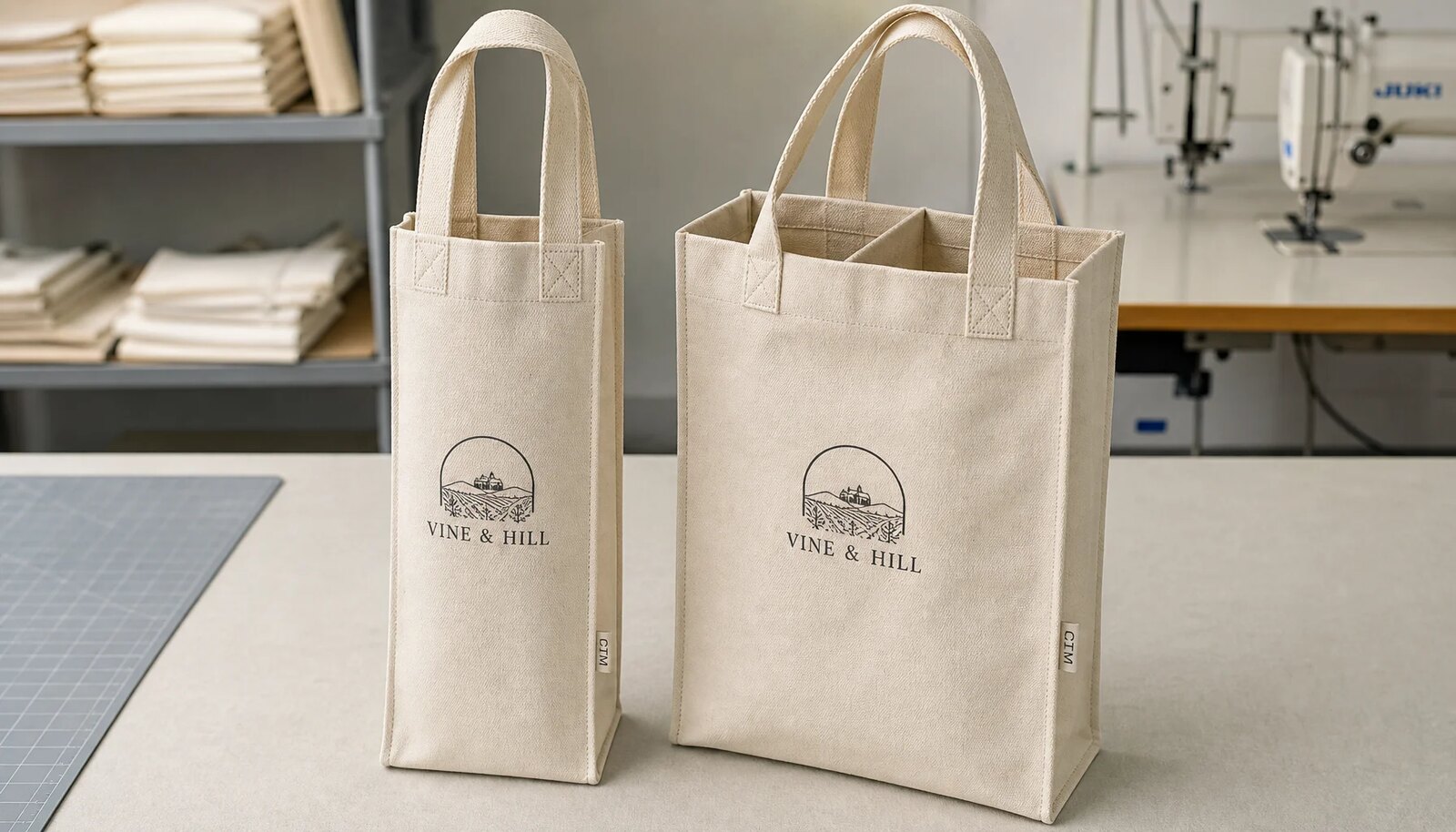
Start With the Bottle, Not the Bag Sketch
A practical canvas wine carriers lead time planning guide for hotel retail has to begin with the bottle. That sounds obvious, yet many RFQs still start with a reference photo, an old tote size, or a sentence like “for a 750 ml wine bottle.” For procurement, that is not enough. Wine and beverage bottles are dimensional, heavy, breakable, and inconsistent across formats. A Bordeaux bottle, a sloped Burgundy bottle, a champagne bottle, and a tall spirit bottle can all be sold through a hotel boutique, but they do not fill a fabric carrier in the same way.
The tight point may be the shoulder rather than the base. A bottle can look fine in a flat sample and then jam when tissue, a neck card, or a retail sleeve is added. Two-bottle carriers introduce another layer of risk because both bottles need shoulder clearance, the divider must not steal too much usable space, and the boxed bottom has to carry the combined weight without twisting. If the pattern is built around the easiest bottle, the first sample may pass visually and still fail in daily hotel use.
Before requesting price or lead time, collect the actual bottle SKUs from retail, beverage, events, minibar, and room amenity teams. Measure the filled bottle height, widest body or shoulder diameter, base diameter, cap or cork height, and loaded weight. Add every secondary item that will be used at launch: tissue wrap, belly band, hang tag, neck card, corkscrew, tasting note, paper sleeve, or gift insert. If the assortment changes seasonally, sample against the largest diameter and heaviest filled bottle expected, not the average bottle.
- Measure the bottle at the widest shoulder or body point, not only at the base.
- Use actual filled bottle weight when defining handle and seam tests.
- Test champagne, Burgundy, sparkling wine, and spirits separately from standard Bordeaux bottles.
- Include tissue wrap, neck tags, sleeves, and retail inserts in fit sampling.
- For mixed assortments, approve the pattern against the largest and heaviest bottle expected.
Turn Hotel Use Into a Specification a Factory Can Build
Hotel retail packaging has to do more than look good in a catalog image. A welcome amenity carrier may be placed by housekeeping beside a bottle in the room. A boutique carrier may sit on a shelf, be opened and refilled by staff, and be handled by guests before purchase. An event carrier may be loaded quickly at registration and carried across the property. Each situation changes the structure, handle comfort, logo visibility, fold method, and acceptable tolerance.
A strong specification separates outside dimensions from internal usable bottle space. This point prevents many disputes. A supplier may measure the finished sewn product laid flat, while a buyer measures the open space after the boxed bottom is formed. Thick canvas, seam allowance, divider construction, and folded bottom corners all reduce usable space. State the finished width, finished height, bottom depth, divider requirement, handle width, handle drop, seam construction, reinforcement stitch, canvas weight, fabric color, print size, print location, label details, and packing method in one controlled document.
Also define what natural canvas should look like. Light seed flecks and slubs can be part of an unbleached cotton appearance. Oil marks, mildew odor, dark contamination, water stains, dirty handling marks, and severe panel shade mismatch should not be treated as normal. If the hotel brand needs a cleaner, more uniform surface, consider bleached, dyed, or tighter-weave canvas. Those options may improve appearance but can add shade approval steps, fabric lead time, and cost.
- Create one spec sheet per style, fabric color, and artwork route.
- Define finished outside size and internal usable bottle space separately.
- State whether the bag must stand empty, stand loaded, or only carry safely.
- Separate fixed brand requirements from construction details the factory may optimize.
- Attach reference photos as visual guidance only, not as the specification.
Choose Canvas Weight With Structure, Sewing, and Freight in View
For many reusable hotel retail wine carriers, 10 oz to 12 oz cotton canvas, roughly 280 to 340 GSM, is a sensible starting range. It usually has enough body for a premium hand feel, can print cleanly, and remains manageable for cutting, folding, and sewing. A lighter 8 oz canvas may reduce unit cost, but it can sag around glass, wrinkle across the print panel, and feel closer to short-use promotional packaging than a hotel boutique product.
Heavier is not automatically better. A 14 oz or 16 oz canvas can feel substantial in the hand, but it also increases material cost, gross weight, carton cube, needle wear, and sewing difficulty. The problem is most visible at folded intersections: boxed bottoms, divider bases, side seams, and handle attachments. A two-bottle carrier with a center divider and reinforced handles may create several layers of fabric in one seam. That slows sewing and increases the chance of uneven stitches, needle cuts, or bulky corners.
Procurement should approve fabric by more than GSM. Look at weave density, hand feel, shrinkage, finishing, surface cleanliness, and print result. A tightly woven 10 oz canvas may print more sharply than a loose 12 oz or 14 oz canvas. Dyed fabric requires shade lot control. Washed, softened, enzyme-finished, or preshrunk fabric may need wider size tolerance. Approving a swatch early keeps the conversation specific when bulk fabric arrives.
- 8 oz canvas is best limited to low-cost or short-use programs unless sampling proves structure is acceptable.
- 10 oz canvas can suit single-bottle carriers with moderate reuse and simple logo printing.
- 12 oz canvas is often better for structured bottoms, two-bottle carriers, and premium retail presentation.
- 14 oz plus canvas should trigger extra review of seam bulk, handle reinforcement, carton weight, and freight cube.
- Approve fabric swatches and print tests before bulk cutting when brand appearance is sensitive.
Design the Carrier Around Load Points
A canvas wine carrier is a small product, but the load path matters. The bottle weight travels through the bottom panel, side seams, handle attachment, and, in a two-bottle format, the center divider. If one of those points is underbuilt, the rest of the bag may look acceptable while the functional performance is weak. This is why handle construction, seam allowance, and reinforcement should be specified rather than left as vague “standard sewing.”
Common B2B options include self-fabric handles and cotton webbing handles. Both can work when the width, handle drop, stitch box size, stitch type, stitch density, and thread are agreed. Box-and-cross stitching or bar-tack reinforcement is typically easier to inspect than an undefined straight stitch. Handle drop also affects the guest experience. Too short, and the carrier feels cramped around the hand; too long, and the bottle may swing or the carrier may look unbalanced on a shelf.
For two-bottle carriers, the divider height and base attachment need extra attention. A divider that is too low allows bottles to knock together. A divider that is too high or too wide can make loading slow and reduce usable internal space. Ask the factory to test the loaded sample with two filled bottles, then check whether the bottom remains flat, the side seams stay vertical, and the logo panel does not twist.
- Define handle material, width, drop, stitch box size, stitch pattern, and thread color.
- Confirm whether the carrier is single-bottle, two-bottle, or a mixed-use body.
- Check that the boxed bottom supports the loaded bottle without collapsing inward.
- For two-bottle carriers, inspect the divider base and center seam under load.
- Avoid adding rope, faux leather, or metal hardware late unless the sourcing time and testing plan are revised.
Lock Artwork Early Because Print Decisions Move the Schedule
Artwork is not a final cosmetic detail; it can drive the production calendar. Many hotel retail canvas wine carriers use water-based screen printing because hotel logos, resort marks, event graphics, and wine club names are often simple, solid-color designs. For one to three solid colors on cotton canvas, screen printing is usually predictable, repeatable, and straightforward to inspect.
More complex artwork needs more time. Gradients, photographic art, metallic ink, puff effects, large ink coverage, very small lettering, and multiple property logos may require extra screens, special curing, transfers, digital printing, or additional strike-offs. A brand color that looks correct in a PDF can shift on natural cotton because the base fabric is not bright white. When Pantone accuracy matters, approve a physical strike-off on the selected canvas before releasing bulk production.
Give the supplier vector artwork, Pantone references, print size, print location, color count, and brand clearance at RFQ stage. Print position should be measured from fixed points such as the top edge, side seam, or bottom seam. For simple front prints, ±3 mm to ±5 mm is a common starting tolerance, but it must be written into the approval. If artwork changes after screens, labels, films, or carton marks are prepared, the schedule should be formally revised.
- Use water-based screen print for clean hotel logos with one to three solid colors.
- Request a print strike-off on the selected canvas for Pantone-sensitive marks.
- Avoid approving small text below about 5 mm height without a physical print test.
- Treat metallic ink, transfers, digital print, and heavy coverage as added sampling risks.
- Build an artwork matrix for multi-property programs showing file name, logo, Pantone, print size, quantity, and destination.
Clarify MOQ Before the Order Splits Become Expensive
MOQ is rarely one number in real production. A supplier may quote a total order MOQ, while a buyer assumes that quantity can be divided freely across several hotel properties, fabric colors, logos, carton marks, and shipping destinations. On the factory side, every split can affect fabric purchasing, cutting yield, print setup, sewing line changeover, packing, inspection, and export documents.
For custom canvas wine carriers, 500 to 1,000 pieces per style, fabric color, or artwork is a practical starting point for stable B2B pricing in many sourcing situations. Smaller quantities may still be possible, but the pattern work, print preparation, packing setup, and administration are spread across fewer units. Larger quantities may improve price through fabric yield, printing efficiency, carton planning, and fewer line changes, but only when the specification is standardized.
Hotel groups can protect both cost and lead time by standardizing the carrier body and varying the print only where needed. Before requesting a final quote, prepare an allocation table with style, fabric color, artwork, quantity, carton mark, destination, requested ex-factory date, and required receiving date. Without that table, a quote can look clean on paper and become complicated once purchasing reveals the real order structure.
- Ask whether MOQ is per total PO, style, fabric color, artwork, carton mark, shipment, or destination.
- Request price breaks at 500, 1,000, 3,000, and 5,000 pieces.
- Standardize one carrier body when multiple hotel properties use similar bottles.
- Limit fabric colorways unless brand value justifies dye lot approval and added setup.
- Confirm whether blank stock plus later printing is available before assuming it will shorten lead time.
Build the Calendar Backward From the Hotel Receiving Date
A lead time plan should start with the date the hotel actually needs usable stock. Work backward from the in-store, in-room, or event launch date to hotel receipt, warehouse processing, freight arrival, customs clearance if applicable, vessel or air departure, ex-factory date, final inspection, bulk completion, production start, final approval sample, print strike-off, blank fit sample, and RFQ confirmation. This backward plan makes hidden decision deadlines visible.
For a new custom carrier, the first physical step should usually be a blank fit sample. It checks the pattern, internal bottle space, bottom depth, divider function, handle drop, standing shape, and sewing construction without spending time on full decoration. After the fit is right, a print strike-off or printed pre-production sample confirms logo scale, color, placement, ink coverage, hand feel, and legibility. The sealed approval sample then becomes the reference for bulk production and inspection.
If a supplier quotes 25 to 35 working days for bulk production, ask what starts the clock. In many orders, production lead time begins only after final sample approval, deposit receipt, fabric approval, artwork approval, packing approval, carton mark approval, and complete PO allocation. Sampling, courier transit, buyer review, holidays, failed strike-offs, inspection booking, and freight transit are separate. Seasonal launches, holiday gift sets, hotel openings, and wine dinners need buyer-side buffers as well as factory-side buffers.
- Work backward from required hotel receipt or retail launch date.
- Separate pattern, blank sample, print strike-off, pre-production sample, approval, bulk production, inspection, and freight.
- Write the exact production-start trigger into the PO or order confirmation.
- Add buffer for artwork correction, failed samples, holidays, peak export periods, and inspection booking.
- Do not approve bulk cutting while bottle size, artwork, packing, or carton marks remain open.
Use Sampling to Test the Way Staff Will Actually Use the Carrier
A sample photo can be misleading. The carrier may stand neatly when empty and lean after loading. The logo may look centered flat and distort around a bottle. The handle may feel fine for a quick photo and uncomfortable when carried through a lobby. Sampling should test the product in the same way hotel teams will use it: open it, load it, carry it, place it on a shelf, fold it back into a carton, and repeat the process.
A strong sequence uses three approvals. The blank fit sample confirms size, bottom depth, bottle clearance, handle drop, divider height, standing shape, and construction. The print strike-off or printed pre-production sample confirms color, logo scale, placement, ink coverage, hand feel, and small-text legibility. The sealed approval sample is then kept as the physical reference for bulk sewing, printing, packing, and final inspection. When possible, both buyer and factory should hold a signed or clearly identified reference sample.
Make sample approval measurable. Record finished width, height, bottom depth, handle drop, print size, print position, and approved tolerances. Take photos of the sample flat, loaded, standing, and packed, ideally with a ruler and the intended bottle visible. A short email saying “approved” is not enough if the bulk order later raises questions about shade, print hand feel, seam placement, or bottle fit.
- Approve a blank fit sample before printed sampling for new or uncertain bottle formats.
- Test with the heaviest and widest intended bottle, not the easiest bottle.
- Measure dimensions and print placement on the physical sample.
- Check staff handling: opening, loading, carrying, shelf display, and repacking.
- Keep one buyer reference sample and one sealed factory reference sample before mass production.
Compare Quotes by Landed Cost, Not the Lowest Unit Price
Two quotes that sound identical may not describe the same product. Both may say 12 oz canvas, screen print, boxed bottom, and reinforced handle. One may include a tighter weave, better handle stitching, clean carton segregation, and proper export packing. The other may exclude labels, inner protection, destination sorting, or inspection support. Procurement needs suppliers to restate the complete specification so pricing can be compared line by line.
Key cost drivers include fabric GSM, weave, finishing, shrinkage control, fabric width, cutting yield, number of panels, boxed bottom construction, divider design, handle length, reinforcement stitch, seam binding, labels, print area, ink coverage, color count, packing method, carton quantity, and Incoterms. A two-bottle carrier with a center divider and large front print is not comparable to a simple single-bottle sleeve, even if both are called canvas wine bags.
Landed cost should include carton dimensions, pieces per carton, gross weight, net weight, estimated CBM, palletization assumptions, freight mode, destination charges, and receiving labor where relevant. Individual polybags may protect natural canvas, but they add cost, unpacking time, and waste. Paper belly bands may improve retail presentation, but they add packing labor. Decide which details matter operationally before selecting the supplier, not after the lowest FOB price has been chosen.
- Require every quote to list fabric GSM, finishing, dimensions, handle construction, print method, packing, carton data, and Incoterms.
- Compare carton cube and gross weight per 1,000 pieces before choosing a supplier.
- Ask what is excluded: labels, hang tags, dividers, inner packing, carton marks, inspection support, or destination sorting.
- Treat very low quotes carefully if reinforcement, packing, or QC standards are not specified.
- Use landed cost and launch risk as the decision basis, not FOB unit price alone.
Specify Packing, Carton Marks, and Segregation Early
Packing is part of the product experience. Natural canvas can pick up dust, moisture marks, abrasion, odor, and pressure creases during handling. At the same time, excessive individual plastic packing may conflict with hotel sustainability policies or create extra backroom work. The right method protects the carrier while matching how the hotel receives, stores, and displays the item.
Flat packing is usually efficient, but the fold method still matters. Handles can be folded inside, placed behind the body, or arranged to avoid pressing into the print panel. If ink has not fully cured, tight packing can leave transfer marks. If the boxed bottom is crushed too hard, the carrier may not stand neatly after unpacking. Carton quantity should balance freight efficiency with a practical handling weight for hotel stockrooms and retail teams.
Multi-property orders need disciplined carton segregation. When one PO includes different logos, destinations, PO numbers, carton marks, or launch dates, the packing list must identify what is inside every carton. Avoid mixed cartons unless the receiving team has approved them in writing. A shipment can pass product workmanship inspection and still fail commercially if the wrong property receives the wrong logo.
- Confirm individual polybag, recycled polybag, paper belly band, tissue, or clean bulk pack before PO approval.
- Specify how handles and boxed bottoms are folded to protect the print and shelf shape.
- Request carton dimensions, pieces per carton, gross weight, net weight, and CBM per 1,000 pieces.
- Avoid over-compressed cartons that cause hard creases, ink transfer, or distorted boxed bottoms.
- Require carton marks by style, artwork, property, PO number, quantity, and destination.
Specification comparison for buyers
| Planning decision | Recommended B2B specification | Best use case | Procurement risk to control |
|---|---|---|---|
| Bottle basis | Quote from actual filled bottle height, widest body or shoulder diameter, base diameter, cap or cork height, and total loaded weight including tissue, tags, inserts, or sleeves | Hotel boutiques, minibar amenity programs, tasting-room bundles, wine-pairing sets, and branded retail add-ons | A sample approved flat may fail when loaded with champagne, Burgundy, tall spirit, wide craft beverage, or mixed bottle assortments |
| Finished size tolerance | State finished sewn dimensions and internal usable space separately; use ±5 mm for width and bottom depth and ±10 mm for height as a normal starting point unless washed fabric requires wider tolerance | Custom bodies where bottle fit, shelf presentation, and carton count matter | Unclear measuring points cause disputes when suppliers measure flat panels while buyers measure internal bottle space |
| Canvas weight | 10 oz to 12 oz cotton canvas, approximately 280 to 340 GSM, with weave, finishing, shrinkage, color, and fabric hand approved by swatch | Reusable premium packaging that must stand neatly, print cleanly, and feel appropriate for hotel retail | Below 8 oz can sag around glass; above 14 oz increases carton weight, seam bulk, needle stress, and sewing variability |
| Carrier structure | Single-bottle or two-bottle upright carrier with boxed bottom; divider height, seam allowance, and bottom depth confirmed on loaded sample | Single-bottle for room gifts and retail add-ons; two-bottle for holiday sets, tasting bundles, and wine club packaging | Divider height, base width, bottle shoulder clearance, and seam placement often require pattern corrections after first sampling |
| Handle construction | Self-fabric handles or cotton webbing with defined width, handle drop, stitch box size, and box-and-cross or bar-tack reinforcement | Repeatable sewing, balanced appearance, and reliable carrying strength for filled glass bottles | Unspecified handles lead to weak attachment, uncomfortable grip, inconsistent drop, or added sourcing time for rope, faux leather, or hardware |
| Artwork route | Water-based screen print for 1 to 3 solid colors; strike-off required for Pantone-sensitive logos; evaluate transfer or digital print only for complex art | Hotel logos, resort marks, event branding, wine club graphics, and clean retail layouts | Fine gradients, metallic ink, small text, large ink coverage, or multi-property artwork can add screens, curing time, and approval rounds |
| MOQ strategy | Plan 500 to 1,000 pieces per style/color/artwork as a practical starting point; request price breaks at 500, 1,000, 3,000, and 5,000 pieces | Efficient cutting, print setup, packing, inspection, and export documentation | Splitting small quantities by property, logo, fabric color, carton mark, or destination raises cost and can extend production staging |
| Sample sequence | Blank fit sample first, then print strike-off or printed pre-production sample, then sealed approval sample before bulk cutting | New custom sizes, two-bottle carriers, structured bottoms, strict brand placement, and fixed launch dates | Skipping fit sampling can hide bottle clearance, handle strength, standing shape, or divider problems until printed samples are already made |
| Approval trigger | Production lead time starts only after final sample, artwork, Pantone or color standard, packing, carton marks, deposit, and complete PO allocation are approved | Seasonal hotel retail launches, holiday gift sets, opening events, and distributor delivery windows | Factories cannot protect lead time when approvals arrive in pieces or artwork changes after screens, labels, or cartons are prepared |
Buyer checklist before sampling
- Define the bottle program before quoting: standard 750 ml Bordeaux, Burgundy, champagne, sparkling wine, spirit bottle, half bottle, mixed bundle, or rotating retail assortment.
- Provide actual bottle height, widest diameter, base diameter, shoulder profile, cap or cork height, filled weight, and all add-ons such as tissue wrap, hang tag, belly band, neck card, gift insert, or retail sleeve.
- State finished carrier width, height, bottom depth, internal usable bottle space, divider requirement, handle width, handle drop, fabric weight, fabric color, shrinkage expectation, and whether the loaded carrier must stand upright.
- Specify the measurement method: finished sewn product laid flat, internal usable space when opened, loaded standing dimensions, or carton-folded dimensions.
- Choose the print method from artwork reality, not only unit price; include vector logo file, print size, color count, Pantone references, print location, ink type, and any special effect or transfer requirement.
- Separate pattern development, blank sample time, print strike-off time, pre-production sample time, courier transit, buyer review, artwork correction, bulk production, inspection booking, and freight in the launch calendar.
- Confirm whether MOQ is per total order, per style, per fabric color, per print artwork, per carton mark, per shipment, or per destination warehouse.
- Ask for price breaks at 500, 1,000, 3,000, and 5,000 pieces and require the supplier to state what changes at each tier, such as print setup, fabric purchase, carton count, or packing labor.
- Request carton dimensions, pieces per carton, gross weight, net weight, estimated CBM, palletization assumptions, and Incoterms before comparing landed cost.
- Set acceptance criteria for finished size, bottle fit, standing shape, handle pull strength, seam security, print registration, stains, odor, shade variation, stitch defects, and packing accuracy.
Factory quote questions to send
- What canvas ounce weight and GSM are you quoting, and is the fabric greige, natural, bleached, dyed, washed, softened, enzyme finished, or preshrunk?
- What is the expected fabric shrinkage and shade tolerance, and will bulk fabric be submitted for approval before cutting?
- Is the quoted size measured as finished sewn outside dimensions, flat panel dimensions, internal usable bottle space, or loaded standing size, and what tolerance will you follow?
- What bottle height, widest diameter, base diameter, and filled weight did you assume when preparing the pattern, seam allowance, bottom depth, and handle reinforcement?
- What is the MOQ per style, fabric color, artwork, carton mark, and shipment, and how does price change at 500, 1,000, 3,000, and 5,000 pieces?
- Which Incoterm is included in the quote, which port or warehouse is assumed, and are export cartons, inner packing, labels, and carton marks included?
- Which print method is included, how many colors are included, what ink type is used, what curing process is required, and what is the maximum printable area for this carrier size?
- Can you provide a print strike-off on the selected bulk canvas before the full pre-production sample, especially for Pantone-sensitive hotel logos?
- Can you provide a blank fit sample before printed sampling, and how many working days are needed for pattern making, blank sample, printed sample, buyer revision, and sample courier dispatch?
- What handle construction is included, including handle width, handle drop, stitch box size, stitch type, stitch density, thread type, and any loaded pull or hang test you can perform?
Quality-control points to confirm
- Finished size should normally be controlled within ±5 mm for width and bottom depth and ±10 mm for height unless washed fabric, softened fabric, or deliberately relaxed construction is approved with a wider tolerance.
- Internal bottle fit must be tested with the actual bottle type, including cap or cork height, shoulder width, filled weight, tissue wrap, neck tag, belly band, hang tag, and any secondary retail packaging.
- Loaded standing shape should be checked on a flat surface; the carrier should not lean excessively, collapse at the boxed bottom, twist at the side seams, or distort the printed logo when filled.
- Handle attachment should show consistent stitch density, no skipped stitches, no loose thread nests, no needle cuts, and no seam tearing after a realistic loaded hang or pull test based on the intended bottle weight.
- Bottom seams, side seams, and divider seams should be checked under load because two-bottle carriers concentrate stress at the base, center divider, and handle attachment points.
- Print position should be measured from fixed reference points such as top edge, side seam, or bottom seam with an agreed tolerance, commonly ±3 mm to ±5 mm for simple front prints.
- Print quality should be inspected for registration, ink coverage, cracking, bleeding, pinholes, color shift, excessive hand feel, edge fuzziness, and legibility of small hotel marks.
- Natural canvas should be checked against the approved swatch for acceptable seed flecks and slubs, while rejecting oil marks, mildew odor, heavy dark contamination, water stains, panel shade mismatch, and dirty handling marks.
- Stitching should be checked for open seams, skipped stitches, broken thread, uneven seam allowance, puckering, backstitch security, loose threads, and reinforcement placement.
- Cartons should be dry, correctly marked, not over-compressed, and separated by design, property, PO number, carton mark, or destination when the packing list requires segregation.