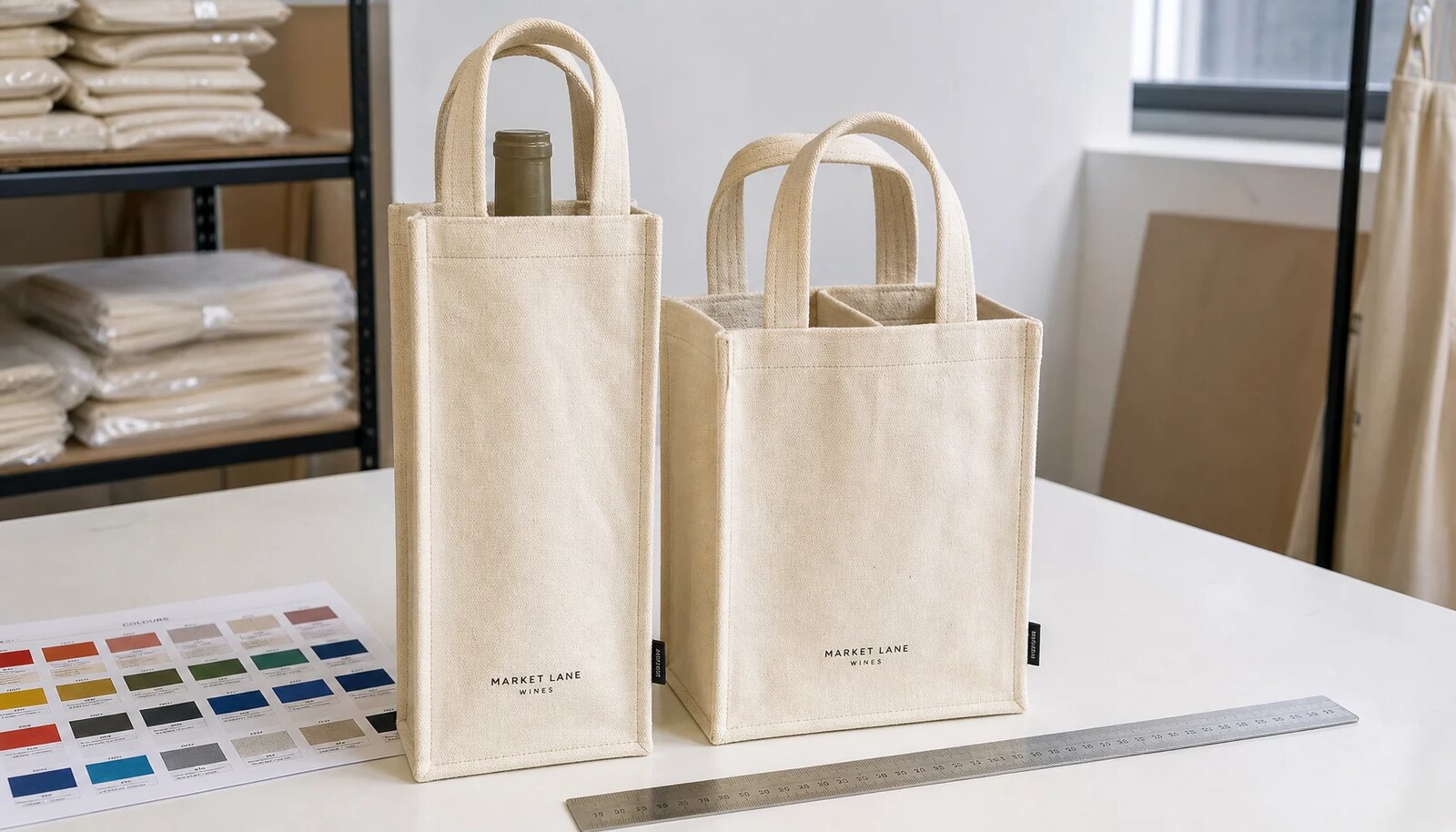
Start With the Retail Use Case
Canvas wine carriers for hotel retail are doing two jobs at once. They protect and present glass bottles, and they also carry the hotel’s brand into a guest’s room, car, or home. That makes them different from ordinary small totes. They may be displayed in lobby shops, resort boutiques, winery corners, minibar gift areas, wedding desks, and event merchandise tables. A proofing checklist has to cover the look of the logo and the performance of the carrier.
If proofing stops at a digital logo mockup, important problems can remain hidden. The bottle may lean forward. The handle may twist under a filled load. A divider may allow bottle-to-bottle contact. A fold line may cut through the printed mark. On a shelf, small flaws feel larger because guests are seeing the item as retail packaging, not just a free bag.
Procurement should use the buying brief to make factory quotes comparable. One supplier may quote a light promotional wine bag with minimal reinforcement. Another may quote a retail-grade canvas wine carrier with a boxed base, divider, reinforced handles, and controlled export packing. Both descriptions sound similar, but the cost, carton volume, sample requirements, and risk profile are not the same.
- Define whether the carrier will be sold empty, bundled with wine, used as a room amenity, or packed for events.
- Treat visual approval and functional approval as separate gates: print, bottle fit, handle strength, divider, and packing.
- Compare supplier prices only when fabric GSM, construction, print process, carton quantity, and sample scope match.
- For hotel groups, decide whether each property logo is a separate SKU or only a print version on one common body.
- Include delivery market, launch date, property allocation, barcode needs, and sustainability rules in the first RFQ.
Choose Canvas Weight With Tradeoffs in Mind
For many hotel retail wine carriers, the practical canvas range is 10 oz to 12 oz cotton canvas, often about 280-340 GSM depending on weave, yarn, and finishing. This range usually gives enough body for shelf presentation without making seams too bulky. It is still not a universal rule. The correct weight depends on bottle weight, logo coverage, handle design, the desired retail feel, and the buyer’s freight budget.
Lighter 8 oz canvas can reduce unit cost and shipping weight. It may work for budget single-bottle promotions, but it can wrinkle easily, collapse around the bottle, and show the bottle outline. Heavier 14 oz canvas can feel more premium in hand, yet it brings its own risks: thicker seam allowances, more needle stress, larger folded packs, higher carton CBM, heavier freight, and stronger fold memory across printed panels.
The word canvas is not precise enough for a purchase order. Natural cotton canvas, unbleached cotton, dyed canvas, washed canvas, recycled cotton blends, and cotton-poly blends can all print and sew differently. Open-weave canvas may absorb ink and soften logo edges. Tighter weaves usually give cleaner print detail. Natural cotton may show seeds, neps, and slubs; that can support a rustic winery look, but it may not suit a crisp luxury hotel identity.
- Ask for fabric swatches or reference samples in at least two weights before finalizing the RFQ.
- Specify both oz and GSM target, because oz alone can be interpreted differently by suppliers.
- For dyed canvas, test print opacity, underbase, dye rub-off, and contrast on the actual material.
- For 14 oz canvas, check seam bulk, handle comfort, folded thickness, needle holes, and freight impact.
- Keep printed panels away from heavy fold memory when the packing method requires tight flat packing.
Engineer Bottle Fit, Not Just Bag Size
A canvas wine carrier should be sized around real bottles, not only the words 750 ml. A standard Bordeaux bottle is usually narrower than many Burgundy or sparkling bottles. Regional and specialty bottles can change diameter, shoulder shape, punt depth, cap height, and overall height. A sample that fits the factory’s reference bottle may still be too tight for the wine sold in the hotel shop.
External bag dimensions do not tell the full story. Seam allowance, fabric thickness, divider construction, and bottom shape all reduce usable space. The RFQ should request internal compartment width after sewing, gusset depth, usable opening width, divider height, and maximum tested bottle diameter and height. For two-bottle carriers, the divider should be tall and stable enough to prevent direct glass contact if the buyer requires that protection.
Load testing can be simple, but it should be realistic. Use the heaviest approved filled bottles, lift the carrier by the handles, set it down repeatedly, and check whether the base stays flat. Watch the front logo panel while the bag is loaded; a print that looks centered on a flat sample may look pulled or bowed once bottles are inside.
- Provide bottle diameter, total height, shoulder style, cap or cork height, punt shape, and filled weight.
- Approve against the largest planned bottle, not the easiest bottle to fit.
- For two-bottle styles, state divider height and whether bottle-to-bottle contact is allowed or rejected.
- Check insertion, removal, lifting, counter placement, and shelf display with the carrier filled.
- Confirm whether the SKU must fit sparkling wine, wide Burgundy bottles, tall bottles, or standard still wine only.
Match the Print Method to the Artwork
Screen printing is often the best fit for solid hotel logos, property names, line art, and one to three brand colors. It can be durable and efficient at volume when mesh, ink viscosity, squeegee pressure, registration, and curing are controlled. Canvas texture, however, limits fine detail. Small serif lines, reversed text, thin location copy, and tight spacing should be tested on the exact fabric before approval.
Heat transfer can handle gradients, detailed illustrations, photographic effects, and high-color artwork without a separate screen for each color. It can also help with limited runs. The tradeoff is feel and durability risk. The wrong transfer can show a film edge, lift at corners, crack on folds, or feel too plastic for boutique retail. If heat transfer is chosen, proof it after folding and dry rubbing, not only when the panel is flat and new.
Embroidery, woven labels, and sewn patches are useful when the brand expression is more restrained. Embroidery can look premium for a small crest or monogram, but it may pucker lighter canvas and is not usually efficient for a large filled front mark. Woven labels and sewn patches work well when many hotel properties share one carrier body and need smaller property-level variations.
- Use screen print for bold marks, solid logos, and repeat orders with stable artwork.
- Use heat transfer for gradients or high-color graphics only after adhesion, fold, rub, and edge-lift checks.
- Use embroidery for small premium accents rather than large filled logos on light canvas.
- Use woven labels or sewn patches for subtle branding and multi-property programs.
- For dark canvas, approve opacity, underbase coverage, and hand feel together.
Turn the Proof Into a Control Document
A production-ready proof is more than a pretty picture. It should tell the cutting, printing, sewing, inspection, and packing teams exactly what to do. Include logo width and height in millimeters, top drop, side margin, bottom fold clearance, and clearance from handle stitching, seams, labels, pockets, and divider reference points. If the logo should look centered after bottles are loaded, say that; flat-panel center and loaded visual center are not always the same.
Tolerances need to be agreed before bulk production. For many front-panel logos, ±3 mm placement tolerance is a practical starting point. If the artwork is close to seams, handles, labels, or narrow borders, the design may need more clearance or a wider tolerance. Tilt should be listed separately. A mark can sit in the right position and still look crooked, especially on a narrow wine carrier front panel.
Color approval should come from a printed swatch or strike-off on the actual canvas. Pantone references are useful, but coated paper, uncoated paper, digital screens, and cotton canvas do not show color the same way. The proof should also state ink color count, underbase requirement, minimum line thickness if relevant, logo version, barcode version, hangtag version, and carton mark version.
- Show logo size, top drop, side margin, bottom fold clearance, and handle-area clearance in millimeters.
- State placement tolerance, tilt tolerance, color tolerance, ink coverage limits, and acceptable edge clarity.
- Approve color from a print swatch on actual canvas under consistent lighting.
- Keep fine text large enough for canvas texture; small text may fill in, break, or blur.
- Version-control property logos, hangtags, barcodes, carton marks, proof files, and purchase order references.
Plan MOQ Around SKU Splits
MOQ for canvas wine carriers is rarely one clean number. It may be driven by fabric purchase, fabric color, cutting efficiency, print setup, sewing line arrangement, label production, barcode printing, and packing configuration. A factory may combine one common blank body across several hotel properties, but still price each logo screen, transfer setup, sewn label, hangtag, or barcode version separately.
The RFQ should ask for MOQ by layer: blank body MOQ, canvas color MOQ, logo version MOQ, print color MOQ, sewn label MOQ, hangtag MOQ, barcode MOQ, carton mark MOQ, and packing SKU MOQ. This prevents a familiar procurement problem: the first quote looks acceptable, then changes after the buyer adds five property logos, three barcode formats, and separate carton marks.
Reorder strategy matters too. Custom dyed canvas can look distinctive but may require larger fabric batches and longer lead times. A standard natural or black canvas body can simplify replenishment if the supplier keeps the approved pattern, artwork files, color records, and signed sample. Buyers should also confirm whether setup charges are one-time, repeated every order, amortized into unit price, or waived above a defined quantity.
- Quote one common body separately from property-level print, label, hangtag, barcode, and carton changes.
- Expect canvas color changes to affect MOQ more than a one-color front print change.
- For small property runs, compare screen print against labels, transfers, or sewn patches.
- Treat barcode, hangtag, carton mark, and property allocation as packing variables, not minor admin details.
- Ask how setup charges are billed for first orders and reorders.
Approve Samples in the Right Order
A physical sample is essential for hotel retail. A digital mockup can confirm the layout direction, but it cannot prove fabric hand feel, ink absorption, print edge clarity, curing, handle comfort, divider stability, odor, or bottle fit. If the first sample uses substitute fabric for shape approval, the buyer should still require a later print proof or pre-production sample on actual bulk fabric.
The cleanest sequence has three gates. First, approve structure: dimensions, bottle fit, handle drop, divider, base stability, and stitch reinforcement. Second, approve print: color, opacity, logo edge, hand feel, adhesion, and folding behavior on actual canvas. Third, approve the complete pre-production sample: final fabric, final print, final labels, hangtag, barcode placement, country-of-origin marking, carton mark, and packing method.
Document the sample with measurements and photos. Record flat width, height, gusset, handle width, handle drop, divider height, logo position, print color, stitch type, and fold method. Keep one signed or sealed sample with the buyer and one with the factory. Final inspection becomes much easier when both sides are comparing bulk goods to the same physical reference.
- Measure the sample flat and filled; record width, height, gusset, handle drop, and divider dimensions.
- Load approved bottles and check balance, grip comfort, seam stress, bottle removal, and base stability.
- Rub the cured print and fold the carrier exactly as it will be packed.
- Measure logo placement with a ruler against the proof sheet rather than approving by eye only.
- Retain signed buyer and factory samples for inspection comparison.
Protect the Print During Packing
Flat packing saves freight, but it can damage the part of the carrier the guest sees first. If a large logo sits in the center panel, folding directly through heavy ink may create pressure lines, whitening, cracking, or transfer marks. The factory should allow full curing before stacking, and the fold direction should be written into the packing instruction.
Packing is also an operations issue for hotels and distributors. Carton quantity should be easy to count. Gross weight should be practical for manual handling. Outer cartons should show property name, SKU, color, logo version, purchase order, carton number, quantity, and any barcode or allocation reference required by the buyer. Multi-property orders should not be mixed casually in one carton unless the inner separation and packing list are very clear.
Some hotel brands restrict individual polybags for sustainability reasons. If individual polybags are not allowed, the buyer should specify acceptable alternatives such as a master polybag, carton liner, paper band, tissue interleaving, or moisture-control method. Packing approval should happen before mass packing, not after cartons are sealed.
- Specify whether the printed panel may be folded through the logo or must remain flat.
- Use interleaving paper when print coverage is heavy or units are stacked print-to-print.
- Control carton quantity and gross weight to reduce crushing and warehouse handling issues.
- Approve carton marks, SKU labels, barcode labels, property names, and PO references before packing.
- Align individual polybags, master bags, carton liners, paper protection, and moisture control with hotel policy.
Write QC Criteria Inspectors Can Use
Quality control should translate brand expectations into measurable checks. “Good printing” is not enough. The inspection sheet should define print position tolerance, tilt tolerance, color approval method, smudges, pinholes, missing ink, edge bleeding, ink buildup, stains, shade variation, loose threads, skipped stitches, needle holes, odor, and packing errors. For many front logos, ±3 mm placement tolerance is a workable baseline, adjusted to the artwork and panel width.
Functional inspection deserves the same attention as print inspection. Inspectors should load the approved bottle type, lift the carrier, check handle stress, confirm the base sits flat, and verify that dividers prevent bottle contact if required. Handle ends should show bartack, box stitch, cross stitch, or another approved reinforcement method. Stitch density should be consistent, with no skipped stitches at stress points.
Mixed-logo control needs its own line in the QC plan. Hotel retail orders often include similar property names, logos, barcodes, hangtags, and carton marks. A well-made carrier still fails commercially if the wrong property receives the wrong barcode or the wrong logo. Inspect finished goods against the approved proof, then inspect carton contents against the packing list.
- Inspect print position, tilt, color, opacity, edge clarity, smears, missing ink, and heavy buildup.
- Check handle attachment, base seams, divider seams, stitch density, skipped stitches, and loose threads.
- Reject major stains, oil marks, mildew odor, unacceptable shade variation, and visible front-panel needle damage.
- Test bottle fit and lifting with the largest approved filled bottle.
- Verify carton quantity, logo allocation, barcode version, carton mark, fold method, and packing protection.
Break Down Lead Time and Quote Data
Lead time for canvas wine carriers includes more than sewing time. The schedule may include artwork review, proof correction, print swatch or strike-off, structure sample, pre-production sample, fabric procurement, cutting, printing, curing, sewing, trimming, inspection, packing, export documents, and inland delivery to port or forwarder. Late artwork approval or unclear property allocation can create as much risk as production capacity.
Ask suppliers to separate sample lead time from bulk lead time after written approval. For a first order, allow at least one correction cycle for structure or print. For repeat orders using the same fabric, logo, and packing method, the schedule may be shorter if screens, artwork files, patterns, and reference samples remain valid. Custom dyed canvas, specialty labels, unusual hardware, or many property splits can extend the calendar.
A useful quote supports landed-cost analysis, not only unit price comparison. Procurement should request unit price by quantity tier, setup charges, sample charges, packing cost, carton size, carton quantity, gross weight, net weight, CBM, Incoterms, payment terms, export documentation fees, and lead time assumptions. The supplier that gives these details early is easier to compare and easier to manage.
- Start bulk lead time only after written sample approval, final artwork, PO or deposit, and confirmed packing split.
- Ask for separate timelines for proofing, sampling, bulk fabric, printing, sewing, inspection, and packing.
- Add buffer for hotel retail launches, holiday programs, wedding season, wine events, and freight delays.
- For multi-property programs, assign approval owners so one late logo does not unintentionally hold all production.
- Compare landed cost using carton CBM, gross weight, Incoterms, setup charges, and packing method, not unit price alone.
Specification comparison for buyers
| Spec decision | Recommended option | When it fits | Buyer risk to check |
|---|---|---|---|
| Canvas weight | 10 oz to 12 oz cotton canvas, typically about 280-340 GSM depending on weave and finish; review 14 oz only after checking seam bulk, fold memory, and freight impact | Hotel gift shops, resort boutiques, winery corners, minibar gift sets, wedding packages, and premium retail where the carrier must stand better than a light promotional tote | 8 oz may collapse or show bottle outlines; 14 oz can create bulky seams, higher carton CBM, heavier freight, and visible creases across printed panels |
| Bottle capacity | Single-bottle or two-bottle construction with stated internal width, gusset depth, divider height, usable opening, and maximum tested bottle diameter | Single bottle for welcome gifts and room amenities; two-bottle carrier for retail upsell, local wine bundles, wedding programs, and gift sets | Bordeaux, Burgundy, sparkling, and specialty bottles vary; approve against the largest actual bottle diameter and filled weight, not a generic factory bottle |
| Logo print method | Screen print for 1-3 solid colors; heat transfer for gradients or high-color graphics; woven label or sewn patch for subtle multi-property branding | Screen print suits repeat hotel programs with stable artwork; labels work when many property names share one body style | Ink can bleed on open-weave canvas, lose opacity on dark fabric, crack at folds, or look shifted once bottles change the panel shape |
| Artwork proof | Vector artwork with Pantone or brand color reference, logo size in mm, placement from seams/edges, fold-line restrictions, tilt tolerance, and version code | Useful when several hotel properties share one carrier but use different logos, barcodes, hangtags, or retail labels | A digital mockup does not prove ink coverage, fabric texture, curing, true print position after sewing, or distortion when loaded |
| Construction | Reinforced handle ends, boxed or gusseted base, stable divider for two-bottle styles, seam allowance matched to fabric thickness, and stitch density stated | Retail shelves and hotel checkout counters where staff and guests handle filled bottles repeatedly | Weak bartacks, narrow handles, loose divider seams, or a base that leans can fail even when print approval looks acceptable |
| MOQ logic | Quote MOQ separately for blank body, canvas color, logo version, print color count, hangtag, barcode, carton mark, and packing SKU | Hotel groups, distributors, and retail buyers ordering one common body with property-level artwork splits | Low quantity per logo may trigger extra screens, changeover charges, inefficient packing, longer proofing, or mixed-logo risk |
| Packing method | Flat-packed with approved fold direction, print-facing protection where needed, controlled carton weight, moisture protection, and plastic policy alignment | Import cartons, hotel warehouse storage, distributor picking, and later allocation to multiple properties | Insufficient curing or over-compressed cartons can cause ink offset, fold lines through logos, carton crush, and barcode/property mix-ups |
| Bulk approval | Pre-production sample with final fabric, final print process, final handle, divider, label, hangtag, barcode, carton mark, fold method, and signed tolerance sheet | Hotel retail launches, seasonal gift programs, wine club inventory, distributor stock, and multi-property replenishment programs | Approving only photos can miss handle comfort, load performance, canvas odor, true color, logo position, label placement, and packing damage |
Buyer checklist before sampling
- Confirm whether the program needs single-bottle, two-bottle, or both styles before requesting quotes; capacity changes pattern cutting, divider sewing, carton CBM, sample cost, and MOQ.
- Specify canvas weight in both oz and GSM target, such as 10 oz/about 280 GSM or 12 oz/about 340 GSM, and identify natural cotton, dyed canvas, recycled cotton blend, washed canvas, or unbleached cotton.
- Share real bottle dimensions and filled weight: diameter, total height, shoulder shape, punt/base shape, cork or cap height, and whether sparkling or wide Burgundy bottles must fit.
- State the required safe-use load for each style; for two 750 ml bottles, test the sample with the heaviest approved filled bottles plus normal lifting and shelf handling.
- Send vector artwork with Pantone or brand color reference, logo width/height in millimeters, print position from top edge and side seams, fold-line limits, and allowable placement and tilt tolerance.
- Choose print method by artwork and fabric: screen print for solid hotel marks, heat transfer for gradients, embroidery for small premium accents, and woven or sewn labels for subtle multi-property branding.
- Require a physical pre-production sample using final canvas, final print process, final handle construction, divider, labels, hangtag, barcode, country-of-origin marking, and approved packing fold.
- Set measurable QC limits for print position, tilt, color variation, adhesion, edge clarity, seam strength, handle reinforcement, stains, needle holes, fabric slubs, odor, and carton compression.
- Ask the supplier to separate unit price, screen or transfer setup, artwork fee, sample cost, packing cost, carton data, inland freight, export documentation, Incoterms, payment terms, and lead time.
- Confirm whether MOQ is per style, fabric color, logo, print color, hangtag, barcode, or packing SKU; this prevents surprise charges when artwork is split by property.
Factory quote questions to send
- What canvas weights can you quote for this style, such as 10 oz, 12 oz, and 14 oz, and what are the approximate GSM, fabric width, carton quantity, gross weight, and CBM per 1,000 pieces for each option?
- Is the MOQ calculated per carrier style, canvas color, logo artwork, print color, sewn label, hangtag, barcode, or carton mark version, and what surcharge applies to smaller property-level logo runs?
- Which print method will you use on this exact canvas, and what ink type, underbase, curing method, mesh or transfer type, and color tolerance will apply?
- Can the pre-production sample use the exact bulk fabric, final logo size, final handle construction, divider, sewn label, hangtag, barcode placement, country-of-origin marking, and packing method?
- What are the internal bottle compartment dimensions after sewing, including usable opening width, gusset depth, divider height, and maximum tested bottle diameter and height?
- What filled bottle weight and lifting method have you tested, and what handle reinforcement will be used: bartack, box stitch, cross stitch, or another method?
- How will you prevent ink offset, print cracking, logo distortion, fold-line pressure marks, and transfer edge lift when carriers are folded, stacked, and packed for export?
- What is the standard export carton quantity, carton size, gross weight, net weight, and estimated CBM per 1,000 pieces for each canvas weight and packing option?
- What inspection standard and AQL level do you normally use for fabric defects, print defects, seam defects, loose threads, stains, odor, packing errors, and mixed-logo errors?
- What is the realistic timeline for artwork proof, strike-off or print swatch, structure sample, pre-production sample, bulk fabric preparation, cutting, printing, curing, sewing, inspection, and export packing?
Quality-control points to confirm
- Print position tolerance should normally be controlled within ±3 mm for front-panel logos; tighten only if the factory can prove repeatability, and widen or redesign if the logo sits close to seams, handles, labels, or fold lines.
- Print tilt should be specified separately from position; for narrow wine carriers, even 2-3 degrees of rotation can look visibly crooked on a hotel retail shelf.
- Pantone color should be judged from a printed swatch on the actual canvas under consistent lighting, not from coated paper, a screen image, or a factory-floor photo.
- For dark canvas, inspect opacity and underbase coverage; weak underbase can make cream, white, or metallic brand colors look dull or uneven.
- Ink adhesion should pass a practical tape test and dry rub test after curing; fold the carrier using the approved packing method to check cracking, whitening, transfer marks, or edge lift.
- Bottle fit should be tested with the largest approved bottle type, including insertion, removal, lifting, counter placement, and shelf display with the carrier filled.
- Handle attachment should use bartack, dense box stitch, cross stitch, or equivalent reinforcement appropriate for filled bottle weight, with no skipped stitches at stress points.
- Base, gusset, side seams, and divider seams should be checked for skipped stitches, loose threads, uneven seam allowance, fabric pulling, divider movement, and bottle-to-bottle contact.
- Canvas panels should be checked before cutting and before packing for major slubs, stains, oil marks, shade variation, mildew odor, unacceptable crease marks, and needle damage on visible panels.
- Packing inspection should verify fold method, interleaving paper if required, carton quantity, carton strength, moisture protection, barcode accuracy, logo version, property allocation, and carton marks.