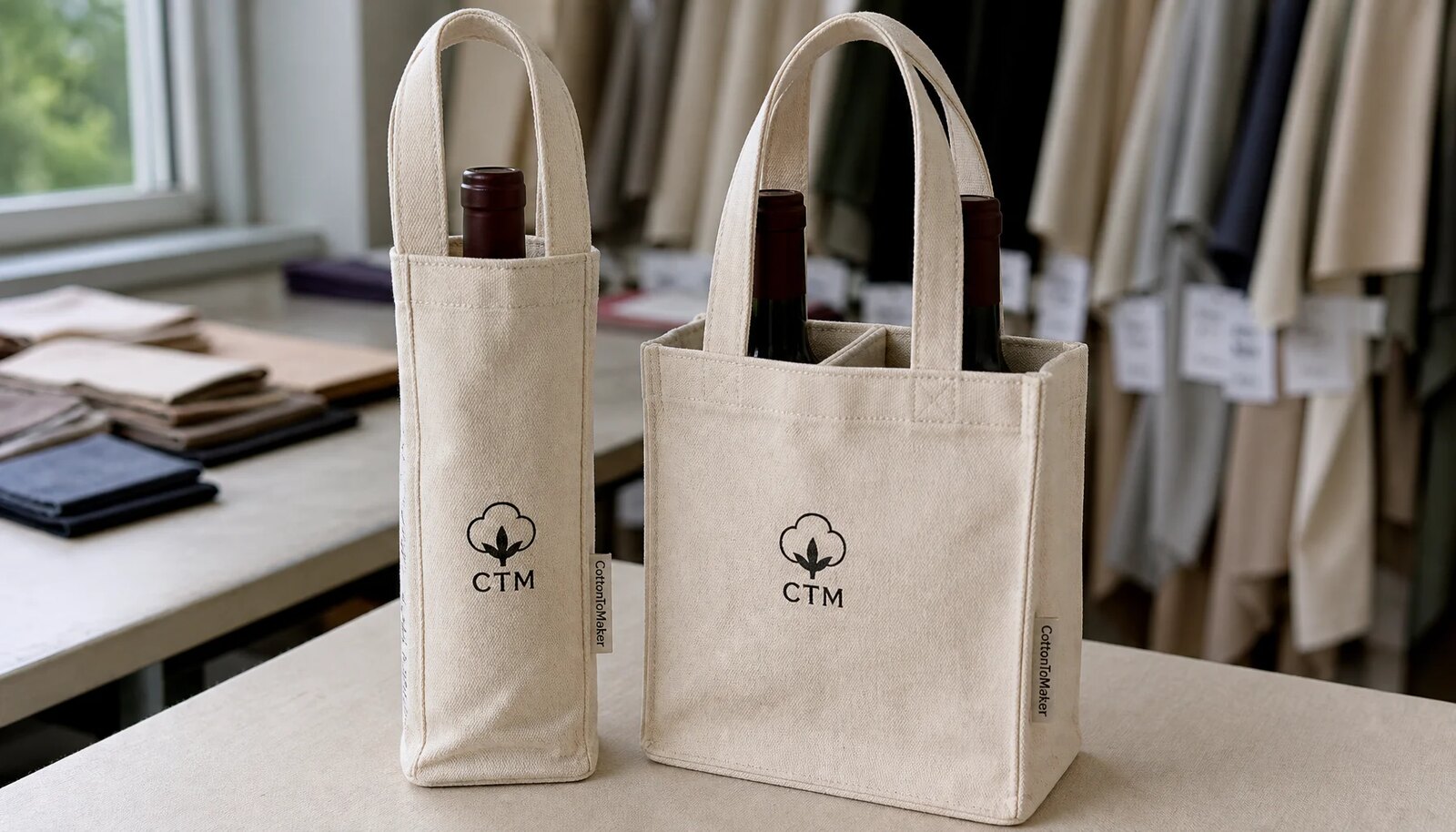
Start with the hotel retail use case, not the fabric name
Canvas wine carriers for hotel retail are not one specification. A carrier sold in a lobby shop as a reusable gift bag has different material needs from a carrier used by a restaurant to send a guest back to the room with one bottle. Procurement teams often begin with the phrase “canvas wine bag” and receive quotes that look comparable but are built on different assumptions: thin cotton fabric, heavy canvas, lined construction, reinforced base, or a simple flat pouch with handles. The first buying decision is to define how the guest will use it and how the hotel will display it.
For hotel retail, the most common mistake is paying for material features guests will not notice while missing construction details they will notice immediately. A 16 oz canvas may sound premium, but if the handle length is awkward or the divider is weak, the product fails at use. A lighter 10 oz canvas with clean stitching, correct bottle fit, and a strong print can sell better and ship cheaper. The material selection should support shelf presentation, bottle safety, branding, and landed cost at the same time.
- Lobby shop souvenir: prioritize print clarity, shelf appearance, and folded packing.
- Wine shop add-on sale: prioritize bottle fit, handle comfort, and quick replenishment.
- Room amenity or welcome gift: prioritize premium handfeel, lining, and low defect visibility.
- Event or seasonal retail program: prioritize MOQ flexibility, production speed, and repeatable color.
Canvas weight: how GSM changes feel, structure, and shipping cost
Canvas weight is usually quoted in ounces per square yard or GSM. For procurement comparison, both can work, but the quote should show at least one measurable value. As a practical range, 8 oz canvas is often around 220-240 GSM, 10 oz around 280 GSM, 12 oz around 330-340 GSM, and 16 oz around 430-450 GSM, depending on weave and finishing. These numbers are not exact conversions across every mill, so the approved swatch matters more than the sales description.
For hotel retail wine carriers, 10 oz to 12 oz cotton canvas is usually the safest middle range. It is strong enough for a full 750 ml bottle, presents well on a shelf, accepts screen printing, and does not make carton weight excessive. 8 oz can be acceptable for promotional single-bottle carriers if the bottom and handles are correctly reinforced. 14 oz to 16 oz is better for premium reusable carriers, but it increases sewing difficulty, edge bulk, needle marks, and unit cost. If the bag needs to stand upright when empty, fabric weight alone is not enough; the bottom gusset, seam structure, and optional base insert matter.
- Budget single-bottle retail: 8 oz to 10 oz canvas, reinforced handle joints.
- Standard hotel shop carrier: 10 oz to 12 oz canvas, boxed bottom, clean screen print.
- Premium gift carrier: 12 oz to 14 oz canvas with lining or structured bottom.
- Heavy two-bottle carrier: 12 oz canvas plus divider and bottom reinforcement is often better than simply using very heavy fabric.
Bottle fit and structure are material decisions too
Wine carrier material selection cannot be separated from bottle size. A Bordeaux bottle, Burgundy bottle, and Champagne bottle have different diameters and shoulder profiles. If the carrier is cut only for a slim 750 ml bottle, a hotel may discover later that the product does not fit the sparkling wine sold in its shop. The RFQ should identify the bottle type or provide bottle diameter and height. If the hotel sells mixed bottle formats, the carrier should be sized for the widest expected bottle, while avoiding an oversized loose fit that looks cheap.
Structure is where many low quotes hide risk. A flat canvas sleeve with two handles may look acceptable in a photo, but it can pull at the seams when loaded. A boxed bottom improves stability and makes the carrier easier to fill at the point of sale. For two-bottle carriers, the divider should separate the bottle bodies and be attached securely enough that it does not shift during carrying. The divider fabric can be the same canvas, a lighter cotton, or a lined panel, but it needs enough height and anchoring to prevent bottle impact.
- Single-bottle carriers should be dimensioned around actual bottle diameter plus seam allowance and ease.
- Two-bottle carriers need a divider that reaches high enough to stop glass contact during normal movement.
- A reinforced bottom panel helps the bag stand and reduces stress at lower side seams.
- If Champagne bottles are included, do not approve a sample tested only with a narrow Bordeaux bottle.
Outer canvas, lining, and coatings: when each material choice pays back
Unlined cotton canvas is the most common choice because it is cost-efficient, printable, and easy to fold. It works well for dry retail environments where the carrier is sold or given with a room-temperature bottle. The inside will show raw or overlocked seams depending on construction, so buyers should define whether exposed seam finishing is acceptable. For many hotel retail programs, a clean unlined build with strong stitching is more practical than adding a lining just for the word “premium.”
A cotton lining improves handfeel and hides internal seams, which is useful for higher-end hotel brands, gift sets, or retail displays where guests inspect the product closely. However, lining adds material cost, labor time, seam bulk, and inspection points. PE-coated or water-resistant lining should be used only when there is a real moisture requirement, such as chilled wine or transfer from a restaurant. Coating can reduce breathability, complicate sustainability messaging, and create wrinkle or odor concerns if not handled properly.
- Unlined canvas: lower cost, faster production, easiest to inspect and fold.
- Cotton lined: better perceived value, cleaner inside, higher labor and MOQ sensitivity.
- PE-coated lining: moisture resistance, but more careful claim control and packing needed.
- Base insert: useful for shelf posture, but specify removable, sewn-in, or covered construction.
Handle material and reinforcement determine real carrying performance
A wine carrier may fail even when the fabric is strong if the handle joint is weak. A full 750 ml bottle weighs roughly 1.2 to 1.5 kg depending on bottle glass and contents, and two-bottle carriers can carry close to 3 kg before accounting for the bag itself. Hotel guests may carry the bottle with other purchases, so handle comfort and reinforcement should not be left to factory default. Same-fabric canvas handles look consistent, while cotton webbing handles can improve grip and load capacity.
For standard carriers, handles should be attached with X-stitch, box stitch, bartack, or a defined reinforcement pattern. The quote should state what is included because photos do not always show the stitching under the handle. Handle length also matters commercially. Too short, and guests cannot carry comfortably; too long, and the bottle swings or the carrier looks sloppy on a shelf. For retail, a practical hand-carry length is usually better than a shoulder length unless the design is intentionally a reusable tote-style wine bag.
- Specify handle width, length, material, and stitching method.
- Use webbing handles for heavier two-bottle designs or repeated use positioning.
- Require reinforcement at handle roots, not only decorative top stitching.
- Include a loaded carry test in sample approval before mass production.
Print method: match hotel branding to canvas texture
Most hotel retail canvas wine carriers use screen printing because it is reliable for solid logos, simple illustrations, and one to three brand colors. It performs well on natural cotton canvas and keeps unit cost manageable. The limitation is detail. Coarse canvas texture can break small lettering, thin lines, and fine crests. If the logo includes a small serif wordmark, a thin emblem, or a detailed resort illustration, the buyer should review a printed sample at actual size rather than relying only on an artwork proof.
Heat transfer can reproduce gradients and photographic detail, but it changes the handfeel and may look less natural on rustic canvas. Embroidery is possible but not always ideal on wine carriers because stitch density can distort small panels and add cost. Woven labels or side tabs work well for luxury hotels that prefer understated branding. For dark canvas such as black, navy, or forest green, the factory may need an underbase layer or adjusted ink system to reach opacity. That affects cost, curing time, and print feel.
- Screen print: best for solid logos, clean cost control, and repeat hotel shop orders.
- Heat transfer: useful for full-color graphics, but test adhesion and handfeel.
- Embroidery: premium look on some designs, but watch puckering and small details.
- Woven label: subtle branding, consistent color, good for premium reusable carriers.
- Dark canvas printing: confirm underbase, ink opacity, and rub resistance.
MOQ logic: why material choice changes the minimum order
MOQ is not only a supplier policy. It is driven by fabric availability, dyeing route, printing setup, cutting efficiency, and sewing line changeover. A natural cotton canvas wine carrier with one-color screen print can often be produced at a lower MOQ than a custom-dyed lined two-bottle carrier with a woven label and retail belly band. When buyers compare suppliers, they should separate the MOQ for stock fabric customization from the MOQ for custom material development.
Stock natural canvas is the most flexible starting point for hotel retail tests. It reduces color approval time, avoids dye minimums, and allows the buyer to validate sell-through before committing to a larger program. Custom dyed canvas makes sense when brand color consistency is critical or when the carrier is part of a coordinated retail collection. Lining, special webbing, metal accessories, and custom packaging can each introduce separate component MOQs. A quote that says “MOQ 500 pcs” may not include the same material route as a quote that says “MOQ 1,000 pcs.”
- Lowest MOQ route: stock natural canvas, standard handle, one-color print, simple bulk packing.
- Medium MOQ route: stock dyed canvas, custom print, hangtag or belly band.
- Higher MOQ route: custom dyed canvas, lining, custom webbing, woven label, retail packaging.
- Best RFQ practice: ask which components are stock and which require custom purchasing.
Cost drivers to separate before comparing quotes
Two quotes for canvas wine carriers can differ for valid reasons. Fabric GSM, lining, divider construction, bottom reinforcement, print method, handle type, and packing all move the cost. A low unit price may exclude retail hangtags, barcode labels, reinforced stitching, or color matching. A high quote may include a stronger material specification that the buyer did not request. To compare fairly, procurement teams should force the quote into a component view instead of only reviewing the final unit price.
For landed-cost thinking, carton efficiency is especially important. Heavy canvas and structured bottom inserts increase gross weight and carton volume. Individual polybags protect the product but add labor, material cost, and waste-handling concerns. If the hotel buyer needs shelf-ready belly bands or hangtags, applying them at the factory can reduce local labor but increases pre-shipment inspection complexity. The right quote format makes these tradeoffs visible before purchase order approval.
- Fabric: GSM, color route, shrinkage control, lining, coating, or base insert.
- Labor: divider sewing, handle reinforcement, lining assembly, trimming, and pressing.
- Branding: screen setup, number of colors, label type, print placement, and curing.
- Packing: polybag, belly band, hangtag, barcode, carton strength, and carton count.
- Logistics: carton CBM, gross weight, port terms, and whether quote is EXW, FOB, or another Incoterm.
Sample approval: what to inspect before mass cutting
A printed prototype is not just a visual sample. It is the buyer's last practical chance to catch fit, strength, print, and packing issues before the factory cuts bulk fabric. For hotel retail wine carriers, sample approval should include the actual bottle type. Place the intended bottle into the carrier, lift it repeatedly, set it on a shelf, and check whether the opening, bottom, and handles behave as expected. For two-bottle versions, test with two filled bottles and listen for glass contact.
Material approval should be documented with a retained swatch, sample photos, and written tolerances. Natural cotton canvas can vary slightly in shade and slub, so buyers should define what is acceptable. If the carrier uses custom dyed fabric, approve a lab dip or strike-off before sample making. For print, review actual size, actual ink color, edge sharpness, and placement. For packing, approve how the carrier is folded because heavy creases on printed areas can create complaints at hotel retail receiving.
- Measure finished width, height, bottom gusset, handle length, and divider height.
- Compare fabric handfeel and GSM with approved swatch or reference sample.
- Load test with the real bottle type, not only an empty display bottle.
- Rub the printed area after curing to check basic adhesion and ink transfer.
- Approve final folding method, tag position, barcode readability, and carton quantity.
Packing and retail readiness for hotel distribution
Hotel retail distribution usually involves multiple handling points: factory packing, export carton movement, importer warehouse receiving, possible regional distribution, hotel storage, and final shelf display. Natural and white canvas can pick up dust or carton marks, so the packing specification should match the product color and receiving standards. Bulk packing may be acceptable for dark canvas or back-of-house use, while individual polybags or paper wraps may be needed for light-colored retail units.
Retail readiness also includes labeling. If the hotel or distributor needs barcodes, hangtags, price stickers, care labels, or country-of-origin labels, these should be in the quote and sample approval. Belly bands are useful for keeping folded wine carriers neat on shelves, but they need correct sizing so they do not slide off or crush the product. Carton weight should remain manageable for warehouse teams; overloading cartons with heavy canvas two-bottle carriers can create carton breakage and receiving delays.
- Light canvas: consider individual polybag, paper wrap, or clean inner carton liner.
- Folded retail display: approve fold lines away from the printed logo when possible.
- Shelf barcode: define sticker size, location, and scan direction before production.
- Carton marks: include item code, quantity, color, PO number, and destination if required.
- Carton strength: specify export carton quality for heavy two-bottle carriers.
Specification comparison for buyers
| Spec decision | Recommended option | When it fits | Buyer risk to check |
|---|---|---|---|
| Outer canvas weight | 10 oz to 12 oz cotton canvas, about 280-340 GSM | Most hotel retail wine carriers where the bag must stand neatly on a shelf and carry a standard 750 ml bottle | Below 240 GSM may collapse and feel promotional; above 380 GSM increases cost, carton weight, and sewing bulk without always improving retail value |
| Construction type | Single-bottle carrier with boxed bottom or two-bottle carrier with sewn center divider | Single-bottle style fits minibar gifting and upsell counters; two-bottle style fits wine shop and holiday gift sets | A loose divider or thin bottom panel can let bottles knock together; require divider height and bottom reinforcement in the spec |
| Lining choice | Unlined for low-cost retail, cotton lining for premium feel, PE-coated lining only when moisture resistance is required | Unlined canvas works for dry retail shelves; lined construction is better for luxury hotels or gift packaging | Coated linings can affect recyclability claims and may wrinkle; lining adds labor and changes seam thickness |
| Handle material | Same canvas handles with reinforced X-stitch or heavy cotton webbing handles | Canvas handles look coordinated; webbing handles suit heavier two-bottle carriers and frequent reuse | Short handles frustrate guests carrying multiple items; handles without bartack or X-stitch can fail during load testing |
| Print method | Screen print for 1-3 solid colors; heat transfer for gradients; woven label for subtle hotel branding | Screen print is best for most hotel logos and retail price points; woven labels suit understated luxury programs | Thick canvas texture reduces fine logo detail; metallic inks and small serif text need pre-production print proofing |
| Color and dye route | Natural, black, navy, or custom dyed canvas with color tolerance stated | Natural canvas is fastest and usually lowest MOQ; custom dyed fabric fits brand color programs or exclusive hotel ranges | Custom dye requires higher MOQ and lab dip approval; dark fabric may need underbase printing for logo opacity |
| Retail packaging | Folded with paper belly band, hangtag, or individual polybag only when required by retail handling | Belly bands and hangtags fit hotel shop shelves; polybags protect white or natural canvas during warehouse transfer | Overpacking increases unit cost and waste; underpacking can cause dust marks, corner crushing, or barcode handling problems |
| MOQ and production route | Stock fabric with custom print for lower MOQ; custom fabric, lining, or dye for higher MOQ | Use stock canvas for first orders or seasonal retail tests; move to custom material after sell-through is proven | Comparing quotes without separating stock-fabric MOQ from custom-material MOQ leads to misleading price gaps |
Buyer checklist before sampling
- Define bottle format before quoting: 750 ml Bordeaux, Burgundy, Champagne, or mixed formats, because diameter and shoulder shape change bag width and divider design.
- State target retail position: budget souvenir, mid-range hotel shop item, premium room amenity, or gift-with-purchase carrier.
- Specify outer fabric in oz or GSM, not only the word canvas; include acceptable tolerance such as plus or minus 5-8 percent.
- Choose unlined, cotton lined, or coated lined construction based on actual use rather than perceived premium value.
- Confirm whether the carrier must stand upright when empty; this affects canvas weight, bottom gusset, and reinforcement.
- Provide logo artwork in vector format and note exact print size, color references, and placement from top edge or side seam.
- Include handle length, handle width, reinforcement method, and minimum load expectation for one or two full bottles.
- Define packing method, barcode location, carton quantity, carton mark requirements, and whether hotel retail labels are applied at factory.
- Request one material sample or swatch set before full prototype if comparing several fabric weights.
- Approve a pre-production sample with actual fabric, actual print, actual divider, and actual packing before mass cutting.
Factory quote questions to send
- Which canvas weights do you hold in stock, and what GSM or oz measurement is verified after finishing?
- For the quoted MOQ, is the fabric stock natural canvas, stock dyed canvas, custom dyed fabric, or custom woven fabric?
- What is the recommended bag size for our bottle type, and have you allowed enough width for Champagne or Burgundy bottles if needed?
- Is the bottom panel reinforced, and what material is used inside the bottom if reinforcement is quoted?
- How is the divider made for a two-bottle carrier: sewn into side seams, attached to bottom, removable, or only a loose fabric panel?
- Which print method is included in the quote, how many colors, and what is the maximum printable area on the selected canvas?
- Are handle bartacks, X-stitches, or hidden reinforcements included, and what load test do you use for finished wine carriers?
- What sample fees and sample lead times apply for blank sample, printed sample, and pre-production sample?
- What is the estimated production lead time after sample approval and deposit, and what schedule risks apply if custom dyeing or lining is added?
- How are units packed per carton, what is the estimated carton size and gross weight, and can you support barcode stickers or retail hangtags?
Quality-control points to confirm
- Finished size tolerance should usually be controlled within plus or minus 1 cm for body dimensions and plus or minus 0.5 cm for handle placement on small carriers.
- Canvas GSM should be checked against the approved swatch; a large drop in weight changes shelf posture and perceived value.
- Seams at handle joints, side gussets, bottom corners, and divider attachment points need reinforcement and clean backstitching.
- A single-bottle carrier should hold a filled 750 ml bottle without seam strain; two-bottle carriers should prevent bottle-to-bottle impact during normal carrying.
- Print must pass basic rub testing after curing, especially on dark canvas, thick ink, or coated surfaces.
- Divider height should be high enough to separate bottle bodies, not only the lower base area.
- Natural canvas should be checked for unacceptable stains, oil marks, weaving defects, and excessive shade variation.
- Cartons should protect against compression and dust; white or natural canvas carriers should not be packed loose in dirty cartons.
- Retail barcode, hangtag, or belly band placement should match the buyer's receiving and shelf plan.
- Final inspection should include random load testing, visual grading, measurement checks, print position checks, and carton count verification.