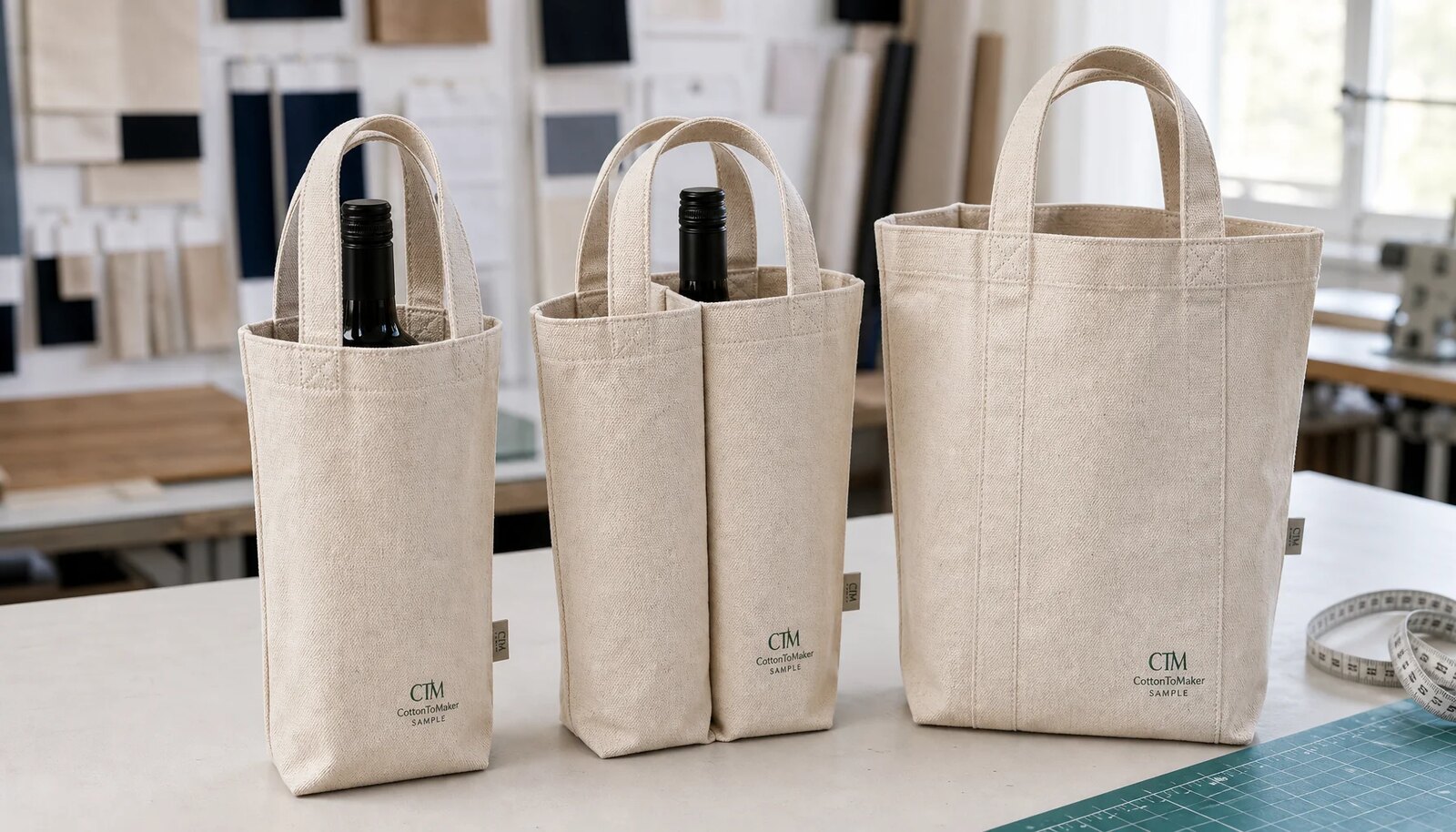
Why fabric weight matters more for hotel wine carriers than for flat totes
A canvas wine carrier is not just a small tote. It holds a heavy glass bottle with a narrow base, it is displayed in a gift shop or behind a reception counter, and it may be sold as part of a branded hotel retail experience. If the fabric is too light, the carrier collapses around the bottle and the print looks uneven. If the fabric is too heavy, the buyer pays for material, sewing difficulty, and carton space that may not convert into a higher retail price.
For hotel retail, the correct fabric weight is the point where the carrier feels substantial in the guest's hand, stands well enough for merchandising, and still lands at a cost that works for distributor or hotel boutique margins. Most sourcing mistakes happen because the RFQ says only "canvas wine bag" without weight, bottle size, handle structure, or packing method. Suppliers then quote different assumptions, and the cheapest offer often wins for the wrong reason.
- Use 8 oz / about 270 GSM only for very price-sensitive single-use promotions or sleeve-style carriers.
- Use 10 oz / about 340 GSM for most standard hotel retail canvas wine carriers.
- Use 12 oz / about 400 GSM when the carrier must stand better, feel more premium, or carry two bottles.
- Use 14 oz / about 475 GSM for premium gift packaging, but budget for higher sewing and freight impact.
Choosing GSM by retail position and bottle format
Fabric weight should be chosen after the buyer defines how the product will be sold. A lobby gift shop carrier for a single 750 ml bottle does not need the same structure as a two-bottle holiday gift carrier used by a luxury resort. A wine carrier sold empty needs shelf presence; a carrier packed with wine and placed inside a hamper needs load strength and divider protection. The same GSM can perform differently depending on bag width, bottom gusset, and handle reinforcement.
A practical starting point is to match GSM to the required stiffness and perceived value. Natural cotton canvas around 340 GSM gives a balanced hand feel and usually prints well with screen print. Around 400 GSM gives a thicker retail feel and improves the loaded shape. Above 450 GSM, the buyer should have a clear reason, such as a high retail price point, long reuse expectation, embroidery, or a premium branded collection.
- Single 750 ml wine carrier: 10 oz / 340 GSM is usually the safe commercial base.
- Two-bottle wine carrier: 12 oz / 400 GSM is often better, especially with a sewn divider.
- Champagne or Burgundy bottles: increase width and depth before increasing GSM; fit is usually the first issue.
- Empty shelf display: boxed bottom and packing method matter as much as GSM.
- Low-cost giveaway: 8 oz can work only if the buyer accepts a softer, less structured bag.
How canvas weight changes cost, not just hand feel
Canvas cost increases with material consumption, but the landed cost impact is wider than fabric price. Heavier fabric can slow sewing speed, require heavier needles, produce more seam bulk at the handle area, and increase carton volume. It can also change the folding method because thick canvas develops strong crease marks when compressed. For hotel retail buyers, the important comparison is not only FOB unit price but the cost per sellable, good-looking carrier arriving at the hotel or distributor warehouse.
When comparing quotes, normalize the specification before judging price. A 10 oz natural canvas carrier with simple screen print cannot be compared directly with a 12 oz dyed canvas carrier with woven label and reinforced divider. If suppliers do not state GSM, bag dimensions, seam type, print method, and packing, the quote is incomplete. A low quote may simply mean the supplier assumed lighter fabric, smaller size, no divider, thinner handle, or tight compressed packing.
- Fabric: heavier GSM increases material cost and may increase cutting waste on small wine bag panels.
- Labor: boxed bottoms, dividers, and reinforced handles add more cost than many buyers expect.
- Printing: screen setup cost is spread over quantity; small MOQ orders may carry high print cost per unit.
- Packing: retail-safe flat packing may use larger cartons than aggressive compression.
- Freight: heavier canvas and larger carton CBM both affect landed cost.
Construction details that must match the selected fabric weight
Fabric weight alone does not make a safe wine carrier. The handle attachment, top seam, bottom gusset, and divider design must be engineered around the expected load. A single 750 ml bottle with glass can weigh around 1.2 kg to 1.5 kg, and two bottles can approach 3 kg before any accessories are added. That load concentrates at the handles and upper side seams. A heavier canvas body with weak handle stitching is still a failed product.
For standard hotel retail, self-fabric handles with box-X stitching or dense bartacks are usually the cleanest solution. Cotton webbing handles can reduce sewing bulk and improve strength, but the texture may not match the canvas body. For two-bottle carriers, a sewn center divider is strongly preferred over a loose divider if guests will carry the bottles after purchase. The divider should reach high enough to reduce bottle contact, not just cover the bottom few centimeters.
- Handle width: commonly 2.5 cm to 3.5 cm for comfort and strength.
- Handle drop: short hand-carry drop is typical; shoulder drop usually looks awkward on wine carriers.
- Top seam: folded and stitched top edge improves durability and visual finish.
- Bottom: boxed bottom gives better shelf standing than a flat pouch style.
- Divider: full-height or near full-height sewn divider reduces glass clinking in two-bottle formats.
Print method decisions on 8 oz, 10 oz, 12 oz, and 14 oz canvas
Print quality on canvas depends on weave texture, ink coverage, artwork detail, and fabric color. Screen print is the most common choice for hotel logos because it handles solid marks, crest-style branding, and one to three spot colors well. On 10 oz and 12 oz natural canvas, screen print normally gives a good balance of cost and durability. Very fine text, thin lines, and small registration details need artwork adjustment because ink sits on a woven surface, not a smooth paper sheet.
Heat transfer may suit complex full-color artwork or small quantities, but it can create a different surface feel and may not match the natural look many hotel retail buyers want. Embroidery can look premium on heavier canvas, especially 12 oz or 14 oz, but it adds cost, can pucker lighter fabric, and is not ideal for tiny lettering. Woven side labels are useful when the front should remain clean or when reorders may use different fabric colors while keeping the brand mark consistent.
- 8 oz canvas: avoid heavy ink coverage and dense embroidery because puckering and distortion are more likely.
- 10 oz canvas: suitable for standard one-color or two-color screen print hotel logos.
- 12 oz canvas: good for screen print, woven label, leather/PU patch, or controlled embroidery.
- 14 oz canvas: works for premium branding but test fold marks and needle holes.
- Dyed canvas: print opacity and color matching must be tested on the final dyed fabric, not on natural canvas.
MOQ logic for natural, dyed, and custom retail programs
MOQ is not only a supplier policy; it is driven by fabric availability, dyeing, cutting efficiency, print setup, label production, and packing labor. Natural cotton canvas in standard weights usually allows a lower MOQ than custom dyed canvas because mills and bag factories may keep common fabric in stock. A dyed hotel brand color may require a higher minimum because the fabric dye lot must be run economically and shade approval must be controlled.
For importers and distributors, it is useful to separate MOQ by specification layer. The factory may accept a lower order for a natural 10 oz carrier with one-color screen print, while the same factory may need a higher quantity for 12 oz dyed canvas with woven labels and individual retail packaging. If a buyer needs multiple hotel properties with different logos, the best structure may be one shared fabric order with separate print runs, but only if the base fabric, dimensions, and packing are identical.
- Lower MOQ route: natural canvas, standard size, one-color screen print, no custom label.
- Medium MOQ route: natural or stock dyed canvas, custom logo, woven side label, standard carton packing.
- Higher MOQ route: custom dyed canvas, special handle color, premium patch, or custom retail sleeve.
- Multi-property program: standardize the bag body and vary only the logo to reduce cost and risk.
- Reorder planning: keep the approved fabric weight and shade record so repeat orders do not drift.
Sample approval should test loaded performance, not only appearance
A wine carrier sample can look acceptable when empty and fail when loaded with the real bottle. Procurement teams should approve the sample with the nominated bottle type inside, including any divider, paper wrap, hangtag, or gift card that will be used in retail. The sample should also be packed and unpacked in the intended way, because thick canvas can arrive with hard fold lines that change the product's shelf appearance.
A useful sample approval file includes the fabric swatch, finished bag weight, dimensions, logo placement, print color, stitch details, and packing photo. The buyer should sign off on measurable criteria, not only a photo. For example, if the hotel expects the logo center to sit a certain distance from the bottom edge, write the measurement and tolerance. If the carrier must stand upright when loaded, record that as an acceptance requirement.
- Measure internal fit using the real bottle shape, not only outside bag dimensions.
- Compare fabric hand feel against approved swatch after printing and folding.
- Check handle comfort with one full bottle and, for two-bottle bags, two full bottles.
- Rub the printed logo after curing to detect poor ink adhesion or surface tackiness.
- Photograph the approved packing method so bulk packing does not change later.
QC thresholds for stitching, stains, print, and finished size
Canvas is a natural-looking material, but hotel retail still requires clean presentation. Cotton specks and small slubs may be acceptable on unbleached canvas, while oil stains, large dark marks near the logo, broken yarns, or dirty handling marks should not be accepted. The defect standard should be practical: natural variation is normal, but visible defects on the front panel reduce retail value and create disputes at final inspection.
Finished size tolerance matters because wine bottles have limited clearance. A small reduction in width or gusset can make a Burgundy or Champagne bottle difficult to insert. Handle drop also matters at the counter; too short feels uncomfortable, too long may let the bottle swing. QC should include measurement, load test, print inspection, and standing test, using a written inspection plan rather than subjective comments like "good quality canvas."
- Size tolerance: define acceptable variation for height, width, gusset, and handle drop before production.
- Stitch density: require consistent stitching with no skipped stitches, loose threads, or open seams.
- Load test: test above normal bottle weight with a defined hold time and no seam failure.
- Print position: set tolerance from top edge, side seam, or bottom edge, not by visual estimate.
- Front panel grading: classify visible stains, large slubs, and print contamination as major defects.
Packing choices that protect shelf shape and retail presentation
Packing is often treated as an afterthought, but it can ruin a well-made canvas wine carrier. Wine carriers are small and factories may be tempted to compress them tightly to reduce carton volume. That can create deep fold marks across the logo, crushed boxed bottoms, and distorted handles. For hotel retail, especially when the goods go directly to property storerooms, the product should arrive ready for quick display with minimal steaming or reshaping.
Flat packing in controlled bundles is usually the safest commercial method. Premium carriers may need tissue between printed surfaces, paper banding, or lower bundle counts per carton. Individual polybags may protect against moisture and dirt, but some hotel and resort buyers prefer reduced plastic. If plastic-free packing is required, the RFQ should state that clearly because it changes material choice, carton lining, and moisture control planning.
- Avoid overfilled cartons that force hard creases through the logo area.
- Keep printed panels facing safely to prevent ink transfer or abrasion.
- Limit carton gross weight so hotel staff can handle replenishment easily.
- Use moisture protection for sea freight, especially with natural cotton canvas.
- Specify carton marks by SKU, hotel property, logo version, and quantity per carton.
Lead time risks from fabric, artwork, and holiday hotel retail calendars
Canvas wine carriers are often ordered for seasonal gifting, festive hampers, wine dinners, resort openings, or minibar retail launches. These programs have fixed dates, so the buying calendar must include artwork proofing, sample making, sample revision, fabric booking, bulk production, inspection, and shipping. The shortest quoted production lead time is not useful if it excludes fabric dyeing or buyer approval delays.
Natural canvas with simple print is usually the fastest route because standard fabric is easier to source. Custom dyed canvas, embroidery, woven labels, and retail sleeves add approval steps. If the order is for a holiday period, reserve extra time for congestion before peak season and for carton labeling by property or distributor destination. A late wine carrier does not simply miss a delivery date; it may miss the retail selling window.
- Artwork proof: confirm logo size, placement, and print color before sampling.
- Sample round: allow time for one correction, especially if bottle fit or print detail is uncertain.
- Fabric booking: verify whether quoted lead time starts after deposit, artwork approval, or fabric arrival.
- Bulk inspection: schedule before final balance payment or shipment release.
- Shipping plan: compare sea freight savings against the risk of missing the hotel retail launch.
Specification comparison for buyers
| Spec decision | Recommended option | When it fits | Buyer risk to check |
|---|---|---|---|
| Main fabric weight | 10 oz / about 340 GSM natural cotton canvas for standard hotel retail | Most gift shop and minibar upsell programs where the bag must stand reasonably well but stay cost-controlled | Below 280 GSM may feel like a thin tote sleeve; above 450 GSM may raise freight, sewing time, and retail price without improving sell-through |
| Premium fabric weight | 12 oz / about 400 GSM or 14 oz / about 475 GSM canvas | Luxury hotel boutiques, wine club welcome gifts, or paid retail items positioned as reusable packaging | Heavier canvas can crease more visibly, needs stronger needles, and may require larger carton volume; confirm folded appearance after packing |
| Single vs two-bottle format | Single-bottle carrier for impulse retail; two-bottle carrier with sewn divider for gift packs | Single format suits lobby shops and tasting rooms; two-bottle format suits holiday hampers and corporate gifting | Two-bottle bags without a full-height divider can clink during transport and fail buyer handling tests |
| Handle construction | Self-fabric handles made from matching canvas with box-X reinforcement | Best for a clean retail look and consistent dye/texture with the bag body | Handle width under 2.5 cm can cut into the hand; weak bartack or loose box stitch is a common failure point with glass bottles |
| Bottom structure | Flat boxed bottom with reinforced seam allowance; optional inserted base for premium ranges | Needed when the carrier must stand on a retail shelf or hold a bottle during guest checkout | A simple flat pouch construction saves cost but tips over easily and looks poor in hotel retail displays |
| Print method | Screen print for solid hotel logos; heat transfer only for complex small-color artwork; embroidery mainly for premium labels | Screen print is usually best for one to three spot colors on natural or dyed canvas | Heavy ink layers on coarse canvas can crack at folds; very fine serif logos may fill in unless artwork is adjusted |
| Fabric finish | Unbleached natural canvas for rustic wine retail; dyed canvas for brand color programs after lab dip approval | Natural fabric works for organic, winery, resort, and boutique hotel themes; dyed fabric fits strict brand palettes | Natural canvas has shade variation and cotton specks; dyed canvas has MOQ and shade tolerance issues that must be written into approval |
| Packing method | Flat-packed in bundles with tissue or paper banding for retail-ready condition | Works for hotel storerooms, gift shop replenishment, and distributor carton handling | Over-compression causes hard fold lines, warped bottoms, and print offset; bottle bags need more careful packing than flat totes |
Buyer checklist before sampling
- Define the bottle type before quoting: standard 750 ml Bordeaux, Burgundy, Champagne, or mixed formats, because carrier width and divider design change by bottle diameter.
- State the target fabric weight in oz and GSM, for example 10 oz / about 340 GSM, and specify whether tolerance is based on finished fabric or greige fabric.
- Decide whether the bag must stand on shelf when empty; if yes, include boxed bottom dimensions, seam reinforcement, and packing requirements in the RFQ.
- Provide logo artwork in vector format and note the smallest text height; coarse canvas can lose detail, especially with script hotel logos.
- Set load expectations: one 750 ml bottle is commonly 1.2 kg to 1.5 kg including glass, so handle stitching should be tested above normal use weight.
- Request one pre-production sample using correct fabric weight, correct handle, correct print method, and correct folded packing method, not only a material swatch.
- Define acceptable shade variation for natural canvas or dyed fabric; hotel retail reorder consistency depends on this.
- Confirm individual packing, bundle quantity, carton size, carton weight, and whether cartons must fit hotel storeroom handling limits.
- Separate sample lead time, bulk production lead time, and sea or air transit time in the buying calendar.
- Require quote data by line item: fabric, printing, label, packing, carton, mold/tooling if any, sample charge, and freight basis.
Factory quote questions to send
- What exact canvas weight are you quoting in oz and GSM, and is it measured before or after washing, dyeing, or finishing?
- What bottle size did you use to calculate the bag dimensions and divider width?
- Can you provide fabric swatches in 8 oz, 10 oz, 12 oz, and 14 oz so our retail team can compare hand feel and shelf structure?
- For our logo, do you recommend screen print, heat transfer, embroidery, woven label, or leather/PU patch, and what artwork limitation should we allow?
- What is your MOQ for natural canvas, dyed canvas, and custom printed fabric, and which cost item causes the MOQ?
- What handle reinforcement will be used at the top seam, and what load test weight do you apply for wine carriers?
- How will two-bottle carriers be separated internally: sewn divider, loose divider panel, or no divider?
- Will the bags be packed flat, folded, or shaped with insert support, and what carton dimensions and gross weight do you estimate?
- What defects are you classifying as critical, major, and minor for stitching, stains, print, and size tolerance?
- What is the realistic timeline for artwork proof, sample, sample revision, bulk material booking, production, inspection, and shipment?
Quality-control points to confirm
- Finished fabric weight should be within the agreed tolerance, commonly plus or minus 5% if not otherwise specified.
- Bag internal width and depth must fit the nominated bottle type without forcing the seam or leaving excessive wobble.
- Handle attachment should pass a static load test above expected bottle weight, with no popped stitches, seam tearing, or visible fabric distortion.
- Boxed bottom should stand evenly on a flat surface when loaded with the nominated bottle.
- Divider stitching on two-bottle carriers should prevent glass-to-glass contact during normal carrying movement.
- Logo print should match approved color standard within agreed tolerance and show no cracking, bleeding, ghosting, or misregistration.
- Natural cotton stains, oil marks, dark slubs near the logo, and large weaving defects should be classified before production.
- Top opening, handle drop, height, and bottom gusset should be measured against approved sample with written tolerances.
- Cartons should protect the bag shape and print surface; overfilled cartons should be rejected if they deform the bottom or transfer ink.
- Final inspection should include both empty shelf-standing check and loaded carry check using the real bottle format.