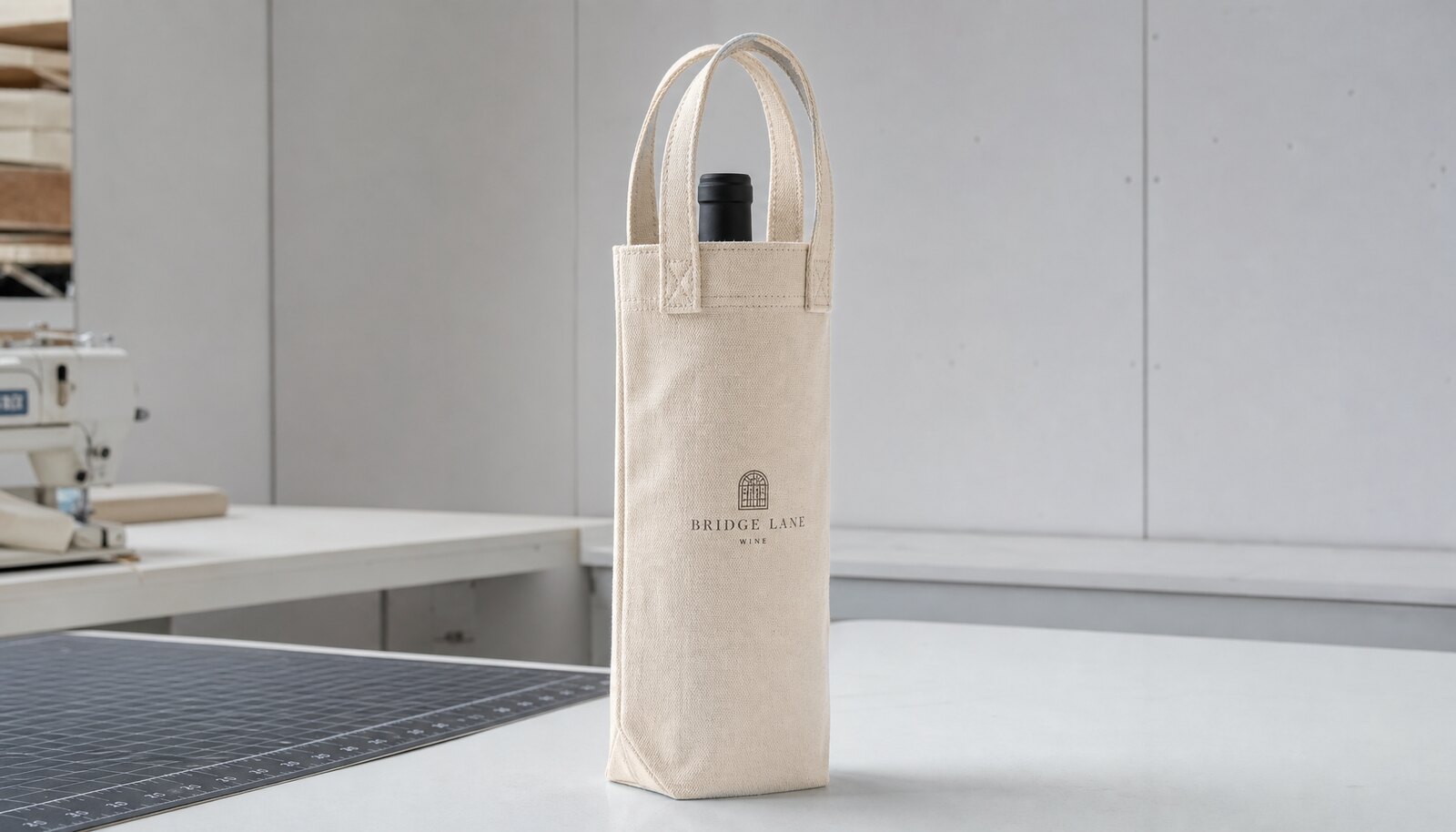
Why gift shop wine carriers fail in practice
Canvas wine carriers for gift shops fail for the same reason many retail soft goods fail: the visible spec looks fine, but the hidden build is too weak for real handling. Customers do not baby a wine carrier. They pick it up by the handles, swing it in a bag, set it on a counter, and often reuse it for a second gift or a trip home. If the bag loses shape, the handles feel thin, or the print cracks after a few folds, the product looks cheap even if the artwork is attractive.
That is why procurement teams should treat durability as a sourcing requirement, not a nice-to-have. The issue is not only returns. Weak carriers create a shelf problem, because gift-shop shoppers compare tactile quality immediately. A bag that collapses around the bottle, twists at the handles, or sheds ink during handling hurts conversion before the sale even happens. The durability testing checklist needs to cover load, drop, rub, and seam integrity so the order is evaluated like a retail product, not like a decorative pouch.
- Most retail failures show up first at the handle join, bottom seam, or print surface.
- A carrier that passes appearance review can still fail after a few lift cycles.
- The buyer should define performance for shelf display, carry use, and re-use.
Start with the bottle profile, not the artwork
The best sourcing spec starts with the bottle, because bottle diameter and height determine nearly every other decision. A standard 750 ml Bordeaux bottle is not the same as a Burgundy bottle or a sparkling bottle with a wider base and shoulder. If the carrier is too tight, the fabric stretches, the seams lean, and the handle load rises. If it is too loose, the bottle shifts in transit and the bag reads as unfinished at retail. For gift shops, that fit problem is especially visible because customers often inspect the bag in their hand before buying.
Once the bottle profile is clear, size the bag around actual use, not a theoretical dimension from a catalog. Ask the supplier to sample with the bottle type you really sell. Confirm the exact finished height, body width, and any gusset or depth. If the product line includes more than one bottle shape, compare fit on the largest and heaviest bottle first. That prevents the common mistake of approving a sample with a narrow bottle and discovering later that the real assortment does not fit cleanly.
- Identify the widest bottle in the assortment before finalizing the bag width.
- Confirm whether the carrier needs to hold a bottle with a foil capsule or neck wrap.
- If you sell sparkling bottles, test the gusset and base seam on the widest profile first.
Choose the build option that matches your retail position
The comparison that matters is not only fabric weight or price. It is build choice. A single-bottle open-top carrier is the simplest and usually the easiest to buy at scale. It works well for everyday gift-shop merchandising where customers want a clean, practical carry solution. A flap or snap closure adds perceived value and can support premium gifting, but it also introduces hardware, alignment, and tolerance issues. A two-bottle carrier with a divider is a different sourcing problem altogether because the divider carries load and the handles see more stress when the customer lifts a full set.
Handle construction deserves the same scrutiny. Self-fabric handles are efficient and visually cohesive, but they need strong edge finishing and reinforcement to avoid premature wear. Cotton webbing handles often feel better in hand and can improve the premium impression, but they add cost and color-matching risk. For a gift-shop buyer, the best decision is usually the one that preserves presentation without making the item hard to pack, hard to sew, or fragile in handling. The table above is meant to help compare those tradeoffs before quoting.
- Open-top carriers are simpler, but the bottle must sit stable without a closure.
- Closure hardware should be checked for scratch risk and alignment repeatability.
- Two-bottle carriers need a separate stress review at the divider and handle junction.
Lock fabric weight and construction before you ask for price
Fabric weight is the base decision because it affects structure, print appearance, sewing difficulty, and freight cube. For most canvas wine carriers sold through gift shops, 12 oz to 16 oz canvas is a practical range, or roughly 407 to 540 GSM. Lighter canvas can be economical, but it may sag around the bottle and make the product feel thin on the shelf. Heavier canvas gives better structure and a stronger retail impression, but it also increases material cost and can make seam turning, folding, and final packing more labor-intensive.
The quote must state what is being measured. Ask whether the GSM or ounce weight refers to greige fabric, finished fabric, or pre-washed fabric. Those are not interchangeable. Also ask whether the carrier is using a single layer or a lined build, because lining changes both the appearance and the production risk. If a supplier gives you only the phrase 'heavy canvas,' you do not yet have a quote that can be compared with other factories. You have a style conversation, not a procurement spec.
- Require the fabric weight to be stated with a tolerance, not as a marketing label.
- Ask if the fabric is pre-shrunk, dyed, or finished after weaving.
- Test the same fabric on the actual target bottle before approving the build.
Use a real durability testing checklist, not a generic quality promise
The best durability testing checklist is specific enough that a factory can run it without interpretation. For a one-bottle canvas carrier, start with a static load test using the actual bottle weight plus a small allowance for handling. A practical in-line check is to hang or lift the fully loaded carrier repeatedly for 20 to 30 cycles, then inspect the handle joins, top edge, and bottom seam for opening, stitch loss, or deformation. The test does not need to be complex to be useful; it needs to mirror the way the product is actually used.
Add a drop test because shipping and retail handling are not gentle. A simple protocol is a loaded bag dropped from about 80 to 100 centimeters onto a hard surface or firm board, once on the base and once on each side. After the sequence, the carrier should still hold the bottle securely and remain usable. For rub resistance, use dry cotton cloth rubbing across the printed logo for a defined number of strokes, then repeat with a slightly damp cloth if the artwork or brand standard requires it. What matters is that pass and fail are visible, repeatable, and written into the purchase spec.
- Load test: use the real bottle, repeat lifts, and inspect the handle joins after the cycle.
- Drop test: 80 to 100 cm is a practical starting range for retail pack validation.
- Rub test: use a defined stroke count and inspect for smearing, peeling, or loss of legibility.
- Seam review: inspect the bottom seam, side seams, and bartacks after the load and drop sequence.
Write acceptance thresholds the factory can actually execute
A durable bag spec is only useful if it can be inspected consistently. That means you need measurable thresholds, not just words like 'strong' or 'premium.' For load testing, define the bottle weight, the number of lift cycles, and what constitutes failure. For example, if a handle stitch opens, a bartack pops, or the base seam visibly separates, the unit fails. If the bag deforms but remains functional, decide in advance whether that is a warning condition or a hard fail. Buyers need that line before production starts, not after the first shipment is in the warehouse.
The same principle applies to print quality. If your logo has fine lines, define a minimum line width and minimum type size. If you care about brand color consistency, ask the supplier to confirm the print reference on the actual canvas color and not only on a white sample board. If the order includes multiple artwork versions, keep the approval record separate for each version, because different screens, inks, or heat-transfer settings can drift independently. Clear thresholds reduce dispute risk and make inspection meaningful.
- Define failure states for seams, handles, print, and carton damage before bulk production.
- Set a numbered stroke count for rub tests instead of saying the print must be 'durable.'
- If acceptable deformation exists, document it with photos and a tolerance note.
Sample approval should prove the production method, not just the look
A pre-production sample should be a production proxy. If the sample is made from different fabric, different thread, or a different print process, it may look better than the bulk goods and create a false sense of security. Ask the factory to make the sample from bulk-intended materials and to confirm the sewing line that will actually run the order. This is especially important for canvas because slight differences in weave density, finishing, or dye lot can change how the bag folds and how the logo sits on the panel.
Approval should capture the dimensions that matter commercially: finished size, handle drop, bottle fit, print placement, and folded packing size. Take one approved sample and document it with photos from the front, side, and interior if visible. Keep a note of any allowances, such as small shifts in print centering or stitching appearance, so the factory has a clean reference. If you approve only by eye, you lose the ability to inspect the bulk order against a shared standard.
- Approve the sample against the real bottle and the real retail use case.
- Record handle drop and bag height so the order can be measured consistently later.
- Save the approved sample, photos, and spec version together.
Print method and decoration choices affect durability more than buyers expect
On coarse canvas, decoration is not only a branding decision; it is a durability decision. Screen print is usually the strongest choice for simple logos because it gives good opacity and repeatability on textured fabric. Heat transfer can work when the artwork is more detailed, but the buyer should inspect edge lift, cracking, and how the graphic behaves after folding. Embroidery creates a premium feel and can survive handling well, but it also stiffens the panel and can add snag risk, which matters for a soft retail accessory that may be stored, stacked, or moved by customers quickly.
A practical commercial question is whether the logo still looks clean after the carrier has been folded, handled, and repacked. Ask for a dry rub test after curing and check the reverse side for strike-through or ghosting on dyed canvas. If the print sits near a seam or handle, make sure the artwork placement leaves enough margin for sewing variation. Good decoration control is a sign that the factory can control the rest of the build as well.
- Screen print is usually best for simple, repeatable retail branding.
- Heat transfer needs rub and edge-lift checks if the artwork is detailed.
- Embroidery should be tested for stiffness, snag risk, and panel distortion.
Packing, carton size, and freight are part of the product spec
Canvas wine carriers are often light but bulky, which means packing can move the landed cost more than the fabric price. Flat packing usually works best because it keeps the carton efficient and avoids unnecessary freight cube. If the carrier has a structured insert or closure hardware, ask the factory exactly how it will be folded so the folds do not become permanent creases. Tissue, individual polybags, and retail tags can improve presentation, but each one adds labor and can increase packing volume. For gift shops, the right answer is often the simplest packing that still protects the finish and the print.
The carton spec needs the same discipline as the bag spec. Ask for the exact outer carton dimensions, gross weight, and piece count. If two suppliers quote the same unit price but one packs at a larger cube, the freight cost can erase the savings quickly. Also ask how cartons are marked, whether mixed artwork versions are allowed, and whether each variant is separated by batch. Good carton control reduces receiving errors and makes store replenishment easier.
- Prefer flat-packed cartons unless the carrier shape requires formed packing.
- Compare landed cost using carton cube, not only unit price.
- Use clear SKU marks and batch separation when more than one artwork version ships together.
Lead time is usually lost in approval steps, not sewing time
For this category, schedule risk usually comes from front-end decisions. Fabric confirmation, print setup, sample approval, and packing sign-off all happen before the main line can run efficiently. If the supplier cannot tell you when the schedule starts, you are missing the critical path. Some factories start the clock after deposit, others after artwork approval, and others only after the sample is signed. That difference changes whether the order can hit a seasonal retail window.
A procurement team should ask for separate sample and bulk lead times. The sample lead time shows how fast the factory can move through design and proofing. The bulk lead time shows how quickly they can actually produce once the order is locked. If the order is tied to holiday gift sales, build enough time for at least one correction cycle. A fast quote with a weak approval process is often slower in practice than a slightly higher quote with disciplined samples and clear pre-production control.
- Separate sample time from bulk time in every quote request.
- Ask what event starts production: deposit, artwork approval, or sample approval.
- Leave schedule buffer for seasonal selling periods and holiday delivery windows.
Specification comparison for buyers
| Build or sourcing choice | Best fit | Advantages | Tradeoffs and buyer risk |
|---|---|---|---|
| Single-bottle open-top carrier | Core gift-shop SKU for wine, olive oil, or gourmet bottle gifts | Lowest sewing complexity, easiest to quote, compact carton pack, good shelf display | Less protection in transit, handle and base strength must be proven because there is no closure to hold the bottle in place |
| Single-bottle carrier with flap or snap closure | Premium gifting, seasonal promotions, or bundled bottle presentation | Stronger perceived value, better bottle retention, cleaner unboxing | More parts and sewing steps, hardware can scratch bottles, closure alignment must be checked on every sample |
| Two-bottle carrier with center divider | Gift baskets, holiday sets, and paired bottle promotions | Higher average order value, better merchandising for premium sets | Divider seam takes more stress, handle pull loads rise sharply, carton weight and cube increase |
| Self-fabric handles | Value-focused retail SKUs and repeat reorder programs | Lower material count, simpler sourcing, consistent look with the body fabric | Can feel less comfortable in-hand and may wear faster if the edge finishing is weak |
| Cotton webbing handles | Premium retail positioning or heavier bottle loads | Better grip, often cleaner load distribution, familiar premium accessory look | Higher material cost, color matching risk, and more coordination if webbing is dyed separately |
| Screen print decoration | Simple logo art, two colors or fewer, repeat orders | Best cost-to-durability ratio, strong opacity on canvas, predictable repeat quality | Not ideal for fine detail, soft gradients, or very small text |
| Embroidery or woven label branding | Higher-end gift presentation and tighter brand identity control | Premium tactile feel, good for minimal logos, durable if the stitch count is controlled | Raises cost, can stiffen the panel, and may snag or distort on lighter canvas |
| Factory-direct sourcing | Buyers who need consistent QC, stable reorders, and cleaner change control | Better access to fabric, stitch, and packing details; fewer communication hops | Requires stronger spec writing and more diligence on sample and inspection discipline |
| Trading or consolidation route | Small programs, mixed SKUs, or buyers who need lower administrative effort | Can simplify multi-item purchasing and lower barrier to entry | Factory transparency may be weaker, technical answers may be indirect, and bulk consistency can be harder to verify |
Buyer checklist before sampling
- Define the bottle profile first: standard 750 ml Bordeaux, Burgundy, sparkling, or a wider specialty bottle.
- Lock fabric weight in GSM or oz and state whether the tolerance applies to greige, finished, or washed material.
- Specify the bag build: single-bottle, two-bottle with divider, open-top, flap closure, or snap closure.
- State handle type, handle width, handle drop, and reinforcement method at the attachment points.
- Require seam details in the spec: stitch type, stitch density, seam allowance, and bartack placement.
- Describe logo method, artwork size, minimum line thickness, and acceptable color match range.
- Ask for a pre-production sample made from bulk fabric and bulk thread, not a showroom sample from different stock.
- Set a durability testing checklist with measurable pass or fail criteria for load, drop, seam pull, and rub resistance.
- Define packing format: flat-packed or formed, tissue use, inner polybag use, carton quantity, and carton label content.
- Request carton dimensions and gross weight so freight and warehouse cube can be compared on equal terms.
Factory quote questions to send
- What is the actual fabric weight in GSM or oz, and is that measured before or after finishing?
- Will the pre-production sample and bulk order use the same fabric lot, same thread, and same print process?
- What seam allowance do you use at the side seams, bottom seam, and handle joins?
- What stitch density do you recommend for this build, and can you keep it consistent across production?
- What is your planned reinforcement method at the handle attachment and bottom stress points?
- How many bottles per carton, and what are the exact carton dimensions, gross weight, and carton master marks?
- What is the MOQ by artwork version, and what setup cost changes if we add one or two more designs?
- Can you quote the same bag with self-fabric handles and with cotton webbing handles for comparison?
- What in-house tests can you support: load test, drop test, rub test, and colorfastness check?
- What is your lead time for sample approval, bulk production, and export packing, and when does the clock start?
Quality-control points to confirm
- {'point': 'Finished dimensions', 'threshold': 'Width, height, and depth must match the approved sample within the agreed tolerance and still fit the target bottle without forcing.'}
- {'point': 'Handle reinforcement', 'threshold': 'No seam opening, loose bartacks, or thread breakage after repeated lift cycles with a full bottle load.'}
- {'point': 'Bottle fit and retention', 'threshold': 'The target bottle must insert and remove smoothly, and the carrier must not tip excessively when lifted by the handles.'}
- {'point': 'Load durability', 'threshold': 'The carrier must complete the specified load test without handle tear, bottom seam failure, or visible structural distortion beyond the allowable limit.'}
- {'point': 'Drop resistance', 'threshold': 'After the defined drop sequence, the bag should remain usable, with no broken handles, exposed stitching failure, or bottle-impact damage to the structure.'}
- {'point': 'Print rub resistance', 'threshold': 'After dry rub and wet rub checks, the logo should not show heavy smearing, peeling, or loss of legibility beyond the approved standard.'}
- {'point': 'Stitch consistency', 'threshold': 'Topstitching, side seams, and bartacks must remain even across the first, middle, and last inspected units from the run.'}
- {'point': 'Packing integrity', 'threshold': 'Cartons must arrive with the correct piece count, SKU labeling, and no mixed variants unless the order specifically allows it.'}