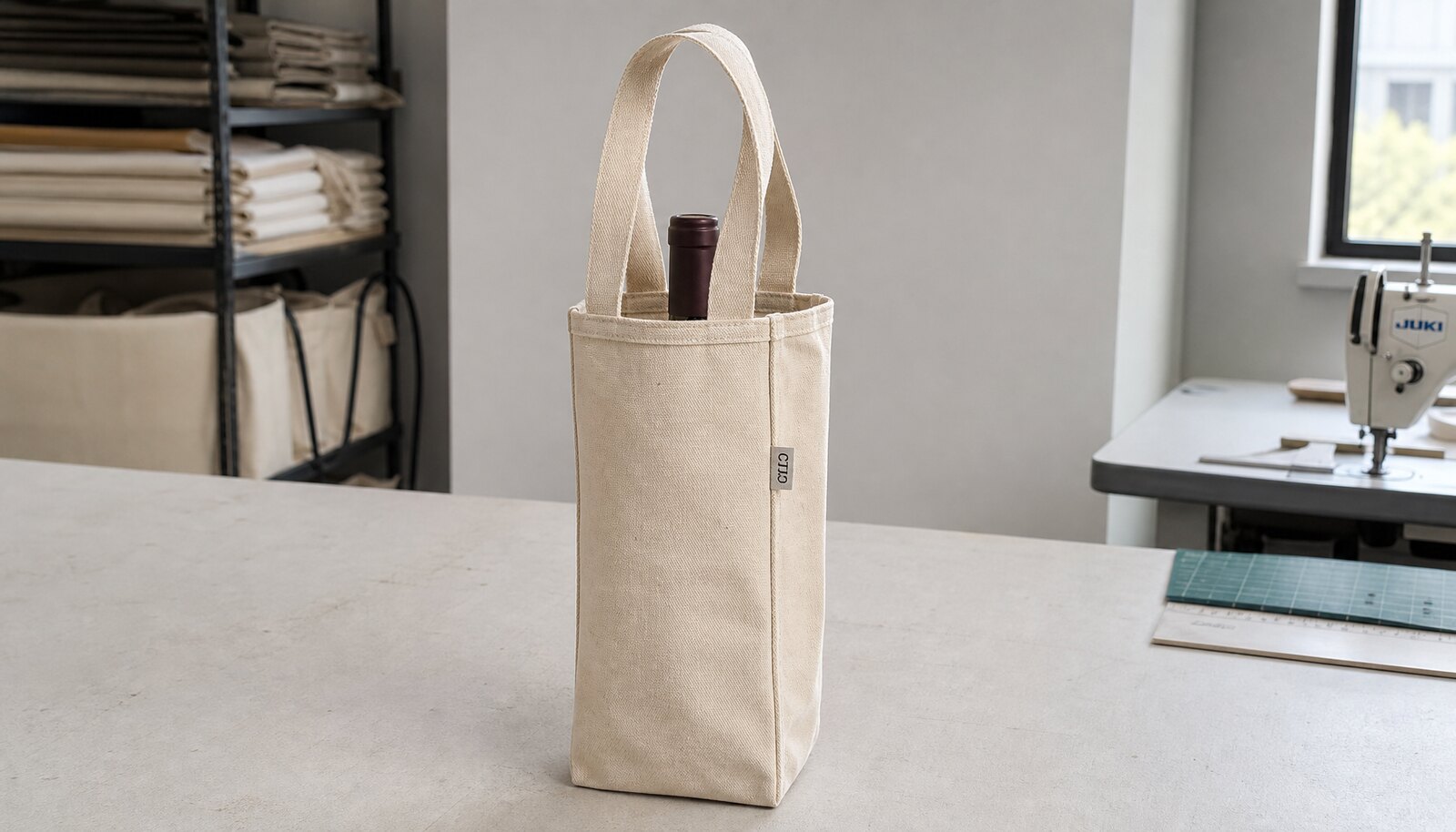
Why Carton Planning Changes The Quote
For canvas wine carriers sold through gift shops, the quoted unit price is only one part of the buying decision. The shipping carton plan affects freight cube, warehouse labor, retail readiness, and even whether the product arrives looking clean enough to go straight onto a shelf. A carrier that is a few cents cheaper at the factory can still land at a higher total cost if it ships in a bulky carton, needs repacking, or arrives with crushed shape and scuffed seams. That is why carton planning belongs in the RFQ from the start, not as a follow-up after pricing comes in.
The buyer needs to define the finished carrier, the inner pack, and the master carton before quote comparison begins. If the supplier is left to guess the carton format, every response drifts in a different direction. One vendor may price a flat-folded carrier with simple polybagging. Another may price a retail-ready pack with a sewn label, a larger carton, and extra void fill. Those are not comparable quotes. Procurement teams need a common spec sheet that makes the vendors quote the same product, the same packing method, and the same shipment logic.
- Treat the carton as part of the product specification, not an afterthought.
- Compare unit price together with pieces per carton, gross weight, carton size, and pallet count.
- Use the same bottle reference and the same packing method across suppliers so the quote means something.
Start With Bottle Geometry And Carrier Fit
A wine carrier spec should start with the bottle, not the bag. Standard 750 ml bottles vary enough in shoulder shape, base diameter, and neck height that a generic size description is too loose for sourcing. A carrier that fits a narrow Bordeaux bottle can feel tight or awkward around a wider sparkling bottle. A carrier that is too loose can look cheap, collapse in transit, and waste carton space. Measure the actual bottle you will sell, then lock the finished carrier around that reference rather than around the product category name.
The useful measurements are practical, not decorative. Record the body diameter at the widest point, the shoulder angle, the total height, and the base width. Then define whether the carrier should be a snug fit, a relaxed fit, or a gift-style oversized fit. Handle length matters too, because a handle that is too short makes the product hard to carry and a handle that is too long creates extra bulk inside the carton. Gusset depth, side seam reinforcement, and any base insert also shape both shelf appearance and shipping efficiency.
- Measure the bottle at its widest point, not only by nominal bottle type.
- Confirm whether the carrier should handle standard wine, sparkling wine, or a taller specialty bottle.
- Set the handle length and gusset depth before requesting a price.
- If you want a premium look, buy shape through fabric density and construction, not through cosmetic overdesign.
Turn The Spec Into Carton Math
The carton is where the sourcing math becomes real. Once the carrier is folded, compressed, and packed, you need to know how many pieces fit without crushing the contents or creating a carton that is too heavy to handle. The cleanest way to do this is to ask the supplier for the actual folded thickness of a sample piece, then build the carton around that measurement. Do not rely on a prototype that was hand-folded differently from the bulk production method.
A simple formula helps. Estimate carton height as the folded piece thickness multiplied by the number of layers, then add allowance for the top pad, bottom pad, and carton board thickness. Example only: if one folded carrier is 8 mm thick, a 2-layer pack of 12 pieces per layer needs about 192 mm of stack height before you add protection. With top and bottom protection, the internal height may need to move closer to 210-220 mm, not the 180 mm that looks convenient on paper. The same logic applies to weight. If the carton moves above a practical handling target, reduce the count even if the piece price looks attractive.
Carton count should be checked against gross weight and pallet pattern at the same time. Twenty-four pieces per carton can work when the carrier is flat and the polybag is slim. Sixteen or twenty pieces per carton may be the better answer when you add heavier fabric, thicker inserts, or a more retail-ready presentation. For example, on a 1,200 x 1,000 mm pallet, a carton footprint around 550 x 350 mm can often be arranged in a 2 x 2 layer pattern. If the carton footprint gets too wide or too tall, the pallet loses efficiency, carton count per pallet drops, and freight cost rises even if the sewn unit price does not change.
- Use the folded thickness of a real production sample to design the carton.
- Keep carton gross weight within a handling range that the warehouse can receive without repacking.
- Recheck pieces per carton whenever you change fabric weight, polybag thickness, or decoration method.
- If the carton becomes too tall for stable pallet stacking, reduce the count before production starts.
Compare Supplier Routes On Measurable Terms
The source route matters as much as the product spec. A direct factory is usually the best choice when you need repeat private-label runs, carton discipline, and the ability to adjust pack-out or label placement without reworking a middleman's interpretation. A trading company or consolidator can help when the purchase order must combine several accessory SKUs, but the real production site and inspection discipline may be less visible. A domestic stock supplier is the fastest route for short replenishment windows, but you usually give up carton flexibility, custom labeling, and color choice.
The decision should be based on measurable variables, not just on supplier type. Ask how the MOQ changes when you add print, sewn labels, or a custom carton. Ask where the lead time sits for raw material booking, sewing, packing, and final inspection. Ask whether the supplier can improve packing efficiency by changing the fold or carton pattern. Those answers tell you which route is actually cheapest on a landed basis. A lower invoice price is not useful if the supplier cannot hold a consistent carton count or if the shipment arrives with mixed SKU labels.
- Direct factory: usually best for repeat runs, carton control, and stable private-label packaging.
- Trading company: useful when one buyer needs multiple products under one purchase order, but margin and QC control are less transparent.
- Domestic stock supplier: useful for fast replenishment, but custom carton and branding options are often limited.
- Compare route options using MOQ, lead time, packing efficiency, and damage risk rather than unit price alone.
Build An RFQ That Normalizes Quotes
A useful RFQ forces suppliers to quote the same buying problem. It should include the bottle reference, finished carrier size, fabric GSM, body color, handle construction, decoration method, inner pack, carton target, and destination. If you omit any of those items, the supplier fills the gap with assumptions and the quote becomes hard to compare. Procurement teams usually lose time because each vendor answers a slightly different version of the request. The fix is to define the specification once and send it in a form the factory can price directly.
The quote itself should be broken into line items. At a minimum, ask for unit price at MOQ, unit price at the next volume break, sample cost, setup cost, carton cost, inner-pack cost, and any repacking or labeling charge. Then ask for the same quote on the same Incoterm so freight comparisons stay clean. A simple normalization sheet works well: one column for product cost, one for setup amortization, one for packaging, one for inland or export handling, one for freight, and one for duty. That turns a loose quote into a real landed-cost comparison.
- Quote the same bottle reference, same packing method, and same destination for every supplier.
- Ask for separate lines for sample, setup, carton, label, and repacking costs.
- Request carton dimensions and gross weight inside the quote rather than after approval.
- Ask the factory to confirm what is included in the unit price so hidden extras do not appear later.
Sample Approval Should Prove The Carton Plan
A sample only has value if it represents the actual production method. If the sample was hand-finished with different stitch tension, a different canvas lot, or a different label position, it tells you very little about the bulk lot. Ask for a pre-production sample made with the same fabric weight, decoration method, and packing style that will be used in production. If the product will be folded and packed in a certain carton count, the sample should also be folded that way and placed in that kind of carton. The sample is not a display object. It is the production reference.
Test the sample with the real bottle. Put the bottle in, close the carrier, lift it, and leave it loaded long enough to see whether the shape holds. Watch the handle anchor, seam tension, and sidewall collapse. If the bag looks clean at first glance but slouches when it sits loaded, the carton plan has not been validated. You also want a packed-carton photo, not only a product photo. That image shows whether the count is right, the labels are clean, the polybags are neat, and the carton closes without bulging. It is cheaper to catch those issues on a sample than to correct them in a bulk shipment.
- Approve one pre-production sample per decoration method and color.
- Test the sample with the actual bottle type, not a substitute bottle.
- Require a packed-carton photo before bulk release.
- Reject a sample if the carton format differs from the quoted production plan.
Packing Choices That Balance Retail Presentation And Freight
Packing has to serve two customers at once: the warehouse and the gift shop. Plain bulk packing is the cheapest way to move product, and it works when the receiving team will reopen cartons and handle each carrier before shelf placement. Individual polybagging protects against dust and light abrasion, and it is often the best balance for a simple gift-shop program. If the product needs more visible branding, a woven label, belly band, or small hang tag can improve presentation without the full cost of a retail insert. The right choice depends on how the store merchandises the item, not just on what looks better in a product photo.
The packing method has a direct effect on cube. More layers and more inserts create more air inside the carton, which lowers piece density and raises freight cost. Too much protection can also produce a carton that is awkward to handle or a carton that must be repacked at the distribution center. For many buyers, the sweet spot is a clean fold, a slim polybag, and one branding cue rather than several. If the product will be opened in-store, make sure the top piece in the carton still looks clean after transit. That way the buyer is not paying to protect a piece that still needs to be repacked by the retailer.
- Plain bulk pack is the lowest-cost option, but it is not retail ready.
- Individual polybagging is a common compromise when you want clean presentation and manageable freight cube.
- Belly bands, sewn labels, and simple hang tags can improve shelf appearance without excessive carton bulk.
- Ask the supplier to optimize fold direction and carton fill before adding more packaging materials.
QC Thresholds Factory Teams Can Actually Inspect Against
Quality control needs thresholds, not broad intentions. For canvas wine carriers, the first control point is fabric weight. Require the average GSM to fall within plus or minus 5 percent of the approved spec and verify it on at least five swatches from different areas of the order. The second control point is dimensions. Finished width, height, and gusset should stay within plus or minus 5 mm, or plus or minus 2 percent if the piece is large enough that a fixed 5 mm limit is too strict. Those numbers are practical enough for a factory to inspect and strict enough to protect carton planning.
Loading performance should be tested with the actual bottle. A basic bench test is to place the bottle in the carrier, load it, and hang it for 30 minutes. The carrier should not show seam opening greater than 2 mm, handle stitch failure, or visible distortion that makes closure impossible. For print, ask the supplier to check placement within plus or minus 3 mm and to reject obvious smearing, pinholes, or misregistration. For rub resistance, use a dry white cotton cloth and 10 back-and-forth rub cycles. If the logo transfers clearly, the lot should be reworked or held. For carton control, critical defects should be zero, and AQL 2.5 major and AQL 4.0 minor is a sensible default if your quality agreement does not specify something stricter.
- Measure GSM on at least five swatches and compare the average to the approved spec.
- Check dimensions against a plus or minus 5 mm or plus or minus 2 percent tolerance.
- Run a 30-minute loaded-bottle hang test to verify seam and handle strength.
- Use a dry rub test for print and label transfer resistance.
- Treat wrong SKU, missing handles, broken seams, and mixed carton counts as critical defects with zero tolerance.
Landed Cost Scenarios And Carton Tradeoffs
The right supplier is not always the one with the lowest invoice price. A better carton plan can outweigh a slightly higher piece price if it improves pallet density, reduces handling, or lowers damage risk. Example only: Supplier A quotes a lower factory price, but the carrier packs at 20 pieces per carton with a heavier gross weight and a larger cube. Supplier B quotes a slightly higher factory price, but the carrier packs at 24 pieces per carton, stays under a practical gross-weight limit, and uses a carton footprint that fits the pallet more efficiently. If freight is charged by volume and handling is part of the receiving cost, Supplier B may land cheaper even with the higher sewn price.
This is why procurement should compare cost per sellable unit rather than cost per sewn piece. The formula is simple enough to use in a spreadsheet: unit price plus setup amortization plus inner pack plus master carton plus freight plus duty plus expected damage allowance. A product with a slightly higher invoice cost but a cleaner pack-out can outperform the cheaper quote as soon as you factor in warehouse labor and lower damage. The key is not to guess at those offsets. Ask the supplier to quote both the plain bulk format and the retail-ready format, then compare the landed cost under the same shipment assumptions.
- Compare cost per sellable unit, not just piece price.
- Use the same freight basis and the same destination when comparing suppliers.
- Include setup amortization and packing materials in the landed-cost sheet.
- If a higher piece price improves carton density, the total landed cost may still be lower.
Award, Label, And Release Without Surprises
The order should be awarded to the supplier who matches the full commercial and quality picture, not the one with the smallest headline number. Before release, lock the final artwork, carton label, barcode position, carton orientation, and packing count. Ask for a carton proof and confirm that the labels match the purchase order exactly. Then ask for a packed-carton photo and a final inspection summary before balance payment. Those steps are basic, but they catch the mistakes that usually create the most expensive friction at receiving: wrong quantity, wrong SKU, mixed labels, or a carton that looks fine empty but bulges once filled.
The last control point is release discipline. If the supplier changes carton dimensions, inserts, label placement, or piece count after approval, treat that as a spec change and not as a harmless production tweak. The carton plan is part of the product. When it changes, freight math, warehouse handling, and sometimes retail presentation change with it. Good procurement teams document that boundary early so the supplier knows what can be adjusted and what needs a formal re-quote. That is the difference between a clean replenishment program and an order that keeps creating exceptions.
- Approve the carton proof before production starts.
- Verify carton label content, barcode, SKU, and quantity before shipment.
- Require packed-carton photos and a final inspection summary before release.
- Treat carton size, pack count, and inner-pack changes as commercial changes, not minor details.
Specification comparison for buyers
| Decision point | Practical baseline | Commercial signal to watch | Buyer risk to verify |
|---|---|---|---|
| Direct factory | Best when you need repeat private-label runs and carton control | MOQ often becomes workable only after artwork, carton spec, and pack-out are frozen; lead time usually sits in the mid-range rather than the fastest band | Quote may exclude label work, carton printing, repacking labor, or packed-carton photos unless you specify them |
| Trading company or consolidator | Useful when one purchase order must combine several accessory SKUs | Can reduce admin effort, but the real factory and inspection standard may be less visible; lead time can stretch if sub-suppliers are changed | Unit price can hide margin and QC enforcement may vary by sub-supplier |
| Domestic stock supplier | Best for rush replenishment or small seasonal top-ups | MOQ is usually the lowest, and lead time is the shortest, but carton format and branding options are often fixed | Color, size, and packing flexibility are limited, which can make the item hard to align with your shelf presentation |
| 10oz canvas | Entry-price choice for lighter single-bottle carriers | Lower sewing load and lower fabric cost can support more competitive quotes, but the carrier may feel softer in hand | If the bottle is heavy or the gusset is wide, shape retention and shelf appearance can suffer |
| 12oz canvas | Better for premium gift-shop presentation and sturdier shape | Usually improves hand feel and structure, but freight weight and sewing time increase | A lower piece price can disappear if cube and gross weight rise enough to change freight and handling cost |
| One-color screen print | Good when logo artwork is simple and visibility matters | Setup cost is predictable, and the method works well on natural canvas at scale | Ink curing, placement, and rub resistance must be controlled or the print can scuff in transit |
| Sewn woven label or patch | Useful when you want branding without a full print panel | Can improve retail look while reducing print-related rework risk | Brand visibility depends on label size and placement, so the specification must be explicit |
| Individual polybag plus master carton | A common balance of cleanliness and efficient carton loading | Protects against dust and scuffing, but every added layer affects labor and cube | Overpacking with inserts or oversized bags can reduce carton density and raise freight cost |
Buyer checklist before sampling
- Send one physical bottle sample or a measured drawing with full height, body diameter, shoulder shape, neck finish, and base diameter.
- Lock the finished carrier size, fabric GSM, handle length, handle width, and gusset depth before you ask for prices.
- Specify the decoration method exactly: screen print, woven label, sewn patch, belly band, hang tag, or plain blank.
- Define the inner pack: plain fold, individual polybag, polybag plus insert card, tissue wrap, or shelf-ready bundle.
- Ask every supplier for finished carton dimensions, gross weight, net weight, pieces per carton, and carton count per pallet.
- State the acceptable carton gross weight target so warehouse handling stays practical for your receiving team.
- Request a pre-production sample and one packed-carton photo before mass shipment is released.
- Confirm Incoterm, carton label content, barcode position, carton orientation, and whether spare units are included.
- Ask for the supplier's exact inspection standard, including the AQL or defect rule they use for major and minor defects.
- Compare quotes only after you normalize the same bottle reference, same packing method, and same destination.
Factory quote questions to send
- What exact fabric weight, weave, and finishing are included in the quoted price, and what tolerance do you allow on GSM?
- What is the finished size after sewing, including handle length, handle width, and gusset depth?
- What is the folded thickness you used to calculate carton count, and did you test it with a real production sample or a prototype?
- What is the pack-out per carton, the carton internal size in millimeters, and the gross weight per carton?
- What is the MOQ by color, decoration method, and packing style, and where are the next price breaks?
- Which items are included in the unit price: polybag, label, carton, carton print, inserts, and export marks?
- What setup fees apply for screen printing, woven labels, artwork proofing, and carton printing?
- What sample do you provide for approval: proto sample, pre-production sample, or production-like sample with final packing?
- What QC points do you inspect before shipment, and can you share inspection photos and packed-carton photos?
- What is the lead time by stage: material booking, sample approval, sewing, packing, final inspection, and departure?
Quality-control points to confirm
- Fabric GSM should match the approved spec within plus or minus 5 percent, measured on at least five swatches taken from different parts of the roll or rolls.
- Finished dimensions should stay within plus or minus 5 mm, or plus or minus 2 percent if the piece is large enough that 5 mm is too tight.
- Seams should have no skipped stitches, open seams, broken thread ends at stress points, or handle anchors that show visible puckering.
- Handle reinforcement should survive a loaded-bottle hang test for 30 minutes with no seam opening greater than 2 mm and no stitch failure at the anchor points.
- Screen print or label placement should stay within plus or minus 3 mm of the approved artwork position, with no obvious misregistration visible at arm's length.
- Print rub resistance should pass a dry rub test of 10 back-and-forth cycles with a white cotton cloth, with no obvious ink transfer or smearing.
- Critical defects should be zero: wrong SKU, missing handles, broken load-bearing seams, severe odor, mold, oil stains, or carton count mismatch.
- For a normal order, use AQL 2.5 for major defects and AQL 4.0 for minor defects unless your quality agreement specifies something stricter.
- Carton gross weight should stay within plus or minus 5 percent of the agreed target so warehouse handling and carrier rates stay predictable.
- Packed cartons should show no crushed corners, failed tape, split seams, mixed SKUs, or barcode errors, and the carton label should match the purchase order exactly.