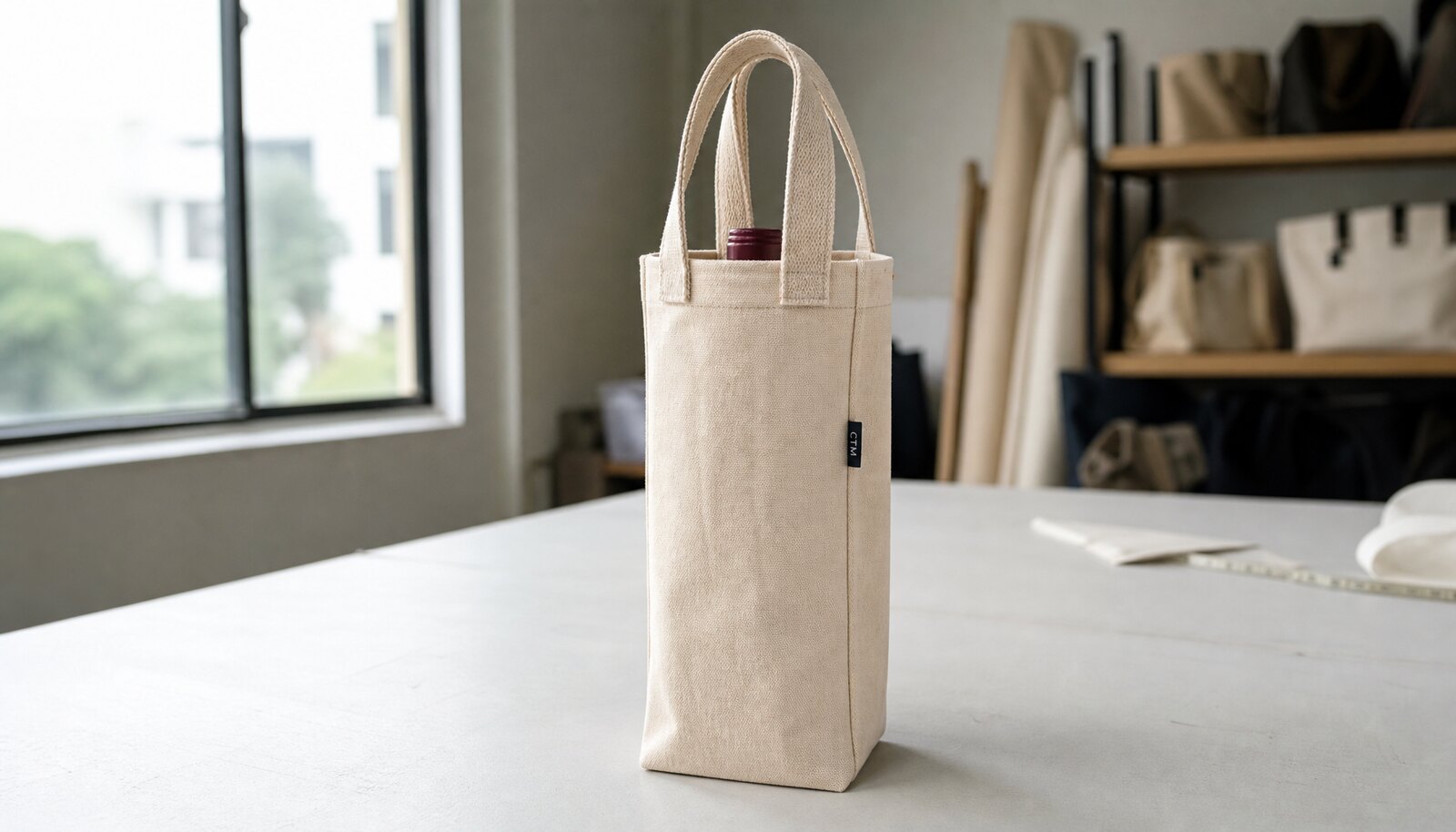
Why gift-shop buyers need a tighter spec for canvas wine carriers
Canvas wine carriers look simple, but the buying risk sits in the details that never show up in a short product listing. For gift shops, the problem is rarely whether the carrier can hold one bottle. The real risk is whether two suppliers are quoting the same fabric weight, handle reinforcement, decoration method, and packing format. If those points are loose, the lowest price can hide a lighter cloth, weaker stitching, or a retail pack that creates extra labor later.
A buyer-facing spec should work like a sourcing document, not a style note. It needs to let each supplier quote the same product, so you can compare landed cost instead of only factory price. That matters for winery stores, museum shops, tourist stores, and seasonal gift sets where shelf appearance and replenishment consistency matter as much as the unit number on the quote.
The product definition should also reflect how the bag is sold. A carrier displayed beside a bottle as a gift add-on needs a cleaner front panel and more consistent fold control than a bulk promo sleeve. A resale item in a gift shop may justify a stronger base, a neater stitch line, and better carton packing because the bag is part of the perceived value, not just a transport sleeve.
- Write the spec so each supplier is quoting the same fabric, reinforcement, decoration, and packing format.
- Separate must-have requirements from optional upgrades before you ask for price.
- Tie the product definition to the retail channel, not just the bottle size.
Match the product variant to the way the gift shop sells it
The right carrier for a gift shop depends on the purchase occasion. A single-bottle sleeve works well for a winery checkout display or a small tourist shop where the bottle is already the main item. A two-bottle carrier makes more sense for bundle promotions or higher-margin gifts. A gusseted tote with a reinforced base is better when the retailer wants the bag to stand up on a shelf or in a display crate.
There is also a difference between a premium gift item and a practical add-on. A cleaner woven label, a premium handle, or embroidery can add perceived value, but it also adds labor and process risk. For a seasonal holiday program, a simple one-color print on 12oz canvas may be the right balance. For a winery flagship store, 14oz canvas with a heavier handle and cleaner edge finish can be worth the extra cost if it supports the shelf price.
Use the bottle itself to define the fit. A Bordeaux bottle, a Burgundy bottle, and a sparkling bottle do not stress the carrier the same way. If the shopper needs to insert and remove the bottle easily, say so in the RFQ. If the carrier needs to hold shape while displayed, call for a firmer base, a gusset, or a reinforced bottom panel. Those are commercial decisions, not stylistic preferences.
- Use the actual bottle type, not a generic bottle reference, whenever possible.
- Choose a carrier structure based on whether the unit is sold as an add-on, a bundle, or a shelf item.
- If the bag must stand upright, require base reinforcement or a gusset in the spec.
Turn fabric, sewing, and decoration into measurable quote language
The fastest way to lose quote consistency is vague material language. Saying canvas is not enough. State the fabric in oz per square yard and, if that helps cross-market sourcing, include the approximate GSM. A practical reference point is 10oz at about 339 gsm, 12oz at about 407 gsm, and 14oz at about 475 gsm. If the cloth has a washed finish, coating, or shrinkage behavior, keep those details in the spec and in the approved sample record.
Construction needs the same precision. Ask the factory to quote stitch density on load-bearing seams and the reinforcement method at the handle anchors. For many buyers, a starting point of 8 to 10 stitches per inch on the seams that carry weight is easier to audit than a generic quality promise. If the carrier uses self-fabric handles, specify fold width, edge finish, and the exact place where reinforcement begins and ends. If it uses cotton webbing, state the webbing width and whether the ends are turned under, topstitched, or capped.
Decoration is another place where generic language creates later disputes. Define the print method, number of colors, print area in mm, and whether the artwork must match a Pantone target or only a signed visual sample. If the bag is dyed, washed, or garment-finished, ask the supplier how it controls shade variation and shrinkage before you approve the first sample. If the supplier cannot explain that process clearly, the quote is incomplete.
- Use oz and GSM together so the spec is readable across different sourcing markets.
- Set stitch density and handle reinforcement before you compare prices.
- Freeze print area, color count, and artwork version in the RFQ, not after sampling starts.
Compare quote structures, not only the unit number
A useful comparison starts with the quote structure. One supplier may give you a factory-direct FOB price that separates fabric, labor, print, packing, cartons, and loading. Another may give you a trading-company all-in price that hides how much margin sits between you and the factory. A third may quote EXW, which looks cheap until you add pickup, export paperwork, and loading back into the total. Those are not the same buying situations.
For canvas wine carriers for gift shops, the cheapest-looking price is often the least useful because it omits the costs that affect shelf readiness or landed cost later. Retail-ready packing, barcode labeling, and carton marks may sound minor, but they change labor and carton density. If one supplier quotes bulk pack and another quotes shelf-ready pack, the unit prices are not comparable yet. That is a comparison problem, not a pricing problem.
When you request alternates, keep them controlled. Ask for one base version and one or two clear alternatives, such as a lighter fabric, a premium handle, or a retail-ready pack. That shows the cost of each design decision and keeps the supplier from blending hidden upgrades into the base quote. The goal is to see where the value is actually being added.
- Compare only like-for-like Incoterms and like-for-like packing formats.
- Ask each supplier to separate setup, labor, material, packing, and origin logistics.
- Request one base quote plus controlled alternates so the tradeoffs are visible.
What landed cost really changes in a gift-shop program
The table is most useful when you think in terms of total buying consequences, not just price basis. A factory-direct FOB quote is usually the cleanest baseline because it exposes the cost drivers. A trading-company quote can be fine for a small test order, but you need to assume a margin layer and less visibility into the factory layer. EXW can work if your logistics team is strong, but it is not a fair comparison until you add inland freight, paperwork, and loading.
Origin also matters. If a quote is unusually low, ask where the fabric comes from, where the sewing happens, and whether any step is subcontracted. A low price with unclear origin detail often becomes a delayed shipment or a surprise fee change. Country of origin can also affect tariff exposure, labeling, and the paperwork your retailer wants before receiving. That is why the question is not just where is it made, but who actually controls the fabric, sewing, printing, and packing.
For gift shops, the commercial decision is often between lower origin cost and lower destination labor. Retail-ready packing may cost more at the factory, but it can reduce repacking, relabeling, or store backroom work later. A bulk-packed carrier may save a little on the quote, then cost more once it reaches the warehouse. The better choice depends on where your labor sits, not where the factory sits.
- Ask for the same quote basis from every supplier before comparing numbers.
- If the supplier offers DDP, ask for the customs basis, duty assumption, and excluded destination charges.
- Verify whether the factory or a subcontractor is actually doing the sewing and packing.
How to verify supplier capability without relying on brochure claims
Supplier vetting should focus on actual capability. Ask for the business registration, export capability, and the production site address. Then ask for photos or a short video of cutting, sewing, packing, and final inspection. If the supplier claims a quality system, request the certificate and issuing body. If social compliance matters for your retailer, request the current audit status and ask whether any part of the order will be subcontracted.
Country-specific risk is usually about process control, not the country itself. In China, the risk is often quote layering and a wide range of factory capabilities that can look similar on paper but behave very differently on a line. In India, cotton-heavy supply chains can be attractive, but shade consistency and pre-production timing deserve extra attention. In Vietnam or Cambodia, confirm whether the factory is sewing imported fabric or sourcing locally, because fabric dependency can affect schedule and color control. In any origin, a trading layer that cannot show the actual production site deserves more scrutiny.
The easiest practical test is simple: can the supplier make the same item twice the same way, can they pack it the same way, and can they show where deviations are caught? If they cannot answer those questions clearly, the hidden cost usually shows up later as rework, re-labeling, or a delayed shipment. The right supplier should be able to explain the process without improvising.
- Request factory photos of sewing, packing, and final inspection, not only product beauty shots.
- Ask which steps are in-house and which are subcontracted, and who controls quality at each step.
- Confirm that approved samples and production records are tied to your purchase order.
Use sample approval to catch commercial problems early
Sample approval is where many buyer mistakes can still be corrected cheaply. Ask for a fabric swatch first if the cloth weight or finish is uncertain. Then approve a pre-production sample that shows the final construction, print placement, handle reinforcement, and fold method. If the program is retail-facing, ask for a packed sample or at least a photo of the packed carton so you can check labels, count, and carton marks before bulk production starts.
The sample should be judged as a usable retail unit, not just as a craft sample. Check whether the carrier opens and closes cleanly around the actual bottle type. Look at the front panel under the lighting it will see in the store, not just under a sample-room lamp. If the artwork is positioned too high, too low, or too close to a seam, that is a production issue even if the print itself is clean.
Keep the approval trail visible. Each sample stage should show what changed from the last one, whether it was fabric, handle width, stitch pattern, or pack format. That prevents the factory from later claiming the approved version was different from the one you signed off. When the sample chain is clean, the bulk order is much easier to control.
- Ask for a swatch, a pre-production sample, and a packed sample or packed carton photo.
- Approve the bag on the actual bottle type if the fit matters to the retail experience.
- Document every change between samples so the approved version is unambiguous.
Set QC rules that a factory inspector can actually follow
Quality control should be measurable. Start with dimensions, fabric weight, print placement, stitch quality, and packing count. Then define what counts as a critical, major, or minor defect for this item. Many buyers use 0 for critical, 2.5 for major, and 4.0 for minor as a starting point, but that is only a baseline if the retailer does not impose a stricter plan. For premium gift-shop programs, the buyer should tighten critical defects because the item is being sold as part of a gift experience.
The load-bearing areas matter more than cosmetic perfection. The handle anchors, bartacks, and inside seams should be checked on the first pieces off the line, then again during in-process inspection and final inspection. Ask for close-up photos of the front, back, and inside of each stress point. If the bag fails at the handle or starts fraying at the seam, the issue is structural, not cosmetic.
Use route-aware packaging tests instead of a single universal rule. For textile goods, a carton drop sequence often depends on whether the shipment is moving by parcel, pallet, or mixed freight. A lower height can be appropriate for shelf-ready retail packs with printed cartons, while a stricter sequence may be needed if the cartons are stacked or handled multiple times. The point is to match the test to the route and packaging, not to repeat a generic height because it sounds standard.
- Define defect categories before production so the inspector and factory are using the same language.
- Check loaded-bottle fit, not only a flat sample, when you judge seam strength and handle behavior.
- Ask for QC photos at fabric, first article, stuffed sample, carton, and master-mark stages.
Packaging details that protect retail acceptance and freight efficiency
Packaging is part of the product for gift-shop buyers. If the carrier needs to go directly from carton to shelf, specify the fold method, barcode location, hangtag position, and whether each bag needs a polybag. If the order is going to a distributor warehouse first, the packing format may be simpler, but the count, labeling, and carton marks still need to be written down. Do not assume the factory knows what your receiving team expects.
Carton packing affects both freight and appearance. An overpacked carton can crush the fabric and distort the print panel. An underpacked carton can let the units shift and crease. Ask for carton size, carton count, and the maximum gross weight before you approve the order. If the product is being stored in a back room or warehouse before shelf placement, ask the factory how it protects the units from edge crush and fold marks during transit.
For gift-shop programs, retail-ready packing can actually be the cheaper total decision even if the origin unit price is higher. It can reduce unpacking, relabeling, and repacking on arrival. That is especially true when the destination team has to move fast during a seasonal selling window. The right comparison is not origin price alone. It is the cost of getting a sellable unit onto the shelf with the least handling.
- Specify barcode position, carton marks, and any retailer label format before production starts.
- Require a standard fold so the product opens consistently on shelf.
- Check carton size against freight cube, receiving labor, and shelf-ready presentation needs.
Lead time, MOQ, and change control for seasonal buying
Lead time should be broken into stages instead of treated as one number. Sampling, fabric booking, decoration approval, bulk sewing, packing, and shipping each take time, and the total can change quickly if any step moves. For standard custom carriers using stock-supported fabric and one-color print, 30 to 45 days after sample approval is a reasonable planning range in many programs. If you add custom dyeing, embroidery, multiple print colors, or special retail packing, expect the schedule to stretch.
MOQ deserves the same attention. Ask whether the minimum applies per color, per print design, per packaging SKU, or per fabric lot. A low minimum can still create cost pressure if the factory has to book a unique cloth run or change the cutting layout. For seasonal gift-shop programs, the more important question is repeatability. Can the supplier repeat the exact same item later without changing the shade, packing, or carton mark?
Use change control after sample approval. Late changes to artwork, barcode format, handle length, or carton size create rework and are a common reason for shipment delays. The easiest way to avoid that is to freeze the spec before the pre-production sample and record every approved change in writing. If the supplier needs to deviate from the signed version, ask for a revised sample or a written deviation note before bulk production continues.
- Separate sample lead time from bulk lead time in the RFQ and PO.
- Ask whether MOQ applies to fabric color, print color, and pack format separately.
- Freeze artwork and carton marks before bulk cutting begins.
Specification comparison for buyers
| Sourcing route | What the quote usually includes | Best buying scenario | Landed-cost consequence to check |
|---|---|---|---|
| Factory-direct FOB | Fabric, cutting, sewing, decoration, packing, cartons, and export loading are usually priced separately and clearly | Best for repeat programs where you need to compare suppliers on the same spec | Usually the cleanest baseline, but confirm whether setup fees, carton changes, and inland trucking are already inside the price |
| Trading-company all-in | One unit price that may bundle factory cost, broker margin, and some export handling | Useful for small test orders or when you need faster coordination | Easy to buy quickly, but harder to see if the quote hides a lighter fabric, weaker packing, or an extra margin layer |
| EXW factory price | Ex-factory unit price only, before pickup, export paperwork, and origin logistics | Useful when your forwarder manages collection and export process | Not comparable to FOB unless you add trucking, documents, loading, and any origin charges back into the total |
| FOB with retail-ready packing | Often includes barcode label, polybag, fold standard, carton mark, and count control | Best when the bags go straight to a store, DC, or distributor shelf | Higher origin price, but often lower destination labor and fewer receiving issues if you need shelf-ready goods |
| DDP delivered quote | Freight, duty, brokerage, and delivery are rolled into one price | Useful for fast budgeting or a small import program with limited internal logistics support | Ask for the customs basis, duty assumption, route, and any excluded destination charges before comparing it to FOB or EXW |
| Blank stock plus local decoration | Undecorated carrier is shipped first, then print, tag, or pack work happens locally | Good for low-MOQ trials, regional artwork changes, or event-driven gift programs | Adds touchpoints and labor, and the total cost can rise fast once local handling, rework, and QC are included |
Buyer checklist before sampling
- Identify the sales channel first: boutique gift shop, winery store, museum store, tourist shop, or distributor replenishment. The channel determines how much shelf presentation and packing control you actually need.
- Name the exact bottle type the carrier must hold: standard 750 ml Bordeaux, Burgundy, sparkling, or a wider gourmet bottle. If the shape matters, attach a bottle drawing or send the bottle itself for sampling.
- Lock the fabric spec in both oz per square yard and approximate GSM. Use one measurement system for the RFQ and another in the internal spec so suppliers in different markets cannot reinterpret the cloth weight.
- Define the carrier structure: single-bottle sleeve, gusseted tote, two-bottle gift carrier, reinforced-bottom style, or retail-fold version. A simple description like canvas wine bag is too broad to compare quotes cleanly.
- State handle material, width, attachment method, and reinforcement. If the bag uses cotton webbing, specify width and finish. If it uses self-fabric handles, state folding method and edge treatment.
- Set finished dimensions and tolerances, including body width, body height, base depth, and handle drop. Use the approved sample as the reference point and record the acceptable variance in writing.
- Choose decoration details up front: screen print, heat transfer, embroidery, woven label, or combination decoration. Include artwork version, print area, color count, and whether Pantone matching is required.
- Specify packing format before the quote is issued: bulk pack, individual polybag, retail fold, barcode label, hangtag, or shelf-ready pack. Packing changes labor, carton density, and final shelf appearance.
- Request sample stages: fabric swatch, pre-production sample, and packed carton photo or physical packed sample. The sample approval chain should show what was changed between each stage.
- Ask for the full commercial breakdown: material, labor, print setup, packaging, cartons, sample charge, inland trucking, and any excluded export or rush fees. If the quote does not break those out, it is not ready for comparison.
Factory quote questions to send
- What exact fabric weight, weave, finish, and tolerance are you quoting, and what incoming inspection do you use on the fabric roll?
- Is the material 100% cotton, cotton blend, recycled cotton, or sourced blank stock, and who supplies the fabric?
- What handle material and width are included, and how are the handle ends anchored to the body?
- Which steps are in-house at your factory, and which steps are subcontracted to another site?
- Can you share photos of cutting, sewing, packing, and final inspection from a current or recent production run of a similar item?
- What is included in the unit price: setup, screens or plates, sample making, barcode labels, polybags, and master cartons?
- Which costs are excluded and likely to appear later as add-ons, such as art revisions, carton redesign, rush production, or rework caused by late changes?
- What carton pack count, carton size, and maximum gross weight did you price into the quote?
- What is your standard inspection method, and what AQL plan do you use for critical, major, and minor defects?
- Can you provide business registration, export capability details, and the compliance documents that are already on file for this factory?
Quality-control points to confirm
- Verify the fabric roll against the approved swatch before cutting. Check weight, weave, color, and finish so the line does not start with the wrong cloth lot.
- Inspect the first article for handle anchors, bartacks, inside seams, and edge finish. Take close-up photos of both the exterior and the inside of the stress points, not just the front panel.
- Measure finished size on a stuffed sample using the actual bottle type. Record body width, base width, height, and handle drop so retail staff can reuse the same acceptance reference later.
- Check print registration and artwork placement on the filled bag, not only on a flat panel. A design can look correct flat and still distort once the bottle is inside.
- Agree a buyer-set defect plan before production. Many teams use 0 for critical defects, 2.5 for major defects, and 4.0 for minor defects as a starting point, but retailer standards should override any generic default.
- Set a route-specific carton test instead of relying on a universal drop height. For textile goods, many buyers benchmark corner and edge drops around 75 cm to 100 cm depending on the freight mode, carton strength, and retail-ready packing, but the real standard should match your route and packaging risk.
- Ask for QC photos at the right checkpoints: fabric roll, cut pieces, first sewn unit, print close-up, stuffed sample, packed carton, and outer master marks.
- Confirm carton count, SKU label, barcode position, and outer marks against the packing list before release. A clean product with the wrong count or sticker is still a reject for most buyers.