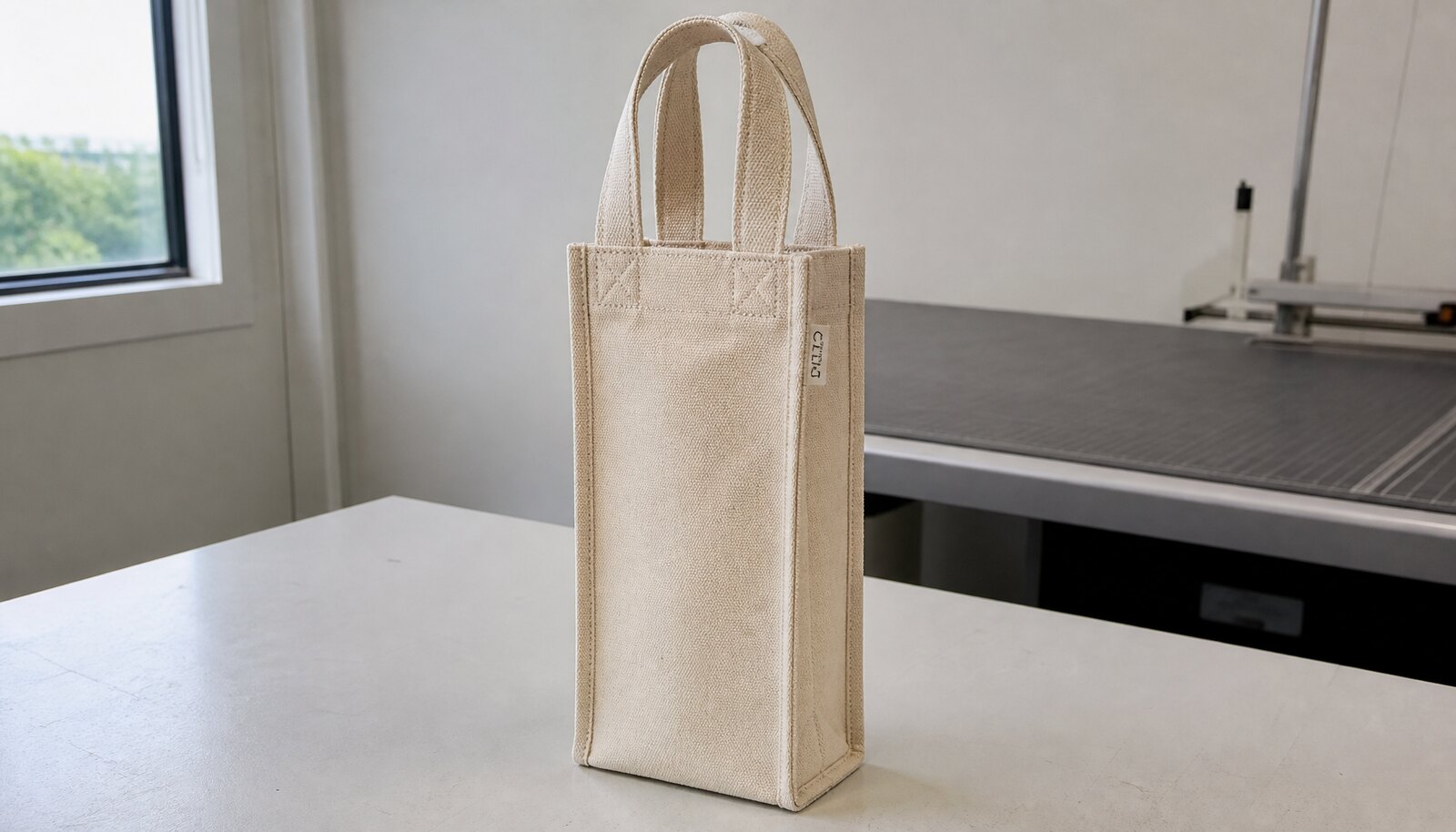
Start With the Retail Use Case, Not the Fabric Swatch
The fastest way to buy the wrong canvas wine carrier is to start with a fabric sample and ignore how the bag will sell in the gift shop. A carrier for a tourism shop, a museum store, and a neighborhood wine merchant may all hold one 750 ml bottle, but they do not need the same presentation, handle strength, or decoration method. If the item is meant to sit near the checkout as an add-on purchase, the bag needs to look finished from both sides, survive repeated handling, and pack efficiently. If it is a holiday gift item, the finish matters more than a bare utility bag, and the cost of a poor print or weak handle quickly shows up as returns or markdowns.
Before you send a quote request, define the bottle type, target retail price band, and whether the carrier is meant for single-bottle gifting, corporate gifting, or bundled wine-and-accessory sets. That decision changes everything downstream: fabric weight, closure style, lining, decoration method, carton pack, and the amount of manual labor required. Buyers often lose margin by writing a vague spec such as 'canvas wine bag' and then comparing unrelated quotes from suppliers who are building different constructions. A useful RFQ names the bottle size, desired shelf feel, decoration area, and whether you want a low-cost seasonal program or a repeatable core SKU.
- State the bottle size first: standard 750 ml, magnum, or split bottle.
- Define the retail role: impulse add-on, seasonal gift, premium branded carry, or multi-item gift set.
- Decide whether the carrier needs to stand upright, close at the top, or simply protect the bottle in transit.
Choose Canvas Weight and Build Like a Merchandiser
Canvas weight is where many quote comparisons go wrong. A 10 oz canvas carrier can be acceptable for lightweight seasonal gifting, but it will feel softer and show more distortion than a 12 oz or 14 oz bag. For gift-shop programs, 12 oz canvas, roughly 400 GSM, is often the practical middle ground because it gives enough body for retail presentation without pushing the cost too high. If the bag carries a printed logo and a bottle that may be sold as a premium souvenir, 14 oz canvas, around 475 GSM, usually improves structure and reduces the floppy look buyers dislike on the shelf. Very heavy canvas, such as 16 oz or higher, creates a more rigid, premium hand but raises material cost, needle wear, and sewing difficulty.
Construction matters as much as fabric weight. A good carrier needs a clean top opening, a bottom that sits flat, and handle reinforcement that does not pull out under repeated use. If the bag includes a divider or board insert, the insert should not rattle or warp the body. Many buyers also forget the bottle neck area: if the opening is too narrow, the bottle scratches the fabric during loading; if it is too loose, the carrier looks cheap and unstable. Ask the factory to quote the build as a system, not as isolated parts, and compare the stitching method, seam allowance, and handle attachment in the sample rather than only reading the spec sheet.
- Use 10 oz canvas for cost-sensitive seasonal use, 12 oz for the standard retail range, and 14 oz or heavier for premium shelf presence.
- Require a clear handle reinforcement detail, such as bar-tacks or boxed stitching, not only a decorative seam.
- Verify that the bag stands in the carton without collapsing if the shop expects display-friendly packing.
Compare Sourcing Routes Before You Compare Price
Two quotes can look similar on paper and still create very different buying outcomes. A supplier selling a stock blank plus local printing is optimized for speed, while a direct factory quote may be better for repeatability and lower unit cost on larger orders. A trading company may be useful when you need mixed product sourcing, but you should know whether they own the factory relationship or are simply passing along a markup. The right comparison is not 'who is cheapest.' It is 'who can produce the same standard at the lowest landed cost with the least risk of rework.'
For canvas wine carriers for gift shops, the best route depends on how stable your demand is. If you are testing a holiday program, a local decorator on imported blanks can help you move quickly, but only if the blank quality is controlled and the print area is consistent from lot to lot. If you already have a proven seller, a direct custom factory usually gives better control over fabric shade, label placement, and packing format. If your buying team handles several categories, a trading company may reduce coordination time, but you should still push for factory-level visibility on fabric source, production responsibility, and inspection ownership.
- For launch tests, prioritize speed and sample responsiveness over absolute unit cost.
- For repeat orders, prioritize lot consistency, documented QC, and stable packing specs.
- For premium retail, prioritize construction control, decoration accuracy, and clean presentation over the lowest bid.
Inspect the Things That Actually Fail in Production
Most defects on canvas wine carriers are basic, and that is why they are expensive. Thin spots in the canvas, loose threads at the handle base, wavy stitching, and crooked print placement all hurt the perceived value of a simple gift item. In gift shops, a customer often picks up the product before buying it, so tactile defects matter more than they would in a sealed commodity pack. Ask the factory to inspect fabric shading, seam alignment, handle symmetry, and top edge finish before shipment. If the sample has a crisp edge and the bulk has curling or uneven seam tension, the bag will look cheaper even if the measurements are technically within range.
Add use-based tests, not just visual checks. A standard 750 ml bottle should slide in without scraping the opening, the carrier should not twist hard when lifted by one handle, and the bottom should not buckle if the bag is set on a shelf. If the print is a screen print, look for ink build-up, missing corners, or a stiff hand where the print area feels heavier than the rest of the bag. A good inspection plan focuses on the points where a shopper notices quality in the first three seconds: structure, symmetry, decoration, and the feeling that the bag was made for retail rather than for a generic giveaway.
- Check the opening width against the real bottle, not against a drawing.
- Look for seam waviness and thread tails at every stress point.
- Compare the bulk bag to the approved sample under the same light before accepting the lot.
Set Decoration Rules Before the Factory Starts Printing
Decoration can make a plain canvas wine carrier look premium or make it look cheap. Screen printing is usually the most practical option for solid logos and simple art because it gives strong color and better repeatability on natural canvas. Heat transfer can work for short runs or multicolor graphics, but the hand feel may be less desirable on a simple retail gift item. Embroidery or a woven side label can improve perceived value, especially when the design is minimal and the brand wants a tactile finish. Each method affects cost, lead time, and rejection risk, so the quote must state exactly which method is included and what artwork complexity is assumed.
The key inspection issue is not just whether the logo is visible. It is whether the print sits where the buyer approved it, survives folding and handling, and stays visually balanced on a textured material. Natural canvas absorbs ink differently than coated fabric, so a factory that prints too heavily can create bleeding or a stiff patch. If the design uses fine type, thin outlines, or a centered logo near a seam, ask for a strike-off or digital proof on actual fabric before bulk production. A clean sample on paper tells you almost nothing; a good print on canvas tells you whether the factory understands registration, pressure, and ink control.
- Use screen print for simple logos and repeatable retail runs.
- Use embroidery or woven labeling when the brand story needs a more tactile premium finish.
- Require a strike-off on actual canvas for any design with small text, edge detail, or close seam placement.
Treat the Sample as the Production Standard
A sample is not a preview; it is the contract reference. If the buyer approves a sample with a clean top edge, tight handle stitching, and a specific shade of natural canvas, the bulk order should be measured against that exact object, not against a vague description. Keep one golden sample sealed, label it with the order reference, and note the fabric weight, dimensions, print method, and packing arrangement in writing. Without that discipline, the factory can argue that the bulk is 'within normal tolerance' while still delivering a bag that feels different in hand. The more retail-facing the product, the more important it is to tie approval to a physical standard.
For pre-production, do not approve the sample until you have checked dimensions, seam quality, print position, bottle fit, and packing logic. A good factory will show you the blank bag, the printed bag, and the packed unit if those steps happen separately. If the carrier includes a side label, hangtag, or barcode sticker, those details should also be in the approval set. The most efficient buyers treat sample approval like a controlled handoff: they verify what is approved, what is still open, and what must not change in bulk. That reduces rework and protects the margin that often disappears in the last mile of production.
- Keep one sealed golden sample and one working reference sample.
- Approve the printed sample on the actual canvas, not on paper or a digital mockup.
- Record every approved variable: fabric, color, print method, trim, carton pack, and label placement.
Build Packing and Carton Rules Around the Gift Shop Shelf
Packing is part of the product for gift shop buyers. If the carrier arrives wrinkled, crushed, or packed in a way that makes the shelf look messy, the unit may still be technically correct but commercially weak. Decide whether the bag ships flat, stuffed, or folded with tissue, and whether each unit needs a barcode sticker, insert card, or hangtag. If the item is meant for a high-turn retail shelf, the factory should pack in a way that speeds receiving and replenishment rather than forcing the retailer to rework each piece. Carton dimensions matter as much as outer appearance because they affect freight cost, warehouse handling, and pallet efficiency.
Ask the supplier to give you both retail and bulk packing options if you are comparing channels. A single-bag polybag may protect the item, but some retailers want open presentation or recyclable packaging. A stronger carton plan can save money at the warehouse even if it costs slightly more at the factory, especially when the carrier is lightweight and freight density becomes the main landed-cost lever. For imported goods, you also need clean carton marks and a clear count structure so the receiving team can reconcile what arrived without opening every master carton. Small packing mistakes become expensive when they multiply across a holiday order.
- Specify whether the carrier ships flat, folded, or stuffed.
- Lock barcode, insert card, and carton mark requirements before bulk starts.
- Ask for carton dimensions and gross weight so freight and pallet planning are not guesswork.
Use Quote Data to Expose Real Cost Drivers
A useful quote for canvas wine carriers should show more than a unit price. It should separate fabric, sewing labor, decoration, accessories, packing, sample charge, and any tooling or setup costs. If a supplier gives one blended number, you cannot tell whether the price is low because the fabric is lighter, the print is smaller, or the carton spec has been downgraded. For gift shop buyers, that matters because the wrong cut can lead to a product that looks acceptable on paper but underperforms in-store. The strongest quote response includes fabric weight in GSM or oz, dimensions, print area, trim details, and the exact carton pack so procurement can compare apples to apples.
MOQ logic should also be visible. One supplier may offer a low MOQ but charge heavily for print setup or custom trim, while another may ask for a higher quantity but give a better unit cost and cleaner consistency. Lead time needs to be broken into sample time, approval time, production time, and dispatch time. If your calendar is tied to a holiday launch or a tourism season, the biggest risk is not only the bulk production window but also the time lost in sample revision. Buyers who manage margin well ask for the total landed cost per sellable unit, including freight, duty if applicable, and the cost of any anticipated rework.
- Insist on separated pricing for fabric, labor, print, packing, and setup.
- Compare MOQ against total program cost, not against unit price alone.
- Request lead time by phase so approval delays do not hide inside the promised delivery date.
Release the Order Only When QC and Freight Are Aligned
The final approval step should connect product quality with shipment readiness. A carrier can pass visual inspection and still create trouble if the carton count is wrong, the packs are not labeled correctly, or the pallet plan does not fit the warehouse receiving process. For larger programs, tell the factory whether you want random carton checks, full AQL-style inspection, or a third-party inspection before shipment. The exact method matters less than the fact that it is written into the order and tied to the product standard you approved. That is how you stop a factory from treating QC as a last-minute formality.
Release criteria should be practical and measurable. The bag should match the approved sample on fabric, print, dimensions, and packing; the cartons should be countable and legible; and the shipment documents should line up with the PO. If there are small cosmetic variations in natural canvas, define them in advance so the factory knows what normal looks like and what does not. The best buyers are not looking for perfection in an artisanal product. They are looking for repeatable retail acceptability, low surprise risk, and a clean path from factory floor to gift shop shelf.
- Tie shipment release to the approved sample, carton count, and packing spec.
- Use the same inspection logic for every reorder so quality does not drift by season.
- Do not release freight if the carton marks or quantity report do not match the PO.
Specification comparison for buyers
| Spec decision | Recommended option | When it fits | Buyer risk to check |
|---|---|---|---|
| Stock blank from bag wholesaler | Blank 10-12 oz canvas with local decoration | Fast seasonal replenishment for gift shops that need quick turns | Fabric lots can vary; confirm GSM, shade, and handle reinforcement before printing |
| Direct custom factory order | Made-to-order carrier with controlled fabric, trim, and print | Recurring programs where the shop wants consistent branding and repeat orders | MOQ and lead time are higher; lock the sample standard before bulk approval |
| Trading company consolidation | One vendor bundles bag, tag, and packing services | Buyers handling multiple SKUs or limited sourcing bandwidth | Margin can hide the real factory source; verify who owns QC and who answers defects |
| Local print decorator on imported blanks | Unbranded carriers printed near the destination market | Short lead times for holidays, events, or retail test runs | Blank quality may be inconsistent; inspect the base bag before decoration starts |
| Domestic cut-and-sew supplier | Local production with easier communication and faster revisions | High-compliance programs or urgent reorder risk | Unit cost is usually higher; compare landed cost, not only ex-factory price |
| Eco-positioned recycled canvas route | Recycled or blended canvas with traceable material claims | Gift shops selling on sustainability or premium story-led merchandising | Ask for traceability documents and make sure the fabric hand still feels retail-ready |
| Private label factory with woven label | Custom side label, hangtag, and carton marks | Brands that need shelf distinction and repeatable presentation | Label placement, stitch quality, and color match often drift if not signed off in detail |
| Dual-source development route | Prototype locally, then move bulk offshore once approved | When the buyer needs speed now and cost control later | Sample-to-bulk drift is common; keep the approved sample and photo record as the control reference |
Buyer checklist before sampling
- Confirm the exact bottle size the carrier must fit, including diameter, height, and closure style.
- Lock the fabric weight target in GSM or oz, not just the word canvas.
- Approve the handle length, drop, and reinforcement method against the actual shelf load.
- Specify the print method, artwork placement, and acceptable color tolerance before sampling.
- Request one pre-production sample and compare it against the approved reference bag.
- Set a seam, stitch, and load expectation for the carrier and its base gusset.
- Define packing format: single polybag, insert card, barcode sticker, or shelf-ready carton pack.
- Check carton dimensions and master carton quantity against warehouse and retailer receiving rules.
- Ask whether the quote includes sampling, plates/screens, hangtags, and export cartons.
- Confirm the production timeline by step: sample, approval, bulk, inspection, and dispatch.
Factory quote questions to send
- What is the exact canvas weight in GSM or oz, and is it finished weight or greige fabric weight?
- Is the carrier made from single-layer canvas, lined canvas, or canvas with an inserted divider or board?
- Which print method is included in the quote, and how many colors are covered at that price?
- What is the MOQ per color, per print, and per custom trim if I split the order into variants?
- What dimensions are guaranteed, and what tolerance do you allow on width, height, gusset, and handle length?
- What is the sample charge, and will it be credited against bulk if the order converts?
- What is the production lead time after artwork approval and after deposit?
- What packing format is included, and can you quote retail-ready and bulk-packed options separately?
- What inspection standard do you use before shipment, and can I join or appoint a third-party inspection?
- What documents will you provide with the shipment, including carton list, packing list, and any test reports my market needs?
Quality-control points to confirm
- Fabric weight must match the approved range, with no thin spots, obvious yarn slubs, or mixed lot shading across the same order.
- Seam allowance should stay even, with no open stitches, skipped stitches, broken thread tails, or puckering at stress points.
- Handle attachment must use reinforced stitching or bar-tack logic that matches the load requirement, not just a cosmetic seam.
- Base and side gussets must hold shape, sit flat, and keep the bottle centered without twisting the carrier body.
- Print registration, logo placement, and edge sharpness must match the approved sample, with no ghosting, cracking, or heavy ink bleed.
- Color should stay within the agreed tolerance under normal retail light, especially for natural canvas where shade variation is common.
- Finished dimensions should stay within a practical tolerance that still fits the intended bottle and shelf display requirement.
- Carton count, inner packing, and barcode placement must match the retail chain or warehouse receiving instructions exactly.