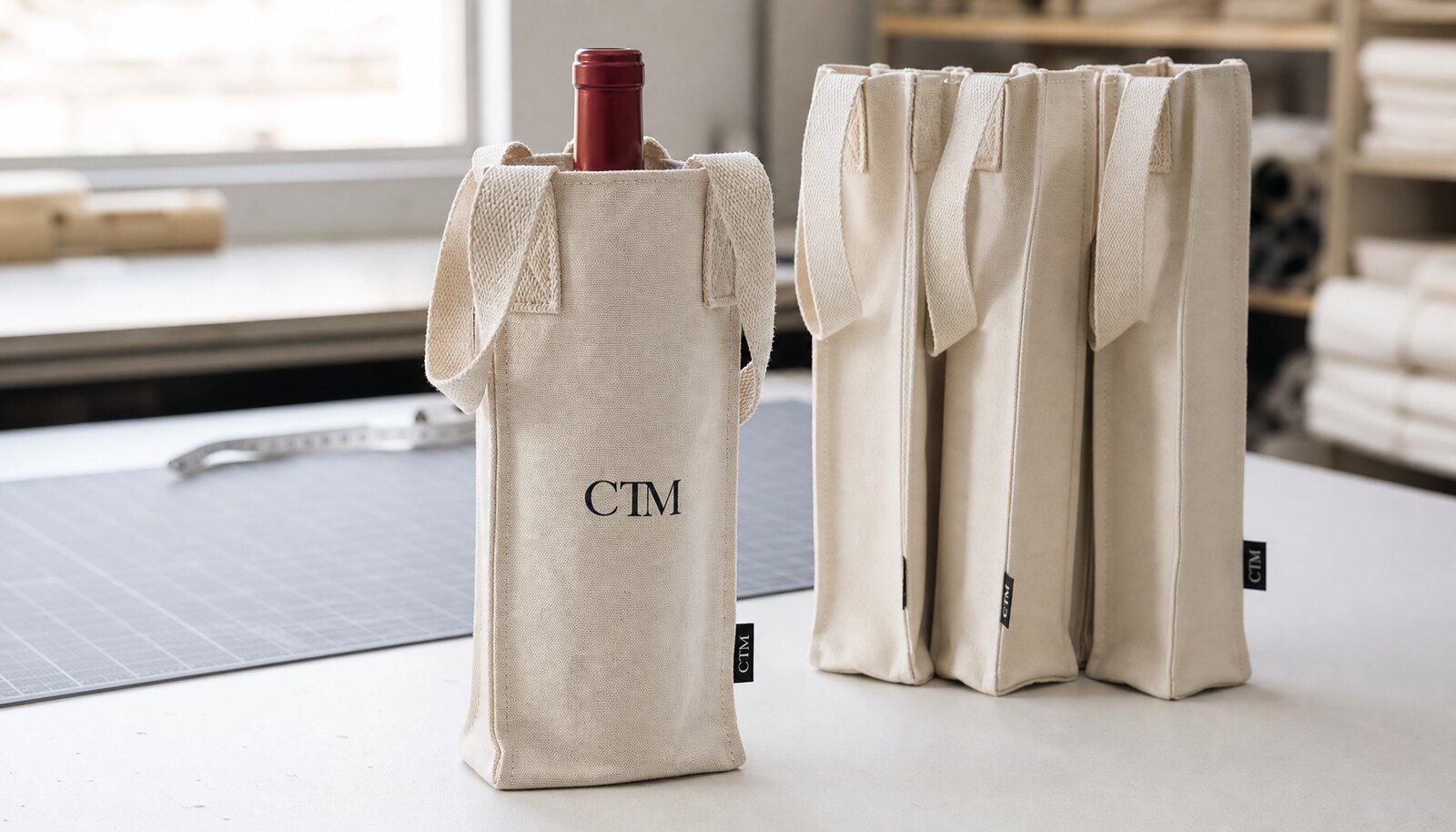
Why canvas wine carriers need a sourcing lens, not a tote-bag lens
A canvas wine carrier is not just a small bag with a bottle-sized opening. For gift shops, it is a retail presentation item that has to sell visually before it ever carries anything. That means the fabric has to look intentional under store lighting, the silhouette has to feel balanced when empty, and the decoration has to stay crisp enough to read from a shelf or hanger. If you buy it like a generic tote, you usually get a product that works on paper but does not hold margin at retail.
The procurement problem is that several small decisions interact. Canvas weight affects structure, but so does weave tightness and finish. Decoration quality depends on both the artwork and the cloth texture. Packing and folding affect whether the product arrives ready to display or arrives with creases that make it look like a commodity. A buyer who only asks for 'canvas wine bags' is leaving out the details that determine resale value, not just cost.
- Treat the item as gift packaging first and carrying utility second.
- Compare shelf appearance, not only measured dimensions.
- Write the spec so the supplier can make the same item twice without interpretation.
Start with the bottle profile and the retail display format
The first sourcing step is to define the bottle family the carrier must fit. Standard 750 ml bottles are only part of the market. Burgundy bottles are wider through the body, sparkling bottles are taller at the neck, and some gift-shop assortments use unusual local or imported bottle shapes. A pattern that fits one bottle cleanly can look stretched or sloppy on another. Before you ask for quotes, send the supplier the actual bottle dimensions, including maximum body diameter, overall height, cap or cork clearance, and any collar or neck shape that may interfere with the opening.
The second step is to define how the product will be merchandised. A carrier intended for shelf display needs a more stable body and cleaner top line than one meant to be tucked into a gift basket. A bag that hangs on a peg needs a more controlled top opening and label placement than a bag stacked flat in a counter display. If the factory knows the use case, it can pattern the width, seam placement, and handle length around real selling conditions instead of guessing from a sketch.
- Measure the bottle family with calipers or a tape, not a marketing photo.
- Specify whether the carrier must stand upright when empty, partially filled, or only when fully loaded.
- Tell the factory if the product is for shelf, peg, counter, or checkout display.
Canvas selection: where oz, GSM, weave, and finish change the outcome
For most gift-shop programs, the workable range is usually 11 oz to 14 oz cotton canvas, with many buyers finding the best balance around 12 oz to 13 oz. That range is not a rule; it is a sourcing starting point. The real decision is the combination of cloth weight, weave density, yarn consistency, and finishing treatment. A loose canvas at a nominal weight can print poorly and stretch at seams, while a tighter cloth at the same weight can hold shape better and look more premium. That is why you should ask for both ounces and GSM, plus a physical swatch.
Finish matters almost as much as weight. Pre-shrunk cloth reduces surprises after steaming or transit moisture. Light washing or enzyme softening can make the carrier feel better in the hand and recover from packing folds more cleanly, but too much softening can make the body collapse and reduce shelf presence. If your customer is buying the carrier as a gift-ready item, a crisp but not board-stiff hand is usually the right balance. The best quote includes fabric spec, finish, and shrink expectation together, not as separate afterthoughts.
- Ask for oz, GSM, weave type, and finish in one line.
- Request a swatch that shows print response and fold recovery.
- Confirm whether the supplier controls weaving and finishing or buys cloth from a separate mill.
Construction details that separate a retail product from a low-cost bag
On a product this small, construction details are highly visible. Handle width, seam allowance, reinforcement type, and top hem behavior all influence whether the carrier feels premium. Self-fabric handles often work well when the gift-shop brief is clean and understated, but they need controlled folding and strong anchoring. Webbing handles can add strength, yet they may look too utilitarian unless the design intentionally uses that contrast. Regardless of the handle type, reinforcement should be visible in the sample and measurable in the production record, not just described as 'strong.'
Seams deserve the same attention. A narrow seam allowance can keep the profile neat, but if it is too tight for the cloth, the seam will pucker or creep after repeated use. Bar-tacks or box-X reinforcement at stress points should be called out explicitly. If the carrier uses a divider or inner partition, check how it is attached because that detail often affects bottle alignment more than the outer bag does. A clean retail piece is usually the result of controlled sewing rather than expensive materials alone.
- Specify handle width and the reinforcement pattern, not just 'reinforced handles.'
- Ask for stitch density or seam allowance if the factory can provide it.
- Review the top hem after loading the bottle to see if it buckles or twists.
Decoration choices: match the artwork to the fabric, not the other way around
Screen print is usually the most commercially sensible option for a simple logo or seasonal one- to two-color artwork. It holds cost down and gives a clean look if the mesh, ink, and fabric texture are matched correctly. The limitation is detail: small type, thin strokes, and delicate gradients can fill in or break apart on textured canvas. Before approving the artwork, ask the factory to confirm the minimum line weight and smallest readable text size for that cloth. That turns the conversation from design preference into production reality.
Heat transfer can support more color variation or short runs, but it should be used with clear awareness of edge lift, gloss, and feel. Embroidery offers a premium touch, especially for a gift item, but it raises unit cost and can distort smaller logos or create needle-hole marks on lighter fabric. For buyers managing multiple seasonal SKUs, the most practical approach is often to standardize on one decoration method for core volume and reserve more expensive methods for premium sets or limited runs. The quote should separate setup from per-piece decoration so you can see the true economics.
- Use screen print for repeatable, simple graphics.
- Use heat transfer only when the artwork needs more color or a short-run adjustment.
- Use embroidery only when the retail price can absorb the labor and stitch complexity.
Supplier routes and cost drivers: where the quote really comes from
The route you choose changes the level of control you have over the order. A direct factory is usually the best option when you need repeatable fabric, clear sewing standards, and simple claims handling. That is especially true if you expect to reorder the same carrier for more than one season. A trading company can be useful when you need multi-category coordination or lower internal admin load, but the buyer has to insist on factory identity, material proof, and sample traceability so the quote does not blur together several different supply chains. A hybrid route can work if the trader controls communication while the factory still signs off on the exact spec.
Cost drivers in this category are predictable once you ask the right questions. Fabric weight and finish move material cost. Print setup moves artwork cost. Closures, labels, and dividers add labor and component cost. Packing format changes carton efficiency, which affects freight and warehouse handling. Buyers should not treat the lowest unit price as the winning offer unless the bill of materials, packing, and inspection terms are comparable. A slightly higher quote can be the safer commercial choice if it includes fewer hidden charges and lower defect risk.
- Direct factory: best for repeat orders and tighter spec control.
- Trading company: best when you want consolidated communication and multiple product groups.
- Hybrid: acceptable only when the actual producer, not just the middle layer, is named and documented.
What a procurement-ready quote should actually contain
A useful quote should be readable by procurement, operations, and QA without follow-up calls. It should name the fabric spec, decoration method, MOQ tier, sample fee, lead time, and packing format. It should also show what is included and what is excluded. The difference matters because many bag quotes look similar until you discover that one includes carton labeling, another includes polybagging, and a third assumes the buyer will supply artwork-ready files and approved swatches before production starts. If the supplier cannot quote clearly, the risk often shows up later as schedule slip or cost creep.
You should also ask for the quote in a way that exposes tradeoffs. For example, ask the supplier to price 1,000, 3,000, and 5,000 pcs so you can see where the real cost break sits. Ask for the same build across all tiers so the unit price changes are easier to interpret. If the supplier changes fabric, trim, or sewing quality between tiers, the quote is not a clean comparison. Strong buyers treat the RFQ as a controlled experiment: same spec, same question, same scoring.
- Base price by MOQ tier with the same spec across all tiers.
- Setup or screen charges separated from the unit price.
- Sample fee, sample lead time, and bulk lead time listed clearly.
- Packing included or excluded, with carton and inner pack details.
- Any artwork limits, color limits, or chargeable revisions stated upfront.
MOQ planning and assortment strategy for gift shops
MOQ for canvas wine carriers is usually driven by fabric setup, print setup, and cutting efficiency rather than sewing labor alone. If you choose a standard natural canvas with one-color print, the threshold can often stay manageable. The moment you change to a custom dyed color, add a woven label, or request a special closure, the order size usually needs to rise to make the production run efficient. That is not the factory being difficult; it is the reality of how component sourcing and machine setup work. The buyer’s job is to distinguish genuine process minimums from arbitrary sales language.
Gift shops should also think in terms of assortment economics. A core neutral color can carry the bulk of volume, while a smaller seasonal run handles holidays, weddings, or tourist-driven impulse buys. This reduces dead stock and makes it easier to reorder the winner instead of committing to several small one-off colors. The best way to manage MOQ is not to fight it on every line. It is to structure the assortment so the factory can run efficiently and the retailer can keep inventory moving.
- Keep one core SKU stable and limit seasonal variations.
- Use standard canvas and simple print to lower the production threshold.
- Avoid fragmenting demand into too many colors or artwork versions.
Sample approval and quality control before bulk release
The sample should be treated as the production standard, not as a design courtesy. The buyer should check fit with the actual bottle, examine seam symmetry, compare color against the approved swatch, and look at the print under daylight and indoor store lighting. The sample also needs to be handled the way the final product will be handled: folded, opened, refolded, and loaded. That is where wrinkling, seam creep, and closure pressure become visible. If the sample feels good only when it is untouched, it is not a reliable production guide.
QC for this category should be concrete enough to prevent argument. Ask for a sampling plan, an AQL target, and pass/fail rules for the defects that matter most in retail. Minor thread tails are not the same as crooked artwork or a broken seam. A practical inspection standard should define what counts as a major defect, what counts as a cosmetic defect, and what triggers rework. For repeated orders, keep a signed physical reference sample and a photo record so the next production run is not judged against memory.
- Check the sample with the actual bottle, not a substitute.
- Inspect print, seams, handles, and label placement under consistent lighting.
- Write defect severity into the PO or inspection brief before bulk starts.
Packing, transit, and warehouse handling: the hidden margin issue
Packing is often where a retail bag stops behaving like a product and starts behaving like freight. If the carrier folds badly, the carton count drops and the product arrives creased. If the print faces rub against each other, the front panel can scuff before it reaches the shelf. If the carton is overpacked, the top hem can deform and the bag will no longer present cleanly in-store. This is why the quote should define fold direction, inner pack count, and carton dimensions rather than leaving packing as an informal detail.
You should also align packing with the receiving process at your warehouse or 3PL. A carton that is too large for a standard pallet or too heavy for easy handling adds labor that does not show up in the product quote. If the order is mixed across colors, the carton marking should make receiving easy and reduce mis-picks. Gift-shop buyers often overlook the fact that a small aesthetic defect on a canvas wine carrier can translate into markdowns or repacking labor. Packing is not a final step; it is part of the commercial spec.
- Define fold direction and inner pack count.
- Protect print surfaces from face-to-face abrasion.
- Specify carton marks, SKU labeling, and count verification requirements.
Specification comparison for buyers
| Spec decision | Practical buying range | Why it matters in retail | Supplier comparison detail | Buyer risk to check |
|---|---|---|---|---|
| Fabric weight | 11 oz to 14 oz cotton canvas; many gift-shop programs land at 12 oz to 13 oz | Heavier fabric gives structure and a premium hand feel, while lighter fabric reduces freight and unit cost but can slump on shelf | Direct factories can usually hold a tighter declared weight and cut tolerance; traders may quote only a general canvas description unless pressed for details | Ask for both oz and GSM, plus a fabric swatch with measured shrink response; a low quote on unnamed canvas often hides a lighter cloth |
| Weave and finish | Plain weave canvas, duck canvas, or tightly woven decorative canvas; pre-shrunk or enzyme-softened when presentation matters | Tighter weave improves print sharpness and reduces seam distortion; soft finish improves hand feel and wrinkle recovery | Weaving mills or vertically integrated factories give better control over weave count and finish consistency; sourcing layers add variance unless the spec is written clearly | Too open a weave can show strike-through and uneven print edges; too much softening can reduce body and make the carrier collapse |
| Cut dimensions | Sized to actual bottle height and diameter with 3 to 8 mm production tolerance on critical openings | Fit determines whether the carrier feels intentional or improvised on shelf, especially for burgundy and sparkling bottle profiles | Factories with in-house patterning are better at adjusting for bottle shape changes; generic bag factories may scale patterns without correcting proportion | If the top opening is too tight, packing slows and seams stress; if too loose, the bottle shifts and the product feels low value |
| Handle construction | Self-fabric handles, folded webbing, or reinforced canvas handles with bar-tack or box-X reinforcement | Handle stiffness changes perceived quality and affects load distribution when a bottle is carried by the neck and body | Bag specialists can usually quote stitch density and reinforcement style explicitly; some traders bundle all 'reinforced handle' claims together | Thin handles and weak anchoring fail lift tests and make the carrier look like promotional packaging instead of retail giftware |
| Seam allowance and reinforcement | Side seams around 8 to 10 mm with bar-tacks or double stitching at stress points | Reinforcement is what prevents seam creep, puckering, and handle tear-out after repeated handling | Factories with strong sewing control can cite stitch count per inch and reinforcement locations; low-detail quotes often miss these completely | If reinforcement is not specified, the factory may save time with minimal stitching that passes visual review but fails use testing |
| Decoration method | Screen print for simple logos; heat transfer for short runs with more color; embroidery for premium SKUs | Decoration method changes cost, lead time, artwork limits, and shelf appearance | Screen-print specialists usually give the best repeatability for one- to two-color graphics; embroidery and transfer often need more proofing and may be outsourced | Fine text can fill in on canvas, transfers can gloss or lift at the edge, and embroidery can distort small logos or create needle-hole visibility |
| Closure style | Open top, button tab, drawstring, snap, or divider-based format depending on bottle presentation | Closure affects gift perception, pack speed, and bottle retention during transport | Factories that make gift packaging can explain closure tradeoffs; basic tote factories may treat closures as an add-on and underestimate labor | A closure that looks premium can increase packing time or create pressure marks on the canvas if the bag is stacked tightly |
| Supplier route | Direct factory for spec control; trading company for multi-category coordination; hybrid only when the factory identity is documented | Route affects transparency, cost structure, and claim resolution if the first bulk run misses the approved sample | Direct factories usually provide stronger control over materials and QC; traders can be useful if they manage multiple SKUs, but the buyer must insist on factory-level proof | If the supplier cannot identify the actual producer, it is harder to verify capacity, resolve defects, or compare one quote to another on a like-for-like basis |
| MOQ structure | 1,000 to 3,000 pcs per color or print version is a common starting band for custom retail programs | MOQ should reflect fabric, print setup, and packing labor rather than a vague sales target | Factories with dyeing or special trim sourcing often justify higher MOQ with real material constraints; traders may quote flexible MOQ while shifting cost into sample fees or unit price | A low MOQ that looks attractive may still create dead stock if the unit price is too high for your retail margin |
Buyer checklist before sampling
- Measure the actual bottle family first: standard 750 ml, Burgundy, sparkling, or tall specialty bottles, then set internal width and height around that real product instead of a generic dimension.
- State the retail use case in one sentence: shelf display, gift wrap substitute, or carry bag for in-store checkout, because that changes the required hand feel and structure.
- Lock the fabric spec in writing with oz, GSM, weave type, and finish, and ask the supplier to confirm whether the cloth is pre-shrunk before cutting.
- Define the critical fit points: maximum bottle diameter, neck height, and how much top clearance you want above the cap or closure.
- Choose the decoration method after the artwork is finalized, not before, so the factory quotes the correct setup, proofing, and registration limits.
- Require a pre-production sample built from the same fabric, thread, label, and closure that will be used in bulk, not a blank substitute.
- Ask for carton count, fold method, and package protection so the quote reflects actual packing labor and not just sewing cost.
- Set a visible quality standard for shelf-facing defects: no crooked top edges, no loose threads at the front panel, no print blur, and no handle twist.
- Ask the supplier to identify the factory floor or production route for the order, including whether dyeing, printing, or embroidery is in-house or outsourced.
- Confirm the order plan by SKU and season so you do not overbuy a single colorway and carry unsold stock through the next retail cycle.
Factory quote questions to send
- What exact canvas specification will you use, including oz, GSM, weave type, finish, and whether the fabric is pre-shrunk or enzyme-softened?
- Can you quote by MOQ tier at 1,000, 3,000, and 5,000 pcs, with separate lines for base bag, decoration, label, and special packing?
- What is the actual bottle size you patterned against, and what internal width, body height, and top clearance did you build into the sample?
- What stitch construction do you use for handles and stress points, and can you provide stitch density or seam allowance rather than a general reinforcement statement?
- Which print method are you recommending for this artwork, what is the maximum line thickness and minimum text size, and what setup charge applies?
- What packing format is included in the unit price: fold direction, inner pack count, polybag thickness, carton size, and carton labeling?
- Do you produce the fabric, cut and sew in-house, or outsource dyeing, printing, or embroidery, and how does that change lead time or defect responsibility?
- What acceptance standard do you use for bulk, including AQL target, visual grading rule, or any in-process inspection checkpoints?
- What sample timeline, bulk lead time, and buffer should we plan for if artwork changes after proof approval?
- If a lot fails on color, print registration, or seam strength, how do you handle remake, credit, or replacement at the factory level?
Quality-control points to confirm
- Fabric weight verification: measure incoming cloth at 3 random points per roll or lot and confirm it stays within a buyer tolerance of about +/- 5 percent versus the approved spec, or reject the lot for review.
- Shrinkage test: wash or steam the approved fabric sample using the agreed method and require finished dimensions to stay within 3 percent of target before cutting approval.
- Color match: compare panels, handles, and labels under D65 or equivalent daylight lighting, with visible shade difference not exceeding the approved reference swatch by eye and no obvious panel-to-panel drift.
- Stitch quality: inspect 10 sample units per lot for skipped stitches, loose thread bundles, and seam puckering; set a pass/fail rule that no structural seam may show gap, skipped stitch, or broken tension under normal handling.
- Handle strength: perform a static lift test on a filled carrier using the target bottle weight plus a safety margin, and reject if handle stitching slips, tears, or distorts the top opening.
- Print registration: check placement against the approved artwork board and require the logo to sit within the agreed positional tolerance, typically within 3 mm on key-facing artwork where practical.
- Print durability: rub test with dry and lightly damp cloth on a sample panel; the print should not smear, peel, crack, or transfer visible color to the cloth under normal handling pressure.
- Bottle fit test: insert the actual target bottle and verify it seats fully, does not buckle side seams, and does not compress the neck label or closure hardware.
- AQL planning: use an inspection level and acceptance plan that matches retail risk, such as AQL 2.5 for major defects and AQL 4.0 for minor cosmetic issues, then write that into the PO or inspection brief.
- Carton audit: verify count, SKU, color, barcode or carton mark, and net/gross weight on each master carton; no mixed SKUs, no short pack, and no crushed top edges after compression or pallet stacking.